Japan Robotic Cooking Market Size & Growth Rate
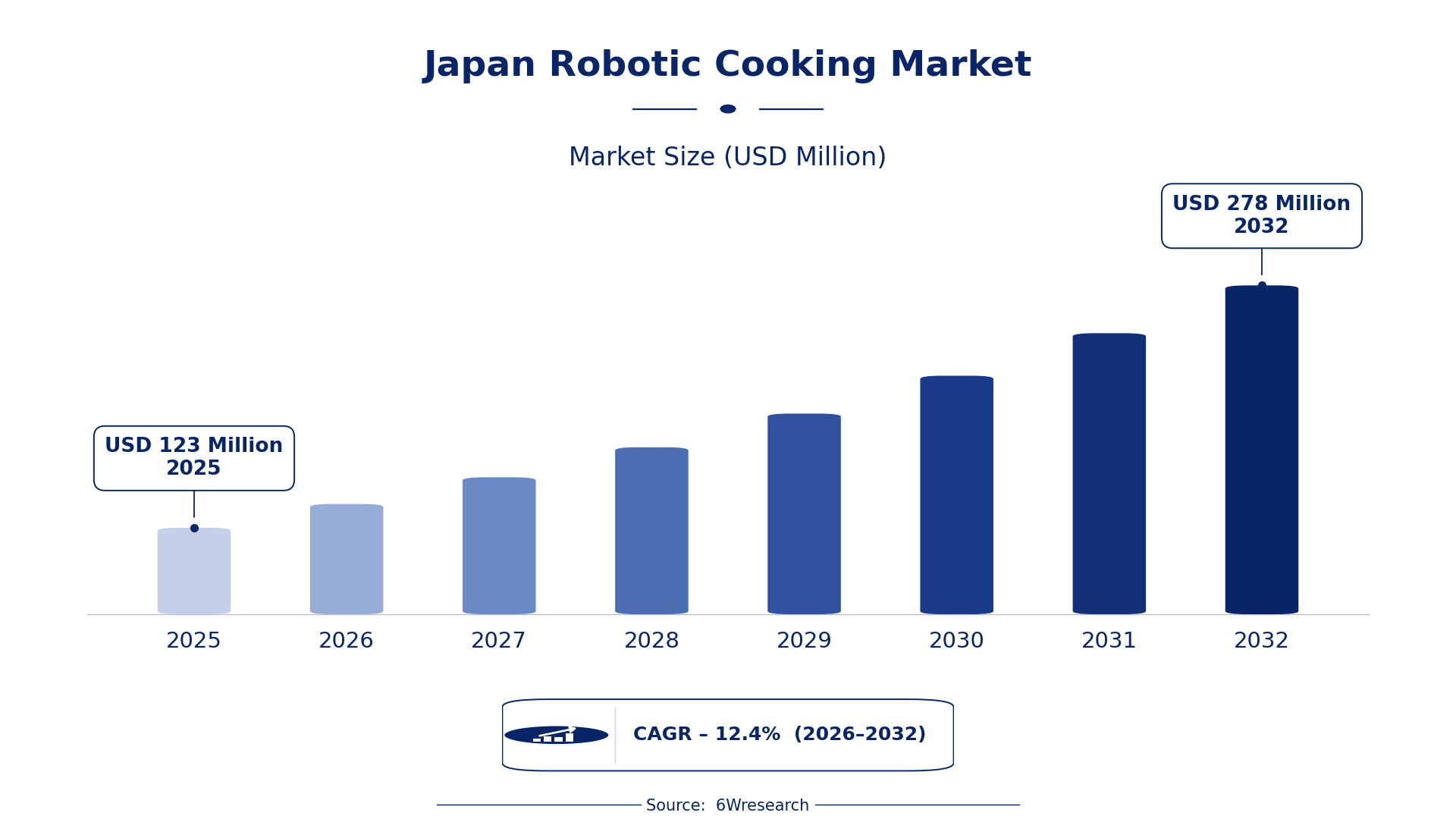
According to 6Wresearch internal database and industry insights, the Japan Robotic Cooking Market was valued at USD 123 Million in 2025 and is projected to reach USD 278 Million by 2032, growing at a CAGR of approximately 12.4% during 2026–2032.
Japan Robotic Cooking Market Highlights
| Report Metric | Details |
| Report Name | Japan Robotic Cooking Market (2026-2032) |
| Market Size 2025 | USD 123 Million |
| Market Size 2032 | USD 278 Million |
| Absolute Growth 2025–2032 | USD 155 Million |
| CAGR 2026–2032 | 12.4% |
| Peak Annual Growth | 15.2% in 2026 |
| Forecast Period | 2026–2032 |
| Historical Data | 2022–2025 |
| Base Year | 2025 |
| Leading System Type, 2025 | Automated Stations (38% share) |
| Leading Operation Mode, 2025 | Preprogrammed Recipes (38% share) |
| Leading Cuisine Application, 2025 | Fast Food (48% share) |
| Leading End User, 2025 | QSR Chains (46% share) |
| Fastest-Growing System Type | Multi-Cooker Robots (17.5% CAGR) |
| Fastest-Growing Operation Mode | IoT Integrated (16.0% CAGR) |
| Fastest-Growing Cuisine Application | Home Cooking (16.1% CAGR) |
| Fastest-Growing End User | Cloud Kitchens (16.2% CAGR) |
| Growing Sector | Food Preparation |
| Key End Users | QSR Chains, Households, Cloud Kitchens |
Japan Robotic Cooking Market Year-wise Growth Rate and Key Drivers (2022–2032)
This graph illustrates the annual growth rates of the market from 2022 to 2032, highlighting a steady upward trajectory and projected market expansion over the forecast period.
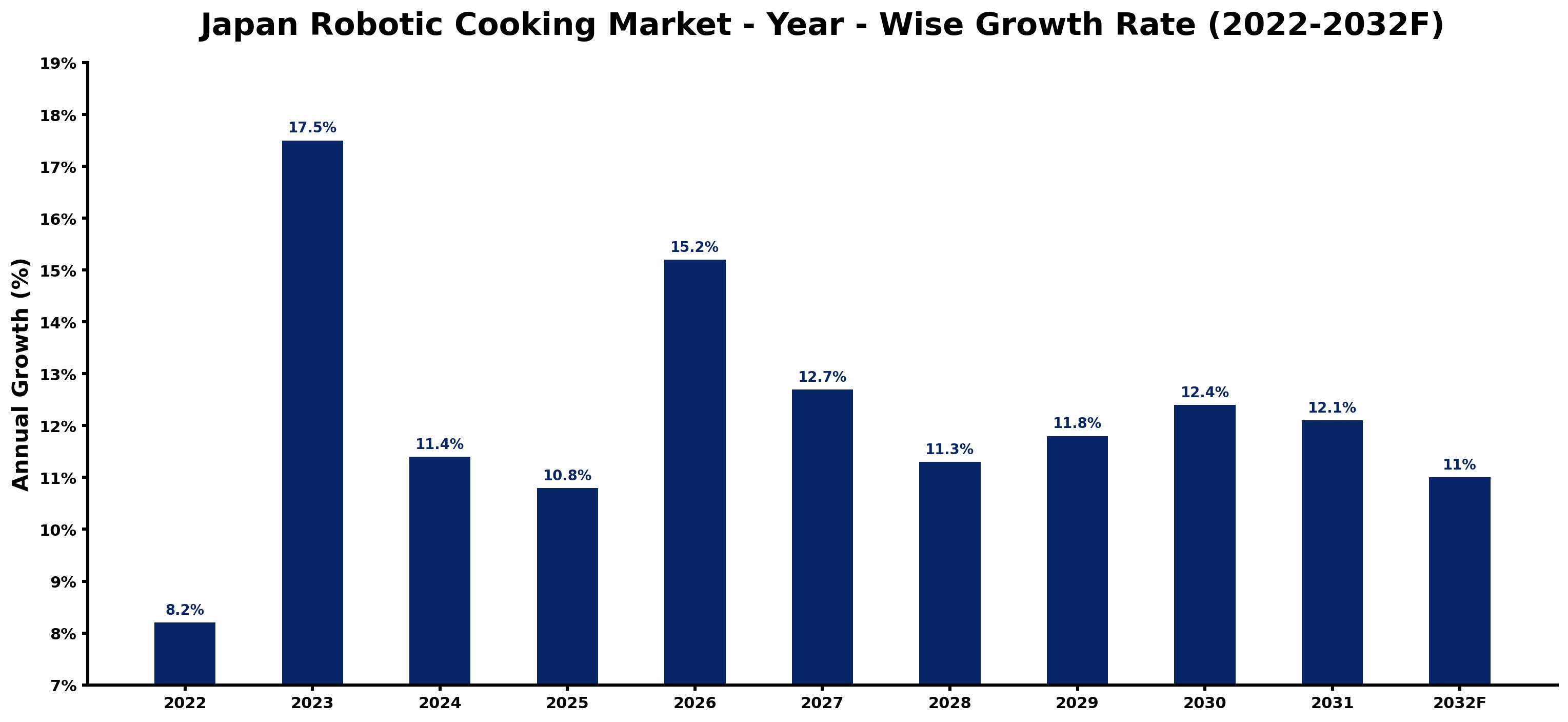
For each year, the table pairs the estimated growth rate with the leading influence on demand, showing how the drivers changed across the period.
| Year | Estimated Annual Growth (%) | Market Rationale |
| 2022 | 8.2 | The market showed steady growth as interest in automation began to rise among consumers. |
| 2023 | 17.5 | Demand surged as urban households increasingly adopted robotic cooking solutions for convenience. |
| 2024 | 11.4 | Growth slowed as market saturation began to affect new installations in urban areas. |
| 2025 | 10.8 | The market continued to grow, driven by the popularity of multi-cooker robots in households. |
| 2026 | 15.2 | Growth is expected to accelerate as QSR chains expand their use of robotic cooking systems for efficiency. |
| 2027 | 12.7 | A slight slowdown is projected as competition intensifies among suppliers in the robotic cooking sector. |
| 2028 | 11.3 | Growth is anticipated to decelerate as the market matures, with fewer new entrants in the robotic cooking space. |
| 2029 | 11.8 | Demand is expected to pick up again as smart kitchen integration becomes a focal point for consumers. |
| 2030 | 12.4 | Growth will continue as AI-based chef systems gain traction in both commercial and home cooking. |
| 2031 | 12.1 | The market is projected to experience a slowdown as consumers become more selective in their purchases. |
| 2032 | 11.0 | Growth will slow further as the market stabilises, with established players dominating. |
Note: Market size estimations and growth projections presented in this report are based on 6Wresearch's proprietary forecasting methodology, utilizing the latest available industry data, government publications, and primary research inputs.
Japan Robotic Cooking Market Synopsis
Robotic cooking technology utilises automated systems that prepare food through robotics and AI, serving restaurants, smart kitchens, and home cooking. The Japan Robotic Cooking Market is expanding, driven by rising demand from urban households and quick service restaurant chains. The smart kitchen market is poised for considerable growth, supported by government initiatives promoting automation. In 2023, a new initiative was launched to encourage AI adoption in food preparation, highlighting the potential for innovation and investment in this sector.
Market Dynamics Impact Analysis (2026–2032)
| Factor | Type | Impact | Primary Segment Affected |
| Growing urban population leads to increased demand for convenient cooking solutions. | Driver | High | Multi-Cooker Robots |
| Rising interest in smart kitchens drives demand for integrated robotic cooking systems. | Driver | High | AI-Based Chef Systems |
| Increasing demand for efficient food preparation in urban areas creates opportunities for new entrants. | Opportunity | High | Automated Stations |
| The popularity of cloud kitchens is rising, requiring advanced robotic cooking solutions. | Opportunity | Medium | Cloud Kitchens |
| High initial investment costs deter some potential buyers from adopting robotic cooking technology. | Restraint | High | Robotic Arms |
| Limited awareness of robotic cooking benefits among traditional cooks slows market penetration. | Restraint | Medium | Preprogrammed Recipes |
| Technological complexity of robotic systems can lead to high maintenance costs for operators. | Challenge | High | AI-Based Chef Systems |
| Competition from traditional cooking methods remains a significant barrier to market growth. | Challenge | Medium | Home Cooking |
Evaluation of Drivers in Japan Robotic Cooking Market (2026–2032)
Demand rests on the following drivers, each shown with the segment it touches most.
| Drivers | Primary Segment Affected | Why It Matters (Evidence) |
| Increased urbanisation drives demand for convenient cooking solutions. | Multi-Cooker Robots | Japan's urban population exceeds 126 million, leading to a growing interest in automated cooking. |
| The rise of smart kitchens encourages the adoption of robotic cooking systems. | AI-Based Chef Systems | The smart kitchen market is expected to grow significantly by 2025, driving consumer interest. |
| QSR chains are expanding their use of robotic cooking for efficiency. | Automated Stations | Tokyo serves as a major hub for QSR chains, utilising robotic cooking systems to streamline operations. |
| Consumer interest in home cooking is rising, driving demand for versatile cooking devices. | Multi-Cooker Robots | Multi-cooker robots are increasingly popular in urban households for their versatility and convenience. |
| The demand for AI in food preparation is increasing, improving cooking efficiency. | AI-Based Chef Systems | In 2023, a new initiative was launched to promote AI adoption in food preparation. |
Buyers are increasing capacity as urbanisation fuels the demand for convenient cooking solutions, with Japan's urban population surpassing 126 million. The smart kitchen market is anticipated to grow substantially by 2025, spurring interest in AI-based chef systems. Quick service restaurant chains in Tokyo are broadening their use of automated stations, enhancing operational efficiency. Multi-cooker robots are becoming popular in urban households, providing versatility in meal preparation.
Evaluation of Restraints in Japan Robotic Cooking Market
The following restraints limit how fast demand can grow.
| Market Restraint | Primary Segment Affected | Why It Matters (Evidence) |
| High initial investment costs deter potential buyers from adopting robotic cooking technology. | Robotic Arms | The average cost of robotic systems can exceed JPY 1 million, limiting accessibility for smaller businesses. |
| Limited awareness of robotic cooking benefits among traditional cooks slows market penetration. | Preprogrammed Recipes | Many traditional cooks lack knowledge about the advantages of automation in food preparation. |
| Technological complexity of robotic systems can lead to high maintenance costs for operators. | AI-Based Chef Systems | Operators may face unexpected costs, with maintenance fees reaching up to 20% of initial investment. |
| Integration challenges with existing kitchen setups can hinder adoption rates. | Automated Stations | Many kitchens lack the infrastructure to support advanced robotic cooking systems, complicating installations. |
| Regulatory compliance can be burdensome for new entrants in the market. | Multi-Cooker Robots | Compliance with ISO 22000 standards adds additional costs and complexities for manufacturers. |
Japan Robotic Cooking Market Challenges
Urban buyers encounter rising costs as Japan's minimum wage increased to JPY 1,055 per hour in October 2024, limiting access to robotic cooking solutions. Competition from traditional cooking methods remains strong, as many consumers favour manual cooking for its familiarity and lower expenses, hindering market expansion. A shortage of skilled professionals in robotics and AI obstructs technology development and maintenance, delaying product launches for producers. Stricter compliance with ISO 22000 standards adds financial burdens for suppliers, complicating their ability to scale operations effectively.
Trends in the Japan Robotic Cooking Market
These developments are changing demand patterns in the Japan Robotic Cooking Market.
- Shift from Manual to Automated Cooking in Urban Areas: In Tokyo, there is a notable shift towards automated cooking solutions as urban households increasingly adopt robotic cooking systems. In 2023, over 30% of new kitchen installations included robotic components, indicating a growing trend among consumers.
- Transition from Traditional to Smart Kitchens: Since 2023, there has been a noticeable transition towards smart kitchens in Japan, with 25% of households integrating IoT devices for cooking. This trend is reshaping consumer preferences and driving demand for robotic cooking technologies.
- Home Cooking Gaining Popularity: In recent years, home cooking has seen a resurgence, with a 16.1% CAGR projected for the home cooking segment. This trend is particularly evident among urban households seeking convenience and efficiency in meal preparation.
- Emergence of Cloud Kitchens: Cloud kitchens are emerging as a trend in Japan, with a 16.2% CAGR expected for this segment. As more food delivery services adopt robotic cooking technologies, suppliers have new opportunities to meet demand.
Investment Opportunities in the Japan Robotic Cooking Market
The following opportunities in the Japan Robotic Cooking Market pair current demand with a clear way in.
- Collaborate with Local Suppliers: Partnering with local suppliers can facilitate market entry, especially in urban areas. The demand for automated cooking solutions is rising, with over 126 million people in Japan seeking convenience.
- Invest in Multi-Cooker Robots: Supplying multi-cooker robots presents a prime opportunity, as urban households increasingly adopt these devices. The smart kitchen market is expected to grow significantly by 2025.
- Engage with Cloud Kitchens: The cloud kitchen segment is expanding rapidly, with a projected 16.2% CAGR. Collaborating with food delivery services can open new avenues for suppliers.
- Secure JIS Certification: Obtaining JIS certification for robotic cooking products can improve marketability. Compliance with Japanese Industrial Standards is important for gaining consumer trust.
Government Initiatives in the Japan Robotic Cooking Market
The New Robot Strategy, initiated in 2015, aims to expand robot use across various sectors, including food service. This strategy encourages producers to invest in automation technologies, improving efficiency and productivity in the industry. Additionally, the AI Promotion Act, set to take effect in 2025, establishes a national framework for AI development, which will further support the integration of AI in food preparation, benefiting both producers and consumers.
The Ministry of Economy, Trade and Industry oversees the implementation of regulations regarding food safety and product standards. This agency funds projects aimed at improving technology adoption among producers, including grants for research and development. Furthermore, the National Institute of Advanced Industrial Science and Technology plays a role in approving robotics research projects, ensuring that innovations align with industry standards.
Future Insight of the Japan Robotic Cooking Market
Investment in automation initiatives will stimulate demand for robotic cooking solutions, particularly in urban centres. By 2032, the integration of AI in food preparation will increase, supported by government programmes for smart kitchen advancements. The appeal of versatile cooking systems will address diverse culinary preferences, improving user experiences. In Tokyo, the emphasis on quick service restaurants will drive efficiency and precision through advanced robotic systems.
Market Segmentation Analysis
Japan Robotic Cooking Market report covers a detailed analysis of the following market segments:
By System Type – Automated Stations Lead, Multi-Cooker Robots Expected to Grow Fastest
According to Saurav Kr Singh, Senior Research Analyst at 6Wresearch, the largest system type category in 2025 was Automated Stations, at 38% of revenue. Automated Stations hold the largest share due to their role in high-volume food preparation, essential for large-scale operations. For instance, quick service restaurants in Tokyo rely on these systems to efficiently meet the demand for fast meals. Over 2026–2032, Multi-Cooker Robots are expected to post the fastest growth, at a CAGR of 17.5%. The rapid growth of Multi-Cooker Robots is attributed to their versatility, appealing to both home and commercial users seeking efficient cooking solutions. As urban households increasingly adopt these devices, this segment is set for notable expansion. Suppliers should enhance the features of Multi-Cooker Robots to cater to the growing demand for versatile cooking options.
By Operation Mode – Preprogrammed Recipes Lead, IoT Integrated Expected to Grow Fastest
Preprogrammed Recipes held 38% of the Japan Robotic Cooking Market by operation mode in 2025. Preprogrammed Recipes lead the market because they provide consistency in food preparation, crucial for maintaining quality across various food service operations. Many businesses implement these recipes to streamline cooking processes and reduce errors. IoT Integrated is set to record the highest CAGR in this split, 16.0% over 2026–2032. IoT Integrated systems are experiencing swift growth as they connect seamlessly with smart home systems, offering users enhanced convenience. This trend is particularly attractive to consumers who value smart kitchen technologies. Buyers should invest in IoT Integrated systems to boost kitchen efficiency and connectivity.
By Cuisine Application – Fast Food Leads, Home Cooking Expected to Grow Fastest
With 48% of cuisine application revenue in 2025, Fast Food was the largest category. Fast Food leads the market due to its widespread adoption in quick service restaurants, which seek to maximise efficiency and speed. The high demand for fast food in urban areas drives the need for robotic cooking solutions. Home Cooking is projected to grow fastest, at a CAGR of 16.1% during 2026–2032. Home Cooking is the fastest-growing segment as more consumers show interest in automated cooking solutions for personal use. The rise of home cooking trends, especially in metropolitan areas, is propelling this segment forward. Suppliers should consider developing products tailored for home cooking to meet the increasing consumer demand.
By End User – QSR Chains Lead, Cloud Kitchens Expected to Grow Fastest
QSR Chains took 46% of end user revenue in 2025, more than any other category. QSR Chains are the primary users of robotic cooking technology, utilising these systems to enhance operational efficiency and satisfy high customer demand. Their established presence in the market solidifies their leading position in the sector. The quickest growth will come from Cloud Kitchens, forecast to expand at a CAGR of 16.2% between 2026 and 2032. Cloud Kitchens are rapidly gaining traction as the trend for food delivery services expands, necessitating efficient cooking solutions. This shift towards delivery-focused operations is significantly propelling the growth of this segment. Suppliers should target Cloud Kitchens to capitalise on the rising demand in the food delivery services market.
Key Attractiveness of the Report
- 10 Years of Market Numbers
- Historical Data Starting from 2022 to 2025
- Base Year 2025
- Forecast Data until 2032
- Key Performance Indicators Impacting the Market
- Major Upcoming Developments and Projects
Key Highlights of the Report:
- Japan Robotic Cooking Market Outlook
- Market Size of Japan Robotic Cooking Market, 2025
- Forecast of Japan Robotic Cooking Market, 2032
- Historical Data and Forecast of Japan Robotic Cooking Revenues & Volume for the Period 2022-2032F
- Japan Robotic Cooking Market Trend Evolution
- Japan Robotic Cooking Market Drivers and Challenges
- Japan Robotic Cooking Price Trends
- Japan Robotic Cooking Porter's Five Forces
- Japan Robotic Cooking Industry Life Cycle
- Historical Data and Forecast of Japan Robotic Cooking Market Revenues & Volume By System Type for the Period 2022-2032F
- Historical Data and Forecast of Japan Robotic Cooking Market Revenues & Volume By Robotic Arms for the Period 2022-2032F
- Historical Data and Forecast of Japan Robotic Cooking Market Revenues & Volume By Automated Stations for the Period 2022-2032F
- Historical Data and Forecast of Japan Robotic Cooking Market Revenues & Volume By Multi-Cooker Robots for the Period 2022-2032F
- Historical Data and Forecast of Japan Robotic Cooking Market Revenues & Volume By AI-Based Chef Systems for the Period 2022-2032F
- Historical Data and Forecast of Japan Robotic Cooking Market Revenues & Volume By Operation Mode for the Period 2022-2032F
- Historical Data and Forecast of Japan Robotic Cooking Market Revenues & Volume By Preprogrammed Recipes for the Period 2022-2032F
- Historical Data and Forecast of Japan Robotic Cooking Market Revenues & Volume By Conveyor + AI for the Period 2022-2032F
- Historical Data and Forecast of Japan Robotic Cooking Market Revenues & Volume By IoT Integrated for the Period 2022-2032F
- Historical Data and Forecast of Japan Robotic Cooking Market Revenues & Volume By Adaptive Cooking for the Period 2022-2032F
- Historical Data and Forecast of Japan Robotic Cooking Market Revenues & Volume By Cuisine Application for the Period 2022-2032F
- Historical Data and Forecast of Japan Robotic Cooking Market Revenues & Volume By Indian/Asian Cuisine for the Period 2022-2032F
- Historical Data and Forecast of Japan Robotic Cooking Market Revenues & Volume By Fast Food for the Period 2022-2032F
- Historical Data and Forecast of Japan Robotic Cooking Market Revenues & Volume By Home Cooking for the Period 2022-2032F
- Historical Data and Forecast of Japan Robotic Cooking Market Revenues & Volume By International Cuisine for the Period 2022-2032F
- Historical Data and Forecast of Japan Robotic Cooking Market Revenues & Volume By End User for the Period 2022-2032F
- Historical Data and Forecast of Japan Robotic Cooking Market Revenues & Volume By Smart Kitchens for the Period 2022-2032F
- Historical Data and Forecast of Japan Robotic Cooking Market Revenues & Volume By QSR Chains for the Period 2022-2032F
- Historical Data and Forecast of Japan Robotic Cooking Market Revenues & Volume By Households for the Period 2022-2032F
- Historical Data and Forecast of Japan Robotic Cooking Market Revenues & Volume By Cloud Kitchens for the Period 2022-2032F
- Japan Robotic Cooking Import Export Trade Statistics
- Market Opportunity Assessment By System Type
- Market Opportunity Assessment By Operation Mode
- Market Opportunity Assessment By Cuisine Application
- Market Opportunity Assessment By End User
- Japan Robotic Cooking Top Companies Market Share
- Japan Robotic Cooking Competitive Benchmarking By Technical and Operational Parameters
- Japan Robotic Cooking Company Profiles
- Japan Robotic Cooking Key Strategic Recommendations
Market Covered
The report covers the following segments.
By System Type
- Robotic Arms
- Automated Stations
- Multi-Cooker Robots
- AI-Based Chef Systems
By Operation Mode
- Preprogrammed Recipes
- Conveyor + AI
- IoT Integrated
- Adaptive Cooking
By Cuisine Application
- Indian/Asian Cuisine
- Fast Food
- Home Cooking
- International Cuisine
By End User
- Smart Kitchens
- QSR Chains
- Households
- Cloud Kitchens































