Japan Robotic Excavators Market Size & Growth Rate
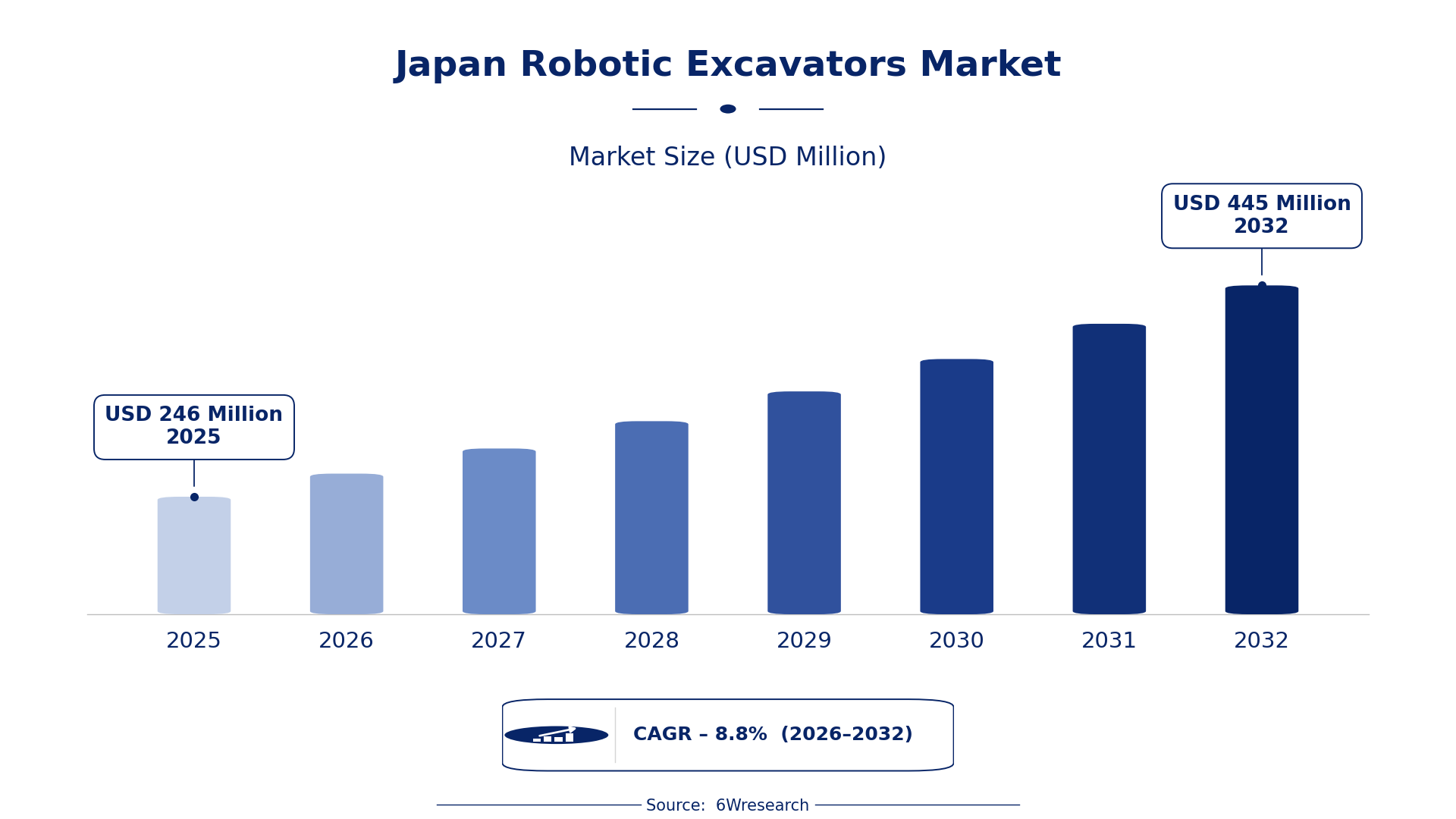
According to 6Wresearch internal database and industry insights, the Japan Robotic Excavators Market was valued at USD 246 Million in 2025 and is projected to reach USD 445 Million by 2032, growing at a CAGR of approximately 8.8% during 2026–2032.
Japan Robotic Excavators Market Highlights
| Report Metric | Details |
| Report Name | Japan Robotic Excavators Market (2026-2032) |
| Market Size 2025 | USD 246 Million |
| Market Size 2032 | USD 445 Million |
| Absolute Growth 2025–2032 | USD 199 Million |
| CAGR 2026–2032 | 8.8% |
| Peak Annual Growth | 9.9% in 2027 |
| Forecast Period | 2026–2032 |
| Historical Data | 2022–2025 |
| Base Year | 2025 |
| Leading Excavator Type, 2025 | Mini Excavators (41% share) |
| Leading Automation Level, 2025 | Semi-Autonomous (49% share) |
| Leading Control Method, 2025 | Remote-Controlled (52% share) |
| Leading End User, 2025 | Urban Construction (50% share) |
| Fastest-Growing Excavator Type | Large Excavators (12.8% CAGR) |
| Fastest-Growing Automation Level | Fully Autonomous (11.6% CAGR) |
| Fastest-Growing Control Method | GPS-Based AI (13.1% CAGR) |
| Fastest-Growing End User | Mining Companies (11.8% CAGR) |
| Growing Sector | Mining Companies |
| Key End Users | Urban Construction, Mining Companies, Infrastructure Firms, Green Construction |
Japan Robotic Excavators Market Year-wise Growth Rate and Key Drivers (2022–2032)
This graph illustrates the annual growth rates of the market from 2022 to 2032, highlighting a steady upward trajectory and projected market expansion over the forecast period.
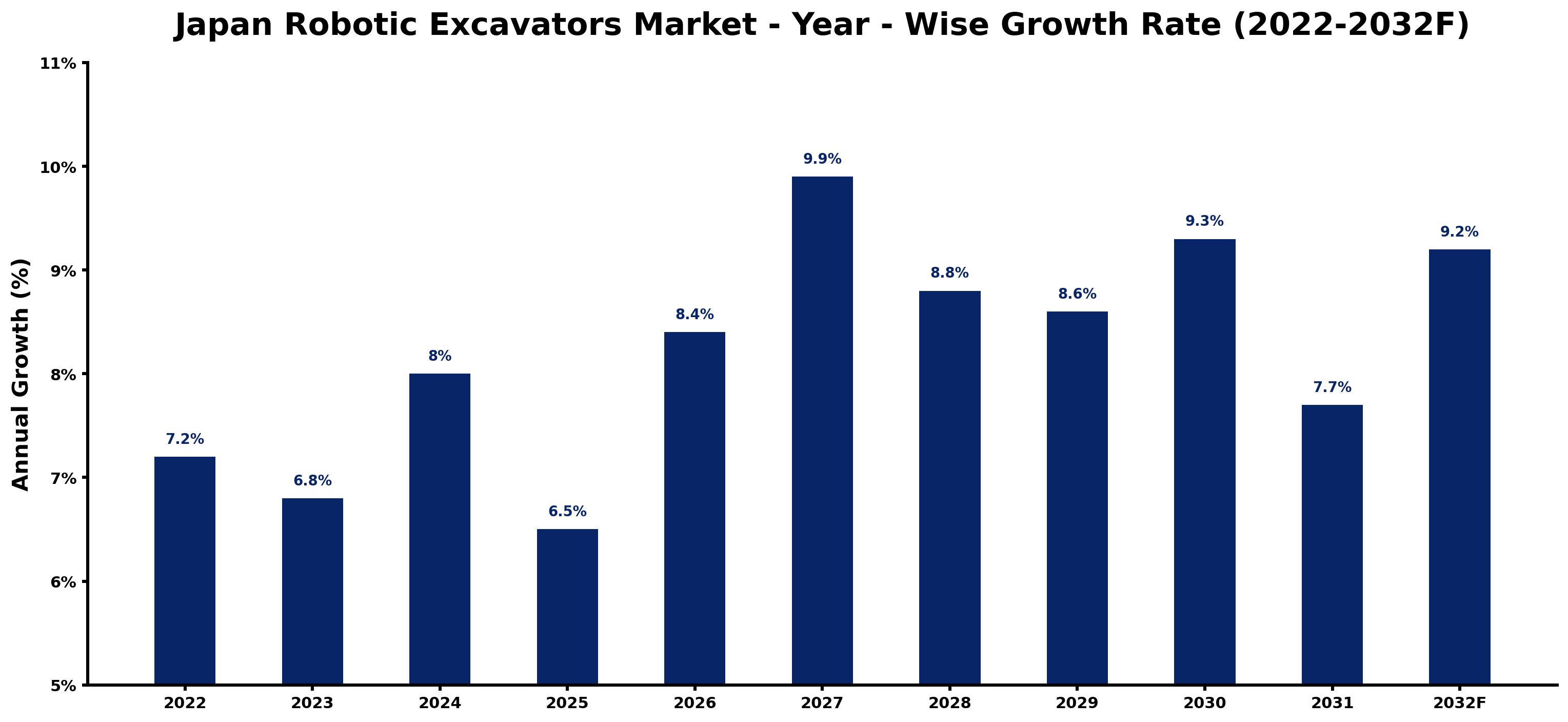
Each row of the following table gives one year's estimated growth and the event or demand shift that explains it.
| Year | Estimated Annual Growth (%) | Market Rationale |
| 2022 | 7.2 | The market was characterised by steady demand from urban construction projects. |
| 2023 | 6.8 | Growth slowed as the market adjusted to previous peaks in construction activity. |
| 2024 | 8.0 | Increased investments in infrastructure led to a surge in demand for robotic excavators. |
| 2025 | 6.5 | Demand growth moderated as the market stabilised after rapid expansion. |
| 2026 | 8.4 | Technological advancements in automation drove renewed interest in robotic excavators. |
| 2027 | 9.9 | Peak growth occurred as urban construction initiatives gained momentum. |
| 2028 | 8.8 | The market experienced a slight slowdown as demand normalised after high peaks. |
| 2029 | 8.6 | Growth continued to slow as the market adjusted to new operational standards. |
| 2030 | 9.3 | Increased focus on sustainability boosted demand for electric excavators. |
| 2031 | 7.7 | Demand growth slowed as the market stabilised after several years of expansion. |
| 2032 | 9.2 | Robotic excavators gained traction due to ongoing infrastructure projects. |
Note: Market size estimations and growth projections presented in this report are based on 6Wresearch's proprietary forecasting methodology, utilizing the latest available industry data, government publications, and primary research inputs.
Japan Robotic Excavators Market Synopsis
Robotic excavators are advanced machinery that integrate robotics and automation technologies to improve excavation tasks. Their primary applications include urban construction, mining, and infrastructure development. The Japan Robotic Excavators Market is expanding due to substantial investments in infrastructure, with the government allocating 500 billion JPY for such projects in 2023. Furthermore, demand for mini excavators has increased by 15% in urban areas since 2022, driven by ongoing construction projects and advancements in automation.
Market Dynamics Impact Analysis (2026–2032)
| Factor | Type | Impact | Primary Segment Affected |
| Increasing investments in infrastructure development | Driver | High | Urban Construction |
| Growing demand for automation in construction | Driver | High | Semi-Autonomous |
| Rising interest in electric excavators for sustainability | Opportunity | High | Electric Excavators |
| Demand for advanced excavation technology in mining | Opportunity | High | Mining Companies |
| High average age of existing construction machinery | Restraint | High | Large Excavators |
| Limited adoption of electric excavators due to infrastructure constraints | Restraint | Medium | Electric Excavators |
| High initial investment costs for advanced robotic excavators | Challenge | High | Fully Autonomous |
| Slow adoption of fully autonomous technology in construction | Challenge | Medium | Fully Autonomous |
Evaluation of Drivers in Japan Robotic Excavators Market (2026–2032)
The table below links each growth driver to the segment it affects and the evidence for it.
| Drivers | Primary Segment Affected | Why It Matters (Evidence) |
| Investment in infrastructure development | Urban Construction | Japan's construction industry is valued at approximately 6 trillion JPY, driving demand for robotic excavators. |
| Advancements in automation technology | Semi-Autonomous | The average annual investment in construction technology is around 200 billion JPY, increasing demand for semi-autonomous machinery. |
| Rising demand for mini excavators in urban areas | Mini Excavators | The demand for mini excavators has increased by 15% in urban areas since 2022, prompting more purchases. |
| Government initiatives promoting autonomous machinery | Fully Autonomous | In 2023, Japan launched a program to promote autonomous machinery in construction, boosting demand. |
| Focus on sustainability in construction | Electric Excavators | The government aims to reduce carbon emissions by promoting electric excavators by 2030, increasing interest. |
The strongest pull on demand comes from significant investments in infrastructure development, with Japan's construction industry valued at approximately 6 trillion JPY. Technological advancements in automation are also influential, as the average annual investment in construction technology reaches around 200 billion JPY. The demand for mini excavators has surged by 15% in urban areas since 2022, prompting increased purchases.
Evaluation of Restraints in Japan Robotic Excavators Market
Below are the constraints most often cited by buyers and suppliers, with the segment each affects.
| Market Restraint | Primary Segment Affected | Why It Matters (Evidence) |
| High average age of existing construction machinery | Large Excavators | The average age of construction machinery in Japan exceeds 10 years, necessitating upgrades. |
| Limited adoption of electric excavators due to infrastructure constraints | Electric Excavators | Electric excavators are being tested in urban projects, but infrastructure limitations hinder widespread use. |
| High initial investment costs for advanced robotic excavators | Fully Autonomous | The cost of fully autonomous excavators can deter buyers, impacting market growth. |
| Slow adoption of fully autonomous technology in construction | Fully Autonomous | Fully autonomous excavators are still in development, limiting their deployment in the market. |
| Consumer awareness of robotic excavators is low | Semi-Autonomous | Many potential buyers are unfamiliar with the benefits of robotic excavators, slowing adoption. |
Japan Robotic Excavators Market Challenges
Robotic excavators face technological limitations, as many models still rely on outdated control systems, which delays project timelines for buyers in urban construction. Buyers encounter high costs due to the average age of machinery exceeding ten years, necessitating expensive upgrades that can reach 500 billion JPY annually. Regulatory hurdles persist with strict compliance to the JIS B 8001 standard, slowing the introduction of new machinery and increasing costs for suppliers. Rising minimum wages, now at JPY 1,055 per hour, inflate operational expenses for construction firms, impacting profitability.
Trends in the Japan Robotic Excavators Market
The following changes are redrawing the Japan Robotic Excavators Market.
- Shift Towards Automation in Urban Construction: Urban construction firms are increasingly adopting robotic excavators, with a 15% rise in mini excavator demand since 2022. This trend reflects a broader shift towards automation in construction practices.
- Transition from Traditional to Electric Excavators: The Japanese government aims to reduce carbon emissions by promoting electric excavators by 2030. This initiative is gaining traction among infrastructure firms, resulting in increased investment in electric machinery.
- Emergence of GPS-Based AI in Excavation: GPS-Based AI technology is becoming more prevalent in excavation projects, with a projected CAGR of 13.1% for this segment. This shift improves precision in large-scale excavation tasks.
- Growing Interest in Fully Autonomous Excavators: The push for automation is leading to increased interest in fully autonomous excavators, supported by the government's 2023 program to promote such machinery in construction.
Investment Opportunities in the Japan Robotic Excavators Market
The following areas offer the clearest openings for investors and suppliers in the Japan Robotic Excavators Market.
- Supply of Electric Excavators: With the government's target to reduce carbon emissions by 2030, there is a growing opportunity to supply electric excavators. Infrastructure firms are increasingly interested in sustainable machinery, creating a demand for suppliers.
- Investment in Semi-Autonomous Technology: Now is the time to invest in semi-autonomous technology as urban construction projects expand. Collaborating with construction firms in Tokyo could facilitate entry into this growing market.
- Development of GPS-Based AI Solutions: The rise of GPS-based AI in excavation presents an opportunity to develop related technologies. Mining companies are looking for precision solutions, making this a timely investment area.
- Promotion of Autonomous Machinery: The 2023 government program to promote autonomous machinery creates an opportunity for suppliers to enter the market. Partnering with local construction firms can improve market access.
Government Initiatives in the Japan Robotic Excavators Market
The Act against Unjustifiable Premiums and Misleading Representations (1962) prohibits misleading labelling and advertising of goods, ensuring that buyers can trust the information provided about robotic excavators. The New Robot Strategy (2015) aims to expand robot use in various sectors, including construction, which encourages manufacturers to innovate and improve their products.
The Ministry of Land, Infrastructure, Transport and Tourism oversees the implementation of construction regulations, ensuring compliance with safety standards such as JIS B 8001. The Japan Construction Equipment Manufacturers Association promotes innovation and supports initiatives that enhance the competitiveness of the construction equipment sector.
Future Insight of the Japan Robotic Excavators Market
New infrastructure development projects will emerge, increasing demand for robotic excavators. By 2032, the government’s initiative to promote autonomous machinery will improve operational efficiency for buyers and suppliers. The testing of electric excavators in urban projects aligns with sustainability goals, driving a shift towards greener technology. Investment in construction technology is expected to rise, with an average annual allocation of 200 billion JPY, leading to advancements in machinery capabilities and operational effectiveness.
Market Segmentation Analysis
Japan Robotic Excavators Market report covers a detailed analysis of the following market segments:
By Excavator Type – Mini Excavators Lead, Large Excavators Expected to Grow Fastest
According to Saurav Kr Singh, Senior Research Analyst at 6Wresearch, in 2025, Mini Excavators led the excavator type split with a 41% share. Mini excavators dominate the market due to their suitability for small-scale excavation tasks in urban environments, particularly in major cities like Tokyo and Osaka. Their compact nature makes them essential for ongoing construction projects, which are prevalent in these regions. The quickest growth will come from Large Excavators, forecast to expand at a CAGR of 12.8% between 2026 and 2032. Large excavators are experiencing rapid growth as they are critical for extensive construction and mining projects, which are becoming increasingly ambitious. The Japanese government's allocation of 500 billion JPY for infrastructure development is expected to significantly drive demand for these machines. Suppliers should focus on enhancing the features and availability of large excavators to meet the rising demand in the construction sector.
By Automation Level – Semi-Autonomous Leads, Fully Autonomous Expected to Grow Fastest
With 49% of automation level revenue in 2025, Semi-Autonomous was the largest category. Semi-autonomous robotic excavators are favoured for their ability to improve safety and operational efficiency, making them a popular choice among contractors. Their extensive application in various construction projects demonstrates their effectiveness in boosting productivity. Over 2026–2032, Fully Autonomous is expected to post the fastest growth, at a CAGR of 11.6%. Fully autonomous excavators are projected to grow rapidly as advancements in technology continue, with ongoing testing in urban projects indicating a strong future demand. The government's initiative to promote autonomous machinery in construction is likely to accelerate this growth. Buyers should prepare for a shift towards fully autonomous solutions, which may provide substantial operational benefits.
By Control Method – Remote-Controlled Leads, GPS-Based AI Expected to Grow Fastest
Remote-Controlled took 52% of control method revenue in 2025, more than any other category. Remote-controlled excavators are favoured for their effectiveness in hazardous environments and remote operations, making them indispensable in various construction scenarios. Their established presence in the market reflects the need for safety in challenging conditions. GPS-Based AI is projected to grow fastest, at a CAGR of 13.1% during 2026–2032. GPS-based AI control methods are gaining traction due to their precision in large-scale excavation projects, which require accurate positioning and operational efficiency. As projects grow in complexity, the demand for this technology is expected to rise. Suppliers must invest in developing advanced GPS-based AI technologies to meet the increasing demand for precision in excavation.
By End User – Urban Construction Leads, Mining Companies Expected to Grow Fastest
The largest end user category in 2025 was Urban Construction, at 50% of revenue. Urban construction is the leading end user of robotic excavators, driven by the high volume of ongoing projects in densely populated areas. Continuous urban development in cities like Tokyo ensures a consistent demand for these machines. Mining Companies are set to record the highest CAGR in this split, 11.8% over 2026–2032. Mining companies are increasingly adopting robotic excavators to improve efficiency in large-scale operations, particularly in regions like Hokkaido where mining activities are significant. The push for modernised equipment in this sector is driving rapid growth. Suppliers should customise their offerings to cater to the specific requirements of mining companies, which are seeking advanced excavation solutions.
Key Attractiveness of the Report
- 10 Years of Market Numbers
- Historical Data Starting from 2022 to 2025
- Base Year 2025
- Forecast Data until 2032
- Key Performance Indicators Impacting the Market
- Major Upcoming Developments and Projects
Key Highlights of the Report:
- Japan Robotic Excavators Market Outlook
- Market Size of Japan Robotic Excavators Market, 2025
- Forecast of Japan Robotic Excavators Market, 2032
- Historical Data and Forecast of Japan Robotic Excavators Revenues & Volume for the Period 2022-2032F
- Japan Robotic Excavators Market Trend Evolution
- Japan Robotic Excavators Market Drivers and Challenges
- Japan Robotic Excavators Price Trends
- Japan Robotic Excavators Porter's Five Forces
- Japan Robotic Excavators Industry Life Cycle
- Historical Data and Forecast of Japan Robotic Excavators Market Revenues & Volume By Excavator Type for the Period 2022-2032F
- Historical Data and Forecast of Japan Robotic Excavators Market Revenues & Volume By Mini Excavators for the Period 2022-2032F
- Historical Data and Forecast of Japan Robotic Excavators Market Revenues & Volume By Large Excavators for the Period 2022-2032F
- Historical Data and Forecast of Japan Robotic Excavators Market Revenues & Volume By Hybrid Excavators for the Period 2022-2032F
- Historical Data and Forecast of Japan Robotic Excavators Market Revenues & Volume By Electric Excavators for the Period 2022-2032F
- Historical Data and Forecast of Japan Robotic Excavators Market Revenues & Volume By Automation Level for the Period 2022-2032F
- Historical Data and Forecast of Japan Robotic Excavators Market Revenues & Volume By Semi-Autonomous for the Period 2022-2032F
- Historical Data and Forecast of Japan Robotic Excavators Market Revenues & Volume By Fully Autonomous for the Period 2022-2032F
- Historical Data and Forecast of Japan Robotic Excavators Market Revenues & Volume By Operator-Assisted for the Period 2022-2032F
- Historical Data and Forecast of Japan Robotic Excavators Market Revenues & Volume By Battery-Powered for the Period 2022-2032F
- Historical Data and Forecast of Japan Robotic Excavators Market Revenues & Volume By Control Method for the Period 2022-2032F
- Historical Data and Forecast of Japan Robotic Excavators Market Revenues & Volume By Remote-Controlled for the Period 2022-2032F
- Historical Data and Forecast of Japan Robotic Excavators Market Revenues & Volume By GPS-Based AI for the Period 2022-2032F
- Historical Data and Forecast of Japan Robotic Excavators Market Revenues & Volume By Sensor-Enabled for the Period 2022-2032F
- Historical Data and Forecast of Japan Robotic Excavators Market Revenues & Volume By Smart Controls for the Period 2022-2032F
- Historical Data and Forecast of Japan Robotic Excavators Market Revenues & Volume By End User for the Period 2022-2032F
- Historical Data and Forecast of Japan Robotic Excavators Market Revenues & Volume By Urban Construction for the Period 2022-2032F
- Historical Data and Forecast of Japan Robotic Excavators Market Revenues & Volume By Mining Companies for the Period 2022-2032F
- Historical Data and Forecast of Japan Robotic Excavators Market Revenues & Volume By Infrastructure Firms for the Period 2022-2032F
- Historical Data and Forecast of Japan Robotic Excavators Market Revenues & Volume By Green Construction for the Period 2022-2032F
- Japan Robotic Excavators Import Export Trade Statistics
- Market Opportunity Assessment By Excavator Type
- Market Opportunity Assessment By Automation Level
- Market Opportunity Assessment By Control Method
- Market Opportunity Assessment By End User
- Japan Robotic Excavators Top Companies Market Share
- Japan Robotic Excavators Competitive Benchmarking By Technical and Operational Parameters
- Japan Robotic Excavators Company Profiles
- Japan Robotic Excavators Key Strategic Recommendations
Market Covered
The following segment groups are covered in the report.
By Excavator Type
- Mini Excavators
- Large Excavators
- Hybrid Excavators
- Electric Excavators
By Automation Level
- Semi-Autonomous
- Fully Autonomous
- Operator-Assisted
- Battery-Powered
By Control Method
- Remote-Controlled
- GPS-Based AI
- Sensor-Enabled
- Smart Controls
By End User
- Urban Construction
- Mining Companies
- Infrastructure Firms
- Green Construction































