Japan Robotic Palletizing Systems Market Size & Growth Rate
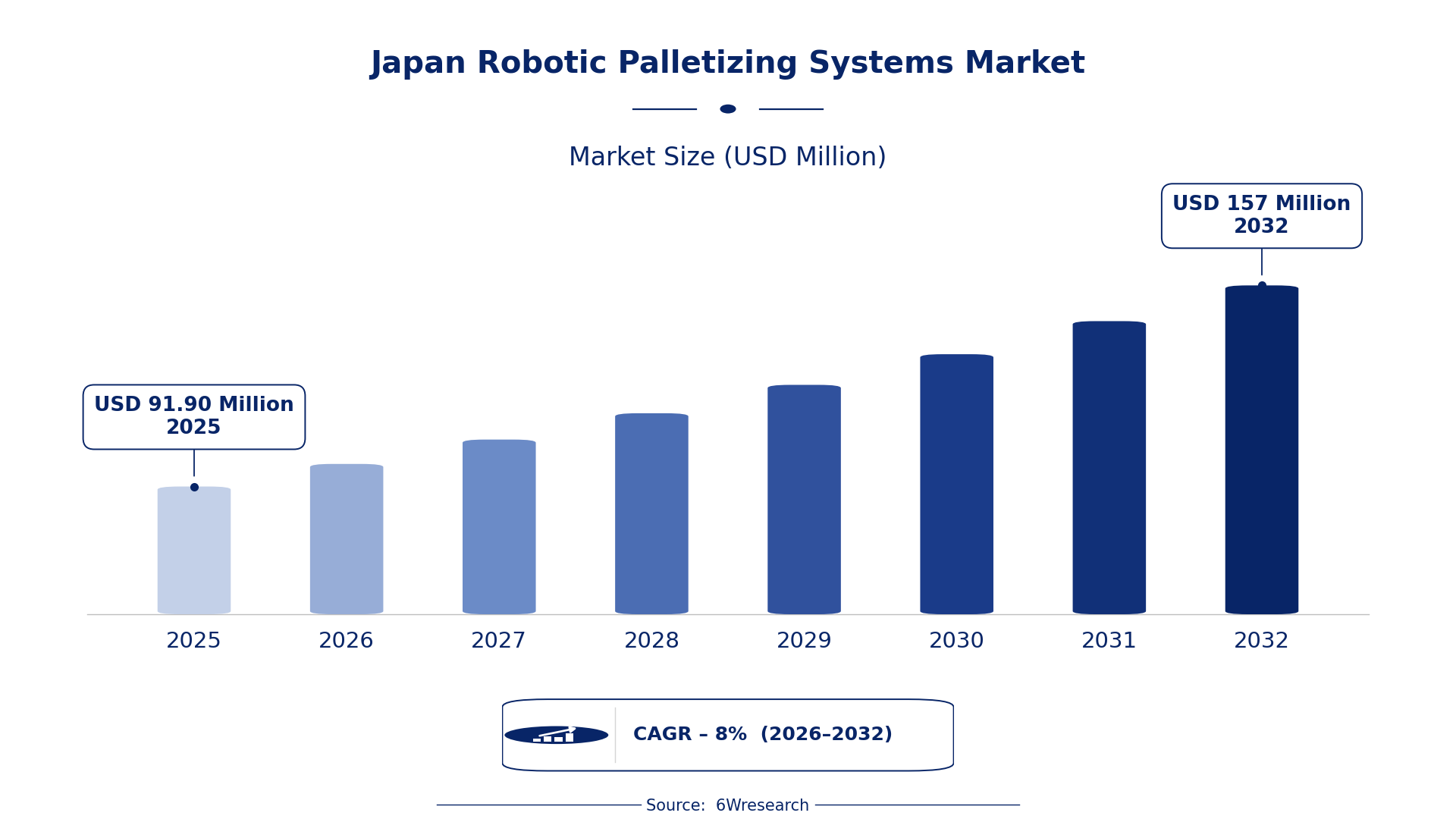
According to 6Wresearch internal database and industry insights, the Japan Robotic Palletizing Systems Market was valued at USD 91.90 Million in 2025 and is projected to reach USD 157 Million by 2032, growing at a CAGR of approximately 8% during 2026–2032.
Japan Robotic Palletizing Systems Market Highlights
| Report Metric | Details |
| Report Name | Japan Robotic Palletizing Systems Market (2026-2032) |
| Market Size 2025 | USD 91.90 Million |
| Market Size 2032 | USD 157 Million |
| Absolute Growth 2025–2032 | USD 65.10 Million |
| CAGR 2026–2032 | 8% |
| Peak Annual Growth | 9.7% in 2026 |
| Forecast Period | 2026–2032 |
| Historical Data | 2022–2025 |
| Base Year | 2025 |
| Leading Palletizing Type, 2025 | Case Palletizing (43% share) |
| Leading Robot Type, 2025 | Layer Forming Robots (43% share) |
| Leading Speed Category, 2025 | High-Speed (44% share) |
| Leading End User, 2025 | FMCG Plants (39% share) |
| Fastest-Growing Palletizing Type | Bag Palletizing (10.7% CAGR) |
| Fastest-Growing Robot Type | Clamp Gripper Arms (11.3% CAGR) |
| Fastest-Growing Speed Category | Medium-Speed (10.0% CAGR) |
| Fastest-Growing End User | Grain & Fertilizer Firms (10.1% CAGR) |
| Growing Sector | FMCG |
| Key End Users | FMCG Plants, Agricultural Firms, Chemical Manufacturers |
Japan Robotic Palletizing Systems Market Year-wise Growth Rate and Key Drivers (2022–2032)
This graph illustrates the annual growth rates of the market from 2022 to 2032, highlighting a steady upward trajectory and projected market expansion over the forecast period.
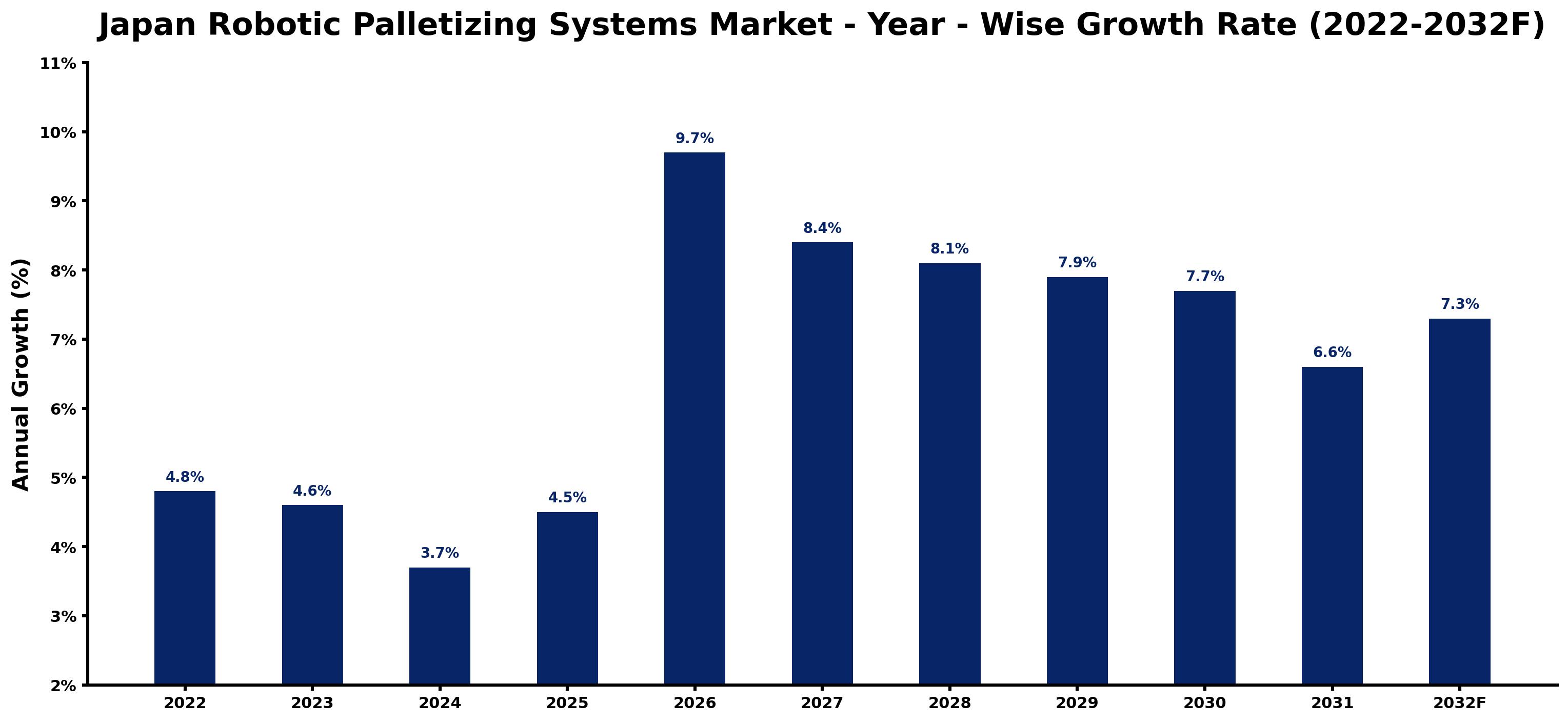
Annual growth estimates for each year appear below with the principal reason behind them, explaining the shifts that set the pace of the market.
| Year | Estimated Annual Growth (%) | Market Rationale |
| 2022 | 4.8 | Demand remained steady as industries continued to adopt automation technologies. |
| 2023 | 4.6 | Growth slowed due to market saturation in some sectors and cautious investment. |
| 2024 | 3.7 | Demand growth decelerated as companies reassessed their automation strategies. |
| 2025 | 4.5 | Increased efficiency demands from FMCG plants drove faster growth this year. |
| 2026 | 9.7 | The introduction of new automation technologies will spur market expansion. |
| 2027 | 8.4 | Growth is projected to moderate as supply chain challenges impact production capabilities. |
| 2028 | 8.1 | Demand is expected to continue growing, albeit at a slower pace due to market adjustments. |
| 2029 | 7.9 | The market is projected to see a slight slowdown as buyers adapt to new technologies. |
| 2030 | 7.7 | Growth is expected to slow further as the market matures and competition intensifies. |
| 2031 | 6.6 | Demand growth is projected to decelerate as companies focus on optimising existing systems. |
| 2032 | 7.3 | Increased investments in automation will drive renewed interest in robotic systems. |
Note: Market size estimations and growth projections presented in this report are based on 6Wresearch's proprietary forecasting methodology, utilizing the latest available industry data, government publications, and primary research inputs.
Japan Robotic Palletizing Systems Market Synopsis
Robotic palletizing systems are automated machines designed to stack products onto pallets for storage or shipping, improving efficiency in packaging and logistics. The Japan Robotic Palletizing Systems Market is set to expand, driven by the FMCG sector valued at approximately 30 trillion JPY and the agricultural sector producing around 8 million tons of grain annually. Demand is further supported by over 1,000 FMCG plants implementing these systems and a projected annual demand for robotic systems reaching 10,000 units by 2025.
Market Dynamics Impact Analysis (2026–2032)
| Factor | Type | Impact | Primary Segment Affected |
| Growing demand for automation in FMCG plants | Driver | High | Case Palletizing |
| Increased efficiency in logistics operations | Driver | High | Bag Palletizing |
| High demand for efficient handling in agriculture | Opportunity | Medium | Bag Palletizing |
| Rising need for automation in chemical manufacturing | Opportunity | Medium | Case Palletizing |
| High initial investment costs for robotic systems | Restraint | High | Case Palletizing |
| Limited availability of skilled technicians for maintenance | Restraint | Medium | Bag Palletizing |
| Supply chain disruptions affecting production timelines | Challenge | High | Case Palletizing |
| Intense competition among suppliers impacting pricing | Challenge | Medium | Bag Palletizing |
Evaluation of Drivers in Japan Robotic Palletizing Systems Market (2026–2032)
Key forces behind demand, with the segment each one moves most, are listed below.
| Drivers | Primary Segment Affected | Why It Matters (Evidence) |
| Increased automation in FMCG plants | Case Palletizing | This trend arises from the need for higher efficiency, with over 1,000 FMCG plants adopting robotic systems. |
| Demand for faster production speeds | High-Speed | The average speed of robotic palletizing systems can exceed 1,200 cases per hour, prompting more purchases in high-speed applications. |
| Growth in the agricultural sector | Bag Palletizing | With the agricultural sector producing around 8 million tons of grain annually, demand for efficient handling increases. |
| Expansion of logistics capabilities | Case Palletizing | The Tokyo metropolitan area is a logistics hub, driving demand for automation in distribution. |
| Support from government initiatives | Case Palletizing | Government initiatives promote automation, increasing market demand. |
A wider customer base explains much of the growth, as the annual demand for robotic systems in Japan is projected to reach 10,000 units by 2025. The agricultural sector, producing around 8 million tons of grain annually, drives demand for efficient bag palletizing solutions. Automation in FMCG plants leads to greater efficiency in logistics operations, with over 1,000 FMCG plants adopting these systems. The average speed of robotic palletizing systems can exceed 1,200 cases per hour, prompting more purchases in high-speed applications.
Evaluation of Restraints in Japan Robotic Palletizing Systems Market
The main factors holding the market back are set out below.
| Market Restraint | Primary Segment Affected | Why It Matters (Evidence) |
| High initial investment costs for robotic systems | Case Palletizing | The average cost of a robotic palletizing system is around 10 million JPY, limiting adoption. |
| Limited availability of skilled technicians | Bag Palletizing | The agricultural sector employs about 2 million people, but skilled technicians for robotics are scarce. |
| Supply chain disruptions affecting production timelines | Case Palletizing | Supply chain issues have delayed the delivery of robotic systems, impacting overall market growth. |
| Intense competition among suppliers | Bag Palletizing | Competition pressures pricing, making it challenging for suppliers to maintain margins. |
| Complexity in integrating robotic systems | Mixed-Load Palletizing | Handling different products complicates integration, deterring buyers from adopting mixed-load solutions. |
Japan Robotic Palletizing Systems Market Challenges
Japan's buyers struggle with a lack of skilled workers trained in robotics, which delays project timelines and increases costs for producers. Rising wages, with the national minimum wage at JPY 1,055 per hour, inflate operational expenses for suppliers, leading to higher prices for end-users. Local suppliers face intense competition from international markets, forcing them to reduce prices, which can compromise quality and service for clinics. Supply chain disruptions from global events can delay the delivery of robotic systems, resulting in lost productivity for manufacturers reliant on timely automation.
Trends in the Japan Robotic Palletizing Systems Market
These developments are changing demand patterns in the Japan Robotic Palletizing Systems Market.
- New Automation Initiatives: In 2023, the Japanese government launched a programme to boost automation in manufacturing, aiming for a 30% increase in logistics automation by 2025. This initiative encourages more businesses to invest in robotic systems.
- Shift Towards High-Speed Solutions: FMCG plants are increasingly adopting high-speed robotic palletizing systems, which accounted for 44% of the market share in 2025. This shift arises from the need for faster production rates to meet consumer demand.
- Growing Use of Bag Palletizing Systems: Bag palletizing systems are gaining traction, particularly in the agricultural sector, which produces around 8 million tons of grain annually. This trend underscores the need for efficient handling in bulk material operations.
- Focus on Safety Standards: The ISO 10218 standard governs the safety of industrial robots in Japan, ensuring compliance and safety in robotic palletizing operations. This emphasis on safety builds buyer confidence in automation.
Investment Opportunities in the Japan Robotic Palletizing Systems Market
The openings below show where demand in the Japan Robotic Palletizing Systems Market is visible and how suppliers can enter.
- FMCG Plants Seeking Efficiency: FMCG plants are increasingly searching for automation solutions, with the sector valued at approximately 30 trillion JPY. Suppliers can collaborate with local manufacturers to meet this growing demand.
- Investment in Agricultural Automation: With the agricultural sector producing around 8 million tons of grain annually, there exists a gap in automation. Suppliers can penetrate this market through joint ventures with grain handling firms.
- Expansion of Logistics Automation: The Tokyo metropolitan area serves as a logistics hub, with a rising need for automated solutions. Suppliers can form partnerships with local distribution centres to provide robotic systems.
- Support for Chemical Manufacturers: The chemical industry, valued at approximately 10 trillion JPY, seeks automation to improve efficiency. Suppliers can offer robotic palletizing systems tailored to meet industry standards.
Government Initiatives in the Japan Robotic Palletizing Systems Market
The New Robot Strategy, adopted in 2015, aims to expand robot use across various sectors, including manufacturing and agriculture. This strategy builds on previous efforts by establishing a framework for automation initiatives, encouraging investment and innovation in robotic technologies. The strategy targets a 30% increase in logistics automation by 2025 and supports funding for automation projects.
The Ministry of Economy, Trade and Industry implements various funding schemes to support automation projects. For instance, they approve grants for companies investing in robotic systems, facilitating the adoption of advanced technologies in manufacturing and logistics. In 2023, the government allocated approximately JPY 150 billion to support these initiatives.
Future Insight of the Japan Robotic Palletizing Systems Market
By 2032, demand for robotic palletizing systems will evolve due to the government's goal of enhancing logistics automation by 30% by 2025. New automation initiatives will streamline processes, benefiting both buyers and suppliers. The average lifespan of a robotic palletizing system is around 10 years, suggesting long-term investment opportunities. The ISO 10218 standard will ensure safety and reliability, promoting wider adoption of these technologies across various sectors.
Market Segmentation Analysis
Japan Robotic Palletizing Systems Market report covers a detailed analysis of the following market segments:
By Palletizing Type – Case Palletizing Leads, Bag Palletizing Expected to Grow Fastest
According to Saurav Kr Singh, Senior Research Analyst at 6Wresearch, Case Palletizing accounted for 43% of the market by palletizing type in 2025. Case palletizing holds the largest market share due to its widespread application in stacking cases of products efficiently, particularly in the FMCG sector. The high concentration of over 1,000 FMCG plants in Japan utilising automation technologies supports consistent demand for case palletizing systems. Over 2026–2032, Bag Palletizing is expected to post the fastest growth, at a CAGR of 10.7%. Bag palletizing is experiencing rapid growth driven by its crucial function in handling bags in the agricultural and chemical sectors, both vital to Japan's economy. The recent government initiative to boost automation in manufacturing further accelerates the growth of this segment. Suppliers should focus on developing solutions for bag palletizing to capitalise on this growing demand.
By Robot Type – Layer Forming Robots Lead, Clamp Gripper Arms Expected to Grow Fastest
Layer Forming Robots held 43% of the Japan Robotic Palletizing Systems Market by robot type in 2025. Layer forming robots dominate the market as they are critical for forming layers of products on pallets, ensuring stability during transport. Their extensive use across various industries, especially in FMCG, highlights their importance in automated operations. Clamp Gripper Arms are set to record the highest CAGR in this split, 11.3% over 2026–2032. Clamp gripper arms are rapidly gaining traction due to their importance in securely holding various product types during palletizing, particularly in sectors with diverse packaging needs. This versatility positions them favourably to address the increasing demand for automation across industries. Buyers should invest in clamp gripper arms to enhance operational flexibility and efficiency.
By Speed Category – High-Speed Leads, Medium-Speed Expected to Grow Fastest
With 44% of speed category revenue in 2025, High-Speed was the largest category. High-speed robotic palletizing systems dominate the market due to their critical role in boosting throughput in fast-paced environments like FMCG plants. Their capability to exceed 1,200 cases per hour is vital for maintaining a competitive edge. The quickest growth will come from Medium-Speed, forecast to expand at a CAGR of 10.0% between 2026 and 2032. Medium-speed systems are rapidly gaining traction as they are suited for moderate demand scenarios, enabling companies to balance efficiency with cost. This trend indicates a shift towards more versatile solutions in various operational contexts. Suppliers must provide a range of speed options to meet diverse operational needs.
By End User – FMCG Plants Lead, Grain & Fertilizer Firms Expected to Grow Fastest
FMCG Plants took 39% of end user revenue in 2025, more than any other category. FMCG plants constitute the largest user group due to their high volume of products that necessitate efficient palletizing solutions. The sector's valuation at approximately 30 trillion JPY highlights the scale of operations benefiting from automation. Grain & Fertilizer Firms are projected to grow fastest, at a CAGR of 10.1% during 2026–2032. Grain and fertilizer firms represent the fastest-growing user segment as they pursue efficiency in handling bulk materials, which is vital for their operations. The agricultural sector's annual production of around 8 million tons of grain illustrates the demand for effective palletizing solutions. Suppliers should focus on grain and fertilizer firms to seize growth opportunities in this expanding market.
Key Attractiveness of the Report
- 10 Years of Market Numbers
- Historical Data Starting from 2022 to 2025
- Base Year 2025
- Forecast Data until 2032
- Key Performance Indicators Impacting the Market
- Major Upcoming Developments and Projects
Key Highlights of the Report:
- Japan Robotic Palletizing Systems Market Outlook
- Market Size of Japan Robotic Palletizing Systems Market, 2025
- Forecast of Japan Robotic Palletizing Systems Market, 2032
- Historical Data and Forecast of Japan Robotic Palletizing Systems Revenues & Volume for the Period 2022-2032F
- Japan Robotic Palletizing Systems Market Trend Evolution
- Japan Robotic Palletizing Systems Market Drivers and Challenges
- Japan Robotic Palletizing Systems Price Trends
- Japan Robotic Palletizing Systems Porter's Five Forces
- Japan Robotic Palletizing Systems Industry Life Cycle
- Historical Data and Forecast of Japan Robotic Palletizing Systems Market Revenues & Volume By Palletizing Type for the Period 2022-2032F
- Historical Data and Forecast of Japan Robotic Palletizing Systems Market Revenues & Volume By Case Palletizing for the Period 2022-2032F
- Historical Data and Forecast of Japan Robotic Palletizing Systems Market Revenues & Volume By Bag Palletizing for the Period 2022-2032F
- Historical Data and Forecast of Japan Robotic Palletizing Systems Market Revenues & Volume By Mixed-Load Palletizing for the Period 2022-2032F
- Historical Data and Forecast of Japan Robotic Palletizing Systems Market Revenues & Volume By Bulk Palletizing for the Period 2022-2032F
- Historical Data and Forecast of Japan Robotic Palletizing Systems Market Revenues & Volume By Robot Type for the Period 2022-2032F
- Historical Data and Forecast of Japan Robotic Palletizing Systems Market Revenues & Volume By Layer Forming Robots for the Period 2022-2032F
- Historical Data and Forecast of Japan Robotic Palletizing Systems Market Revenues & Volume By Clamp Gripper Arms for the Period 2022-2032F
- Historical Data and Forecast of Japan Robotic Palletizing Systems Market Revenues & Volume By Vision-Guided Cobots for the Period 2022-2032F
- Historical Data and Forecast of Japan Robotic Palletizing Systems Market Revenues & Volume By Forklift-Type Robot Arms for the Period 2022-2032F
- Historical Data and Forecast of Japan Robotic Palletizing Systems Market Revenues & Volume By Speed Category for the Period 2022-2032F
- Historical Data and Forecast of Japan Robotic Palletizing Systems Market Revenues & Volume By High-Speed for the Period 2022-2032F
- Historical Data and Forecast of Japan Robotic Palletizing Systems Market Revenues & Volume By Medium-Speed for the Period 2022-2032F
- Historical Data and Forecast of Japan Robotic Palletizing Systems Market Revenues & Volume By Variable Speed for the Period 2022-2032F
- Historical Data and Forecast of Japan Robotic Palletizing Systems Market Revenues & Volume By Low-Speed for the Period 2022-2032F
- Historical Data and Forecast of Japan Robotic Palletizing Systems Market Revenues & Volume By End User for the Period 2022-2032F
- Historical Data and Forecast of Japan Robotic Palletizing Systems Market Revenues & Volume By FMCG Plants for the Period 2022-2032F
- Historical Data and Forecast of Japan Robotic Palletizing Systems Market Revenues & Volume By Grain & Fertilizer Firms for the Period 2022-2032F
- Historical Data and Forecast of Japan Robotic Palletizing Systems Market Revenues & Volume By Retail Distribution for the Period 2022-2032F
- Historical Data and Forecast of Japan Robotic Palletizing Systems Market Revenues & Volume By Chemical Manufacturers for the Period 2022-2032F
- Japan Robotic Palletizing Systems Import Export Trade Statistics
- Market Opportunity Assessment By Palletizing Type
- Market Opportunity Assessment By Robot Type
- Market Opportunity Assessment By Speed Category
- Market Opportunity Assessment By End User
- Japan Robotic Palletizing Systems Top Companies Market Share
- Japan Robotic Palletizing Systems Competitive Benchmarking By Technical and Operational Parameters
- Japan Robotic Palletizing Systems Company Profiles
- Japan Robotic Palletizing Systems Key Strategic Recommendations
Market Covered
The study includes the following segmentation.
By Palletizing Type
- Case Palletizing
- Bag Palletizing
- Mixed-Load Palletizing
- Bulk Palletizing
By Robot Type
- Layer Forming Robots
- Clamp Gripper Arms
- Vision-Guided Cobots
- Forklift-Type Robot Arms
By Speed Category
- High-Speed
- Medium-Speed
- Variable Speed
- Low-Speed
By End User
- FMCG Plants
- Grain & Fertilizer Firms
- Retail Distribution
- Chemical Manufacturers































