Japan Robotic Parking Systems Market Size & Growth Rate
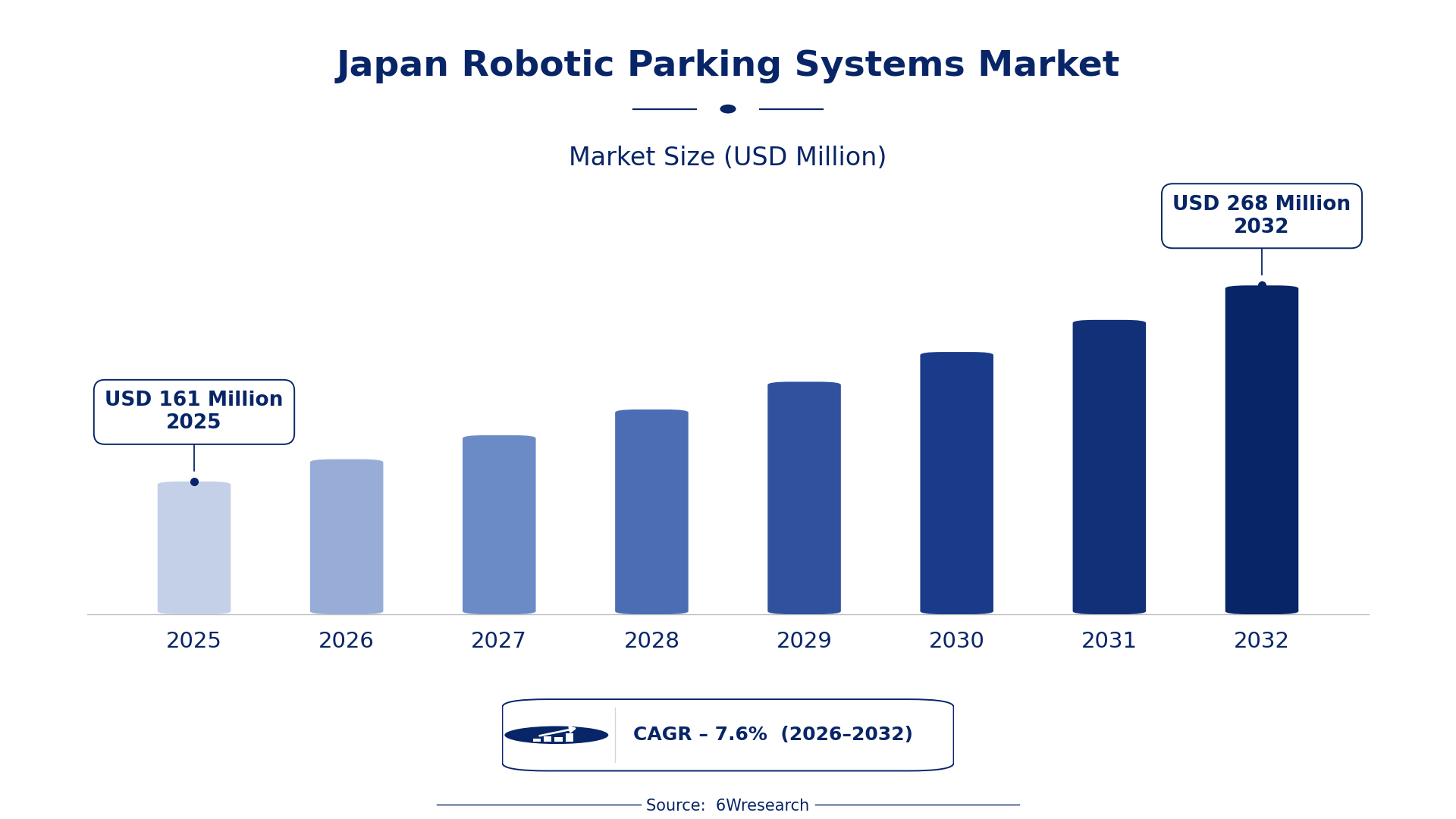
According to 6Wresearch internal database and industry insights, the Japan Robotic Parking Systems Market was valued at USD 161 Million in 2025 and is projected to reach USD 268 Million by 2032, growing at a CAGR of approximately 7.6% during 2026–2032.
Japan Robotic Parking Systems Market Highlights
| Report Metric | Details |
| Report Name | Japan Robotic Parking Systems Market (2026-2032) |
| Market Size 2025 | USD 161 Million |
| Market Size 2032 | USD 268 Million |
| Absolute Growth 2025–2032 | USD 107 Million |
| CAGR 2026–2032 | 7.6% |
| Peak Annual Growth | 8.5% in 2032 |
| Forecast Period | 2026–2032 |
| Historical Data | 2022–2025 |
| Base Year | 2025 |
| Leading Parking Type, 2025 | Tower Parking Systems (46% share) |
| Leading Lift Mechanism, 2025 | Vertical Lift & Shuttle (35% share) |
| Leading Operation Type, 2025 | Fully Automated (48% share) |
| Leading End User, 2025 | Urban Smart Cities (46% share) |
| Fastest-Growing Parking Type | Puzzle Parking Systems (10.7% CAGR) |
| Fastest-Growing Operation Type | Smartphone Controlled (11.1% CAGR) |
| Fastest-Growing End User | Commercial Complexes (10.0% CAGR) |
| Growing Sector | Commercial Complexes |
| Key End Users | Urban Smart Cities, Commercial Complexes, Residential Buildings, Real Estate Developers |
Japan Robotic Parking Systems Market Year-wise Growth Rate and Key Drivers (2022–2032)
This graph illustrates the annual growth rates of the market from 2022 to 2032, highlighting a steady upward trajectory and projected market expansion over the forecast period.
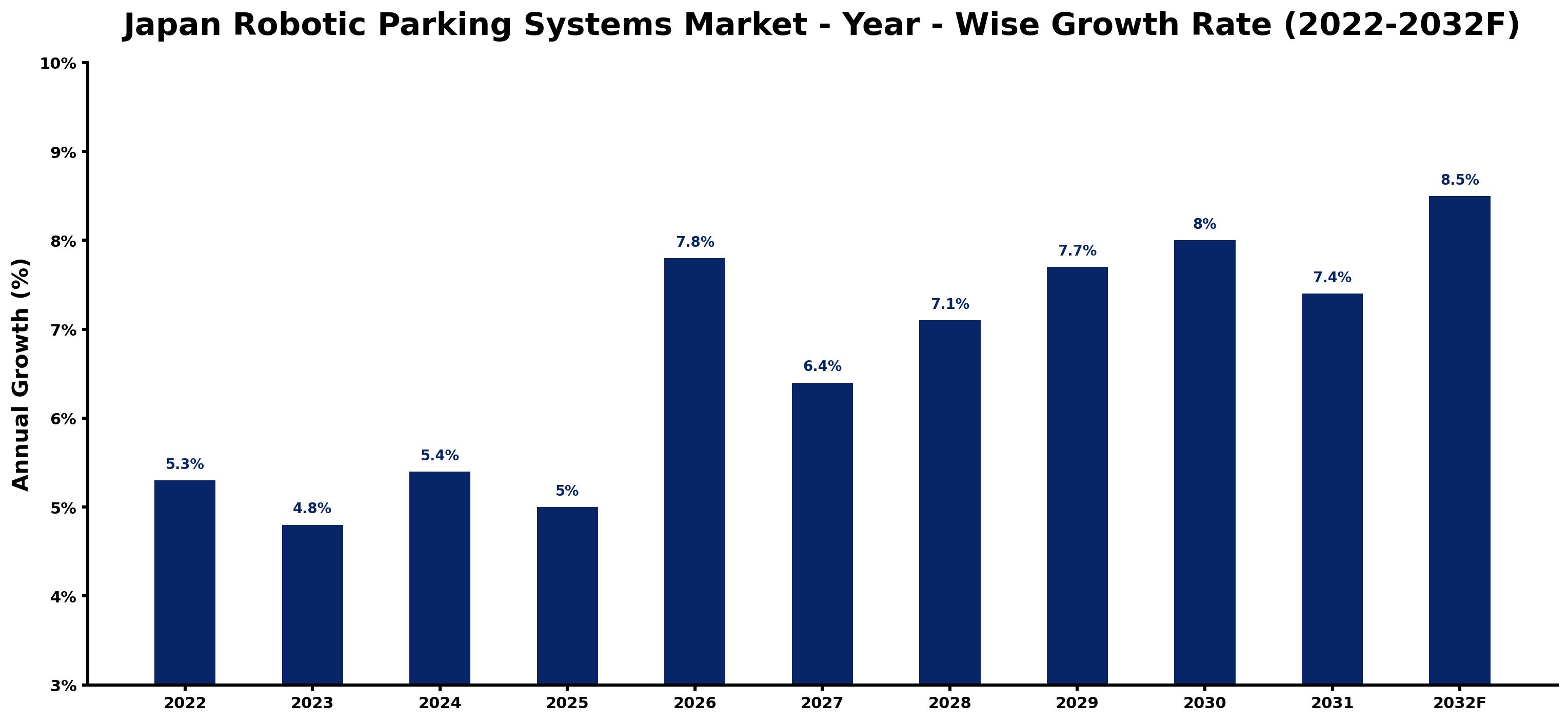
The yearly estimates that follow link every growth rate to its principal driver, so readers can see why the pace changed in each period.
| Year | Estimated Annual Growth (%) | Market Rationale |
| 2022 | 5.3 | The market experienced steady growth due to increasing urbanisation and demand for efficient parking solutions. |
| 2023 | 4.8 | Growth slowed as market adjustments took place following the implementation of new regulations. |
| 2024 | 5.4 | The market rebounded with stronger demand driven by urban smart city initiatives and real estate developments. |
| 2025 | 5.0 | Growth slowed again as the market stabilised after rapid expansions in previous years. |
| 2026 | 7.8 | Investment in smart urban infrastructure is expected to lead to a rise in demand for robotic parking systems. |
| 2027 | 6.4 | Growth is projected to slow as market saturation begins to affect the pace of new installations. |
| 2028 | 7.1 | Demand is expected to increase again, driven by the integration of electric vehicle charging stations in parking systems. |
| 2029 | 7.7 | The market is projected to continue growing as urban planners focus on maximising parking efficiency in cities. |
| 2030 | 8.0 | Investment in new technologies and systems will contribute to a further rise in market demand. |
| 2031 | 7.4 | Growth is expected to slow as the market matures and competition intensifies among suppliers. |
| 2032 | 8.5 | The market is projected to peak as urban smart cities expand their infrastructure, driving high demand for robotic systems. |
Note: Market size estimations and growth projections presented in this report are based on 6Wresearch's proprietary forecasting methodology, utilizing the latest available industry data, government publications, and primary research inputs.
Japan Robotic Parking Systems Market Synopsis
Advanced parking solutions utilise mechanical components, sensors, and control systems to maximise space in urban environments, improving user convenience and reducing human intervention. In 2023, the Tokyo Metropolitan Government launched a programme to support smart parking, reflecting the increasing demand for efficient parking across the country.
Market Dynamics Impact Analysis (2026–2032)
| Factor | Type | Impact | Primary Segment Affected |
| Urbanisation drives demand for efficient parking solutions in densely populated areas. | Driver | High | Tower Parking Systems |
| Real estate developers are increasingly investing in automated parking solutions for new projects. | Driver | High | Real Estate Developers |
| The integration of electric vehicle charging stations presents new opportunities for robotic parking systems. | Opportunity | Medium | Tower Parking Systems |
| Growing urban smart city initiatives are creating demand for advanced parking technologies. | Opportunity | High | Tower Parking Systems |
| High initial costs of robotic parking systems can deter potential buyers. | Restraint | High | Tower Parking Systems |
| The complexity of installation and maintenance may limit market expansion. | Restraint | Medium | Tower Parking Systems |
| Compliance with safety standards can increase operational costs for producers. | Challenge | High | Tower Parking Systems |
| Capacity constraints in urban areas may limit the deployment of new systems. | Challenge | Medium | Tower Parking Systems |
Evaluation of Drivers in Japan Robotic Parking Systems Market (2026–2032)
Demand rests on the following drivers, each shown with the segment it touches most.
| Drivers | Primary Segment Affected | Why It Matters (Evidence) |
| Urbanisation is increasing the need for efficient parking solutions in cities. | Tower Parking Systems | Tokyo has implemented over 50 robotic parking systems, reflecting the need for space-saving technologies. |
| Investment from real estate developers is driving demand for automated solutions. | Real Estate Developers | Approximately 30% of new residential buildings in urban areas are incorporating robotic parking solutions. |
| Government initiatives promote smart parking technologies to improve urban infrastructure. | Tower Parking Systems | In 2023, the Tokyo Metropolitan Government launched a programme to support smart parking solutions. |
| Integration with electric vehicle charging stations is expanding market potential. | Tower Parking Systems | Robotic parking systems are increasingly being integrated with electric vehicle charging stations. |
| Rising demand for space-efficient parking solutions is boosting market growth. | Commercial Complexes | Osaka Prefecture has seen a rise in demand for robotic parking in commercial complexes. |
Spending rises because urbanisation is driving the need for efficient parking solutions in cities, as seen in Tokyo, which has implemented over 50 robotic parking systems. Investment from real estate developers is also increasing demand, with approximately 30% of new residential buildings incorporating robotic parking solutions. The integration of electric vehicle charging stations is further expanding market potential, while demand for space-efficient solutions is rising in Osaka Prefecture's growing commercial complexes.
Evaluation of Restraints in Japan Robotic Parking Systems Market
The table below lists the restraints and the evidence behind each.
| Market Restraint | Primary Segment Affected | Why It Matters (Evidence) |
| High initial costs of robotic parking systems can deter potential buyers. | Tower Parking Systems | The average cost of a robotic parking system in Japan ranges from ¥30 million to ¥100 million. |
| Complex installation and maintenance may limit market expansion. | Tower Parking Systems | The average retrieval time for vehicles in robotic systems is approximately 2-3 minutes, affecting efficiency. |
| Compliance with safety standards can increase operational costs for producers. | Tower Parking Systems | The JIS B 8401 standard governs the safety of automated parking systems in Japan. |
| Limited awareness among potential users may hinder market growth. | Tower Parking Systems | Many urban planners are still unfamiliar with the benefits of robotic parking technologies. |
| Competition among suppliers can lead to price wars, affecting profitability. | Tower Parking Systems | As more suppliers enter the market, price competition may increase, impacting margins. |
Japan Robotic Parking Systems Market Challenges
Tokyo has implemented over 50 robotic parking systems, yet buyers face high installation costs ranging from ¥30 million to ¥100 million, which limits adoption among smaller developers. Competition intensifies as urban areas see increased interest, but suppliers encounter challenges with a limited number of manufacturers, leading to potential delays in system delivery. Technological advancements lag, as the average retrieval time of 2-3 minutes can deter users who expect immediate access, negatively affecting user satisfaction. Regulatory compliance complicates matters; the Ministry of Land, Infrastructure, Transport and Tourism oversees stringent parking regulations, which can prolong project approvals for buyers.
Trends in the Japan Robotic Parking Systems Market
These developments are changing demand patterns in the Japan Robotic Parking Systems Market.
- Shift towards Smart Urban Infrastructure: Tokyo is leading the way in smart urban infrastructure, with over 50 robotic parking systems implemented since 2023. This trend reflects a growing commitment to efficient land use, as robotic systems can reduce land use by up to 60% compared to traditional parking.
- Urban Smart Cities Prioritising Automated Solutions: Urban Smart Cities are increasingly adopting automated parking solutions, with 46% of new residential buildings incorporating robotic systems. This shift is driven by the need for efficient space utilisation in densely populated areas.
- Integration of Electric Vehicle Charging Stations: Robotic parking systems are being integrated with electric vehicle charging stations, increasing their appeal. This trend is evident in Yokohama, where several new public parking facilities have adopted such systems, catering to the rising number of electric vehicles.
- Growing Demand for Space-Efficient Parking: The demand for space-efficient parking solutions is rising, particularly in Osaka Prefecture, where commercial complexes are increasingly adopting robotic systems. This trend is expected to continue as urban areas face land constraints.
Investment Opportunities in the Japan Robotic Parking Systems Market
Several openings in the Japan Robotic Parking Systems Market merit attention from investors.
- Partnering with Local Developers: Now is an opportune moment to invest in robotic parking systems, as urban developers seek efficient solutions. Collaborating with real estate developers in Tokyo can facilitate market entry, given the city's ongoing smart infrastructure projects.
- Investing in Smart Urban Infrastructure: With the government's ¥1 billion allocation for smart urban infrastructure projects in 2023, there is a clear opportunity to supply advanced parking solutions. Engaging with municipal authorities can streamline entry into this growing market.
- Expanding Electric Vehicle Integration: The rise in electric vehicle ownership presents a chance to supply integrated robotic parking systems with charging stations. Targeting urban smart cities will be essential for capturing this emerging demand.
- Enhancing User Convenience: The increasing popularity of smartphone-controlled systems offers a chance to innovate in user convenience. Focusing on urban residential buildings can attract buyers looking for modern parking solutions.
Government Initiatives in the Japan Robotic Parking Systems Market
The Industrial Standardization Act governs the safety and operational standards for automated parking systems, ensuring compliance with regulations for producers and buyers. This law mandates that systems meet specific safety criteria, impacting the design and implementation of robotic parking solutions in urban areas.
In 2023, the government allocated ¥1 billion for smart urban infrastructure projects, overseen by the Ministry of Land, Infrastructure, Transport and Tourism. This funding supports the development and integration of advanced parking technologies, facilitating the adoption of robotic systems across Japan.
Future Insight of the Japan Robotic Parking Systems Market
Urban planners will increasingly adopt robotic parking systems, with the government allocating ¥1 billion for smart urban infrastructure projects by 2032. The Tokyo Metropolitan Government's smart parking initiative will drive innovation, improving user convenience and operational efficiency. Research by the National Institute of Advanced Industrial Science and Technology will advance robotic systems, allowing for a reduction in land use by up to 60% compared to traditional methods. Integration with electric vehicle charging stations will become standard, responding to the rising emphasis on sustainable transport options.
Market Segmentation Analysis
Japan Robotic Parking Systems Market report covers a detailed analysis of the following market segments:
By Parking Type – Tower Parking Systems Lead, Puzzle Parking Systems Expected to Grow Fastest
According to Saurav Kr Singh, Senior Research Analyst at 6Wresearch, Tower Parking Systems held 46% of the Japan Robotic Parking Systems Market by parking type in 2025. Tower Parking Systems dominate the market due to their space-saving design that allows for vertical stacking of vehicles. For instance, the implementation of over 50 such systems in Tokyo illustrates their effectiveness in maximising urban parking efficiency. Puzzle Parking Systems are projected to grow fastest, at a CAGR of 10.7% during 2026–2032. Puzzle Parking Systems are experiencing rapid growth because they utilise interlocking vehicle storage for efficient space use. This method is particularly sought after in densely populated regions like Osaka Prefecture, where innovative parking solutions are increasingly in demand. Suppliers should prioritise the development of space-efficient systems to satisfy the growing urban demand.
By Lift Mechanism – Vertical Lift & Shuttle Leads and Records the Fastest Growth
With 35% of lift mechanism revenue in 2025, Vertical Lift & Shuttle was the largest category. The Vertical Lift & Shuttle mechanism leads the market as it facilitates vertical movement of vehicles in multi-storey setups, making it ideal for urban environments. This design is essential for optimising space in cities where land availability is limited. Vertical Lift & Shuttle is also forecast to expand faster than any other category, at a CAGR of 10.5% over 2026–2032. As the leader, the Vertical Lift & Shuttle mechanism will continue to expand its lead due to its efficiency and versatility in various installations. The ongoing integration of these systems into smart city initiatives further bolsters their growth potential. Buyers will gain from investing in advanced lift mechanisms that improve space utilisation in urban developments.
By Operation Type – Fully Automated Leads, Smartphone Controlled Expected to Grow Fastest
Fully Automated accounted for 48% of the market by operation type in 2025. Fully Automated systems capture the largest market share as they provide complete automation for users, making them the most prevalent type. This is particularly evident in urban smart cities where convenience and operational efficiency are paramount. The quickest growth will come from Smartphone Controlled, forecast to expand at a CAGR of 11.1% between 2026 and 2032. Smartphone Controlled systems are rapidly gaining popularity due to their convenience and accessibility for users. As urban areas increasingly adopt smart technologies, this segment is poised for accelerated growth. Suppliers should integrate smartphone control features to attract tech-savvy consumers in urban markets.
By End User – Urban Smart Cities Lead, Commercial Complexes Expected to Grow Fastest
The largest end user category in 2025 was Urban Smart Cities, at 46% of revenue. Urban Smart Cities represent the largest segment as they are prime markets for advanced parking solutions, driven by the need for efficient urban infrastructure. The adoption of robotic parking systems aligns with these cities' objectives to enhance urban living conditions. Commercial Complexes are set to record the highest CAGR in this split, 10.0% over 2026–2032. Commercial Complexes are experiencing the fastest growth due to a high demand for parking solutions in shopping and business areas. The push for smart parking solutions in commercial settings is propelling this rapid expansion. Suppliers must tailor their offerings to meet the specific needs of commercial complexes to capitalise on this growth opportunity.
Key Attractiveness of the Report
- 10 Years of Market Numbers
- Historical Data Starting from 2022 to 2025
- Base Year 2025
- Forecast Data until 2032
- Key Performance Indicators Impacting the Market
- Major Upcoming Developments and Projects
Key Highlights of the Report:
- Japan Robotic Parking Systems Market Outlook
- Market Size of Japan Robotic Parking Systems Market, 2025
- Forecast of Japan Robotic Parking Systems Market, 2032
- Historical Data and Forecast of Japan Robotic Parking Systems Revenues & Volume for the Period 2022-2032F
- Japan Robotic Parking Systems Market Trend Evolution
- Japan Robotic Parking Systems Market Drivers and Challenges
- Japan Robotic Parking Systems Price Trends
- Japan Robotic Parking Systems Porter's Five Forces
- Japan Robotic Parking Systems Industry Life Cycle
- Historical Data and Forecast of Japan Robotic Parking Systems Market Revenues & Volume By Parking Type for the Period 2022-2032F
- Historical Data and Forecast of Japan Robotic Parking Systems Market Revenues & Volume By Tower Parking Systems for the Period 2022-2032F
- Historical Data and Forecast of Japan Robotic Parking Systems Market Revenues & Volume By Puzzle Parking Systems for the Period 2022-2032F
- Historical Data and Forecast of Japan Robotic Parking Systems Market Revenues & Volume By AGV-Based Systems for the Period 2022-2032F
- Historical Data and Forecast of Japan Robotic Parking Systems Market Revenues & Volume By Rotary Parking Systems for the Period 2022-2032F
- Historical Data and Forecast of Japan Robotic Parking Systems Market Revenues & Volume By Lift Mechanism for the Period 2022-2032F
- Historical Data and Forecast of Japan Robotic Parking Systems Market Revenues & Volume By Vertical Lift & Shuttle for the Period 2022-2032F
- Historical Data and Forecast of Japan Robotic Parking Systems Market Revenues & Volume By Sliding Platform for the Period 2022-2032F
- Historical Data and Forecast of Japan Robotic Parking Systems Market Revenues & Volume By Autonomous Navigation for the Period 2022-2032F
- Historical Data and Forecast of Japan Robotic Parking Systems Market Revenues & Volume By Circular Lift for the Period 2022-2032F
- Historical Data and Forecast of Japan Robotic Parking Systems Market Revenues & Volume By Operation Type for the Period 2022-2032F
- Historical Data and Forecast of Japan Robotic Parking Systems Market Revenues & Volume By Fully Automated for the Period 2022-2032F
- Historical Data and Forecast of Japan Robotic Parking Systems Market Revenues & Volume By Semi-Automated for the Period 2022-2032F
- Historical Data and Forecast of Japan Robotic Parking Systems Market Revenues & Volume By Smartphone Controlled for the Period 2022-2032F
- Historical Data and Forecast of Japan Robotic Parking Systems Market Revenues & Volume By Manual + Auto Retrieval for the Period 2022-2032F
- Historical Data and Forecast of Japan Robotic Parking Systems Market Revenues & Volume By End User for the Period 2022-2032F
- Historical Data and Forecast of Japan Robotic Parking Systems Market Revenues & Volume By Urban Smart Cities for the Period 2022-2032F
- Historical Data and Forecast of Japan Robotic Parking Systems Market Revenues & Volume By Residential Buildings for the Period 2022-2032F
- Historical Data and Forecast of Japan Robotic Parking Systems Market Revenues & Volume By Commercial Complexes for the Period 2022-2032F
- Historical Data and Forecast of Japan Robotic Parking Systems Market Revenues & Volume By Real Estate Developers for the Period 2022-2032F
- Japan Robotic Parking Systems Import Export Trade Statistics
- Market Opportunity Assessment By Parking Type
- Market Opportunity Assessment By Lift Mechanism
- Market Opportunity Assessment By Operation Type
- Market Opportunity Assessment By End User
- Japan Robotic Parking Systems Top Companies Market Share
- Japan Robotic Parking Systems Competitive Benchmarking By Technical and Operational Parameters
- Japan Robotic Parking Systems Company Profiles
- Japan Robotic Parking Systems Key Strategic Recommendations
Market Covered
Coverage by segment is as follows.
By Parking Type
- Tower Parking Systems
- Puzzle Parking Systems
- AGV-Based Systems
- Rotary Parking Systems
By Lift Mechanism
- Vertical Lift & Shuttle
- Sliding Platform
- Autonomous Navigation
- Circular Lift
By Operation Type
- Fully Automated
- Semi-Automated
- Smartphone Controlled
- Manual + Auto Retrieval
By End User
- Urban Smart Cities
- Residential Buildings
- Commercial Complexes
- Real Estate Developers































