Japan Robotic Printing Market Size & Growth Rate
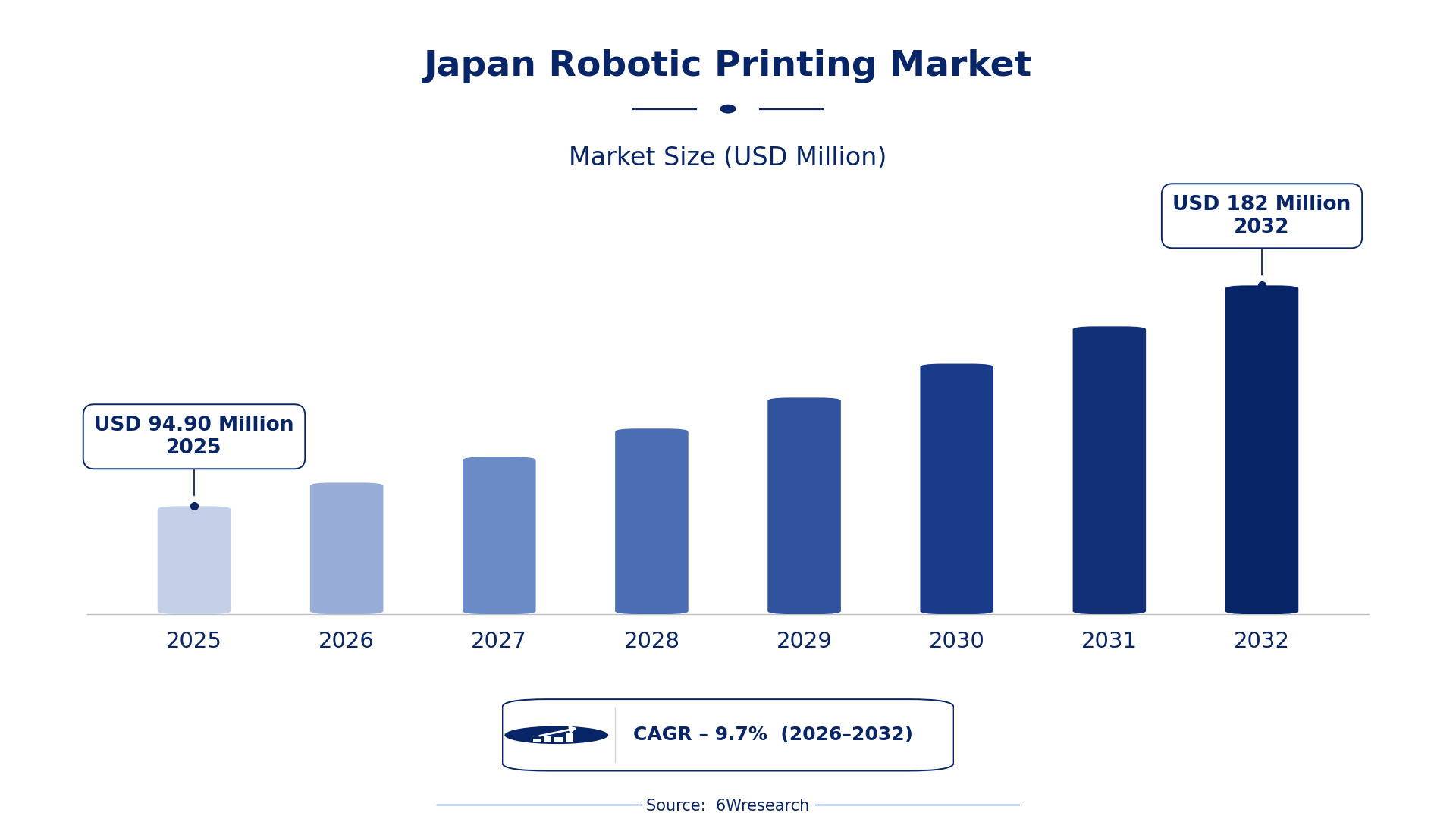
According to 6Wresearch internal database and industry insights, the Japan Robotic Printing Market was valued at USD 94.90 Million in 2025 and is projected to reach USD 182 Million by 2032, growing at a CAGR of approximately 9.7% during 2026–2032.
Japan Robotic Printing Market Highlights
| Report Metric | Details |
| Report Name | Japan Robotic Printing Market (2026-2032) |
| Market Size 2025 | USD 94.90 Million |
| Market Size 2032 | USD 182 Million |
| Absolute Growth 2025–2032 | USD 87.10 Million |
| CAGR 2026–2032 | 9.7% |
| Peak Annual Growth | 10.7% in 2028 |
| Forecast Period | 2026–2032 |
| Historical Data | 2022–2025 |
| Base Year | 2025 |
| Leading Printing Type, 2025 | 3D Printing (46% share) |
| Leading Robot Integration, 2025 | Robotic Arm Fused (38% share) |
| Leading Application Area, 2025 | Rapid Prototyping (51% share) |
| Leading End User, 2025 | Manufacturing R&D (44% share) |
| Fastest-Growing Printing Type | PCB Printing (13.6% CAGR) |
| Fastest-Growing Robot Integration | Pick & Place Robotic Head (13.3% CAGR) |
| Fastest-Growing Application Area | Electronics Manufacturing (11.7% CAGR) |
| Fastest-Growing End User | PCB Foundries (12.3% CAGR) |
| Growing Sector | Textile Printing |
| Key End Users | Electronics manufacturers, consumer goods firms, fashion manufacturers, manufacturing R&D |
Japan Robotic Printing Market Year-wise Growth Rate and Key Drivers (2022–2032)
This graph illustrates the annual growth rates of the market from 2022 to 2032, highlighting a steady upward trajectory and projected market expansion over the forecast period.
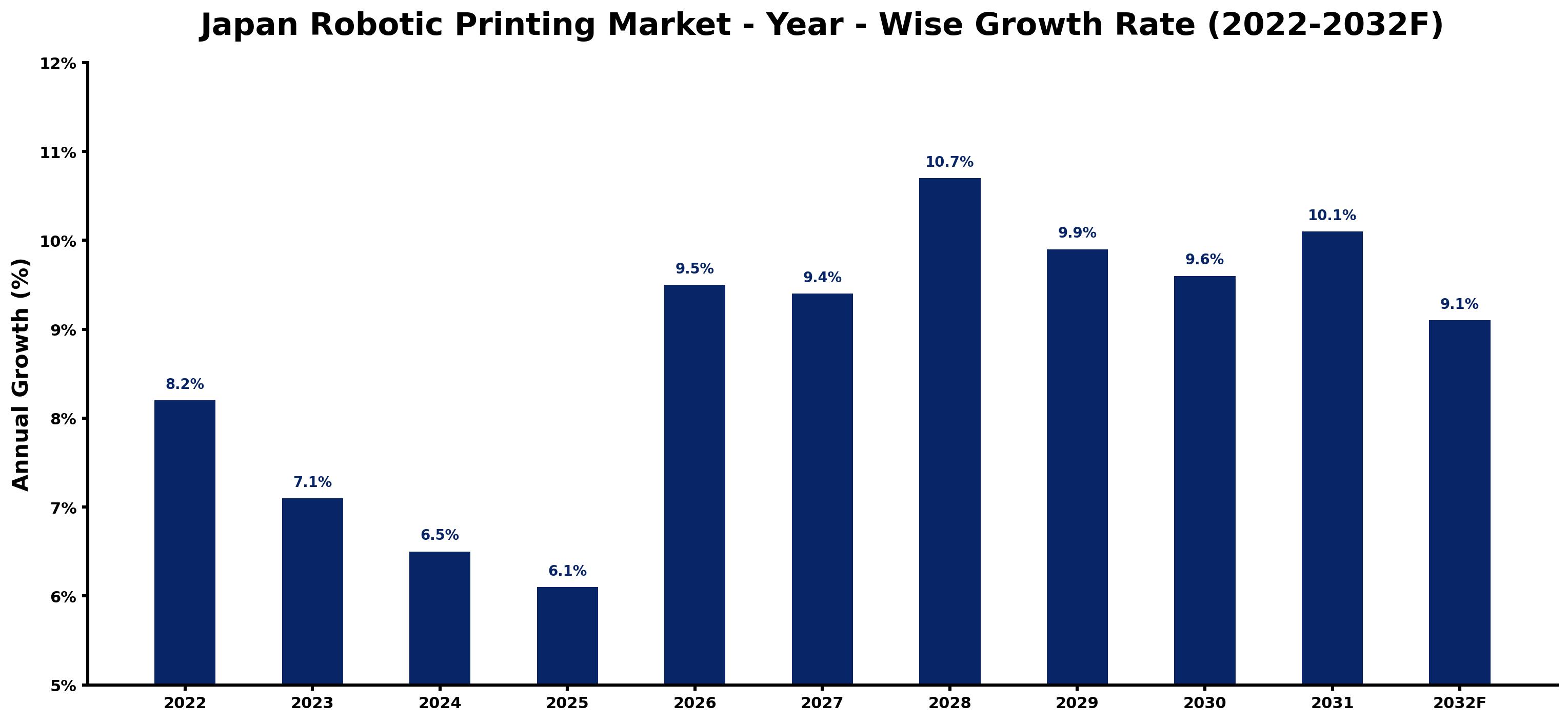
The following figures match every annual growth estimate with the main market development of that year, giving the reasoning behind each rise or slowdown.
| Year | Estimated Annual Growth (%) | Market Rationale |
| 2022 | 8.2 | The market experienced strong demand from manufacturing R&D and consumer goods sectors. |
| 2023 | 7.1 | Growth slowed due to market saturation in certain applications and increased competition. |
| 2024 | 6.5 | Demand remained stable as manufacturers focused on improving production efficiency. |
| 2025 | 6.1 | The market continued to grow, driven by ongoing investments in advanced technologies. |
| 2026 | 9.5 | Growth is expected to accelerate as new applications in electronics manufacturing emerge. |
| 2027 | 9.4 | Demand is projected to slightly decrease as the market adjusts to increased supply capacity. |
| 2028 | 10.7 | The market is expected to peak with heightened interest in robotic printing for custom apparel. |
| 2029 | 9.9 | Growth is projected to slow as the market begins to stabilise following rapid expansion. |
| 2030 | 9.6 | Demand is expected to remain strong, supported by ongoing innovations in robotic technologies. |
| 2031 | 10.1 | The market will see renewed interest as new standards improve product quality. |
| 2032 | 9.1 | Growth is projected to slow as the market matures, with established players dominating. |
Note: Market size estimations and growth projections presented in this report are based on 6Wresearch's proprietary forecasting methodology, utilizing the latest available industry data, government publications, and primary research inputs.
Japan Robotic Printing Market Synopsis
Robotic printing utilises automated systems to perform printing tasks with precision and efficiency. This technology integrates robotics with printing processes, enabling applications such as manufacturing prototypes, printing circuit boards, and custom apparel. The Japan Robotic Printing Market is expanding due to rising demand from the electronics manufacturing sector and consumer goods firms. In 2023, the adoption rate of robotic printing in manufacturing reached 30%, reflecting the technology's growing influence on production capabilities and efficiency.
Market Dynamics Impact Analysis (2026–2032)
| Factor | Type | Impact | Primary Segment Affected |
| Increased automation in manufacturing processes | Driver | High | Robotic Arm Fused |
| Rising demand for custom apparel and prototypes | Driver | High | Textile Printing |
| Growing need for advanced printing solutions in electronics | Opportunity | High | PCB Printing |
| Expansion of e-commerce driving label printing demand | Opportunity | Medium | Label Printing |
| High initial investment costs for robotic systems | Restraint | High | Robotic Arm Fused |
| Limited awareness of robotic printing benefits among SMEs | Restraint | Medium | Textile Printing |
| Competition from traditional printing methods | Challenge | High | PCB Printing |
| Technological advancements outpacing market adaptation | Challenge | Medium | Label Printing |
Evaluation of Drivers in Japan Robotic Printing Market (2026–2032)
The following drivers explain most of the expected growth.
| Drivers | Primary Segment Affected | Why It Matters (Evidence) |
| Increased investment in automation technologies | Robotic Arm Fused | This investment drives demand as manufacturers seek to improve production efficiency, with over 1,000 PCB foundries actively using robotic printing. |
| Growing consumer demand for personalised products | Textile Printing | This trend leads to higher purchases of custom apparel, as the fashion industry increasingly relies on robotic printing solutions. |
| Rising production of electronic devices | PCB Printing | The electronics sector's growth fuels demand, with Japan's adoption rate of robotic printing in manufacturing estimated at 30% in 2023. |
| Expansion of e-commerce and online retail | Label Printing | This shift increases the need for efficient labeling solutions, particularly in packaging and branding for consumer goods. |
| Advancements in rapid prototyping technologies | Rapid Prototyping | These advancements support faster product development cycles, with over 70% of R&D departments in Japan utilising such technologies. |
Buyers are adding capacity as demand for precision printing in manufacturing rises. The electronics sector is expanding, prompting manufacturers to invest in robotic solutions that improve production efficiency. In 2023, the adoption rate of robotic printing in manufacturing reached 30%, driving demand across various applications. The fashion industry is increasingly seeking custom apparel, which boosts the need for advanced textile printing technologies. Additionally, over 1,000 PCB foundries are utilising robotic printing, indicating a notable shift towards automation in production processes.
Evaluation of Restraints in Japan Robotic Printing Market
The main factors holding the market back are set out below.
| Market Restraint | Primary Segment Affected | Why It Matters (Evidence) |
| High initial investment costs for robotic systems | Robotic Arm Fused | These costs deter smaller firms from adopting robotic printing, limiting market growth opportunities. |
| Limited awareness of robotic printing benefits among SMEs | Textile Printing | This lack of knowledge restricts adoption rates, particularly in smaller manufacturing firms. |
| Competition from traditional printing methods | PCB Printing | Established methods continue to dominate, making it challenging for robotic printing to gain market share. |
| Technological advancements outpacing market adaptation | Label Printing | Rapid changes in technology can lead to outdated equipment, affecting buyer confidence. |
| Regulatory hurdles in product labelling standards | Label Printing | Strict compliance requirements can slow down the adoption of new printing technologies. |
Japan Robotic Printing Market Challenges
In 2023, only 30% of manufacturers utilise robotic printing, which hampers efficiency in production processes. Buyers in the electronics sector experience delays as they rely on traditional printing methods, potentially extending lead times by 20%. A shortage of skilled technicians exists, with only 40% trained in advanced robotics, leading to higher operational costs for producers. Compliance with the JIS Z 8401 standard creates challenges, resulting in longer approval times and potential penalties for 25% of manufacturers who do not meet quality benchmarks.
Trends in the Japan Robotic Printing Market
The shifts below are changing how Japan Robotic Printing Market products are bought and supplied.
- Shift towards Customisation in Textile Printing: The fashion industry is increasingly prioritising custom apparel, with robotic printing technologies facilitating this shift. In 2023, the textile printing industry was valued at around 200 million USD, reflecting the growing demand for personalised products.
- Adoption of JIS Z 8401 Standard: The introduction of the JIS Z 8401 standard improves quality assurance in robotic printing processes. This standard is expected to enhance product consistency, encouraging more manufacturers to adopt robotic solutions.
- Rise of Rapid Prototyping Technologies: Rapid prototyping technologies are becoming essential for product development cycles, with over 70% of R&D departments in Japan utilising them. This trend is driving demand for robotic printing solutions that can produce prototypes efficiently.
- Increased Focus on E-commerce Packaging: As e-commerce continues to grow, there is a heightened focus on efficient packaging and labelling solutions. This trend is driving demand for advanced robotic printing technologies in the packaging sector.
Investment Opportunities in the Japan Robotic Printing Market
Several openings in the Japan Robotic Printing Market merit attention from investors.
- Joint Ventures for Technology Integration: Establishing joint ventures with local firms can facilitate entry into the Japanese market. With a projected growth of 9.1% in 2032, there is an opportunity for robotic printing solutions.
- Investment in Custom Apparel Solutions: With the fashion industry increasingly relying on custom printing, there is a gap for innovative solutions. Targeting fashion manufacturers could yield high returns, given the industry's growth.
- Approval Pathways for Robotics Innovations: Navigating approval pathways for robotic printing technologies can open new markets. The government allocated 50 million USD in 2023 for robotics innovation programs, signalling strong support for advancements.
- Expansion into Electronics Manufacturing: Investing in PCB printing solutions is timely, as the electronics sector is expanding rapidly. The growth of over 1,000 PCB foundries presents a lucrative opportunity.
Government Initiatives in the Japan Robotic Printing Market
The New Robot Strategy (2015) aims to expand robot use across various sectors, reinforcing earlier laws like the Industrial Standardization Act (1949). This strategy improves the regulatory framework, encouraging manufacturers to adopt robotic printing technologies more widely.
In 2023, the government allocated 50 million USD for robotics innovation programs, administered by the Ministry of Economy, Trade and Industry. This funding supports advancements in robotic technologies, benefiting producers and buyers in the market.
Future Insight of the Japan Robotic Printing Market
The introduction of robotics innovation programmes will establish advanced manufacturing facilities, enhancing production efficiency. By 2032, production costs may decrease by 15% for buyers due to the broader adoption of automated systems. Initiatives from the Tokyo Metropolitan Government will drive smart manufacturing, fostering partnerships between technology providers and manufacturers. Training programmes will aim to ensure that 70% of the workforce is proficient in robotic technologies, bridging current skills gaps and improving productivity.
Market Segmentation Analysis
Japan Robotic Printing Market report covers a detailed analysis of the following market segments:
By Printing Type – 3D Printing Leads, PCB Printing Expected to Grow Fastest
According to Saurav Kr Singh, Senior Research Analyst at 6Wresearch, in 2025, 3D Printing led the printing type split with a 46% share. 3D Printing commands the largest share because it is extensively used for creating prototypes and custom parts, particularly in sectors like manufacturing and design. The integration of advanced robotics in this process enhances precision and efficiency, making it indispensable for product development. PCB Printing is set to record the highest CAGR in this split, 13.6% over 2026–2032. PCB Printing is experiencing rapid growth due to its essential role in electronics manufacturing, a cornerstone of Japan's economy. The presence of over 1,000 PCB foundries actively employing robotic printing illustrates the increasing demand for this technology. Suppliers should prioritise innovations in PCB Printing to leverage its expanding market presence.
By Robot Integration – Robotic Arm Fused Leads, Pick & Place Robotic Head Expected to Grow Fastest
Robotic Arm Fused accounted for 38% of the market by robot integration in 2025. Robotic Arm Fused technology leads the market as it is essential for precise printing tasks, which are necessary in high-quality production environments. Its widespread adoption in various manufacturing settings solidifies its dominant position. Pick & Place Robotic Head is projected to grow fastest, at a CAGR of 13.3% during 2026–2032. Pick & Place Robotic Head is growing rapidly due to its importance in assembling printed components, especially in the fast-paced electronics sector. The need for efficient assembly processes in manufacturing propels this growth. Buyers should consider investing in Pick & Place Robotic Head systems to improve assembly efficiency.
By Application Area – Rapid Prototyping Leads, Electronics Manufacturing Expected to Grow Fastest
The largest application area category in 2025 was Rapid Prototyping, at 51% of revenue. Rapid Prototyping leads the application areas as it is vital for product development cycles, allowing companies to innovate and expedite their time to market. This importance is underscored by the fact that over 70% of R&D departments in Japan utilise rapid prototyping technologies. The quickest growth will come from Electronics Manufacturing, forecast to expand at a CAGR of 11.7% between 2026 and 2032. Electronics Manufacturing is the fastest-growing application area, driven by the escalating need for efficient PCB and device production in Japan's technology-focused economy. The reliance on robotic printing for electronics manufacturing will likely accelerate this growth further. Suppliers must adapt their offerings to cater to the rising demands of the Electronics Manufacturing sector.
By End User – Manufacturing R&D Leads, PCB Foundries Expected to Grow Fastest
Manufacturing R&D held 44% of the Japan Robotic Printing Market by end user in 2025. Manufacturing R&D is the largest end user as it focuses on innovation and efficiency, making it a primary adopter of robotic printing technologies. This sector's commitment to advancing product development solidifies its leading share. Over 2026–2032, PCB Foundries are expected to post the fastest growth, at a CAGR of 12.3%. PCB Foundries are experiencing the fastest growth as they are core to the electronics supply chain, necessitating advanced printing solutions for PCB production. The increasing complexity of electronic devices drives this demand. Buyers in PCB Foundries should prioritise upgrading their robotic printing capabilities to stay competitive.
Key Attractiveness of the Report
- 10 Years of Market Numbers
- Historical Data Starting from 2022 to 2025
- Base Year 2025
- Forecast Data until 2032
- Key Performance Indicators Impacting the Market
- Major Upcoming Developments and Projects
Key Highlights of the Report:
- Japan Robotic Printing Market Outlook
- Market Size of Japan Robotic Printing Market, 2025
- Forecast of Japan Robotic Printing Market, 2032
- Historical Data and Forecast of Japan Robotic Printing Revenues & Volume for the Period 2022-2032F
- Japan Robotic Printing Market Trend Evolution
- Japan Robotic Printing Market Drivers and Challenges
- Japan Robotic Printing Price Trends
- Japan Robotic Printing Porter's Five Forces
- Japan Robotic Printing Industry Life Cycle
- Historical Data and Forecast of Japan Robotic Printing Market Revenues & Volume By Printing Type for the Period 2022-2032F
- Historical Data and Forecast of Japan Robotic Printing Market Revenues & Volume By 3D Printing for the Period 2022-2032F
- Historical Data and Forecast of Japan Robotic Printing Market Revenues & Volume By PCB Printing for the Period 2022-2032F
- Historical Data and Forecast of Japan Robotic Printing Market Revenues & Volume By Label Printing for the Period 2022-2032F
- Historical Data and Forecast of Japan Robotic Printing Market Revenues & Volume By Textile Printing for the Period 2022-2032F
- Historical Data and Forecast of Japan Robotic Printing Market Revenues & Volume By Robot Integration for the Period 2022-2032F
- Historical Data and Forecast of Japan Robotic Printing Market Revenues & Volume By Robotic Arm Fused for the Period 2022-2032F
- Historical Data and Forecast of Japan Robotic Printing Market Revenues & Volume By Pick & Place Robotic Head for the Period 2022-2032F
- Historical Data and Forecast of Japan Robotic Printing Market Revenues & Volume By Motion Control Robots for the Period 2022-2032F
- Historical Data and Forecast of Japan Robotic Printing Market Revenues & Volume By Multi-Axis Robots for the Period 2022-2032F
- Historical Data and Forecast of Japan Robotic Printing Market Revenues & Volume By Application Area for the Period 2022-2032F
- Historical Data and Forecast of Japan Robotic Printing Market Revenues & Volume By Rapid Prototyping for the Period 2022-2032F
- Historical Data and Forecast of Japan Robotic Printing Market Revenues & Volume By Electronics Manufacturing for the Period 2022-2032F
- Historical Data and Forecast of Japan Robotic Printing Market Revenues & Volume By Packaging & Labeling for the Period 2022-2032F
- Historical Data and Forecast of Japan Robotic Printing Market Revenues & Volume By Custom Apparel for the Period 2022-2032F
- Historical Data and Forecast of Japan Robotic Printing Market Revenues & Volume By End User for the Period 2022-2032F
- Historical Data and Forecast of Japan Robotic Printing Market Revenues & Volume By Manufacturing R&D for the Period 2022-2032F
- Historical Data and Forecast of Japan Robotic Printing Market Revenues & Volume By PCB Foundries for the Period 2022-2032F
- Historical Data and Forecast of Japan Robotic Printing Market Revenues & Volume By Consumer Goods Firms for the Period 2022-2032F
- Historical Data and Forecast of Japan Robotic Printing Market Revenues & Volume By Fashion Manufacturers for the Period 2022-2032F
- Japan Robotic Printing Import Export Trade Statistics
- Market Opportunity Assessment By Printing Type
- Market Opportunity Assessment By Robot Integration
- Market Opportunity Assessment By Application Area
- Market Opportunity Assessment By End User
- Japan Robotic Printing Top Companies Market Share
- Japan Robotic Printing Competitive Benchmarking By Technical and Operational Parameters
- Japan Robotic Printing Company Profiles
- Japan Robotic Printing Key Strategic Recommendations
Market Covered
Segments analysed in this report are listed below.
By Printing Type
- 3D Printing
- PCB Printing
- Label Printing
- Textile Printing
By Robot Integration
- Robotic Arm Fused
- Pick & Place Robotic Head
- Motion Control Robots
- Multi-Axis Robots
By Application Area
- Rapid Prototyping
- Electronics Manufacturing
- Packaging & Labeling
- Custom Apparel
By End User
- Manufacturing R&D
- PCB Foundries
- Consumer Goods Firms
- Fashion Manufacturers































