Japan Robotic Tractors Market Size & Growth Rate
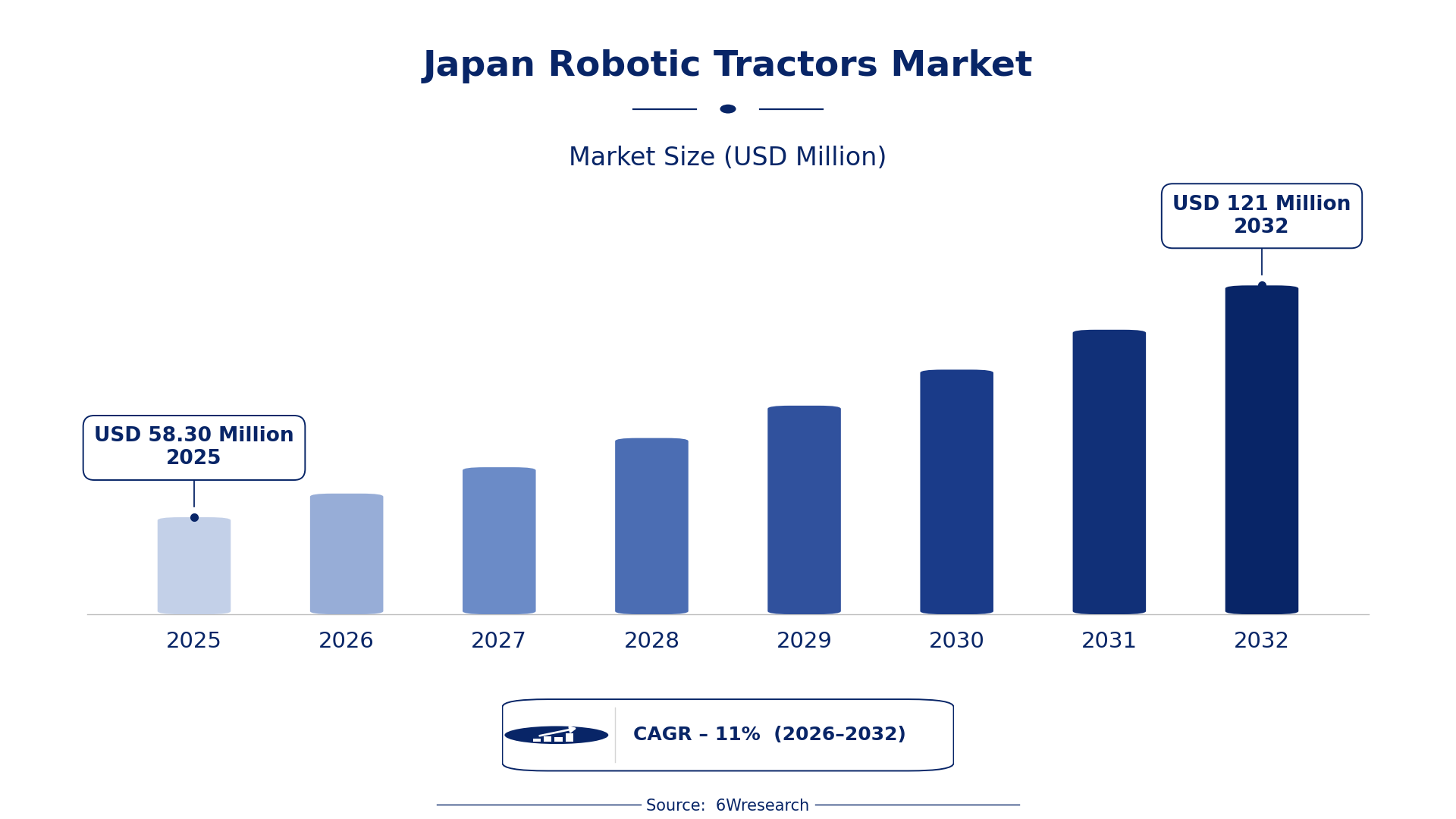
According to 6Wresearch internal database and industry insights, the Japan Robotic Tractors Market was valued at USD 58.30 Million in 2025 and is projected to reach USD 121 Million by 2032, growing at a CAGR of approximately 11% during 2026–2032.
Japan Robotic Tractors Market Highlights
| Report Metric | Details |
| Report Name | Japan Robotic Tractors Market (2026-2032) |
| Market Size 2025 | USD 58.30 Million |
| Market Size 2032 | USD 121 Million |
| Absolute Growth 2025–2032 | USD 62.70 Million |
| CAGR 2026–2032 | 11% |
| Peak Annual Growth | 12.1% in 2032 |
| Forecast Period | 2026–2032 |
| Historical Data | 2022–2025 |
| Base Year | 2025 |
| Leading Tractor Type, 2025 | Fully Autonomous (42% share) |
| Leading Guidance System, 2025 | GPS + AI (53% share) |
| Leading Operation Mode, 2025 | Unmanned (37% share) |
| Leading End User, 2025 | Agro Corporations (49% share) |
| Fastest-Growing Tractor Type | Electric Tractors (15.9% CAGR) |
| Fastest-Growing Operation Mode | Programmable (14.2% CAGR) |
| Fastest-Growing End User | Smart Farms (14.7% CAGR) |
| Growing Sector | Agricultural technology |
| Key End Users | Agro Corporations, Smart Farms, Precision Farming Units |
Japan Robotic Tractors Market Year-wise Growth Rate and Key Drivers (2022–2032)
This graph illustrates the annual growth rates of the market from 2022 to 2032, highlighting a steady upward trajectory and projected market expansion over the forecast period.
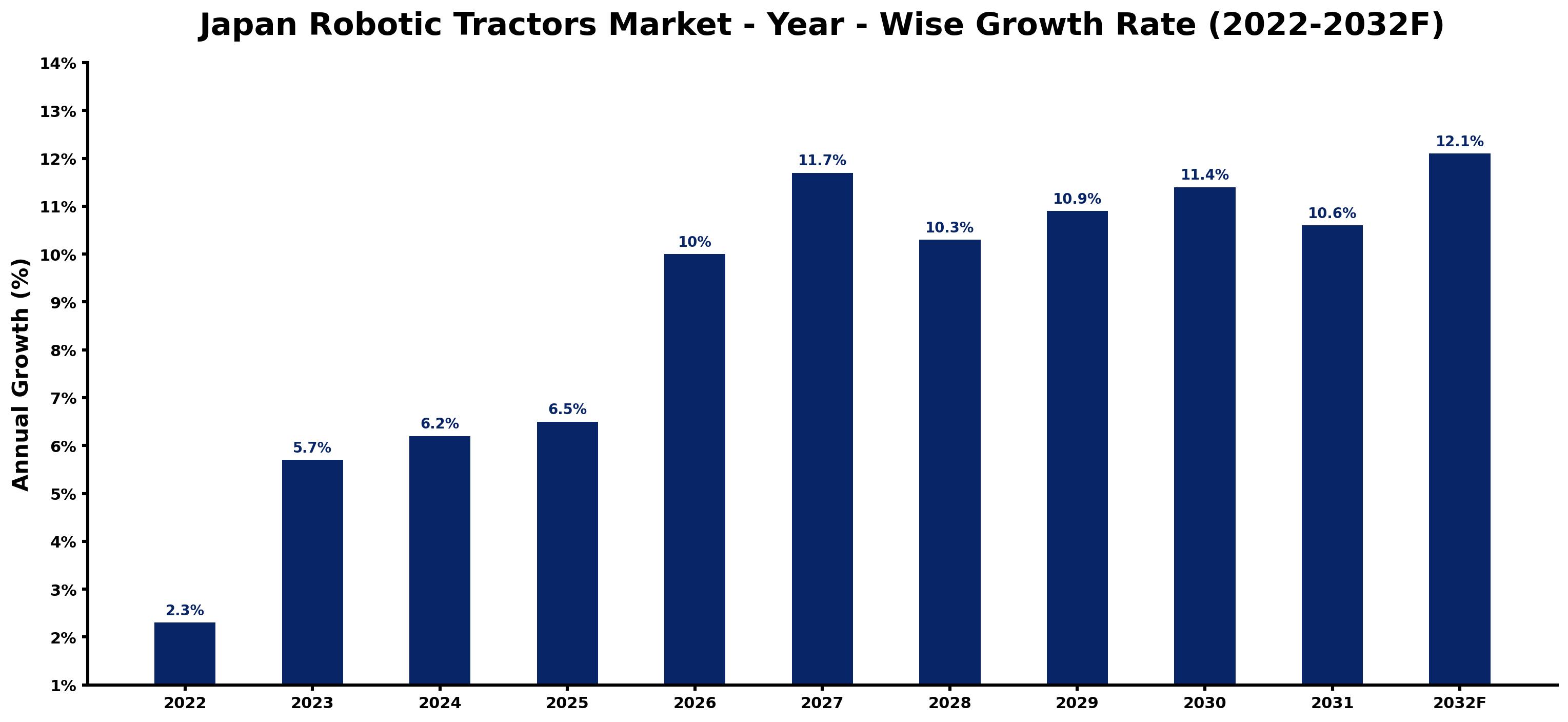
Each row of the following table gives one year's estimated growth and the event or demand shift that explains it.
| Year | Estimated Annual Growth (%) | Market Rationale |
| 2022 | 2.3 | The market experienced moderate growth due to initial automation adoption. |
| 2023 | 5.7 | Increased interest in smart farming technologies spurred higher growth rates. |
| 2024 | 6.2 | Demand continued to rise as more farms implemented automation solutions. |
| 2025 | 6.5 | The market peaked with investments in robotic farming technologies. |
| 2026 | 10.0 | Growth accelerated as technology adoption is expected to become widespread among farmers. |
| 2027 | 11.7 | Rising demand for efficiency in agriculture will drive further market expansion. |
| 2028 | 10.3 | Growth is projected to slow slightly as the market stabilises after rapid expansion. |
| 2029 | 10.9 | Demand is expected to surge again as more farms embrace advanced farming technologies. |
| 2030 | 11.4 | The market will maintain strong growth driven by ongoing technological advancements. |
| 2031 | 10.6 | Growth is projected to moderate as the market approaches saturation in certain areas. |
| 2032 | 12.1 | The market is expected to peak with strong demand for fully autonomous solutions. |
Note: Market size estimations and growth projections presented in this report are based on 6Wresearch's proprietary forecasting methodology, utilizing the latest available industry data, government publications, and primary research inputs.
Japan Robotic Tractors Market Synopsis
Robotic tractors are advanced agricultural machines that utilise automation technology for various farming tasks, including precision farming and crop monitoring. The Japan Robotic Tractors Market is increasingly adopting these technologies, driven by agro corporations and smart farms seeking efficiency and sustainability. The adoption rate of robotic tractors is projected to reach 15% by 2025, supported by government initiatives like the Smart Agriculture Promotion Project launched in 2022, which aims to improve productivity and efficiency in agriculture.
Market Dynamics Impact Analysis (2026–2032)
| Factor | Type | Impact | Primary Segment Affected |
| Growing demand for precision farming technologies | Driver | High | Fully Autonomous |
| Increased investments in smart agriculture | Driver | High | GPS + AI |
| Rising interest in automation solutions among farmers | Opportunity | High | Agro Corporations |
| Expansion of smart farms integrating advanced technologies | Opportunity | High | Smart Farms |
| High initial costs of robotic tractors | Restraint | High | Fully Autonomous |
| Limited awareness of benefits among smaller farms | Restraint | Medium | Agro Corporations |
| Aging farmer population leading to labour shortages | Challenge | High | Agro Corporations |
| Slow adoption rates in rural areas due to infrastructure issues | Challenge | Medium | Smart Farms |
Evaluation of Drivers in Japan Robotic Tractors Market (2026–2032)
The following drivers explain most of the expected growth.
| Drivers | Primary Segment Affected | Why It Matters (Evidence) |
| Increased focus on efficiency in farming | Fully Autonomous | The average age of farmers in Japan exceeds 66, resulting in a higher demand for automation solutions. |
| Government subsidies promoting smart agriculture | GPS + AI | The Ministry of Agriculture, Forestry and Fisheries provides funding initiatives to support technology adoption, contributing to the growth of the market. |
| Growing number of smart farms | Smart Farms | In 2023, 30% of farms in Japan began implementing automation technologies, boosting demand for robotic tractors. |
| Technological advancements in robotics and AI | Semi-Autonomous | Research from the National Institute of Agricultural Sciences improves the capabilities of robotic farming technologies, enhancing market growth. |
| Rising consumer demand for sustainable farming practices | Electric Tractors | The GX Basic Policy aims for substantial decarbonisation investments, influencing farming practices and driving demand for electric solutions. |
Volumes grow on the back of increasing focus on efficiency in farming, as the average age of farmers in Japan exceeds 66, leading to heightened demand for automation solutions. Technological advancements in robotics and AI improve robotic farming capabilities, further driving demand. Rising consumer demand for sustainable practices aligns with decarbonisation investments in agriculture, motivating farmers to adopt automated systems.
Evaluation of Restraints in Japan Robotic Tractors Market
The table below lists the restraints and the evidence behind each.
| Market Restraint | Primary Segment Affected | Why It Matters (Evidence) |
| High initial costs of robotic tractors | Fully Autonomous | The average cost of advanced robotic tractors limits adoption among smaller farms, impacting overall market growth. |
| Limited awareness of benefits among smaller farms | Agro Corporations | Many smaller farms remain unaware of the advantages of automation, hindering market penetration. |
| Aging farmer population creating labour shortages | Agro Corporations | The increasing average age of farmers necessitates automation solutions to address labour gaps. |
| Slow adoption rates in rural areas due to infrastructure issues | Smart Farms | Inadequate infrastructure in rural regions delays the implementation of advanced farming technologies. |
| Regulatory hurdles in technology adoption | GPS + AI | Compliance with JIS standards for agricultural machinery adds complexity and costs for manufacturers. |
Japan Robotic Tractors Market Challenges
High supply chain costs hinder the adoption of robotic tractors, as local producers rely heavily on imported components, which can inflate prices and delay automation investments. Intense competition among domestic manufacturers drives aggressive pricing strategies, squeezing profit margins and limiting suppliers' capacity to innovate. Stringent JIS standards impose compliance costs on manufacturers, which can reduce operational efficiency and raise prices for buyers. Rising labour costs, with the minimum wage at JPY 1,055 per hour, further challenge producers, complicating their transition to automation while increasing the urgency for cost-effective solutions.
Trends in the Japan Robotic Tractors Market
Four trends stand out in the Japan Robotic Tractors Market.
- Agro Corporations Adopting Automation: Agro corporations are increasingly adopting robotic tractors to improve productivity, with 30% of farms implementing automation technologies in 2023. This shift reflects a growing trend towards modernising agricultural practices.
- Rise of Smart Farms: In Japan, smart farms are integrating robotic tractors into their operations, with a projected growth rate of 14.7% by 2032. This trend demonstrates a commitment to efficiency and sustainability in agriculture.
- Demand for Fully Autonomous Solutions: The demand for fully autonomous tractors is rising as farmers seek to reduce labour costs. The adoption rate is projected to reach 15% by 2025, highlighting this shift in farming practices.
- Investment in Precision Farming: Investment in precision farming technologies is growing, particularly in the Tohoku region, which is key for innovation. This focus is expected to significantly improve agricultural productivity.
Investment Opportunities in the Japan Robotic Tractors Market
Below are the investment opportunities with the strongest case in the Japan Robotic Tractors Market.
- Collaborating with Local Agro Corporations: Investing in partnerships with local agro corporations can facilitate market entry, as they account for 49% of the end-user segment. This collaboration can increase technology adoption and sales.
- Expanding in the Tohoku Region: The Tohoku region is a key area for precision farming technologies, presenting opportunities for suppliers. Investing in local facilities can help meet the rising demand for automation.
- Supplying Electric Tractors: With a projected increase in demand, electric tractors are gaining traction. Suppliers can target agro corporations looking to adopt sustainable farming practices.
- Integrating with Smart Farms: Smart farms are increasingly integrating advanced technologies, creating opportunities for suppliers of robotic tractors. Establishing joint ventures can strengthen market presence.
Government Initiatives in the Japan Robotic Tractors Market
The Act against Unjustifiable Premiums and Misleading Representations, enacted in 1962, prohibits misleading labelling and advertising of goods, ensuring that agricultural machinery manufacturers adhere to safety and efficiency standards. This law protects consumers and promotes fair competition in the market, benefiting robotic tractor producers and buyers alike.
The Smart Agriculture Promotion Project, launched in 2022, supports farmers in adopting advanced technologies through subsidies and training. This initiative aims to improve productivity and efficiency in agriculture, directly benefiting agro corporations and smart farms by facilitating access to robotic tractors.
Future Insight of the Japan Robotic Tractors Market
The emergence of advanced automation technologies will reshape demand for robotic tractors, facilitating more efficient agricultural practices. By 2032, 30% of farms will have adopted automation technologies, driven by initiatives like the Smart Agriculture Promotion Project. As the agricultural workforce ages, the demand for effective farming solutions will escalate, prompting suppliers to innovate. Enhanced research from institutes will further encourage the development of cutting-edge farming technologies, ensuring a thriving market for automated agricultural machinery.
Market Segmentation Analysis
Japan Robotic Tractors Market report covers a detailed analysis of the following market segments:
By Tractor Type – Fully Autonomous Leads, Electric Tractors Expected to Grow Fastest
According to Saurav Kr Singh, Senior Research Analyst at 6Wresearch, Fully Autonomous held 42% of the Japan Robotic Tractors Market by tractor type in 2025. Fully autonomous tractors dominate the market due to their capability for complete automation in large-scale agricultural operations. This trend is particularly prominent in the Tohoku region, where precision farming technologies are increasingly embraced. The quickest growth will come from Electric Tractors, forecast to expand at a CAGR of 15.9% between 2026 and 2032. Electric tractors are experiencing rapid growth as they are being adopted for specific farming tasks, reflecting the industry's shift towards sustainable practices. The government's ambition to enhance agricultural productivity by 20% by 2025 is a key factor driving this segment's growth. Suppliers should concentrate on developing electric tractor solutions to meet the rising demand for sustainable farming technologies.
By Guidance System – GPS + AI Leads and Records the Fastest Growth
With 53% of guidance system revenue in 2025, GPS + AI was the largest category. GPS combined with advanced navigation systems is essential for the effective operation of robotic tractors, making it the leading guidance system in the market. Its extensive application ensures precise farming operations, which are crucial for improving productivity in Japan's agricultural sector. GPS + AI is also forecast to expand faster than any other category, at a CAGR of 12.6% over 2026–2032. The same GPS and navigation technology is also the fastest-growing segment, as its integration greatly enhances the functionality of robotic tractors. The fact that 30% of farms in Japan are adopting automation technologies underscores the increasing dependence on these systems. Buyers should invest in advanced guidance systems to maximise the performance of their robotic tractors.
By Operation Mode – Unmanned Leads, Programmable Expected to Grow Fastest
Unmanned took 37% of operation mode revenue in 2025, more than any other category. Unmanned operation is a core feature of robotic tractors, allowing for autonomous farming without human intervention. This mode is particularly appealing to agro corporations seeking to optimise labour costs and improve efficiency in large-scale farming. Programmable is projected to grow fastest, at a CAGR of 14.2% during 2026–2032. Programmable operation mode is emerging rapidly as it allows for pre-set farming operations, catering to the needs of smart farms. This growth is supported by the ongoing trend towards automation in agriculture, as seen in the Smart Agriculture Promotion Project. Suppliers must ensure their products offer programmable features to attract smart farm operators looking for tailored solutions.
By End User – Agro Corporations Lead, Smart Farms Expected to Grow Fastest
Agro Corporations accounted for 49% of the market by end user in 2025. Agro corporations are the primary users of robotic tractors, utilising them for large-scale farming to enhance productivity. This segment's leadership is indicative of substantial investments in technology aimed at boosting agricultural efficiency across Japan. Over 2026–2032, Smart Farms are expected to post the fastest growth, at a CAGR of 14.7%. Smart farms are rapidly incorporating robotic tractors, driven by the necessity for improved efficiency and sustainable practices. The growth of smart farms signals a shift towards more technologically advanced agricultural methods. Suppliers should tailor solutions for smart farms to improve their operational efficiency and align with sustainability goals.
Key Attractiveness of the Report
- 10 Years of Market Numbers
- Historical Data Starting from 2022 to 2025
- Base Year 2025
- Forecast Data until 2032
- Key Performance Indicators Impacting the Market
- Major Upcoming Developments and Projects
Key Highlights of the Report:
- Japan Robotic Tractors Market Outlook
- Market Size of Japan Robotic Tractors Market, 2025
- Forecast of Japan Robotic Tractors Market, 2032
- Historical Data and Forecast of Japan Robotic Tractors Revenues & Volume for the Period 2022-2032F
- Japan Robotic Tractors Market Trend Evolution
- Japan Robotic Tractors Market Drivers and Challenges
- Japan Robotic Tractors Price Trends
- Japan Robotic Tractors Porter's Five Forces
- Japan Robotic Tractors Industry Life Cycle
- Historical Data and Forecast of Japan Robotic Tractors Market Revenues & Volume By Tractor Type for the Period 2022-2032F
- Historical Data and Forecast of Japan Robotic Tractors Market Revenues & Volume By Fully Autonomous for the Period 2022-2032F
- Historical Data and Forecast of Japan Robotic Tractors Market Revenues & Volume By Semi-Autonomous for the Period 2022-2032F
- Historical Data and Forecast of Japan Robotic Tractors Market Revenues & Volume By Electric Tractors for the Period 2022-2032F
- Historical Data and Forecast of Japan Robotic Tractors Market Revenues & Volume By Diesel-Hybrid Tractors for the Period 2022-2032F
- Historical Data and Forecast of Japan Robotic Tractors Market Revenues & Volume By Guidance System for the Period 2022-2032F
- Historical Data and Forecast of Japan Robotic Tractors Market Revenues & Volume By GPS + AI for the Period 2022-2032F
- Historical Data and Forecast of Japan Robotic Tractors Market Revenues & Volume By Remote Controlled for the Period 2022-2032F
- Historical Data and Forecast of Japan Robotic Tractors Market Revenues & Volume By Battery Powered for the Period 2022-2032F
- Historical Data and Forecast of Japan Robotic Tractors Market Revenues & Volume By Fuel + Electric Hybrid for the Period 2022-2032F
- Historical Data and Forecast of Japan Robotic Tractors Market Revenues & Volume By Operation Mode for the Period 2022-2032F
- Historical Data and Forecast of Japan Robotic Tractors Market Revenues & Volume By Unmanned for the Period 2022-2032F
- Historical Data and Forecast of Japan Robotic Tractors Market Revenues & Volume By Assisted for the Period 2022-2032F
- Historical Data and Forecast of Japan Robotic Tractors Market Revenues & Volume By Programmable for the Period 2022-2032F
- Historical Data and Forecast of Japan Robotic Tractors Market Revenues & Volume By Real-Time Navigation for the Period 2022-2032F
- Historical Data and Forecast of Japan Robotic Tractors Market Revenues & Volume By End User for the Period 2022-2032F
- Historical Data and Forecast of Japan Robotic Tractors Market Revenues & Volume By Agro Corporations for the Period 2022-2032F
- Historical Data and Forecast of Japan Robotic Tractors Market Revenues & Volume By Precision Farming Units for the Period 2022-2032F
- Historical Data and Forecast of Japan Robotic Tractors Market Revenues & Volume By Smart Farms for the Period 2022-2032F
- Historical Data and Forecast of Japan Robotic Tractors Market Revenues & Volume By Contract Farmers for the Period 2022-2032F
- Japan Robotic Tractors Import Export Trade Statistics
- Market Opportunity Assessment By Tractor Type
- Market Opportunity Assessment By Guidance System
- Market Opportunity Assessment By Operation Mode
- Market Opportunity Assessment By End User
- Japan Robotic Tractors Top Companies Market Share
- Japan Robotic Tractors Competitive Benchmarking By Technical and Operational Parameters
- Japan Robotic Tractors Company Profiles
- Japan Robotic Tractors Key Strategic Recommendations
Market Covered
The following segment groups are covered in the report.
By Tractor Type
- Fully Autonomous
- Semi-Autonomous
- Electric Tractors
- Diesel-Hybrid Tractors
By Guidance System
- GPS + AI
- Remote Controlled
- Battery Powered
- Fuel + Electric Hybrid
By Operation Mode
- Unmanned
- Assisted
- Programmable
- Real-Time Navigation
By End User
- Agro Corporations
- Precision Farming Units
- Smart Farms
- Contract Farmers































