Japan Robotic Welding Systems Market Size & Growth Rate
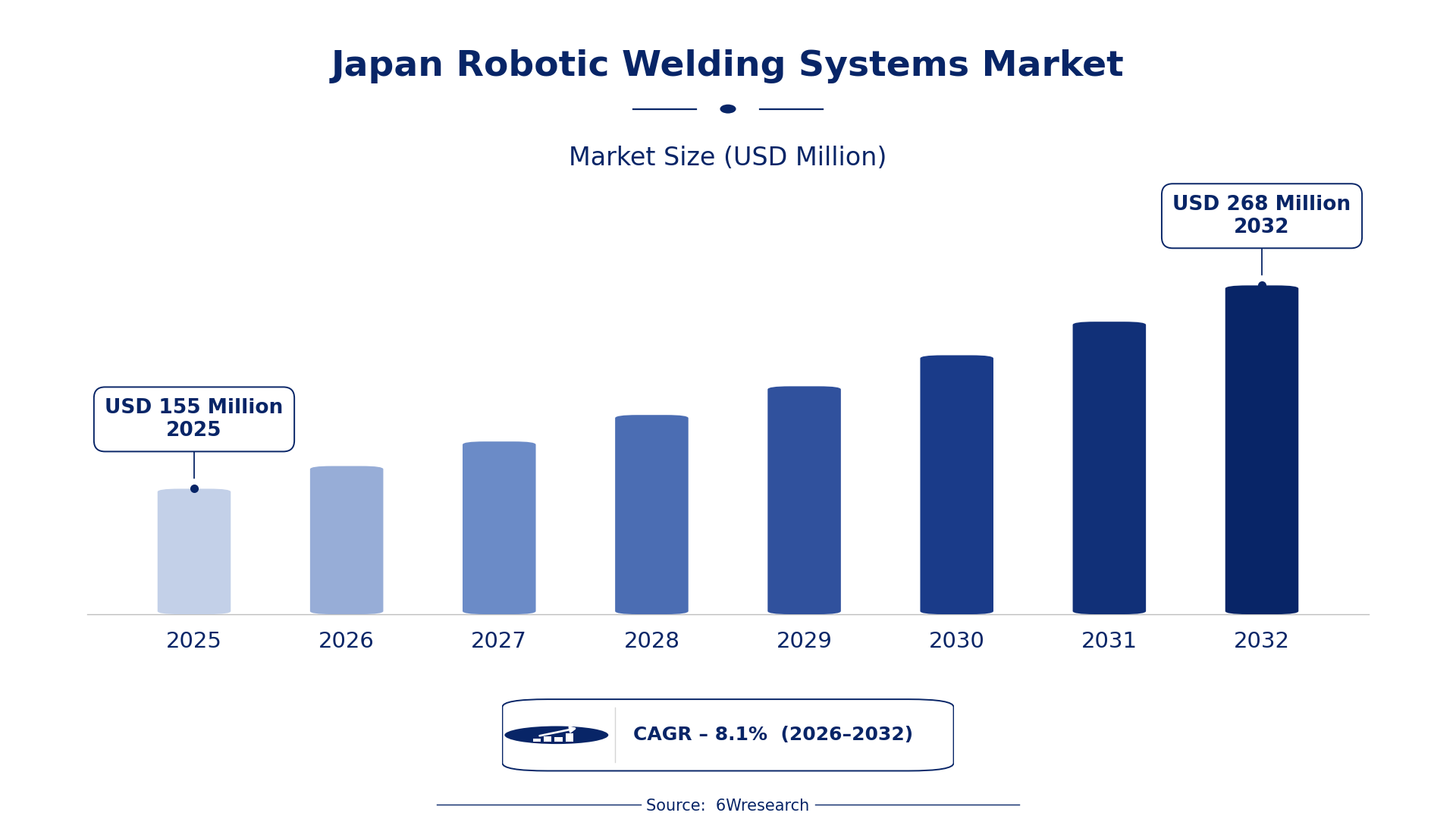
According to 6Wresearch internal database and industry insights, the Japan Robotic Welding Systems Market was valued at USD 155 Million in 2025 and is projected to reach USD 268 Million by 2032, growing at a CAGR of approximately 8.1% during 2026–2032.
Japan Robotic Welding Systems Market Highlights
| Report Metric | Details |
| Report Name | Japan Robotic Welding Systems Market (2026-2032) |
| Market Size 2025 | USD 155 Million |
| Market Size 2032 | USD 268 Million |
| Absolute Growth 2025–2032 | USD 113 Million |
| CAGR 2026–2032 | 8.1% |
| Peak Annual Growth | 9.5% in 2028 |
| Forecast Period | 2026–2032 |
| Historical Data | 2022–2025 |
| Base Year | 2025 |
| Leading Welding Type, 2025 | MIG Welding Robots (37% share) |
| Leading Robot Type, 2025 | 6-Axis Arms (42% share) |
| Leading Power Source, 2025 | Electric Arc (49% share) |
| Leading End User, 2025 | Automotive Plants (38% share) |
| Fastest-Growing Welding Type | TIG Welding Robots (11.7% CAGR) |
| Fastest-Growing Robot Type | Precision Multi-Arm (12.0% CAGR) |
| Fastest-Growing Power Source | High Frequency (11.3% CAGR) |
| Fastest-Growing End User | Aerospace Components (10.3% CAGR) |
| Growing Sector | Aerospace Components |
| Key End Users | Automotive Plants, Aerospace Components, Sheet Metal Factories, Electronics Assembly |
Japan Robotic Welding Systems Market Year-wise Growth Rate and Key Drivers (2022–2032)
This graph illustrates the annual growth rates of the market from 2022 to 2032, highlighting a steady upward trajectory and projected market expansion over the forecast period.
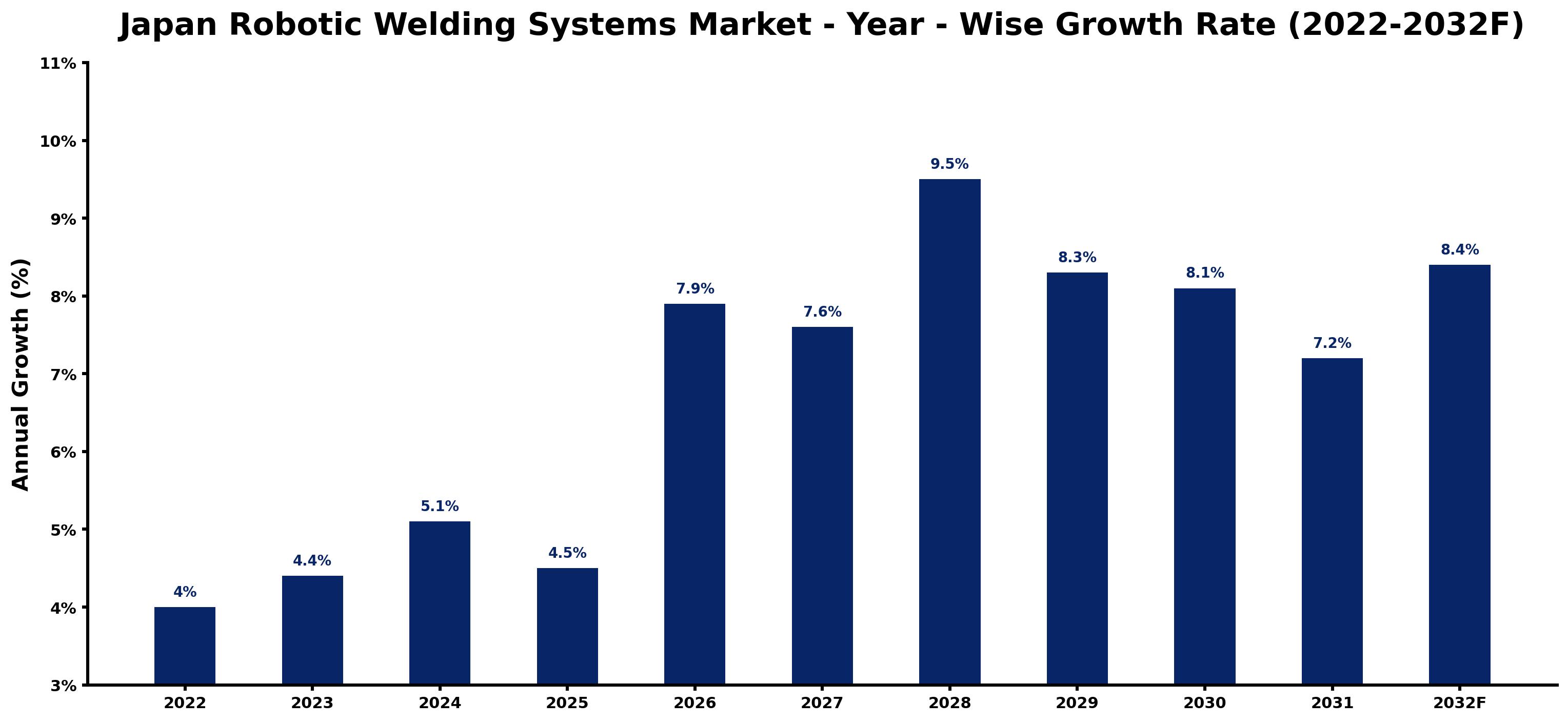
The table below sets out the estimated growth rate for each year and the main factor behind it.
| Year | Estimated Annual Growth (%) | Market Rationale |
| 2022 | 4.0 | The market experienced steady growth due to strong automotive production levels. |
| 2023 | 4.4 | Manufacturers accelerated automation efforts to enhance operational efficiency and productivity. |
| 2024 | 5.1 | Rising demand for precision welding in aerospace contributed to higher growth rates. |
| 2025 | 4.5 | Growth slowed slightly as manufacturers adjusted to changing market conditions. |
| 2026 | 7.9 | Investments in automation technologies are projected to drive a resurgence in growth. |
| 2027 | 7.6 | Growth is expected to moderate as the market stabilises after rapid expansion. |
| 2028 | 9.5 | Heightened demand for robotic welding in automotive applications will drive peak growth. |
| 2029 | 8.3 | The market is expected to slow as it adjusts to peak demand levels. |
| 2030 | 8.1 | Continued investments in advanced welding technologies will support ongoing growth. |
| 2031 | 7.2 | The market will decelerate as it normalises after previous peaks. |
| 2032 | 8.4 | Emerging applications in electronics assembly will accelerate market growth. |
Note: Market size estimations and growth projections presented in this report are based on 6Wresearch's proprietary forecasting methodology, utilizing the latest available industry data, government publications, and primary research inputs.
Japan Robotic Welding Systems Market Synopsis
Robotic welding systems are advanced automated machines designed for welding processes across various industries, including automotive and aerospace. These systems utilise high-precision components and programming software, enabling efficient manufacturing. The Japan Robotic Welding Systems Market is expanding due to rising demand from automotive plants, which produced 8.3 million vehicles in 2022, and the aerospace industry, valued at approximately $20 billion. The ongoing shift towards automation in manufacturing, driven by initiatives like the New Robot Strategy, is propelling further growth in this sector.
Market Dynamics Impact Analysis (2026–2032)
| Factor | Type | Impact | Primary Segment Affected |
| Increasing automation in manufacturing processes | Driver | High | MIG Welding Robots |
| Growing demand for precision welding in aerospace | Driver | High | TIG Welding Robots |
| Expansion of small and medium enterprises adopting robotic systems | Opportunity | High | Electric Arc |
| Rising investments in manufacturing innovation | Opportunity | High | 6-Axis Arms |
| High initial investment costs for robotic systems | Restraint | Medium | Spot Welding Robots |
| Limited availability of skilled operators for advanced systems | Restraint | Medium | Laser Welding Robots |
| Competition from low-cost manual welding solutions | Challenge | High | Precision Multi-Arm |
| Technological advancements requiring constant updates | Challenge | Medium | Dual-Electrode Arms |
Evaluation of Drivers in Japan Robotic Welding Systems Market (2026–2032)
Demand rests on the following drivers, each shown with the segment it touches most.
| Drivers | Primary Segment Affected | Why It Matters (Evidence) |
| Increased production capacity in automotive manufacturing | MIG Welding Robots | Japan's automotive sector produced 8.3 million vehicles in 2022, driving demand for efficient welding solutions. |
| Rising complexity in aerospace components | TIG Welding Robots | The aerospace industry in Japan is valued at approximately $20 billion, necessitating high-quality welding. |
| Government support for automation initiatives | Electric Arc | The government allocated $500 million for manufacturing innovation in 2023, encouraging robotic adoption. |
| Growing electronics sector requiring precision welding | Laser Welding Robots | The electronics sector is expected to grow by 5% annually, increasing the need for advanced welding. |
| Modernisation of existing welding systems | 6-Axis Arms | The average age of welding robots in Japan is 5 years, indicating a shift towards newer technologies. |
What keeps demand rising is the increasing production capacity in automotive manufacturing, with 8.3 million vehicles produced in 2022, leading to higher purchases of robotic welding systems. The aerospace sector, valued at approximately $20 billion, drives demand for high-quality welding due to the complexity of components. A $500 million allocation for manufacturing innovation in 2023 boosts adoption of advanced technologies. The electronics sector's expected growth of 5% annually raises the demand for precision welding solutions. The average age of welding robots in Japan is 5 years, prompting modernisation and increased purchases of newer models.
Evaluation of Restraints in Japan Robotic Welding Systems Market
The following restraints limit how fast demand can grow.
| Market Restraint | Primary Segment Affected | Why It Matters (Evidence) |
| High compliance costs due to new precision welding standards | TIG Welding Robots | The demand for compliance with new aerospace standards increases operational costs for manufacturers. |
| Delays in sourcing high-precision components | MIG Welding Robots | The demand for robotic welding systems exceeds local production capabilities, causing order fulfillment delays. |
| Aging robotic systems requiring costly upgrades | 6-Axis Arms | The average age of welding robots in Japan is 5 years, necessitating significant investment in modernisation. |
| Intense competition in the automotive sector | Spot Welding Robots | With 8.3 million vehicles produced in 2022, manufacturers face pressure to reduce costs while maintaining quality. |
| Limited adoption of advanced technologies in SMEs | Laser Welding Robots | Small and medium enterprises often struggle to invest in the latest welding technologies, hindering growth. |
Japan Robotic Welding Systems Market Challenges
In Aichi Prefecture, automotive manufacturers struggle with intense competition, producing 8.3 million vehicles in 2022, which forces them to reduce costs while maintaining quality. Suppliers encounter challenges in sourcing high-precision components, as local production cannot keep pace with the increasing demand for robotic welding systems, leading to order fulfillment delays that can extend lead times by up to three months. New regulations in aerospace regarding precision welding standards result in heightened compliance costs for manufacturers, straining their operational budgets. Buyers face difficulties with the average age of welding robots at five years, necessitating upgrades that can exceed JPY 1 million per unit.
Trends in the Japan Robotic Welding Systems Market
Buyers and suppliers in the Japan Robotic Welding Systems Market are adjusting to the following trends.
- Shift towards Automation in Manufacturing: Since 2023, there has been a notable shift towards automation in manufacturing processes, particularly in automotive plants. This change is reflected in the $500 million government allocation for manufacturing innovation, leading to increased efficiency and productivity.
- Transition from Traditional to Advanced Welding Technologies: In 2023, the adoption of advanced welding technologies surged, driven by the need for precision in aerospace applications. This shift is reflected in the increasing demand for TIG welding robots, which are essential for high-quality welds.
- Emergence of Robotics Training Programs: In 2023, local governments initiated training programs for robotic welding operators, addressing the skills gap in the workforce. This initiative supports the growing automation sector and ensures a skilled labour pool.
- Growing Demand for Laser Welding Solutions: Starting in 2023, the demand for laser welding solutions has risen sharply, particularly in electronics assembly. This trend is driven by the electronics sector's projected annual growth of 5%, highlighting the need for advanced welding capabilities.
Investment Opportunities in the Japan Robotic Welding Systems Market
Several openings in the Japan Robotic Welding Systems Market merit attention from investors.
- Partnerships with Local SMEs: Now is an ideal time to form partnerships with small and medium enterprises, which are increasingly adopting robotic welding systems. The government allocated $500 million for manufacturing innovation in 2023, creating a supportive environment for collaboration.
- Investment in Robotics Training Programs: With the growing need for skilled operators, investing in training programs for robotic welding is timely. Local governments are supporting these initiatives, ensuring a steady supply of qualified personnel for the industry.
- Expansion into Aerospace Component Manufacturing: The aerospace industry, valued at approximately $20 billion, presents a significant opportunity for suppliers. Investing in technologies tailored for aerospace applications can capture this growing market segment.
- Focus on High-Precision Welding Technologies: As demand for precision welding increases, now is the time to invest in advanced laser welding solutions. The expected 5% annual growth in the electronics sector underscores the need for high-quality welding applications.
Government Initiatives in the Japan Robotic Welding Systems Market
The Act against Unjustifiable Premiums and Misleading Representations, enacted in 1962, prohibits misleading labelling and advertising of goods, ensuring that producers of robotic welding systems maintain transparency in their marketing practices. This law has been instrumental in establishing consumer trust and compliance in the market.
The New Robot Strategy, overseen by the Ministry of Economy, Trade and Industry, aims to expand robot use in manufacturing, services, and agriculture. By funding automation initiatives, the ministry supports manufacturers in adopting robotic welding systems, boosting productivity and competitiveness.
Future Insight of the Japan Robotic Welding Systems Market
By 2032, automotive manufacturers will increasingly adopt advanced robotic welding systems, driven by a government programme to enhance manufacturing automation. The electronics sector is expected to expand by 5% annually, which will elevate the demand for efficient welding technologies. Local government initiatives will create training programmes to ensure a skilled workforce capable of operating new systems. Suppliers will need to align their products with JIS B 8430 standards, meeting the growing requirements for precision and efficiency in production.
Market Segmentation Analysis
Japan Robotic Welding Systems Market report covers a detailed analysis of the following market segments:
By Welding Type – MIG Welding Robots Lead, TIG Welding Robots Expected to Grow Fastest
According to Saurav Kr Singh, Senior Research Analyst at 6Wresearch, MIG Welding Robots took 37% of welding type revenue in 2025, more than any other category. MIG welding robots dominate the market due to their widespread use in various metal joining tasks, particularly in the automotive sector. The production of 8.3 million vehicles in 2022 highlights the reliance on these systems for efficient manufacturing processes. Over 2026–2032, TIG Welding Robots are expected to post the fastest growth, at a CAGR of 11.7%. TIG welding robots are experiencing rapid growth as they are increasingly utilised for high-quality welds in sensitive applications, particularly within the aerospace industry. The rising need for precision welding due to new regulations is a significant driver of this trend. Suppliers should prioritise the development of TIG welding systems to take advantage of the growing demand in precision welding applications.
By Robot Type – 6-Axis Arms Lead, Precision Multi-Arm Expected to Grow Fastest
In 2025, 6-Axis Arms led the robot type split with a 42% share. 6-axis arms are the leading robot type because of their versatility and effectiveness in a variety of welding applications. Their widespread adoption in automotive plants, where efficiency is paramount, reinforces their dominant position in the market. Precision Multi-Arm is projected to grow fastest, at a CAGR of 12.0% during 2026–2032. Precision multi-arm robots are witnessing swift growth as they are particularly suited for intricate welding tasks that require high accuracy. This demand is especially pronounced in sectors like aerospace, where precision is critical, ensuring their continued market expansion. Buyers in sectors requiring high precision should invest in multi-arm robots to enhance their welding capabilities and meet industry standards.
By Power Source – Electric Arc Leads, High Frequency Expected to Grow Fastest
Electric Arc accounted for 49% of the market by power source in 2025. Electric arc is the predominant power source for robotic welders, serving as the standard for many welding applications across various industries. Its reliability and efficiency make it the preferred choice for automotive plants and manufacturing facilities. The quickest growth will come from High Frequency, forecast to expand at a CAGR of 11.3% between 2026 and 2032. High frequency power sources are experiencing rapid growth due to their application in specialised welding tasks that require specific conditions. This niche demand is increasing as industries seek advanced solutions for complex welding requirements. Suppliers must explore opportunities in high frequency power sources to meet the needs of specialised applications.
By End User – Automotive Plants Lead, Aerospace Components Expected to Grow Fastest
The largest end user category in 2025 was Automotive Plants, at 38% of revenue. Automotive plants represent the largest end user of robotic welding systems, primarily driven by their extensive production needs and the use of advanced manufacturing techniques. With about 5 million people employed in this sector, the demand for automation remains strong. Aerospace Components are set to record the highest CAGR in this split, 10.3% over 2026–2032. The aerospace components sector is the fastest-growing end user, propelled by increasing complexity and regulatory requirements in aerospace manufacturing. This growth reflects a broader trend towards automation in high-stakes industries, indicating future demand. Suppliers should align their strategies to cater to the growing needs of the aerospace sector for advanced robotic welding solutions.
Key Attractiveness of the Report
- 10 Years of Market Numbers
- Historical Data Starting from 2022 to 2025
- Base Year 2025
- Forecast Data until 2032
- Key Performance Indicators Impacting the Market
- Major Upcoming Developments and Projects
Key Highlights of the Report:
- Japan Robotic Welding Systems Market Outlook
- Market Size of Japan Robotic Welding Systems Market, 2025
- Forecast of Japan Robotic Welding Systems Market, 2032
- Historical Data and Forecast of Japan Robotic Welding Systems Revenues & Volume for the Period 2022-2032F
- Japan Robotic Welding Systems Market Trend Evolution
- Japan Robotic Welding Systems Market Drivers and Challenges
- Japan Robotic Welding Systems Price Trends
- Japan Robotic Welding Systems Porter's Five Forces
- Japan Robotic Welding Systems Industry Life Cycle
- Historical Data and Forecast of Japan Robotic Welding Systems Market Revenues & Volume By Welding Type for the Period 2022-2032F
- Historical Data and Forecast of Japan Robotic Welding Systems Market Revenues & Volume By MIG Welding Robots for the Period 2022-2032F
- Historical Data and Forecast of Japan Robotic Welding Systems Market Revenues & Volume By TIG Welding Robots for the Period 2022-2032F
- Historical Data and Forecast of Japan Robotic Welding Systems Market Revenues & Volume By Spot Welding Robots for the Period 2022-2032F
- Historical Data and Forecast of Japan Robotic Welding Systems Market Revenues & Volume By Laser Welding Robots for the Period 2022-2032F
- Historical Data and Forecast of Japan Robotic Welding Systems Market Revenues & Volume By Robot Type for the Period 2022-2032F
- Historical Data and Forecast of Japan Robotic Welding Systems Market Revenues & Volume By 6-Axis Arms for the Period 2022-2032F
- Historical Data and Forecast of Japan Robotic Welding Systems Market Revenues & Volume By Precision Multi-Arm for the Period 2022-2032F
- Historical Data and Forecast of Japan Robotic Welding Systems Market Revenues & Volume By Dual-Electrode Arms for the Period 2022-2032F
- Historical Data and Forecast of Japan Robotic Welding Systems Market Revenues & Volume By Fiber-Laser Enabled for the Period 2022-2032F
- Historical Data and Forecast of Japan Robotic Welding Systems Market Revenues & Volume By Power Source for the Period 2022-2032F
- Historical Data and Forecast of Japan Robotic Welding Systems Market Revenues & Volume By Electric Arc for the Period 2022-2032F
- Historical Data and Forecast of Japan Robotic Welding Systems Market Revenues & Volume By High Frequency for the Period 2022-2032F
- Historical Data and Forecast of Japan Robotic Welding Systems Market Revenues & Volume By Resistance-Based for the Period 2022-2032F
- Historical Data and Forecast of Japan Robotic Welding Systems Market Revenues & Volume By Optical Control for the Period 2022-2032F
- Historical Data and Forecast of Japan Robotic Welding Systems Market Revenues & Volume By End User for the Period 2022-2032F
- Historical Data and Forecast of Japan Robotic Welding Systems Market Revenues & Volume By Automotive Plants for the Period 2022-2032F
- Historical Data and Forecast of Japan Robotic Welding Systems Market Revenues & Volume By Aerospace Components for the Period 2022-2032F
- Historical Data and Forecast of Japan Robotic Welding Systems Market Revenues & Volume By Sheet Metal Factories for the Period 2022-2032F
- Historical Data and Forecast of Japan Robotic Welding Systems Market Revenues & Volume By Electronics Assembly for the Period 2022-2032F
- Japan Robotic Welding Systems Import Export Trade Statistics
- Market Opportunity Assessment By Welding Type
- Market Opportunity Assessment By Robot Type
- Market Opportunity Assessment By Power Source
- Market Opportunity Assessment By End User
- Japan Robotic Welding Systems Top Companies Market Share
- Japan Robotic Welding Systems Competitive Benchmarking By Technical and Operational Parameters
- Japan Robotic Welding Systems Company Profiles
- Japan Robotic Welding Systems Key Strategic Recommendations
Market Covered
The report covers the following segments.
By Welding Type
- MIG Welding Robots
- TIG Welding Robots
- Spot Welding Robots
- Laser Welding Robots
By Robot Type
- 6-Axis Arms
- Precision Multi-Arm
- Dual-Electrode Arms
- Fiber-Laser Enabled
By Power Source
- Electric Arc
- High Frequency
- Resistance-Based
- Optical Control
By End User
- Automotive Plants
- Aerospace Components
- Sheet Metal Factories
- Electronics Assembly































