Japan Robotics AI Software Market Size & Growth Rate
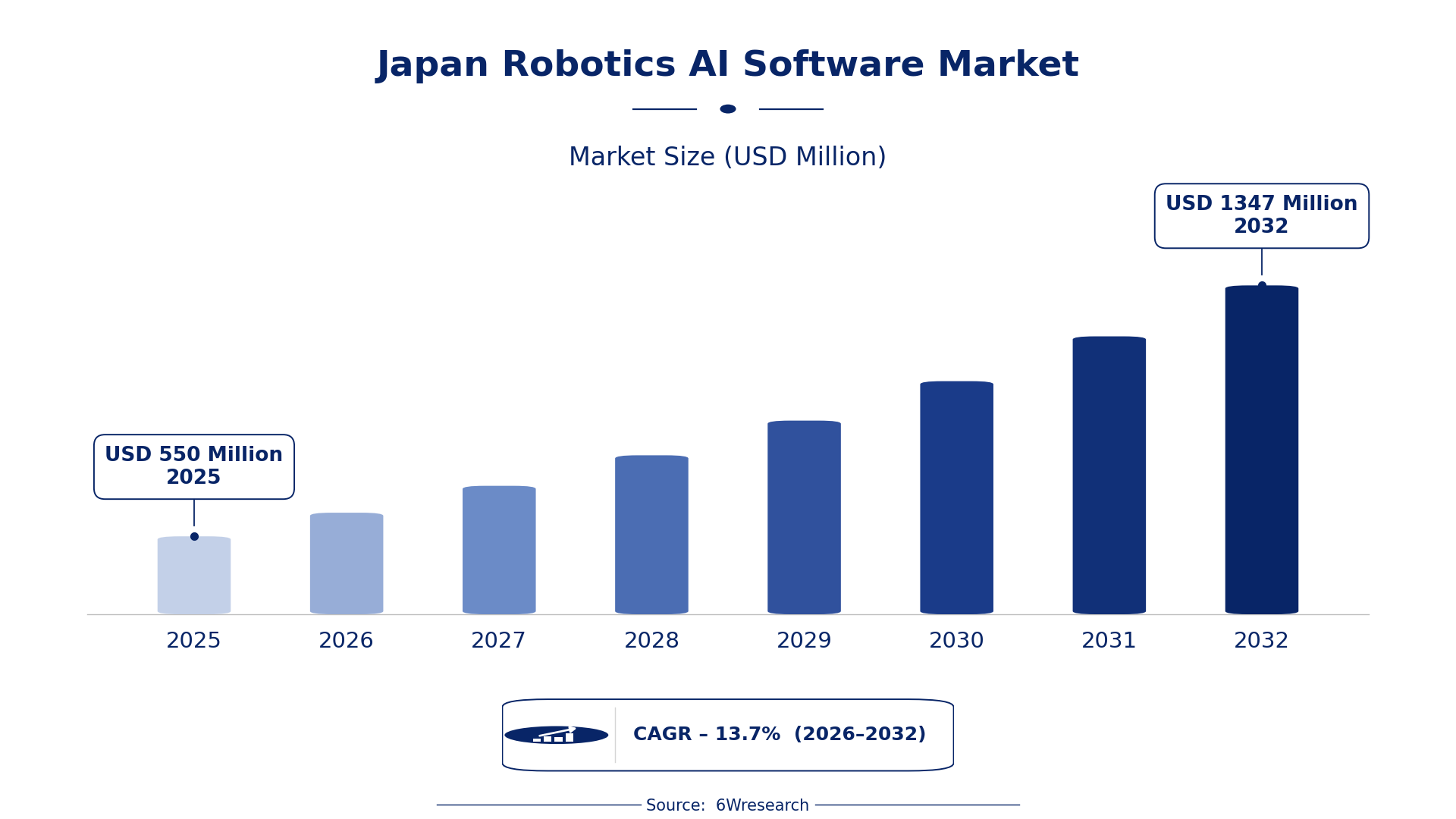
According to 6Wresearch internal database and industry insights, the Japan Robotics AI Software Market was valued at USD 550 Million in 2025 and is projected to reach USD 1,347 Million by 2032, growing at a CAGR of approximately 13.7% during 2026–2032.
Japan Robotics AI Software Market Highlights
| Report Metric | Details |
| Report Name | Japan Robotics AI Software Market (2026-2032) |
| Market Size 2025 | USD 550 Million |
| Market Size 2032 | USD 1,347 Million |
| Absolute Growth 2025–2032 | USD 797 Million |
| CAGR 2026–2032 | 13.7% |
| Peak Annual Growth | 14.3% in 2029 |
| Forecast Period | 2026–2032 |
| Historical Data | 2022–2025 |
| Base Year | 2025 |
| Leading AI Function, 2025 | Motion Planning (41% share) |
| Leading Application Area, 2025 | Manufacturing Robots (47% share) |
| Leading Learning Model, 2025 | Deep Learning/NLP Models (40% share) |
| Leading End User, 2025 | Robotics Engineers (44% share) |
| Fastest-Growing AI Function | Visual Perception (18.0% CAGR) |
| Fastest-Growing Application Area | Service Robots (18.4% CAGR) |
| Fastest-Growing End User | AI Robotics Developers (19.2% CAGR) |
| Growing Sector | Healthcare and Logistics |
| Key End Users | Manufacturers, Healthcare Providers, Logistics Companies, Robotics Engineers |
Japan Robotics AI Software Market Year-wise Growth Rate and Key Drivers (2022–2032)
This graph illustrates the annual growth rates of the market from 2022 to 2032, highlighting a steady upward trajectory and projected market expansion over the forecast period.
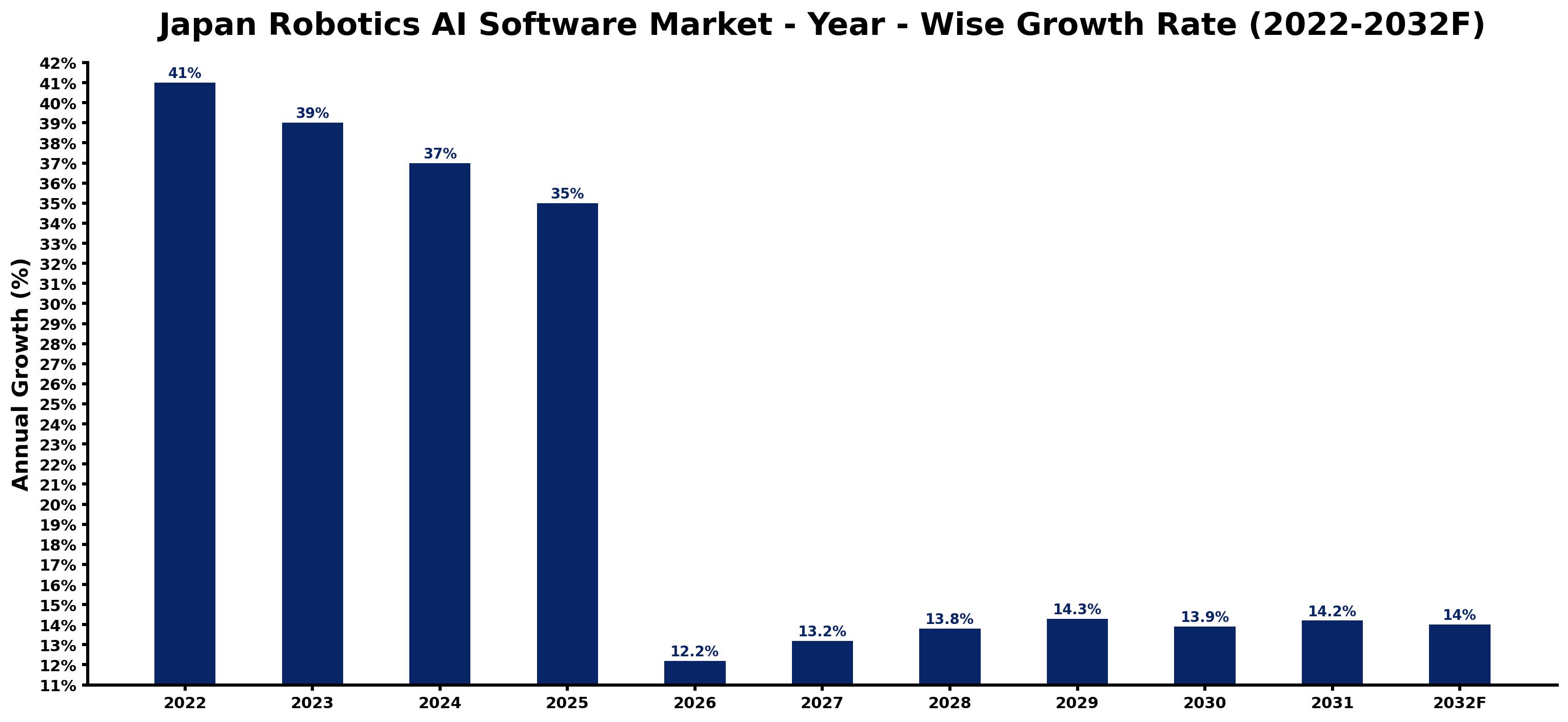
The yearly estimates that follow link every growth rate to its principal driver, so readers can see why the pace changed in each period.
| Year | Estimated Annual Growth (%) | Market Rationale |
| 2022 | 41.0 | The market experienced high demand as companies invested in automation technologies. |
| 2023 | 39.0 | Growth slowed due to market saturation in certain sectors and increased competition. |
| 2024 | 37.0 | Continued investment in robotics was apparent, but growth rates began to normalise. |
| 2025 | 35.0 | The market maintained steady growth as manufacturing sectors increasingly adopted robotics. |
| 2026 | 12.2 | Growth is expected to decelerate as the market stabilises after rapid expansion in previous years. |
| 2027 | 13.2 | Demand will rise again as new applications in logistics and healthcare emerge. |
| 2028 | 13.8 | Increased adoption of service robots in various sectors will contribute to growth. |
| 2029 | 14.3 | The market is projected to peak with advancements in AI integration and robotics. |
| 2030 | 13.9 | Growth is anticipated to slow slightly as the market adjusts to new technological standards. |
| 2031 | 14.2 | Demand will increase again as industries seek to enhance operational efficiency. |
| 2032 | 14.0 | The market remains strong, driven by ongoing investments in automation. |
Note: Market size estimations and growth projections presented in this report are based on 6Wresearch's proprietary forecasting methodology, utilizing the latest available industry data, government publications, and primary research inputs.
Japan Robotics AI Software Market Synopsis
Robotics AI Software integrates artificial intelligence with robotics to improve automation and decision-making capabilities. This technology optimises robotic functions and boosts efficiency in manufacturing while enabling advanced human-robot interactions. The Japan Robotics AI Software Market is expanding due to substantial investments in automation across various sectors, with over 1,000 active robotics companies as of 2023 and a national strategy launched in 2023 to enhance industrial competitiveness.
Market Dynamics Impact Analysis (2026–2032)
| Factor | Type | Impact | Primary Segment Affected |
| Increased investments in automation technologies drive demand for Robotics AI Software. | Driver | High | Manufacturing Robots |
| Growing adoption of service robots in healthcare creates new market opportunities. | Driver | High | Service Robots |
| Expansion of AI applications in logistics presents opportunities for Robotics AI Software. | Opportunity | High | Mobile Robots |
| Rising demand for predictive maintenance solutions in manufacturing boosts software needs. | Opportunity | Medium | Predictive Maintenance |
| High competition among robotics firms may limit market share for new entrants. | Restraint | High | Robotics Engineers |
| Rapid technological advancements require constant updates to software solutions. | Restraint | Medium | AI Robotics Developers |
| Cost pressures from rising wages in Japan affect profitability for robotics firms. | Challenge | High | System Integrators |
| Compliance with stringent safety standards can delay product launches. | Challenge | Medium | Manufacturing Robots |
Evaluation of Drivers in Japan Robotics AI Software Market (2026–2032)
Key forces behind demand, with the segment each one moves most, are listed below.
| Drivers | Primary Segment Affected | Why It Matters (Evidence) |
| Increased automation in manufacturing | Manufacturing Robots | Japan's manufacturing sector invested ¥500 billion in automation technologies in 2023, leading to higher demand for Robotics AI Software. |
| Growing logistics sector | Mobile Robots | The logistics sector in the Tokyo metropolitan area is increasingly adopting mobile robots to enhance operational efficiency, driving demand for Robotics AI Software. |
| Healthcare sector expansion | Service Robots | Over 50 hospitals are implementing AI solutions by 2024, driving demand for service robots. |
| Investment in AI research | Predictive Maintenance | The Japanese government allocated ¥10 billion for AI and robotics R&D in 2023, boosting predictive maintenance capabilities. |
| Rise in robotics companies | Robotics Engineers | Japan has over 1,000 active robotics companies as of 2023, increasing the demand for skilled Robotics Engineers. |
Several shifts outside the market lift sales. The manufacturing sector's investment of ¥500 billion in automation technologies in 2023 increased demand for Robotics AI Software, particularly for Manufacturing Robots. In the Tokyo metropolitan area, logistics firms are adopting mobile robots to improve operational efficiency, contributing to market growth. Over 50 hospitals are expected to implement AI solutions by 2024, boosting demand for Service Robots. With over 1,000 active robotics companies, the need for skilled Robotics Engineers continues to rise, reinforcing the market's expansion.
Evaluation of Restraints in Japan Robotics AI Software Market
Below are the constraints most often cited by buyers and suppliers, with the segment each affects.
| Market Restraint | Primary Segment Affected | Why It Matters (Evidence) |
| High competition among robotics firms limits market entry. | Robotics Engineers | With over 1,000 active robotics companies, new entrants face challenges in gaining market share. |
| Technological advancements require constant software updates. | AI Robotics Developers | Keeping up with rapid changes in technology necessitates ongoing investment in software development. |
| Rising wages impact profitability for robotics firms. | System Integrators | Japan's national minimum wage rose to JPY 1,055 per hour in October 2024, increasing operational costs. |
| Compliance with safety standards can delay product launches. | Manufacturing Robots | Adhering to standards like JIS B 8401 requires extensive testing and certification. |
| Market saturation in certain sectors slows growth rates. | Service Robots | As more companies adopt service robots, the market experiences slower growth due to saturation. |
Japan Robotics AI Software Market Challenges
Producers incur rising input costs due to Japan's national minimum wage increase to JPY 1,055 per hour, which raises operational expenses for manufacturers. Limited supply of advanced robotics components delays buyers, as over 1,000 active robotics companies compete for the same resources, extending lead times for projects. A shortage of skilled personnel restricts growth, leaving many firms unable to develop and implement essential robotics solutions. Compliance with JIS B 8401 standards incurs additional costs for manufacturers, resulting in an estimated 10% rise in production expenses for those struggling to meet these regulations.
Trends in the Japan Robotics AI Software Market
The following changes are redrawing the Japan Robotics AI Software Market.
- Shift towards AI in Healthcare: The healthcare sector is increasingly adopting AI service robots, with over 50 hospitals implementing solutions by 2024. This trend indicates a growing reliance on technology for patient care.
- Transition from Traditional to Mobile Robotics in Logistics: Logistics firms are moving from traditional systems to mobile robots for efficiency. The Tokyo metropolitan area is leading this change, with a notable rise in mobile robot deployments.
- Service Robots Gaining Ground in Hospitality: The hospitality sector is increasingly utilising service robots to improve customer experiences. This shift is clear, with a projected increase in service robot adoption across hotels and restaurants.
- Growing Emphasis on Predictive Maintenance Solutions: Manufacturers are prioritising predictive maintenance to reduce downtime and improve efficiency. This trend is supported by a ¥10 billion government investment in AI and robotics R&D.
Investment Opportunities in the Japan Robotics AI Software Market
The following opportunities in the Japan Robotics AI Software Market pair current demand with a clear way in.
- Healthcare Providers Seeking Advanced Robotics Solutions: Healthcare providers are actively pursuing advanced robotics solutions, with over 50 hospitals implementing AI technologies by 2024. This presents a strong opportunity for suppliers to meet this growing need.
- Logistics Companies Adopting Mobile Robots: Logistics companies in the Tokyo metropolitan area are increasingly adopting mobile robots to enhance efficiency, with a notable rise in automation needs. Collaborating with local firms can facilitate market entry.
- Manufacturers Investing in Predictive Maintenance: Manufacturers are investing in predictive maintenance solutions to reduce downtime, with substantial funding available for AI technologies. Partnering with system integrators can help suppliers tap into this market.
- Rising Demand for Robotics Engineers: The demand for Robotics Engineers is increasing, with over 1,000 active robotics companies in Japan. Investing in training and development can help meet this growing need.
Government Initiatives in the Japan Robotics AI Software Market
The New Robot Strategy, established in 2015, aimed to expand robot use across manufacturing, services, agriculture, and care sectors. This initiative has led to increased funding and support for robotics development, improving the industry's competitiveness. The government allocated ¥10 billion in 2023 for research and development in AI and robotics, directly benefiting Robotics AI Software producers and buyers by promoting innovation and enhancing capabilities.
The Digital Agency, established in September 2021, is responsible for leading government digital transformation. It approves projects that improve common system standards and supports initiatives that promote AI and robotics integration, directly impacting Robotics AI Software development and deployment.
Future Insight of the Japan Robotics AI Software Market
The shift in policy led by the Ministry of Economy, Trade and Industry in 2023 will drive suppliers to innovate in automation technologies. By 2032, investments in automation technologies by the manufacturing sector are projected to exceed ¥1 trillion, improving production efficiencies. The integration of advanced AI in healthcare will lead to increased adoption of robotics, with over 50 hospitals implementing AI solutions by 2024. Collaboration promoted by the Tokyo Robotics Association will facilitate knowledge sharing, advancing the sector significantly.
Market Segmentation Analysis
Japan Robotics AI Software Market report covers a detailed analysis of the following market segments:
By AI Function – Motion Planning Leads, Visual Perception Expected to Grow Fastest
According to Saurav Kr Singh, Senior Research Analyst at 6Wresearch, Motion Planning accounted for 41% of the market by ai function in 2025. Motion planning is vital for guiding robots in dynamic environments, especially in manufacturing and logistics applications. Its extensive use in factories to optimise workflows and improve efficiency solidifies its leading position in the market. Visual Perception is set to record the highest CAGR in this split, 18.0% over 2026–2032. Visual perception is rapidly gaining traction as it allows robots to interpret their surroundings, which is essential for various applications. The rising adoption of advanced imaging technologies is propelling growth, as sectors aim to enhance automation capabilities. Suppliers should focus on developing visual perception technologies to meet the increasing demand in robotics.
By Application Area – Manufacturing Robots Lead, Service Robots Expected to Grow Fastest
Manufacturing Robots held 47% of the Japan Robotics AI Software Market by application area in 2025. Manufacturing robots are essential in production lines, significantly boosting efficiency and productivity within Japan's strong industrial sector. Their widespread deployment in factories highlights their critical role in maintaining operational excellence and justifies their leading market share. The quickest growth will come from Service Robots, forecast to expand at a CAGR of 18.4% between 2026 and 2032. Service robots are experiencing swift adoption, particularly in healthcare and hospitality, where they assist with a variety of tasks. The expected implementation of AI solutions in over 50 hospitals by 2024 suggests a robust growth trajectory for this segment. Buyers in the service industry should consider investing in robotics to enhance operational efficiency and service quality.
By Learning Model – Deep Learning/NLP Models Lead and Record the Fastest Growth
In 2025, Deep Learning/NLP Models led the learning model split with a 40% share. Deep learning and NLP models provide essential capabilities for robotics applications, enabling machines to process and understand complex data. Their widespread use across various AI applications supports their leading position in the market. Deep Learning/NLP Models are also forecast to expand faster than any other category, at a CAGR of 15.7% over 2026–2032. As deep learning and NLP models continue to advance, their applications in robotics will expand, further solidifying their market position. The ongoing development in this area ensures that these models will remain at the forefront of robotics innovation. Suppliers must prioritise advancements in deep learning and NLP to maintain competitiveness in the robotics market.
By End User – Robotics Engineers Lead, AI Robotics Developers Expected to Grow Fastest
Robotics Engineers took 44% of end user revenue in 2025, more than any other category. Robotics engineers are pivotal in the development and implementation of robotics solutions, establishing them as the primary users in the industry. Their technical expertise and involvement in diverse projects highlight their leading role in advancing robotics technology. Over 2026–2032, AI Robotics Developers are expected to post the fastest growth, at a CAGR of 19.2%. AI robotics developers are becoming significant contributors, concentrating on creating advanced applications that improve robotic functionalities. Their growing engagement reflects the trend towards integrating AI into robotics, which is likely to accelerate their market growth. Companies should collaborate with AI robotics developers to integrate advanced technologies into their robotics initiatives.
Key Attractiveness of the Report
- 10 Years of Market Numbers
- Historical Data Starting from 2022 to 2025
- Base Year 2025
- Forecast Data until 2032
- Key Performance Indicators Impacting the Market
- Major Upcoming Developments and Projects
Key Highlights of the Report:
- Japan Robotics AI Software Market Outlook
- Market Size of Japan Robotics AI Software Market, 2025
- Forecast of Japan Robotics AI Software Market, 2032
- Historical Data and Forecast of Japan Robotics AI Software Revenues & Volume for the Period 2022-2032F
- Japan Robotics AI Software Market Trend Evolution
- Japan Robotics AI Software Market Drivers and Challenges
- Japan Robotics AI Software Price Trends
- Japan Robotics AI Software Porter's Five Forces
- Japan Robotics AI Software Industry Life Cycle
- Historical Data and Forecast of Japan Robotics AI Software Market Revenues & Volume By AI Function for the Period 2022-2032F
- Historical Data and Forecast of Japan Robotics AI Software Market Revenues & Volume By Motion Planning for the Period 2022-2032F
- Historical Data and Forecast of Japan Robotics AI Software Market Revenues & Volume By Predictive Maintenance for the Period 2022-2032F
- Historical Data and Forecast of Japan Robotics AI Software Market Revenues & Volume By Visual Perception for the Period 2022-2032F
- Historical Data and Forecast of Japan Robotics AI Software Market Revenues & Volume By Voice/NLP Interface for the Period 2022-2032F
- Historical Data and Forecast of Japan Robotics AI Software Market Revenues & Volume By Application Area for the Period 2022-2032F
- Historical Data and Forecast of Japan Robotics AI Software Market Revenues & Volume By Industrial Arms for the Period 2022-2032F
- Historical Data and Forecast of Japan Robotics AI Software Market Revenues & Volume By Manufacturing Robots for the Period 2022-2032F
- Historical Data and Forecast of Japan Robotics AI Software Market Revenues & Volume By Mobile Robots for the Period 2022-2032F
- Historical Data and Forecast of Japan Robotics AI Software Market Revenues & Volume By Service Robots for the Period 2022-2032F
- Historical Data and Forecast of Japan Robotics AI Software Market Revenues & Volume By Learning Model for the Period 2022-2032F
- Historical Data and Forecast of Japan Robotics AI Software Market Revenues & Volume By Reinforcement Learning for the Period 2022-2032F
- Historical Data and Forecast of Japan Robotics AI Software Market Revenues & Volume By Supervised Learning for the Period 2022-2032F
- Historical Data and Forecast of Japan Robotics AI Software Market Revenues & Volume By CNNs/Transformers for the Period 2022-2032F
- Historical Data and Forecast of Japan Robotics AI Software Market Revenues & Volume By Deep Learning/NLP Models for the Period 2022-2032F
- Historical Data and Forecast of Japan Robotics AI Software Market Revenues & Volume By End User for the Period 2022-2032F
- Historical Data and Forecast of Japan Robotics AI Software Market Revenues & Volume By Robotics Engineers for the Period 2022-2032F
- Historical Data and Forecast of Japan Robotics AI Software Market Revenues & Volume By System Integrators for the Period 2022-2032F
- Historical Data and Forecast of Japan Robotics AI Software Market Revenues & Volume By AI Robotics Developers for the Period 2022-2032F
- Historical Data and Forecast of Japan Robotics AI Software Market Revenues & Volume By Public Interaction AI for the Period 2022-2032F
- Japan Robotics AI Software Import Export Trade Statistics
- Market Opportunity Assessment By AI Function
- Market Opportunity Assessment By Application Area
- Market Opportunity Assessment By Learning Model
- Market Opportunity Assessment By End User
- Japan Robotics AI Software Top Companies Market Share
- Japan Robotics AI Software Competitive Benchmarking By Technical and Operational Parameters
- Japan Robotics AI Software Company Profiles
- Japan Robotics AI Software Key Strategic Recommendations
Market Covered
Coverage by segment is as follows.
By AI Function
- Motion Planning
- Predictive Maintenance
- Visual Perception
- Voice/NLP Interface
By Application Area
- Industrial Arms
- Manufacturing Robots
- Mobile Robots
- Service Robots
By Learning Model
- Reinforcement Learning
- Supervised Learning
- CNNs/Transformers
- Deep Learning/NLP Models
By End User
- Robotics Engineers
- System Integrators
- AI Robotics Developers
- Public Interaction AI































