Japan Robotics and Control Systems Market Size & Growth Rate
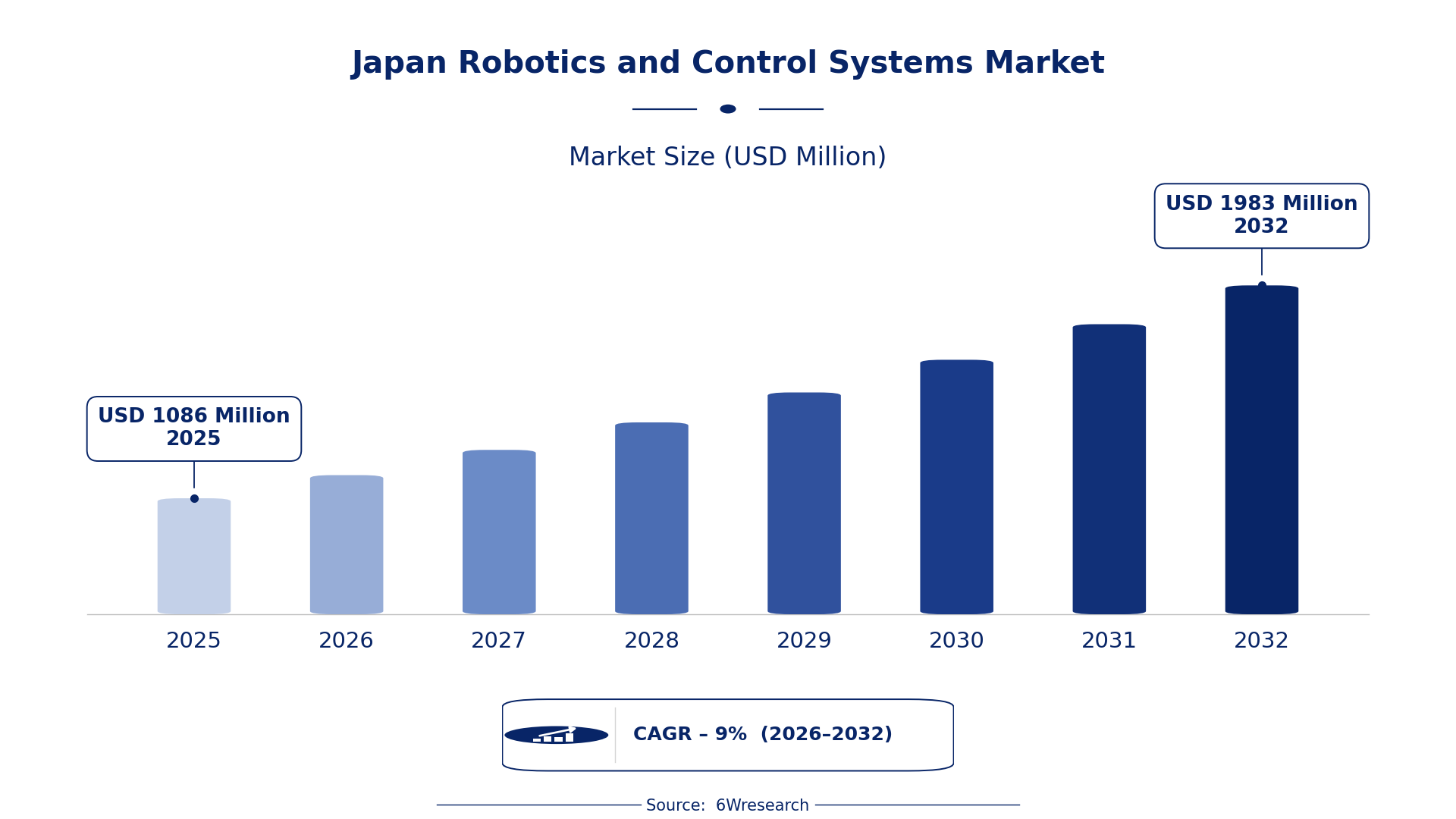
According to 6Wresearch internal database and industry insights, the Japan Robotics and Control Systems Market was valued at USD 1,086 Million in 2025 and is projected to reach USD 1,983 Million by 2032, growing at a CAGR of approximately 9% during 2026–2032.
Japan Robotics and Control Systems Market Highlights
| Report Metric | Details |
| Report Name | Japan Robotics and Control Systems Market (2026-2032) |
| Market Size 2025 | USD 1,086 Million |
| Market Size 2032 | USD 1,983 Million |
| Absolute Growth 2025–2032 | USD 897 Million |
| CAGR 2026–2032 | 9% |
| Peak Annual Growth | 9.5% in 2026 |
| Forecast Period | 2026–2032 |
| Historical Data | 2022–2025 |
| Base Year | 2025 |
| Leading Control Type, 2025 | Real-Time Control (41% share) |
| Leading Robot Integration, 2025 | Assembly Line Robots (47% share) |
| Leading Feedback System, 2025 | Encoder-Based (45% share) |
| Leading End User, 2025 | Electronics Factories (39% share) |
| Fastest-Growing Control Type | Wireless Control (12.8% CAGR) |
| Fastest-Growing Robot Integration | AGVs & Drones (12.1% CAGR) |
| Fastest-Growing Feedback System | Edge Communication (13.0% CAGR) |
| Fastest-Growing End User | Smart Warehouses (11.6% CAGR) |
| Growing Sector | Manufacturing |
| Key End Users | Electronics Factories, Smart Warehouses, Manufacturing Units, R&D Labs |
Japan Robotics and Control Systems Market Year-wise Growth Rate and Key Drivers (2022–2032)
This graph illustrates the annual growth rates of the market from 2022 to 2032, highlighting a steady upward trajectory and projected market expansion over the forecast period.
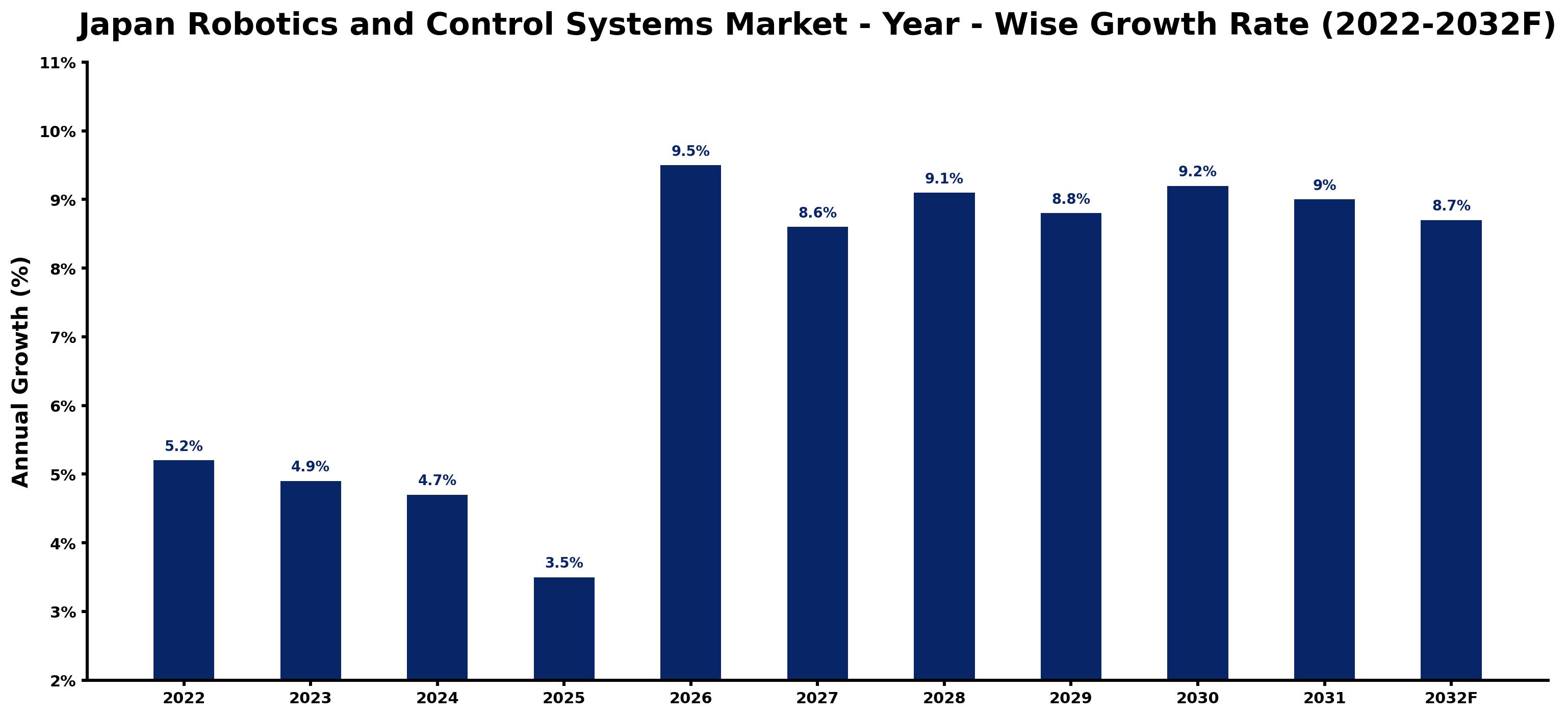
The table below sets out the estimated growth rate for each year and the main factor behind it.
| Year | Estimated Annual Growth (%) | Market Rationale |
| 2022 | 5.2 | The market experienced steady growth due to increased automation in manufacturing. |
| 2023 | 4.9 | Demand slowed slightly as companies adjusted to operational costs and market conditions. |
| 2024 | 4.7 | Continued investment in robotics faced challenges from rising operational costs. |
| 2025 | 3.5 | Growth decelerated as firms began consolidating technology investments. |
| 2026 | 9.5 | Demand surged as companies ramped up automation efforts to improve efficiency. |
| 2027 | 8.6 | Growth moderated as the market stabilised after the previous year's spike. |
| 2028 | 9.1 | Demand increased with the adoption of advanced robotics in logistics. |
| 2029 | 8.8 | Growth slowed slightly as market saturation began in certain sectors. |
| 2030 | 9.2 | Demand rose again as new technologies in robotics gained traction. |
| 2031 | 9.0 | Growth slowed as the market reached a more mature phase. |
| 2032 | 8.7 | The market continues to grow, driven by ongoing technological advancements. |
Note: Market size estimations and growth projections presented in this report are based on 6Wresearch's proprietary forecasting methodology, utilizing the latest available industry data, government publications, and primary research inputs.
Japan Robotics and Control Systems Market Synopsis
Robotics and Control Systems in Japan involve advanced technologies for automating machinery and processes, integrating software, hardware, and sensors. As of 2023, the Japan Robotics and Control Systems Market is valued at approximately 1.5 trillion yen, driven by strong demand from over 500 electronics factories and ongoing investments in technology development. The 'Robot Strategy' program and the integration of robotics in manufacturing and logistics are propelling market growth, with smart warehouse adoption expected to rise by 30% by 2025.
Market Dynamics Impact Analysis (2026–2032)
| Factor | Type | Impact | Primary Segment Affected |
| Increased automation in manufacturing processes | Driver | High | Assembly Line Robots |
| Growing demand for logistics optimization | Driver | High | AGVs & Drones |
| Expansion of smart warehouses | Opportunity | High | Smart Warehouses |
| Investment in AI-driven robotics | Opportunity | High | Decentralized AI Control |
| Rising operational costs for manufacturers | Restraint | High | Manufacturing Units |
| Challenges in integrating new technologies | Restraint | Medium | Electronics Factories |
| Shortage of skilled labour in robotics | Challenge | High | Real-Time Control |
| High initial investment costs for automation | Challenge | Medium | Real-Time Control |
Evaluation of Drivers in Japan Robotics and Control Systems Market (2026–2032)
The following drivers explain most of the expected growth.
| Drivers | Primary Segment Affected | Why It Matters (Evidence) |
| Increased investment in automation technologies | Assembly Line Robots | Manufacturing units are investing heavily, with 70% of them integrating robotics to improve productivity. |
| Demand for logistics efficiency | AGVs & Drones | Smart warehouses are projected to increase by 30% in adoption by 2025, driving purchases of logistics robots. |
| Rising minimum wage levels | Manufacturing Units | Japan's national minimum wage rose to JPY 1,055 per hour in October 2024, prompting firms to automate. |
| Support from government initiatives | Decentralized AI Control | The AI Promotion Act encourages investment in AI technologies, increasing demand for advanced robotics. |
| Growing focus on precision and reliability | Encoder-Based | The integration of encoder-based feedback systems is critical for operational accuracy in factories, leading to increased purchases of robotics systems. |
Volumes grow on the back of increased investment in automation technologies, with 70% of manufacturing units integrating robotics to improve productivity. Demand for logistics efficiency is rising, as smart warehouses are projected to increase by 30% in adoption by 2025. The national minimum wage increase is prompting firms to invest in automation. The integration of encoder-based feedback systems is critical for operational accuracy in factories, leading to increased purchases of robotics systems.
Evaluation of Restraints in Japan Robotics and Control Systems Market
The following restraints limit how fast demand can grow.
| Market Restraint | Primary Segment Affected | Why It Matters (Evidence) |
| Rising operational costs for manufacturers | Manufacturing Units | As operational costs rise, manufacturers hesitate to invest in new robotics technologies, impacting growth. |
| Challenges in integrating new technologies | Electronics Factories | Many electronics factories face difficulties in adopting advanced robotics, which slows down market growth. |
| Shortage of skilled labour in robotics | Real-Time Control | The lack of skilled workers in robotics limits companies' ability to fully utilise automation potential. |
| High initial investment costs for automation | Real-Time Control | Many firms are deterred by the high upfront costs associated with implementing robotics solutions. |
| Regulatory compliance costs | Real-Time Control | Compliance with safety standards increases operational costs, affecting the affordability of robotics systems. |
Japan Robotics and Control Systems Market Challenges
Japan's robotics market faces a technology gap, with 30% of manufacturing units lacking advanced automation, which limits efficiency for producers. Supply chain disruptions arise from reliance on specific electronics factories, potentially delaying production timelines for manufacturers by six months. A skills shortage exists, as only 10% of universities offer specialised robotics programs, resulting in a limited talent pool for companies. Regulatory constraints also challenge integration, as compliance with ISO 8373 can raise operational costs by 15% for hospitals adopting service robots.
Trends in the Japan Robotics and Control Systems Market
The shifts below are changing how Japan Robotics and Control Systems Market products are bought and supplied.
- Shift towards AI-driven Robotics: Japan is increasingly adopting AI technologies in robotics, enhancing automation capabilities in manufacturing. The AI Promotion Act supports this shift, with a budget of 10 billion yen allocated for AI integration.
- Transition from Traditional to Smart Warehousing: The adoption of smart warehousing solutions is accelerating, with a projected 30% increase by 2025. Tokyo is a key region for this trend, as companies seek to optimise logistics and inventory management.
- Emergence of Decentralized Control Systems: Decentralized AI control systems are gaining traction in Japan, enabling more autonomous decision-making in robotics. This shift is apparent in various manufacturing units, improving operational efficiency.
- Increase in Robotics Integration in R&D: Research and development labs are increasingly incorporating robotics for experimental purposes. This trend is supported by the growing number of R&D facilities across Japan, driving innovation.
Investment Opportunities in the Japan Robotics and Control Systems Market
Several openings in the Japan Robotics and Control Systems Market merit attention from investors.
- Tokyo's Robotics Integration: Tokyo is experiencing a surge in robotics integration, with substantial investments in smart warehouses. Companies can enter this market by partnering with local firms to improve logistics capabilities.
- Investment in AI-Driven Robotics: The AI Promotion Act creates opportunities for investment in AI-driven robotics solutions. Firms can establish joint ventures with technology providers to tap into this growing market.
- Expansion of Smart Warehousing: With smart warehouses projected to grow by 30% by 2025, there is a strong demand for robotics solutions. Companies should focus on supplying automation technologies to logistics providers.
- Growing Demand for Encoder-Based Systems: The rising need for precision in manufacturing creates opportunities for supplying encoder-based feedback systems. Collaborating with electronics factories can facilitate market entry.
Government Initiatives in the Japan Robotics and Control Systems Market
The New Robot Strategy (2015) aims to expand robot use across various sectors including manufacturing and services. This strategy builds on previous regulations by providing a framework for integrating robotics into the economy, promoting innovation and efficiency. The initiative includes funding for research and development, which benefits robotics producers and users alike.
In 2023, Japan allocated 10 billion yen to support AI in robotics, administered by the Ministry of Economy, Trade and Industry. This initiative is designed to promote research and development in AI technologies, benefiting robotics producers and users.
Future Insight of the Japan Robotics and Control Systems Market
Investment in robotics is projected to drive demand for automation solutions across various sectors. By 2032, the installed base of industrial robots is expected to approach 400,000 units, enabling suppliers to improve productivity. The government's 'Robot Strategy' program will further promote innovation, allowing buyers to access advanced technologies. New funding initiatives will support the growth of robotics startups, providing buyers with diverse solutions and increasing competition in the market.
Market Segmentation Analysis
Japan Robotics and Control Systems Market report covers a detailed analysis of the following market segments:
By Control Type – Real-Time Control Leads, Wireless Control Expected to Grow Fastest
According to Saurav Kr Singh, Senior Research Analyst at 6Wresearch, with 41% of control type revenue in 2025, Real-Time Control was the largest category. Real-Time Control holds the largest share due to its necessity for immediate response in automation processes, particularly in manufacturing settings. Its integration into 70% of manufacturing units in Japan underscores its critical role in ensuring operational efficiency. Over 2026–2032, Wireless Control is expected to post the fastest growth, at a CAGR of 12.8%. Wireless Control is experiencing rapid growth as it enables remote operation and monitoring of systems, which is increasingly important in modern automation. The anticipated 30% increase in smart warehouses by 2025 illustrates the rising demand for such technology. Suppliers should prioritise the enhancement of wireless solutions to align with the growing need for remote control capabilities.
By Robot Integration – Assembly Line Robots Lead, AGVs & Drones Expected to Grow Fastest
Assembly Line Robots held 47% of the Japan Robotics and Control Systems Market by robot integration in 2025. Assembly Line Robots dominate the market as they are widely used in manufacturing for their efficiency in production lines. The installed base of around 400,000 industrial robots in Japan underscores their critical role in this sector. AGVs & Drones are set to record the highest CAGR in this split, 12.1% over 2026–2032. AGVs & Drones are the fastest-growing segment, driven by their critical role in material handling and logistics, particularly in smart warehouses. The ongoing government initiative to support AI in robotics further accelerates their adoption. Buyers should consider investing in AGVs and drones to optimise logistics and material handling in their operations.
By Feedback System – Encoder-Based Leads, Edge Communication Expected to Grow Fastest
The largest feedback system category in 2025 was Encoder-Based, at 45% of revenue. Encoder-Based systems dominate the market since they are vital for delivering precise position feedback in robotic applications. Their extensive adoption in industrial environments guarantees both reliability and accuracy in automation processes. The quickest growth will come from Edge Communication, forecast to expand at a CAGR of 13.0% between 2026 and 2032. Edge Communication is expanding quickly due to its capacity to improve real-time data processing capabilities, which are crucial for efficient operations. The ongoing integration of advanced technologies in robotics is propelling this segment's growth. Suppliers must focus on developing edge communication technologies to meet the rising demand for real-time data processing.
By End User – Electronics Factories Lead, Smart Warehouses Expected to Grow Fastest
Electronics Factories accounted for 39% of the market by end user in 2025. Electronics Factories are the largest user group of robotic systems, utilising automation extensively for assembly tasks. The presence of over 500 electronics factories in Japan highlights the substantial demand for robotics in this sector. Smart Warehouses are projected to grow fastest, at a CAGR of 11.6% during 2026–2032. Smart Warehouses are the fastest-growing end user segment, as their adoption for inventory management is increasing significantly. The projected growth in smart warehouses indicates a transition towards more automated logistics solutions. Buyers in the logistics sector should consider automation solutions to improve efficiency in inventory management.
Key Attractiveness of the Report
- 10 Years of Market Numbers
- Historical Data Starting from 2022 to 2025
- Base Year 2025
- Forecast Data until 2032
- Key Performance Indicators Impacting the Market
- Major Upcoming Developments and Projects
Key Highlights of the Report:
- Japan Robotics and Control Systems Market Outlook
- Market Size of Japan Robotics and Control Systems Market, 2025
- Forecast of Japan Robotics and Control Systems Market, 2032
- Historical Data and Forecast of Japan Robotics and Control Systems Revenues & Volume for the Period 2022-2032F
- Japan Robotics and Control Systems Market Trend Evolution
- Japan Robotics and Control Systems Market Drivers and Challenges
- Japan Robotics and Control Systems Price Trends
- Japan Robotics and Control Systems Porter's Five Forces
- Japan Robotics and Control Systems Industry Life Cycle
- Historical Data and Forecast of Japan Robotics and Control Systems Market Revenues & Volume By Control Type for the Period 2022-2032F
- Historical Data and Forecast of Japan Robotics and Control Systems Market Revenues & Volume By Real-Time Control for the Period 2022-2032F
- Historical Data and Forecast of Japan Robotics and Control Systems Market Revenues & Volume By Wireless Control for the Period 2022-2032F
- Historical Data and Forecast of Japan Robotics and Control Systems Market Revenues & Volume By Centralized Control for the Period 2022-2032F
- Historical Data and Forecast of Japan Robotics and Control Systems Market Revenues & Volume By Decentralized AI Control for the Period 2022-2032F
- Historical Data and Forecast of Japan Robotics and Control Systems Market Revenues & Volume By Robot Integration for the Period 2022-2032F
- Historical Data and Forecast of Japan Robotics and Control Systems Market Revenues & Volume By Assembly Line Robots for the Period 2022-2032F
- Historical Data and Forecast of Japan Robotics and Control Systems Market Revenues & Volume By AGVs & Drones for the Period 2022-2032F
- Historical Data and Forecast of Japan Robotics and Control Systems Market Revenues & Volume By Multi-Robot Systems for the Period 2022-2032F
- Historical Data and Forecast of Japan Robotics and Control Systems Market Revenues & Volume By Swarm Robotics for the Period 2022-2032F
- Historical Data and Forecast of Japan Robotics and Control Systems Market Revenues & Volume By Feedback System for the Period 2022-2032F
- Historical Data and Forecast of Japan Robotics and Control Systems Market Revenues & Volume By Encoder-Based for the Period 2022-2032F
- Historical Data and Forecast of Japan Robotics and Control Systems Market Revenues & Volume By Edge Communication for the Period 2022-2032F
- Historical Data and Forecast of Japan Robotics and Control Systems Market Revenues & Volume By SCADA/PLC Interface for the Period 2022-2032F
- Historical Data and Forecast of Japan Robotics and Control Systems Market Revenues & Volume By Sensor Fusion for the Period 2022-2032F
- Historical Data and Forecast of Japan Robotics and Control Systems Market Revenues & Volume By End User for the Period 2022-2032F
- Historical Data and Forecast of Japan Robotics and Control Systems Market Revenues & Volume By Electronics Factories for the Period 2022-2032F
- Historical Data and Forecast of Japan Robotics and Control Systems Market Revenues & Volume By Smart Warehouses for the Period 2022-2032F
- Historical Data and Forecast of Japan Robotics and Control Systems Market Revenues & Volume By Manufacturing Units for the Period 2022-2032F
- Historical Data and Forecast of Japan Robotics and Control Systems Market Revenues & Volume By R&D Labs for the Period 2022-2032F
- Japan Robotics and Control Systems Import Export Trade Statistics
- Market Opportunity Assessment By Control Type
- Market Opportunity Assessment By Robot Integration
- Market Opportunity Assessment By Feedback System
- Market Opportunity Assessment By End User
- Japan Robotics and Control Systems Top Companies Market Share
- Japan Robotics and Control Systems Competitive Benchmarking By Technical and Operational Parameters
- Japan Robotics and Control Systems Company Profiles
- Japan Robotics and Control Systems Key Strategic Recommendations
Market Covered
The following segment groups are covered in the report.
By Control Type
- Real-Time Control
- Wireless Control
- Centralized Control
- Decentralized AI Control
By Robot Integration
- Assembly Line Robots
- AGVs & Drones
- Multi-Robot Systems
- Swarm Robotics
By Feedback System
- Encoder-Based
- Edge Communication
- SCADA/PLC Interface
- Sensor Fusion
By End User
- Electronics Factories
- Smart Warehouses
- Manufacturing Units
- R&D Labs































