Japan Robotics & Automation Market Size & Growth Rate
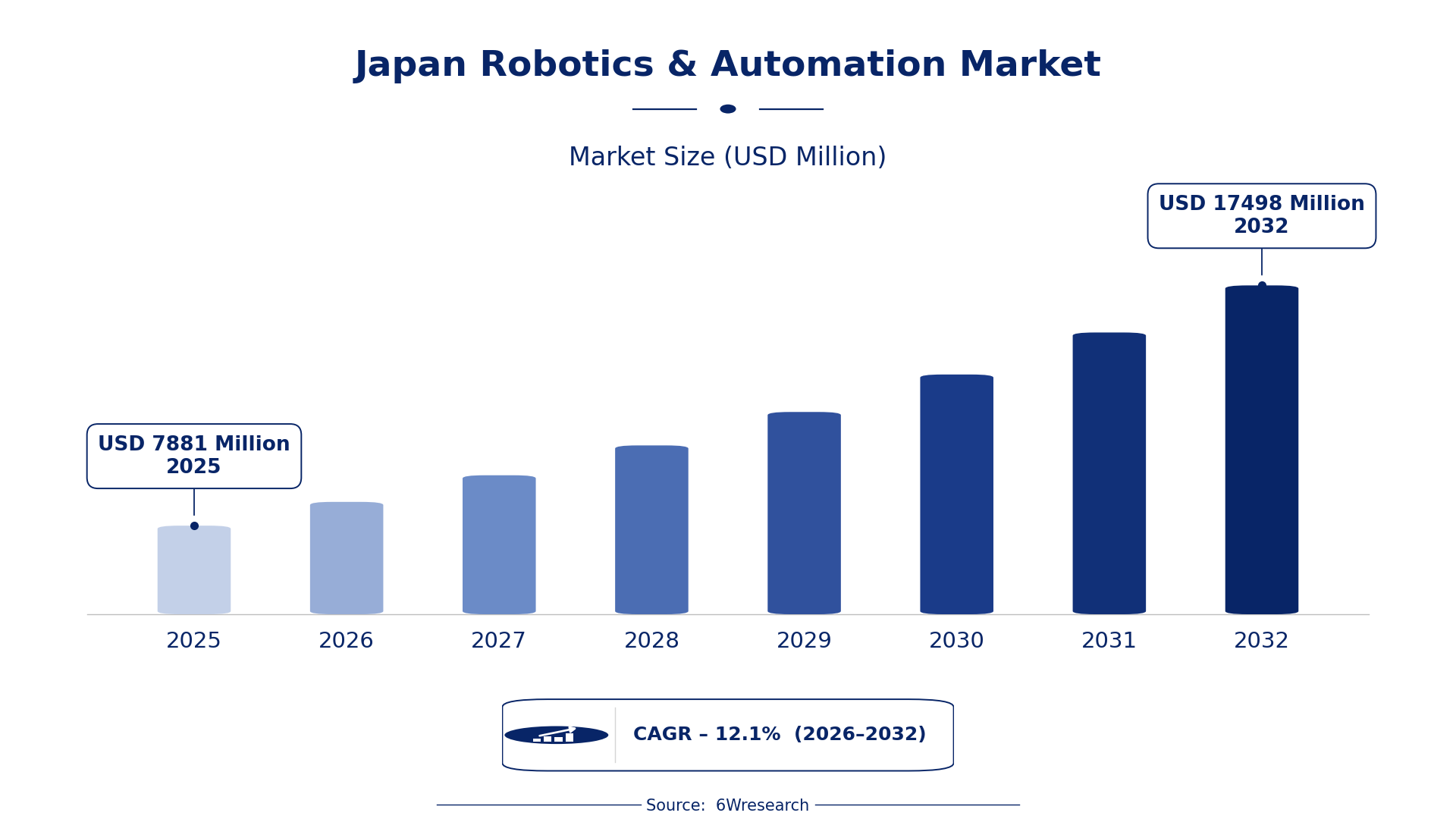
According to 6Wresearch internal database and industry insights, the Japan Robotics & Automation Market was valued at USD 7,881 Million in 2025 and is projected to reach USD 17,498 Million by 2032, growing at a CAGR of approximately 12.1% during 2026–2032.
Japan Robotics & Automation Market Highlights
| Report Metric | Details |
| Report Name | Japan Robotics & Automation Market (2026-2032) |
| Market Size 2025 | USD 7,881 Million |
| Market Size 2032 | USD 17,498 Million |
| Absolute Growth 2025–2032 | USD 9,617 Million |
| CAGR 2026–2032 | 12.1% |
| Peak Annual Growth | 13.2% in 2028 |
| Forecast Period | 2026–2032 |
| Historical Data | 2022–2025 |
| Base Year | 2025 |
| Leading Application Segment, 2025 | Industrial Automation (43% share) |
| Leading Robot Category, 2025 | Manufacturing Robots (38% share) |
| Leading Integration Type, 2025 | PLC-Integrated (47% share) |
| Leading End User, 2025 | Assembly Plants (35% share) |
| Fastest-Growing Application Segment | Service Robotics (17.6% CAGR) |
| Fastest-Growing Robot Category | Domestic/Commercial Robots (17.0% CAGR) |
| Fastest-Growing Integration Type | Autonomous Navigation (17.7% CAGR) |
| Fastest-Growing End User | Consumers/SMEs (15.8% CAGR) |
| Growing Sector | Healthcare and Service Robotics |
| Key End Users | Manufacturers, Logistics Providers, Healthcare Facilities, Small and Medium Enterprises |
Japan Robotics & Automation Market Year-wise Growth Rate and Key Drivers (2022–2032)
This graph illustrates the annual growth rates of the market from 2022 to 2032, highlighting a steady upward trajectory and projected market expansion over the forecast period.
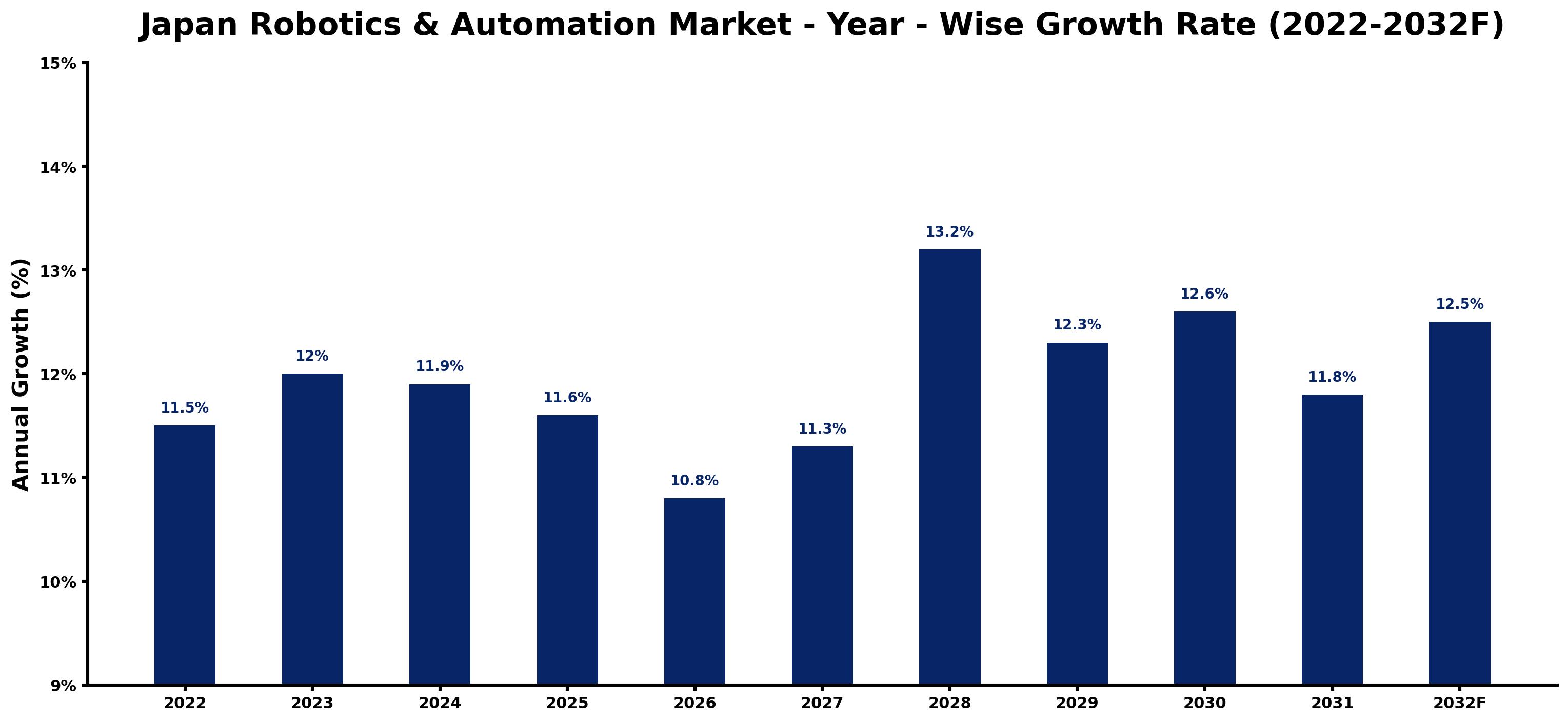
Below, each year's estimated growth is shown next to the factor that most influenced it.
| Year | Estimated Annual Growth (%) | Market Rationale |
| 2022 | 11.5 | The market showed strong growth due to increased automation in manufacturing. |
| 2023 | 12.0 | Growth accelerated as more companies adopted robotics for efficiency. |
| 2024 | 11.9 | The market experienced a slowdown as demand stabilised after rapid growth. |
| 2025 | 11.6 | Growth continued to slow as companies adjusted to market saturation. |
| 2026 | 10.8 | The market growth rate is expected to slow further as competition intensifies. |
| 2027 | 11.3 | Demand picked up again with new investments in automation technologies. |
| 2028 | 13.2 | Growth surged as technological advancements drove higher adoption rates. |
| 2029 | 12.3 | The market saw a slowdown as growth began to normalise after peaks. |
| 2030 | 12.6 | Demand increased again as industries sought to improve productivity. |
| 2031 | 11.8 | Growth slowed as the market matured and competition increased. |
| 2032 | 12.5 | Demand is projected to rise as new applications for robotics emerge. |
Note: Market size estimations and growth projections presented in this report are based on 6Wresearch's proprietary forecasting methodology, utilizing the latest available industry data, government publications, and primary research inputs.
Japan Robotics & Automation Market Synopsis
Robotics and automation in Japan involve advanced technologies performing tasks traditionally done by humans, primarily in manufacturing, logistics, and service sectors. The Japan Robotics & Automation Market is expanding due to increasing demand from manufacturing facilities and logistics providers, driven by the need for efficiency and productivity. The 'New Robot Strategy' launched in 2015 aims to promote innovation, while the aging population is boosting the demand for service robots in healthcare and domestic applications, creating opportunities for growth.
Market Dynamics Impact Analysis (2026–2032)
| Factor | Type | Impact | Primary Segment Affected |
| Increased automation in manufacturing processes | Driver | High | Industrial Automation |
| Growing demand for service robots in healthcare | Driver | High | Service Robotics |
| Rising investments in logistics automation | Opportunity | High | Mobile Robotics |
| Expansion of robotics applications in public spaces | Opportunity | Medium | Humanoid Robots |
| High initial investment costs for robotics systems | Restraint | High | Manufacturing Robots |
| Limited awareness of robotics benefits among SMEs | Restraint | Medium | Domestic/Commercial Robots |
| Shortage of skilled workforce for robotics integration | Challenge | High | AGVs/AMRs |
| Rapid technological advancements leading to obsolescence | Challenge | Medium | AI-Driven Interaction |
Evaluation of Drivers in Japan Robotics & Automation Market (2026–2032)
Demand rests on the following drivers, each shown with the segment it touches most.
| Drivers | Primary Segment Affected | Why It Matters (Evidence) |
| Growing demand for automation in assembly lines | Manufacturing Robots | This demand is supported by the high number of industrial robots installed in Japan, improving production efficiency. |
| Increased adoption of robotics in elderly care | Service Robotics | The healthcare sector is projected to require a significant number of service robots by 2030, addressing the needs of the aging population. |
| Expansion of logistics operations across Japan | Mobile Robotics | With logistics robots projected to increase substantially, companies are investing heavily in automation. |
| Government initiatives promoting robotics integration | Industrial Automation | The 'Smart Factory' programme encourages robotics adoption, resulting in increased investments in manufacturing processes. |
| Growing consumer interest in domestic robots | Domestic/Commercial Robots | The rising population is stimulating demand for robots in homes and small businesses. |
Purchasing is picking up as the healthcare sector anticipates a need for numerous service robots by 2030, prompting healthcare providers to invest in automation. The logistics industry is also responding to increased demand, with projections of substantial growth in logistics robots, improving efficiency in supply chains. In manufacturing, a high number of industrial robots are already in use, driving companies to boost productivity. As a result, the growing consumer interest in domestic robots is creating new market opportunities, particularly among small and medium enterprises. The push for automation is clear in various sectors, leading to a surge in investments and innovations.
Evaluation of Restraints in Japan Robotics & Automation Market
These are the pressures that could keep growth below its potential.
| Market Restraint | Primary Segment Affected | Why It Matters (Evidence) |
| High initial investment costs for robotics systems | Manufacturing Robots | Many manufacturers face challenges due to the substantial upfront costs associated with robotics integration, limiting adoption. |
| Limited awareness of robotics benefits among SMEs | Domestic/Commercial Robots | Small and medium enterprises often lack knowledge about the advantages of robotics, hindering market growth. |
| Shortage of skilled workforce for robotics integration | AGVs/AMRs | The lack of qualified personnel for robotics implementation hampers automation efforts in various sectors. |
| Rapid technological advancements leading to obsolescence | AI-Driven Interaction | The fast pace of technology evolution can make existing systems outdated quickly, discouraging investment. |
| Regulatory challenges in robotics deployment | Service Robotics | Compliance with safety standards and regulations can delay the introduction of new robotic solutions in the market. |
Japan Robotics & Automation Market Challenges
Japan's stringent regulations on robotics safety and quality assurance create compliance burdens for manufacturers, causing product launch delays of up to six months. Rising operational costs, driven by a national minimum wage increase to JPY 1,055 per hour, compel producers to raise prices, impacting buyers in the manufacturing sector. A shortage of skilled robotics engineers extends project timelines, forcing clinics to delay the adoption of service robots for elderly care. Rapid technological advancements outpace existing infrastructure, resulting in inefficiencies that can inflate logistics costs by 15% for suppliers.
Trends in the Japan Robotics & Automation Market
These developments are changing demand patterns in the Japan Robotics & Automation Market.
- Shift to Automated Manufacturing: Manufacturing facilities are increasingly adopting automation technologies, with a significant number of industrial robots installed. This shift improves productivity and efficiency, particularly in regions like Aichi Prefecture.
- Growing Use of Service Robots in Healthcare: Healthcare providers are integrating service robots to assist in elderly care, with projections indicating a substantial need by 2030. This trend reflects the aging population's demands for support.
- Expansion of Robotics in Logistics: Logistics providers are rapidly adopting mobile robotics, with numerous logistics centers implementing AGVs. The number of logistics robots is projected to increase significantly, streamlining operations.
- Increased Investment in Robotics Startups: The 'Robotics New Business Development Program' has a budget of 5 billion yen, supporting innovation in robotics. This funding is expected to improve the competitive environment for startups.
Investment Opportunities in the Japan Robotics & Automation Market
The following areas offer the clearest openings for investors and suppliers in the Japan Robotics & Automation Market.
- Growing Need for Service Robots in Aging Care: With Japan's population aging, the healthcare sector needs a substantial number of service robots by 2030. Companies can enter this market by partnering with healthcare providers.
- Investment in Logistics Automation: Logistics providers are increasingly investing in mobile robotics, with projections indicating significant growth. Suppliers can enter this market through joint ventures with logistics firms.
- Expansion of Robotics in Public Spaces: The Tokyo Metropolitan Government is investing in public space robotics projects, creating opportunities for suppliers to engage in new solutions. This sector is ripe for new technologies.
- Growing Market for Domestic Robots: As the population increases, there is a growing market for domestic robots. Suppliers can explore this opportunity by obtaining local certifications and partnering with SMEs.
Government Initiatives in the Japan Robotics & Automation Market
The 'Robotics Strategy' launched in 2023 adds to the existing 'New Robot Strategy' from 2015, aiming to expand robot use across various sectors, including manufacturing and healthcare. This strategy promotes innovation and investment in robotics, ensuring Japan remains competitive globally.
The 'Robotics New Business Development Program' has a budget of 5 billion yen, administered by the Ministry of Economy, Trade and Industry (METI). This funding supports startups in the robotics field, facilitating the development of new technologies and applications.
Future Insight of the Japan Robotics & Automation Market
By 2032, manufacturers will need to integrate 1 million robots into their operations, reflecting a major shift in production capabilities. The 'Society 5.0' initiative will enhance the role of robotics in daily life, benefiting consumers through improved services. The 'Advanced Robotics for Manufacturing' program will boost factory productivity, enabling suppliers to compete more effectively. Public and private investments in decarbonisation are projected to reach JPY 150 trillion over the next decade, driving innovation across the robotics field.
Market Segmentation Analysis
Japan Robotics & Automation Market report covers a detailed analysis of the following market segments:
By Application Segment – Industrial Automation Leads, Service Robotics Expected to Grow Fastest
According to Saurav Kr Singh, Senior Research Analyst at 6Wresearch, with 43% of application segment revenue in 2025, Industrial Automation was the largest category. Industrial automation holds the largest share due to its critical role in manufacturing processes, particularly in automotive and electronics sectors. The presence of over 500,000 industrial robots in Japan's manufacturing facilities highlights the extensive reliance on these technologies for productivity. Service Robotics are set to record the highest CAGR in this split, 17.6% over 2026–2032. Service robotics is experiencing rapid growth, driven by increasing demand in healthcare and hospitality sectors, with projections indicating a need for 30,000 service robots by 2030 for elderly care. This growth will not impede industrial automation's lead, as both segments are likely to converge in applications. Suppliers should consider expanding their product offerings to cater to both industrial automation and service robotics markets.
By Robot Category – Manufacturing Robots Lead, Domestic/Commercial Robots Expected to Grow Fastest
Manufacturing Robots accounted for 38% of the market by robot category in 2025. Manufacturing robots dominate the market as they are essential components of assembly lines, particularly in the automotive industry. This reliance is reflected in the substantial investment and infrastructure supporting manufacturing robotics in Japan. Domestic/Commercial Robots are projected to grow fastest, at a CAGR of 17.0% during 2026–2032. Domestic and commercial robots are growing quickly as households and businesses increasingly adopt them for cleaning and maintenance tasks, indicating a shift in consumer behaviour. This growth will further solidify the position of manufacturing robots by driving innovation in robotic applications. Buyers should consider investing in domestic and commercial robots to improve efficiency in everyday tasks.
By Integration Type – PLC-Integrated Leads, Autonomous Navigation Expected to Grow Fastest
The largest integration type category in 2025 was PLC-Integrated, at 47% of revenue. PLC-integrated robots dominate the market as they are essential for automation control in manufacturing systems, enhancing operational efficiency. This integration is crucial for manufacturers aiming to improve productivity and maintain a competitive edge. Over 2026–2032, Autonomous Navigation is expected to post the fastest growth, at a CAGR of 17.7%. The growth of autonomous navigation is fuelled by the increasing need for mobile robots to operate independently, especially in logistics and service applications. This trend will complement PLC integration, further enhancing overall automation capabilities. Suppliers must prioritise the development of advanced autonomous navigation solutions to meet evolving market demands.
By End User – Assembly Plants Lead, Consumers/SMEs Expected to Grow Fastest
Assembly Plants took 35% of end user revenue in 2025, more than any other category. Assembly plants are the primary users of robotics, utilising these technologies to streamline production processes and improve operational efficiency. The significant dependence on robotics in this sector contributes to its leading market share. The quickest growth will come from Consumers/SMEs, forecast to expand at a CAGR of 15.8% between 2026 and 2032. The consumer and SME segments are increasingly adopting robotics for personal and small business applications, indicating a growing market for accessible automation solutions. This shift towards user-friendly robotic technologies is expected to further stimulate market growth. Suppliers should customise their products to address the specific needs of consumers and SMEs to effectively leverage this expanding market segment.
Key Attractiveness of the Report
- 10 Years of Market Numbers
- Historical Data Starting from 2022 to 2025
- Base Year 2025
- Forecast Data until 2032
- Key Performance Indicators Impacting the Market
- Major Upcoming Developments and Projects
Key Highlights of the Report:
- Japan Robotics & Automation Market Outlook
- Market Size of Japan Robotics & Automation Market, 2025
- Forecast of Japan Robotics & Automation Market, 2032
- Historical Data and Forecast of Japan Robotics & Automation Revenues & Volume for the Period 2022-2032F
- Japan Robotics & Automation Market Trend Evolution
- Japan Robotics & Automation Market Drivers and Challenges
- Japan Robotics & Automation Price Trends
- Japan Robotics & Automation Porter's Five Forces
- Japan Robotics & Automation Industry Life Cycle
- Historical Data and Forecast of Japan Robotics & Automation Market Revenues & Volume By Application Segment for the Period 2022-2032F
- Historical Data and Forecast of Japan Robotics & Automation Market Revenues & Volume By Industrial Automation for the Period 2022-2032F
- Historical Data and Forecast of Japan Robotics & Automation Market Revenues & Volume By Service Robotics for the Period 2022-2032F
- Historical Data and Forecast of Japan Robotics & Automation Market Revenues & Volume By Mobile Robotics for the Period 2022-2032F
- Historical Data and Forecast of Japan Robotics & Automation Market Revenues & Volume By Humanoid Robots for the Period 2022-2032F
- Historical Data and Forecast of Japan Robotics & Automation Market Revenues & Volume By Robot Category for the Period 2022-2032F
- Historical Data and Forecast of Japan Robotics & Automation Market Revenues & Volume By Manufacturing Robots for the Period 2022-2032F
- Historical Data and Forecast of Japan Robotics & Automation Market Revenues & Volume By Domestic/Commercial Robots for the Period 2022-2032F
- Historical Data and Forecast of Japan Robotics & Automation Market Revenues & Volume By AGVs/AMRs for the Period 2022-2032F
- Historical Data and Forecast of Japan Robotics & Automation Market Revenues & Volume By AI-Driven Interaction for the Period 2022-2032F
- Historical Data and Forecast of Japan Robotics & Automation Market Revenues & Volume By Integration Type for the Period 2022-2032F
- Historical Data and Forecast of Japan Robotics & Automation Market Revenues & Volume By PLC-Integrated for the Period 2022-2032F
- Historical Data and Forecast of Japan Robotics & Automation Market Revenues & Volume By Cloud-Based for the Period 2022-2032F
- Historical Data and Forecast of Japan Robotics & Automation Market Revenues & Volume By Autonomous Navigation for the Period 2022-2032F
- Historical Data and Forecast of Japan Robotics & Automation Market Revenues & Volume By NLP/Visual Interface for the Period 2022-2032F
- Historical Data and Forecast of Japan Robotics & Automation Market Revenues & Volume By End User for the Period 2022-2032F
- Historical Data and Forecast of Japan Robotics & Automation Market Revenues & Volume By Assembly Plants for the Period 2022-2032F
- Historical Data and Forecast of Japan Robotics & Automation Market Revenues & Volume By Consumers/SMEs for the Period 2022-2032F
- Historical Data and Forecast of Japan Robotics & Automation Market Revenues & Volume By Logistics Providers for the Period 2022-2032F
- Historical Data and Forecast of Japan Robotics & Automation Market Revenues & Volume By Public Spaces for the Period 2022-2032F
- Japan Robotics & Automation Import Export Trade Statistics
- Market Opportunity Assessment By Application Segment
- Market Opportunity Assessment By Robot Category
- Market Opportunity Assessment By Integration Type
- Market Opportunity Assessment By End User
- Japan Robotics & Automation Top Companies Market Share
- Japan Robotics & Automation Competitive Benchmarking By Technical and Operational Parameters
- Japan Robotics & Automation Company Profiles
- Japan Robotics & Automation Key Strategic Recommendations
Market Covered
The report covers the following segments.
By Application Segment
- Industrial Automation
- Service Robotics
- Mobile Robotics
- Humanoid Robots
By Robot Category
- Manufacturing Robots
- Domestic/Commercial Robots
- AGVs/AMRs
- AI-Driven Interaction
By Integration Type
- PLC-Integrated
- Cloud-Based
- Autonomous Navigation
- NLP/Visual Interface
By End User
- Assembly Plants
- Consumers/SMEs
- Logistics Providers
- Public Spaces































