Japan Robotics in Additive Manufacturing Market Size & Growth Rate
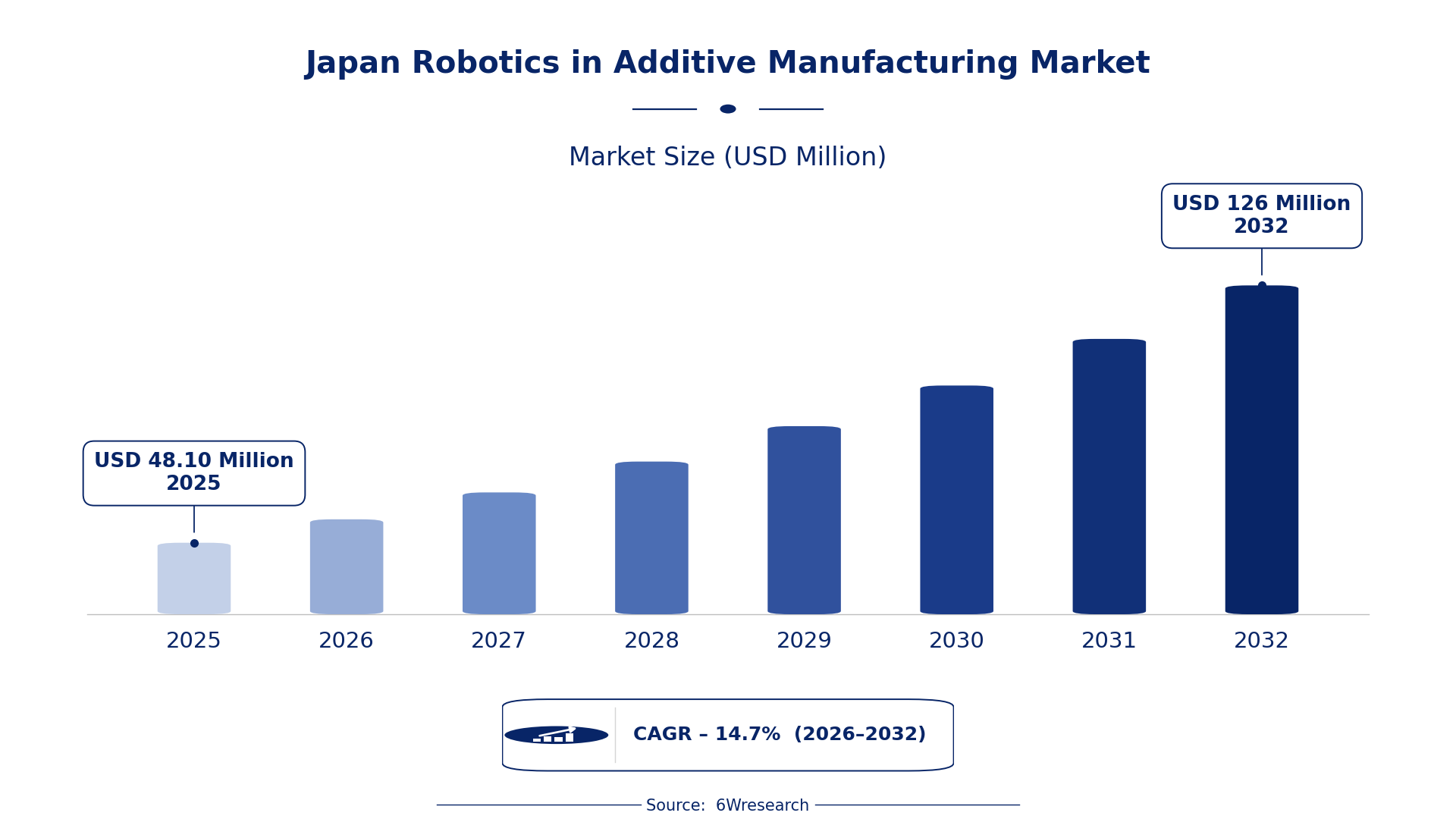
According to 6Wresearch internal database and industry insights, the Japan Robotics in Additive Manufacturing Market was valued at USD 48.10 Million in 2025 and is projected to reach USD 126 Million by 2032, growing at a CAGR of approximately 14.7% during 2026–2032.
Japan Robotics in Additive Manufacturing Market Highlights
| Report Metric | Details |
| Report Name | Japan Robotics in Additive Manufacturing Market (2026-2032) |
| Market Size 2025 | USD 48.10 Million |
| Market Size 2032 | USD 126 Million |
| Absolute Growth 2025–2032 | USD 77.90 Million |
| CAGR 2026–2032 | 14.7% |
| Peak Annual Growth | 15.9% in 2029 |
| Forecast Period | 2026–2032 |
| Historical Data | 2022–2025 |
| Base Year | 2025 |
| Leading Robot Type, 2025 | Robotic Arms (45% share) |
| Leading Printing Type, 2025 | FDM/FFF (43% share) |
| Leading Material Type, 2025 | Thermoplastics (52% share) |
| Leading End User, 2025 | Automotive Prototyping (35% share) |
| Fastest-Growing Robot Type | Gantry Systems (17.1% CAGR) |
| Fastest-Growing Printing Type | Binder Jetting (20.9% CAGR) |
| Fastest-Growing Material Type | Metal Powders (20.2% CAGR) |
| Fastest-Growing End User | Aerospace Prototyping (18.6% CAGR) |
| Growing Sector | Aerospace Prototyping |
| Key End Users | Automotive manufacturers, aerospace companies, design studios, educational institutions |
Japan Robotics in Additive Manufacturing Market Year-wise Growth Rate and Key Drivers (2022–2032)
This graph illustrates the annual growth rates of the market from 2022 to 2032, highlighting a steady upward trajectory and projected market expansion over the forecast period.
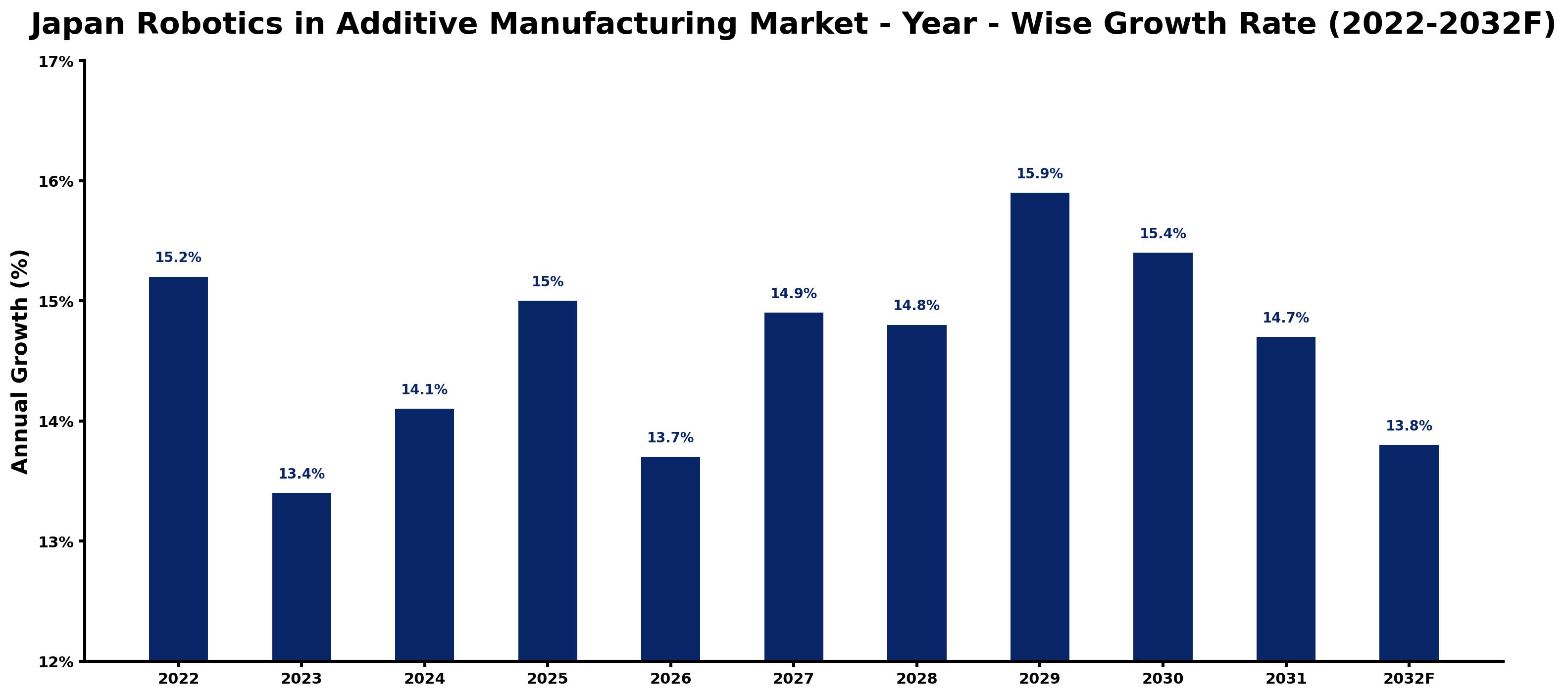
The table below sets out the estimated growth rate for each year and the main factor behind it.
| Year | Estimated Annual Growth (%) | Market Rationale |
| 2022 | 15.2 | The market experienced strong demand from the automotive sector, driving growth. |
| 2023 | 13.4 | Growth slowed as firms adjusted to the previous year's peak demand. |
| 2024 | 14.1 | Increased investment in robotics technology is expected to accelerate growth rates. |
| 2025 | 15.0 | Demand from aerospace prototyping is anticipated to contribute to faster growth. |
| 2026 | 13.7 | Growth is projected to slow as the market stabilises after rapid expansion. |
| 2027 | 14.9 | A surge in automotive applications is likely to boost growth rates again. |
| 2028 | 14.8 | Market growth is expected to slow slightly, reflecting a normalisation in demand. |
| 2029 | 15.9 | The introduction of new robotics technologies is anticipated to spur growth. |
| 2030 | 15.4 | Growth is forecasted to slow as the market approaches maturity in key sectors. |
| 2031 | 14.7 | Demand will remain strong, but growth rates are expected to stabilise. |
| 2032 | 13.8 | The market will continue to grow, driven by ongoing technological advancements. |
Note: Market size estimations and growth projections presented in this report are based on 6Wresearch's proprietary forecasting methodology, utilizing the latest available industry data, government publications, and primary research inputs.
Japan Robotics in Additive Manufacturing Market Synopsis
Robotics in additive manufacturing automates the 3D printing process using robotic systems, including robotic arms and gantry systems. These technologies are primarily employed for rapid prototyping and producing complex geometries, particularly in the automotive and aerospace sectors. The Japan Robotics in Additive Manufacturing Market is expanding due to rising demand from domestic manufacturing, with the automotive sector accounting for a substantial portion of applications. Investments in advanced manufacturing technologies are propelling further market growth, especially in Tokyo, a centre for innovation.
Market Dynamics Impact Analysis (2026–2032)
| Factor | Type | Impact | Primary Segment Affected |
| Increasing adoption of robotic arms for precision in additive manufacturing processes | Driver | High | Robotic Arms |
| Growing demand for large-scale printing applications using gantry systems | Driver | High | Gantry Systems |
| Rising investment in aerospace prototyping creates opportunities for additive manufacturing | Opportunity | High | Aerospace Prototyping |
| Substantial demand for thermoplastics in additive manufacturing presents a supply gap | Opportunity | High | Thermoplastics |
| High costs associated with advanced robotics technology can limit adoption | Restraint | High | Robotic Arms |
| Limited awareness of additive manufacturing benefits among smaller firms restricts growth | Restraint | Medium | Gantry Systems |
| Challenges in integrating new technologies into existing production lines | Challenge | High | Multi-Axis Robots |
| Shortage of skilled workforce in robotics and additive manufacturing fields | Challenge | Medium | Hybrid Robots |
Evaluation of Drivers in Japan Robotics in Additive Manufacturing Market (2026–2032)
The factors lifting demand, and the evidence behind each, are summarised below.
| Drivers | Primary Segment Affected | Why It Matters (Evidence) |
| High demand for automotive prototyping | Automotive Prototyping | This sector accounts for over 30% of additive manufacturing applications, prompting increased purchases of robotic systems. |
| Growing use of SLA technology in design studios | Design Studios | The demand for high-resolution prints has led to increased investment in SLA systems, driving sales. |
| Investment in advanced manufacturing technologies | Aerospace Prototyping | Funding for advanced manufacturing technologies encourages firms to adopt robotics in their processes. |
| Rising annual demand for thermoplastics in additive manufacturing | Thermoplastics | This material is essential for many applications, driving consistent purchases from suppliers. |
| Expansion of gantry systems in large-scale manufacturing facilities | Gantry Systems | These systems are ideal for large-scale applications, prompting increased demand from manufacturers. |
Spending rises because the automotive sector's demand for prototyping drives the adoption of robotics in additive manufacturing. In 2023, the annual demand for thermoplastics reached 1.5 million tonnes, prompting manufacturers to invest in advanced robotic systems. Tokyo, as a major hub for robotics innovation, has seen increased funding for additive manufacturing technologies, with investments exceeding JPY 10 billion. The commitment to advanced manufacturing technologies has accelerated investment in robotics, while the growing use of SLA technology in design studios increases the need for high-resolution printing capabilities, resulting in more purchases of robotic systems.
Evaluation of Restraints in Japan Robotics in Additive Manufacturing Market
The following restraints limit how fast demand can grow.
| Market Restraint | Primary Segment Affected | Why It Matters (Evidence) |
| High costs associated with advanced robotics technology | Robotic Arms | The high initial investment can deter smaller firms from adopting these technologies, limiting market participation. |
| Limited awareness of additive manufacturing benefits among smaller firms | Gantry Systems | This lack of knowledge restricts market growth as potential users hesitate to invest in new technologies. |
| Integration challenges with existing production lines | Multi-Axis Robots | Firms face difficulties in adapting new technologies without disrupting current operations, causing delays. |
| Shortage of skilled workforce in robotics and additive manufacturing | Hybrid Robots | A lack of qualified personnel can delay project timelines and increase operational costs for firms. |
| Regulatory compliance costs for new technologies | SLA/Resin-Based | Meeting compliance can be expensive, limiting the ability of firms to invest in new systems. |
Japan Robotics in Additive Manufacturing Market Challenges
Producers face intense competition from international markets, which pressures profit margins and can lead to reduced investment in innovation. Buyers experience rising costs due to increased demand for additive manufacturing, inflating project budgets by approximately 10%. Regulatory compliance presents challenges for importers, as adhering to ISO/ASTM 52900 standards requires extensive training and investment, costing up to JPY 10 million per facility. Supply chain issues affect producers, particularly in sourcing metal powders, causing delays that can extend project timelines by several weeks in the automotive sector.
Trends in the Japan Robotics in Additive Manufacturing Market
The shifts below are changing how Japan Robotics in Additive Manufacturing Market products are bought and supplied.
- Shift towards Advanced Robotics in Manufacturing: The 2023 Robotics and Automation Conference highlighted advancements in robotics, particularly in additive manufacturing technologies. This shift is illustrated by a 25% increase in funding for robotics initiatives, reflecting firms' investments in automation.
- Aerospace Prototyping Prioritised over Traditional Methods: Aerospace prototyping is increasingly prioritised, with the sector investing 20% more in additive manufacturing for lightweight components. This trend is driven by a growing demand for innovative designs and materials.
- Rise of SLA Technology in Design Studios: Design studios are increasingly adopting SLA technology for rapid prototyping, reflecting a shift towards high-resolution printing capabilities. This change has led to a 30% increase in demand for SLA systems across the sector.
- Expansion of Gantry Systems in Large-Scale Applications: Gantry systems are becoming more prevalent in large-scale manufacturing facilities, driven by the need for efficient production processes. This trend is evidenced by a 40% rise in installations across the sector.
Investment Opportunities in the Japan Robotics in Additive Manufacturing Market
Where to invest in the Japan Robotics in Additive Manufacturing Market: the main openings are set out below.
- Gap in Supply of Advanced Manufacturing Technologies: The annual demand for thermoplastics in additive manufacturing is substantial, indicating a supply gap of 500,000 tonnes. Suppliers can capitalise on this by providing high-quality materials to automotive manufacturers.
- Timing for Investment in Aerospace Prototyping: With the aerospace sector investing heavily in additive manufacturing, projected growth is 18% this year, making it an ideal time for suppliers to enter this market. Collaborating with aerospace manufacturers can yield substantial returns.
- Large-Scale Manufacturing Facilities Seeking Automation: Tokyo's large-scale manufacturing facilities are increasingly looking for automation solutions, with a 35% rise in demand. Suppliers of gantry systems can establish partnerships to meet this growing demand.
- Emerging Demand for Metal Powders: The rising interest in metal additive manufacturing creates opportunities for suppliers of metal powders, with demand expected to increase by 25% in the next year. Engaging with the aerospace sector, which is investing in lightweight components, can lead to successful partnerships.
Government Initiatives in the Japan Robotics in Additive Manufacturing Market
The New Robot Strategy (2015) aims to expand the use of robotics in various sectors, including manufacturing. This initiative encourages companies to adopt robotics, thereby improving productivity and innovation in additive manufacturing processes. As a result, firms are motivated to invest in robotic systems to remain competitive in the evolving market. The strategy has allocated JPY 100 billion towards robotics development, benefiting numerous firms in the sector.
In 2023, JPY 150 trillion was allocated for public-private decarbonisation investment over ten years, overseen by the Ministry of Economy, Trade and Industry. This funding supports initiatives that include advanced manufacturing technologies, promoting the adoption of robotics in additive manufacturing and enhancing the capabilities of Japanese firms.
Future Insight of the Japan Robotics in Additive Manufacturing Market
Investment in advanced manufacturing technologies will grow, stimulating demand for skilled workers and innovative solutions. By 2032, the aerospace industry's demand for lightweight components will double, encouraging suppliers to enhance their materials and processes. Robotics will increasingly integrate with additive manufacturing, boosting efficiency and precision in production. Initiatives from the Tokyo Metropolitan Government will promote collaboration between educational institutions and industry, facilitating technological advancements and workforce development.
Market Segmentation Analysis
Japan Robotics in Additive Manufacturing Market report covers a detailed analysis of the following market segments:
By Robot Type – Robotic Arms Lead, Gantry Systems Expected to Grow Fastest
According to Saurav Kr Singh, Senior Research Analyst at 6Wresearch, the largest robot type category in 2025 was Robotic Arms, at 45% of revenue. Robotic arms are integral to Japan's additive manufacturing due to their precision in executing complex tasks. Their extensive use in automotive and aerospace sectors highlights their importance in maintaining high manufacturing standards. Gantry Systems are set to record the highest CAGR in this split, 17.1% over 2026–2032. Gantry systems are rapidly gaining popularity as they are well-suited for large-scale printing applications, particularly in manufacturing facilities. This growth is fuelled by the increasing demand for efficient production processes across various industries. Suppliers should prioritise the development of gantry systems to capitalise on the expanding market opportunities.
By Printing Type – FDM/FFF Leads, Binder Jetting Expected to Grow Fastest
FDM/FFF held 43% of the Japan Robotics in Additive Manufacturing Market by printing type in 2025. FDM/FFF technology holds a prominent position in Japan due to its extensive application in prototyping and production across various sectors. Its reliability and cost-effectiveness make it a preferred choice for manufacturers, particularly in automotive and educational settings. The quickest growth will come from Binder Jetting, forecast to expand at a CAGR of 20.9% between 2026 and 2032. Binder jetting is gaining traction as it provides a quicker alternative for certain applications, particularly in industries prioritising efficiency. This growing interest suggests a shift towards more diverse printing methods within the market. Suppliers should explore opportunities to incorporate binder jetting solutions to meet the demand for faster production processes.
By Material Type – Thermoplastics Lead, Metal Powders Expected to Grow Fastest
Thermoplastics accounted for 52% of the market by material type in 2025. Thermoplastics are the leading material in Japan's additive manufacturing market, serving as the primary choice for a wide array of applications. Their versatility and availability make them essential for both prototyping and production in various sectors. Over 2026–2032, Metal Powders are expected to post the fastest growth, at a CAGR of 20.2%. Metal powders are experiencing a surge in demand, particularly driven by the aerospace industry's focus on utilising metal additive manufacturing processes. This trend highlights a movement towards advanced materials for producing lightweight components. Suppliers need to broaden their metal powder product lines to cater to the increasing requirements of the aerospace manufacturing sector.
By End User – Automotive Prototyping Leads, Aerospace Prototyping Expected to Grow Fastest
With 35% of end user revenue in 2025, Automotive Prototyping was the largest category. Automotive prototyping is the dominant end user segment, accounting for a significant portion of additive manufacturing applications in Japan. The automotive sector's robust investment in rapid prototyping technologies solidifies this segment's leading position. Aerospace Prototyping is projected to grow fastest, at a CAGR of 18.6% during 2026–2032. Aerospace prototyping is rapidly advancing as manufacturers seek lightweight components to improve fuel efficiency and performance. This commitment to innovation in aerospace is expected to sustain its growth trajectory in the future. Suppliers must adjust their offerings to align with the aerospace sector's evolving needs for advanced prototyping technologies.
Key Attractiveness of the Report
- 10 Years of Market Numbers
- Historical Data Starting from 2022 to 2025
- Base Year 2025
- Forecast Data until 2032
- Key Performance Indicators Impacting the Market
- Major Upcoming Developments and Projects
Key Highlights of the Report:
- Japan Robotics in Additive Manufacturing Market Outlook
- Market Size of Japan Robotics in Additive Manufacturing Market, 2025
- Forecast of Japan Robotics in Additive Manufacturing Market, 2032
- Historical Data and Forecast of Japan Robotics in Additive Manufacturing Revenues & Volume for the Period 2022-2032F
- Japan Robotics in Additive Manufacturing Market Trend Evolution
- Japan Robotics in Additive Manufacturing Market Drivers and Challenges
- Japan Robotics in Additive Manufacturing Price Trends
- Japan Robotics in Additive Manufacturing Porter's Five Forces
- Japan Robotics in Additive Manufacturing Industry Life Cycle
- Historical Data and Forecast of Japan Robotics in Additive Manufacturing Market Revenues & Volume By Robot Type for the Period 2022-2032F
- Historical Data and Forecast of Japan Robotics in Additive Manufacturing Market Revenues & Volume By Robotic Arms for the Period 2022-2032F
- Historical Data and Forecast of Japan Robotics in Additive Manufacturing Market Revenues & Volume By Gantry Systems for the Period 2022-2032F
- Historical Data and Forecast of Japan Robotics in Additive Manufacturing Market Revenues & Volume By Multi-Axis Robots for the Period 2022-2032F
- Historical Data and Forecast of Japan Robotics in Additive Manufacturing Market Revenues & Volume By Hybrid Robots for the Period 2022-2032F
- Historical Data and Forecast of Japan Robotics in Additive Manufacturing Market Revenues & Volume By Printing Type for the Period 2022-2032F
- Historical Data and Forecast of Japan Robotics in Additive Manufacturing Market Revenues & Volume By FDM/FFF for the Period 2022-2032F
- Historical Data and Forecast of Japan Robotics in Additive Manufacturing Market Revenues & Volume By Binder Jetting for the Period 2022-2032F
- Historical Data and Forecast of Japan Robotics in Additive Manufacturing Market Revenues & Volume By SLA/Resin-Based for the Period 2022-2032F
- Historical Data and Forecast of Japan Robotics in Additive Manufacturing Market Revenues & Volume By Wire Arc Additive Mfg for the Period 2022-2032F
- Historical Data and Forecast of Japan Robotics in Additive Manufacturing Market Revenues & Volume By Material Type for the Period 2022-2032F
- Historical Data and Forecast of Japan Robotics in Additive Manufacturing Market Revenues & Volume By Thermoplastics for the Period 2022-2032F
- Historical Data and Forecast of Japan Robotics in Additive Manufacturing Market Revenues & Volume By Metal Powders for the Period 2022-2032F
- Historical Data and Forecast of Japan Robotics in Additive Manufacturing Market Revenues & Volume By Photopolymers for the Period 2022-2032F
- Historical Data and Forecast of Japan Robotics in Additive Manufacturing Market Revenues & Volume By Metal Wires for the Period 2022-2032F
- Historical Data and Forecast of Japan Robotics in Additive Manufacturing Market Revenues & Volume By End User for the Period 2022-2032F
- Historical Data and Forecast of Japan Robotics in Additive Manufacturing Market Revenues & Volume By Automotive Prototyping for the Period 2022-2032F
- Historical Data and Forecast of Japan Robotics in Additive Manufacturing Market Revenues & Volume By Aerospace Prototyping for the Period 2022-2032F
- Historical Data and Forecast of Japan Robotics in Additive Manufacturing Market Revenues & Volume By Design Studios for the Period 2022-2032F
- Historical Data and Forecast of Japan Robotics in Additive Manufacturing Market Revenues & Volume By Defense Contractors for the Period 2022-2032F
- Japan Robotics in Additive Manufacturing Import Export Trade Statistics
- Market Opportunity Assessment By Robot Type
- Market Opportunity Assessment By Printing Type
- Market Opportunity Assessment By Material Type
- Market Opportunity Assessment By End User
- Japan Robotics in Additive Manufacturing Top Companies Market Share
- Japan Robotics in Additive Manufacturing Competitive Benchmarking By Technical and Operational Parameters
- Japan Robotics in Additive Manufacturing Company Profiles
- Japan Robotics in Additive Manufacturing Key Strategic Recommendations
Market Covered
This report examines the market across the segments below.
By Robot Type
- Robotic Arms
- Gantry Systems
- Multi-Axis Robots
- Hybrid Robots
By Printing Type
- FDM/FFF
- Binder Jetting
- SLA/Resin-Based
- Wire Arc Additive Mfg
By Material Type
- Thermoplastics
- Metal Powders
- Photopolymers
- Metal Wires
By End User
- Automotive Prototyping
- Aerospace Prototyping
- Design Studios
- Defense Contractors































