Japan Roller Bearing Market Size & Growth Rate
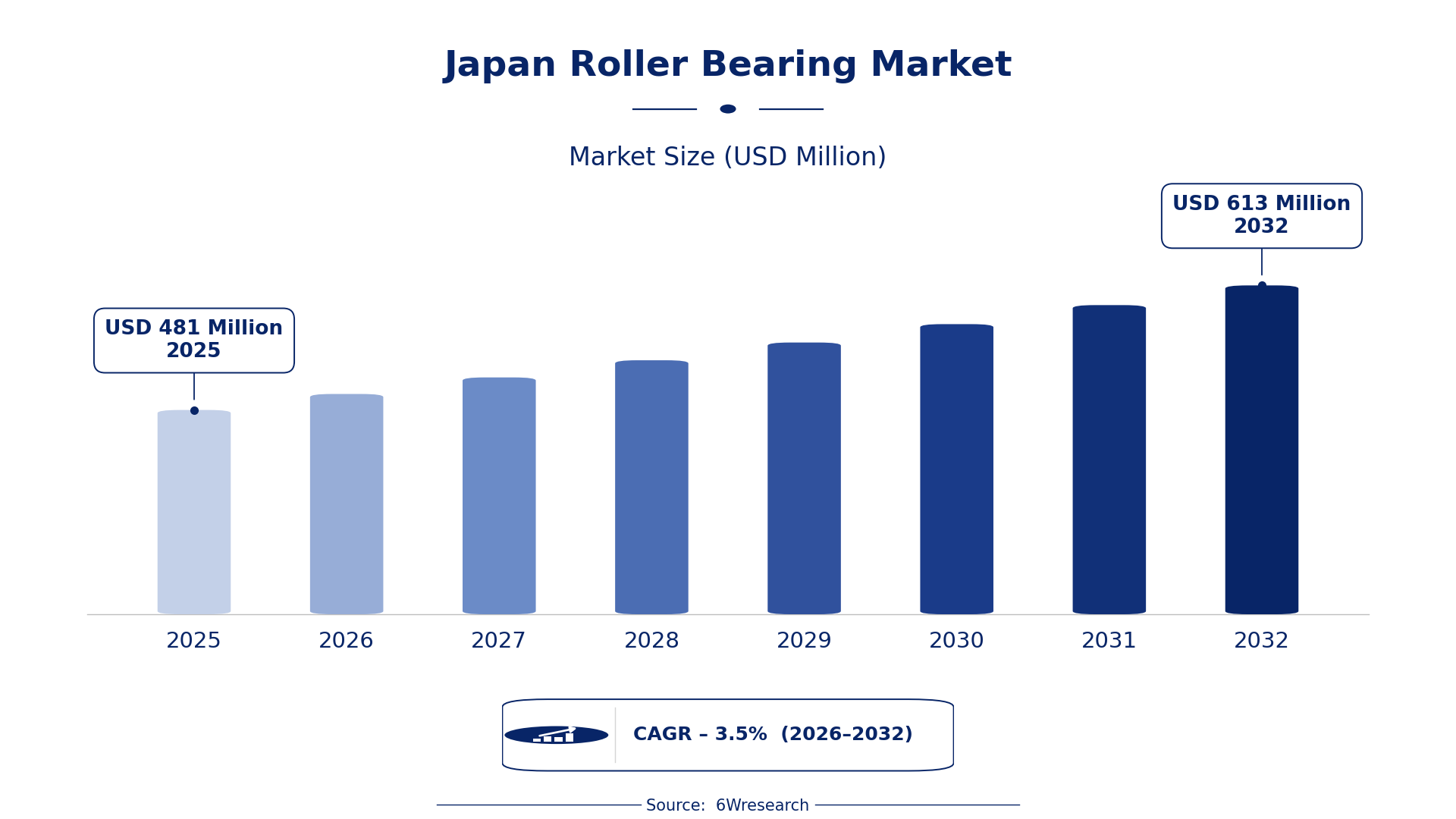
According to 6Wresearch internal database and industry insights, the Japan Roller Bearing Market was valued at USD 481 Million in 2025 and is projected to reach USD 613 Million by 2032, growing at a CAGR of approximately 3.5% during 2026–2032.
Japan Roller Bearing Market Highlights
| Report Metric | Details |
| Report Name | Japan Roller Bearing Market (2026-2032) |
| Market Size 2025 | USD 481 Million |
| Market Size 2032 | USD 613 Million |
| Absolute Growth 2025–2032 | USD 132 Million |
| CAGR 2026–2032 | 3.5% |
| Peak Annual Growth | 4.1% in 2029 |
| Forecast Period | 2026–2032 |
| Historical Data | 2022–2025 |
| Base Year | 2025 |
| Leading Bearing Type, 2025 | Roller Bearings (47% share) |
| Leading Construction Style, 2025 | Deep Groove (53% share) |
| Leading Material, 2025 | Chrome Steel (50% share) |
| Leading End User, 2025 | Automotive OEMs (49% share) |
| Fastest-Growing Bearing Type | Needle Bearings (4.9% CAGR) |
| Fastest-Growing Construction Style | Thin Profile (4.7% CAGR) |
| Fastest-Growing Material | Polymer Coated (5.4% CAGR) |
| Fastest-Growing End User | Aerospace Components (4.6% CAGR) |
| Growing Sector | automotive |
| Key End Users | Automotive OEMs, Heavy Machinery Makers, Aerospace Components |
Japan Roller Bearing Market Year-wise Growth Rate and Key Drivers (2022–2032)
This graph illustrates the annual growth rates of the market from 2022 to 2032, highlighting a steady upward trajectory and projected market expansion over the forecast period.
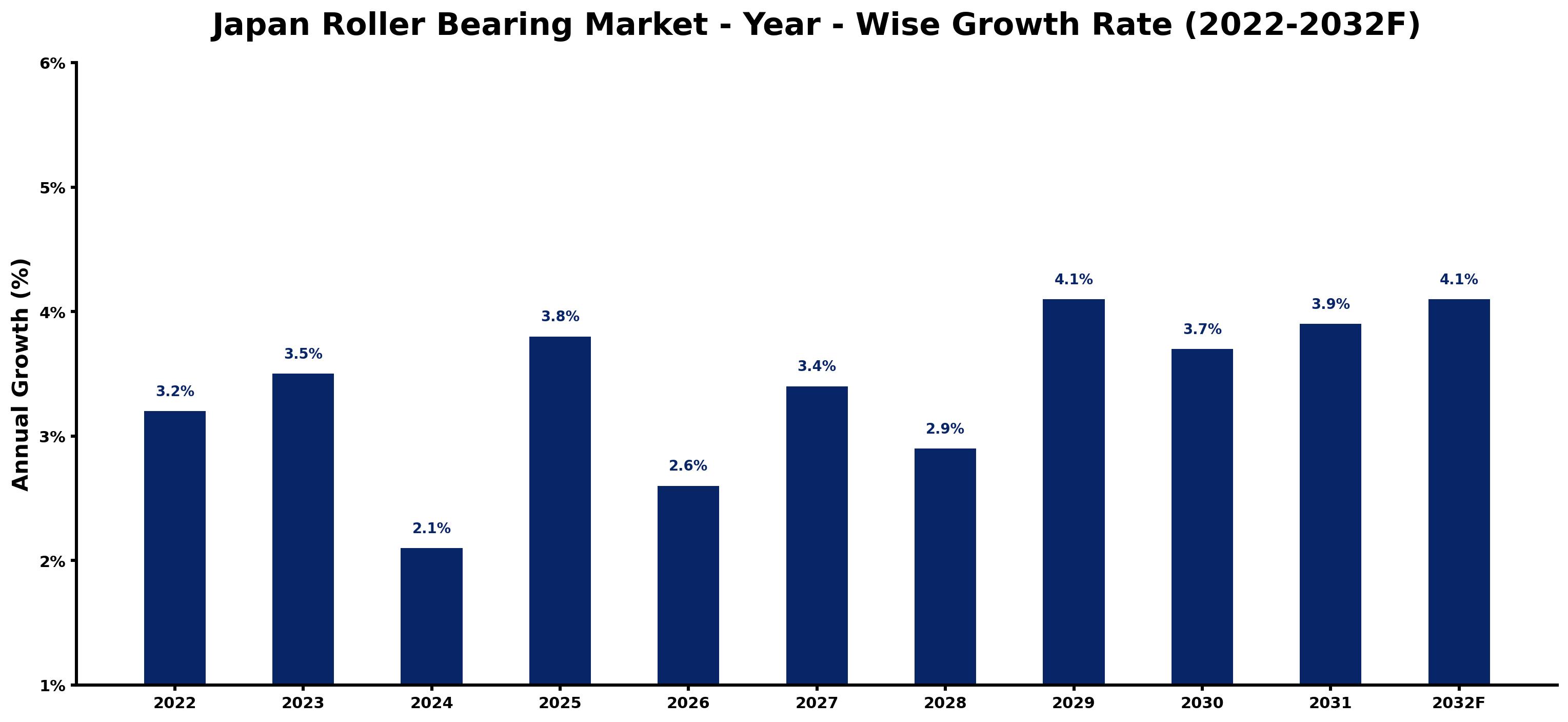
Annual growth estimates for each year appear below with the principal reason behind them, explaining the shifts that set the pace of the market.
| Year | Estimated Annual Growth (%) | Market Rationale |
| 2022 | 3.2 | The market showed steady growth due to consistent demand from the automotive sector. |
| 2023 | 3.5 | Growth accelerated as automotive production reached 8 million vehicles, boosting bearing requirements. |
| 2024 | 2.1 | Demand growth slowed as manufacturers adjusted to market saturation in some segments. |
| 2025 | 3.8 | The market rebounded with increased automotive production and heavy machinery demand. |
| 2026 | 2.6 | Growth is expected to decelerate as manufacturers face challenges in sourcing raw materials. |
| 2027 | 3.4 | Demand is projected to rise again as investments in advanced manufacturing technologies gain momentum. |
| 2028 | 2.9 | Growth is anticipated to slow due to fluctuations in heavy machinery production levels. |
| 2029 | 4.1 | The market is expected to peak as automotive and aerospace sectors expand production capabilities. |
| 2030 | 3.7 | Growth will moderate as the market stabilises following peak production levels. |
| 2031 | 3.9 | Demand is projected to increase again as manufacturers adapt to new technologies and standards. |
| 2032 | 4.1 | The market is expected to grow steadily with rising investments in advanced production. |
Note: Market size estimations and growth projections presented in this report are based on 6Wresearch's proprietary forecasting methodology, utilizing the latest available industry data, government publications, and primary research inputs.
Japan Roller Bearing Market Synopsis
Roller bearings are essential mechanical components that reduce friction in moving parts, typically made from materials like chrome steel or stainless steel. The Japan Roller Bearing Market is influenced by the automotive sector, which constitutes approximately 30% of the market, with production reaching 8 million vehicles in 2023. This market is expanding due to increased production in automotive and heavy machinery sectors, supported by investments in advanced manufacturing technologies and adherence to quality standards such as ISO 9001.
Market Dynamics Impact Analysis (2026–2032)
| Factor | Type | Impact | Primary Segment Affected |
| Strong demand from the automotive sector drives purchases of roller bearings. | Driver | High | Roller Bearings |
| Investments in advanced manufacturing technologies enhance production capabilities. | Driver | High | Roller Bearings |
| Increasing automotive production creates opportunities for suppliers. | Opportunity | High | Automotive OEMs |
| The growth of the aerospace industry opens new markets for roller bearings. | Opportunity | Medium | Aerospace Components |
| Sourcing challenges for raw materials may limit production capacity. | Restraint | High | Roller Bearings |
| Market saturation in certain segments can constrain growth potential. | Restraint | Medium | Roller Bearings |
| High costs associated with advanced manufacturing technology implementation hinder smaller producers. | Challenge | High | Roller Bearings |
| Competition from imported bearings affects local manufacturers' market share. | Challenge | Medium | Roller Bearings |
Evaluation of Drivers in Japan Roller Bearing Market (2026–2032)
The following drivers explain most of the expected growth.
| Drivers | Primary Segment Affected | Why It Matters (Evidence) |
| Rising automotive production increases demand for roller bearings. | Roller Bearings | In 2023, Japan's automotive production reached 8 million vehicles, driving bearing demand. |
| Investments in manufacturing technologies improve production efficiency. | Roller Bearings | The heavy machinery sector, valued over 10 trillion JPY, influences bearing usage. |
| Growing aerospace industry boosts demand for high-precision bearings. | Roller Bearings | Roller bearings are critical components in Japan's aerospace industry, which is expanding. |
| Adoption of ISO 9001 standard ensures quality in manufacturing processes. | Roller Bearings | This standard is widely adopted in the roller bearing manufacturing sector in Japan. |
| Technological advancements in bearing materials improve performance. | Roller Bearings | Stainless steel bearings are increasingly used in automotive applications for corrosion resistance. |
Orders keep climbing as the automotive sector expands, with production reaching 8 million vehicles in 2023. Heavy machinery production, valued at over 10 trillion JPY, influences bearing usage. The aerospace industry is also growing steadily, increasing demand for high-precision bearings. The adoption of quality standards ensures that manufacturers maintain high-quality production processes, leading to greater customer satisfaction. Advancements in materials, such as stainless steel, improve performance and durability, prompting manufacturers to invest in roller bearings.
Evaluation of Restraints in Japan Roller Bearing Market
The table below lists the restraints and the evidence behind each.
| Market Restraint | Primary Segment Affected | Why It Matters (Evidence) |
| Sourcing challenges for raw materials may limit production capacity. | Roller Bearings | Increased demand has led to competition for raw materials, raising costs for manufacturers. |
| Market saturation in certain segments can constrain growth potential. | Roller Bearings | With high production levels, some segments face diminishing returns on investment. |
| High costs associated with advanced manufacturing technology implementation hinder smaller producers. | Roller Bearings | Smaller manufacturers may struggle to invest in new technologies, affecting their competitiveness. |
| Competition from imported bearings affects local manufacturers' market share. | Roller Bearings | Imported products may offer lower prices, challenging local producers' pricing strategies. |
| Regulatory compliance costs can burden manufacturers in the sector. | Roller Bearings | Producers must invest in compliance with standards, increasing operational costs. |
Japan Roller Bearing Market Challenges
Local manufacturers face challenges in meeting the automotive sector's demand for roller bearings, which supports the production of 8 million vehicles in 2023, leading to delays for buyers. Shortages of skilled workers in advanced manufacturing techniques impede producers' ability to achieve the precision required for these applications, resulting in extended production times. Rising costs of stainless steel compel producers to raise prices, impacting buyers who must absorb these additional expenses. The slow uptake of automation technologies restricts efficiency, causing longer lead times for buyers who need timely delivery of high-quality bearings.
Trends in the Japan Roller Bearing Market
Four trends stand out in the Japan Roller Bearing Market.
- Shift towards Advanced Manufacturing Technologies: A government program supports advanced manufacturing technologies in the bearing industry, aiming to improve production efficiency. This initiative is projected to increase competitiveness and innovation in the sector, with funding allocated for technological upgrades.
- Transition from Chrome Steel to Stainless Steel: Since 2022, there has been a notable shift towards using stainless steel in automotive applications for its corrosion resistance. This trend is particularly evident in the Kanto region, where manufacturers are adapting to changing material preferences.
- Emergence of High-Precision Bearings: The Tohoku region is becoming a hub for high-precision bearing production, responding to the growing aerospace industry's demands. This shift is expected to drive innovation and quality improvements in bearing manufacturing, with an increase in specialized applications.
- Growing Focus on Quality Standards: With the adoption of ISO 9001, manufacturers are prioritising quality assurance in production processes. This trend is particularly important for automotive OEMs, as they seek reliable components to meet stringent performance requirements.
Investment Opportunities in the Japan Roller Bearing Market
Where to invest in the Japan Roller Bearing Market: the main openings are set out below.
- Gap in High-Precision Bearing Supply: With the aerospace industry expanding, there is a gap in the supply of high-precision bearings. Manufacturers focused on this niche can benefit from increased demand, particularly in the Tohoku region, which is known for its production capabilities.
- Rising Demand from Automotive OEMs: The automotive sector is a major consumer of roller bearings, with production reaching 8 million vehicles in 2023. Suppliers can capitalise on this demand by establishing partnerships with local manufacturers to ensure timely delivery.
- Investment in Advanced Manufacturing: With government support for advanced manufacturing technologies, now is an opportune time to invest in automation and efficiency improvements. Local manufacturers in the Kanto region are seeking partners to enhance their production capabilities.
- Emerging Need for Corrosion-Resistant Bearings: As industries increasingly require corrosion-resistant components, there is a growing opportunity for suppliers of stainless steel bearings. The automotive sector is particularly interested in these products, driven by the need for durability.
Government Initiatives in the Japan Roller Bearing Market
The Chemical Substances Control Law requires the evaluation and control of chemical substances used in manufacturing, ensuring safety and environmental protection. This law impacts manufacturers by necessitating compliance with safety standards, promoting sustainable practices within the roller bearing industry. Additionally, the Building Energy Efficiency Act, amended in 2022, mandates that all new buildings comply with energy efficiency measures starting from April 2025, influencing production facility standards.
The Ministry of Economy, Trade and Industry (METI) oversees the approval of advanced manufacturing technologies in the bearing sector. METI funds projects aimed at improving production efficiency and quality, supporting manufacturers in adopting new technologies. This funding is vital for local producers looking to innovate and remain competitive in the global market.
Future Insight of the Japan Roller Bearing Market
Technological advancements in automation will transform the roller bearing market by 2032. Government initiatives promoting advanced manufacturing will improve production capabilities, enabling suppliers to better meet the automotive sector's demands. As the aerospace industry grows, the need for high-precision bearings will stimulate innovation in materials and design. With the automotive sector comprising around 30% of the roller bearing market, suppliers will concentrate on developing corrosion-resistant bearings to meet industry standards.
Market Segmentation Analysis
Japan Roller Bearing Market report covers a detailed analysis of the following market segments:
By Bearing Type – Roller Bearings Lead, Needle Bearings Expected to Grow Fastest
According to Saurav Kr Singh, Senior Research Analyst at 6Wresearch, Roller Bearings accounted for 47% of the market by bearing type in 2025. Roller bearings hold the largest share in Japan due to their critical role in reducing friction within heavy machinery and automotive sectors. For instance, the automotive sector constitutes approximately 30% of the roller bearing market, highlighting the extensive use of these components. Over 2026–2032, Needle Bearings are expected to post the fastest growth, at a CAGR of 4.9%. Needle bearings are experiencing rapid growth as they cater to specific applications that require compact designs. The increasing demand for space-saving solutions in various machinery is propelling this segment's expansion. Suppliers should focus on developing needle bearings to capture the growing niche market.
By Construction Style – Deep Groove Leads, Thin Profile Expected to Grow Fastest
In 2025, Deep Groove led the construction style split with a 53% share. Deep groove bearings dominate the market as they are widely used in electric motors and automotive applications, making them essential components in these industries. Their versatility and reliability contribute to their leading position. Thin Profile is set to record the highest CAGR in this split, 4.7% over 2026–2032. Thin profile bearings are growing quickly due to their application in specialized areas where space is at a premium. This trend is driven by advancements in technology that require smaller, more efficient components. Manufacturers should consider investing in thin profile designs to meet the needs of niche applications.
By Material – Chrome Steel Leads, Polymer Coated Expected to Grow Fastest
Chrome Steel held 50% of the Japan Roller Bearing Market by material in 2025. Chrome steel holds the largest share in the roller bearing market due to its exceptional durability and strength. Its extensive application across various industries, including automotive and heavy machinery, reinforces its leading position. The quickest growth will come from Polymer Coated, forecast to expand at a CAGR of 5.4% between 2026 and 2032. The polymer coated segment is experiencing rapid growth as it meets the specific needs for reduced friction and wear in applications like automotive and aerospace. This trend is driven by the increasing focus on efficiency and longevity in component performance. Suppliers should consider expanding their offerings to include polymer coated materials to align with market demands.
By End User – Automotive OEMs Lead, Aerospace Components Expected to Grow Fastest
The largest end user category in 2025 was Automotive OEMs, at 49% of revenue. Automotive OEMs hold the largest share of the roller bearing market as they are essential for vehicle production, which reached 8 million units in 2023. This robust automotive manufacturing base in Japan guarantees a continuous demand for roller bearings. Aerospace Components are projected to grow fastest, at a CAGR of 4.6% during 2026–2032. The aerospace components segment is experiencing rapid growth, driven by the industry's need for high-precision and reliable components. As the aerospace sector continues to expand, the demand for roller bearings will likely increase significantly. This indicates that suppliers should prioritise aerospace applications to capitalise on the growing demand for precision components in this sector.
Key Attractiveness of the Report
- 10 Years of Market Numbers
- Historical Data Starting from 2022 to 2025
- Base Year 2025
- Forecast Data until 2032
- Key Performance Indicators Impacting the Market
- Major Upcoming Developments and Projects
Key Highlights of the Report:
- Japan Roller Bearing Market Outlook
- Market Size of Japan Roller Bearing Market, 2025
- Forecast of Japan Roller Bearing Market, 2032
- Historical Data and Forecast of Japan Roller Bearing Revenues & Volume for the Period 2022-2032F
- Japan Roller Bearing Market Trend Evolution
- Japan Roller Bearing Market Drivers and Challenges
- Japan Roller Bearing Price Trends
- Japan Roller Bearing Porter's Five Forces
- Japan Roller Bearing Industry Life Cycle
- Historical Data and Forecast of Japan Roller Bearing Market Revenues & Volume By Bearing Type for the Period 2022-2032F
- Historical Data and Forecast of Japan Roller Bearing Market Revenues & Volume By Ball Bearings for the Period 2022-2032F
- Historical Data and Forecast of Japan Roller Bearing Market Revenues & Volume By Roller Bearings for the Period 2022-2032F
- Historical Data and Forecast of Japan Roller Bearing Market Revenues & Volume By Needle Bearings for the Period 2022-2032F
- Historical Data and Forecast of Japan Roller Bearing Market Revenues & Volume By Spherical Bearings for the Period 2022-2032F
- Historical Data and Forecast of Japan Roller Bearing Market Revenues & Volume By Construction Style for the Period 2022-2032F
- Historical Data and Forecast of Japan Roller Bearing Market Revenues & Volume By Deep Groove for the Period 2022-2032F
- Historical Data and Forecast of Japan Roller Bearing Market Revenues & Volume By Tapered / Cylindrical for the Period 2022-2032F
- Historical Data and Forecast of Japan Roller Bearing Market Revenues & Volume By Thin Profile for the Period 2022-2032F
- Historical Data and Forecast of Japan Roller Bearing Market Revenues & Volume By Self-Aligning for the Period 2022-2032F
- Historical Data and Forecast of Japan Roller Bearing Market Revenues & Volume By Material for the Period 2022-2032F
- Historical Data and Forecast of Japan Roller Bearing Market Revenues & Volume By Chrome Steel for the Period 2022-2032F
- Historical Data and Forecast of Japan Roller Bearing Market Revenues & Volume By Stainless Steel for the Period 2022-2032F
- Historical Data and Forecast of Japan Roller Bearing Market Revenues & Volume By Alloy Steel for the Period 2022-2032F
- Historical Data and Forecast of Japan Roller Bearing Market Revenues & Volume By Polymer Coated for the Period 2022-2032F
- Historical Data and Forecast of Japan Roller Bearing Market Revenues & Volume By End User for the Period 2022-2032F
- Historical Data and Forecast of Japan Roller Bearing Market Revenues & Volume By Automotive OEMs for the Period 2022-2032F
- Historical Data and Forecast of Japan Roller Bearing Market Revenues & Volume By Heavy Machinery Makers for the Period 2022-2032F
- Historical Data and Forecast of Japan Roller Bearing Market Revenues & Volume By Aerospace Components for the Period 2022-2032F
- Historical Data and Forecast of Japan Roller Bearing Market Revenues & Volume By Conveyor System Builders for the Period 2022-2032F
- Japan Roller Bearing Import Export Trade Statistics
- Market Opportunity Assessment By Bearing Type
- Market Opportunity Assessment By Construction Style
- Market Opportunity Assessment By Material
- Market Opportunity Assessment By End User
- Japan Roller Bearing Top Companies Market Share
- Japan Roller Bearing Competitive Benchmarking By Technical and Operational Parameters
- Japan Roller Bearing Company Profiles
- Japan Roller Bearing Key Strategic Recommendations
Market Covered
The following segment groups are covered in the report.
By Bearing Type
- Ball Bearings
- Roller Bearings
- Needle Bearings
- Spherical Bearings
By Construction Style
- Deep Groove
- Tapered / Cylindrical
- Thin Profile
- Self-Aligning
By Material
- Chrome Steel
- Stainless Steel
- Alloy Steel
- Polymer Coated
By End User
- Automotive OEMs
- Heavy Machinery Makers
- Aerospace Components
- Conveyor System Builders































