Japan Roller Blinds Market Size & Growth Rate
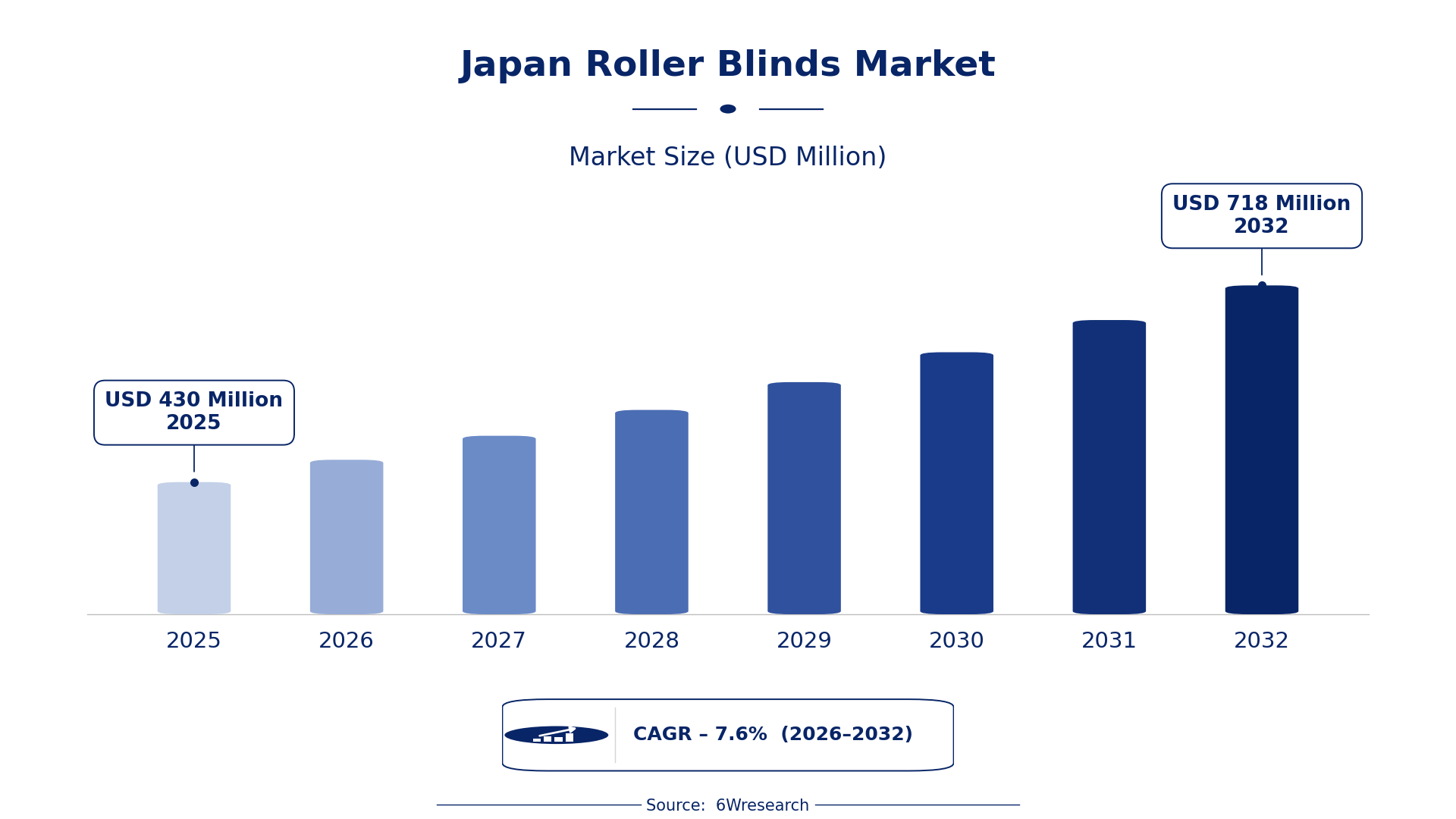
According to 6Wresearch internal database and industry insights, the Japan Roller Blinds Market was valued at USD 430 Million in 2025 and is projected to reach USD 718 Million by 2032, growing at a CAGR of approximately 7.6% during 2026–2032.
Japan Roller Blinds Market Highlights
| Report Metric | Details |
| Report Name | Japan Roller Blinds Market (2026-2032) |
| Market Size 2025 | USD 430 Million |
| Market Size 2032 | USD 718 Million |
| Absolute Growth 2025–2032 | USD 288 Million |
| CAGR 2026–2032 | 7.6% |
| Peak Annual Growth | 8.6% in 2029 |
| Forecast Period | 2026–2032 |
| Historical Data | 2022–2025 |
| Base Year | 2025 |
| Leading Fabric Type, 2025 | Light-Filtering (45% share) |
| Leading Operation Mode, 2025 | Manual Chain (39% share) |
| Leading Control System, 2025 | Cordless Motorized (40% share) |
| Leading End User, 2025 | Residential Homeowners (46% share) |
| Fastest-Growing Fabric Type | Blackout Blinds (11.2% CAGR) |
| Fastest-Growing Operation Mode | Spring-Assisted (10.4% CAGR) |
| Fastest-Growing Control System | Remote-Controlled (11.7% CAGR) |
| Fastest-Growing End User | Hotels & Hospitality (10.7% CAGR) |
| Growing Sector | Residential sector |
| Key End Users | Residential Homeowners, Hotels & Hospitality, Retail & Office Buildings |
Japan Roller Blinds Market Year-wise Growth Rate and Key Drivers (2022–2032)
This graph illustrates the annual growth rates of the market from 2022 to 2032, highlighting a steady upward trajectory and projected market expansion over the forecast period.
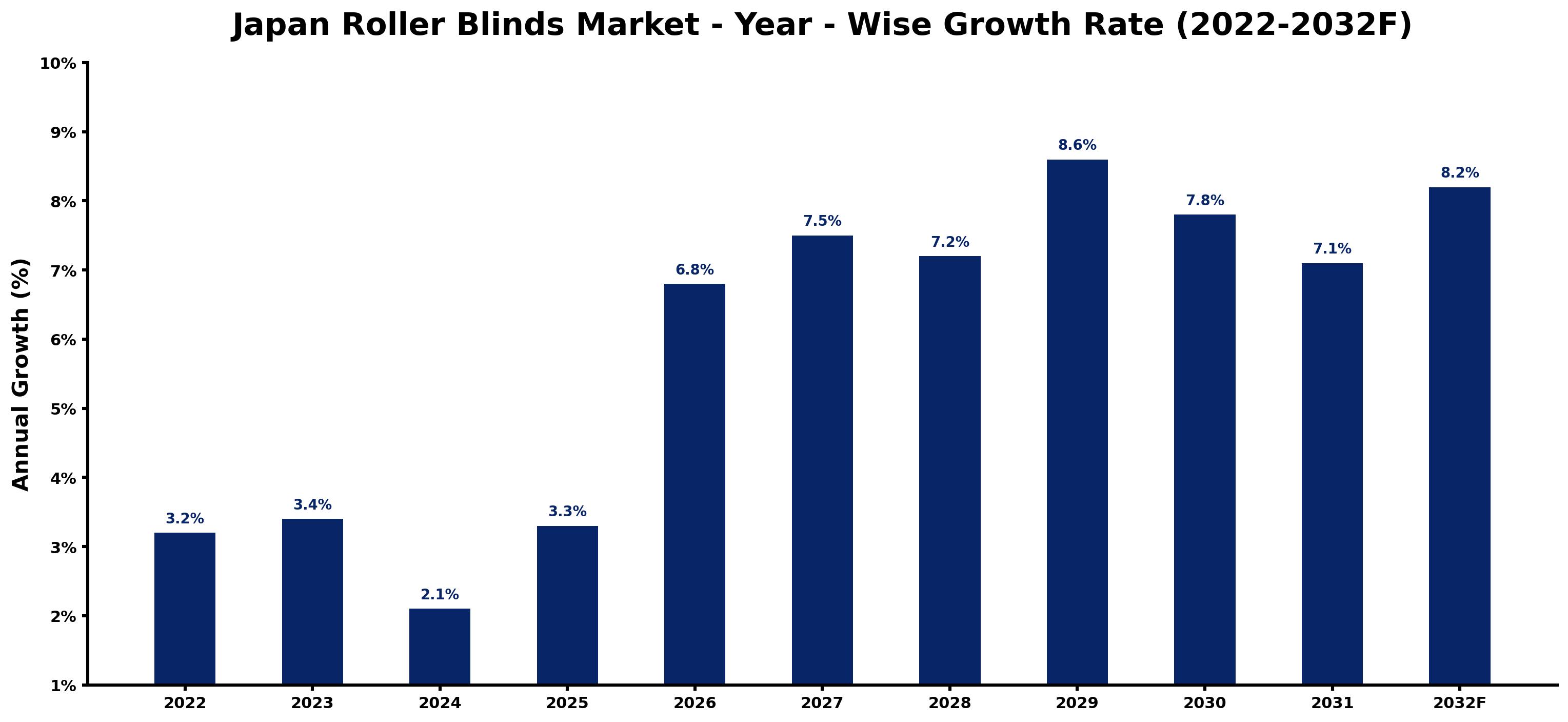
The following figures match every annual growth estimate with the main market development of that year, giving the reasoning behind each rise or slowdown.
| Year | Estimated Annual Growth (%) | Market Rationale |
| 2022 | 3.2 | The market showed steady growth with increased demand from residential homeowners. |
| 2023 | 3.4 | The demand for roller blinds grew faster due to rising urbanisation in major cities. |
| 2024 | 2.1 | Growth slowed as the market adjusted to supply chain challenges in manufacturing. |
| 2025 | 3.3 | Demand picked up again as urban households renovated their living spaces. |
| 2026 | 6.8 | The market is expected to grow faster with the introduction of smart home technologies. |
| 2027 | 7.5 | Increased interest in energy-efficient solutions drives demand for modern roller blinds. |
| 2028 | 7.2 | Growth is projected to slow slightly as the market stabilises after rapid expansion. |
| 2029 | 8.6 | The peak growth year is anticipated as consumer preferences shift towards automation. |
| 2030 | 7.8 | Demand is expected to slow as the market reaches maturity in urban areas. |
| 2031 | 7.1 | Growth is projected to continue but at a reduced rate as competition intensifies. |
| 2032 | 8.2 | The market will see renewed interest in energy-efficient products, boosting demand. |
Note: Market size estimations and growth projections presented in this report are based on 6Wresearch's proprietary forecasting methodology, utilizing the latest available industry data, government publications, and primary research inputs.
Japan Roller Blinds Market Synopsis
Roller blinds are adaptable window coverings crafted from fabric, designed to manage light and privacy. They find application in both residential and commercial settings, offering aesthetic appeal and insulation. The Japan Roller Blinds Market is expanding due to rising urbanisation, the adoption of smart home technologies, and an emphasis on energy efficiency. The residential sector represents around 60% of demand, while the hospitality industry is also growing, further propelling market expansion.
Market Dynamics Impact Analysis (2026–2032)
| Factor | Type | Impact | Primary Segment Affected |
| Rising urbanisation in cities like Tokyo and Osaka | Driver | High | Residential Homeowners |
| Growing demand for energy-efficient solutions | Driver | High | Solar Shades |
| Expansion of the hospitality sector increases demand | Opportunity | High | Hotels & Hospitality |
| Increasing integration of smart technologies in homes | Opportunity | High | Motorized Electric |
| Supply chain disruptions affecting availability of materials | Restraint | High | Blackout Blinds |
| High costs associated with premium fabric types | Restraint | Medium | Light-Filtering |
| Intense competition among manufacturers | Challenge | High | Sunscreen Blinds |
| Consumer reluctance to adopt new technologies | Challenge | Medium | Smart Home Integrable |
Evaluation of Drivers in Japan Roller Blinds Market (2026–2032)
The main growth drivers and the segments they affect most are set out below.
| Drivers | Primary Segment Affected | Why It Matters (Evidence) |
| Increased urbanisation | Residential Homeowners | The population of Tokyo, over 14 million, drives demand for residential window treatments, leading to more purchases of roller blinds. |
| Focus on energy efficiency | Solar Shades | The GX Promotion Act supports energy-efficient housing, prompting more installations of solar shades in new constructions. |
| Growth in the hospitality sector | Blackout Blinds | The expanding hospitality sector increases the need for blackout blinds in hotels, improving guest experiences. |
| Rising interest in smart home solutions | Motorized Electric | Remote-controlled blinds are increasingly integrated into smart home systems, attracting tech-savvy consumers. |
| Consumer preference for aesthetic enhancements | Light-Filtering | Roller blinds are popular for diffusing natural light, appealing to homeowners seeking aesthetic improvements. |
Most of the extra volume comes from the increasing urbanisation in cities, where demand for residential window treatments is rising. The hospitality sector's expansion increases the need for blackout blinds in hotels, which enhances guest experiences. Rising interest in smart home solutions is evident, with remote-controlled blinds integrated into smart home systems, attracting tech-savvy consumers. Homeowners are increasingly seeking aesthetic enhancements, making light-filtering roller blinds popular for diffusing natural light.
Evaluation of Restraints in Japan Roller Blinds Market
These are the pressures that could keep growth below its potential.
| Market Restraint | Primary Segment Affected | Why It Matters (Evidence) |
| Supply chain disruptions | Blackout Blinds | Supply chain disruptions have delayed production timelines, increasing costs for manufacturers and limiting availability of products. |
| High costs of premium fabrics | Light-Filtering | The average price for high-quality blackout blinds is around ¥10,000 per unit, limiting consumer purchases. |
| Intense competition among manufacturers | Sunscreen Blinds | Intense competition has led to price wars, reducing profit margins for producers in the sunscreen blinds segment. |
| Consumer reluctance to adopt new technologies | Smart Home Integrable | Many consumers are hesitant to invest in smart technologies, slowing the adoption of smart home integrable roller blinds. |
| Limited awareness of energy-efficient options | Solar Shades | Limited awareness of energy-efficient options among consumers restricts market growth for solar shades. |
Japan Roller Blinds Market Challenges
Buyers face delays due to a shortage of skilled installers, potentially extending project timelines by up to 20%. Suppliers are grappling with rising costs for high-quality fabrics, resulting in price increases of approximately 15% for consumers. Compliance with JIS standards necessitates additional testing, causing product availability to lag by several weeks for manufacturers. Rapid advancements in smart home systems require constant updates, straining suppliers' resources and possibly leaving buyers with outdated products.
Trends in the Japan Roller Blinds Market
The following changes are redrawing the Japan Roller Blinds Market.
- Shift towards Smart Home Integration: Urban areas are increasingly incorporating remote-controlled blinds into smart home systems. Approximately 30% of new office buildings feature smart window solutions, enhancing user convenience.
- Rising Demand for Blackout Solutions: The hospitality sector is progressively adopting blackout blinds to elevate guest experiences. In 2023, demand surged as hotels aimed to improve room comfort for visitors.
- Focus on Energy Efficiency: The GX Promotion Act is advocating for the use of solar shades in new constructions. This initiative seeks to enhance energy efficiency, with many new buildings integrating these solutions.
- Growing Popularity of Motorized Options: Motorized roller blinds are becoming increasingly popular in urban apartments due to their convenience. The installed base of motorized blinds in Japan is estimated at 1 million units, reflecting this trend.
Investment Opportunities in the Japan Roller Blinds Market
The openings below show where demand in the Japan Roller Blinds Market is visible and how suppliers can enter.
- Market Gap for Energy-Efficient Solutions: With approximately 60% of roller blinds demand coming from the residential sector, there is a gap for energy-efficient solutions. The GX Promotion Act promotes energy-efficient housing, creating investment opportunities.
- Increasing Demand in Hospitality Sector: The hospitality sector is expanding, with hotels requiring aesthetic and functional window treatments. Investing in blackout blinds for hotels can meet this growing demand.
- Urban Renovation Projects: The average household in Japan has 5 windows requiring treatments, indicating a strong need for renovation. Collaborating with residential homeowners can tap into this market.
- Smart Home Technology Integration: The rise of smart home technologies presents opportunities for suppliers of motorized blinds. Engaging with urban developers can facilitate market entry.
Government Initiatives in the Japan Roller Blinds Market
The GX Promotion Act, enacted in 2023, encourages energy-efficient housing, affecting roller blinds producers by promoting the use of energy-efficient materials and designs. This initiative aims to improve energy efficiency in residential buildings, benefiting manufacturers who comply with these standards.
The Japan Window Covering Association regulates industry standards and guidelines, ensuring quality and safety in roller blinds production. This agency supports adherence to JIS standards, strengthening the market for roller blinds.
Future Insight of the Japan Roller Blinds Market
Investment in smart technologies will rise, creating demand for roller blinds that improve energy efficiency. By 2032, the Tokyo Metropolitan Government's subsidy program is expected to support a 30% increase in energy-efficient home renovations. The expansion of the hospitality sector will require more blackout solutions, enhancing guest experiences. As urban areas develop, the integration of motorized systems will become standard, reflecting the shift towards home automation.
Market Segmentation Analysis
Japan Roller Blinds Market report covers a detailed analysis of the following market segments:
By Fabric Type – Light-Filtering Leads, Blackout Blinds Expected to Grow Fastest
According to Saurav Kr Singh, Senior Research Analyst at 6Wresearch, Light-Filtering took 45% of fabric type revenue in 2025, more than any other category. Light-filtering roller blinds dominate the market as they are widely used in residential and commercial spaces for their effective light diffusion. Their strong presence in urban areas like Tokyo highlights their appeal to homeowners and businesses prioritising aesthetics and comfort. Over 2026–2032, Blackout Blinds are expected to post the fastest growth, at a CAGR of 11.2%. Blackout blinds are experiencing rapid growth, primarily due to the increasing demand for complete light blockage in bedrooms and media rooms. The hospitality sector significantly contributes to this trend, as hotels focus on ensuring guest comfort and privacy. Suppliers should focus on developing blackout blinds to address the rising demand from both residential and hospitality sectors.
By Operation Mode – Manual Chain Leads, Spring-Assisted Expected to Grow Fastest
With 39% of operation mode revenue in 2025, Manual Chain was the largest category. Manual chain operation is the most widely adopted method for roller blinds, favoured for its simplicity and reliability among homeowners. This traditional approach is especially prevalent in older residential buildings where modern alternatives have yet to gain traction. The quickest growth will come from Spring-Assisted, forecast to expand at a CAGR of 10.4% between 2026 and 2032. Spring-assisted roller blinds are gaining popularity as they offer ease of use, appealing to homeowners who value convenience. The trend towards home automation is likely to further accelerate their adoption in residential environments. Manufacturers should focus on improving the design and marketing of spring-assisted blinds to align with the changing preferences of consumers.
By Control System – Cordless Motorized Leads, Remote-Controlled Expected to Grow Fastest
Cordless Motorized accounted for 40% of the market by control system in 2025. Cordless motorized systems lead the market due to their safety features, making them particularly suitable for homes with children. This safety aspect is crucial for families, resulting in their widespread adoption in residential applications. Remote-Controlled is projected to grow fastest, at a CAGR of 11.7% during 2026–2032. Remote-controlled systems are rapidly gaining popularity as they offer enhanced convenience and seamless integration into smart home setups. As households increasingly adopt smart technologies, the demand for remote-controlled blinds is expected to surge. Suppliers should invest in advanced remote-controlled options to align with the growing trend of smart home integration.
By End User – Residential Homeowners Lead, Hotels & Hospitality Expected to Grow Fastest
The largest end user category in 2025 was Residential Homeowners, at 46% of revenue. Residential homeowners constitute the largest segment of roller blinds users, seeking effective solutions for light control and aesthetic enhancement in their living spaces. This demand is especially pronounced in densely populated urban areas like Tokyo, where window treatments are essential. Hotels & Hospitality is set to record the highest CAGR in this split, 10.7% over 2026–2032. The hotels and hospitality sector is witnessing the fastest growth, driven by the need for stylish and functional window treatments that enhance guest experiences. As tourism in Japan continues to flourish, the demand for roller blinds in this sector is set to increase significantly. Vendors should target the hospitality industry with tailored solutions to capitalise on the growing demand for roller blinds in hotels.
Key Attractiveness of the Report
- 10 Years of Market Numbers
- Historical Data Starting from 2022 to 2025
- Base Year 2025
- Forecast Data until 2032
- Key Performance Indicators Impacting the Market
- Major Upcoming Developments and Projects
Key Highlights of the Report:
- Japan Roller Blinds Market Outlook
- Market Size of Japan Roller Blinds Market, 2025
- Forecast of Japan Roller Blinds Market, 2032
- Historical Data and Forecast of Japan Roller Blinds Revenues & Volume for the Period 2022-2032F
- Japan Roller Blinds Market Trend Evolution
- Japan Roller Blinds Market Drivers and Challenges
- Japan Roller Blinds Price Trends
- Japan Roller Blinds Porter's Five Forces
- Japan Roller Blinds Industry Life Cycle
- Historical Data and Forecast of Japan Roller Blinds Market Revenues & Volume By Fabric Type for the Period 2022-2032F
- Historical Data and Forecast of Japan Roller Blinds Market Revenues & Volume By Light-Filtering for the Period 2022-2032F
- Historical Data and Forecast of Japan Roller Blinds Market Revenues & Volume By Blackout Blinds for the Period 2022-2032F
- Historical Data and Forecast of Japan Roller Blinds Market Revenues & Volume By Sunscreen Blinds for the Period 2022-2032F
- Historical Data and Forecast of Japan Roller Blinds Market Revenues & Volume By Solar Shades for the Period 2022-2032F
- Historical Data and Forecast of Japan Roller Blinds Market Revenues & Volume By Operation Mode for the Period 2022-2032F
- Historical Data and Forecast of Japan Roller Blinds Market Revenues & Volume By Manual Chain for the Period 2022-2032F
- Historical Data and Forecast of Japan Roller Blinds Market Revenues & Volume By Spring-Assisted for the Period 2022-2032F
- Historical Data and Forecast of Japan Roller Blinds Market Revenues & Volume By Motorized Electric for the Period 2022-2032F
- Historical Data and Forecast of Japan Roller Blinds Market Revenues & Volume By Solar-Powered for the Period 2022-2032F
- Historical Data and Forecast of Japan Roller Blinds Market Revenues & Volume By Control System for the Period 2022-2032F
- Historical Data and Forecast of Japan Roller Blinds Market Revenues & Volume By Cordless Motorized for the Period 2022-2032F
- Historical Data and Forecast of Japan Roller Blinds Market Revenues & Volume By Remote-Controlled for the Period 2022-2032F
- Historical Data and Forecast of Japan Roller Blinds Market Revenues & Volume By Smart Home Integrable for the Period 2022-2032F
- Historical Data and Forecast of Japan Roller Blinds Market Revenues & Volume By Smart Sensor Enabled for the Period 2022-2032F
- Historical Data and Forecast of Japan Roller Blinds Market Revenues & Volume By End User for the Period 2022-2032F
- Historical Data and Forecast of Japan Roller Blinds Market Revenues & Volume By Residential Homeowners for the Period 2022-2032F
- Historical Data and Forecast of Japan Roller Blinds Market Revenues & Volume By Hotels & Hospitality for the Period 2022-2032F
- Historical Data and Forecast of Japan Roller Blinds Market Revenues & Volume By Retail & Office Buildings for the Period 2022-2032F
- Historical Data and Forecast of Japan Roller Blinds Market Revenues & Volume By Green Building Projects for the Period 2022-2032F
- Japan Roller Blinds Import Export Trade Statistics
- Market Opportunity Assessment By Fabric Type
- Market Opportunity Assessment By Operation Mode
- Market Opportunity Assessment By Control System
- Market Opportunity Assessment By End User
- Japan Roller Blinds Top Companies Market Share
- Japan Roller Blinds Competitive Benchmarking By Technical and Operational Parameters
- Japan Roller Blinds Company Profiles
- Japan Roller Blinds Key Strategic Recommendations
Market Covered
The report covers the following segments.
By Fabric Type
- Light-Filtering
- Blackout Blinds
- Sunscreen Blinds
- Solar Shades
By Operation Mode
- Manual Chain
- Spring-Assisted
- Motorized Electric
- Solar-Powered
By Control System
- Cordless Motorized
- Remote-Controlled
- Smart Home Integrable
- Smart Sensor Enabled
By End User
- Residential Homeowners
- Hotels & Hospitality
- Retail & Office Buildings
- Green Building Projects































