Japan Roofing Shingles Market Size & Growth Rate
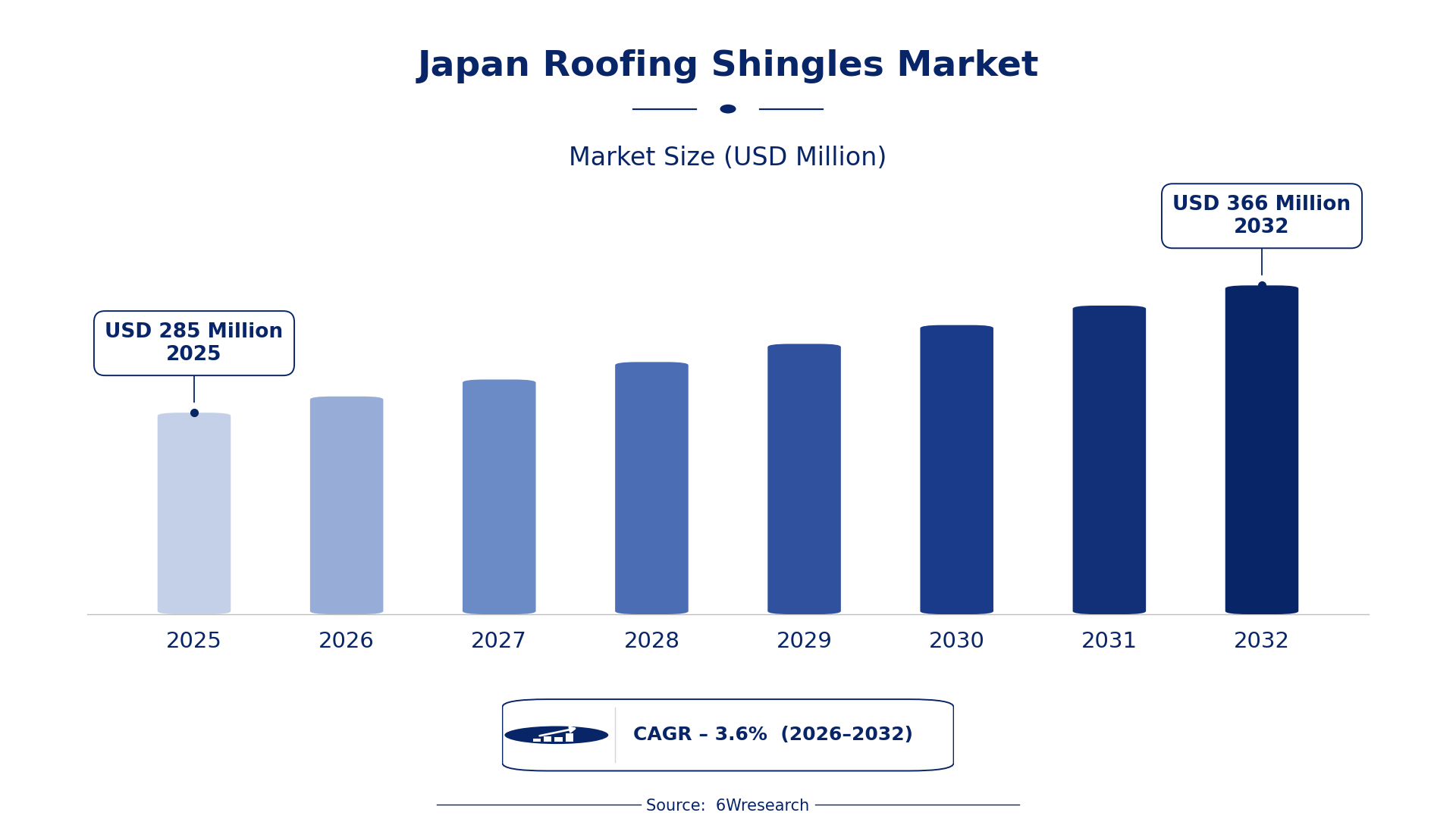
According to 6Wresearch internal database and industry insights, the Japan Roofing Shingles Market was valued at USD 285 Million in 2025 and is projected to reach USD 366 Million by 2032, growing at a CAGR of approximately 3.6% during 2026–2032.
Japan Roofing Shingles Market Highlights
| Report Metric | Details |
| Report Name | Japan Roofing Shingles Market (2026-2032) |
| Market Size 2025 | USD 285 Million |
| Market Size 2032 | USD 366 Million |
| Absolute Growth 2025–2032 | USD 81 Million |
| CAGR 2026–2032 | 3.6% |
| Peak Annual Growth | 4.3% in 2028 |
| Forecast Period | 2026–2032 |
| Historical Data | 2022–2025 |
| Base Year | 2025 |
| Leading Shingle Type, 2025 | Asphalt Shingles (44% share) |
| Leading Material Composition, 2025 | Fiberglass Base (36% share) |
| Leading Style Variant, 2025 | 3-Tab / Architectural (45% share) |
| Leading End User, 2025 | Residential Roofers (35% share) |
| Fastest-Growing Shingle Type | Composite Shingles (4.9% CAGR) |
| Fastest-Growing Material Composition | Synthetic Polymers (5.3% CAGR) |
| Fastest-Growing Style Variant | Standing Seam / Tile Look (4.7% CAGR) |
| Fastest-Growing End User | Commercial Builders (4.6% CAGR) |
| Growing Sector | Residential Roofing |
| Key End Users | Residential Roofers, Commercial Builders, Roofing Contractors |
Japan Roofing Shingles Market Year-wise Growth Rate and Key Drivers (2022–2032)
This graph illustrates the annual growth rates of the market from 2022 to 2032, highlighting a steady upward trajectory and projected market expansion over the forecast period.
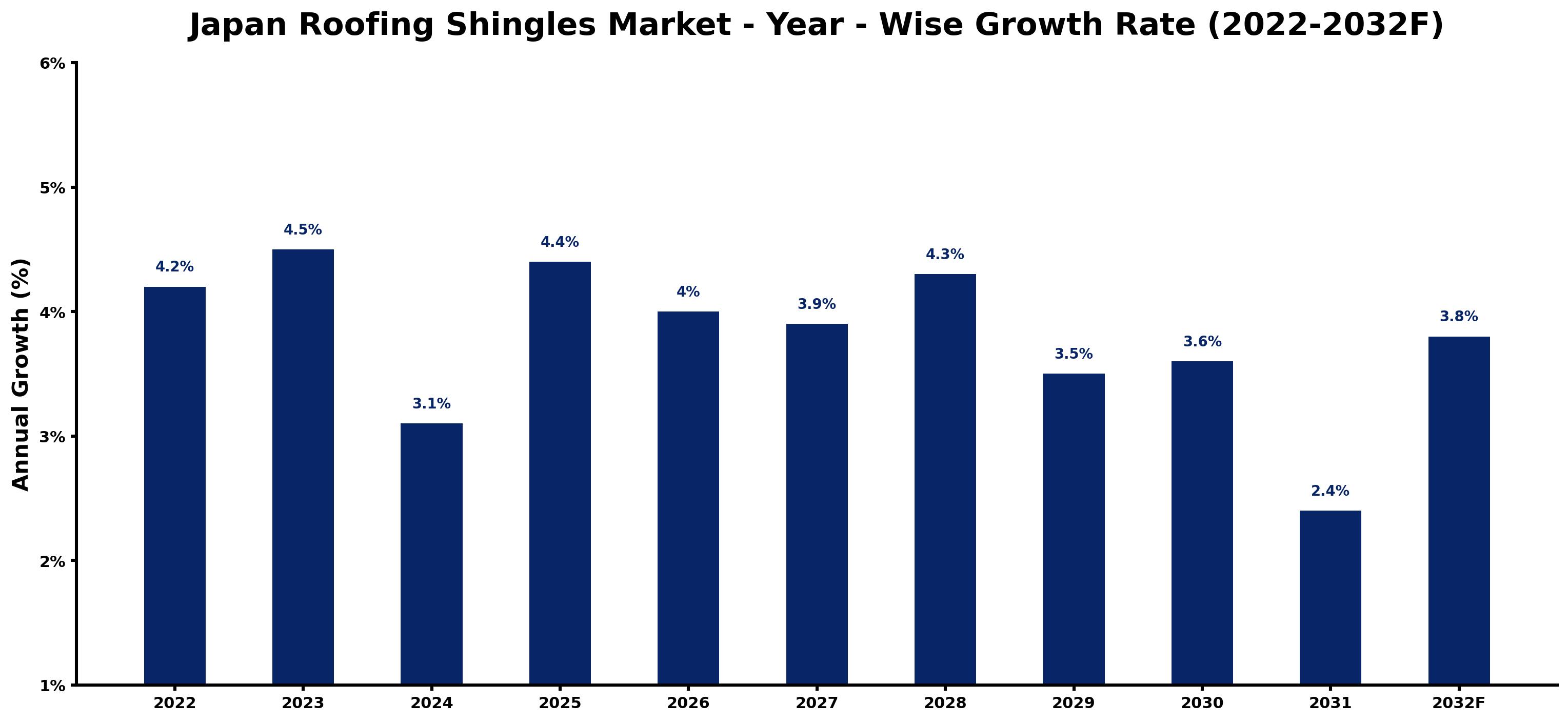
Each row of the following table gives one year's estimated growth and the event or demand shift that explains it.
| Year | Estimated Annual Growth (%) | Market Rationale |
| 2022 | 4.2 | The market experienced solid growth due to strong residential construction activity. |
| 2023 | 4.5 | Growth accelerated as urban development projects increased demand for roofing materials. |
| 2024 | 3.1 | The market saw a slowdown as construction activities stabilised after previous highs. |
| 2025 | 4.4 | Demand surged again with rising residential building projects across major cities. |
| 2026 | 4.0 | Growth is expected to slow slightly as the market adjusts to previous rapid expansions. |
| 2027 | 3.9 | A continued slowdown is projected as builders face supply chain challenges. |
| 2028 | 4.3 | The market is expected to rebound with renewed interest in energy-efficient roofing solutions. |
| 2029 | 3.5 | Growth is projected to slow again as competition intensifies among roofing material suppliers. |
| 2030 | 3.6 | Demand is expected to pick up as urban renewal projects gain momentum. |
| 2031 | 2.4 | The market will face a slowdown as regulatory compliance becomes more stringent. |
| 2032 | 3.8 | Growth is expected to accelerate with increased investments in sustainable roofing materials. |
Note: Market size estimations and growth projections presented in this report are based on 6Wresearch's proprietary forecasting methodology, utilizing the latest available industry data, government publications, and primary research inputs.
Japan Roofing Shingles Market Synopsis
The Japan Roofing Shingles Market encompasses various materials, including asphalt, metal, and composites, which provide waterproofing and insulation for buildings. Demand is primarily driven by the residential construction sector, valued at approximately 5 trillion JPY in 2022. Urban development projects and government initiatives promoting energy-efficient materials are further boosting demand, particularly for asphalt and composite shingles, which are increasingly favoured by builders and contractors.
Market Dynamics Impact Analysis (2026–2032)
| Factor | Type | Impact | Primary Segment Affected |
| Growing residential construction projects | Driver | High | Asphalt Shingles |
| Increased adoption of energy-efficient roofing materials | Driver | High | Composite Shingles |
| Rising demand for sustainable roofing solutions | Opportunity | Medium | Metal Shingles |
| Expansion of urban development initiatives | Opportunity | High | Composite Shingles |
| High installation costs for roofing materials | Restraint | High | Asphalt Shingles |
| Limited availability of skilled roofing contractors | Restraint | Medium | Metal Shingles |
| Compliance with stringent building regulations | Challenge | High | Composite Shingles |
| Fluctuating raw material prices affecting production | Challenge | Medium | Asphalt Shingles |
Evaluation of Drivers in Japan Roofing Shingles Market (2026–2032)
Demand rests on the following drivers, each shown with the segment it touches most.
| Drivers | Primary Segment Affected | Why It Matters (Evidence) |
| Increased residential construction activity | Asphalt Shingles | The residential construction sector was valued at approximately 5 trillion JPY in 2022, driving demand for cost-effective roofing solutions. |
| Shift towards energy-efficient roofing | Composite Shingles | Government initiatives launched in 2023 are promoting energy-efficient materials, leading to increased purchases of composite shingles. |
| Urban development projects in major cities | Metal Shingles | The ongoing urban development is expected to create significant demand for durable roofing solutions, with metal shingles accounting for about 15% of the market. |
| Growing awareness of sustainability | Composite Shingles | The introduction of sustainable roofing initiatives in 2023 is encouraging builders to opt for eco-friendly materials. |
| Aging housing stock requiring replacements | Asphalt Shingles | The average age of homes in Japan is around 30 years, necessitating roof replacements and driving demand for asphalt shingles. |
Much of the new demand traces back to the residential construction sector, valued at approximately 5 trillion JPY in 2022, which has spurred purchases of roofing materials. Ongoing urban development projects in the Tokyo metropolitan area are driving demand, with metal shingles accounting for about 15% of the market. The aging housing stock, with an average age of 30 years, necessitates roof replacements, boosting demand for durable solutions. Builders are increasingly opting for eco-friendly materials, reflecting a growing awareness of sustainability.
Evaluation of Restraints in Japan Roofing Shingles Market
The main factors holding the market back are set out below.
| Market Restraint | Primary Segment Affected | Why It Matters (Evidence) |
| High installation costs for roofing materials | Asphalt Shingles | The average cost of roofing installation ranges from 1,500 to 3,000 JPY per square meter, limiting affordability for some buyers. |
| Limited availability of skilled roofing contractors | Metal Shingles | A shortage of qualified roofing contractors can delay project timelines and increase costs for builders. |
| Strict compliance with building regulations | Composite Shingles | Compliance with standards such as JIS A 5402 requires additional testing and certification, which can extend project timelines. |
| Volatility in raw material prices | Asphalt Shingles | Fluctuating raw material costs can impact production budgets and pricing strategies for roofing contractors. |
| Intense competition among roofing material suppliers | Metal Shingles | Heightened competition can lead to price wars, affecting profit margins for suppliers. |
Japan Roofing Shingles Market Challenges
Contractors in the roofing market often face inefficiencies due to outdated technology, which can inflate project costs by up to 20%. Suppliers struggle with sourcing quality materials because local production capabilities are limited, causing delays of up to three months for contractors. Strict adherence to JIS A 5402 regulations complicates operations, as contractors must ensure compliance, potentially pushing project timelines back. Buyers experience rising installation costs, averaging between 1,500 to 3,000 JPY per square meter, which can strain budgets, particularly for residential renovations.
Trends in the Japan Roofing Shingles Market
Four trends stand out in the Japan Roofing Shingles Market.
- Shift towards Energy-Efficient Roofing Materials: Residential builders are increasingly adopting energy-efficient roofing solutions, influenced by new government programmes. In 2023, a programme was launched to promote these materials, resulting in a notable increase in demand.
- Growing Popularity of Composite Shingles: Composite shingles are gaining traction among contractors due to their lightweight and durable properties. In 2022, over 60% of new residential buildings utilized asphalt shingles, but the trend is shifting towards composites.
- Increased Adoption of ISO 9001 Standards: Roofing contractors are increasingly implementing ISO 9001 standards for quality management. This trend is particularly visible in the Kanto region, where many contractors are adopting these practices.
- Rising Demand for Metal Shingles in Commercial Buildings: Commercial builders are increasingly opting for metal shingles due to their durability. Currently, metal shingles account for about 15% of the roofing market in Japan.
Investment Opportunities in the Japan Roofing Shingles Market
The following opportunities in the Japan Roofing Shingles Market pair current demand with a clear way in.
- Partnerships with Local Contractors: Collaborating with local roofing contractors can provide access to the growing market. The average installation cost ranges from 1,500 to 3,000 JPY per square meter, indicating a substantial opportunity.
- Expansion in Urban Development Areas: With urban development projects projected to rise, there is a gap in the supply of roofing materials. The Tokyo metropolitan area is a major hub for roofing contractors, presenting an opportunity for suppliers.
- Supply of Sustainable Roofing Materials: The 2023 initiative promoting sustainable roofing materials creates a demand for eco-friendly products. Suppliers can target commercial builders looking to meet new sustainability standards.
- Investment in Composite Shingle Production: As composite shingles gain popularity, investing in production capabilities can meet the growing demand. The market for composite shingles is anticipated to expand in the coming years.
Government Initiatives in the Japan Roofing Shingles Market
The Economic Security Promotion Act, enacted in 2022, strengthens supply-chain resilience for critical roofing materials, building on previous regulations like the Act on the Rational Use of Energy from 1979. This law requires large energy users to improve energy efficiency, impacting the roofing sector by encouraging the use of energy-efficient materials in construction projects.
Roofing contractors benefit from the PRTR Law, which mandates businesses to report chemical substances. The Ministry of Land, Infrastructure, Transport and Tourism oversees compliance, ensuring that roofing materials meet safety and environmental standards.
Future Insight of the Japan Roofing Shingles Market
The investment pipeline for energy-efficient roofing technologies will reshape the market by 2032, creating significant demand for advanced materials. Urban development will necessitate replacing aging roofs, with around 30% of homes requiring new installations. Government initiatives promoting sustainable materials will encourage buyers to choose eco-friendly options, aligning with global trends. As quality management improves through the adoption of ISO 9001 standards, suppliers will benefit from operational efficiency, positively impacting the overall market.
Market Segmentation Analysis
Japan Roofing Shingles Market report covers a detailed analysis of the following market segments:
By Shingle Type – Asphalt Shingles Lead, Composite Shingles Expected to Grow Fastest
According to Saurav Kr Singh, Senior Research Analyst at 6Wresearch, with 44% of shingle type revenue in 2025, Asphalt Shingles was the largest category. Asphalt shingles dominate the market due to their cost-effectiveness and widespread use in residential roofing. In 2022, over 60% of new residential buildings in Japan utilised asphalt shingles, highlighting their popularity among homeowners. Over 2026–2032, Composite Shingles are expected to post the fastest growth, at a CAGR of 4.9%. Composite shingles are experiencing rapid growth as they offer versatility and durability, appealing to a growing segment of environmentally conscious consumers. The government's 2023 initiative to promote energy-efficient roofing materials further supports this trend. Suppliers should focus on expanding their composite shingle offerings to meet the rising demand.
By Material Composition – Fiberglass Base Leads, Synthetic Polymers Expected to Grow Fastest
Fiberglass Base took 36% of material composition revenue in 2025, more than any other category. Fiberglass base is essential for asphalt shingles, delivering the strength and durability required for effective roofing. Its widespread use in residential projects, particularly in urban areas, underpins its dominant market position. The quickest growth will come from Synthetic Polymers, forecast to expand at a CAGR of 5.3% between 2026 and 2032. The rising adoption of synthetic polymers is attributed to their flexibility, making them suitable for composite shingles that meet contemporary design requirements. This trend is expected to accelerate as builders seek lightweight and resilient roofing options. Suppliers must focus on developing and promoting synthetic polymer products to meet the increasing demand for composite shingles.
By Style Variant – 3-Tab / Architectural Leads, Standing Seam / Tile Look Expected to Grow Fastest
3-Tab / Architectural held 45% of the Japan Roofing Shingles Market by style variant in 2025. The 3-tab and architectural styles are extensively used in residential roofing, providing a classic look that resonates with homeowners. Their prevalence in new residential constructions, particularly in urban settings, solidifies their leading market share. Standing Seam / Tile Look is projected to grow fastest, at a CAGR of 4.7% during 2026–2032. Standing seam and tile look styles are increasingly favoured for modern commercial buildings, where both aesthetics and functionality are critical. This preference is set to grow as urban development continues to rise. Suppliers should expand their offerings to include contemporary style variants to cater to the evolving preferences of commercial builders.
By End User – Residential Roofers Lead, Commercial Builders Expected to Grow Fastest
The largest end user category in 2025 was Residential Roofers, at 35% of revenue. Residential roofers are the primary users of various shingle types, driven by the high demand for roofing in the residential sector. Their reliance on asphalt shingles reflects the established practices in home construction. Commercial Builders are set to record the highest CAGR in this split, 4.6% over 2026–2032. Commercial builders are increasingly seeking metal and composite shingles, responding to the demand for durable and efficient roofing solutions. This shift is indicative of broader trends in commercial construction towards sustainability. Suppliers must strengthen relationships with commercial builders to tap into the growing demand for advanced roofing materials.
Key Attractiveness of the Report
- 10 Years of Market Numbers
- Historical Data Starting from 2022 to 2025
- Base Year 2025
- Forecast Data until 2032
- Key Performance Indicators Impacting the Market
- Major Upcoming Developments and Projects
Key Highlights of the Report:
- Japan Roofing Shingles Market Outlook
- Market Size of Japan Roofing Shingles Market, 2025
- Forecast of Japan Roofing Shingles Market, 2032
- Historical Data and Forecast of Japan Roofing Shingles Revenues & Volume for the Period 2022-2032F
- Japan Roofing Shingles Market Trend Evolution
- Japan Roofing Shingles Market Drivers and Challenges
- Japan Roofing Shingles Price Trends
- Japan Roofing Shingles Porter's Five Forces
- Japan Roofing Shingles Industry Life Cycle
- Historical Data and Forecast of Japan Roofing Shingles Market Revenues & Volume By Shingle Type for the Period 2022-2032F
- Historical Data and Forecast of Japan Roofing Shingles Market Revenues & Volume By Asphalt Shingles for the Period 2022-2032F
- Historical Data and Forecast of Japan Roofing Shingles Market Revenues & Volume By Metal Shingles for the Period 2022-2032F
- Historical Data and Forecast of Japan Roofing Shingles Market Revenues & Volume By Wood Shingles for the Period 2022-2032F
- Historical Data and Forecast of Japan Roofing Shingles Market Revenues & Volume By Composite Shingles for the Period 2022-2032F
- Historical Data and Forecast of Japan Roofing Shingles Market Revenues & Volume By Material Composition for the Period 2022-2032F
- Historical Data and Forecast of Japan Roofing Shingles Market Revenues & Volume By Fiberglass Base for the Period 2022-2032F
- Historical Data and Forecast of Japan Roofing Shingles Market Revenues & Volume By Aluminum / Steel for the Period 2022-2032F
- Historical Data and Forecast of Japan Roofing Shingles Market Revenues & Volume By Cedar / Pine for the Period 2022-2032F
- Historical Data and Forecast of Japan Roofing Shingles Market Revenues & Volume By Synthetic Polymers for the Period 2022-2032F
- Historical Data and Forecast of Japan Roofing Shingles Market Revenues & Volume By Style Variant for the Period 2022-2032F
- Historical Data and Forecast of Japan Roofing Shingles Market Revenues & Volume By 3-Tab / Architectural for the Period 2022-2032F
- Historical Data and Forecast of Japan Roofing Shingles Market Revenues & Volume By Standing Seam / Tile Look for the Period 2022-2032F
- Historical Data and Forecast of Japan Roofing Shingles Market Revenues & Volume By Tapered Edge Style for the Period 2022-2032F
- Historical Data and Forecast of Japan Roofing Shingles Market Revenues & Volume By Designer Patterns for the Period 2022-2032F
- Historical Data and Forecast of Japan Roofing Shingles Market Revenues & Volume By End User for the Period 2022-2032F
- Historical Data and Forecast of Japan Roofing Shingles Market Revenues & Volume By Residential Roofers for the Period 2022-2032F
- Historical Data and Forecast of Japan Roofing Shingles Market Revenues & Volume By Commercial Builders for the Period 2022-2032F
- Historical Data and Forecast of Japan Roofing Shingles Market Revenues & Volume By Heritage Home Renovators for the Period 2022-2032F
- Historical Data and Forecast of Japan Roofing Shingles Market Revenues & Volume By Roofing Contractors for the Period 2022-2032F
- Japan Roofing Shingles Import Export Trade Statistics
- Market Opportunity Assessment By Shingle Type
- Market Opportunity Assessment By Material Composition
- Market Opportunity Assessment By Style Variant
- Market Opportunity Assessment By End User
- Japan Roofing Shingles Top Companies Market Share
- Japan Roofing Shingles Competitive Benchmarking By Technical and Operational Parameters
- Japan Roofing Shingles Company Profiles
- Japan Roofing Shingles Key Strategic Recommendations
Market Covered
The following segment groups are covered in the report.
By Shingle Type
- Asphalt Shingles
- Metal Shingles
- Wood Shingles
- Composite Shingles
By Material Composition
- Fiberglass Base
- Aluminum / Steel
- Cedar / Pine
- Synthetic Polymers
By Style Variant
- 3-Tab / Architectural
- Standing Seam / Tile Look
- Tapered Edge Style
- Designer Patterns
By End User
- Residential Roofers
- Commercial Builders
- Heritage Home Renovators
- Roofing Contractors































