Japan Rotor Balancing Machine Market Size & Growth Rate
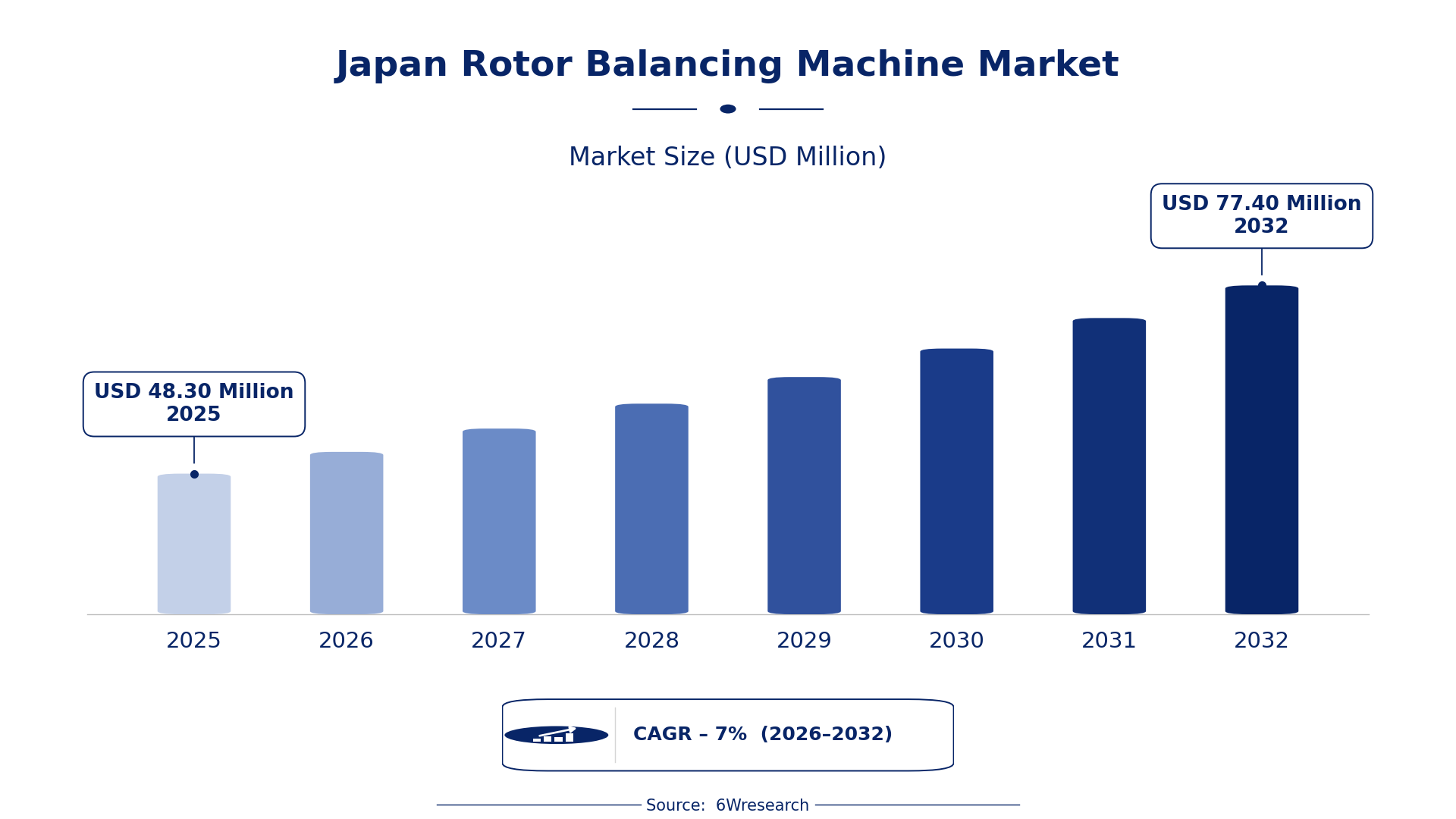
According to 6Wresearch internal database and industry insights, the Japan Rotor Balancing Machine Market was valued at USD 48.30 Million in 2025 and is projected to reach USD 77.40 Million by 2032, growing at a CAGR of approximately 7% during 2026–2032.
Japan Rotor Balancing Machine Market Highlights
| Report Metric | Details |
| Report Name | Japan Rotor Balancing Machine Market (2026-2032) |
| Market Size 2025 | USD 48.30 Million |
| Market Size 2032 | USD 77.40 Million |
| Absolute Growth 2025–2032 | USD 29.10 Million |
| CAGR 2026–2032 | 7% |
| Peak Annual Growth | 8.5% in 2026 |
| Forecast Period | 2026–2032 |
| Historical Data | 2022–2025 |
| Base Year | 2025 |
| Leading Machine Type, 2025 | Two-Plane Balancers (56% share) |
| Leading Balancing Method, 2025 | Static and Dynamic (39% share) |
| Leading Size Range, 2025 | Medium to Large Rotors (43% share) |
| Leading End User, 2025 | Motor Manufacturing Lines (42% share) |
| Fastest-Growing Machine Type | Portable Balancers (9.9% CAGR) |
| Fastest-Growing Balancing Method | On-Site Vibration-Based (9.7% CAGR) |
| Fastest-Growing Size Range | High-Speed Rotors (8.9% CAGR) |
| Fastest-Growing End User | Maintenance Service Teams (9.0% CAGR) |
| Growing Sector | motor manufacturing |
| Key End Users | motor manufacturers, aerospace component plants, turbine manufacturers, maintenance service teams |
Japan Rotor Balancing Machine Market Year-wise Growth Rate and Key Drivers (2022–2032)
This graph illustrates the annual growth rates of the market from 2022 to 2032, highlighting a steady upward trajectory and projected market expansion over the forecast period.
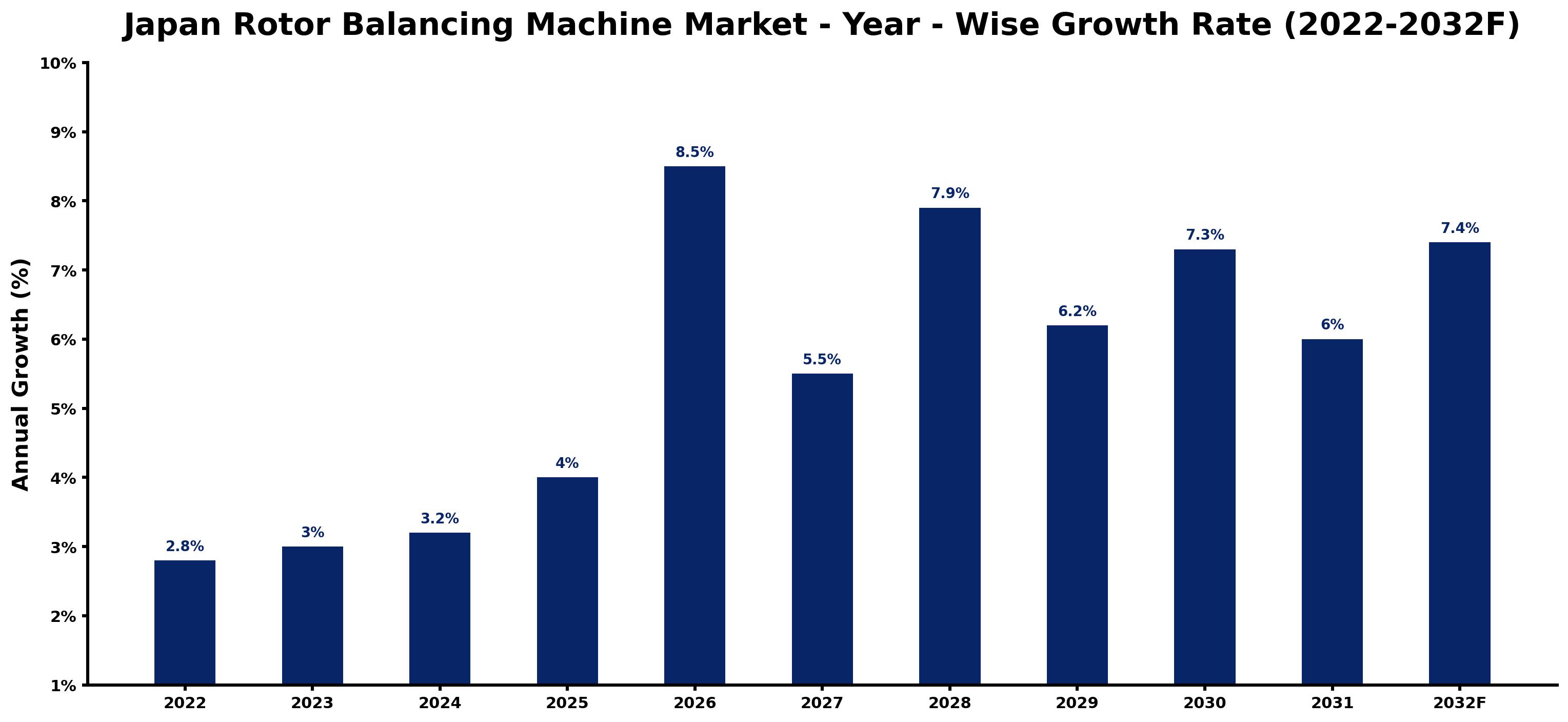
Annual growth estimates for each year appear below with the principal reason behind them, explaining the shifts that set the pace of the market.
| Year | Estimated Annual Growth (%) | Market Rationale |
| 2022 | 2.8 | The market experienced steady growth due to ongoing demand from motor manufacturing facilities. |
| 2023 | 3.0 | Increased production rates in the aerospace sector drove faster growth than the previous year. |
| 2024 | 3.2 | The rise in turbine manufacturing activities contributed to continued growth in the market. |
| 2025 | 4.0 | Demand surged as manufacturers modernised equipment to meet evolving standards. |
| 2026 | 8.5 | The peak growth year is attributed to substantial investments in rotor balancing technology. |
| 2027 | 5.5 | Growth is expected to slow as the market adjusts following the peak investment phase. |
| 2028 | 7.9 | A resurgence in aerospace and turbine production is projected to spur faster growth again. |
| 2029 | 6.2 | Growth is anticipated to slow as manufacturers face challenges in sourcing advanced technology. |
| 2030 | 7.3 | Increased focus on efficiency in production lines will boost demand for balancing machines. |
| 2031 | 6.0 | A slight slowdown is expected as the market stabilises after rapid expansion. |
| 2032 | 7.4 | The market is projected to grow steadily as modernization efforts continue. |
Note: Market size estimations and growth projections presented in this report are based on 6Wresearch's proprietary forecasting methodology, utilizing the latest available industry data, government publications, and primary research inputs.
Japan Rotor Balancing Machine Market Synopsis
Rotor balancing machines are precision tools that ensure rotors operate smoothly without vibration. They find applications in various industries, including motor manufacturing, aerospace, and turbine production. The Japan Rotor Balancing Machine Market is growing due to over 1,000 motor manufacturing facilities and a burgeoning aerospace sector that employs around 80,000 people. The adoption of advanced standards and programmes, such as the JIS B 0901, fuels demand for these machines, driving market growth.
Market Dynamics Impact Analysis (2026–2032)
| Factor | Type | Impact | Primary Segment Affected |
| High demand from motor manufacturing facilities is driving the need for precision balancing tools. | Driver | High | Motor Manufacturing Lines |
| The aerospace sector's expansion is creating opportunities for rotor balancing machine suppliers. | Driver | High | Aerospace Component Plants |
| The increasing adoption of portable balancers in maintenance services presents a significant opportunity. | Opportunity | High | Maintenance Service Teams |
| The focus on renewable energy is driving growth in the turbine manufacturing sector. | Opportunity | High | Turbine & Compressor OEMs |
| The average age of existing balancing machines exceeds 10 years, indicating a need for upgrades. | Restraint | Medium | Two-Plane Balancers |
| High costs associated with advanced balancing technology can deter smaller manufacturers from upgrading. | Restraint | Medium | Two-Plane Balancers |
| Limited availability of skilled technicians affects the deployment of advanced balancing solutions. | Challenge | High | Two-Plane Balancers |
| Competition from international suppliers may pressure local manufacturers' market share. | Challenge | Medium | Two-Plane Balancers |
Evaluation of Drivers in Japan Rotor Balancing Machine Market (2026–2032)
Demand rests on the following drivers, each shown with the segment it touches most.
| Drivers | Primary Segment Affected | Why It Matters (Evidence) |
| The high number of motor manufacturing facilities drives demand for rotor balancing machines. | Motor Manufacturing Lines | Japan has over 1,000 motor manufacturing facilities, increasing the need for precision balancing. |
| The aerospace sector's growth leads to higher demand for balancing machines. | Aerospace Component Plants | Approximately 80,000 people are employed in Japan's aerospace sector, boosting machinery requirements. |
| Investment in rotor balancing technology is encouraged under the Industrial Safety and Health Act. | Two-Plane Balancers | This law mandates safety standards, prompting manufacturers to purchase advanced balancing machines. |
| The adoption of standards like JIS B 0901 improves rotor balancing practices. | Two-Plane Balancers | Compliance with these standards drives manufacturers to invest in updated balancing solutions. |
| The growth of the turbine manufacturing industry supports demand for balancing machines. | Turbine & Compressor OEMs | The sector is projected to grow, requiring more precision balancing for turbine components. |
Buyers are adding capacity as Japan's motor manufacturing facilities exceed 1,000, driving demand for rotor balancing machines. The aerospace sector employs around 80,000 people, which boosts the need for precise solutions. The growth of the turbine manufacturing industry necessitates precision balancing for turbine components, boosting overall market demand. Additionally, the adoption of standards like JIS B 0901 leads manufacturers to invest in advanced solutions.
Evaluation of Restraints in Japan Rotor Balancing Machine Market
The main factors holding the market back are set out below.
| Market Restraint | Primary Segment Affected | Why It Matters (Evidence) |
| The average age of rotor balancing machines in use exceeds 10 years, indicating a need for upgrades. | Two-Plane Balancers | Older machines may lack modern features, limiting efficiency and accuracy. |
| High costs associated with advanced balancing technology can deter smaller manufacturers from upgrading. | Two-Plane Balancers | Smaller manufacturers may struggle to afford the latest technology, slowing market growth. |
| Limited availability of skilled technicians affects the deployment of advanced balancing solutions. | Two-Plane Balancers | A shortage of qualified personnel can delay machine installation and operation. |
| Competition from international suppliers may pressure local manufacturers' market share. | Two-Plane Balancers | Local companies may face challenges in pricing and technology compared to global competitors. |
| The complexity of balancing methods can deter some manufacturers from adopting new technology. | Two-Plane Balancers | Manufacturers may prefer simpler solutions over advanced balancing techniques. |
Japan Rotor Balancing Machine Market Challenges
Portable balancers are gaining traction among maintenance service teams, but their higher initial costs may constrain budgets for buyers, delaying essential upgrades. The average age of rotor balancing machines in operation exceeds 10 years, leading to increased downtime and maintenance costs for producers, which affects operational efficiency. Compliance with the ISO 1940 standard incurs additional costs for manufacturers, potentially raising prices for buyers by up to 15%. Dependence on outdated technology limits the availability of advanced balancing solutions, causing delays in meeting the growing demand from sectors such as aerospace and renewable energy.
Trends in the Japan Rotor Balancing Machine Market
The trends below show where the Japan Rotor Balancing Machine Market is heading.
- Shift from Static to Dynamic Balancing: In 2023, the trend towards dynamic balancing methods gained momentum as manufacturers recognised their advantages. Over 60% of rotor balancing applications now utilise dynamic techniques, improving accuracy and efficiency.
- Increase in Portable Balancer Adoption: The adoption of portable balancers in maintenance service teams has risen, with a 20% increase in efficiency reported. This trend reflects the growing need for on-site balancing solutions across various industries.
- Growth in High-Speed Rotor Applications: High-speed rotors are becoming increasingly prevalent, particularly in aerospace applications, which account for 30% of demand. This shift requires advanced balancing solutions to ensure safety and performance.
- Expansion of In-Line Balancing in Automotive Production: In-line balancing is gaining traction in automotive production lines, enhancing efficiency. This trend is supported by the growing need for precision in high-volume manufacturing environments.
Investment Opportunities in the Japan Rotor Balancing Machine Market
The opportunities below stand out in the Japan Rotor Balancing Machine Market for new entrants and existing suppliers.
- Chubu Region's Aerospace Component Plants: The Chubu region is known for its concentration of aerospace component plants, presenting opportunities for suppliers. With a projected growth in the aerospace sector, investment in balancing technology is timely.
- Supply of Portable Balancers: Portable balancers are increasingly adopted in maintenance service teams, creating a demand for suppliers. This trend is driven by the need for on-site solutions, making it an opportune time to enter the market.
- Entry through Joint Ventures: Establishing joint ventures with local manufacturers can facilitate market entry. This approach allows foreign suppliers to utilise local expertise and distribution networks, ensuring successful integration.
- Timing with Renewable Energy Focus: The current emphasis on renewable energy creates a demand for turbine balancing solutions. Suppliers can capitalise on this trend by offering advanced balancing machines tailored to the turbine sector.
Government Initiatives in the Japan Rotor Balancing Machine Market
The New Robot Strategy, initiated in 2015, promotes the integration of robotics in manufacturing and services. This initiative aligns with the Industrial Safety and Health Act, which mandates employer responsibilities for machinery safety, ensuring producers comply with rigorous standards for rotor balancing machines.
The Ministry of Economy, Trade and Industry supports advancements in rotor technology with funding of JPY 5 billion for manufacturing projects. This financial support enables manufacturers to adopt modern balancing solutions, enhancing efficiency and safety in production.
Future Insight of the Japan Rotor Balancing Machine Market
Motor manufacturers will increasingly adopt advanced rotor balancing technology by 2032, influenced by the Ministry of Economy, Trade and Industry's programme aimed at improving manufacturing efficiency. The installed base of machines is expected to modernise, shifting towards high-performance applications. As the aerospace sector expands, the demand for precision tools will grow, prompting suppliers to innovate. The focus on renewable energy will stimulate investment in turbine manufacturing, further increasing the need for effective balancing solutions.
Market Segmentation Analysis
Japan Rotor Balancing Machine Market report covers a detailed analysis of the following market segments:
By Machine Type – Two-Plane Balancers Lead, Portable Balancers Expected to Grow Fastest
According to Saurav Kr Singh, Senior Research Analyst at 6Wresearch, the largest machine type category in 2025 was Two-Plane Balancers, at 56% of revenue. Two-Plane Balancers are crucial for addressing complex rotor balancing needs, making them the top choice for manufacturers. Their prevalent use in over 1,000 motor manufacturing facilities in Japan highlights their role in maintaining operational reliability. The quickest growth will come from Portable Balancers, forecast to expand at a CAGR of 9.9% between 2026 and 2032. The rise of Portable Balancers is attributed to their adaptability for on-site balancing in diverse industries. Reports indicate a 20% increase in efficiency among maintenance service teams using these modern machines, suggesting a trend towards portable solutions. Suppliers should prioritise the development of Portable Balancers to cater to the increasing demand from maintenance service teams.
By Balancing Method – Static and Dynamic Leads, On-Site Vibration-Based Expected to Grow Fastest
Static and Dynamic held 39% of the Japan Rotor Balancing Machine Market by balancing method in 2025. Static and Dynamic methods are critical for accurate balancing measurements, which is vital for the performance of rotors. This method is employed in over 60% of rotor balancing applications, showcasing its dominance in the market. On-Site Vibration-Based is set to record the highest CAGR in this split, 9.7% over 2026–2032. On-Site Vibration-Based methods are gaining traction as they provide immediate balancing solutions, catering to the urgent needs of industries. This shift reflects a growing preference for efficiency in maintenance operations. Buyers are likely to prioritise suppliers that offer On-Site Vibration-Based solutions to improve operational efficiency.
By Size Range – Medium to Large Rotors Lead, High-Speed Rotors Expected to Grow Fastest
Medium to Large Rotors took 43% of size range revenue in 2025, more than any other category. Medium to Large Rotors are primarily employed in heavy machinery and turbines, which are vital sectors within Japan's manufacturing framework. Their significant role in the turbine manufacturing industry emphasises their importance for large-scale production. High-Speed Rotors are projected to grow fastest, at a CAGR of 8.9% during 2026–2032. High-Speed Rotors are gaining prominence due to their essential role in aerospace and high-performance applications, leading to their swift growth. This trend aligns with the expansion of the aerospace sector, which employs approximately 80,000 individuals and requires sophisticated balancing solutions. Suppliers should adjust their product strategies to meet the rising demand for High-Speed Rotors in aerospace applications.
By End User – Motor Manufacturing Lines Lead, Maintenance Service Teams Expected to Grow Fastest
Motor Manufacturing Lines accounted for 42% of the market by end user in 2025. Motor Manufacturing Lines are the primary users of rotor balancing machines, reflecting their foundational role in the production process. The extensive installed base of balancing machines in these lines indicates a stable demand. Over 2026–2032, Maintenance Service Teams are expected to post the fastest growth, at a CAGR of 9.0%. Maintenance Service Teams are experiencing growth due to their essential support for rotor balancing, particularly with the rise of portable solutions. This trend is likely to continue as efficiency becomes a priority. Suppliers should consider developing tailored solutions for Maintenance Service Teams to capitalise on this growing segment.
Key Attractiveness of the Report
- 10 Years of Market Numbers
- Historical Data Starting from 2022 to 2025
- Base Year 2025
- Forecast Data until 2032
- Key Performance Indicators Impacting the Market
- Major Upcoming Developments and Projects
Key Highlights of the Report:
- Japan Rotor Balancing Machine Market Outlook
- Market Size of Japan Rotor Balancing Machine Market, 2025
- Forecast of Japan Rotor Balancing Machine Market, 2032
- Historical Data and Forecast of Japan Rotor Balancing Machine Revenues & Volume for the Period 2022-2032F
- Japan Rotor Balancing Machine Market Trend Evolution
- Japan Rotor Balancing Machine Market Drivers and Challenges
- Japan Rotor Balancing Machine Price Trends
- Japan Rotor Balancing Machine Porter's Five Forces
- Japan Rotor Balancing Machine Industry Life Cycle
- Historical Data and Forecast of Japan Rotor Balancing Machine Market Revenues & Volume By Machine Type for the Period 2022-2032F
- Historical Data and Forecast of Japan Rotor Balancing Machine Market Revenues & Volume By Single-Plane Balancers for the Period 2022-2032F
- Historical Data and Forecast of Japan Rotor Balancing Machine Market Revenues & Volume By Two-Plane Balancers for the Period 2022-2032F
- Historical Data and Forecast of Japan Rotor Balancing Machine Market Revenues & Volume By Portable Balancers for the Period 2022-2032F
- Historical Data and Forecast of Japan Rotor Balancing Machine Market Revenues & Volume By In-Line Balancers for the Period 2022-2032F
- Historical Data and Forecast of Japan Rotor Balancing Machine Market Revenues & Volume By Balancing Method for the Period 2022-2032F
- Historical Data and Forecast of Japan Rotor Balancing Machine Market Revenues & Volume By Static and Dynamic for the Period 2022-2032F
- Historical Data and Forecast of Japan Rotor Balancing Machine Market Revenues & Volume By Dual-Axis Balancing for the Period 2022-2032F
- Historical Data and Forecast of Japan Rotor Balancing Machine Market Revenues & Volume By On-Site Vibration-Based for the Period 2022-2032F
- Historical Data and Forecast of Japan Rotor Balancing Machine Market Revenues & Volume By On-Machine Balancing for the Period 2022-2032F
- Historical Data and Forecast of Japan Rotor Balancing Machine Market Revenues & Volume By Size Range for the Period 2022-2032F
- Historical Data and Forecast of Japan Rotor Balancing Machine Market Revenues & Volume By Small to Medium Rotors for the Period 2022-2032F
- Historical Data and Forecast of Japan Rotor Balancing Machine Market Revenues & Volume By Medium to Large Rotors for the Period 2022-2032F
- Historical Data and Forecast of Japan Rotor Balancing Machine Market Revenues & Volume By Variable Rotor Sizes for the Period 2022-2032F
- Historical Data and Forecast of Japan Rotor Balancing Machine Market Revenues & Volume By High-Speed Rotors for the Period 2022-2032F
- Historical Data and Forecast of Japan Rotor Balancing Machine Market Revenues & Volume By End User for the Period 2022-2032F
- Historical Data and Forecast of Japan Rotor Balancing Machine Market Revenues & Volume By Motor Manufacturing Lines for the Period 2022-2032F
- Historical Data and Forecast of Japan Rotor Balancing Machine Market Revenues & Volume By Turbine & Compressor OEMs for the Period 2022-2032F
- Historical Data and Forecast of Japan Rotor Balancing Machine Market Revenues & Volume By Maintenance Service Teams for the Period 2022-2032F
- Historical Data and Forecast of Japan Rotor Balancing Machine Market Revenues & Volume By Aerospace Component Plants for the Period 2022-2032F
- Japan Rotor Balancing Machine Import Export Trade Statistics
- Market Opportunity Assessment By Machine Type
- Market Opportunity Assessment By Balancing Method
- Market Opportunity Assessment By Size Range
- Market Opportunity Assessment By End User
- Japan Rotor Balancing Machine Top Companies Market Share
- Japan Rotor Balancing Machine Competitive Benchmarking By Technical and Operational Parameters
- Japan Rotor Balancing Machine Company Profiles
- Japan Rotor Balancing Machine Key Strategic Recommendations
Market Covered
The report covers the following segments.
By Machine Type
- Single-Plane Balancers
- Two-Plane Balancers
- Portable Balancers
- In-Line Balancers
By Balancing Method
- Static and Dynamic
- Dual-Axis Balancing
- On-Site Vibration-Based
- On-Machine Balancing
By Size Range
- Small to Medium Rotors
- Medium to Large Rotors
- Variable Rotor Sizes
- High-Speed Rotors
By End User
- Motor Manufacturing Lines
- Turbine & Compressor OEMs
- Maintenance Service Teams
- Aerospace Component Plants































