Japan Ruminant Feed Additive Market Size & Growth Rate
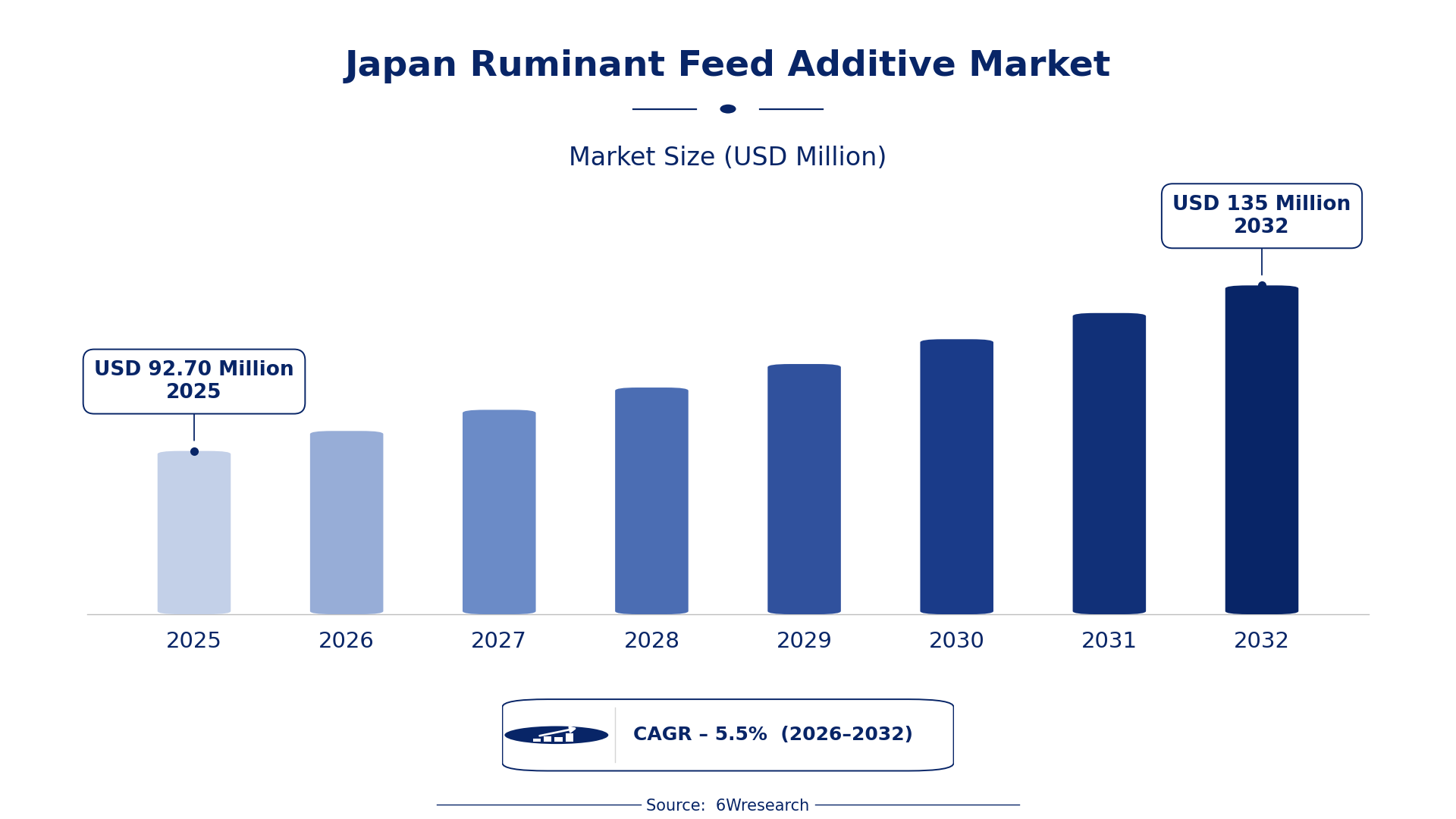
According to 6Wresearch internal database and industry insights, the Japan Ruminant Feed Additive Market was valued at USD 92.70 Million in 2025 and is projected to reach USD 135 Million by 2032, growing at a CAGR of approximately 5.5% during 2026–2032.
Japan Ruminant Feed Additive Market Highlights
| Report Metric | Details |
| Report Name | Japan Ruminant Feed Additive Market (2026-2032) |
| Market Size 2025 | USD 92.70 Million |
| Market Size 2032 | USD 135 Million |
| Absolute Growth 2025–2032 | USD 42.30 Million |
| CAGR 2026–2032 | 5.5% |
| Peak Annual Growth | 7.3% in 2026 |
| Forecast Period | 2026–2032 |
| Historical Data | 2022–2025 |
| Base Year | 2025 |
| Leading Additive Type, 2025 | Probiotics (39% share) |
| Leading Form Type, 2025 | Powder (46% share) |
| Leading Animal Type, 2025 | Cattle (45% share) |
| Leading End User, 2025 | Dairy Farmers (53% share) |
| Fastest-Growing Additive Type | Amino Acids (7.6% CAGR) |
| Fastest-Growing Form Type | Liquid (7.5% CAGR) |
| Fastest-Growing Animal Type | Sheep & Goats (8.0% CAGR) |
| Fastest-Growing End User | Livestock Farms (6.9% CAGR) |
| Growing Sector | Dairy Farming |
| Key End Users | Dairy Farmers, Livestock Farms, Feed Manufacturers |
Japan Ruminant Feed Additive Market Year-wise Growth Rate and Key Drivers (2022–2032)
This graph illustrates the annual growth rates of the market from 2022 to 2032, highlighting a steady upward trajectory and projected market expansion over the forecast period.
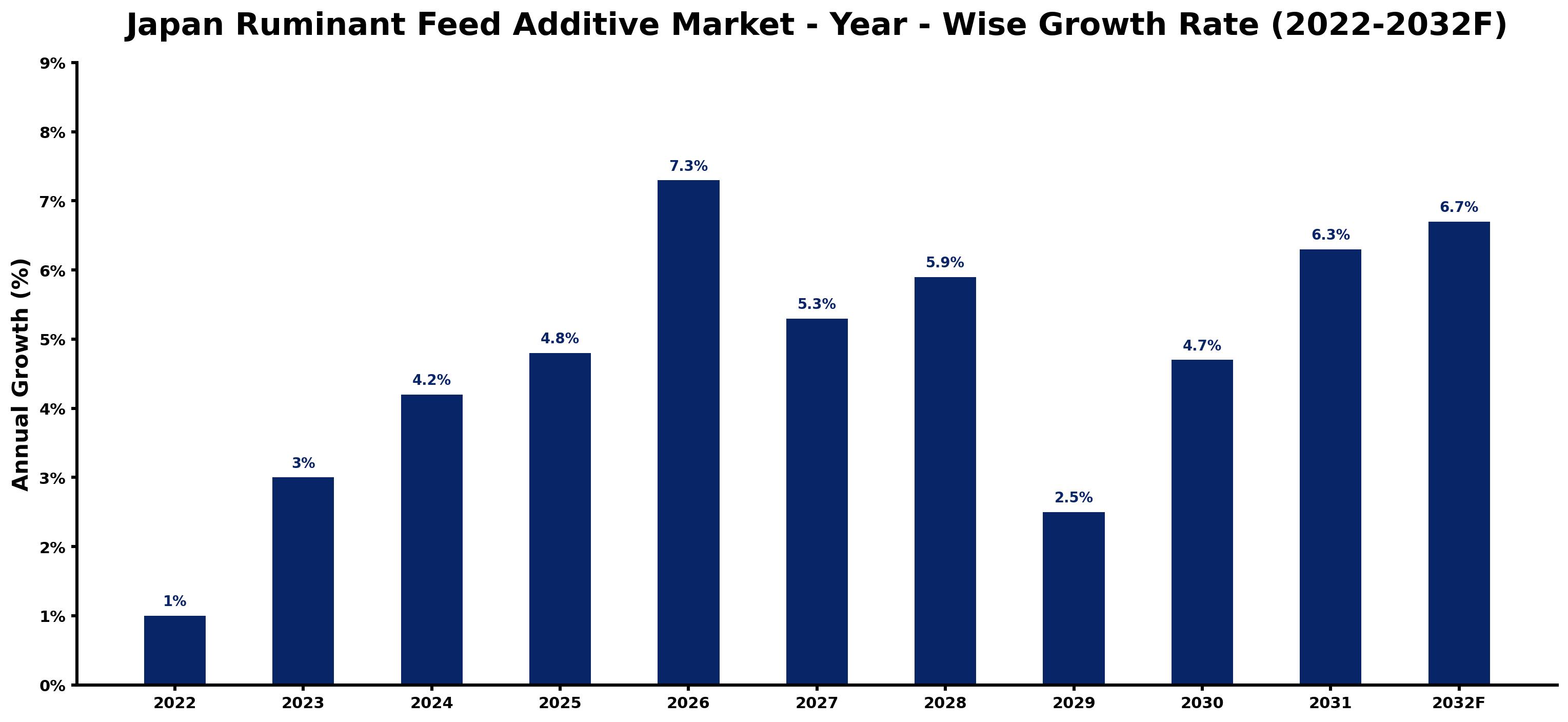
Year by year, the estimates below pair each growth rate with the development that shaped it.
| Year | Estimated Annual Growth (%) | Market Rationale |
| 2022 | 1.0 | The market showed steady activity with existing demand from domestic users. |
| 2023 | 3.0 | Growth accelerated due to increased interest in feed efficiency among livestock farmers. |
| 2024 | 4.2 | Demand continued to rise as producers sought to improve animal health and productivity. |
| 2025 | 4.8 | The market experienced a peak as dairy farmers expanded operations in Hokkaido. |
| 2026 | 7.3 | A surge in demand is anticipated from the adoption of advanced feed formulations. |
| 2027 | 5.3 | Growth is projected to slow as the market adjusts to previous high levels of demand. |
| 2028 | 5.9 | A rebound is expected as producers invest in new feed technologies and additives. |
| 2029 | 2.5 | Growth is projected to slow further as market saturation begins to take effect. |
| 2030 | 4.7 | Demand is expected to increase again as livestock farms focus on improving feed quality. |
| 2031 | 6.3 | The market is projected to grow as feed manufacturers adopt more effective solutions. |
| 2032 | 6.7 | A continued rise in demand is expected to be supported by a growing cattle population. |
Note: Market size estimations and growth projections presented in this report are based on 6Wresearch's proprietary forecasting methodology, utilizing the latest available industry data, government publications, and primary research inputs.
Japan Ruminant Feed Additive Market Synopsis
Ruminant feed additives are substances added to the feed of ruminant animals to improve their growth, health, and productivity. The Japan Ruminant Feed Additive Market is growing due to rising demand from dairy farmers, particularly in Hokkaido, which produces 60% of the country's milk. The emphasis on improving feed efficiency and livestock health drives purchases, with total livestock feed production reaching approximately 4.2 million tons in 2022. This growth is backed by advancements in feed formulations and increasing awareness of animal health benefits.
Market Dynamics Impact Analysis (2026–2032)
| Factor | Type | Impact | Primary Segment Affected |
| Increased focus on feed efficiency | Driver | High | Amino Acids |
| Growing awareness of animal health benefits | Driver | High | Probiotics |
| Rising cattle population in Japan | Opportunity | High | Cattle |
| Expansion of dairy farming in Hokkaido | Opportunity | High | Dairy Farmers |
| Regulatory compliance costs for feed manufacturers | Restraint | Medium | Feed Manufacturers |
| Limited awareness of feed additives among small farmers | Restraint | Medium | Livestock Farms |
| High production costs for feed additives | Challenge | High | Veterinary Distributors |
| Competition from alternative feed solutions | Challenge | Medium | Feed Manufacturers |
Evaluation of Drivers in Japan Ruminant Feed Additive Market (2026–2032)
Key forces behind demand, with the segment each one moves most, are listed below.
| Drivers | Primary Segment Affected | Why It Matters (Evidence) |
| Increased focus on feed efficiency | Amino Acids | Feed additives improve nutrient absorption, resulting in higher growth rates and better feed conversion ratios, with a focus on amino acids for protein synthesis. |
| Growing awareness of animal health benefits | Probiotics | Probiotics improve gut health, leading to better overall health for livestock, driving demand among dairy farmers. |
| Rising cattle population | Cattle | With approximately 4.5 million cattle in Japan, demand for feed additives to support their health and productivity is increasing. |
| Expansion of dairy farming | Dairy Farmers | Hokkaido's dairy sector, accounting for 60% of milk production, drives the need for effective feed additives to improve milk yield. |
| Adoption of ISO 9001 standards | Feed Manufacturers | Compliance with ISO 9001 ensures quality management in feed production, increasing the demand for reliable feed additives. |
Much of the new demand stems from the increased focus on feed efficiency, with additives improving nutrient absorption. The cattle population in Japan reached around 4.5 million in 2023, prompting livestock farmers to enhance productivity through better feed solutions. The dairy farming sector in Hokkaido, responsible for a substantial share of milk production, is particularly driving this trend. In addition, the adoption of quality management standards among feed manufacturers ensures reliable production, boosting the demand for effective additives. The health benefits of probiotics are increasingly acknowledged, prompting higher purchases among dairy farmers seeking to improve animal health.
Evaluation of Restraints in Japan Ruminant Feed Additive Market
Several factors work against faster growth; the main ones are summarised below.
| Market Restraint | Primary Segment Affected | Why It Matters (Evidence) |
| Regulatory compliance costs for feed additives | Feed Manufacturers | Compliance with the Food Sanitation Act increases operational costs for feed manufacturers, impacting pricing strategies. |
| Limited awareness of feed additives among small farmers | Livestock Farms | Many small-scale farmers lack knowledge about the benefits of feed additives, resulting in lower adoption rates. |
| High production costs for additives | Veterinary Distributors | Rising raw material prices for feed additives result in higher costs for distributors, affecting market pricing. |
| Competition from alternative feed solutions | Feed Manufacturers | The emergence of alternative feed solutions challenges traditional feed additive sales, affecting market share. |
| Market saturation in certain segments | Dairy Farmers | As the market matures, growth potential diminishes, resulting in intensified competition among existing products. |
Japan Ruminant Feed Additive Market Challenges
Buyers face inflated costs due to rising demand for specialty feeds, which can increase expenses by 10% for livestock owners. Producers struggle with outdated technology in feed production, leading to productivity losses that diminish their competitiveness in the market. Importers encounter stringent regulations under the Food Sanitation Act, complicating new product introductions and risking potential revenue losses of around 5% annually. Supply chain disruptions result in delays in feed deliveries, forcing buyers to stockpile and raising their holding costs by 20%.
Trends in the Japan Ruminant Feed Additive Market
The shifts below are changing how Japan Ruminant Feed Additive Market products are bought and supplied.
- Shift from Traditional to Specialty Feed Additives: A shift towards specialty feed additives began in 2022, with dairy farmers increasingly seeking tailored solutions. Approximately 4.2 million tons of livestock feed were produced in 2022, reflecting this trend.
- Transition from Powder to Liquid Form Additives: Since 2023, liquid form additives gained traction among feed manufacturers, with a projected CAGR of 7.5%. This shift allows for easier mixing and application in feed formulations.
- Emergence of Granular Feed Additives: In 2023, granular forms of feed additives started gaining popularity among feed manufacturers, responding to specific formulation needs. This trend is expected to continue as producers seek flexibility in feed options.
- Increased Adoption of Probiotics in Livestock Feed: Since 2022, there has been a noticeable increase in the use of probiotics in livestock feed, driven by their health benefits. The regulatory framework under the Food Sanitation Act supports this trend.
Investment Opportunities in the Japan Ruminant Feed Additive Market
The following areas offer the clearest openings for investors and suppliers in the Japan Ruminant Feed Additive Market.
- Local Partnerships for Feed Production: With the cattle population at approximately 4.5 million, local partnerships can enhance feed production. Collaborating with livestock farms in Hokkaido can provide tailored solutions.
- Investment in Innovative Feed Technologies: Now is an ideal time to invest in innovative feed technologies, with a projected growth of 5.5% CAGR from 2026 to 2032. Feed manufacturers can focus on developing specialty additives.
- Expansion into Specialty Feed Markets: The growing interest in specialty feeds presents an opportunity for investment. Targeting dairy farmers in Hokkaido can facilitate market entry through local partnerships.
- Certification for Quality Standards: With rising demand for quality assurance, obtaining ISO 9001 certification can open doors for feed manufacturers. This certification is increasingly valued by livestock farms.
Government Initiatives in the Japan Ruminant Feed Additive Market
The Food Sanitation Act amendment in 2018 mandated HACCP-based hygiene management for food businesses, improving safety standards for feed additives. This measure complements previous regulations by ensuring that feed manufacturers adhere to strict hygiene protocols, thereby enhancing product quality and consumer confidence.
In 2022, the Livestock Improvement Program allocated USD 10 million to support livestock health initiatives. The Ministry of Agriculture, Forestry and Fisheries oversees this funding, which aims to improve the overall health and productivity of livestock through enhanced feed practices.
Future Insight of the Japan Ruminant Feed Additive Market
New livestock feed production facilities will emerge by 2032, enhancing efficiency and quality for producers and buyers. The Livestock Improvement Program will drive advancements in livestock health, promoting better feed additives. Adoption of ISO 9001 standards will ensure consistent quality across production processes. With Japan's cattle population at approximately 4.5 million, the demand for tailored feed solutions will rise, reflecting a shift towards more specialised nutrition in the livestock sector.
Market Segmentation Analysis
Japan Ruminant Feed Additive Market report covers a detailed analysis of the following market segments:
By Additive Type – Probiotics Lead, Amino Acids Expected to Grow Fastest
According to Saurav Kr Singh, Senior Research Analyst at 6Wresearch, Probiotics accounted for 39% of the market by additive type in 2025. Probiotics hold the largest share as they are widely used to improve gut health in ruminants, particularly in dairy cattle. Their regulation under the Food Sanitation Act in Japan assures farmers of their safety and effectiveness, leading to high adoption rates. Amino Acids are projected to grow fastest, at a CAGR of 7.6% during 2026–2032. Amino acids are experiencing rapid growth due to their essential role in protein synthesis, crucial for livestock development. The increasing focus on enhancing feed efficiency in the livestock sector is significantly boosting their demand. Suppliers should prioritise the development of amino acid products to capitalise on this growth trend.
By Form Type – Powder Leads, Liquid Expected to Grow Fastest
Powder held 46% of the Japan Ruminant Feed Additive Market by form type in 2025. Powder form additives dominate the market as they are preferred for their ease of mixing into feed, which is crucial for farmers. This preference is reinforced by the substantial total livestock feed production in Japan, indicating a strong market for this form. Liquid is set to record the highest CAGR in this split, 7.5% over 2026–2032. Liquid forms are gaining traction due to their specific applications that improve nutrient absorption and feed efficiency. As awareness of these benefits grows among farmers, the demand for liquid additives is set to increase. Suppliers may need to expand their product lines to include liquid forms to align with shifting market preferences.
By Animal Type – Cattle Leads, Sheep & Goats Expected to Grow Fastest
With 45% of animal type revenue in 2025, Cattle was the largest category. Cattle represent the largest segment as they are the primary focus for feed additives aimed at enhancing growth and milk production. The notable cattle population in Japan underscores the significance of this segment within the market. The quickest growth will come from Sheep & Goats, forecast to expand at a CAGR of 8.0% between 2026 and 2032. Sheep and goats are increasingly acknowledged for their potential in utilising feed additives, particularly for health and growth improvements. The rising interest in specialty feeds for these animals is driving their rapid market growth. Suppliers should explore tailored solutions for sheep and goats to capitalise on this emerging opportunity.
By End User – Dairy Farmers Lead, Livestock Farms Expected to Grow Fastest
In 2025, Dairy Farmers led the end user split with a 53% share. Dairy farmers are the main end users of feed additives, primarily for enhancing milk production and maintaining herd health. Their pivotal role in the livestock sector highlights their dependence on these products for successful operations. Over 2026–2032, Livestock Farms are expected to post the fastest growth, at a CAGR of 6.9%. Livestock farms are witnessing the fastest growth as they incorporate feed additives to improve overall herd health and productivity. This trend aligns with government initiatives that promote livestock health through better feeding practices. Suppliers must engage with livestock farms to deliver comprehensive solutions that meet their health and productivity requirements.
Key Attractiveness of the Report
- 10 Years of Market Numbers
- Historical Data Starting from 2022 to 2025
- Base Year 2025
- Forecast Data until 2032
- Key Performance Indicators Impacting the Market
- Major Upcoming Developments and Projects
Key Highlights of the Report:
- Japan Ruminant Feed Additive Market Outlook
- Market Size of Japan Ruminant Feed Additive Market, 2025
- Forecast of Japan Ruminant Feed Additive Market, 2032
- Historical Data and Forecast of Japan Ruminant Feed Additive Revenues & Volume for the Period 2022-2032F
- Japan Ruminant Feed Additive Market Trend Evolution
- Japan Ruminant Feed Additive Market Drivers and Challenges
- Japan Ruminant Feed Additive Price Trends
- Japan Ruminant Feed Additive Porter's Five Forces
- Japan Ruminant Feed Additive Industry Life Cycle
- Historical Data and Forecast of Japan Ruminant Feed Additive Market Revenues & Volume By Additive Type for the Period 2022-2032F
- Historical Data and Forecast of Japan Ruminant Feed Additive Market Revenues & Volume By Probiotics for the Period 2022-2032F
- Historical Data and Forecast of Japan Ruminant Feed Additive Market Revenues & Volume By Enzymes for the Period 2022-2032F
- Historical Data and Forecast of Japan Ruminant Feed Additive Market Revenues & Volume By Vitamins for the Period 2022-2032F
- Historical Data and Forecast of Japan Ruminant Feed Additive Market Revenues & Volume By Amino Acids for the Period 2022-2032F
- Historical Data and Forecast of Japan Ruminant Feed Additive Market Revenues & Volume By Form Type for the Period 2022-2032F
- Historical Data and Forecast of Japan Ruminant Feed Additive Market Revenues & Volume By Powder for the Period 2022-2032F
- Historical Data and Forecast of Japan Ruminant Feed Additive Market Revenues & Volume By Liquid for the Period 2022-2032F
- Historical Data and Forecast of Japan Ruminant Feed Additive Market Revenues & Volume By Granular for the Period 2022-2032F
- Historical Data and Forecast of Japan Ruminant Feed Additive Market Revenues & Volume By Pellet for the Period 2022-2032F
- Historical Data and Forecast of Japan Ruminant Feed Additive Market Revenues & Volume By Animal Type for the Period 2022-2032F
- Historical Data and Forecast of Japan Ruminant Feed Additive Market Revenues & Volume By Cattle for the Period 2022-2032F
- Historical Data and Forecast of Japan Ruminant Feed Additive Market Revenues & Volume By Sheep & Goats for the Period 2022-2032F
- Historical Data and Forecast of Japan Ruminant Feed Additive Market Revenues & Volume By Buffalo for the Period 2022-2032F
- Historical Data and Forecast of Japan Ruminant Feed Additive Market Revenues & Volume By Calves for the Period 2022-2032F
- Historical Data and Forecast of Japan Ruminant Feed Additive Market Revenues & Volume By End User for the Period 2022-2032F
- Historical Data and Forecast of Japan Ruminant Feed Additive Market Revenues & Volume By Dairy Farmers for the Period 2022-2032F
- Historical Data and Forecast of Japan Ruminant Feed Additive Market Revenues & Volume By Livestock Farms for the Period 2022-2032F
- Historical Data and Forecast of Japan Ruminant Feed Additive Market Revenues & Volume By Feed Manufacturers for the Period 2022-2032F
- Historical Data and Forecast of Japan Ruminant Feed Additive Market Revenues & Volume By Veterinary Distributors for the Period 2022-2032F
- Japan Ruminant Feed Additive Import Export Trade Statistics
- Market Opportunity Assessment By Additive Type
- Market Opportunity Assessment By Form Type
- Market Opportunity Assessment By Animal Type
- Market Opportunity Assessment By End User
- Japan Ruminant Feed Additive Top Companies Market Share
- Japan Ruminant Feed Additive Competitive Benchmarking By Technical and Operational Parameters
- Japan Ruminant Feed Additive Company Profiles
- Japan Ruminant Feed Additive Key Strategic Recommendations
Market Covered
This report examines the market across the segments below.
By Additive Type
- Probiotics
- Enzymes
- Vitamins
- Amino Acids
By Form Type
- Powder
- Liquid
- Granular
- Pellet
By Animal Type
- Cattle
- Sheep & Goats
- Buffalo
- Calves
By End User
- Dairy Farmers
- Livestock Farms
- Feed Manufacturers
- Veterinary Distributors































