Japan Runway Safety Barrier Market Size & Growth Rate
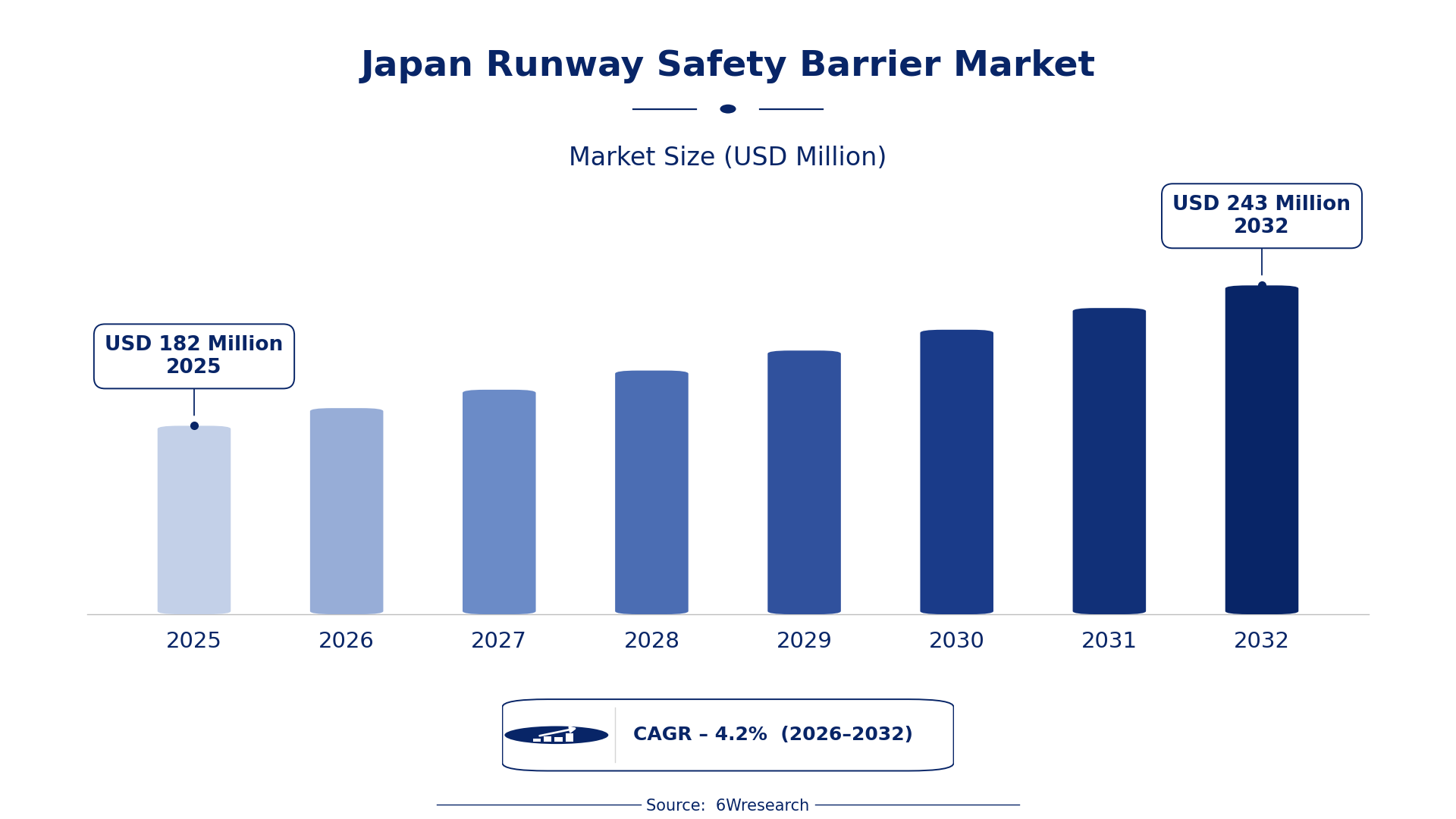
According to 6Wresearch internal database and industry insights, the Japan Runway Safety Barrier Market was valued at USD 182 Million in 2025 and is projected to reach USD 243 Million by 2032, growing at a CAGR of approximately 4.2% during 2026–2032.
Japan Runway Safety Barrier Market Highlights
| Report Metric | Details |
| Report Name | Japan Runway Safety Barrier Market (2026-2032) |
| Market Size 2025 | USD 182 Million |
| Market Size 2032 | USD 243 Million |
| Absolute Growth 2025–2032 | USD 61 Million |
| CAGR 2026–2032 | 4.2% |
| Peak Annual Growth | 5.1% in 2028 |
| Forecast Period | 2026–2032 |
| Historical Data | 2022–2025 |
| Base Year | 2025 |
| Leading Barrier Type, 2025 | Arrestor Beds (48% share) |
| Leading Material Used, 2025 | Crushed Stone (47% share) |
| Leading Deployment Type, 2025 | Fixed (40% share) |
| Leading End User, 2025 | Large Airports (46% share) |
| Fastest-Growing Barrier Type | Engineered Systems (5.9% CAGR) |
| Fastest-Growing Material Used | Foam Blocks (6.2% CAGR) |
| Fastest-Growing Deployment Type | Temporary (6.4% CAGR) |
| Fastest-Growing End User | Emergency Landing Areas (5.5% CAGR) |
| Growing Sector | aviation safety |
| Key End Users | civil aviation authorities, airport operators, military airstrip managers |
Japan Runway Safety Barrier Market Year-wise Growth Rate and Key Drivers (2022–2032)
This graph illustrates the annual growth rates of the market from 2022 to 2032, highlighting a steady upward trajectory and projected market expansion over the forecast period.
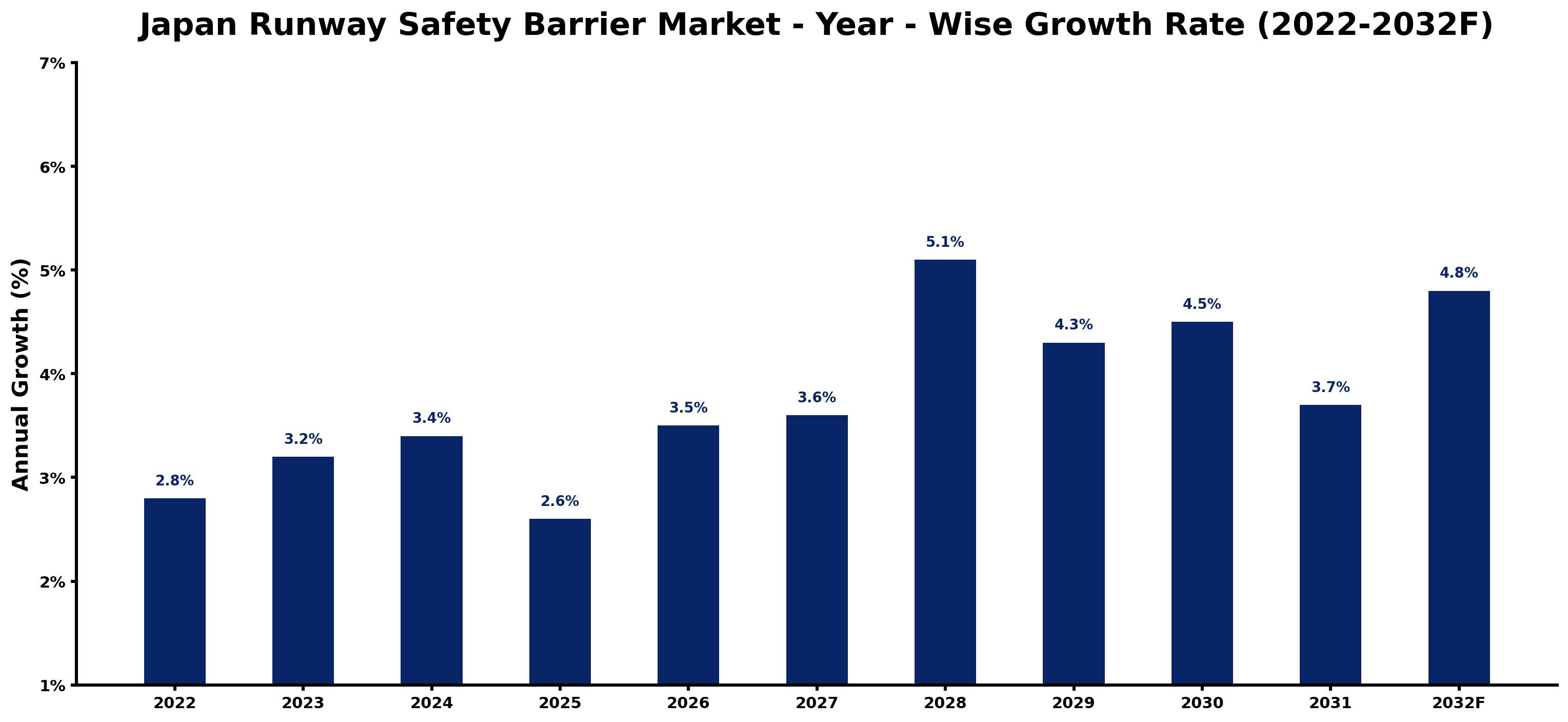
Annual growth estimates for each year appear below with the principal reason behind them, explaining the shifts that set the pace of the market.
| Year | Estimated Annual Growth (%) | Market Rationale |
| 2022 | 2.8 | The market experienced steady demand due to ongoing airport operations. |
| 2023 | 3.2 | Growth accelerated as safety regulations became more stringent across airports. |
| 2024 | 3.4 | Increased emergency landings raised awareness of runway safety needs. |
| 2025 | 2.6 | Growth slowed as some airports completed their initial safety upgrades. |
| 2026 | 3.5 | Demand is expected to rise with new investments in airport safety infrastructure. |
| 2027 | 3.6 | Continued focus on safety standards will drive further market expansion. |
| 2028 | 5.1 | The peak growth will be achieved due to heightened safety measures and upgrades. |
| 2029 | 4.3 | A slowdown will occur as the market begins to stabilise after rapid growth. |
| 2030 | 4.5 | Growth is projected to resume as technology adoption in safety systems increases. |
| 2031 | 3.7 | The market will see a slight slowdown as installations reach saturation. |
| 2032 | 4.8 | Demand is expected to rise again with new safety initiatives. |
Note: Market size estimations and growth projections presented in this report are based on 6Wresearch's proprietary forecasting methodology, utilizing the latest available industry data, government publications, and primary research inputs.
Japan Runway Safety Barrier Market Synopsis
Runway safety barriers are crucial installations that prevent aircraft overruns during emergencies, constructed from materials such as crushed stone and engineered systems. The Japan Runway Safety Barrier Market is growing due to heightened safety regulations, ongoing airport operations, and investments in safety infrastructure. With over 90 airports currently equipped with these systems, demand is driven by civil aviation authorities and airport operators prioritising improved safety measures.
Market Dynamics Impact Analysis (2026–2032)
| Factor | Type | Impact | Primary Segment Affected |
| Increased safety regulations are driving demand for runway safety barriers. | Driver | High | Arrestor Beds |
| Ongoing airport operations ensure a constant need for safety installations. | Driver | High | Engineered Systems |
| The growing number of emergency landings highlights the need for improved safety measures. | Opportunity | High | Emergency Landing Areas |
| Investment in airport safety infrastructure is creating new market opportunities. | Opportunity | High | Large Airports |
| High installation costs can deter some airport operators from upgrading barriers. | Restraint | Medium | Fixed |
| Limited awareness of advanced barrier systems may slow adoption rates. | Restraint | Medium | Retractable Barriers |
| The high cost of advanced materials can limit market access for smaller airports. | Challenge | High | Hydraulic Steel |
| Technological advancements may outpace current regulatory frameworks, causing delays. | Challenge | Medium | Engineered Systems |
Evaluation of Drivers in Japan Runway Safety Barrier Market (2026–2032)
The following drivers explain most of the expected growth.
| Drivers | Primary Segment Affected | Why It Matters (Evidence) |
| Increased emergency landings necessitate more runway safety installations. | Emergency Landing Areas | In 2022, Japan reported over 200 emergency landings, prompting demand for safety measures. |
| Investment in airport safety infrastructure is rising. | Large Airports | In 2023, the government allocated JPY 10 billion for upgrading airport safety infrastructure. |
| Stringent safety regulations mandate the installation of barriers. | Arrestor Beds | Runway safety barriers are mandated by Japanese aviation safety standards. |
| Growing awareness of safety technologies boosts demand for advanced systems. | Engineered Systems | The Kansai region has implemented advanced engineered systems at its airports. |
| Civil aviation authorities enforce safety standards, driving barrier installations. | Civil Aviation Bodies | The Japan Civil Aviation Bureau conducts regular safety assessments to ensure compliance. |
A wider customer base explains much of the growth, as increased emergency landings necessitate more runway safety installations. In 2022, Japan reported over 200 emergency landings, prompting demand for safety measures. Awareness of safety technologies is driving demand for advanced systems, particularly in the Kansai region, where engineered systems have been implemented.
Evaluation of Restraints in Japan Runway Safety Barrier Market
Below are the constraints most often cited by buyers and suppliers, with the segment each affects.
| Market Restraint | Primary Segment Affected | Why It Matters (Evidence) |
| High installation costs can deter some airport operators from upgrading barriers. | Fixed | The cost of implementing advanced runway safety barriers can be prohibitive for smaller airports. |
| Limited awareness of advanced barrier systems may slow adoption rates. | Retractable Barriers | Some airport operators may not be familiar with the benefits of newer barrier technologies. |
| Budget constraints often limit smaller airports' ability to invest in advanced materials. | Hydraulic Steel | Smaller airports often operate under tighter budgets, making expensive materials less feasible. |
| Regulatory delays can hinder the timely installation of safety systems. | Engineered Systems | Technological advancements may outpace current regulatory frameworks, causing project delays. |
| Market saturation in major airports may limit growth opportunities. | Arrestor Beds | As major airports complete installations, fewer new projects may arise. |
Japan Runway Safety Barrier Market Challenges
Airport operators must navigate strict regulations, as compliance with the JIS A 1470 standard can delay project approvals by up to six months. Buyers face higher costs due to mandatory upgrades, with installation expenses increasing by 15% to satisfy evolving safety requirements. Suppliers struggle to source advanced materials like hydraulic steel, which may lead to project delays of several weeks. Competition intensifies as government funding for airport safety infrastructure rises, compelling suppliers to lower prices while maintaining quality, potentially reducing profit margins by 10%.
Trends in the Japan Runway Safety Barrier Market
Four trends stand out in the Japan Runway Safety Barrier Market.
- Adoption of Advanced Engineered Systems: The Kansai region is increasingly implementing advanced engineered systems at its airports. Investments in these systems have surged, reflecting a growing commitment to airport safety, with JPY 5 billion allocated for upgrades.
- Rise in Emergency Landing Areas: In 2022, Japan recorded over 200 emergency landings, prompting a focus on emergency landing areas. This trend shows a growing recognition of the need for dedicated safety installations, leading to increased demand for mobile barriers.
- Shift Towards Modular Barrier Systems: Military airstrips in Japan are adopting modular barrier systems for rapid deployment. This shift allows for quick setups during emergencies, improving operational readiness and safety at military facilities.
- Increased Investment in Airport Safety Measures: The Tokyo region has experienced increased investment in airport safety measures, with JPY 5 billion allocated for upgrades. This trend underscores the commitment to enhancing safety standards across Japan's aviation sector.
Investment Opportunities in the Japan Runway Safety Barrier Market
The openings below show where demand in the Japan Runway Safety Barrier Market is visible and how suppliers can enter.
- Runway Safety Barriers: The demand for runway safety barriers is increasing, with JPY 10 billion allocated for upgrades in 2023. Large airports are looking to improve safety measures, creating opportunities for suppliers to provide advanced systems.
- Engineered Systems: With a 5.9% growth projected for engineered systems, the market gap is clear. Suppliers can target large airports, particularly in the Tokyo region, to meet growing safety demands.
- Mobile Barrier Solutions: In 2022, over 200 emergency landings highlighted the need for mobile barriers. Airports can invest in these solutions to improve safety during emergencies, creating a market for flexible installations.
- Temporary Barrier Installations: The Chubu region's new standards for temporary barriers indicate a growing need for adaptable safety solutions. Suppliers can enter this market by partnering with local airport authorities.
Government Initiatives in the Japan Runway Safety Barrier Market
The GX Basic Policy, adopted in 2023, aims for about JPY 150 trillion of public-private decarbonisation investment over the next decade. This policy strengthens existing regulations by promoting safer and more sustainable airport operations, ensuring that runway safety barriers are integrated into future infrastructure developments.
The Japan Civil Aviation Bureau oversees the implementation of safety standards, ensuring compliance across airports. This agency conducts regular assessments and approvals for safety installations, facilitating the adoption of advanced runway safety barriers among civil aviation bodies.
Future Insight of the Japan Runway Safety Barrier Market
Emerging technologies will reshape demand for runway safety barriers, particularly through the use of advanced materials and designs. Automated safety assessment tools will streamline compliance processes for buyers, improving operational efficiency. Increased government investment in airport infrastructure will drive a wave of installations, especially in the Tokyo region, where over 90 airports will undergo upgrades. Collaborative research with aerospace agencies will enhance barrier performance, ensuring higher safety standards across the aviation sector.
Market Segmentation Analysis
Japan Runway Safety Barrier Market report covers a detailed analysis of the following market segments:
By Barrier Type – Arrestor Beds Lead, Engineered Systems Expected to Grow Fastest
According to Saurav Kr Singh, Senior Research Analyst at 6Wresearch, Arrestor Beds accounted for 48% of the market by barrier type in 2025. Arrestor beds hold the largest share due to their essential role in halting runaway aircraft, particularly at major airports like Tokyo International Airport. Their widespread installation is mandated by Japanese aviation safety standards, ensuring compliance across various facilities. Engineered Systems are projected to grow fastest, at a CAGR of 5.9% during 2026–2032. Engineered systems are experiencing rapid growth as investments in airport safety infrastructure increase, particularly with advanced systems being adopted in the Kansai region. This trend suggests a move towards more sophisticated safety solutions, further solidifying their market position. Suppliers should focus on engineered systems to meet the rising demand for advanced safety measures in the aviation sector.
By Material Used – Crushed Stone Leads, Foam Blocks Expected to Grow Fastest
The largest material used category in 2025 was Crushed Stone, at 47% of revenue. Crushed stone is the primary material for arrestor beds, which are widely used at over 90 airports in Japan. This material's effectiveness in stopping runaway aircraft contributes to its dominant market share. Over 2026–2032, Foam Blocks are expected to post the fastest growth, at a CAGR of 6.2%. Foam blocks are gaining popularity as they are used in engineered systems for cushioning impact, particularly in advanced safety installations. Their versatility in various applications is driving their rapid adoption. Buyers may benefit from exploring options that incorporate foam blocks for improved safety performance.
By Deployment Type – Fixed Leads, Temporary Expected to Grow Fastest
In 2025, Fixed led the deployment type split with a 40% share. Fixed barriers are the most prevalent deployment type, commonly used for permanent installations across airports to ensure consistent safety. Their reliability aligns with the strict safety regulations set by civil aviation authorities, making them the preferred option. The quickest growth will come from Temporary, forecast to expand at a CAGR of 6.4% between 2026 and 2032. Temporary barriers are seeing increased demand as they provide flexible solutions for short-term safety requirements during events, enabling airport operators to adjust to fluctuating traffic conditions. This flexibility is vital for maintaining safety without permanent infrastructure changes. Suppliers should consider developing temporary barrier solutions to cater to the changing needs of airport safety management.
By End User – Large Airports Lead, Emergency Landing Areas Expected to Grow Fastest
With 46% of end user revenue in 2025, Large Airports was the largest category. Large airports are the main users of runway safety barriers, accounting for a substantial portion of the market due to their extensive operations and safety requirements. Their commitment to safety is reflected in the installation of advanced systems. Emergency Landing Areas are set to record the highest CAGR in this split, 5.5% over 2026–2032. Emergency landing areas are critical for safety in emergency situations, leading to a surge in demand for barriers specifically designed for these zones. The recent increase in emergency landings highlights their importance. Buyers must prioritise safety installations in emergency landing areas to ensure compliance and readiness.
Key Attractiveness of the Report
- 10 Years of Market Numbers
- Historical Data Starting from 2022 to 2025
- Base Year 2025
- Forecast Data until 2032
- Key Performance Indicators Impacting the Market
- Major Upcoming Developments and Projects
Key Highlights of the Report:
- Japan Runway Safety Barrier Market Outlook
- Market Size of Japan Runway Safety Barrier Market, 2025
- Forecast of Japan Runway Safety Barrier Market, 2032
- Historical Data and Forecast of Japan Runway Safety Barrier Revenues & Volume for the Period 2022-2032F
- Japan Runway Safety Barrier Market Trend Evolution
- Japan Runway Safety Barrier Market Drivers and Challenges
- Japan Runway Safety Barrier Price Trends
- Japan Runway Safety Barrier Porter's Five Forces
- Japan Runway Safety Barrier Industry Life Cycle
- Historical Data and Forecast of Japan Runway Safety Barrier Market Revenues & Volume By Barrier Type for the Period 2022-2032F
- Historical Data and Forecast of Japan Runway Safety Barrier Market Revenues & Volume By Arrestor Beds for the Period 2022-2032F
- Historical Data and Forecast of Japan Runway Safety Barrier Market Revenues & Volume By Engineered Systems for the Period 2022-2032F
- Historical Data and Forecast of Japan Runway Safety Barrier Market Revenues & Volume By Retractable Barriers for the Period 2022-2032F
- Historical Data and Forecast of Japan Runway Safety Barrier Market Revenues & Volume By Cable Barrier Systems for the Period 2022-2032F
- Historical Data and Forecast of Japan Runway Safety Barrier Market Revenues & Volume By Material Used for the Period 2022-2032F
- Historical Data and Forecast of Japan Runway Safety Barrier Market Revenues & Volume By Crushed Stone for the Period 2022-2032F
- Historical Data and Forecast of Japan Runway Safety Barrier Market Revenues & Volume By Foam Blocks for the Period 2022-2032F
- Historical Data and Forecast of Japan Runway Safety Barrier Market Revenues & Volume By Hydraulic Steel for the Period 2022-2032F
- Historical Data and Forecast of Japan Runway Safety Barrier Market Revenues & Volume By Steel Ropes for the Period 2022-2032F
- Historical Data and Forecast of Japan Runway Safety Barrier Market Revenues & Volume By Deployment Type for the Period 2022-2032F
- Historical Data and Forecast of Japan Runway Safety Barrier Market Revenues & Volume By Fixed for the Period 2022-2032F
- Historical Data and Forecast of Japan Runway Safety Barrier Market Revenues & Volume By Temporary for the Period 2022-2032F
- Historical Data and Forecast of Japan Runway Safety Barrier Market Revenues & Volume By Mobile for the Period 2022-2032F
- Historical Data and Forecast of Japan Runway Safety Barrier Market Revenues & Volume By Modular for the Period 2022-2032F
- Historical Data and Forecast of Japan Runway Safety Barrier Market Revenues & Volume By End User for the Period 2022-2032F
- Historical Data and Forecast of Japan Runway Safety Barrier Market Revenues & Volume By Large Airports for the Period 2022-2032F
- Historical Data and Forecast of Japan Runway Safety Barrier Market Revenues & Volume By Emergency Landing Areas for the Period 2022-2032F
- Historical Data and Forecast of Japan Runway Safety Barrier Market Revenues & Volume By Military Airstrips for the Period 2022-2032F
- Historical Data and Forecast of Japan Runway Safety Barrier Market Revenues & Volume By Civil Aviation Bodies for the Period 2022-2032F
- Japan Runway Safety Barrier Import Export Trade Statistics
- Market Opportunity Assessment By Barrier Type
- Market Opportunity Assessment By Material Used
- Market Opportunity Assessment By Deployment Type
- Market Opportunity Assessment By End User
- Japan Runway Safety Barrier Top Companies Market Share
- Japan Runway Safety Barrier Competitive Benchmarking By Technical and Operational Parameters
- Japan Runway Safety Barrier Company Profiles
- Japan Runway Safety Barrier Key Strategic Recommendations
Market Covered
The study includes the following segmentation.
By Barrier Type
- Arrestor Beds
- Engineered Systems
- Retractable Barriers
- Cable Barrier Systems
By Material Used
- Crushed Stone
- Foam Blocks
- Hydraulic Steel
- Steel Ropes
By Deployment Type
- Fixed
- Temporary
- Mobile
- Modular
By End User
- Large Airports
- Emergency Landing Areas
- Military Airstrips
- Civil Aviation Bodies






































