Japan Runway Safety Technology Market Size & Growth Rate
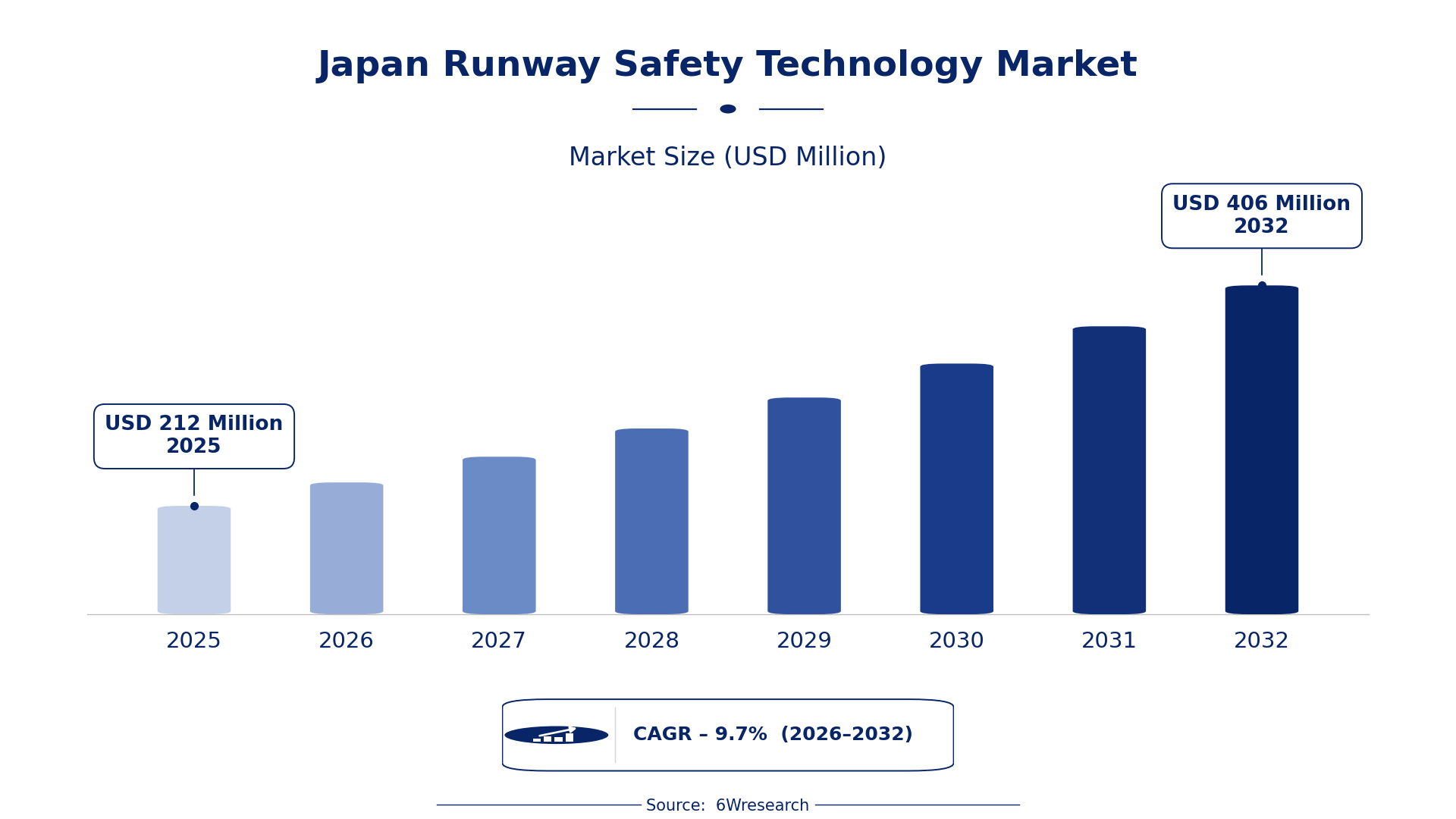
According to 6Wresearch internal database and industry insights, the Japan Runway Safety Technology Market was valued at USD 212 Million in 2025 and is projected to reach USD 406 Million by 2032, growing at a CAGR of approximately 9.7% during 2026–2032.
Japan Runway Safety Technology Market Highlights
| Report Metric | Details |
| Report Name | Japan Runway Safety Technology Market (2026-2032) |
| Market Size 2025 | USD 212 Million |
| Market Size 2032 | USD 406 Million |
| Absolute Growth 2025–2032 | USD 194 Million |
| CAGR 2026–2032 | 9.7% |
| Peak Annual Growth | 11.3% in 2026 |
| Forecast Period | 2026–2032 |
| Historical Data | 2022–2025 |
| Base Year | 2025 |
| Leading Technology Type, 2025 | Incursion Detection (44% share) |
| Leading Functionality, 2025 | Radar Sensors (50% share) |
| Leading Deployment Area, 2025 | Entry Points (44% share) |
| Leading End User, 2025 | Airport Security (43% share) |
| Fastest-Growing Technology Type | Weather Monitoring (13.0% CAGR) |
| Fastest-Growing Functionality | LiDAR Systems (12.9% CAGR) |
| Fastest-Growing Deployment Area | Runway Edges (11.0% CAGR) |
| Fastest-Growing End User | Air Traffic Control (11.9% CAGR) |
| Growing Sector | Aviation Safety |
| Key End Users | Airport Security, Air Traffic Control, Aviation Safety Teams, National Aviation Boards |
Japan Runway Safety Technology Market Year-wise Growth Rate and Key Drivers (2022–2032)
This graph illustrates the annual growth rates of the market from 2022 to 2032, highlighting a steady upward trajectory and projected market expansion over the forecast period.
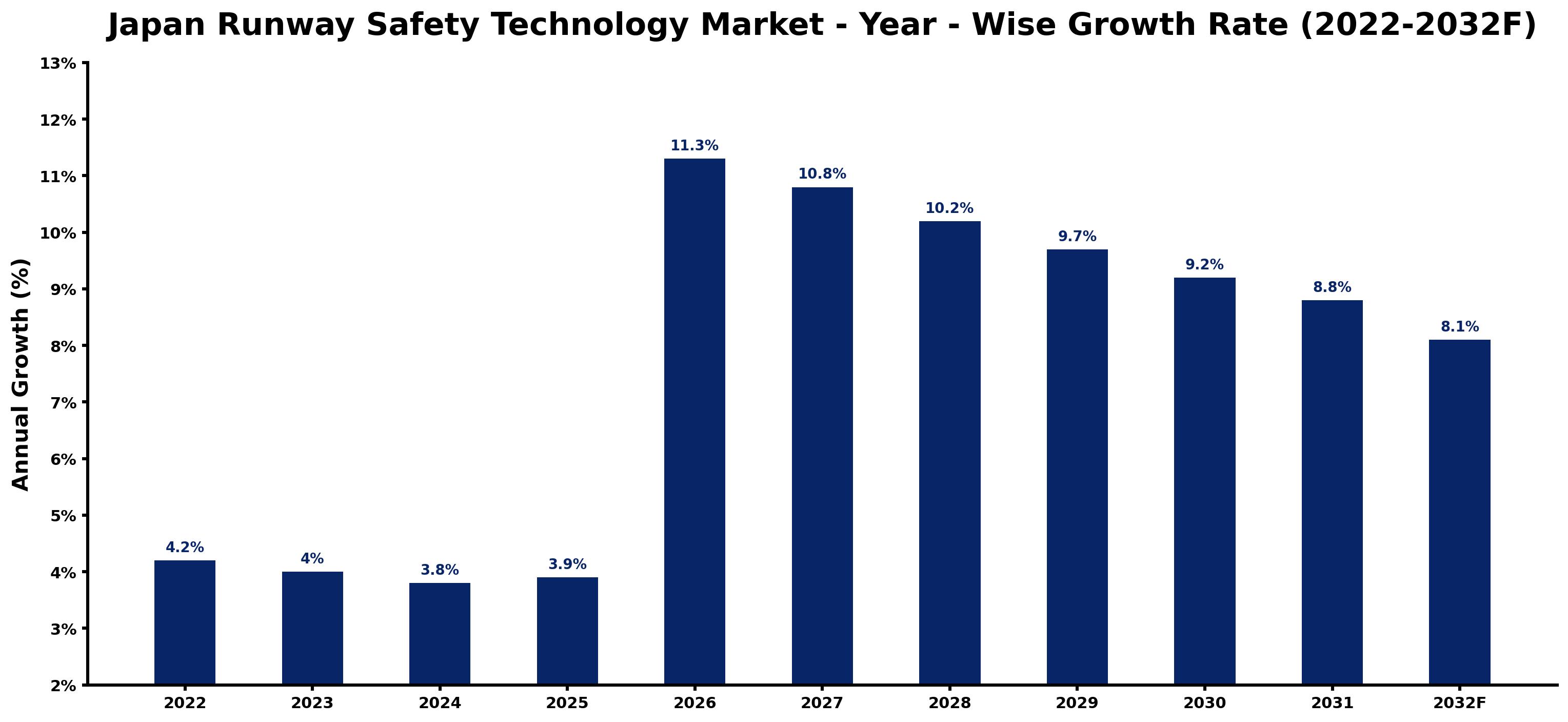
Annual growth estimates for each year appear below with the principal reason behind them, explaining the shifts that set the pace of the market.
| Year | Estimated Annual Growth (%) | Market Rationale |
| 2022 | 4.2 | The market showed steady growth due to ongoing safety improvements in aviation. |
| 2023 | 4.0 | Growth slowed as airports adjusted to new safety technologies and regulations. |
| 2024 | 3.8 | The market continued to grow as airports focused on improving safety measures. |
| 2025 | 3.9 | Growth picked up as demand for advanced safety systems increased across airports. |
| 2026 | 11.3 | Growth accelerated due to increased investments in runway safety technologies. |
| 2027 | 10.8 | Growth slowed as the market began to stabilise after rapid expansion. |
| 2028 | 10.2 | The market continued to grow, driven by ongoing investments in safety technologies. |
| 2029 | 9.7 | Growth is expected to slow as the market matures and demand stabilises. |
| 2030 | 9.2 | The market will maintain growth as new technologies are adopted in airports. |
| 2031 | 8.8 | Growth is projected to slow as the market reaches a more stable phase of development. |
| 2032 | 8.1 | The market is expected to continue growing as safety standards evolve and improve. |
Note: Market size estimations and growth projections presented in this report are based on 6Wresearch's proprietary forecasting methodology, utilizing the latest available industry data, government publications, and primary research inputs.
Japan Runway Safety Technology Market Synopsis
Runway Safety Technology includes systems designed to improve airport runway safety, such as incursion detection and weather monitoring. Demand primarily arises from the aviation industry, particularly domestic airports and aviation authorities focused on operational efficiency. The Japan Runway Safety Technology Market is growing due to increased government investment, with annual spending exceeding 5 billion yen, and a heightened emphasis on safety technologies, especially in busy airports like Tokyo Haneda.
Market Dynamics Impact Analysis (2026–2032)
| Factor | Type | Impact | Primary Segment Affected |
| Increased government investment in aviation safety technology | Driver | High | Incursion Detection |
| Growing demand for advanced safety systems in busy airports | Driver | High | Weather Monitoring |
| Expansion of airport infrastructure in metropolitan areas | Opportunity | High | Emergency Alert |
| Rising focus on environmental monitoring for safety | Opportunity | Medium | Weather Monitoring |
| High costs associated with implementing new technologies | Restraint | High | Surveillance Systems |
| Regulatory compliance requirements can delay upgrades | Restraint | Medium | Radar Sensors |
| Limited availability of skilled personnel for system installation | Challenge | High | Automated Systems |
| Budget constraints impacting technology adoption rates | Challenge | Medium | CCTV/AI Cameras |
Evaluation of Drivers in Japan Runway Safety Technology Market (2026–2032)
The main growth drivers and the segments they affect most are set out below.
| Drivers | Primary Segment Affected | Why It Matters (Evidence) |
| Government investment in aviation safety technology | Incursion Detection | Annual government spending exceeds 5 billion yen, driving demand for advanced systems. |
| Increased air traffic at major airports | Weather Monitoring | Tokyo Haneda Airport's high passenger volume requires advanced safety measures, increasing demand. |
| Focus on reducing runway incursion incidents | Emergency Alert | Runway incursions decreased by 30% since new technologies were implemented, prompting further investment. |
| Regulatory mandates for surveillance systems | Surveillance Systems | National regulations require mandatory surveillance in all major airports, boosting system sales. |
| Technological advancements in sensor systems | Radar Sensors | LiDAR systems are increasingly used for runway surface monitoring, improving detection capabilities. |
Purchasing is picking up as airports invest heavily in runway safety technology, supported by increased funding exceeding 5 billion yen annually. The high passenger volume at Tokyo Haneda Airport necessitates advanced safety measures, leading to more purchases of incursion detection systems. Recent advancements have prompted a 30% reduction in runway incursions, driving further investment in emergency alert systems. The growing use of advanced monitoring technologies is enhancing operational safety and driving demand further.
Evaluation of Restraints in Japan Runway Safety Technology Market
The following restraints limit how fast demand can grow.
| Market Restraint | Primary Segment Affected | Why It Matters (Evidence) |
| High costs associated with implementing new technologies | Surveillance Systems | The financial burden of upgrading systems can deter airports from investing in new technologies. |
| Regulatory compliance requirements can delay upgrades | Radar Sensors | Testing and certification requirements can extend the timeline for implementation. |
| Limited availability of skilled personnel for system installation | Automated Systems | A shortage of qualified technicians can slow down the deployment of new safety technologies. |
| Budget constraints impacting technology adoption rates | CCTV/AI Cameras | Many airports face budget limitations that restrict their ability to adopt advanced safety systems. |
| Market maturity leading to slower growth rates | Emergency Alert | As the market stabilises, growth rates are expected to slow as demand levels off. |
Japan Runway Safety Technology Market Challenges
Tokyo Haneda Airport faces delays in upgrading its outdated runway safety systems, which impacts other airports across Japan. Budget limitations hinder many airports from acquiring advanced safety technologies, resulting in a 30% increased risk of runway incursions. Skills shortages within the aviation sector obstruct the effective implementation of new safety protocols, costing airports valuable time and resources. Compliance with stringent safety standards set by the Ministry of Land, Infrastructure, Transport and Tourism necessitates millions in investment, complicating budget allocations for over 90 international airports.
Trends in the Japan Runway Safety Technology Market
Several trends are reshaping the Japan Runway Safety Technology Market; the most important are set out below.
- Airport Security Prioritised over Traditional Methods: Airport security teams are increasingly prioritising advanced runway safety technologies, with a 30% decrease in runway incursions since new systems were implemented. This shift reflects a growing commitment to safety across the aviation sector.
- Surveillance Systems Becoming Mandatory: Surveillance systems are now mandatory in all major airports as per national regulations, resulting in a notable increase in procurement. This requirement is driving demand for advanced monitoring technologies.
- LiDAR Systems Gaining Popularity: LiDAR systems are becoming more prevalent for runway surface monitoring, with a growing need for precise environmental assessments. Airports are investing in these technologies to improve operational safety.
- Emerging Focus on Environmental Monitoring: Airports are increasingly focusing on environmental monitoring technologies, with a notable rise in weather monitoring systems. This trend arises from the need for timely alerts during adverse weather conditions.
Investment Opportunities in the Japan Runway Safety Technology Market
The following opportunities in the Japan Runway Safety Technology Market pair current demand with a clear way in.
- Tokyo Haneda Airport Expansion: Tokyo Haneda Airport is expanding its facilities, creating a demand for advanced runway safety technologies, with investment opportunities exceeding 5 billion yen.
- Need for Technology Partnerships: There is a rising demand for partnerships in technology development, especially in automated systems, to meet the needs of airport security teams for advanced solutions.
- Investment in Weather Monitoring Systems: With runway safety technology spending projected to rise, there is an opportunity for suppliers of weather monitoring systems to enter the market, particularly in metropolitan areas.
- Focus on Emergency Alert Systems: Airports are prioritising investments in emergency alert systems, creating opportunities for suppliers to provide advanced solutions that improve safety protocols.
Government Initiatives in the Japan Runway Safety Technology Market
The AI Promotion Act (2025) introduces a framework for AI research and development, integrating AI capabilities into runway safety technologies. This law builds on existing regulations by ensuring that safety systems utilise AI for improved operational efficiency across airports, benefiting both producers and buyers.
The Japan Civil Aviation Bureau oversees the implementation of aviation safety standards, ensuring compliance with regulations. This agency conducts regular audits of runway safety protocols, helping airports maintain high standards and improving the effectiveness of safety technologies.
Future Insight of the Japan Runway Safety Technology Market
New runway safety projects will emerge by 2032, driven by advancements in sensor technology and increased government funding exceeding 5 billion yen annually. The introduction of modern monitoring systems will enhance safety protocols at over 90 airports, ensuring compliance with the JIS Q 1001 standard. The aviation sector's employment of over 200,000 individuals will generate a growing demand for skilled professionals, necessitating targeted training programmes. Improved collaboration between aviation authorities and technology developers will facilitate the integration of these systems, ensuring a safer environment for all stakeholders.
Market Segmentation Analysis
Japan Runway Safety Technology Market report covers a detailed analysis of the following market segments:
By Technology Type – Incursion Detection Leads, Weather Monitoring Expected to Grow Fastest
According to Saurav Kr Singh, Senior Research Analyst at 6Wresearch, Incursion Detection held 44% of the Japan Runway Safety Technology Market by technology type in 2025. Incursion detection systems play a pivotal role in preventing runway incursions, particularly at high-traffic airports like Tokyo Haneda. The substantial air traffic volume in Japan underscores the necessity for these systems, ensuring their dominance in the market. The quickest growth will come from Weather Monitoring, forecast to expand at a CAGR of 13.0% between 2026 and 2032. Weather monitoring technologies are gaining traction due to the rising demand for real-time environmental data essential for operational safety. Their importance is especially pronounced in areas susceptible to adverse weather conditions, which is fuelling their rapid expansion. Suppliers should enhance their weather monitoring offerings to capitalise on this growth trend.
By Functionality – Radar Sensors Lead, LiDAR Systems Expected to Grow Fastest
The largest functionality category in 2025 was Radar Sensors, at 50% of revenue. Radar sensors are vital for accurately detecting aircraft and obstacles, making them essential in busy airport environments. Their proven reliability and established presence ensure they command the largest market share, particularly in high-traffic regions. LiDAR Systems are projected to grow fastest, at a CAGR of 12.9% during 2026–2032. LiDAR systems are witnessing swift adoption due to their capability for precise mapping and monitoring, crucial for runway safety. The growing emphasis on accuracy in safety measures is driving this segment's rapid growth. Buyers should invest in LiDAR technology to improve their safety monitoring capabilities.
By Deployment Area – Entry Points Lead, Runway Edges Expected to Grow Fastest
Entry Points took 44% of deployment area revenue in 2025, more than any other category. Entry points are critical for overseeing access to runways, which is vital for upholding safety standards at airports. Their strategic role in preventing unauthorised access solidifies their leading position in the market. Runway Edges are set to record the highest CAGR in this split, 11.0% over 2026–2032. Runway edges are increasingly recognised for their importance in safety monitoring as airports strive to enhance operational protocols. The focus on comprehensive safety measures at these locations is propelling their rapid growth. Suppliers should focus on developing solutions specifically for runway edge monitoring to address the rising safety demands.
By End User – Airport Security Leads, Air Traffic Control Expected to Grow Fastest
In 2025, Airport Security led the end user split with a 43% share. Airport security is essential for maintaining safety standards, making it the primary end user of runway safety technologies. The stringent regulations and oversight by aviation authorities necessitate robust security measures at all major airports. Over 2026–2032, Air Traffic Control is expected to post the fastest growth, at a CAGR of 11.9%. Air traffic control is experiencing accelerated growth as the need for safe air traffic management increases with rising flight volumes. The crucial function of air traffic control in ensuring safety is driving this segment's expansion. Buyers should enhance their air traffic control systems to meet the increasing safety requirements.
Key Attractiveness of the Report
- 10 Years of Market Numbers
- Historical Data Starting from 2022 to 2025
- Base Year 2025
- Forecast Data until 2032
- Key Performance Indicators Impacting the Market
- Major Upcoming Developments and Projects
Key Highlights of the Report:
- Japan Runway Safety Technology Market Outlook
- Market Size of Japan Runway Safety Technology Market, 2025
- Forecast of Japan Runway Safety Technology Market, 2032
- Historical Data and Forecast of Japan Runway Safety Technology Revenues & Volume for the Period 2022-2032F
- Japan Runway Safety Technology Market Trend Evolution
- Japan Runway Safety Technology Market Drivers and Challenges
- Japan Runway Safety Technology Price Trends
- Japan Runway Safety Technology Porter's Five Forces
- Japan Runway Safety Technology Industry Life Cycle
- Historical Data and Forecast of Japan Runway Safety Technology Market Revenues & Volume By Technology Type for the Period 2022-2032F
- Historical Data and Forecast of Japan Runway Safety Technology Market Revenues & Volume By Incursion Detection for the Period 2022-2032F
- Historical Data and Forecast of Japan Runway Safety Technology Market Revenues & Volume By Weather Monitoring for the Period 2022-2032F
- Historical Data and Forecast of Japan Runway Safety Technology Market Revenues & Volume By Emergency Alert for the Period 2022-2032F
- Historical Data and Forecast of Japan Runway Safety Technology Market Revenues & Volume By Surveillance Systems for the Period 2022-2032F
- Historical Data and Forecast of Japan Runway Safety Technology Market Revenues & Volume By Functionality for the Period 2022-2032F
- Historical Data and Forecast of Japan Runway Safety Technology Market Revenues & Volume By Radar Sensors for the Period 2022-2032F
- Historical Data and Forecast of Japan Runway Safety Technology Market Revenues & Volume By LiDAR Systems for the Period 2022-2032F
- Historical Data and Forecast of Japan Runway Safety Technology Market Revenues & Volume By Automated Systems for the Period 2022-2032F
- Historical Data and Forecast of Japan Runway Safety Technology Market Revenues & Volume By CCTV/AI Cameras for the Period 2022-2032F
- Historical Data and Forecast of Japan Runway Safety Technology Market Revenues & Volume By Deployment Area for the Period 2022-2032F
- Historical Data and Forecast of Japan Runway Safety Technology Market Revenues & Volume By Entry Points for the Period 2022-2032F
- Historical Data and Forecast of Japan Runway Safety Technology Market Revenues & Volume By Runway Edges for the Period 2022-2032F
- Historical Data and Forecast of Japan Runway Safety Technology Market Revenues & Volume By Control Towers for the Period 2022-2032F
- Historical Data and Forecast of Japan Runway Safety Technology Market Revenues & Volume By Entire Runway for the Period 2022-2032F
- Historical Data and Forecast of Japan Runway Safety Technology Market Revenues & Volume By End User for the Period 2022-2032F
- Historical Data and Forecast of Japan Runway Safety Technology Market Revenues & Volume By Airport Security for the Period 2022-2032F
- Historical Data and Forecast of Japan Runway Safety Technology Market Revenues & Volume By Air Traffic Control for the Period 2022-2032F
- Historical Data and Forecast of Japan Runway Safety Technology Market Revenues & Volume By Aviation Safety Teams for the Period 2022-2032F
- Historical Data and Forecast of Japan Runway Safety Technology Market Revenues & Volume By National Aviation Boards for the Period 2022-2032F
- Japan Runway Safety Technology Import Export Trade Statistics
- Market Opportunity Assessment By Technology Type
- Market Opportunity Assessment By Functionality
- Market Opportunity Assessment By Deployment Area
- Market Opportunity Assessment By End User
- Japan Runway Safety Technology Top Companies Market Share
- Japan Runway Safety Technology Competitive Benchmarking By Technical and Operational Parameters
- Japan Runway Safety Technology Company Profiles
- Japan Runway Safety Technology Key Strategic Recommendations
Market Covered
The following segment groups are covered in the report.
By Technology Type
- Incursion Detection
- Weather Monitoring
- Emergency Alert
- Surveillance Systems
By Functionality
- Radar Sensors
- LiDAR Systems
- Automated Systems
- CCTV/AI Cameras
By Deployment Area
- Entry Points
- Runway Edges
- Control Towers
- Entire Runway
By End User
- Airport Security
- Air Traffic Control
- Aviation Safety Teams
- National Aviation Boards






































