Japan Rural Broadband Market Size & Growth Rate
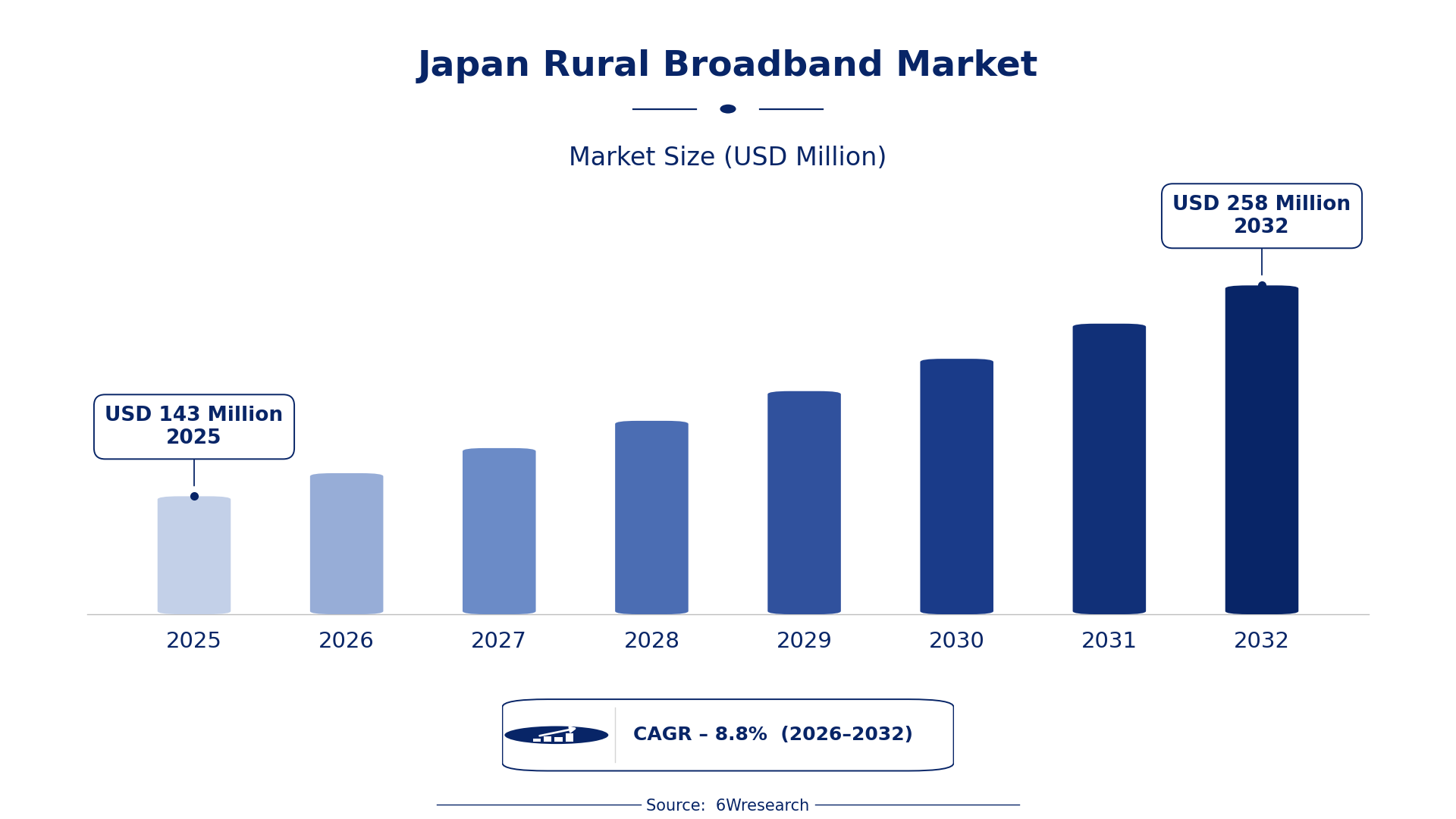
According to 6Wresearch internal database and industry insights, the Japan Rural Broadband Market was valued at USD 143 Million in 2025 and is projected to reach USD 258 Million by 2032, growing at a CAGR of approximately 8.8% during 2026–2032.
Japan Rural Broadband Market Highlights
| Report Metric | Details |
| Report Name | Japan Rural Broadband Market (2026-2032) |
| Market Size 2025 | USD 143 Million |
| Market Size 2032 | USD 258 Million |
| Absolute Growth 2025–2032 | USD 115 Million |
| CAGR 2026–2032 | 8.8% |
| Peak Annual Growth | 9.5% in 2027 |
| Forecast Period | 2026–2032 |
| Historical Data | 2022–2025 |
| Base Year | 2025 |
| Leading Technology Type, 2025 | Fiber-to-the-Home (47% share) |
| Leading Network Type, 2025 | Wired Broadband (39% share) |
| Leading Delivery Method, 2025 | Government Initiatives (46% share) |
| Leading End User, 2025 | Rural Households (38% share) |
| Fastest-Growing Technology Type | Fixed Wireless Access (12.5% CAGR) |
| Fastest-Growing Network Type | Wireless Broadband (12.6% CAGR) |
| Fastest-Growing Delivery Method | Private Operators (12.2% CAGR) |
| Fastest-Growing End User | Small Businesses (11.2% CAGR) |
| Growing Sector | Rural Households |
| Key End Users | Rural Households, Small Businesses, Remote Communities, Agriculture Enterprises |
Japan Rural Broadband Market Year-wise Growth Rate and Key Drivers (2022–2032)
This graph illustrates the annual growth rates of the market from 2022 to 2032, highlighting a steady upward trajectory and projected market expansion over the forecast period.
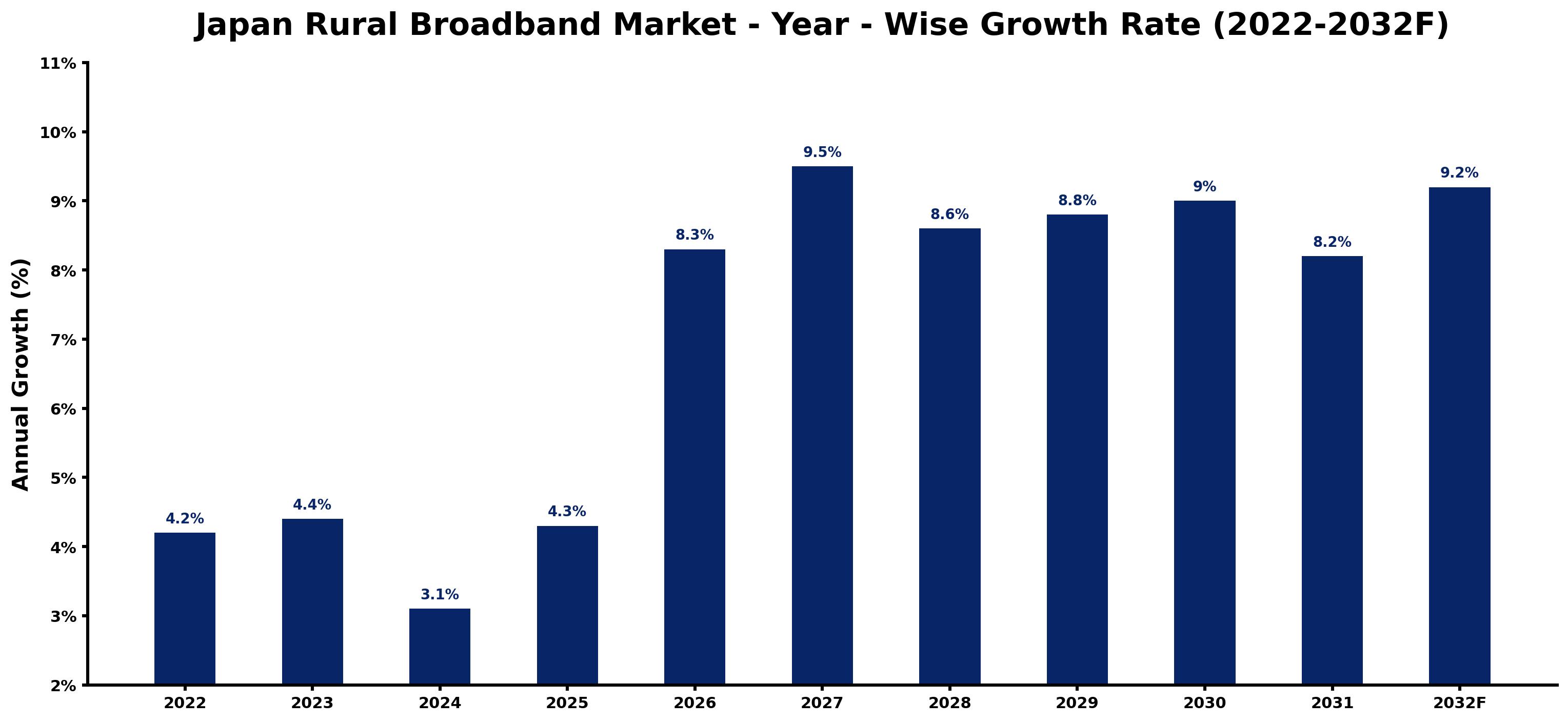
Below, each year's estimated growth is shown next to the factor that most influenced it.
| Year | Estimated Annual Growth (%) | Market Rationale |
| 2022 | 4.2 | The market showed steady growth driven by increased rural connectivity efforts. |
| 2023 | 4.4 | Growth accelerated due to rising demand for high-speed internet in rural areas. |
| 2024 | 3.1 | The market experienced a slowdown as investments adjusted to new technologies. |
| 2025 | 4.3 | Demand surged again as government initiatives expanded broadband access. |
| 2026 | 8.3 | Growth spiked as investments in infrastructure began to yield results. |
| 2027 | 9.5 | The market peaked with advancements in broadband technologies. |
| 2028 | 8.6 | A slight slowdown occurred as the market stabilised after rapid growth. |
| 2029 | 8.8 | Demand increased again due to ongoing rural development projects. |
| 2030 | 9.0 | Growth remained strong as new technologies were adopted widely. |
| 2031 | 8.2 | The market experienced a slowdown as saturation began in certain areas. |
| 2032 | 9.2 | Demand is projected to rise again as new initiatives are launched. |
Note: Market size estimations and growth projections presented in this report are based on 6Wresearch's proprietary forecasting methodology, utilizing the latest available industry data, government publications, and primary research inputs.
Japan Rural Broadband Market Synopsis
Japan Rural Broadband Market focuses on high-speed internet technologies in less populated areas, including fiber optics and fixed wireless. With over 90% of rural households connected as of 2023, the government aims for 100% coverage by 2025. This growth is driven by private investments and government support, particularly through initiatives like the 'Digital Rural Japan' strategy, which improves connectivity in regions such as Nagano and Yamagata.
Market Dynamics Impact Analysis (2026–2032)
| Factor | Type | Impact | Primary Segment Affected |
| Government initiatives drive broadband expansion in underserved areas. | Driver | High | Government Initiatives |
| Rising demand for high-speed internet from rural households boosts investment. | Driver | High | Rural Households |
| Investment in broadband infrastructure is increasing due to government support. | Opportunity | High | National Rollouts |
| Growing need for connectivity in remote communities presents new market potential. | Opportunity | High | Remote Communities |
| DSL connections are declining as newer technologies gain traction. | Restraint | Medium | DSL Connections |
| Limited infrastructure in certain regions hampers broadband deployment. | Restraint | Medium | Fixed Wireless Access |
| High installation costs can deter investment in broadband infrastructure. | Challenge | High | Fiber-to-the-Home |
| Competition among service providers can lead to price wars, affecting profitability. | Challenge | Medium | Telecom Providers |
Evaluation of Drivers in Japan Rural Broadband Market (2026–2032)
These are the developments adding the most demand over the forecast period.
| Drivers | Primary Segment Affected | Why It Matters (Evidence) |
| Government initiatives to expand broadband access in rural areas. | Government Initiatives | The government aims for 100% broadband coverage by 2025, encouraging local partnerships. |
| Rising demand for high-speed internet from rural households. | Rural Households | Over 90% of rural households now have broadband access, increasing service uptake. |
| Investment in broadband infrastructure is expected to increase. | National Rollouts | The government allocated ¥10 billion in 2023 for rural broadband expansion projects. |
| Growing demand in remote communities for reliable internet services. | Remote Communities | Satellite Internet services have expanded due to demand in isolated areas. |
| Technological advancements in broadband deployment are driving growth. | Fiber-to-the-Home | Rapid expansion of Fiber-to-the-Home technology is seen in prefectures like Nagano. |
With over 90% of rural households connected as of 2023, the demand for reliable internet continues to rise. The growth of Fiber-to-the-Home technology in prefectures like Nagano illustrates how advancements are transforming service delivery.
Evaluation of Restraints in Japan Rural Broadband Market
The table below lists the restraints and the evidence behind each.
| Market Restraint | Primary Segment Affected | Why It Matters (Evidence) |
| DSL connections are becoming less common due to speed limitations. | DSL Connections | As of 2023, DSL connections are declining as fiber and wireless technologies gain traction. |
| Limited infrastructure in mountainous regions hampers broadband deployment. | Fixed Wireless Access | Fixed Wireless Access is increasingly used in challenging terrains where cables cannot be laid. |
| High installation costs can deter investment in broadband infrastructure. | Fiber-to-the-Home | The cost of installing Fiber-to-the-Home connections can be prohibitive for some areas. |
| Competition among service providers can lead to price wars. | Telecom Providers | Intense competition drives prices down, affecting profitability for service providers. |
| Regulatory compliance can slow down deployment timelines. | Private Operators | Private Operators must navigate complex regulations, delaying broadband rollout. |
Japan Rural Broadband Market Challenges
Over 90% of rural households in Japan have broadband access, yet regulatory hurdles impede full coverage, costing producers time and delaying service expansion. In mountainous areas, technology limitations restrict the deployment of fiber optics, resulting in slower connections for buyers reliant on high-speed internet. The average broadband speed of 100 Mbps is insufficient for some users, forcing providers to invest in costly upgrades to meet demand. Supply chain complications arise as local governments face difficulties partnering with telecom providers, leading to connectivity delays for rural communities.
Trends in the Japan Rural Broadband Market
The following changes are redrawing the Japan Rural Broadband Market.
- Increase in Satellite Internet Adoption: In 2023, Satellite Internet services are growing due to demand in isolated communities, with a notable increase in installations. This trend supports connectivity for remote areas lacking other options.
- Government Initiatives Accelerating Broadband Expansion: The 'Digital Rural Japan' strategy launched in 2022 aims for 100% broadband coverage by 2025, driving substantial investment in rural broadband infrastructure. This initiative is vital for improving connectivity.
- Rising Use of Fixed Wireless Access: Fixed Wireless Access is increasingly deployed in mountainous regions, providing essential connectivity where traditional infrastructure is challenging. This method is gaining traction, especially in rural prefectures.
- Shift from DSL to Fiber-to-the-Home: In 2023, the shift from DSL to Fiber-to-the-Home technology is clear, with 47% of the market share in rural areas. This transition improves internet speeds, benefiting rural households.
Investment Opportunities in the Japan Rural Broadband Market
Investors looking at the Japan Rural Broadband Market should consider the following areas.
- Support for Broadband Infrastructure Projects: The government allocated ¥10 billion for rural broadband expansion in 2023, creating opportunities for private operators. Collaborating with local partners can facilitate entry into this market.
- Expansion of Satellite Internet Services: The demand for Satellite Internet in isolated communities presents an opportunity for service providers. With over 90% of rural households now connected, there is room for growth in this segment.
- Development of Fixed Wireless Access Technologies: As mountainous regions require new solutions, investing in Fixed Wireless Access technologies is essential. Local governments are partnering with telecom providers to enhance connectivity.
- Investment in Fiber-to-the-Home Solutions: With the government targeting 100% broadband coverage by 2025, there is an opportunity for investment in Fiber-to-the-Home solutions. Rural households are the primary buyers needing reliable internet access.
Government Initiatives in the Japan Rural Broadband Market
The Electrical Appliance and Material Safety Act regulates the safety of broadband equipment, ensuring that all devices meet safety standards. Compliance with this act is important for producers and operators to maintain market access and consumer trust. The Industrial Standardization Act governs JIS product and test standards, ensuring compliance with regulations. In 2023, the government allocated ¥10 billion to support broadband expansion projects, benefiting rural households and small businesses.
The Ministry of Internal Affairs and Communications oversees rural broadband initiatives, funding projects that improve connectivity. In 2023, the government allocated ¥10 billion to support these efforts, benefiting rural households and small businesses.
Future Insight of the Japan Rural Broadband Market
Fixed Wireless Access technology will transform demand by 2032, enabling faster installations in difficult terrains. The government's 'Digital Rural Japan' strategy will stimulate investment in broadband infrastructure, with a projected increase in funding for expansion projects, creating opportunities for suppliers in underserved regions. The 'Smart Agriculture' initiative will promote broadband use in farming, allowing producers to implement modern techniques and improve productivity. Local governments will increasingly collaborate with telecom providers to enhance connectivity.
Market Segmentation Analysis
Japan Rural Broadband Market report covers a detailed analysis of the following market segments:
By Technology Type – Fiber-to-the-Home Leads, Fixed Wireless Access Expected to Grow Fastest
According to Saurav Kr Singh, Senior Research Analyst at 6Wresearch, in 2025, Fiber-to-the-Home led the technology type split with a 47% share. Fiber-to-the-Home technology holds the largest share because it directly provides high-speed internet to residences, essential for rural areas like Nagano and Yamagata. This technology's widespread adoption is supported by government initiatives aimed at enhancing connectivity. Over 2026–2032, Fixed Wireless Access is expected to post the fastest growth, at a CAGR of 12.5%. Fixed Wireless Access is experiencing rapid growth as it offers broadband without the need for physical cables, making it ideal for mountainous regions where installation is difficult. The increasing need for reliable internet in these areas is driving this segment's expansion. Suppliers should focus on developing solutions that enhance Fixed Wireless Access to cater to the growing demand in challenging environments.
By Network Type – Wired Broadband Leads, Wireless Broadband Expected to Grow Fastest
The largest network type category in 2025 was Wired Broadband, at 39% of revenue. Wired Broadband leads the market as it encompasses both fiber and copper connections, guaranteeing stable internet access for rural users. This reliability is essential for households and businesses that rely on consistent connectivity. Wireless Broadband is projected to grow fastest, at a CAGR of 12.6% during 2026–2032. Wireless Broadband is the fastest-growing segment, employing radio signals to deliver internet access in rural settings where wired options may be impractical. The transition towards more adaptable internet solutions is driving this growth. Buyers may find value in exploring Wireless Broadband options as they provide flexibility and adaptability in less accessible areas.
By Delivery Method – Government Initiatives Lead, Private Operators Expected to Grow Fastest
With 46% of delivery method revenue in 2025, Government Initiatives was the largest category. Government Initiatives lead the market by promoting broadband expansion in underserved areas, ensuring rural communities receive essential infrastructure. These initiatives are pivotal for achieving the goal of 100% broadband coverage by 2025. The quickest growth will come from Private Operators, forecast to expand at a CAGR of 12.2% between 2026 and 2032. Private Operators are witnessing rapid growth as they play a vital role in deploying and maintaining broadband services, meeting the rising demand for connectivity in rural regions. Their involvement significantly complements government efforts and speeds up service availability. Suppliers should consider partnerships with Private Operators to enhance service delivery and effectively respond to increasing demand.
By End User – Rural Households Lead, Small Businesses Expected to Grow Fastest
Rural Households held 38% of the Japan Rural Broadband Market by end user in 2025. Rural Households represent the largest end-user group as they are the primary beneficiaries of broadband services in remote areas. With over 90% of these households now having access, their needs drive market growth. Small Businesses are set to record the highest CAGR in this split, 11.2% over 2026–2032. Small Businesses are the fastest-growing segment as they increasingly rely on broadband for operations and connectivity, particularly in rural settings where digital tools are essential for competitiveness. This trend is expected to continue as more businesses recognise the value of reliable internet. Suppliers should tailor their offerings to meet the specific needs of Small Businesses to capitalise on this growing market segment.
Key Attractiveness of the Report
- 10 Years of Market Numbers
- Historical Data Starting from 2022 to 2025
- Base Year 2025
- Forecast Data until 2032
- Key Performance Indicators Impacting the Market
- Major Upcoming Developments and Projects
Key Highlights of the Report:
- Japan Rural Broadband Market Outlook
- Market Size of Japan Rural Broadband Market, 2025
- Forecast of Japan Rural Broadband Market, 2032
- Historical Data and Forecast of Japan Rural Broadband Revenues & Volume for the Period 2022-2032F
- Japan Rural Broadband Market Trend Evolution
- Japan Rural Broadband Market Drivers and Challenges
- Japan Rural Broadband Price Trends
- Japan Rural Broadband Porter's Five Forces
- Japan Rural Broadband Industry Life Cycle
- Historical Data and Forecast of Japan Rural Broadband Market Revenues & Volume By Technology Type for the Period 2022-2032F
- Historical Data and Forecast of Japan Rural Broadband Market Revenues & Volume By Fiber-to-the-Home for the Period 2022-2032F
- Historical Data and Forecast of Japan Rural Broadband Market Revenues & Volume By Fixed Wireless Access for the Period 2022-2032F
- Historical Data and Forecast of Japan Rural Broadband Market Revenues & Volume By Satellite Internet for the Period 2022-2032F
- Historical Data and Forecast of Japan Rural Broadband Market Revenues & Volume By DSL Connections for the Period 2022-2032F
- Historical Data and Forecast of Japan Rural Broadband Market Revenues & Volume By Network Type for the Period 2022-2032F
- Historical Data and Forecast of Japan Rural Broadband Market Revenues & Volume By Wired Broadband for the Period 2022-2032F
- Historical Data and Forecast of Japan Rural Broadband Market Revenues & Volume By Wireless Broadband for the Period 2022-2032F
- Historical Data and Forecast of Japan Rural Broadband Market Revenues & Volume By Satellite for the Period 2022-2032F
- Historical Data and Forecast of Japan Rural Broadband Market Revenues & Volume By Copper Line for the Period 2022-2032F
- Historical Data and Forecast of Japan Rural Broadband Market Revenues & Volume By Delivery Method for the Period 2022-2032F
- Historical Data and Forecast of Japan Rural Broadband Market Revenues & Volume By Government Initiatives for the Period 2022-2032F
- Historical Data and Forecast of Japan Rural Broadband Market Revenues & Volume By Private Operators for the Period 2022-2032F
- Historical Data and Forecast of Japan Rural Broadband Market Revenues & Volume By National Rollouts for the Period 2022-2032F
- Historical Data and Forecast of Japan Rural Broadband Market Revenues & Volume By Telecom Providers for the Period 2022-2032F
- Historical Data and Forecast of Japan Rural Broadband Market Revenues & Volume By End User for the Period 2022-2032F
- Historical Data and Forecast of Japan Rural Broadband Market Revenues & Volume By Rural Households for the Period 2022-2032F
- Historical Data and Forecast of Japan Rural Broadband Market Revenues & Volume By Small Businesses for the Period 2022-2032F
- Historical Data and Forecast of Japan Rural Broadband Market Revenues & Volume By Remote Communities for the Period 2022-2032F
- Historical Data and Forecast of Japan Rural Broadband Market Revenues & Volume By Agriculture Enterprises for the Period 2022-2032F
- Japan Rural Broadband Import Export Trade Statistics
- Market Opportunity Assessment By Technology Type
- Market Opportunity Assessment By Network Type
- Market Opportunity Assessment By Delivery Method
- Market Opportunity Assessment By End User
- Japan Rural Broadband Top Companies Market Share
- Japan Rural Broadband Competitive Benchmarking By Technical and Operational Parameters
- Japan Rural Broadband Company Profiles
- Japan Rural Broadband Key Strategic Recommendations
Market Covered
The following segment groups are covered in the report.
By Technology Type
- Fiber-to-the-Home
- Fixed Wireless Access
- Satellite Internet
- DSL Connections
By Network Type
- Wired Broadband
- Wireless Broadband
- Satellite
- Copper Line
By Delivery Method
- Government Initiatives
- Private Operators
- National Rollouts
- Telecom Providers
By End User
- Rural Households
- Small Businesses
- Remote Communities
- Agriculture Enterprises































