Japan SaaS Operations Market Size & Growth Rate
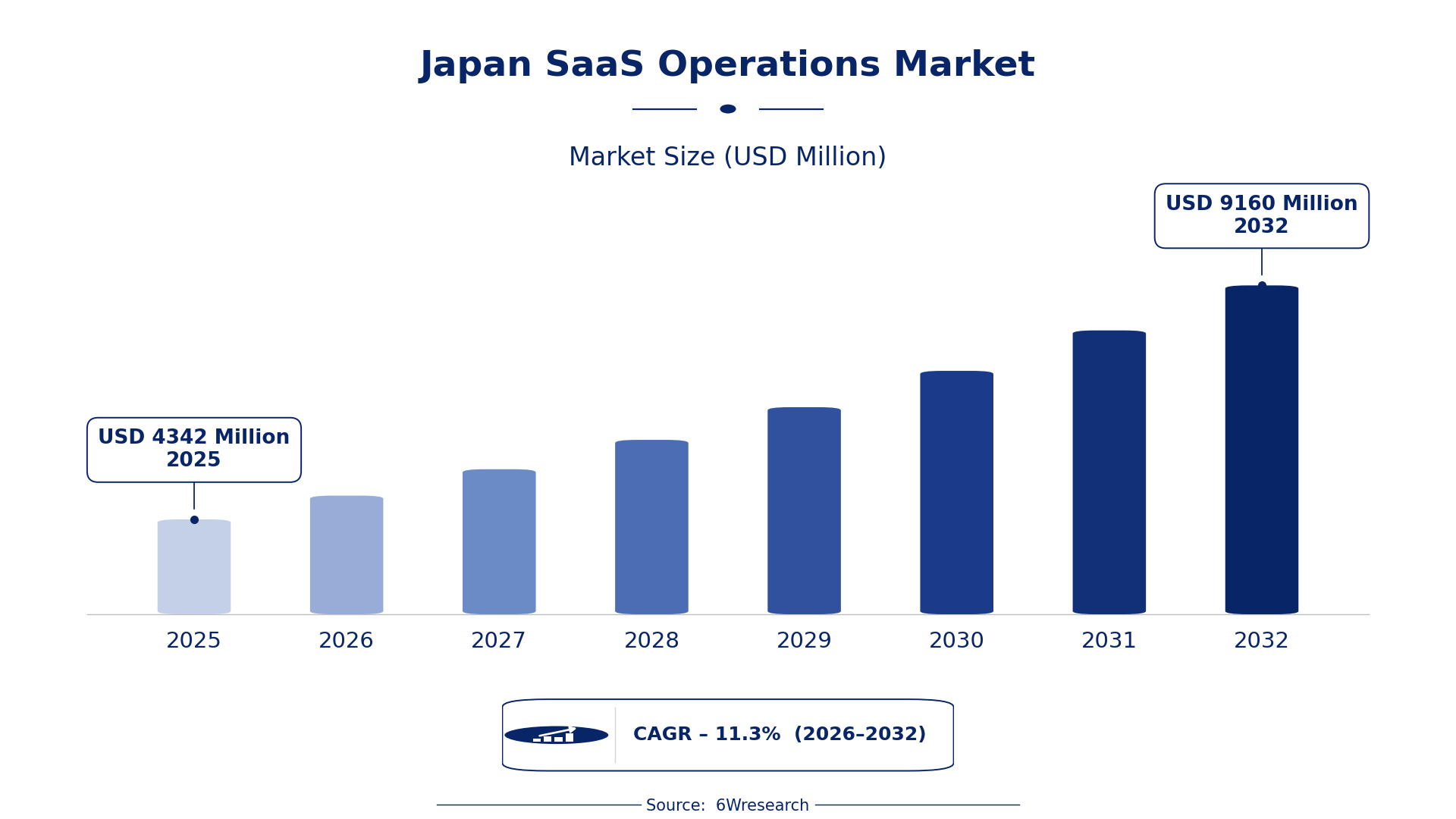
According to 6Wresearch internal database and industry insights, the Japan SaaS Operations Market was valued at USD 4,342 Million in 2025 and is projected to reach USD 9,160 Million by 2032, growing at a CAGR of approximately 11.3% during 2026–2032.
Japan SaaS Operations Market Highlights
| Report Metric | Details |
| Report Name | Japan SaaS Operations Market (2026-2032) |
| Market Size 2025 | USD 4,342 Million |
| Market Size 2032 | USD 9,160 Million |
| Absolute Growth 2025–2032 | USD 4,818 Million |
| CAGR 2026–2032 | 11.3% |
| Peak Annual Growth | 16.0% in 2026 |
| Forecast Period | 2026–2032 |
| Historical Data | 2022–2025 |
| Base Year | 2025 |
| Leading Functionality Type, 2025 | SaaS Management (37% share) |
| Leading Integration Level, 2025 | Multi-App (36% share) |
| Leading Application Area, 2025 | License Management (46% share) |
| Leading End User, 2025 | Large Corporations (48% share) |
| Fastest-Growing Functionality Type | Spend Optimization (15.7% CAGR) |
| Fastest-Growing Integration Level | Low-Code Integration (14.2% CAGR) |
| Fastest-Growing Application Area | Cost Control (13.1% CAGR) |
| Fastest-Growing End User | Finance Departments (14.5% CAGR) |
| Growing Sector | SaaS Management |
| Key End Users | Large Corporations, Finance Departments, SaaS Vendors, Legal Teams |
Japan SaaS Operations Market Year-wise Growth Rate and Key Drivers (2022–2032)
This graph illustrates the annual growth rates of the market from 2022 to 2032, highlighting a steady upward trajectory and projected market expansion over the forecast period.
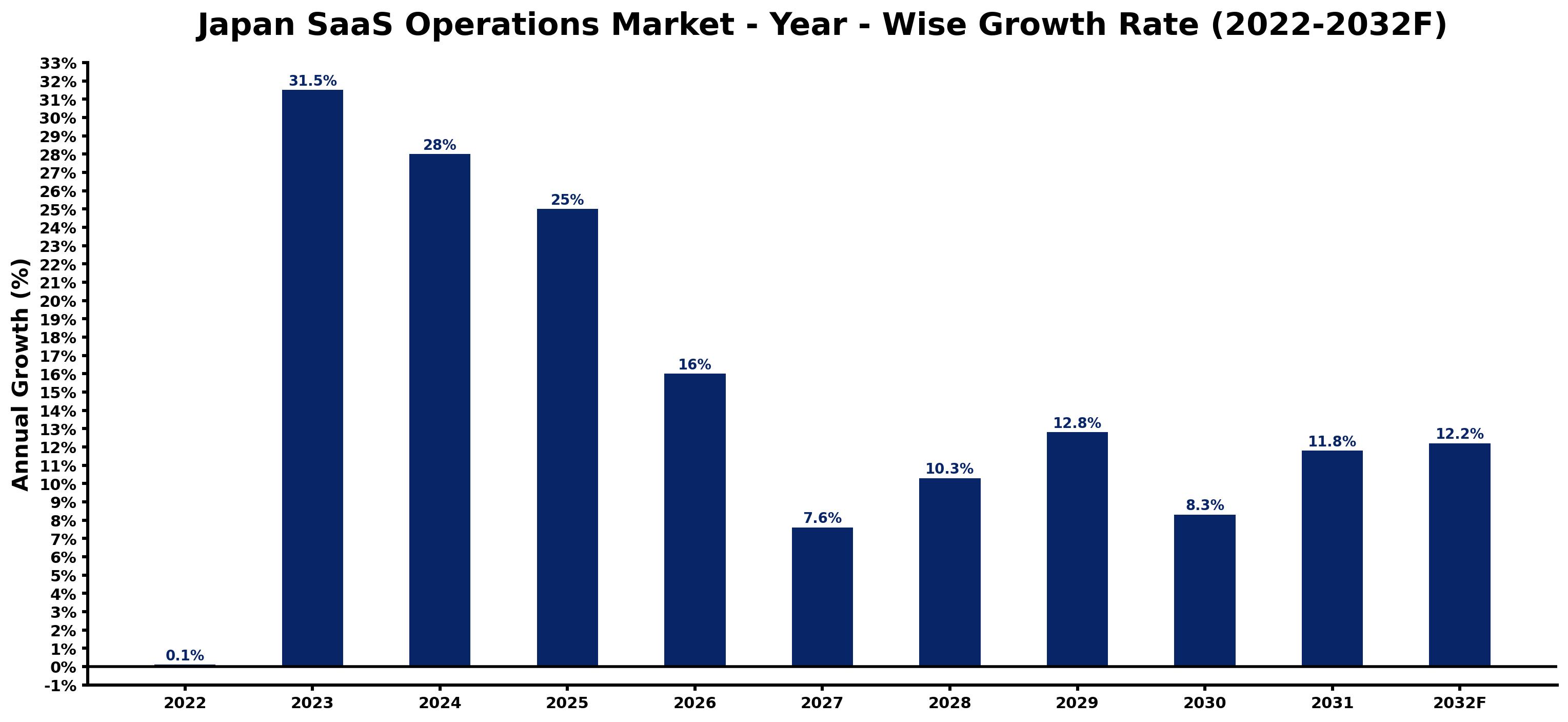
The table below sets out the estimated growth rate for each year and the main factor behind it.
| Year | Estimated Annual Growth (%) | Market Rationale |
| 2022 | 0.1 | The market showed minimal growth as companies began to explore SaaS options. |
| 2023 | 31.5 | Demand surged as businesses increasingly adopted SaaS for operational efficiency. |
| 2024 | 28.0 | Growth slowed as many firms reached their initial SaaS implementation goals. |
| 2025 | 25.0 | The market continued to expand as organizations focused on optimizing SaaS usage. |
| 2026 | 16.0 | Growth decelerated as market saturation began to influence new investments. |
| 2027 | 7.6 | The market growth rate decreased as companies reassessed their SaaS strategies. |
| 2028 | 10.3 | Demand increased as remote work trends continued to drive SaaS adoption. |
| 2029 | 12.8 | Growth accelerated as businesses sought more integrated SaaS solutions. |
| 2030 | 8.3 | The market saw slower growth as competition intensified among providers. |
| 2031 | 11.8 | Demand rose as companies prioritized compliance and security in SaaS. |
| 2032 | 12.2 | Growth picked up as new technologies enhanced SaaS functionalities. |
Note: Market size estimations and growth projections presented in this report are based on 6Wresearch's proprietary forecasting methodology, utilizing the latest available industry data, government publications, and primary research inputs.
Japan SaaS Operations Market Synopsis
SaaS Operations involves managing and optimizing software as a service applications, primarily delivered through cloud platforms. This sector is experiencing growth, driven by the increasing adoption of SaaS among large corporations and the need for compliance monitoring. With Japan's SaaS market projected to reach 1 trillion yen by 2025, the demand for efficient SaaS management and cost control is expected to rise, particularly in regulated industries and finance departments.
Market Dynamics Impact Analysis (2026–2032)
| Factor | Type | Impact | Primary Segment Affected |
| Increasing adoption of SaaS among large corporations | Driver | High | SaaS Management |
| Growing need for compliance monitoring in regulated industries | Driver | High | Compliance Monitoring |
| Expansion of SaaS vendors in Japan | Opportunity | High | SaaS Management |
| Rising demand for cost control solutions | Opportunity | High | Cost Control |
| Market saturation affecting new investments | Restraint | Medium | SaaS Management |
| High competition among SaaS providers leading to price wars | Restraint | Medium | SaaS Management |
| Challenges in integrating multiple SaaS applications | Challenge | High | Multi-App |
| Need for continuous compliance with evolving regulations | Challenge | High | Compliance Monitoring |
Evaluation of Drivers in Japan SaaS Operations Market (2026–2032)
The following drivers explain most of the expected growth.
| Drivers | Primary Segment Affected | Why It Matters (Evidence) |
| Growing operational efficiency demands | SaaS Management | Over 50% of large corporations in Japan utilize SaaS for HR management, driving demand for effective SaaS management solutions. |
| Regulatory compliance requirements | Compliance Monitoring | Regulated industries necessitate adherence to standards, increasing the need for compliance monitoring solutions. |
| Rising SaaS expenditure per company | Cost Control | The average SaaS expenditure per company is around 5 million yen annually, prompting businesses to seek cost control measures. |
| Increased remote work adoption | Workflow Automation | The trend of remote work has led to a notable increase in SaaS usage in finance departments since 2020, boosting demand for workflow automation. |
| Growth of SaaS vendors | SaaS Management | The number of SaaS companies in Japan exceeded 1,000 in 2023, expanding the market and driving competition. |
Several shifts outside the market lift sales. The average SaaS expenditure per company in Japan is around 5 million yen annually, prompting firms to seek effective cost control solutions. More than half of large corporations utilise SaaS for HR management, driving demand for management solutions. Remote work adoption has increased SaaS usage in finance departments, further boosting demand for workflow automation. The number of SaaS companies in Japan surpassed 1,000 in 2023, intensifying competition.
Evaluation of Restraints in Japan SaaS Operations Market
The table below lists the restraints and the evidence behind each.
| Market Restraint | Primary Segment Affected | Why It Matters (Evidence) |
| Integration challenges with multiple SaaS applications | Multi-App | Many organizations struggle to integrate various SaaS applications, resulting in inefficiencies and increased operational costs. |
| Intense competition leading to price wars | SaaS Management | High competition among providers results in aggressive pricing strategies that affect profit margins for suppliers. |
| Market saturation impacting new investments | SaaS Management | As more companies adopt SaaS, the market is becoming saturated, making it difficult for new entrants to gain traction. |
| Evolving regulatory compliance requirements | Compliance Monitoring | Frequent changes in regulations require constant updates to compliance monitoring solutions, increasing operational complexity. |
| Limited awareness of SaaS benefits among smaller firms | Cost Control | Many smaller organizations lack knowledge about the advantages of SaaS, hindering their adoption and investment. |
Japan SaaS Operations Market Challenges
Compliance challenges arise for buyers due to stringent regulations like ISO/IEC 27001, causing implementation delays of up to six months. Suppliers face hurdles with rapid technological changes in cybersecurity, leading to development costs that can increase by 20%. A shortage of skilled professionals in SaaS operations restricts suppliers' ability to meet rising demand, resulting in extended lead times for buyers. Buyers experience shifting preferences for SaaS applications, which can lead to supplier overstock and potential revenue losses of around 15%.
Trends in the Japan SaaS Operations Market
Buyers and suppliers in the Japan SaaS Operations Market are adjusting to the following trends.
- Shift towards Improved Compliance Monitoring: Since 2021, businesses have focused on compliance monitoring to meet regulatory standards. The adoption of ISO/IEC 27001 has increased, with over 1,000 SaaS companies prioritising security protocols.
- Transition from Traditional Software to SaaS Solutions: The trend of moving from traditional software to SaaS solutions began in 2020, with a notable rise in SaaS adoption in finance departments by 30%, reflecting a broader shift in operational strategies.
- Emergence of Low-Code Platforms for Integration: The rise of low-code platforms since 2022 has facilitated easier integration of SaaS applications, with a 20% increase in adoption among developers, making it simpler for businesses to streamline operations.
- Growing Need for Cost Control Solutions: The need for effective cost control solutions has intensified since 2023, with many organizations seeking ways to optimize their SaaS expenditures, reflecting a broader trend in financial management.
Investment Opportunities in the Japan SaaS Operations Market
The openings below show where demand in the Japan SaaS Operations Market is visible and how suppliers can enter.
- Tokyo as a Hub for SaaS Innovation: Tokyo is emerging as a leading hub for SaaS innovation, with over 1,000 SaaS vendors in 2023. Companies can enter this market through partnerships with local startups.
- Investment in Compliance Monitoring Solutions: With regulatory compliance becoming increasingly critical, there is a growing need for compliance monitoring solutions, particularly in finance. Collaborating with industry associations can facilitate market entry.
- Focus on Cost Control Technologies: The average SaaS expenditure per company is around 5 million yen annually, highlighting the need for cost control technologies. Targeting large corporations can yield substantial opportunities.
- Integration of Low-Code Platforms: The rise of low-code platforms offers an opportunity for businesses to streamline SaaS integration. Establishing joint ventures with tech firms can enhance market presence.
Government Initiatives in the Japan SaaS Operations Market
The Digital Agency launched in 2021 to promote digital transformation, supporting the framework for SaaS operations. This initiative aims to assist businesses in adopting cloud technologies and improving operational efficiency, thereby increasing the overall SaaS market potential. The agency has allocated resources to support SaaS adoption, targeting a substantial increase in the number of compliant SaaS applications by 2025.
Large corporations are utilising support from the Ministry of Economy, Trade and Industry to strengthen their SaaS capabilities. The agency provides funding and resources for businesses to implement effective SaaS management and compliance monitoring solutions, ensuring that they can meet regulatory standards and improve operational efficiency.
Future Insight of the Japan SaaS Operations Market
By 2032, large corporations will increasingly adopt advanced cybersecurity measures to protect SaaS applications, enhancing overall security. The Digital Agency's initiatives will drive SaaS spending, expected to reach 1 trillion yen by 2025. Remote work trends will persist, with employees using an average of eight different SaaS applications, necessitating improved management solutions. The rise of low-code platforms will facilitate seamless SaaS integration, benefiting both buyers and suppliers in streamlining operations.
Market Segmentation Analysis
Japan SaaS Operations Market report covers a detailed analysis of the following market segments:
By Functionality Type – SaaS Management Leads, Spend Optimization Expected to Grow Fastest
According to Saurav Kr Singh, Senior Research Analyst at 6Wresearch, with 37% of functionality type revenue in 2025, SaaS Management was the largest category. SaaS Management holds the largest share due to its critical role in overseeing multiple SaaS applications and ensuring compliance across large organisations. For instance, the necessity for effective management is evident in companies that rely on various software tools to streamline operations. Spend Optimization is projected to grow fastest, at a CAGR of 15.7% during 2026–2032. Spend Optimization is witnessing rapid growth as organisations increasingly focus on controlling costs related to SaaS subscriptions. The estimated SaaS spending of 300 billion yen in 2023 reflects the urgency for firms to adopt effective cost management strategies. This trend indicates that suppliers should enhance their offerings in cost management tools to meet rising client demands.
By Integration Level – Multi-App Leads, Low-Code Integration Expected to Grow Fastest
Multi-App took 36% of integration level revenue in 2025, more than any other category. The Multi-App integration level leads the market because it is widely used for connecting various applications into a cohesive system. This is particularly relevant in Tokyo, where seamless connectivity among platforms is crucial for operational efficiency. Low-Code Integration is set to record the highest CAGR in this split, 14.2% over 2026–2032. Low-Code Integration is the fastest-growing segment as it simplifies the integration process, appealing to organisations looking to streamline their operations. The increase in SaaS vendors, surpassing 1,000 in 2023, further drives the demand for accessible integration solutions. Suppliers should focus on developing low-code solutions to address the growing need for simplified integration among users.
By Application Area – License Management Leads, Cost Control Expected to Grow Fastest
In 2025, License Management led the application area split with a 46% share. License Management is the leading area as it is vital for tracking software licenses and ensuring compliance within large organisations. This is especially important in Japan, where adherence to regulatory standards significantly influences SaaS adoption. The quickest growth will come from Cost Control, forecast to expand at a CAGR of 13.1% between 2026 and 2032. Cost Control is the fastest-growing application area as companies aim to optimise their SaaS expenditures amid rising costs. The average annual SaaS expenditure per company, around 5 million yen, highlights the pressing need for effective cost management strategies. This suggests that suppliers should prioritise features that enhance cost control capabilities in their SaaS offerings.
By End User – Large Corporations Lead, Finance Departments Expected to Grow Fastest
The largest end user category in 2025 was Large Corporations, at 48% of revenue. Large Corporations dominate the market as they are the primary users of SaaS Operations, utilising it for improved efficiency and scalability. Notably, over 50% of these corporations employ SaaS for HR management, showcasing their reliance on such solutions. Over 2026–2032, Finance Departments are expected to post the fastest growth, at a CAGR of 14.5%. Finance Departments are the fastest-growing end user segment as they increasingly adopt SaaS for financial management and reporting. The 30% increase in SaaS adoption within finance departments since 2020 indicates a shift towards digital solutions in financial operations. This suggests that suppliers should tailor their products to meet the specific needs of finance departments to capture this expanding market.
Key Attractiveness of the Report
- 10 Years of Market Numbers
- Historical Data Starting from 2022 to 2025
- Base Year 2025
- Forecast Data until 2032
- Key Performance Indicators Impacting the Market
- Major Upcoming Developments and Projects
Key Highlights of the Report:
- Japan SaaS Operations Market Outlook
- Market Size of Japan SaaS Operations Market, 2025
- Forecast of Japan SaaS Operations Market, 2032
- Historical Data and Forecast of Japan SaaS Operations Revenues & Volume for the Period 2022-2032F
- Japan SaaS Operations Market Trend Evolution
- Japan SaaS Operations Market Drivers and Challenges
- Japan SaaS Operations Price Trends
- Japan SaaS Operations Porter's Five Forces
- Japan SaaS Operations Industry Life Cycle
- Historical Data and Forecast of Japan SaaS Operations Market Revenues & Volume By Functionality Type for the Period 2022-2032F
- Historical Data and Forecast of Japan SaaS Operations Market Revenues & Volume By SaaS Management for the Period 2022-2032F
- Historical Data and Forecast of Japan SaaS Operations Market Revenues & Volume By Spend Optimization for the Period 2022-2032F
- Historical Data and Forecast of Japan SaaS Operations Market Revenues & Volume By Workflow Automation for the Period 2022-2032F
- Historical Data and Forecast of Japan SaaS Operations Market Revenues & Volume By Compliance Monitoring for the Period 2022-2032F
- Historical Data and Forecast of Japan SaaS Operations Market Revenues & Volume By Integration Level for the Period 2022-2032F
- Historical Data and Forecast of Japan SaaS Operations Market Revenues & Volume By Multi-App for the Period 2022-2032F
- Historical Data and Forecast of Japan SaaS Operations Market Revenues & Volume By Low-Code Integration for the Period 2022-2032F
- Historical Data and Forecast of Japan SaaS Operations Market Revenues & Volume By High Integration for the Period 2022-2032F
- Historical Data and Forecast of Japan SaaS Operations Market Revenues & Volume By Plug & Play for the Period 2022-2032F
- Historical Data and Forecast of Japan SaaS Operations Market Revenues & Volume By Application Area for the Period 2022-2032F
- Historical Data and Forecast of Japan SaaS Operations Market Revenues & Volume By License Management for the Period 2022-2032F
- Historical Data and Forecast of Japan SaaS Operations Market Revenues & Volume By Cost Control for the Period 2022-2032F
- Historical Data and Forecast of Japan SaaS Operations Market Revenues & Volume By HR/Payroll Systems for the Period 2022-2032F
- Historical Data and Forecast of Japan SaaS Operations Market Revenues & Volume By Regulated Industries for the Period 2022-2032F
- Historical Data and Forecast of Japan SaaS Operations Market Revenues & Volume By End User for the Period 2022-2032F
- Historical Data and Forecast of Japan SaaS Operations Market Revenues & Volume By Large Corporations for the Period 2022-2032F
- Historical Data and Forecast of Japan SaaS Operations Market Revenues & Volume By Finance Departments for the Period 2022-2032F
- Historical Data and Forecast of Japan SaaS Operations Market Revenues & Volume By SaaS Vendors for the Period 2022-2032F
- Historical Data and Forecast of Japan SaaS Operations Market Revenues & Volume By Legal Teams for the Period 2022-2032F
- Japan SaaS Operations Import Export Trade Statistics
- Market Opportunity Assessment By Functionality Type
- Market Opportunity Assessment By Integration Level
- Market Opportunity Assessment By Application Area
- Market Opportunity Assessment By End User
- Japan SaaS Operations Top Companies Market Share
- Japan SaaS Operations Competitive Benchmarking By Technical and Operational Parameters
- Japan SaaS Operations Company Profiles
- Japan SaaS Operations Key Strategic Recommendations
Market Covered
The report covers the following segments.
By Functionality Type
- SaaS Management
- Spend Optimization
- Workflow Automation
- Compliance Monitoring
By Integration Level
- Multi-App
- Low-Code Integration
- High Integration
- Plug & Play
By Application Area
- License Management
- Cost Control
- HR/Payroll Systems
- Regulated Industries
By End User
- Large Corporations
- Finance Departments
- SaaS Vendors
- Legal Teams































