Japan SaaS Voice Generation AI Market Size & Growth Rate

According to 6Wresearch internal database and industry insights, the Japan SaaS Voice Generation AI Market was valued at USD 146 Million in 2025 and is projected to reach USD 385 Million by 2032, growing at a CAGR of approximately 14.9% during 2026–2032.
Japan SaaS Voice Generation AI Market Highlights
| Report Metric | Details |
| Report Name | Japan SaaS Voice Generation AI Market (2026-2032) |
| Market Size 2025 | USD 146 Million |
| Market Size 2032 | USD 385 Million |
| Absolute Growth 2025–2032 | USD 239 Million |
| CAGR 2026–2032 | 14.9% |
| Peak Annual Growth | 15.6% in 2032 |
| Forecast Period | 2026–2032 |
| Historical Data | 2022–2025 |
| Base Year | 2025 |
| Leading Application Type, 2025 | Text-to-Speech (38% share) |
| Leading Voice Output Type, 2025 | Natural Voice (53% share) |
| Leading Deployment Model, 2025 | Cloud-Based (41% share) |
| Leading End User, 2025 | Customer Service Platforms (41% share) |
| Fastest-Growing Application Type | Voice Cloning (20.8% CAGR) |
| Fastest-Growing Voice Output Type | Neural Voice (20.7% CAGR) |
| Fastest-Growing Deployment Model | SaaS Subscription (16.5% CAGR) |
| Fastest-Growing End User | E-learning Platforms (19.3% CAGR) |
| Growing Sector | E-learning |
| Key End Users | Customer service platforms, media and entertainment, e-learning platforms, gaming |
Japan SaaS Voice Generation AI Market Year-wise Growth Rate and Key Drivers (2022–2032)
This graph illustrates the annual growth rates of the market from 2022 to 2032, highlighting a steady upward trajectory and projected market expansion over the forecast period.
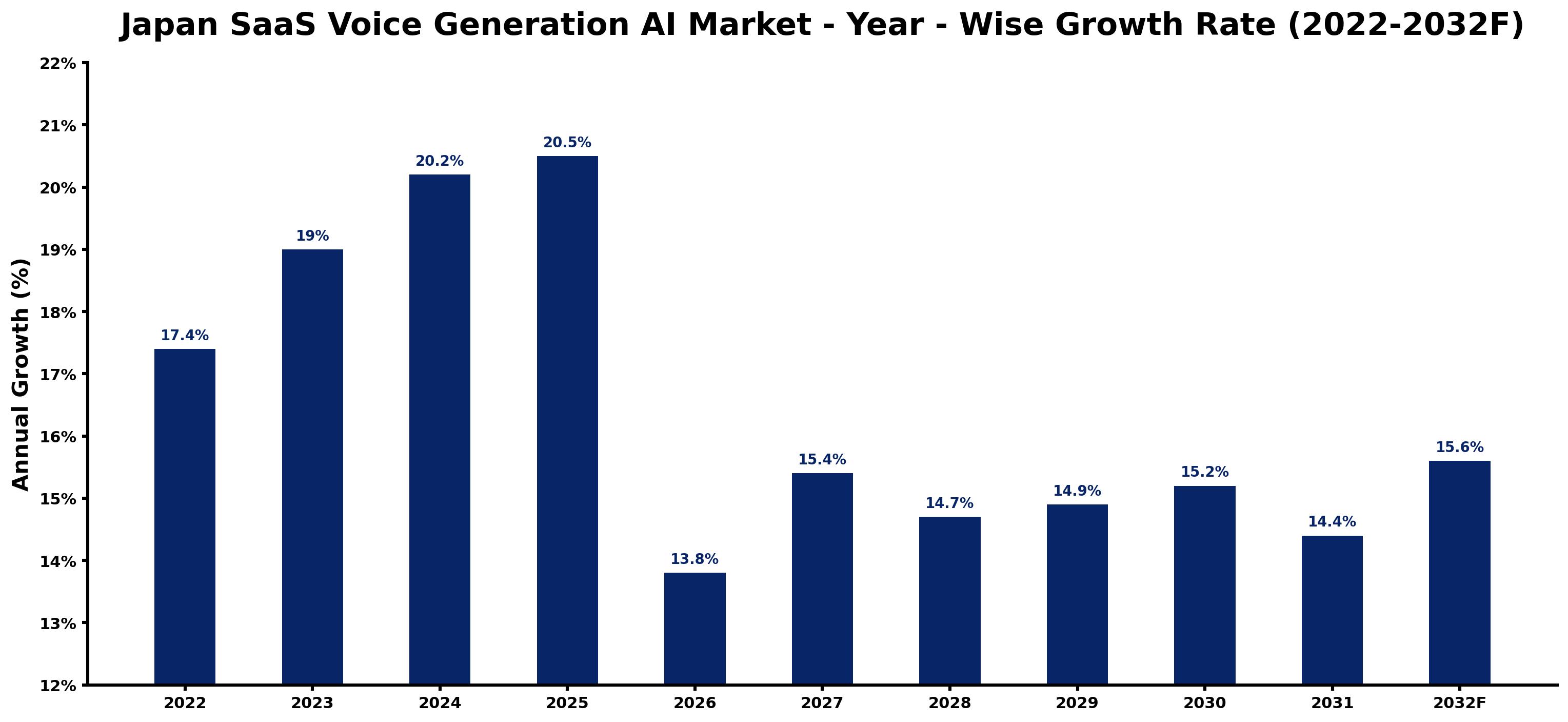
Year by year, the estimates below pair each growth rate with the development that shaped it.
| Year | Estimated Annual Growth (%) | Market Rationale |
| 2022 | 17.4 | The market showed steady growth, reflecting increased adoption of AI technologies across various sectors. |
| 2023 | 19.0 | Demand accelerated as more companies integrated voice generation for customer engagement. |
| 2024 | 20.2 | Growth continued to rise due to expanding applications in e-learning platforms. |
| 2025 | 20.5 | The market peaked, driven by significant investments in media and entertainment technologies. |
| 2026 | 13.8 | Growth is expected to slow as the market stabilises after rapid expansion in previous years. |
| 2027 | 15.4 | Demand will increase again as companies seek to improve user experiences with voice solutions. |
| 2028 | 14.7 | A slight slowdown is projected as market saturation in some areas begins to take effect. |
| 2029 | 14.9 | Growth is expected to pick up as new applications in gaming and animation emerge. |
| 2030 | 15.2 | Demand will continue to rise, supported by advancements in voice quality. |
| 2031 | 14.4 | Growth is projected to slow again as the market adjusts to evolving consumer preferences. |
| 2032 | 15.6 | The market is expected to peak again as demand for realistic voice applications surges. |
Note: Market size estimations and growth projections presented in this report are based on 6Wresearch's proprietary forecasting methodology, utilizing the latest available industry data, government publications, and primary research inputs.
Japan SaaS Voice Generation AI Market Synopsis
SaaS Voice Generation AI technology converts text into human-like speech using machine learning algorithms. Its primary applications include improving customer service interactions, creating engaging media content, and facilitating language learning in e-learning platforms. The Japan SaaS Voice Generation AI Market is expanding rapidly, driven by over 100 million internet users and a flourishing e-learning sector valued at approximately $1 billion. The government's AI Strategy 2021 promotes further adoption across industries, increasing demand for accessible voice solutions.
Market Dynamics Impact Analysis (2026–2032)
| Factor | Type | Impact | Primary Segment Affected |
| Growing internet penetration in Japan | Driver | High | Text-to-Speech |
| Increase in e-learning platforms | Driver | High | E-learning Platforms |
| Expansion of gaming and animation sectors | Opportunity | Medium | Voice Cloning |
| Rising demand for accessibility solutions | Opportunity | High | Text-to-Speech |
| High competition among providers | Restraint | Medium | Neural Voice |
| Market saturation in certain applications | Restraint | High | Conversational AI |
| High development costs for advanced AI systems | Challenge | High | Natural Voice |
| Rapid technological changes in AI | Challenge | Medium | Multilingual Generation |
Evaluation of Drivers in Japan SaaS Voice Generation AI Market (2026–2032)
These are the developments adding the most demand over the forecast period.
| Drivers | Primary Segment Affected | Why It Matters (Evidence) |
| Increased internet accessibility | Text-to-Speech | Over 100 million internet users in Japan drive demand for voice generation solutions. |
| Growth in online education | E-learning Platforms | The Japanese e-learning market was valued at approximately $1 billion, increasing voice generation usage. |
| Demand for realistic voice applications | Voice Cloning | This technology is increasingly used in gaming and animation sectors, improving user experiences. |
| Technological advancements in AI | Natural Voice | Recent improvements lead to better voice quality, attracting more buyers in various sectors. |
| Government support for AI initiatives | Neural Voice | The Japanese government allocated $100 million for AI research, boosting development in voice technologies. |
Buyers are adding capacity as the number of internet users in Japan exceeds 100 million, driving demand for voice generation solutions. The e-learning market, valued at approximately $1 billion in 2022, is expanding quickly, leading to increased voice generation usage. Voice cloning technology is gaining traction in gaming and animation, prompting more investments in this area. Recent advancements are improving voice quality, making these solutions more appealing to various sectors.
Evaluation of Restraints in Japan SaaS Voice Generation AI Market
The main factors holding the market back are set out below.
| Market Restraint | Primary Segment Affected | Why It Matters (Evidence) |
| Intense competition among voice generation providers | Neural Voice | High competition can lead to price wars, affecting profitability for many suppliers. |
| Market saturation in established applications | Conversational AI | Saturation in customer service applications limits growth opportunities for new entrants. |
| High development costs for AI technologies | Natural Voice | Developing advanced AI systems requires substantial investment, which can deter smaller players. |
| Rapid technological changes in the AI sector | Multilingual Generation | Keeping up with fast-paced technological advancements can be challenging for many companies. |
| Consumer preferences evolving quickly | Voice Cloning | Changing consumer demands require constant adaptation, which can strain resources. |
Japan SaaS Voice Generation AI Market Challenges
In Japan, 100 million internet users create a high demand for SaaS solutions, yet the limited supply of advanced voice generation technology restricts producers' ability to meet this need. A shortage of skilled professionals in AI and machine learning delays development timelines, causing setbacks for sectors like media and e-learning. Increased competition from international markets compels local suppliers to innovate rapidly, straining resources and leading to potential product delays for buyers. Rising costs associated with AI research and development, with the government allocating $100 million in 2023, inflate prices for buyers seeking effective solutions.
Trends in the Japan SaaS Voice Generation AI Market
Four trends stand out in the Japan SaaS Voice Generation AI Market.
- Shift from Traditional to AI-Driven Voice Solutions: Since 2021, there has been a shift towards AI-driven voice solutions in Japan. The e-learning sector, valued at approximately $1 billion in 2022, is increasingly adopting these technologies, improving user engagement.
- Transition from Standard to Natural Voice Output: Natural voice output has become the preferred choice for many applications, especially in customer service. In 2025, Natural Voice is expected to hold a 53% market share, reflecting its growing importance.
- Emergence of Real-Time Speech Applications: Real-time speech applications have gained traction, particularly in customer service environments. The demand for such solutions is driven by the need for immediate interaction, with a notable increase in usage in 2023.
- Prioritisation of Accessibility in Voice Generation: Since the introduction of the JIS X 8341-3 standard, there has been a stronger focus on accessibility in digital content. This shift is influencing the development of voice generation technologies to cater to diverse user needs.
Investment Opportunities in the Japan SaaS Voice Generation AI Market
Below are the investment opportunities with the strongest case in the Japan SaaS Voice Generation AI Market.
- Partner with AI Startups for Innovation: Now is an ideal time to invest in partnerships with AI startups in Tokyo, where innovation is thriving. The Japanese government has allocated $100 million for AI research, creating a supportive environment for new ventures.
- Invest in E-Learning Solutions: The growing e-learning sector, expected to grow by 20% annually, presents a strong opportunity. Suppliers can target educational institutions in Japan, offering tailored voice generation solutions.
- Expand Offerings in Gaming and Animation: With voice cloning technology increasingly used in gaming, there is a strong demand for suppliers to develop unique solutions. Collaborating with gaming studios can facilitate entry into this expanding market.
- Focus on Accessibility Solutions: The aging population in Japan, with over 36 million seniors, creates a pressing need for accessible technology. Suppliers can develop voice generation solutions tailored to enhance accessibility for older users.
Government Initiatives in the Japan SaaS Voice Generation AI Market
The Long-Term Care Insurance Act, established in 1997, funds essential nursing care services for older individuals, promoting the adoption of accessible technologies like voice generation AI. The Industrial Standardization Act, amended in 2019, governs product standards, ensuring quality and safety in voice technology applications.
The Digital Agency, established in September 2021, oversees government digital transformation efforts and approves initiatives that support AI adoption. This agency funds projects that advance the development of voice generation technologies.
Future Insight of the Japan SaaS Voice Generation AI Market
By 2032, e-learning platforms will increasingly utilise voice generation AI, enhancing interaction for learners and educators. The Japanese e-learning sector is projected to grow by 20% annually, boosting demand for these technologies. The AI Strategy 2021 will drive further AI adoption across various industries, prompting suppliers to create more sophisticated solutions. Accessibility standards like JIS X 8341-3 will shape the development of voice applications, ensuring that technology meets the needs of Japan's aging population.
Market Segmentation Analysis
Japan SaaS Voice Generation AI Market report covers a detailed analysis of the following market segments:
By Application Type – Text-to-Speech Leads, Voice Cloning Expected to Grow Fastest
According to Saurav Kr Singh, Senior Research Analyst at 6Wresearch, the largest application type category in 2025 was Text-to-Speech, at 38% of revenue. Text-to-Speech holds the largest share as it is extensively employed for accessibility and content creation across various sectors. Its integration into platforms adhering to the JIS X 8341-3 standard highlights its importance in enhancing user engagement and compliance. Over 2026–2032, Voice Cloning is expected to post the fastest growth, at a CAGR of 20.8%. Voice Cloning is experiencing rapid growth due to its ability to create personalised user experiences, particularly in gaming and animation. The rising demand for tailored interactions is significantly driving this segment's expansion. Suppliers should focus on developing solutions that cater to the increasing need for personalised voice experiences.
By Voice Output Type – Natural Voice Leads, Neural Voice Expected to Grow Fastest
With 53% of voice output type revenue in 2025, Natural Voice was the largest category. Natural Voice leads the market as it is preferred for its realistic user engagement, making it vital in customer-facing applications. Its popularity is particularly evident in sectors where user satisfaction is paramount, such as customer service. Neural Voice is projected to grow fastest, at a CAGR of 20.7% during 2026–2032. Neural Voice is the fastest-growing segment owing to its advanced speech quality, which is increasingly sought after in high-fidelity applications. As technology progresses, the demand for superior audio experiences will continue to rise. Buyers will benefit from investing in advanced voice technologies that enhance user interaction and satisfaction.
By Deployment Model – Cloud-Based Leads, SaaS Subscription Expected to Grow Fastest
Cloud-Based accounted for 41% of the market by deployment model in 2025. Cloud-Based deployment is the dominant model, providing scalability and flexibility that meets the needs of various businesses. This model is particularly advantageous for companies looking to expand their voice generation capabilities without heavy upfront investments. SaaS Subscription is set to record the highest CAGR in this split, 16.5% over 2026–2032. SaaS Subscription is growing rapidly as it offers an accessible model for organisations to utilise voice generation services without the need for extensive infrastructure. This trend is expected to continue as more businesses seek cost-effective solutions. Suppliers should prioritise SaaS offerings to capture the growing market of businesses seeking flexible voice generation solutions.
By End User – Customer Service Platforms Lead, E-learning Platforms Expected to Grow Fastest
In 2025, Customer Service Platforms led the end user split with a 41% share. Customer Service Platforms represent the largest user group for voice generation technology, leveraging it to improve user interactions and streamline operational efficiency. The heightened focus on customer experience is driving substantial investments in this area. The quickest growth will come from E-learning Platforms, forecast to expand at a CAGR of 19.3% between 2026 and 2032. E-learning Platforms are witnessing the fastest growth as they adopt voice generation for more interactive learning experiences. The projected 20% annual growth in the e-learning sector highlights the increasing demand for such technologies. Suppliers must tailor their offerings to meet the specific needs of the rapidly expanding e-learning market.
Key Attractiveness of the Report
- 10 Years of Market Numbers
- Historical Data Starting from 2022 to 2025
- Base Year 2025
- Forecast Data until 2032
- Key Performance Indicators Impacting the Market
- Major Upcoming Developments and Projects
Key Highlights of the Report:
- Japan SaaS Voice Generation AI Market Outlook
- Market Size of Japan SaaS Voice Generation AI Market, 2025
- Forecast of Japan SaaS Voice Generation AI Market, 2032
- Historical Data and Forecast of Japan SaaS Voice Generation AI Revenues & Volume for the Period 2022-2032F
- Japan SaaS Voice Generation AI Market Trend Evolution
- Japan SaaS Voice Generation AI Market Drivers and Challenges
- Japan SaaS Voice Generation AI Price Trends
- Japan SaaS Voice Generation AI Porter's Five Forces
- Japan SaaS Voice Generation AI Industry Life Cycle
- Historical Data and Forecast of Japan SaaS Voice Generation AI Market Revenues & Volume By Application Type for the Period 2022-2032F
- Historical Data and Forecast of Japan SaaS Voice Generation AI Market Revenues & Volume By Text-to-Speech for the Period 2022-2032F
- Historical Data and Forecast of Japan SaaS Voice Generation AI Market Revenues & Volume By Voice Cloning for the Period 2022-2032F
- Historical Data and Forecast of Japan SaaS Voice Generation AI Market Revenues & Volume By Multilingual Generation for the Period 2022-2032F
- Historical Data and Forecast of Japan SaaS Voice Generation AI Market Revenues & Volume By Conversational AI for the Period 2022-2032F
- Historical Data and Forecast of Japan SaaS Voice Generation AI Market Revenues & Volume By Voice Output Type for the Period 2022-2032F
- Historical Data and Forecast of Japan SaaS Voice Generation AI Market Revenues & Volume By Natural Voice for the Period 2022-2032F
- Historical Data and Forecast of Japan SaaS Voice Generation AI Market Revenues & Volume By Neural Voice for the Period 2022-2032F
- Historical Data and Forecast of Japan SaaS Voice Generation AI Market Revenues & Volume By Multilingual Audio for the Period 2022-2032F
- Historical Data and Forecast of Japan SaaS Voice Generation AI Market Revenues & Volume By Real-Time Speech for the Period 2022-2032F
- Historical Data and Forecast of Japan SaaS Voice Generation AI Market Revenues & Volume By Deployment Model for the Period 2022-2032F
- Historical Data and Forecast of Japan SaaS Voice Generation AI Market Revenues & Volume By Cloud-Based for the Period 2022-2032F
- Historical Data and Forecast of Japan SaaS Voice Generation AI Market Revenues & Volume By Hybrid for the Period 2022-2032F
- Historical Data and Forecast of Japan SaaS Voice Generation AI Market Revenues & Volume By API Integration for the Period 2022-2032F
- Historical Data and Forecast of Japan SaaS Voice Generation AI Market Revenues & Volume By SaaS Subscription for the Period 2022-2032F
- Historical Data and Forecast of Japan SaaS Voice Generation AI Market Revenues & Volume By End User for the Period 2022-2032F
- Historical Data and Forecast of Japan SaaS Voice Generation AI Market Revenues & Volume By Media & Entertainment for the Period 2022-2032F
- Historical Data and Forecast of Japan SaaS Voice Generation AI Market Revenues & Volume By Customer Service Platforms for the Period 2022-2032F
- Historical Data and Forecast of Japan SaaS Voice Generation AI Market Revenues & Volume By E-learning Platforms for the Period 2022-2032F
- Historical Data and Forecast of Japan SaaS Voice Generation AI Market Revenues & Volume By Virtual Assistant Providers for the Period 2022-2032F
- Japan SaaS Voice Generation AI Import Export Trade Statistics
- Market Opportunity Assessment By Application Type
- Market Opportunity Assessment By Voice Output Type
- Market Opportunity Assessment By Deployment Model
- Market Opportunity Assessment By End User
- Japan SaaS Voice Generation AI Top Companies Market Share
- Japan SaaS Voice Generation AI Competitive Benchmarking By Technical and Operational Parameters
- Japan SaaS Voice Generation AI Company Profiles
- Japan SaaS Voice Generation AI Key Strategic Recommendations
Market Covered
Segments analysed in this report are listed below.
By Application Type
- Text-to-Speech
- Voice Cloning
- Multilingual Generation
- Conversational AI
By Voice Output Type
- Natural Voice
- Neural Voice
- Multilingual Audio
- Real-Time Speech
By Deployment Model
- Cloud-Based
- Hybrid
- API Integration
- SaaS Subscription
By End User
- Media & Entertainment
- Customer Service Platforms
- E-learning Platforms
- Virtual Assistant Providers































