Japan Safety and Surveillance Market Size & Growth Rate
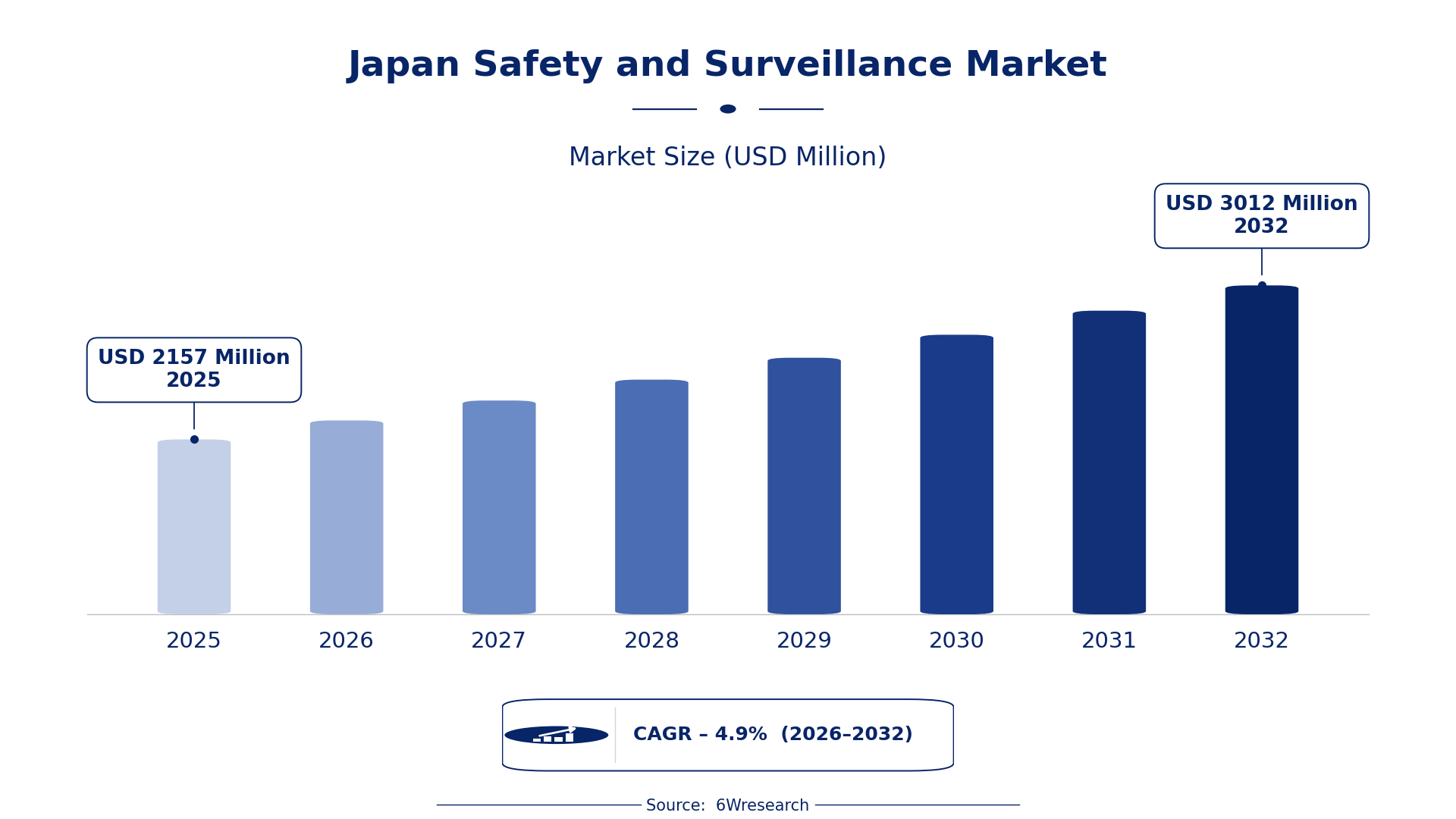
According to 6Wresearch internal database and industry insights, the Japan Safety and Surveillance Market was valued at USD 2,157 Million in 2025 and is projected to reach USD 3,012 Million by 2032, growing at a CAGR of approximately 4.9% during 2026–2032.
Japan Safety and Surveillance Market Highlights
| Report Metric | Details |
| Report Name | Japan Safety and Surveillance Market (2026-2032) |
| Market Size 2025 | USD 2,157 Million |
| Market Size 2032 | USD 3,012 Million |
| Absolute Growth 2025–2032 | USD 855 Million |
| CAGR 2026–2032 | 4.9% |
| Peak Annual Growth | 5.8% in 2026 |
| Forecast Period | 2026–2032 |
| Historical Data | 2022–2025 |
| Base Year | 2025 |
| Leading Product Type, 2025 | CCTV Cameras (41% share) |
| Leading Connectivity, 2025 | Wired/Wireless (40% share) |
| Leading Monitoring Mode, 2025 | Continuous (49% share) |
| Leading End User, 2025 | Urban Safety Authorities (38% share) |
| Fastest-Growing Product Type | Smart Alarms (7.0% CAGR) |
| Fastest-Growing Connectivity | IoT Enabled (6.7% CAGR) |
| Fastest-Growing Monitoring Mode | Motion-Triggered (6.3% CAGR) |
| Fastest-Growing End User | Residential Users (6.4% CAGR) |
| Growing Sector | Urban Safety |
| Key End Users | Urban Safety Authorities, Residential Users, Defense & Border Control, Transportation Hubs |
Japan Safety and Surveillance Market Year-wise Growth Rate and Key Drivers (2022–2032)
This graph illustrates the annual growth rates of the market from 2022 to 2032, highlighting a steady upward trajectory and projected market expansion over the forecast period.
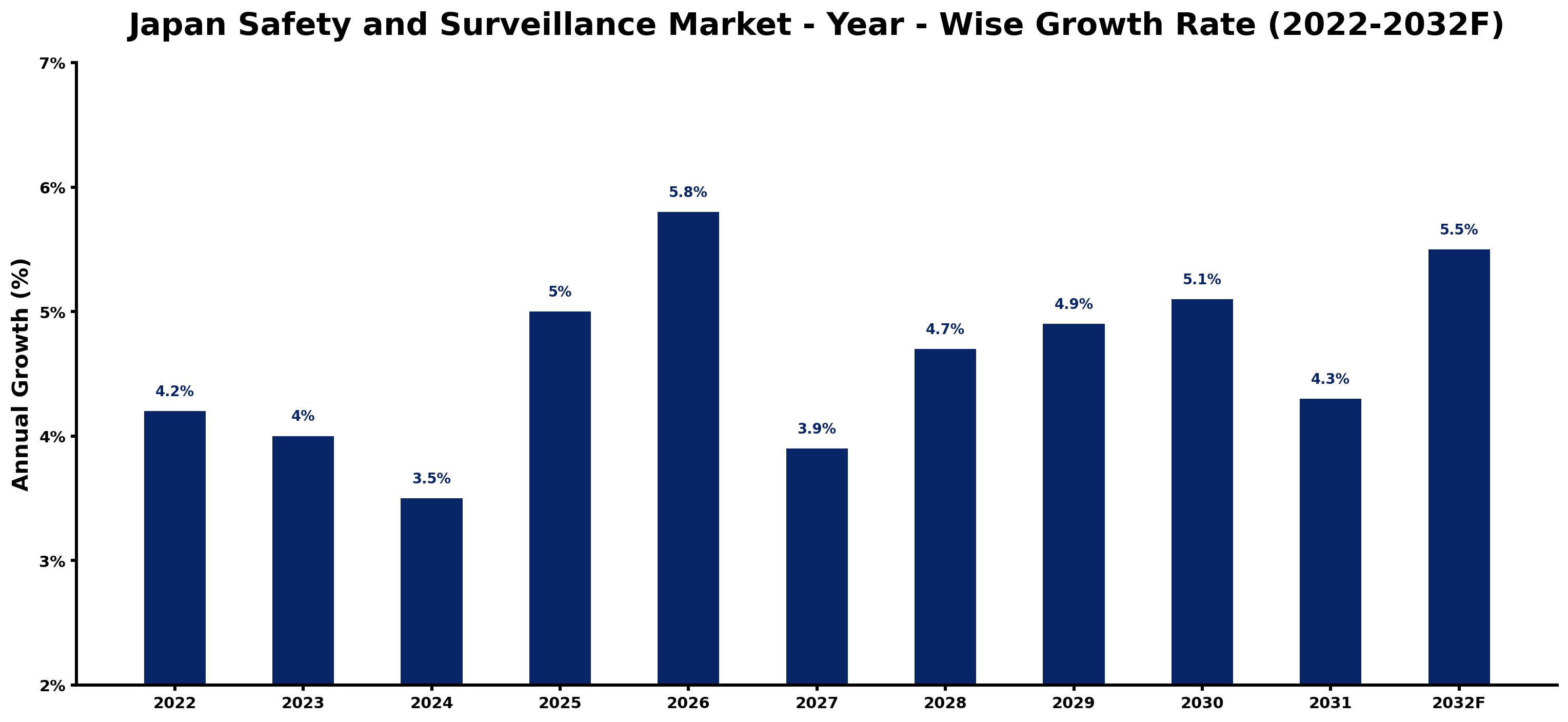
The yearly estimates that follow link every growth rate to its principal driver, so readers can see why the pace changed in each period.
| Year | Estimated Annual Growth (%) | Market Rationale |
| 2022 | 4.2 | The market showed steady growth with increasing installations of surveillance technologies. |
| 2023 | 4.0 | Growth slowed as the market adjusted to previous high demand levels in urban safety. |
| 2024 | 3.5 | Demand continued to decelerate due to market saturation in urban areas. |
| 2025 | 5.0 | Growth accelerated as urban safety authorities expanded their surveillance capabilities. |
| 2026 | 5.8 | The peak growth year was driven by investments in smart city initiatives. |
| 2027 | 3.9 | Growth is expected to slow as competition intensifies among technology providers. |
| 2028 | 4.7 | Demand is projected to increase as remote monitoring solutions gain traction in residential sectors. |
| 2029 | 4.9 | Growth is expected to rise as urban safety authorities adopt advanced analytics for surveillance. |
| 2030 | 5.1 | Demand will continue to grow with integration of IoT technologies in systems. |
| 2031 | 4.3 | Growth is projected to slow as the market matures and new entrants face challenges. |
| 2032 | 5.5 | The market will experience renewed growth driven by advancements in AI analytics. |
Note: Market size estimations and growth projections presented in this report are based on 6Wresearch's proprietary forecasting methodology, utilizing the latest available industry data, government publications, and primary research inputs.
Japan Safety and Surveillance Market Synopsis
The Safety and Surveillance market in Japan encompasses technologies aimed at monitoring and protecting environments, including CCTV cameras, smart alarms, and thermal imaging devices. Demand is increasing due to substantial investments in public safety infrastructure, with over 4 million CCTV cameras installed in urban areas. The government's allocation of ¥10 billion for urban safety projects is driving demand, while smart alarms are being adopted more widely in residential buildings, improving security measures.
Market Dynamics Impact Analysis (2026–2032)
| Factor | Type | Impact | Primary Segment Affected |
| Increasing urban safety initiatives | Driver | High | CCTV Cameras |
| Growing adoption of smart home technologies | Driver | High | Smart Alarms |
| Expansion of urban safety projects | Opportunity | High | Urban Safety Authorities |
| Rising demand for remote monitoring solutions | Opportunity | Medium | Residential Users |
| Market saturation in urban areas | Restraint | High | CCTV Cameras |
| High competition among technology providers | Restraint | Medium | Smart Alarms |
| High costs of advanced surveillance technologies | Challenge | High | Thermal Cameras |
| Regulatory compliance challenges for new entrants | Challenge | Medium | Dome Cameras |
Evaluation of Drivers in Japan Safety and Surveillance Market (2026–2032)
The table below links each growth driver to the segment it affects and the evidence for it.
| Drivers | Primary Segment Affected | Why It Matters (Evidence) |
| Investment in public safety infrastructure | CCTV Cameras | In 2023, ¥10 billion was allocated for urban safety projects, increasing demand for surveillance systems. |
| Rising residential security concerns | Smart Alarms | Smart alarms are adopted in over 30% of new residential buildings, prompting more purchases. |
| Integration of IoT technologies | IoT Enabled | The trend of smart homes is driving demand for IoT-enabled surveillance solutions. |
| Analytics capabilities | AI Analytics | AI analytics are projected to grow by 2025, improving effectiveness for urban safety authorities. |
| Focus on public transport safety | Transportation Hubs | The Osaka Prefecture has implemented smart surveillance systems in public transport hubs, increasing demand. |
Orders keep climbing as ¥10 billion was allocated for urban safety projects in 2023, prompting urban safety authorities to invest in advanced surveillance systems. Security concerns among homeowners reflect in the adoption of smart alarms in over 30% of new residential buildings. The integration of IoT technologies is transforming residential security, with a 20% adoption rate for remote monitoring solutions. AI analytics in surveillance systems are projected to grow by 2025, improving effectiveness for urban safety authorities. Implementation of smart surveillance systems in public transport hubs is driving demand for monitoring solutions.
Evaluation of Restraints in Japan Safety and Surveillance Market
The following restraints limit how fast demand can grow.
| Market Restraint | Primary Segment Affected | Why It Matters (Evidence) |
| Market saturation in urban areas | CCTV Cameras | Over 4 million installed CCTV cameras limit new installations in urban settings. |
| High competition among technology providers | Smart Alarms | Intense competition among providers leads to price pressures and reduced margins. |
| Costs associated with advanced technologies | Thermal Cameras | High costs hinder widespread adoption of thermal cameras in non-defense applications. |
| Regulatory compliance challenges | Dome Cameras | New entrants face difficulties meeting JIS standards set by the National Police Agency. |
| Limited awareness of advanced surveillance solutions | AI Analytics | Many potential users are unaware of the benefits of AI analytics for surveillance. |
Japan Safety and Surveillance Market Challenges
In 2022, Japan had over 4 million installed CCTV cameras across urban areas, yet many rely on outdated technology, causing urban safety authorities to overlook critical incidents. Regulatory standards from the National Police Agency can delay the approval of new equipment, leading suppliers to face longer lead times and increased costs. Intense competition among manufacturers drives down prices, forcing producers to compromise on quality, which ultimately impacts the reliability of safety products for buyers. A shortage of skilled technicians in the tech sector restricts the development of advanced solutions, limiting innovation and responsiveness to emerging threats.
Trends in the Japan Safety and Surveillance Market
These developments are changing demand patterns in the Japan Safety and Surveillance Market.
- Shift towards Smart Surveillance Systems: The Osaka Prefecture's implementation of smart surveillance systems in public transport hubs has resulted in a 20% increase in system adoption. This trend illustrates a growing focus on integrating technology for improved public safety.
- Transition from Traditional to IoT-enabled Devices: Since 2022, there has been a shift towards IoT-enabled surveillance devices, driven by increasing consumer demand for smart home integration. Approximately 30% of new residential buildings now incorporate these advanced systems.
- Emergence of AI Analytics in Surveillance: AI analytics have begun to play a more prominent role in surveillance systems since 2025, with projections indicating a growth rate of 15%. This technology enhances data analysis capabilities for urban safety authorities.
- Prioritisation of Remote Monitoring Solutions: Residential users are increasingly prioritising remote monitoring solutions, with a 20% adoption rate in security systems. This shift is motivated by heightened security concerns and the need for real-time monitoring.
Investment Opportunities in the Japan Safety and Surveillance Market
The following areas offer the clearest openings for investors and suppliers in the Japan Safety and Surveillance Market.
- Supply of Advanced Surveillance Technologies: With the government allocating ¥10 billion for urban safety projects, there is an opportunity to supply advanced surveillance technologies to urban safety authorities, improving public safety measures.
- Investment in Smart Home Security Solutions: Residential users are increasingly adopting smart alarms, with over 30% of new homes incorporating these systems. Suppliers can enter this market by partnering with local builders to integrate solutions.
- Expansion of Thermal Imaging Applications: Thermal cameras, primarily used in defence applications, represent a growing opportunity as demand increases in other sectors. Suppliers can target urban safety authorities looking to enhance surveillance capabilities.
- Development of Integrated Monitoring Systems: The rise in demand for remote monitoring solutions presents an opportunity to develop integrated systems for residential users. Collaboration with local security firms can facilitate market entry.
Government Initiatives in the Japan Safety and Surveillance Market
The Electrical Appliance and Material Safety Act (1961) regulates the safety of electrical appliances, ensuring that surveillance technologies meet safety standards. This act complements the Industrial Standardization Act, which governs product and test standards, building consumer confidence in safety products. Compliance with JIS standards for surveillance equipment is mandated, ensuring quality and reliability in the market.
Urban safety authorities benefit from the Industrial Safety and Health Act (1972), which mandates safety measures for hazardous substances in surveillance equipment. This act, along with the Act against Unjustifiable Premiums and Misleading Representations, ensures transparency in the market, allowing consumers to make informed choices about surveillance technologies.
Future Insight of the Japan Safety and Surveillance Market
The integration of AI analytics in safety systems will reshape demand by 2025, enabling urban safety authorities to respond more effectively to incidents. The Ministry of Internal Affairs and Communications' smart city initiatives will enhance the deployment of surveillance technologies in urban environments. By 2032, the adoption of smart alarms in new residential buildings is expected to exceed 30%, reflecting a growing emphasis on home security. Stricter standards from the Japan Security Systems Association will ensure higher quality and reliability in equipment, benefiting both suppliers and buyers.
Market Segmentation Analysis
Japan Safety and Surveillance Market report covers a detailed analysis of the following market segments:
By Product Type – CCTV Cameras Lead, Smart Alarms Expected to Grow Fastest
According to Saurav Kr Singh, Senior Research Analyst at 6Wresearch, CCTV Cameras accounted for 41% of the market by product type in 2025. CCTV cameras hold the largest share as they are extensively used for urban surveillance, with over 4 million units installed in Japan's cities. This high adoption rate is driven by urban safety authorities that rely on these systems for effective monitoring and crime prevention. Smart Alarms are projected to grow fastest, at a CAGR of 7.0% during 2026–2032. Smart alarms are experiencing rapid growth, with over 30% of new residential buildings adopting them, highlighting a shift towards enhanced home security. This growth will likely continue as homeowners increasingly seek integrated security solutions that offer convenience and reliability. Suppliers should focus on developing advanced features in smart alarms to meet the rising demand from residential users.
By Connectivity – Wired/Wireless Leads, IoT Enabled Expected to Grow Fastest
In 2025, Wired/Wireless led the connectivity split with a 40% share. Wired and wireless connectivity options are vital for the market, facilitating flexible installations across various environments. Their significance is highlighted by the necessity for dependable communication in surveillance systems, ensuring optimal performance in diverse settings. The quickest growth will come from IoT Enabled, forecast to expand at a CAGR of 6.7% between 2026 and 2032. IoT enabled solutions are rapidly expanding, driven by the growing trend of smart home integrations that offer users enhanced control and convenience. This growth suggests a movement towards more interconnected and user-friendly security systems in the market. Suppliers must prioritise IoT capabilities to remain competitive in a market increasingly favouring connected solutions.
By Monitoring Mode – Continuous Leads, Motion-Triggered Expected to Grow Fastest
The largest monitoring mode category in 2025 was Continuous, at 49% of revenue. Continuous monitoring is the prevalent mode for surveillance, ensuring that security personnel can respond swiftly to incidents as they occur. This method is essential for maintaining safety and security in urban environments where prompt action is critical. Over 2026–2032, Motion-Triggered is expected to post the fastest growth, at a CAGR of 6.3%. Motion-triggered monitoring is becoming more popular as it effectively reduces false alarms, making it an attractive option for residential users. This growing preference highlights a demand for more efficient and responsive security solutions that align with user needs. Buyers may increasingly favour motion-triggered systems for their efficiency, prompting suppliers to prioritise this feature in their product offerings.
By End User – Urban Safety Authorities Lead, Residential Users Expected to Grow Fastest
Urban Safety Authorities took 38% of end user revenue in 2025, more than any other category. Urban safety authorities are the primary users of surveillance technology, employing these systems to improve public safety in densely populated areas. Their considerable investments in surveillance infrastructure are a key factor driving the demand for advanced security solutions. Residential Users are set to record the highest CAGR in this split, 6.4% over 2026–2032. Residential users are increasingly focusing on home security, leading to a rapidly expanding market segment as more individuals seek effective safety measures for their homes. This trend is expected to persist as urbanisation continues to rise, further boosting demand. Suppliers should tailor their offerings to meet the specific requirements of residential users, capitalising on the growing interest in home security solutions.
Key Attractiveness of the Report
- 10 Years of Market Numbers
- Historical Data Starting from 2022 to 2025
- Base Year 2025
- Forecast Data until 2032
- Key Performance Indicators Impacting the Market
- Major Upcoming Developments and Projects
Key Highlights of the Report:
- Japan Safety and Surveillance Market Outlook
- Market Size of Japan Safety and Surveillance Market, 2025
- Forecast of Japan Safety and Surveillance Market, 2032
- Historical Data and Forecast of Japan Safety and Surveillance Revenues & Volume for the Period 2022-2032F
- Japan Safety and Surveillance Market Trend Evolution
- Japan Safety and Surveillance Market Drivers and Challenges
- Japan Safety and Surveillance Price Trends
- Japan Safety and Surveillance Porter's Five Forces
- Japan Safety and Surveillance Industry Life Cycle
- Historical Data and Forecast of Japan Safety and Surveillance Market Revenues & Volume By Product Type for the Period 2022-2032F
- Historical Data and Forecast of Japan Safety and Surveillance Market Revenues & Volume By CCTV Cameras for the Period 2022-2032F
- Historical Data and Forecast of Japan Safety and Surveillance Market Revenues & Volume By Smart Alarms for the Period 2022-2032F
- Historical Data and Forecast of Japan Safety and Surveillance Market Revenues & Volume By Thermal Cameras for the Period 2022-2032F
- Historical Data and Forecast of Japan Safety and Surveillance Market Revenues & Volume By Dome Cameras for the Period 2022-2032F
- Historical Data and Forecast of Japan Safety and Surveillance Market Revenues & Volume By Connectivity for the Period 2022-2032F
- Historical Data and Forecast of Japan Safety and Surveillance Market Revenues & Volume By Wired/Wireless for the Period 2022-2032F
- Historical Data and Forecast of Japan Safety and Surveillance Market Revenues & Volume By IoT Enabled for the Period 2022-2032F
- Historical Data and Forecast of Japan Safety and Surveillance Market Revenues & Volume By AI Analytics for the Period 2022-2032F
- Historical Data and Forecast of Japan Safety and Surveillance Market Revenues & Volume By PTZ Capability for the Period 2022-2032F
- Historical Data and Forecast of Japan Safety and Surveillance Market Revenues & Volume By Monitoring Mode for the Period 2022-2032F
- Historical Data and Forecast of Japan Safety and Surveillance Market Revenues & Volume By Continuous for the Period 2022-2032F
- Historical Data and Forecast of Japan Safety and Surveillance Market Revenues & Volume By Motion-Triggered for the Period 2022-2032F
- Historical Data and Forecast of Japan Safety and Surveillance Market Revenues & Volume By Remote Monitoring for the Period 2022-2032F
- Historical Data and Forecast of Japan Safety and Surveillance Market Revenues & Volume By Night Vision for the Period 2022-2032F
- Historical Data and Forecast of Japan Safety and Surveillance Market Revenues & Volume By End User for the Period 2022-2032F
- Historical Data and Forecast of Japan Safety and Surveillance Market Revenues & Volume By Urban Safety Authorities for the Period 2022-2032F
- Historical Data and Forecast of Japan Safety and Surveillance Market Revenues & Volume By Residential Users for the Period 2022-2032F
- Historical Data and Forecast of Japan Safety and Surveillance Market Revenues & Volume By Defense & Border Control for the Period 2022-2032F
- Historical Data and Forecast of Japan Safety and Surveillance Market Revenues & Volume By Transportation Hubs for the Period 2022-2032F
- Japan Safety and Surveillance Import Export Trade Statistics
- Market Opportunity Assessment By Product Type
- Market Opportunity Assessment By Connectivity
- Market Opportunity Assessment By Monitoring Mode
- Market Opportunity Assessment By End User
- Japan Safety and Surveillance Top Companies Market Share
- Japan Safety and Surveillance Competitive Benchmarking By Technical and Operational Parameters
- Japan Safety and Surveillance Company Profiles
- Japan Safety and Surveillance Key Strategic Recommendations
Market Covered
The study includes the following segmentation.
By Product Type
- CCTV Cameras
- Smart Alarms
- Thermal Cameras
- Dome Cameras
By Connectivity
- Wired/Wireless
- IoT Enabled
- AI Analytics
- PTZ Capability
By Monitoring Mode
- Continuous
- Motion-Triggered
- Remote Monitoring
- Night Vision
By End User
- Urban Safety Authorities
- Residential Users
- Defense & Border Control
- Transportation Hubs































