Japan Safety Helmet Electronics Market Size & Growth Rate
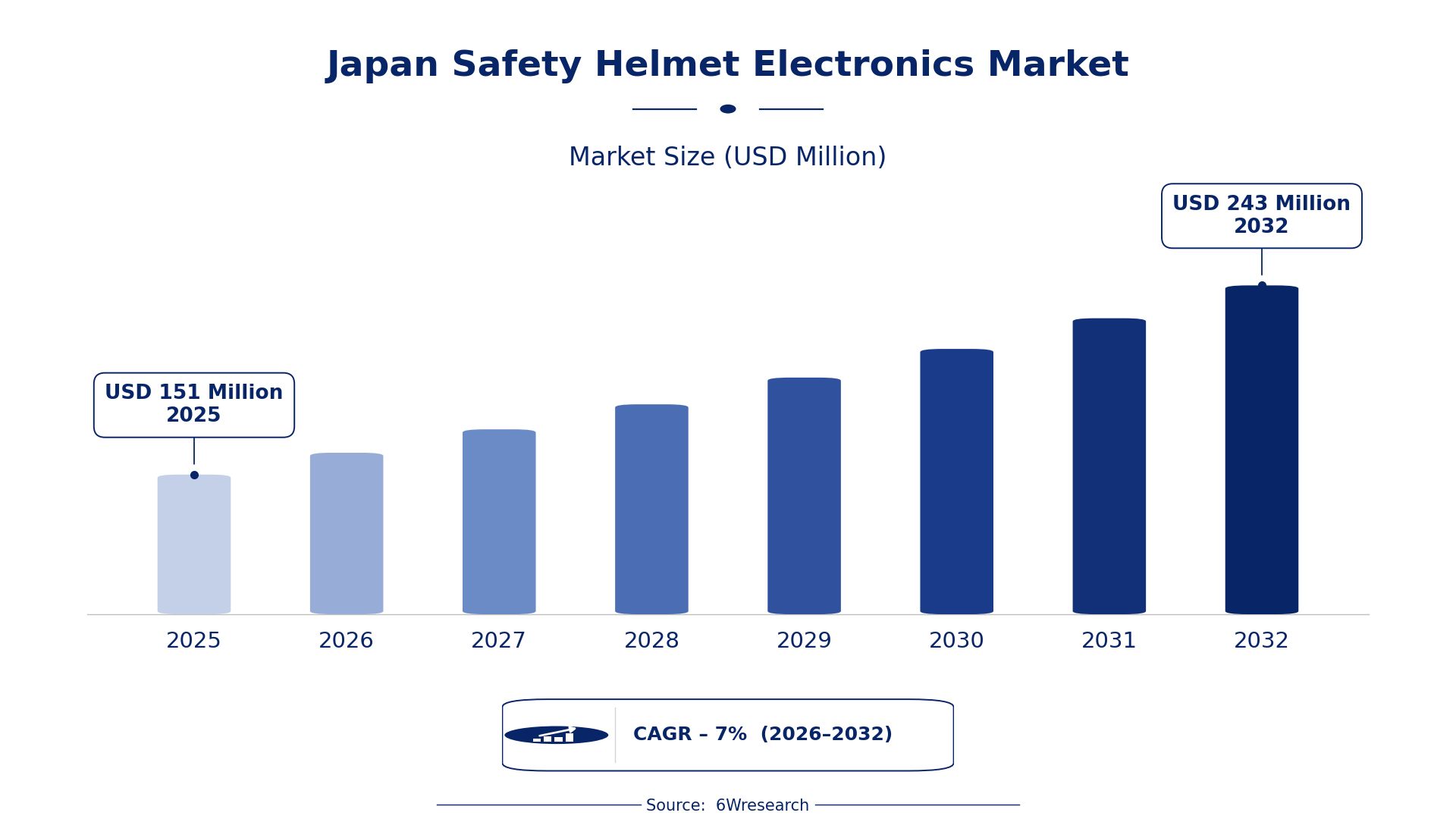
According to 6Wresearch internal database and industry insights, the Japan Safety Helmet Electronics Market was valued at USD 151 Million in 2025 and is projected to reach USD 243 Million by 2032, growing at a CAGR of approximately 7% during 2026–2032.
Japan Safety Helmet Electronics Market Highlights
| Report Metric | Details |
| Report Name | Japan Safety Helmet Electronics Market (2026-2032) |
| Market Size 2025 | USD 151 Million |
| Market Size 2032 | USD 243 Million |
| Absolute Growth 2025–2032 | USD 92 Million |
| CAGR 2026–2032 | 7% |
| Peak Annual Growth | 7.4% in 2032 |
| Forecast Period | 2026–2032 |
| Historical Data | 2022–2025 |
| Base Year | 2025 |
| Leading Device Type, 2025 | Smart Helmets (41% share) |
| Leading Feature Integration, 2025 | Fall Detection (39% share) |
| Leading Power Source, 2025 | Rechargeable Battery (46% share) |
| Leading End User, 2025 | Construction Workers (42% share) |
| Fastest-Growing Device Type | Sensor-Integrated Helmets (10.1% CAGR) |
| Fastest-Growing Power Source | USB Charging (10.4% CAGR) |
| Fastest-Growing End User | Mining Operators (9.2% CAGR) |
| Growing Sector | Construction |
| Key End Users | Construction Workers, Mining Operators, Industrial Crew |
Japan Safety Helmet Electronics Market Year-wise Growth Rate and Key Drivers (2022–2032)
This graph illustrates the annual growth rates of the market from 2022 to 2032, highlighting a steady upward trajectory and projected market expansion over the forecast period.
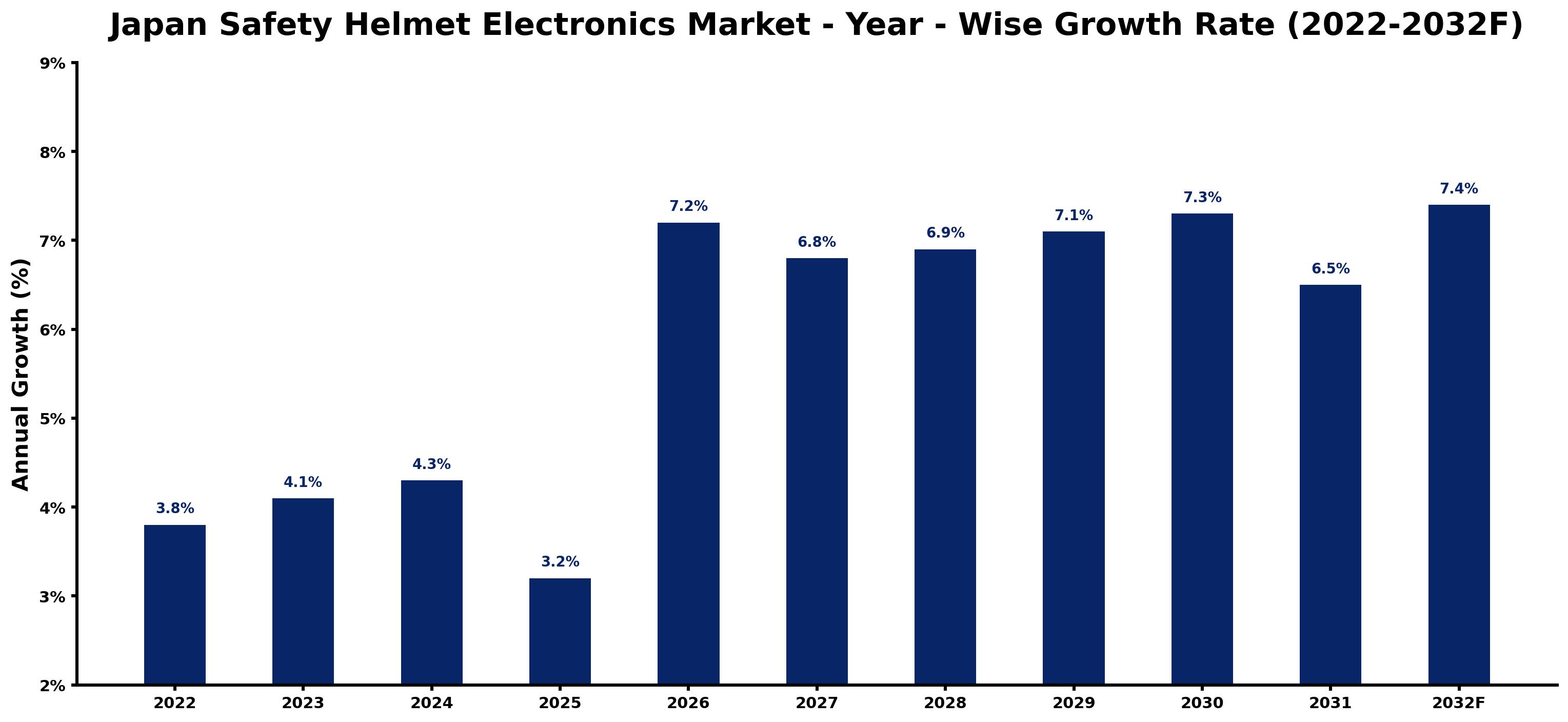
For each year, the table pairs the estimated growth rate with the leading influence on demand, showing how the drivers changed across the period.
| Year | Estimated Annual Growth (%) | Market Rationale |
| 2022 | 3.8 | The market showed steady growth due to ongoing construction activities across Japan. |
| 2023 | 4.1 | Demand increased as safety regulations became more stringent in various industries. |
| 2024 | 4.3 | Growth continued as companies invested in advanced safety technologies for their workforce. |
| 2025 | 3.2 | A slight slowdown occurred as some projects faced delays in implementation. |
| 2026 | 7.2 | Investment surged following the introduction of new safety initiatives by government bodies. |
| 2027 | 6.8 | Demand remained high as industries adopted more integrated safety solutions. |
| 2028 | 6.9 | Growth picked up again as technological advancements improved helmet features. |
| 2029 | 7.1 | The market benefited from rising awareness about workplace safety and health. |
| 2030 | 7.3 | Continued investment in safety gear was driven by increasing workplace accident statistics. |
| 2031 | 6.5 | A slowdown was noted as market saturation began to affect growth rates. |
| 2032 | 7.4 | The peak growth year is anticipated as safety technology adoption reaches new heights. |
Note: Market size estimations and growth projections presented in this report are based on 6Wresearch's proprietary forecasting methodology, utilizing the latest available industry data, government publications, and primary research inputs.
Japan Safety Helmet Electronics Market Synopsis
Safety helmet electronics are advanced headgear designed for worker safety and communication, made from durable materials like polycarbonate and equipped with sensors and displays. The Japan Safety Helmet Electronics Market is growing due to a construction workforce of approximately 5.5 million and the active construction scene in the Tokyo metropolitan area. The launch of a safety initiative by the Ministry of Health, Labour and Welfare in 2023 and the promotion of advanced safety gear by the Japan Safety and Health Association are driving demand for these technologies.
Market Dynamics Impact Analysis (2026–2032)
| Factor | Type | Impact | Primary Segment Affected |
| Increased investment in safety technologies | Driver | High | Smart Helmets |
| Growing focus on workplace safety regulations | Driver | High | Sensor-Integrated Helmets |
| Rising demand for advanced safety solutions | Opportunity | High | Communication Helmets |
| Emerging technologies in helmet electronics | Opportunity | Medium | AR Helmets |
| High costs associated with advanced helmet technologies | Restraint | High | Smart Helmets |
| Limited awareness among smaller construction firms | Restraint | Medium | Sensor-Integrated Helmets |
| Challenges in integrating new technologies | Challenge | High | Communication Helmets |
| Dependence on specific industrial standards | Challenge | Medium | AR Helmets |
Evaluation of Drivers in Japan Safety Helmet Electronics Market (2026–2032)
These are the developments adding the most demand over the forecast period.
| Drivers | Primary Segment Affected | Why It Matters (Evidence) |
| Increased investment in safety technologies | Smart Helmets | Japan's construction workforce of approximately 5.5 million drives demand for advanced safety solutions. |
| Growing focus on workplace safety regulations | Sensor-Integrated Helmets | The Industrial Safety and Health Act mandates protective gear, increasing helmet adoption. |
| Demand for advanced safety solutions | Communication Helmets | The average annual salary for construction workers is around 4 million JPY, justifying investment in safety gear. |
| Technological advancements in helmet electronics | AR Helmets | AR technology is projected to see increased adoption in training programs by 2025. |
| Government initiatives promoting safety gear | Smart Helmets | The Ministry of Health, Labour and Welfare launched a safety initiative in 2023. |
Several shifts outside the market boost sales. Investment in safety technologies is rising sharply in Japan, driven by a construction workforce of approximately 5.5 million, particularly in the Tokyo metropolitan area. The average annual salary for construction workers, around 4 million JPY, supports the purchase of advanced safety gear.
Evaluation of Restraints in Japan Safety Helmet Electronics Market
These are the pressures that could keep growth below its potential.
| Market Restraint | Primary Segment Affected | Why It Matters (Evidence) |
| High costs associated with advanced helmet technologies | Smart Helmets | The average price of advanced helmets can deter smaller construction firms from adoption. |
| Limited awareness among smaller construction firms | Sensor-Integrated Helmets | Many smaller firms lack knowledge about the benefits of helmet electronics. |
| Challenges in integrating new technologies | Communication Helmets | Existing infrastructure may not support advanced helmet features, hindering adoption. |
| Dependence on specific industrial standards | AR Helmets | Compliance with JIS standards can complicate the introduction of new technologies. |
| Market saturation in urban areas | Smart Helmets | High competition in major cities may limit growth opportunities for new entrants. |
Japan Safety Helmet Electronics Market Challenges
In 2023, producers face increased costs due to supply chain disruptions, which can raise safety helmet electronics prices by 15%. Skills shortages arise as the average age of construction workers is 50, delaying the integration of new technologies and reducing productivity for buyers. Compliance with JIS standards can extend procurement timelines by several weeks, impacting project schedules for contractors. Competition intensifies as new entrants innovate rapidly, forcing established suppliers to allocate resources to R&D, which may limit their ability to invest in production capacity.
Trends in the Japan Safety Helmet Electronics Market
The shifts below are changing how Japan Safety Helmet Electronics Market products are bought and supplied.
- Shift towards Advanced Safety Features: The 2023 safety initiative by the Ministry of Health, Labour and Welfare promotes helmet electronics, leading to increased adoption among construction workers.
- Transition from Basic to Smart Helmets: Since 2022, there has been a notable move towards smart helmets in the construction sector, with a significant rise in demand for integrated safety features.
- Construction Workers Embracing Advanced Gear: Construction workers are increasingly adopting advanced helmet electronics, with a marked increase in purchases reported since 2022, driven by safety concerns.
- Growing Interest in AR Technology: The introduction of AR features in training programs has gained traction since 2023, with an anticipated increase in AR helmet usage by 2025.
Investment Opportunities in the Japan Safety Helmet Electronics Market
Several openings in the Japan Safety Helmet Electronics Market merit attention from investors.
- Partner with Local Suppliers: Investing in safety helmet electronics is timely, as Japan's construction workforce is expected to grow, creating demand for advanced helmets.
- Focus on Urban Construction Projects: The Tokyo metropolitan area remains a key market, with ongoing construction projects driving the need for safety helmet electronics.
- Invest in Training Programs: With AR technology projected to see increased adoption by 2025, suppliers can develop training programs to improve safety gear usage.
- Certification for Compliance: Obtaining JIS certification can open doors for suppliers, as compliance with safety standards is essential for market entry.
Government Initiatives in the Japan Safety Helmet Electronics Market
The Industrial Safety and Health Act mandates that employers provide protective gear, including safety helmet electronics, to their workers. This law ensures that helmets meet specific safety standards, thereby improving worker safety in hazardous environments. The Act has been instrumental in promoting the adoption of advanced safety solutions across various industries, especially in construction, where the average age of workers is 50, highlighting the need for improved safety measures.
The Semiconductor and Digital Industry Strategy, initiated in June 2021, aims to secure domestic semiconductor manufacturing. The Ministry of Economy, Trade and Industry oversees this strategy, which funds technological advancements in safety gear, including helmet electronics. This initiative supports the development of innovative safety solutions, ensuring that producers can meet the growing demand for advanced safety helmets.
Future Insight of the Japan Safety Helmet Electronics Market
By 2032, construction workers will increasingly rely on AR technology in helmet electronics, with training programmes expected to be fully implemented by 2025. The safety initiative from the Ministry of Health, Labour and Welfare will promote widespread adoption of these helmets, enhancing workplace communication and safety. Technological advancements supported by the Ministry of Land, Infrastructure, Transport and Tourism will simplify compliance with safety regulations. Increased focus on advanced protective gear will drive investments, addressing the ongoing demand for improved safety in hazardous environments.
Market Segmentation Analysis
Japan Safety Helmet Electronics Market report covers a detailed analysis of the following market segments:
By Device Type – Smart Helmets Lead, Sensor-Integrated Helmets Expected to Grow Fastest
According to Saurav Kr Singh, Senior Research Analyst at 6Wresearch, Smart Helmets took 41% of device type revenue in 2025, more than any other category. Smart Helmets hold the largest market share due to their advanced safety features, essential for Japan's 5.5 million construction workers. Their technological integration directly enhances safety in high-risk environments, particularly in the active construction sector of the Tokyo metropolitan area. Sensor-Integrated Helmets are projected to grow fastest, at a CAGR of 10.1% during 2026–2032. Sensor-Integrated Helmets are experiencing rapid growth as they offer real-time monitoring of environmental conditions, which is crucial in hazardous work settings. The recent safety initiative from the Ministry of Health, Labour and Welfare has further accelerated their adoption among construction workers. Suppliers should focus on enhancing sensor technology to meet the growing demand for advanced safety solutions.
By Feature Integration – Fall Detection Leads and Records the Fastest Growth
The largest feature integration category in 2025 was Fall Detection, at 39% of revenue. Fall Detection is the leading feature because it provides immediate alerts during accidents, which is critical for worker safety in construction. This feature aligns with the Industrial Safety and Health Law, mandating protective gear in hazardous environments, thus ensuring compliance and safety. Its lead should widen, with a projected CAGR of 9.1% during 2026–2032, the highest in this split. The growth of Fall Detection is propelled by its necessity for immediate response in emergencies, particularly highlighted by the 1,200 workplace accidents reported in 2022. As the average age of construction workers rises, the demand for such safety features is likely to increase, solidifying its market position. Buyers will prioritise helmets equipped with advanced fall detection capabilities to enhance workplace safety.
By Power Source – Rechargeable Battery Leads, USB Charging Expected to Grow Fastest
In 2025, Rechargeable Battery led the power source split with a 46% share. Rechargeable Batteries dominate the market as they are essential for powering the electronic components integrated into safety helmets. Their widespread use ensures that construction workers can rely on consistent performance in demanding environments. Over 2026–2032, USB Charging is expected to post the fastest growth, at a CAGR of 10.4%. USB Charging is gaining traction due to its convenience, allowing users to easily recharge helmets on job sites. This trend is particularly appealing to the construction workforce, who require quick and efficient solutions for their safety gear. Suppliers should consider offering helmets with USB charging options to attract a broader customer base.
By End User – Construction Workers Lead, Mining Operators Expected to Grow Fastest
With 42% of end user revenue in 2025, Construction Workers was the largest category. Construction Workers represent the largest user group for safety helmet electronics, driven by ongoing construction activities across Japan. Their significant presence in the workforce necessitates advanced safety solutions to mitigate risks on job sites, especially in urban construction hubs. Mining Operators are set to record the highest CAGR in this split, 9.2% over 2026–2032. Mining Operators are the fastest-growing segment as they increasingly adopt safety helmet electronics for improved communication and safety in operations. The demand for these helmets is expected to rise as mining activities continue to expand in Japan, further enhancing safety measures. Suppliers must tailor their offerings to meet the specific safety needs of mining operators to capture this growing market.
Key Attractiveness of the Report
- 10 Years of Market Numbers
- Historical Data Starting from 2022 to 2025
- Base Year 2025
- Forecast Data until 2032
- Key Performance Indicators Impacting the Market
- Major Upcoming Developments and Projects
Key Highlights of the Report:
- Japan Safety Helmet Electronics Market Outlook
- Market Size of Japan Safety Helmet Electronics Market, 2025
- Forecast of Japan Safety Helmet Electronics Market, 2032
- Historical Data and Forecast of Japan Safety Helmet Electronics Revenues & Volume for the Period 2022-2032F
- Japan Safety Helmet Electronics Market Trend Evolution
- Japan Safety Helmet Electronics Market Drivers and Challenges
- Japan Safety Helmet Electronics Price Trends
- Japan Safety Helmet Electronics Porter's Five Forces
- Japan Safety Helmet Electronics Industry Life Cycle
- Historical Data and Forecast of Japan Safety Helmet Electronics Market Revenues & Volume By Device Type for the Period 2022-2032F
- Historical Data and Forecast of Japan Safety Helmet Electronics Market Revenues & Volume By Smart Helmets for the Period 2022-2032F
- Historical Data and Forecast of Japan Safety Helmet Electronics Market Revenues & Volume By Sensor-Integrated Helmets for the Period 2022-2032F
- Historical Data and Forecast of Japan Safety Helmet Electronics Market Revenues & Volume By AR Helmets for the Period 2022-2032F
- Historical Data and Forecast of Japan Safety Helmet Electronics Market Revenues & Volume By Communication Helmets for the Period 2022-2032F
- Historical Data and Forecast of Japan Safety Helmet Electronics Market Revenues & Volume By Feature Integration for the Period 2022-2032F
- Historical Data and Forecast of Japan Safety Helmet Electronics Market Revenues & Volume By Heads-Up Display for the Period 2022-2032F
- Historical Data and Forecast of Japan Safety Helmet Electronics Market Revenues & Volume By Fall Detection for the Period 2022-2032F
- Historical Data and Forecast of Japan Safety Helmet Electronics Market Revenues & Volume By Navigation + Voice for the Period 2022-2032F
- Historical Data and Forecast of Japan Safety Helmet Electronics Market Revenues & Volume By Intercom + GPS for the Period 2022-2032F
- Historical Data and Forecast of Japan Safety Helmet Electronics Market Revenues & Volume By Power Source for the Period 2022-2032F
- Historical Data and Forecast of Japan Safety Helmet Electronics Market Revenues & Volume By Rechargeable Battery for the Period 2022-2032F
- Historical Data and Forecast of Japan Safety Helmet Electronics Market Revenues & Volume By Solar-Powered for the Period 2022-2032F
- Historical Data and Forecast of Japan Safety Helmet Electronics Market Revenues & Volume By USB Charging for the Period 2022-2032F
- Historical Data and Forecast of Japan Safety Helmet Electronics Market Revenues & Volume By Wired/Wireless for the Period 2022-2032F
- Historical Data and Forecast of Japan Safety Helmet Electronics Market Revenues & Volume By End User for the Period 2022-2032F
- Historical Data and Forecast of Japan Safety Helmet Electronics Market Revenues & Volume By Construction Workers for the Period 2022-2032F
- Historical Data and Forecast of Japan Safety Helmet Electronics Market Revenues & Volume By Mining Operators for the Period 2022-2032F
- Historical Data and Forecast of Japan Safety Helmet Electronics Market Revenues & Volume By Military & Tactical Units for the Period 2022-2032F
- Historical Data and Forecast of Japan Safety Helmet Electronics Market Revenues & Volume By Industrial Crew for the Period 2022-2032F
- Japan Safety Helmet Electronics Import Export Trade Statistics
- Market Opportunity Assessment By Device Type
- Market Opportunity Assessment By Feature Integration
- Market Opportunity Assessment By Power Source
- Market Opportunity Assessment By End User
- Japan Safety Helmet Electronics Top Companies Market Share
- Japan Safety Helmet Electronics Competitive Benchmarking By Technical and Operational Parameters
- Japan Safety Helmet Electronics Company Profiles
- Japan Safety Helmet Electronics Key Strategic Recommendations
Market Covered
The report covers the following segments.
By Device Type
- Smart Helmets
- Sensor-Integrated Helmets
- AR Helmets
- Communication Helmets
By Feature Integration
- Heads-Up Display
- Fall Detection
- Navigation + Voice
- Intercom + GPS
By Power Source
- Rechargeable Battery
- Solar-Powered
- USB Charging
- Wired/Wireless
By End User
- Construction Workers
- Mining Operators
- Military & Tactical Units
- Industrial Crew































