Japan Safety Monitoring AI Market Size & Growth Rate
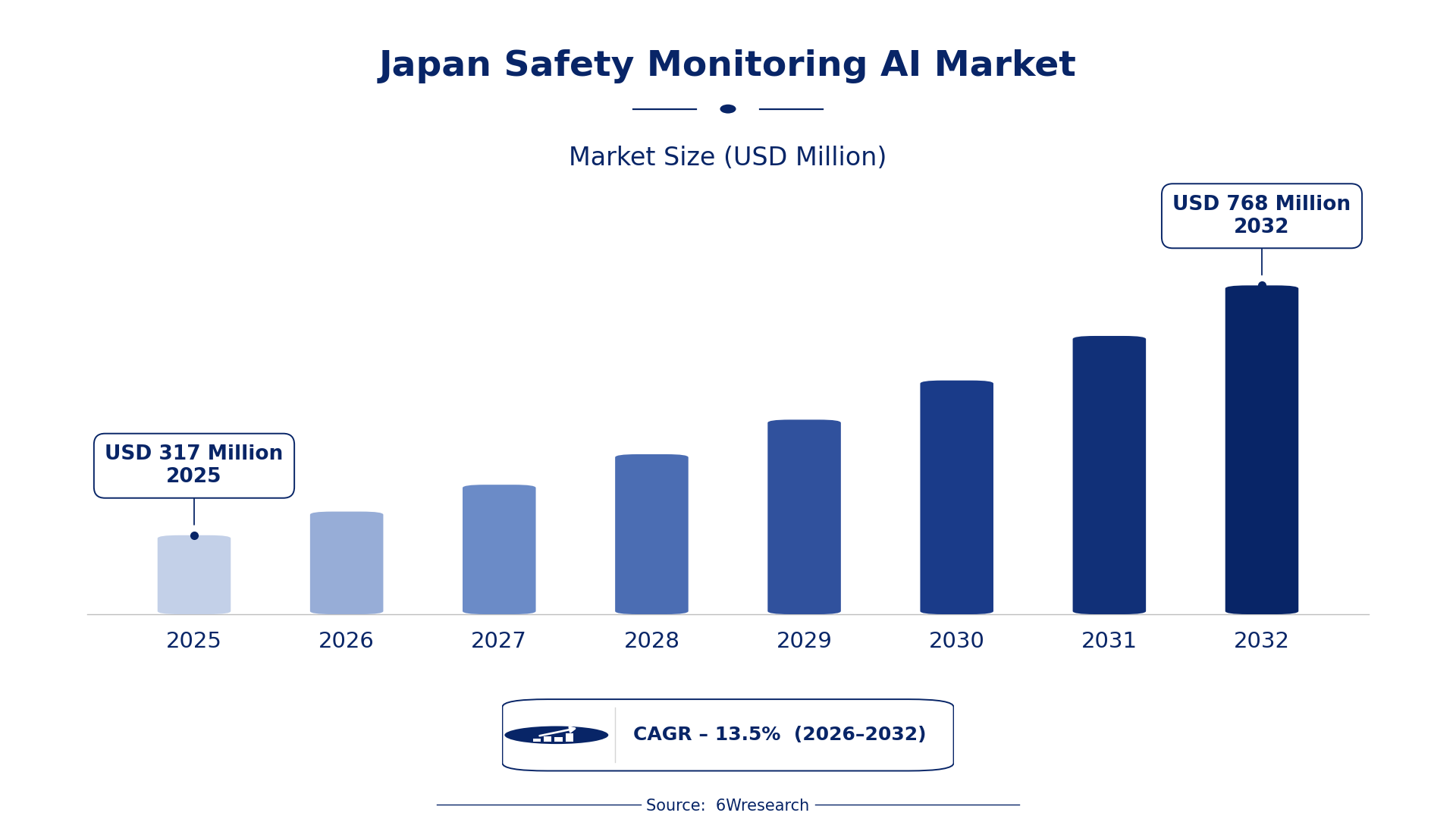
According to 6Wresearch internal database and industry insights, the Japan Safety Monitoring AI Market was valued at USD 317 Million in 2025 and is projected to reach USD 768 Million by 2032, growing at a CAGR of approximately 13.5% during 2026–2032.
Japan Safety Monitoring AI Market Highlights
| Report Metric | Details |
| Report Name | Japan Safety Monitoring AI Market (2026-2032) |
| Market Size 2025 | USD 317 Million |
| Market Size 2032 | USD 768 Million |
| Absolute Growth 2025–2032 | USD 451 Million |
| CAGR 2026–2032 | 13.5% |
| Peak Annual Growth | 17.8% in 2032 |
| Forecast Period | 2026–2032 |
| Historical Data | 2022–2025 |
| Base Year | 2025 |
| Leading Monitoring Type, 2025 | Worker Safety Monitoring (37% share) |
| Leading AI Capability, 2025 | Vision AI (40% share) |
| Leading Application Area, 2025 | Construction Sites (52% share) |
| Leading End User, 2025 | Site Managers (37% share) |
| Fastest-Growing Monitoring Type | Environmental Safety (15.5% CAGR) |
| Fastest-Growing AI Capability | Predictive Analytics (18.0% CAGR) |
| Fastest-Growing Application Area | Chemical Plants (17.1% CAGR) |
| Fastest-Growing End User | Industrial Operators (17.6% CAGR) |
| Growing Sector | Chemical Plants |
| Key End Users | Construction Sites, Chemical Plants, Smart Cities, Manufacturing Units |
Japan Safety Monitoring AI Market Year-wise Growth Rate and Key Drivers (2022–2032)
This graph illustrates the annual growth rates of the market from 2022 to 2032, highlighting a steady upward trajectory and projected market expansion over the forecast period.
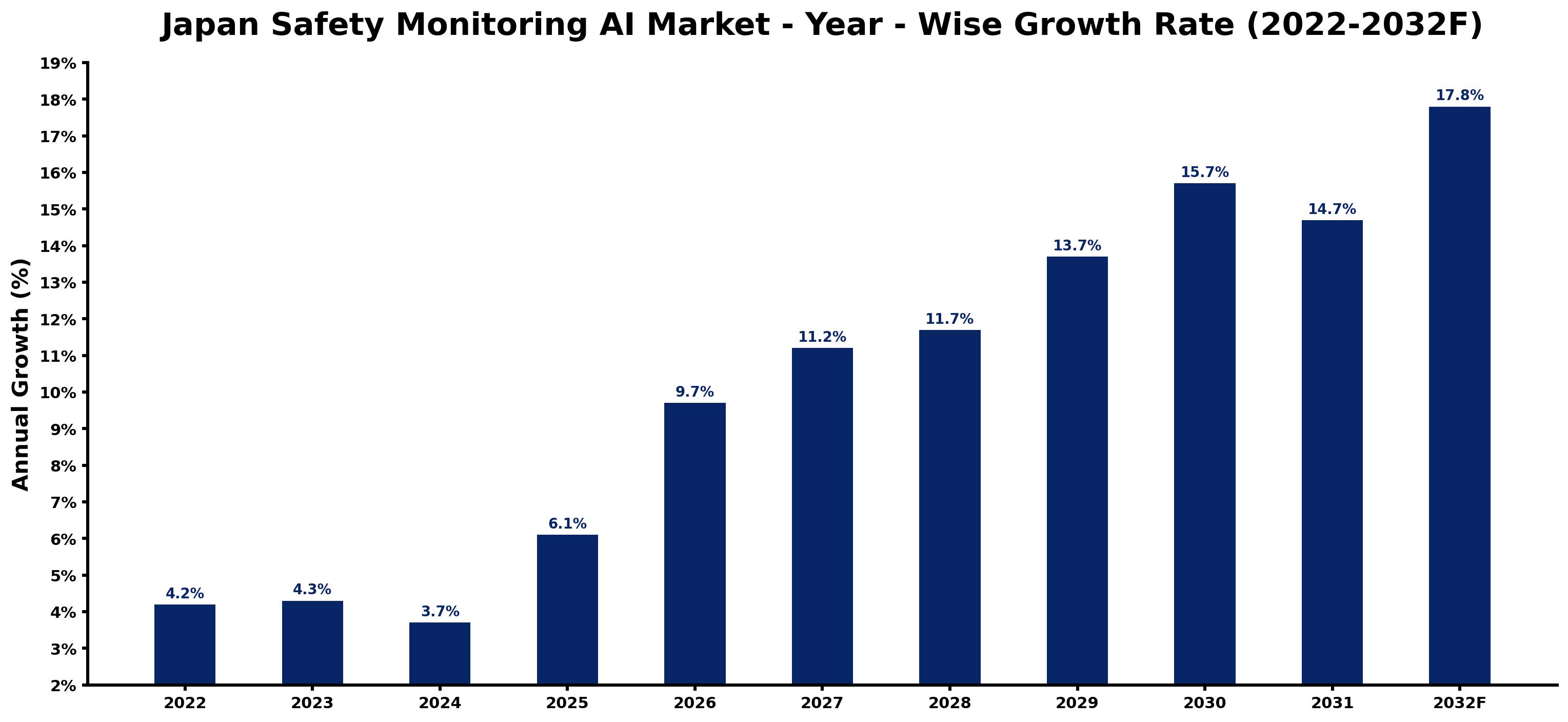
Each row of the following table gives one year's estimated growth and the event or demand shift that explains it.
| Year | Estimated Annual Growth (%) | Market Rationale |
| 2022 | 4.2 | The market showed steady growth, reflecting ongoing industrial activities and safety concerns. |
| 2023 | 4.3 | Growth accelerated due to increased adoption of AI technologies in safety monitoring. |
| 2024 | 3.7 | The market experienced a slowdown as companies reassessed technology investments amid economic uncertainties. |
| 2025 | 6.1 | A surge in investments in safety technologies contributed to faster growth compared to the previous year. |
| 2026 | 9.7 | Demand for predictive analytics in construction sites is expected to drive market expansion. |
| 2027 | 11.2 | New safety standards will further boost the adoption of safety monitoring AI. |
| 2028 | 11.7 | Focus on environmental safety monitoring will lead to a rise in technology integration. |
| 2029 | 13.7 | The market will continue to grow as urban safety initiatives gain traction in major cities. |
| 2030 | 15.7 | Heightened awareness of workplace safety issues will spur investments in AI solutions. |
| 2031 | 14.7 | Growth momentum will be maintained, driven by ongoing technological advancements and regulatory support. |
| 2032 | 17.8 | A peak in growth is anticipated as AI technologies become integral to safety protocols across industries. |
Note: Market size estimations and growth projections presented in this report are based on 6Wresearch's proprietary forecasting methodology, utilizing the latest available industry data, government publications, and primary research inputs.
Japan Safety Monitoring AI Market Synopsis
Safety Monitoring AI utilises advanced technologies to improve safety in various environments through machine learning algorithms and data analytics. Its primary applications include worker safety, environmental protection, and traffic management, particularly in the construction and manufacturing sectors. The Japan Safety Monitoring AI Market is expanding due to strong demand from the construction industry, which employs over 4 million workers, and the integration of AI in urban planning initiatives, such as the program launched in 2023 to enhance public safety in smart cities.
Market Dynamics Impact Analysis (2026–2032)
| Factor | Type | Impact | Primary Segment Affected |
| Growing demand for worker safety solutions | Driver | High | Worker Safety Monitoring |
| Increased regulatory focus on environmental safety | Driver | High | Environmental Safety |
| Rising investments in safety technologies | Opportunity | High | Construction Sites |
| Expansion of smart city projects integrating AI | Opportunity | Medium | Smart Cities |
| High initial investment costs for AI technologies | Restraint | High | Machinery Safety |
| Limited awareness of AI benefits among smaller firms | Restraint | Medium | Road Safety AI |
| Shortage of skilled personnel to implement AI solutions | Challenge | High | Predictive Analytics |
| Regulatory compliance challenges for AI integration | Challenge | Medium | Environmental Safety |
Evaluation of Drivers in Japan Safety Monitoring AI Market (2026–2032)
Below are the drivers that matter most for revenue growth, with supporting evidence.
| Drivers | Primary Segment Affected | Why It Matters (Evidence) |
| Increased focus on workplace safety regulations | Worker Safety Monitoring | Japan's construction industry employs over 4 million workers, necessitating effective safety monitoring solutions. |
| Growing adoption of predictive analytics | Predictive Analytics | Predictive analytics is increasingly used in over 30% of construction sites to prevent accidents. |
| Investment in urban safety initiatives | Road Safety AI | The target to reduce traffic fatalities by 30% by 2025 through AI is driving demand. |
| Rising demand for environmental compliance | Environmental Safety | Environmental regulations require chemical plants to monitor emissions continuously, supported by AI technologies. |
| Integration of AI in manufacturing safety protocols | Machinery Safety | Over 70% of industrial operators report using AI for machinery safety monitoring as of 2023. |
The primary driver of demand stems from Japan's construction industry, which employs over 4 million workers needing effective safety monitoring solutions. In 2023, predictive analytics was adopted in more than 30% of construction sites, facilitating accident prevention. The manufacturing sector is heavily investing in safety technologies, with a substantial proportion of industrial operators employing AI for machinery safety monitoring.
Evaluation of Restraints in Japan Safety Monitoring AI Market
The table below lists the restraints and the evidence behind each.
| Market Restraint | Primary Segment Affected | Why It Matters (Evidence) |
| Compliance burdens from strict safety regulations | Worker Safety Monitoring | Producers face increased operational costs, with firms incurring up to ¥500 million to meet safety standards. |
| Delays in project timelines due to approval processes | Environmental Safety | Approval processes mandated by regulatory bodies can extend project timelines significantly. |
| High competition among suppliers | Road Safety AI | Intense competition drives prices up, squeezing margins for buyers as suppliers invest heavily in AI technologies. |
| Limited availability of skilled personnel | Machinery Safety | The rising demand for skilled workers in AI technologies creates a talent gap in the market. |
| Challenges in technology integration | Predictive Analytics | Many firms struggle with integrating new AI technologies into existing safety protocols, hindering adoption. |
Japan Safety Monitoring AI Market Challenges
Japan's stringent safety regulations impose a considerable compliance burden on producers in the construction and manufacturing sectors. These regulations can result in costs exceeding ¥500 million for some firms, affecting their financial stability. Buyers face project delays due to lengthy approval processes mandated by the Ministry of Land, Infrastructure, Transport and Tourism, which can extend timelines by several months. Competition intensifies as suppliers invest heavily in AI technologies, with over 4 million workers in the construction industry depending on these advancements, driving up prices and squeezing profit margins for buyers.
Trends in the Japan Safety Monitoring AI Market
The following changes are redrawing the Japan Safety Monitoring AI Market.
- Shift Towards Predictive Analytics in Construction: In 2023, the adoption of predictive analytics on construction sites increased to over 30%, enabling proactive safety measures. This trend highlights a growing focus on preventing accidents before they occur, thereby improving overall site safety.
- Increasing Integration of AI in Smart Cities: The 2023 initiative to integrate AI into urban planning is reshaping public safety measures in cities like Osaka. This integration aims to enhance infrastructure and significantly reduce crime rates.
- Focus on Environmental Safety Monitoring: With over 60% of chemical plants implementing AI for emissions monitoring, environmental safety is rising in priority. This shift is driven by strict regulations and the necessity for compliance.
- Expansion of Real-Time Analysis Tools: Real-time analysis tools are being deployed in over 60% of manufacturing units. This trend improves immediate responses to safety incidents, thereby enhancing operational safety.
Investment Opportunities in the Japan Safety Monitoring AI Market
The following areas offer the clearest openings for investors and suppliers in the Japan Safety Monitoring AI Market.
- Investment Gap in Environmental Safety: With over 70% of chemical plants needing AI for emissions monitoring, a gap exists for suppliers. Collaborating with local firms can ease market entry and ensure compliance.
- Growing Demand for Predictive Analytics: The construction sector's increasing reliance on predictive analytics offers a substantial opportunity. Suppliers can penetrate this market by partnering with construction firms to create tailored solutions.
- Urban Safety Initiatives in Major Cities: Cities like Tokyo are investing in AI technologies to improve public safety. Suppliers can engage through joint ventures to deliver solutions that cater to city-specific needs.
- Need for Enhanced Worker Safety Solutions: The construction industry is expected to invest heavily in safety technologies. Suppliers should consider partnerships with industry associations to align with safety standards and practices.
Government Initiatives in the Japan Safety Monitoring AI Market
The Chemical Substances Control Law, established in 1973, mandates the evaluation and control of chemical substances in manufacturing and import. This law influences safety monitoring AI by requiring producers to implement stringent monitoring systems to ensure adherence to safety standards. The Building Energy Efficiency Act, amended in 2022, requires all new buildings to meet energy standards by April 2025, affecting safety monitoring AI for construction projects. Compliance with this law necessitates that producers invest in energy-efficient technologies, ensuring safety measures align with environmental standards.
The Ministry of the Environment advocates for AI in environmental safety monitoring within industrial zones, endorsing technologies that improve compliance with regulations. The Japan Industrial Safety and Health Association supports safety standards and practices across industries, providing funding for initiatives that incorporate AI solutions into safety protocols, ensuring better compliance and safety outcomes.
Future Insight of the Japan Safety Monitoring AI Market
By 2032, buyers in the construction sector will benefit from advanced safety monitoring technologies, contributing to a projected 15% reduction in workplace accidents. Urban planning initiatives will increasingly incorporate AI, resulting in smarter cities with improved public safety measures. Suppliers will more widely adopt ISO 45001 standards, promoting higher compliance across industries. Government funding of ¥200 million for AI research will facilitate the development of more efficient monitoring solutions, creating advantages for both buyers and suppliers.
Market Segmentation Analysis
Japan Safety Monitoring AI Market report covers a detailed analysis of the following market segments:
By Monitoring Type – Worker Safety Monitoring Leads, Environmental Safety Expected to Grow Fastest
According to Saurav Kr Singh, Senior Research Analyst at 6Wresearch, in 2025, Worker Safety Monitoring led the monitoring type split with a 37% share. Worker safety monitoring dominates due to its critical role in protecting over 4 million workers in Japan's construction sector. This segment is essential for ensuring compliance with safety regulations and maintaining high safety standards on-site. The quickest growth will come from Environmental Safety, forecast to expand at a CAGR of 15.5% between 2026 and 2032. Environmental safety is witnessing rapid growth driven by stringent regulations that require continuous monitoring of emissions in chemical plants. The increasing regulatory scrutiny is accelerating the adoption of monitoring technologies in this area. Suppliers should prioritise developing solutions that cater to the growing demand for environmental safety compliance.
By AI Capability – Vision AI Leads, Predictive Analytics Expected to Grow Fastest
With 40% of ai capability revenue in 2025, Vision AI was the largest category. Vision AI maintains the largest share as it is extensively used across various applications, enhancing safety monitoring efforts. Its widespread integration into safety protocols underscores its importance, despite not being the primary focus in this market. Predictive Analytics is set to record the highest CAGR in this split, 18.0% over 2026–2032. Predictive analytics is advancing quickly as it allows for the forecasting of potential safety issues, which is vital for proactive risk management. This capability is increasingly sought after as industries focus on preventing accidents before they occur. Buyers should consider investing in predictive analytics to strengthen their safety measures and reduce the likelihood of incidents.
By Application Area – Construction Sites Lead, Chemical Plants Expected to Grow Fastest
The largest application area category in 2025 was Construction Sites, at 52% of revenue. Construction sites represent the largest application area for safety monitoring, necessitating strict adherence to safety protocols to protect workers. The high adoption rate of monitoring solutions in these environments highlights their critical role in maintaining safety standards. Chemical Plants are projected to grow fastest, at a CAGR of 17.1% during 2026–2032. Chemical plants are experiencing the fastest growth in safety monitoring applications due to the inherent hazards of their operations, which require advanced safety measures. The focus on ensuring safety in these environments is driving substantial investments in monitoring technologies. Suppliers must customise their offerings to meet the specific safety needs of chemical plants to capitalise on this expanding market.
By End User – Site Managers Lead, Industrial Operators Expected to Grow Fastest
Site Managers held 37% of the Japan Safety Monitoring AI Market by end user in 2025. Site managers are the primary users of safety monitoring solutions, responsible for implementing safety measures on construction sites. Their direct involvement in safety protocols makes them pivotal for the adoption of monitoring technologies in this sector. Over 2026–2032, Industrial Operators are expected to post the fastest growth, at a CAGR of 17.6%. Industrial operators are increasingly embracing monitoring solutions to improve operational safety, reflecting a heightened focus on maintaining safety standards in facilities. Their active participation in safety practices is essential for the continued advancement of effective monitoring systems. Suppliers should concentrate on features that specifically address the requirements of industrial operators to enhance adoption and improve safety outcomes.
Key Attractiveness of the Report
- 10 Years of Market Numbers
- Historical Data Starting from 2022 to 2025
- Base Year 2025
- Forecast Data until 2032
- Key Performance Indicators Impacting the Market
- Major Upcoming Developments and Projects
Key Highlights of the Report:
- Japan Safety Monitoring AI Market Outlook
- Market Size of Japan Safety Monitoring AI Market, 2025
- Forecast of Japan Safety Monitoring AI Market, 2032
- Historical Data and Forecast of Japan Safety Monitoring AI Revenues & Volume for the Period 2022-2032F
- Japan Safety Monitoring AI Market Trend Evolution
- Japan Safety Monitoring AI Market Drivers and Challenges
- Japan Safety Monitoring AI Price Trends
- Japan Safety Monitoring AI Porter's Five Forces
- Japan Safety Monitoring AI Industry Life Cycle
- Historical Data and Forecast of Japan Safety Monitoring AI Market Revenues & Volume By Monitoring Type for the Period 2022-2032F
- Historical Data and Forecast of Japan Safety Monitoring AI Market Revenues & Volume By Worker Safety Monitoring for the Period 2022-2032F
- Historical Data and Forecast of Japan Safety Monitoring AI Market Revenues & Volume By Environmental Safety for the Period 2022-2032F
- Historical Data and Forecast of Japan Safety Monitoring AI Market Revenues & Volume By Road Safety AI for the Period 2022-2032F
- Historical Data and Forecast of Japan Safety Monitoring AI Market Revenues & Volume By Machinery Safety for the Period 2022-2032F
- Historical Data and Forecast of Japan Safety Monitoring AI Market Revenues & Volume By AI Capability for the Period 2022-2032F
- Historical Data and Forecast of Japan Safety Monitoring AI Market Revenues & Volume By Vision AI for the Period 2022-2032F
- Historical Data and Forecast of Japan Safety Monitoring AI Market Revenues & Volume By Predictive Analytics for the Period 2022-2032F
- Historical Data and Forecast of Japan Safety Monitoring AI Market Revenues & Volume By Real-Time Analysis for the Period 2022-2032F
- Historical Data and Forecast of Japan Safety Monitoring AI Market Revenues & Volume By Anomaly Detection for the Period 2022-2032F
- Historical Data and Forecast of Japan Safety Monitoring AI Market Revenues & Volume By Application Area for the Period 2022-2032F
- Historical Data and Forecast of Japan Safety Monitoring AI Market Revenues & Volume By Construction Sites for the Period 2022-2032F
- Historical Data and Forecast of Japan Safety Monitoring AI Market Revenues & Volume By Chemical Plants for the Period 2022-2032F
- Historical Data and Forecast of Japan Safety Monitoring AI Market Revenues & Volume By Smart Cities for the Period 2022-2032F
- Historical Data and Forecast of Japan Safety Monitoring AI Market Revenues & Volume By Manufacturing Units for the Period 2022-2032F
- Historical Data and Forecast of Japan Safety Monitoring AI Market Revenues & Volume By End User for the Period 2022-2032F
- Historical Data and Forecast of Japan Safety Monitoring AI Market Revenues & Volume By Site Managers for the Period 2022-2032F
- Historical Data and Forecast of Japan Safety Monitoring AI Market Revenues & Volume By Industrial Operators for the Period 2022-2032F
- Historical Data and Forecast of Japan Safety Monitoring AI Market Revenues & Volume By Government Departments for the Period 2022-2032F
- Historical Data and Forecast of Japan Safety Monitoring AI Market Revenues & Volume By Factory Supervisors for the Period 2022-2032F
- Japan Safety Monitoring AI Import Export Trade Statistics
- Market Opportunity Assessment By Monitoring Type
- Market Opportunity Assessment By AI Capability
- Market Opportunity Assessment By Application Area
- Market Opportunity Assessment By End User
- Japan Safety Monitoring AI Top Companies Market Share
- Japan Safety Monitoring AI Competitive Benchmarking By Technical and Operational Parameters
- Japan Safety Monitoring AI Company Profiles
- Japan Safety Monitoring AI Key Strategic Recommendations
Market Covered
Coverage by segment is as follows.
By Monitoring Type
- Worker Safety Monitoring
- Environmental Safety
- Road Safety AI
- Machinery Safety
By AI Capability
- Vision AI
- Predictive Analytics
- Real-Time Analysis
- Anomaly Detection
By Application Area
- Construction Sites
- Chemical Plants
- Smart Cities
- Manufacturing Units
By End User
- Site Managers
- Industrial Operators
- Government Departments
- Factory Supervisors































