Japan Satellite 5G Connectivity Market Size & Growth Rate
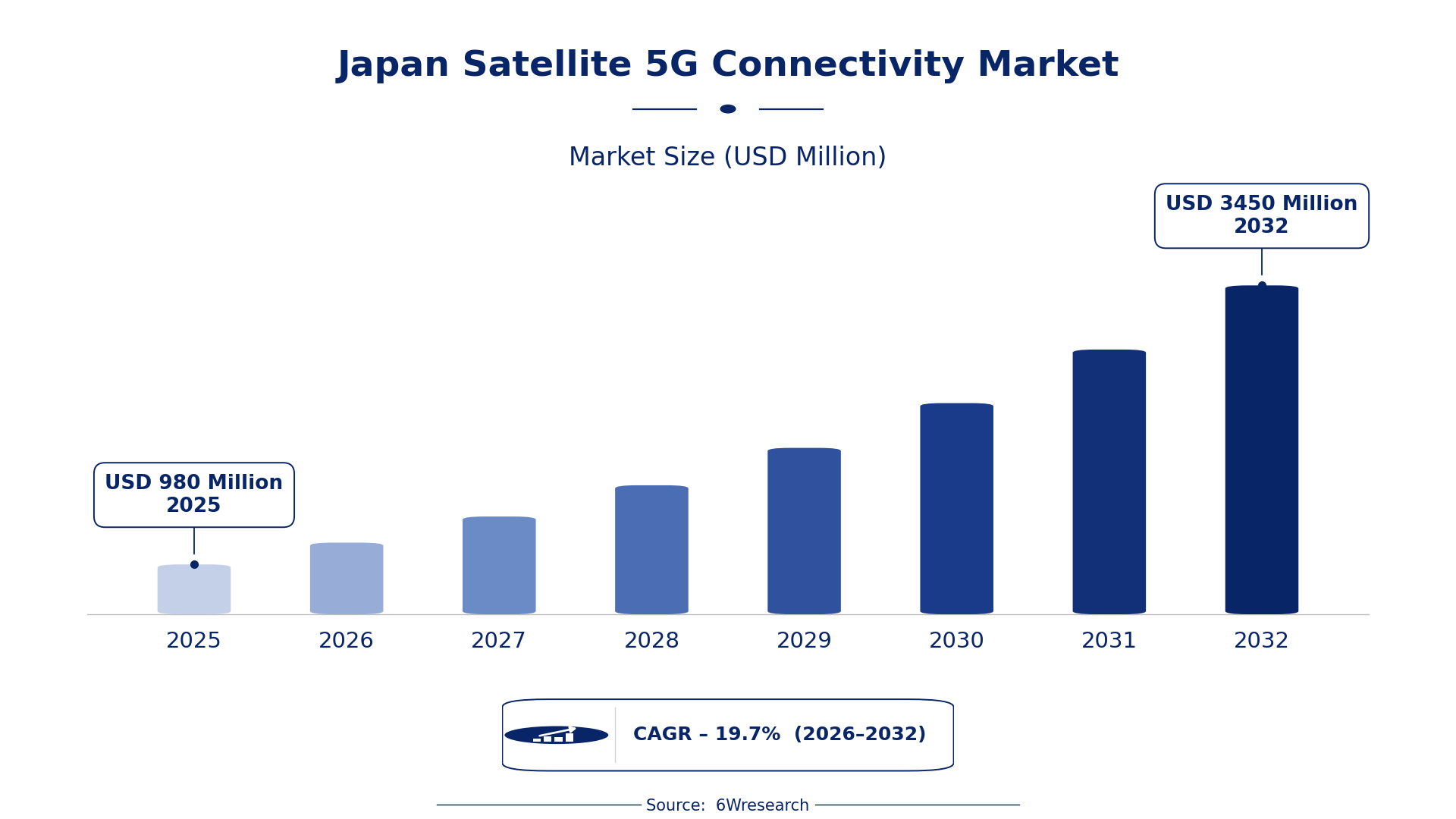
According to 6Wresearch internal database and industry insights, the Japan Satellite 5G Connectivity Market was valued at USD 980 Million in 2025 and is projected to reach USD 3,450 Million by 2032, growing at a CAGR of approximately 19.7% during 2026–2032.
Japan Satellite 5G Connectivity Market Highlights
| Report Metric | Details |
| Report Name | Japan Satellite 5G Connectivity Market (2026-2032) |
| Market Size 2025 | USD 980 Million |
| Market Size 2032 | USD 3,450 Million |
| Absolute Growth 2025–2032 | USD 2,470 Million |
| CAGR 2026–2032 | 19.7% |
| Peak Annual Growth | 20.7% in 2028 |
| Forecast Period | 2026–2032 |
| Historical Data | 2022–2025 |
| Base Year | 2025 |
| Leading Connectivity Type, 2025 | Non-Terrestrial Networks (NTN) (50% share) |
| Leading Satellite Type, 2025 | LEO (43% share) |
| Leading Network Architecture, 2025 | Integrated Core (48% share) |
| Leading End User, 2025 | Mobile Network Operators (44% share) |
| Fastest-Growing Connectivity Type | IoT over Satellite (29.2% CAGR) |
| Fastest-Growing Network Architecture | Edge Connectivity (25.1% CAGR) |
| Fastest-Growing End User | Agriculture Tech Providers (25.3% CAGR) |
| Growing Sector | Agriculture Tech Providers |
| Key End Users | Mobile Network Operators, Remote Area ISPs, Agriculture Tech Providers, Handset Manufacturers |
Japan Satellite 5G Connectivity Market Year-wise Growth Rate and Key Drivers (2022–2032)
This graph illustrates the annual growth rates of the market from 2022 to 2032, highlighting a steady upward trajectory and projected market expansion over the forecast period.
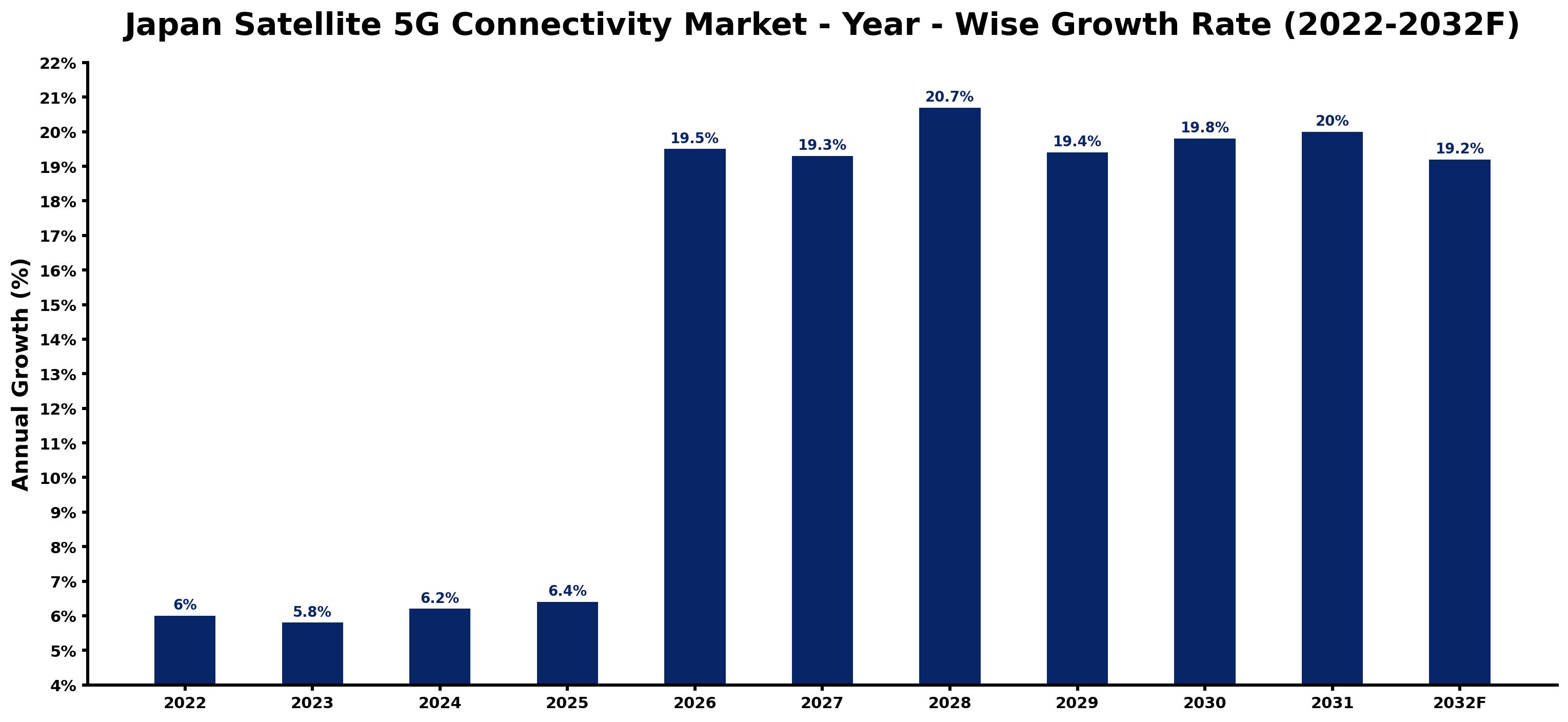
Year by year, the estimates below pair each growth rate with the development that shaped it.
| Year | Estimated Annual Growth (%) | Market Rationale |
| 2022 | 6.0 | The market experienced steady growth due to rising connectivity needs in rural areas. |
| 2023 | 5.8 | Growth slowed slightly as demand stabilised amid ongoing infrastructure developments. |
| 2024 | 6.2 | Increased investments in satellite technology spurred faster growth compared to the previous year. |
| 2025 | 6.4 | Demand surged as the agriculture sector adopted satellite IoT solutions for crop management. |
| 2026 | 19.5 | Growth is expected to accelerate as LEO satellites gain traction in 5G applications. |
| 2027 | 19.3 | The market is projected to continue growing, but at a slower rate due to increased competition. |
| 2028 | 20.7 | A peak in growth is anticipated as new satellite projects launch nationwide. |
| 2029 | 19.4 | Growth is expected to decelerate slightly as the market matures and competition intensifies. |
| 2030 | 19.8 | Demand will rise again as new applications for satellite connectivity emerge. |
| 2031 | 20.0 | Continued innovation in satellite technology is projected to drive further market expansion. |
| 2032 | 19.2 | Growth is expected to slow as the market reaches a more stable phase with established players. |
Note: Market size estimations and growth projections presented in this report are based on 6Wresearch's proprietary forecasting methodology, utilizing the latest available industry data, government publications, and primary research inputs.
Japan Satellite 5G Connectivity Market Synopsis
Satellite 5G Connectivity combines satellite technology with 5G networks to provide high-speed internet access, especially in remote areas. In Japan, the agriculture sector is a key user, investing in satellite IoT solutions to improve crop management. The Japan Satellite 5G Connectivity Market is expanding due to increasing demand for connectivity in rural regions, driven by over 1,000 remote area ISPs and government initiatives aimed at enhancing satellite communications for disaster response by 2025.
Market Dynamics Impact Analysis (2026–2032)
| Factor | Type | Impact | Primary Segment Affected |
| Rising demand for connectivity in rural areas drives investment in satellite 5G solutions. | Driver | High | Non-Terrestrial Networks (NTN) |
| The agriculture sector's investment in satellite IoT solutions enhances operational efficiency. | Driver | High | IoT over Satellite |
| The growing number of remote area ISPs creates opportunities for satellite connectivity providers. | Opportunity | High | Remote Area ISPs |
| The Japanese government's commitment to enhancing satellite technology creates a favourable investment climate. | Opportunity | Medium | Non-Terrestrial Networks (NTN) |
| High initial costs of satellite infrastructure may deter some potential users. | Restraint | High | Direct-to-Device (D2D) |
| Limited awareness of satellite 5G benefits can restrict market growth in certain sectors. | Restraint | Medium | Hybrid 5G-Satellite |
| Infrastructure challenges in remote areas can delay deployment of satellite solutions. | Challenge | High | IoT over Satellite |
| Competition from terrestrial network providers may limit market share for satellite services. | Challenge | Medium | Non-Terrestrial Networks (NTN) |
Evaluation of Drivers in Japan Satellite 5G Connectivity Market (2026–2032)
The factors lifting demand, and the evidence behind each, are summarised below.
| Drivers | Primary Segment Affected | Why It Matters (Evidence) |
| Increasing population in rural areas requires enhanced connectivity solutions. | Non-Terrestrial Networks (NTN) | Japan's population of approximately 126 million drives demand for reliable internet access. |
| The agriculture sector's focus on precision farming boosts demand for satellite IoT applications. | IoT over Satellite | Investment in satellite IoT solutions is projected to reach 5 million devices by 2025. |
| Government initiatives promote satellite technology development and investment. | Hybrid 5G-Satellite | The Ministry of Internal Affairs and Communications supports satellite communications under the 5G Strategy 2020. |
| The rise of remote area ISPs increases the need for satellite connectivity solutions. | Remote Area ISPs | Over 1,000 remote area ISPs are currently utilising satellite technology in Japan. |
| LEO satellites provide low-latency connectivity essential for 5G applications. | Direct-to-Device (D2D) | The adoption of LEO satellites is crucial for enhancing 5G network performance. |
Most of the extra volume stems from the increasing population in rural areas, which necessitates reliable connectivity solutions. Japan's population fuels demand for dependable internet access, resulting in a surge of satellite 5G investments. The agriculture sector's emphasis on precision farming further drives demand for satellite IoT applications, with projections estimating 5 million satellite-enabled IoT devices by 2025. The adoption of LEO satellites is crucial for delivering the low-latency connectivity required for 5G applications. Investment in satellite technology continues to grow, motivated by the need for improved service delivery in underserved regions.
Evaluation of Restraints in Japan Satellite 5G Connectivity Market
The table below lists the restraints and the evidence behind each.
| Market Restraint | Primary Segment Affected | Why It Matters (Evidence) |
| High costs due to limited satellite bandwidth increase operational expenses for remote area ISPs. | Remote Area ISPs | Costs can rise by up to 20%, affecting service affordability. |
| Technology limitations hinder integration of satellite systems with existing 5G networks. | Non-Terrestrial Networks (NTN) | Delays service rollouts for buyers in rural regions, impacting connectivity. |
| Regulatory hurdles create delays for importers in the satellite sector. | Hybrid 5G-Satellite | Compliance with standards such as JIS X 5071 can push project timelines back by six months. |
| Rising costs of satellite technology investments strain budgets for producers and buyers. | IoT over Satellite | Estimated investments of ¥10 billion in 2023 affect overall market growth. |
| Limited consumer awareness of satellite 5G solutions restricts market penetration. | Direct-to-Device (D2D) | This lack of understanding slows adoption rates among potential users. |
Japan Satellite 5G Connectivity Market Challenges
High operational costs burden remote area ISPs due to limited satellite bandwidth, increasing expenses by up to 20%. Technology constraints impede the integration of satellite systems with existing 5G networks, causing delays in service rollouts for buyers in rural regions. Regulatory challenges arise from compliance with JIS X 5071, extending project timelines for importers by an average of six months. Rising investments in satellite technology, with the government allocating ¥10 billion for 2023, strain budgets for producers, ultimately affecting pricing for buyers.
Trends in the Japan Satellite 5G Connectivity Market
Four trends stand out in the Japan Satellite 5G Connectivity Market.
- Shift from Traditional to Satellite Connectivity: The transition to satellite connectivity began in 2023 as rural areas faced persistent connectivity issues. Remote Area ISPs are increasingly adopting satellite technology, with over 1,000 currently operational, improving internet access in underserved regions.
- Emergence of IoT Solutions in Agriculture: In 2023, the agriculture sector started prioritising satellite IoT solutions for precision farming. This shift is driven by the need for improved crop management, with investments projected to reach 5 million satellite-enabled devices by 2025.
- Transition to Low-Latency LEO Satellites: Since 2026, there has been a marked shift towards LEO satellites for 5G applications. The adoption of these satellites is vital for providing the low-latency connectivity required for advanced services in Japan.
- Growing Need for Disaster Response Solutions: The Japanese government began enhancing satellite communications for disaster response in 2020. This initiative aims to improve connectivity during emergencies, with a target to strengthen capabilities by 2025.
Investment Opportunities in the Japan Satellite 5G Connectivity Market
The openings below show where demand in the Japan Satellite 5G Connectivity Market is visible and how suppliers can enter.
- Investment in Satellite IoT Solutions: With 5 million satellite-enabled IoT devices projected by 2025, there is a strong investment opportunity in satellite IoT solutions for agriculture. Collaborating with agriculture tech providers in rural areas can facilitate market entry.
- Growth of Remote Area ISPs: The increase of over 1,000 remote area ISPs indicates a gap in satellite connectivity solutions. Investing in partnerships with these ISPs can enhance service offerings and expand market reach.
- Development of Low-Latency LEO Satellites: The increasing adoption of LEO satellites presents an opportunity for investment in low-latency connectivity solutions. Collaborating with technology developers in the Tokyo region can facilitate entry into this market.
- Enhancement of Disaster Response Capabilities: The government's commitment to improving satellite communications for disaster response by 2025 creates an opportunity for investment in related technologies. Engaging with local research institutions can support this initiative.
Government Initiatives in the Japan Satellite 5G Connectivity Market
Policy measures directly support the satellite 5G connectivity market by establishing frameworks for development. The Industrial Standardization Act of 1949 governs product standards, while the 5G Strategy 2020 promotes satellite communications. The government allocated ¥10 billion for satellite communication projects in 2023, aiming to improve connectivity for remote users and disaster response capabilities by 2025.
Remote area ISPs benefit from government funding and initiatives that promote satellite technology. The National Institute of Information and Communications Technology (NICT) oversees research and development in satellite communications, facilitating advancements that improve service delivery and connectivity for underserved regions.
Future Insight of the Japan Satellite 5G Connectivity Market
The integration of low-latency LEO satellites will transform connectivity for remote users by 2032, boosting demand for satellite 5G solutions. By 2025, satellite-enabled IoT devices in Japan will reach 5 million, reflecting growth in agricultural applications. The government's focus on improving disaster response capabilities will drive further investments in satellite technologies. Collaboration between research institutions and regulatory bodies will accelerate technological advancements, benefiting both buyers and suppliers in the satellite communications sector.
Market Segmentation Analysis
Japan Satellite 5G Connectivity Market report covers a detailed analysis of the following market segments:
By Connectivity Type – Non-Terrestrial Networks (NTN) Leads, IoT over Satellite Expected to Grow Fastest
According to Saurav Kr Singh, Senior Research Analyst at 6Wresearch, Non-Terrestrial Networks (NTN) took 50% of connectivity type revenue in 2025, more than any other category. Non-Terrestrial Networks hold the largest share due to their ability to deliver vital satellite communication for 5G networks, especially in rural regions. The existence of over 1,000 remote area ISPs illustrates the strong demand for this type of connectivity. The quickest growth will come from IoT over Satellite, forecast to expand at a CAGR of 29.2% between 2026 and 2032. The IoT over Satellite segment is witnessing rapid growth as the agriculture sector increasingly invests in satellite IoT solutions for crop management, with projections of 5 million satellite-enabled IoT devices by 2025. This growth will likely widen the lead of Non-Terrestrial Networks as they effectively support these applications. Suppliers should enhance their offerings for IoT applications to capture the growing demand in the agriculture sector.
By Satellite Type – LEO Leads and Records the Fastest Growth
In 2025, LEO led the satellite type split with a 43% share. LEO satellites dominate the market due to their provision of low-latency connectivity, which is essential for 5G applications. Their adoption aligns with Japan's focus on advanced satellite communication technologies, particularly in urban areas like Tokyo. The same category is also set to grow fastest, at a CAGR of 21.1% during 2026–2032. LEO satellites are also the fastest-growing segment, as their characteristics meet the rising demand for low-latency solutions in the 5G rollout. This dual role will solidify LEO's market position as they continue to expand their capabilities. Buyers should prioritise LEO satellite solutions to meet the latency requirements of modern applications.
By Network Architecture – Integrated Core Leads, Edge Connectivity Expected to Grow Fastest
Integrated Core accounted for 48% of the market by network architecture in 2025. The Integrated Core leads this segment as it supports crucial network management functions, making it vital for operators managing satellite 5G networks. Its role in improving overall network efficiency is critical for maintaining service quality. Edge Connectivity is set to record the highest CAGR in this split, 25.1% over 2026–2032. Edge Connectivity is experiencing rapid growth due to its application in specific use cases, particularly in enhancing connectivity for certain applications. As demand for tailored connectivity solutions rises, this segment may gain further traction. Suppliers need to develop edge connectivity solutions to cater to niche applications requiring specific network architectures.
By End User – Mobile Network Operators Lead, Agriculture Tech Providers Expected to Grow Fastest
The largest end user category in 2025 was Mobile Network Operators, at 44% of revenue. Mobile Network Operators are the primary users of satellite 5G technology, utilising it to improve coverage in underserved areas. Their substantial investment in satellite connectivity underscores the critical role they play in expanding access. Agriculture Tech Providers are projected to grow fastest, at a CAGR of 25.3% during 2026–2032. Agriculture Tech Providers are the fastest-growing segment, leveraging satellite connectivity for precision farming to enhance crop management and efficiency. This trend indicates a shift towards more specialised applications of satellite technology, emphasising the need for targeted solutions. Suppliers should focus on agriculture tech providers to align their offerings with the increasing demand for precision farming solutions.
Key Attractiveness of the Report
- 10 Years of Market Numbers
- Historical Data Starting from 2022 to 2025
- Base Year 2025
- Forecast Data until 2032
- Key Performance Indicators Impacting the Market
- Major Upcoming Developments and Projects
Key Highlights of the Report:
- Japan Satellite 5G Connectivity Market Outlook
- Market Size of Japan Satellite 5G Connectivity Market, 2025
- Forecast of Japan Satellite 5G Connectivity Market, 2032
- Historical Data and Forecast of Japan Satellite 5G Connectivity Revenues & Volume for the Period 2022-2032F
- Japan Satellite 5G Connectivity Market Trend Evolution
- Japan Satellite 5G Connectivity Market Drivers and Challenges
- Japan Satellite 5G Connectivity Price Trends
- Japan Satellite 5G Connectivity Porter's Five Forces
- Japan Satellite 5G Connectivity Industry Life Cycle
- Historical Data and Forecast of Japan Satellite 5G Connectivity Market Revenues & Volume By Connectivity Type for the Period 2022-2032F
- Historical Data and Forecast of Japan Satellite 5G Connectivity Market Revenues & Volume By Non-Terrestrial Networks (NTN) for the Period 2022-2032F
- Historical Data and Forecast of Japan Satellite 5G Connectivity Market Revenues & Volume By Hybrid 5G-Satellite for the Period 2022-2032F
- Historical Data and Forecast of Japan Satellite 5G Connectivity Market Revenues & Volume By Direct-to-Device (D2D) for the Period 2022-2032F
- Historical Data and Forecast of Japan Satellite 5G Connectivity Market Revenues & Volume By IoT over Satellite for the Period 2022-2032F
- Historical Data and Forecast of Japan Satellite 5G Connectivity Market Revenues & Volume By Satellite Type for the Period 2022-2032F
- Historical Data and Forecast of Japan Satellite 5G Connectivity Market Revenues & Volume By LEO for the Period 2022-2032F
- Historical Data and Forecast of Japan Satellite 5G Connectivity Market Revenues & Volume By GEO + 5G NR for the Period 2022-2032F
- Historical Data and Forecast of Japan Satellite 5G Connectivity Market Revenues & Volume By MEO for the Period 2022-2032F
- Historical Data and Forecast of Japan Satellite 5G Connectivity Market Revenues & Volume By LEO for the Period 2022-2032F
- Historical Data and Forecast of Japan Satellite 5G Connectivity Market Revenues & Volume By Network Architecture for the Period 2022-2032F
- Historical Data and Forecast of Japan Satellite 5G Connectivity Market Revenues & Volume By Integrated Core for the Period 2022-2032F
- Historical Data and Forecast of Japan Satellite 5G Connectivity Market Revenues & Volume By Backhaul Integration for the Period 2022-2032F
- Historical Data and Forecast of Japan Satellite 5G Connectivity Market Revenues & Volume By Edge Connectivity for the Period 2022-2032F
- Historical Data and Forecast of Japan Satellite 5G Connectivity Market Revenues & Volume By Narrowband Architecture for the Period 2022-2032F
- Historical Data and Forecast of Japan Satellite 5G Connectivity Market Revenues & Volume By End User for the Period 2022-2032F
- Historical Data and Forecast of Japan Satellite 5G Connectivity Market Revenues & Volume By Mobile Network Operators for the Period 2022-2032F
- Historical Data and Forecast of Japan Satellite 5G Connectivity Market Revenues & Volume By Remote Area ISPs for the Period 2022-2032F
- Historical Data and Forecast of Japan Satellite 5G Connectivity Market Revenues & Volume By Handset Manufacturers for the Period 2022-2032F
- Historical Data and Forecast of Japan Satellite 5G Connectivity Market Revenues & Volume By Agriculture Tech Providers for the Period 2022-2032F
- Japan Satellite 5G Connectivity Import Export Trade Statistics
- Market Opportunity Assessment By Connectivity Type
- Market Opportunity Assessment By Satellite Type
- Market Opportunity Assessment By Network Architecture
- Market Opportunity Assessment By End User
- Japan Satellite 5G Connectivity Top Companies Market Share
- Japan Satellite 5G Connectivity Competitive Benchmarking By Technical and Operational Parameters
- Japan Satellite 5G Connectivity Company Profiles
- Japan Satellite 5G Connectivity Key Strategic Recommendations
Market Covered
The report covers the following segments.
By Connectivity Type
- Non-Terrestrial Networks (NTN)
- Hybrid 5G-Satellite
- Direct-to-Device (D2D)
- IoT over Satellite
By Satellite Type
- LEO
- GEO + 5G NR
- MEO
By Network Architecture
- Integrated Core
- Backhaul Integration
- Edge Connectivity
- Narrowband Architecture
By End User
- Mobile Network Operators
- Remote Area ISPs
- Handset Manufacturers
- Agriculture Tech Providers































