Japan Satellite and Space Systems Market Size & Growth Rate

According to 6Wresearch internal database and industry insights, the Japan Satellite and Space Systems Market was valued at USD 845 Million in 2025 and is projected to reach USD 1,294 Million by 2032, growing at a CAGR of approximately 6.3% during 2026–2032.
Japan Satellite and Space Systems Market Highlights
| Report Metric | Details |
| Report Name | Japan Satellite and Space Systems Market (2026-2032) |
| Market Size 2025 | USD 845 Million |
| Market Size 2032 | USD 1,294 Million |
| Absolute Growth 2025–2032 | USD 449 Million |
| CAGR 2026–2032 | 6.3% |
| Peak Annual Growth | 7.2% in 2031 |
| Forecast Period | 2026–2032 |
| Historical Data | 2022–2025 |
| Base Year | 2025 |
| Leading System Type, 2025 | Communications System (44% share) |
| Leading Component Type, 2025 | Payload (33% share) |
| Leading Orbit Type, 2025 | GEO (41% share) |
| Leading End User, 2025 | Telecom Providers (47% share) |
| Fastest-Growing System Type | Observation System (8.9% CAGR) |
| Fastest-Growing Component Type | Optics + Imaging (9.3% CAGR) |
| Fastest-Growing Orbit Type | LEO (9.1% CAGR) |
| Fastest-Growing End User | Weather Agencies (8.2% CAGR) |
| Growing Sector | satellite communication |
| Key End Users | telecom providers, weather agencies, aerospace industry, satellite manufacturers |
Japan Satellite and Space Systems Market Year-wise Growth Rate and Key Drivers (2022–2032)
This graph illustrates the annual growth rates of the market from 2022 to 2032, highlighting a steady upward trajectory and projected market expansion over the forecast period.
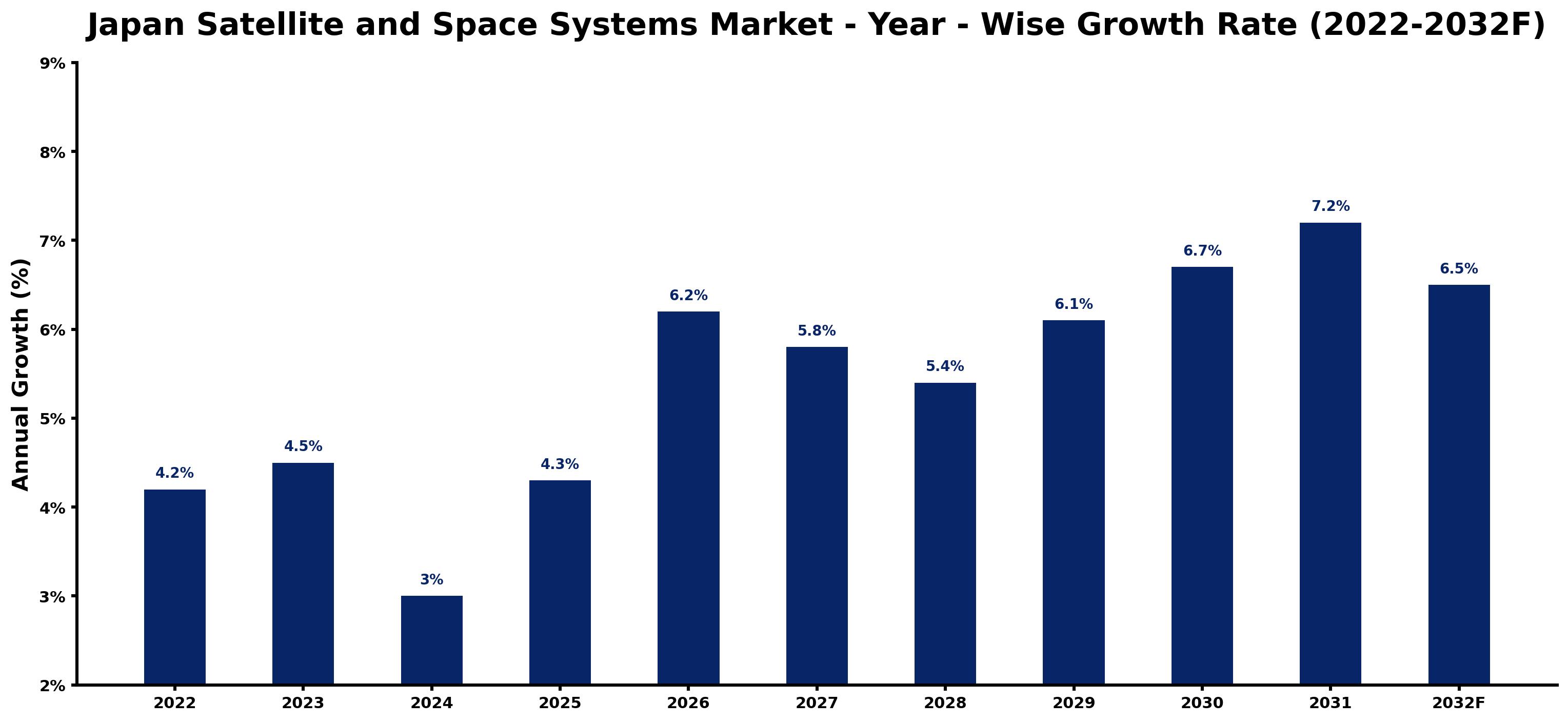
Year by year, the estimates below pair each growth rate with the development that shaped it.
| Year | Estimated Annual Growth (%) | Market Rationale |
| 2022 | 4.2 | The market exhibited strong activity, driven by ongoing satellite projects and international collaborations. |
| 2023 | 4.5 | Growth accelerated due to increased demand for satellite communication services and earth observation. |
| 2024 | 3.0 | A slowdown occurred as some projects faced delays, yet overall demand remained positive. |
| 2025 | 4.3 | Demand rebounded with new satellite launches and improved capabilities in telecommunications. |
| 2026 | 6.2 | The market is expected to see faster growth as investments in satellite technology ramp up. |
| 2027 | 5.8 | A slight slowdown is projected as some sectors adjust to new technological advancements. |
| 2028 | 5.4 | Growth is expected to continue to decelerate as market saturation begins in certain areas of satellite services. |
| 2029 | 6.1 | Renewed interest in satellite applications is anticipated to spur growth, particularly in earth observation. |
| 2030 | 6.7 | Demand is projected to increase as advancements in satellite technology open new opportunities for users. |
| 2031 | 7.2 | The market is expected to peak due to substantial investments in satellite infrastructure and capabilities. |
| 2032 | 6.5 | Growth is projected to slow as the market matures, but demand for innovative satellite solutions will persist. |
Note: Market size estimations and growth projections presented in this report are based on 6Wresearch's proprietary forecasting methodology, utilizing the latest available industry data, government publications, and primary research inputs.
Japan Satellite and Space Systems Market Synopsis
Japan Satellite and Space Systems are integral to the country's communication, observation, and navigation needs, employing advanced technologies for design and testing. The market is expanding due to rising demand from telecom providers and weather agencies, alongside investments in satellite technology. In 2023, the government allocated 100 billion yen for space research and development, further driving market growth. Japan's strategic focus on developing satellite capabilities positions it as a key player in both domestic and international space activities.
Market Dynamics Impact Analysis (2026–2032)
| Factor | Type | Impact | Primary Segment Affected |
| Rising demand for satellite communication services | Driver | High | Communications System |
| Increased investment in satellite technology | Driver | High | Observation System |
| Expansion of satellite applications in various sectors | Opportunity | High | Navigation System |
| Growing interest in earth observation capabilities | Opportunity | High | Observation System |
| High costs associated with satellite development | Restraint | Medium | Payload |
| Limited access to advanced manufacturing technologies | Restraint | Medium | Optics + Imaging |
| Competition from international satellite manufacturers | Challenge | High | Communications System |
| Technological challenges in satellite design and deployment | Challenge | Medium | Navigation System |
Evaluation of Drivers in Japan Satellite and Space Systems Market (2026–2032)
These are the developments adding the most demand over the forecast period.
| Drivers | Primary Segment Affected | Why It Matters (Evidence) |
| Demand for broadband services | Communications System | This demand drives telecom providers to invest in satellite communication, improving service delivery. |
| Need for real-time data | Observation System | Weather agencies require advanced earth observation satellites for accurate forecasting and monitoring. |
| Advancements in satellite manufacturing | Payload | Innovations lead to improved satellite capabilities, prompting manufacturers to invest in new technologies. |
| Interest in space exploration | Observation System | Scientific research initiatives drive demand for advanced satellite systems, expanding the market. |
| Support for satellite projects | Navigation System | Funding from national space policies encourages development and deployment of navigation satellites. |
Volumes are rising due to increased demand for satellite communication services, with Japan's satellite communication market expected to grow in response to broadband requirements. Advances in satellite manufacturing result in improved payload functionalities, encouraging manufacturers to invest heavily in R&D. The growing interest in space exploration further drives demand, as scientific missions necessitate advanced satellite systems for data collection and analysis.
Evaluation of Restraints in Japan Satellite and Space Systems Market
These restraints slow adoption and weigh on supplier margins.
| Market Restraint | Primary Segment Affected | Why It Matters (Evidence) |
| High costs associated with satellite development | Payload | Development expenses limit the ability of smaller manufacturers to compete effectively in the market. |
| Limited access to advanced manufacturing technologies | Optics + Imaging | This restricts production capabilities, hindering the growth of satellite systems in Japan. |
| Regulatory hurdles in satellite launches | Navigation System | Stringent regulations can delay project timelines, affecting overall market growth. |
| Dependence on international suppliers for components | Communications System | This reliance can lead to supply chain vulnerabilities, impacting production schedules. |
| Competition from international satellite manufacturers | Observation System | Local manufacturers face challenges in pricing and technology compared to established global players. |
Japan Satellite and Space Systems Market Challenges
Producers in the satellite industry face regulatory hurdles as the Japan Aerospace Exploration Agency enforces compliance with the Space Activities Law, causing project delays of up to six months for satellite launches. Buyers encounter supply chain disruptions since critical components are often imported, leading to potential assembly delays of three months. Competition intensifies as foreign manufacturers enter the market, forcing local producers to reduce prices by approximately 15%, which compresses their profit margins. Skills shortages in advanced engineering persist, with a projected deficit of 15,000 qualified engineers by 2025, limiting innovation and operational efficiency for manufacturers.
Trends in the Japan Satellite and Space Systems Market
The shifts below are changing how Japan Satellite and Space Systems Market products are bought and supplied.
- Shift towards Advanced Earth Observation Technologies: Japan is increasingly adopting advanced earth observation technologies, highlighted by the successful Hayabusa2 mission in 2020, which returned samples from an asteroid. This initiative underscores the growing capabilities in satellite systems, with Japan's satellite industry valued at approximately 1 trillion yen.
- Emergence of Low Earth Orbit (LEO) Satellites: The focus is shifting towards LEO satellites, which offer advantages in latency and coverage. The growing need for broadband services is prompting investments in LEO satellite systems, with a projected CAGR of 9.1% from 2026 to 2032.
- Increased Collaboration in Space Exploration: Japan's collaboration with international space agencies is strengthening its satellite capabilities. The Japan Space Forum promotes public awareness of space activities, encouraging partnerships that expand the scope of satellite applications.
- Growing Interest in Satellite-Based Navigation: There is a notable increase in demand for satellite-based navigation systems, particularly from the aerospace industry. This trend is supported by advancements in GPS technology and a projected growth rate of 8.2% for weather agencies.
Investment Opportunities in the Japan Satellite and Space Systems Market
The opportunities below stand out in the Japan Satellite and Space Systems Market for new entrants and existing suppliers.
- Supply of Advanced Satellite Components: The demand for advanced satellite components is on the rise, particularly in optics and imaging, with a projected growth rate of 9.3%. Collaborating with satellite manufacturers in Tokyo can facilitate entry into this market.
- Investment in Earth Observation Systems: Investing in earth observation systems is timely, given the increasing interest in environmental monitoring. Weather agencies are seeking new solutions, creating opportunities for local partnerships in Hokkaido.
- Development of Navigation Satellite Systems: The navigation satellite segment is expanding, driven by rising demand for GPS services. Entering this market now could yield substantial returns, especially through partnerships with aerospace industry players.
- Expansion of Satellite Communication Services: The satellite communication market is poised for growth due to rising broadband needs. Establishing joint ventures with telecom providers can strengthen market presence and service offerings.
Government Initiatives in the Japan Satellite and Space Systems Market
The Space Activities Law, enacted in 2008, promotes space activities and has been updated to include new guidelines for satellite launches and operations. This law establishes compliance and safety standards, ensuring that satellite manufacturers adhere to strict regulations.
In 2023, the government allocated 100 billion yen for space research and development, overseen by the Japan Aerospace Exploration Agency (JAXA). This funding supports various projects, including satellite technology advancements and space exploration initiatives.
Future Insight of the Japan Satellite and Space Systems Market
The upcoming lunar lander projects will drive advancements in satellite technology, boosting Japan's capabilities in space exploration. By 2032, the government’s allocation of 50 billion yen for space research and development is expected to yield new satellite designs and improved manufacturing processes. The ISO 9001 standard will uphold production quality across the sector. Increased collaboration with international space agencies will create new opportunities for suppliers, cultivating a more competitive environment.
Market Segmentation Analysis
Japan Satellite and Space Systems Market report covers a detailed analysis of the following market segments:
By System Type – Communications System Leads, Observation System Expected to Grow Fastest
According to Saurav Kr Singh, Senior Research Analyst at 6Wresearch, with 44% of system type revenue in 2025, Communications System was the largest category. The Communications System segment commands the largest share because it is essential for satellite communication services, which connect Japan's population of approximately 126 million. This segment's dominance is highlighted by the extensive use of these systems for both domestic and international communications. Observation System is projected to grow fastest, at a CAGR of 8.9% during 2026–2032. The Observation System is experiencing rapid growth, driven by increasing demand for earth observation capabilities, particularly in response to climate-related issues. Government funding and initiatives aimed at advancing satellite technology are also propelling this segment's swift rise. Suppliers should focus on advancing observation technologies to capitalise on the growing demand in this sector.
By Component Type – Payload Leads, Optics + Imaging Expected to Grow Fastest
Payload took 33% of component type revenue in 2025, more than any other category. Payload holds the largest share as it is essential for satellite functionality, enabling various applications such as communication and earth observation. The widespread adoption of ISO 9001 standards in manufacturing ensures high-quality payloads are produced. Over 2026–2032, Optics + Imaging is expected to post the fastest growth, at a CAGR of 9.3%. Optics + Imaging is the fastest-growing component, driven by the rising demand for advanced imaging and data collection capabilities in various sectors. This growth is supported by initiatives like the Space Robotics Challenge that encourage technological advancements. Buyers should prioritise high-quality optics and imaging solutions to stay competitive in the evolving market.
By Orbit Type – GEO Leads, LEO Expected to Grow Fastest
The largest orbit type category in 2025 was GEO, at 41% of revenue. GEO is the leading orbit type as it is crucial for geostationary satellites, which provide dependable communication links for various applications. The presence of over 50 active satellites across different orbits underscores the vital role of GEO in supporting Japan's satellite infrastructure. The quickest growth will come from LEO, forecast to expand at a CAGR of 9.1% between 2026 and 2032. LEO is the fastest-growing orbit type, spurred by the increasing need for low earth orbit satellites that enable lower latency communication services. This growth is anticipated to accelerate as investments in LEO satellite networks expand. Suppliers should prioritise the development of LEO satellite capabilities to meet the rising market demand.
By End User – Telecom Providers Lead, Weather Agencies Expected to Grow Fastest
Telecom Providers accounted for 47% of the market by end user in 2025. Telecom Providers dominate the market as the primary consumers of satellite communication services, essential for delivering broadband and telecommunications solutions. The increasing interest in satellite technology among Japan's populace reinforces the significance of this segment. Weather Agencies are set to record the highest CAGR in this split, 8.2% over 2026–2032. Weather Agencies are the fastest-growing end user, motivated by the urgent need for precise weather forecasting amid changing climate conditions. The heightened focus on climate-related issues from both the public and government is likely to sustain this growth. Suppliers should seek collaborations with weather agencies to align their offerings with the sector's evolving requirements.
Key Attractiveness of the Report
- 10 Years of Market Numbers
- Historical Data Starting from 2022 to 2025
- Base Year 2025
- Forecast Data until 2032
- Key Performance Indicators Impacting the Market
- Major Upcoming Developments and Projects
Key Highlights of the Report:
- Japan Satellite and Space Systems Market Outlook
- Market Size of Japan Satellite and Space Systems Market, 2025
- Forecast of Japan Satellite and Space Systems Market, 2032
- Historical Data and Forecast of Japan Satellite and Space Systems Revenues & Volume for the Period 2022-2032F
- Japan Satellite and Space Systems Market Trend Evolution
- Japan Satellite and Space Systems Market Drivers and Challenges
- Japan Satellite and Space Systems Price Trends
- Japan Satellite and Space Systems Porter's Five Forces
- Japan Satellite and Space Systems Industry Life Cycle
- Historical Data and Forecast of Japan Satellite and Space Systems Market Revenues & Volume By System Type for the Period 2022-2032F
- Historical Data and Forecast of Japan Satellite and Space Systems Market Revenues & Volume By Communications System for the Period 2022-2032F
- Historical Data and Forecast of Japan Satellite and Space Systems Market Revenues & Volume By Observation System for the Period 2022-2032F
- Historical Data and Forecast of Japan Satellite and Space Systems Market Revenues & Volume By Navigation System for the Period 2022-2032F
- Historical Data and Forecast of Japan Satellite and Space Systems Market Revenues & Volume By Power System for the Period 2022-2032F
- Historical Data and Forecast of Japan Satellite and Space Systems Market Revenues & Volume By Component Type for the Period 2022-2032F
- Historical Data and Forecast of Japan Satellite and Space Systems Market Revenues & Volume By Payload for the Period 2022-2032F
- Historical Data and Forecast of Japan Satellite and Space Systems Market Revenues & Volume By Optics + Imaging for the Period 2022-2032F
- Historical Data and Forecast of Japan Satellite and Space Systems Market Revenues & Volume By Timing Devices for the Period 2022-2032F
- Historical Data and Forecast of Japan Satellite and Space Systems Market Revenues & Volume By Solar Arrays for the Period 2022-2032F
- Historical Data and Forecast of Japan Satellite and Space Systems Market Revenues & Volume By Orbit Type for the Period 2022-2032F
- Historical Data and Forecast of Japan Satellite and Space Systems Market Revenues & Volume By GEO for the Period 2022-2032F
- Historical Data and Forecast of Japan Satellite and Space Systems Market Revenues & Volume By LEO for the Period 2022-2032F
- Historical Data and Forecast of Japan Satellite and Space Systems Market Revenues & Volume By MEO for the Period 2022-2032F
- Historical Data and Forecast of Japan Satellite and Space Systems Market Revenues & Volume By All Orbits for the Period 2022-2032F
- Historical Data and Forecast of Japan Satellite and Space Systems Market Revenues & Volume By End User for the Period 2022-2032F
- Historical Data and Forecast of Japan Satellite and Space Systems Market Revenues & Volume By Telecom Providers for the Period 2022-2032F
- Historical Data and Forecast of Japan Satellite and Space Systems Market Revenues & Volume By Weather Agencies for the Period 2022-2032F
- Historical Data and Forecast of Japan Satellite and Space Systems Market Revenues & Volume By Aerospace Industry for the Period 2022-2032F
- Historical Data and Forecast of Japan Satellite and Space Systems Market Revenues & Volume By Satellite Manufacturers for the Period 2022-2032F
- Japan Satellite and Space Systems Import Export Trade Statistics
- Market Opportunity Assessment By System Type
- Market Opportunity Assessment By Component Type
- Market Opportunity Assessment By Orbit Type
- Market Opportunity Assessment By End User
- Japan Satellite and Space Systems Top Companies Market Share
- Japan Satellite and Space Systems Competitive Benchmarking By Technical and Operational Parameters
- Japan Satellite and Space Systems Company Profiles
- Japan Satellite and Space Systems Key Strategic Recommendations
Market Covered
Segments analysed in this report are listed below.
By System Type
- Communications System
- Observation System
- Navigation System
- Power System
By Component Type
- Payload
- Optics + Imaging
- Timing Devices
- Solar Arrays
By Orbit Type
- GEO
- LEO
- MEO
- All Orbits
By End User
- Telecom Providers
- Weather Agencies
- Aerospace Industry
- Satellite Manufacturers






































