Japan Satellite Link Equipment Market Size & Growth Rate
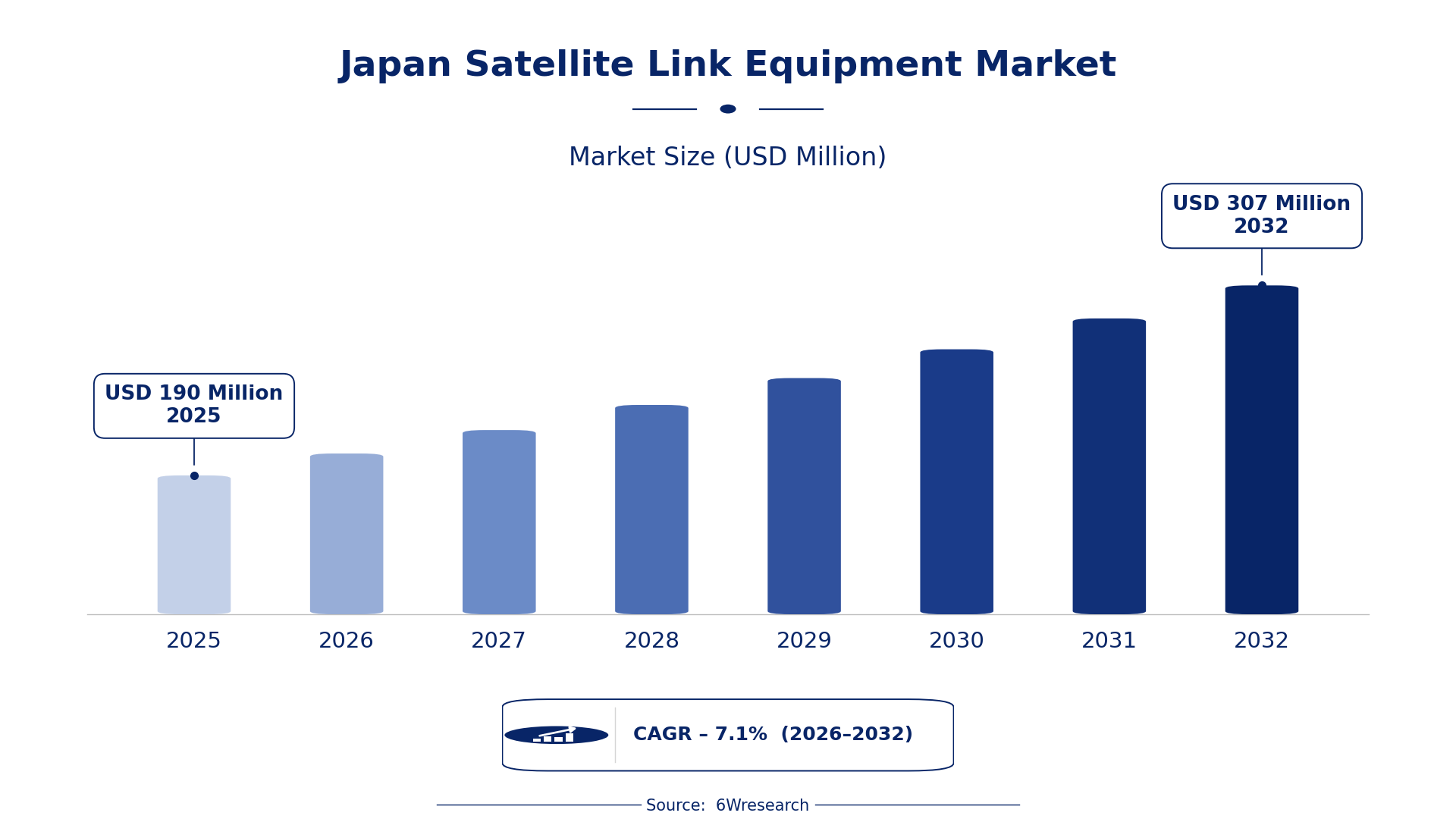
According to 6Wresearch internal database and industry insights, the Japan Satellite Link Equipment Market was valued at USD 190 Million in 2025 and is projected to reach USD 307 Million by 2032, growing at a CAGR of approximately 7.1% during 2026–2032.
Japan Satellite Link Equipment Market Highlights
| Report Metric | Details |
| Report Name | Japan Satellite Link Equipment Market (2026-2032) |
| Market Size 2025 | USD 190 Million |
| Market Size 2032 | USD 307 Million |
| Absolute Growth 2025–2032 | USD 117 Million |
| CAGR 2026–2032 | 7.1% |
| Peak Annual Growth | 7.7% in 2032 |
| Forecast Period | 2026–2032 |
| Historical Data | 2022–2025 |
| Base Year | 2025 |
| Leading Equipment Type, 2025 | Modulators (45% share) |
| Leading Frequency Range, 2025 | C/Ku Band (39% share) |
| Leading Link Type, 2025 | Uplink (46% share) |
| Leading End User, 2025 | Broadcast Stations (48% share) |
| Fastest-Growing Equipment Type | Demodulators (10.0% CAGR) |
| Fastest-Growing Frequency Range | Ka/X Band (9.4% CAGR) |
| Fastest-Growing Link Type | Downlink (10.3% CAGR) |
| Fastest-Growing End User | Satellite ISPs (9.2% CAGR) |
| Growing Sector | Satellite Internet Services |
| Key End Users | Broadcast Stations, Satellite ISPs, VSAT Operators, Earth Stations |
Japan Satellite Link Equipment Market Year-wise Growth Rate and Key Drivers (2022–2032)
This graph illustrates the annual growth rates of the market from 2022 to 2032, highlighting a steady upward trajectory and projected market expansion over the forecast period.
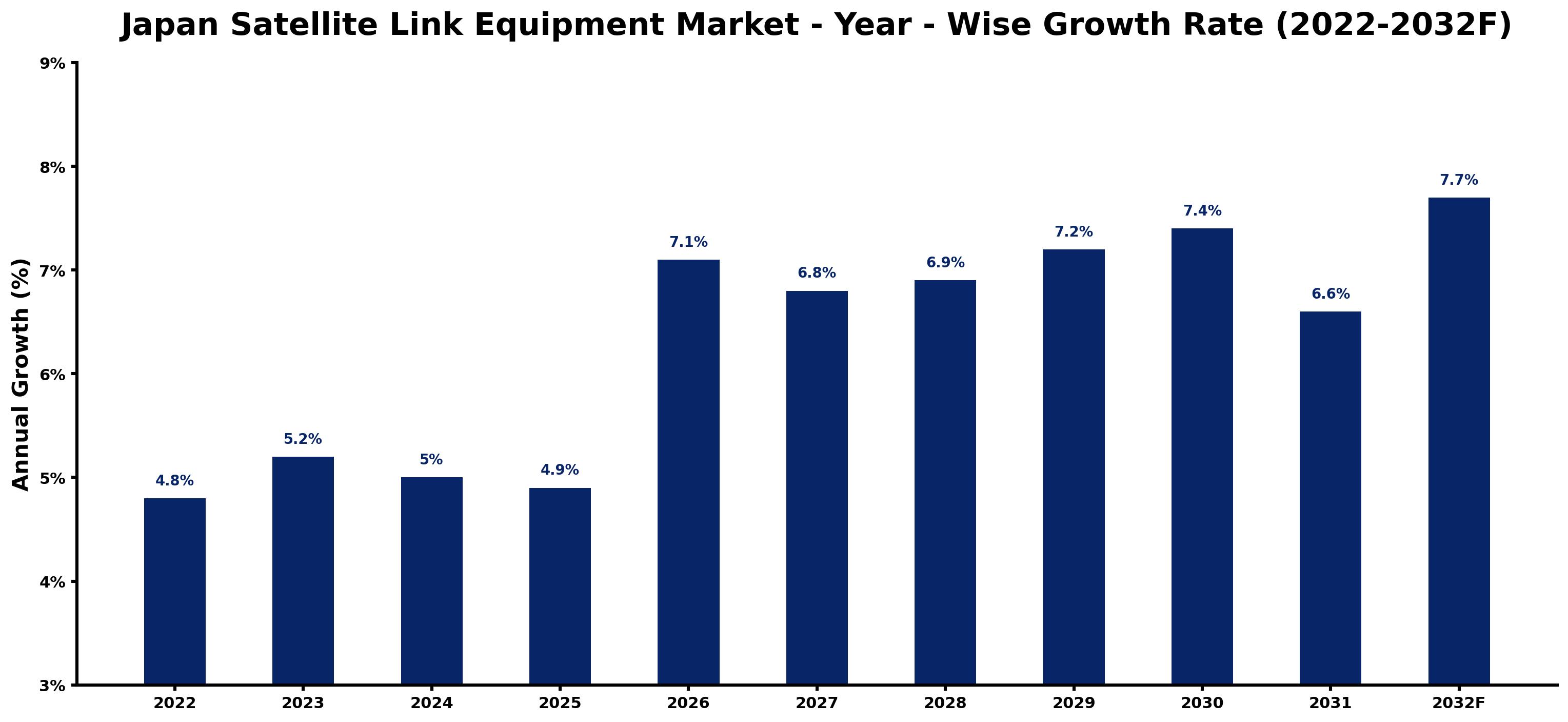
Annual growth estimates for each year appear below with the principal reason behind them, explaining the shifts that set the pace of the market.
| Year | Estimated Annual Growth (%) | Market Rationale |
| 2022 | 4.8 | Demand was stable, with ongoing investments in satellite infrastructure. |
| 2023 | 5.2 | Growth accelerated due to increased broadcasting needs and new satellite launches. |
| 2024 | 5.0 | Demand slowed slightly as market adjustments took place after previous growth. |
| 2025 | 4.9 | Continued investments were apparent, but growth rates moderated compared to earlier years. |
| 2026 | 7.1 | Investment in satellite communication infrastructure is expected to surge, driving higher demand. |
| 2027 | 6.8 | Growth is projected to slow as the market stabilises after rapid expansion in previous years. |
| 2028 | 6.9 | Demand is expected to improve again, supported by advancements in satellite technology. |
| 2029 | 7.2 | Increased demand is anticipated as new applications for satellite services emerge. |
| 2030 | 7.4 | Growth is projected to remain strong, driven by the expansion of internet services via satellite. |
| 2031 | 6.6 | The market is expected to experience a slowdown as growth rates normalise after peaks. |
| 2032 | 7.7 | Demand is projected to surge again, driven by the need for improved broadband capabilities. |
Note: Market size estimations and growth projections presented in this report are based on 6Wresearch's proprietary forecasting methodology, utilizing the latest available industry data, government publications, and primary research inputs.
Japan Satellite Link Equipment Market Synopsis
Satellite link equipment encompasses technology for transmitting and receiving signals via satellites, including modulators and amplifiers. The Japan Satellite Link Equipment Market is projected to grow, reaching USD 307 million by 2032, driven by rising demand from broadcasting and internet service providers. Investment in satellite communication infrastructure reached ¥100 billion in 2022, supporting advancements in technology and service delivery.
Market Dynamics Impact Analysis (2026–2032)
| Factor | Type | Impact | Primary Segment Affected |
| Increased investment in satellite infrastructure | Driver | High | Modulators |
| Growing demand for high-speed internet services | Driver | High | Ka/X Band |
| Expansion of satellite internet services | Opportunity | High | Satellite ISPs |
| Rising need for reliable broadcasting solutions | Opportunity | High | Broadcast Stations |
| High manufacturing costs for advanced equipment | Restraint | Medium | Power Amplifiers |
| Regulatory compliance requirements can delay projects | Restraint | Medium | Demodulators |
| Limited local production capabilities for advanced technology | Challenge | High | Multi-band |
| Competition from alternative communication technologies | Challenge | Medium | Uplink |
Evaluation of Drivers in Japan Satellite Link Equipment Market (2026–2032)
Demand rests on the following drivers, each shown with the segment it touches most.
| Drivers | Primary Segment Affected | Why It Matters (Evidence) |
| Increased investment in satellite infrastructure | Modulators | Investment reached ¥100 billion in 2022, boosting demand for signal processing equipment. |
| Growing demand for high-speed internet services | Ka/X Band | With 2 million users served by satellite ISPs, demand for high-capacity services rises. |
| Expansion of satellite internet services | Satellite ISPs | The installed base of satellite link equipment is estimated at 500,000 units, indicating growth. |
| Rising need for reliable broadcasting solutions | Broadcast Stations | The C/Ku Band is predominantly used for broadcasting, driving demand for related equipment. |
| Technological advancements in satellite communications | Power Amplifiers | New satellite launches in 2023 improve capabilities, increasing demand for amplifiers. |
Most of the extra volume comes from increased investment in satellite infrastructure, which reached ¥100 billion in 2022 and supports demand for signal processing equipment. Approximately 2 million users are served by satellite ISPs, driving the need for high-speed internet services. The installed base of satellite link equipment is estimated at 500,000 units, indicating growth in the sector. The C/Ku Band, primarily used for broadcasting, continues to drive demand for related technologies. Advancements in technology, highlighted by new satellite launches in 2023, are boosting the need for power amplifiers.
Evaluation of Restraints in Japan Satellite Link Equipment Market
Several factors work against faster growth; the main ones are summarised below.
| Market Restraint | Primary Segment Affected | Why It Matters (Evidence) |
| High manufacturing costs for advanced equipment | Power Amplifiers | Manufacturers face rising costs, impacting pricing and affordability for buyers. |
| Regulatory compliance requirements can delay projects | Demodulators | Compliance with standards set by the Ministry of Internal Affairs can slow down deployment. |
| Limited local production capabilities for advanced technology | Multi-band | Dependence on imports for high-tech components can lead to supply chain vulnerabilities. |
| Competition from alternative communication technologies | Uplink | Emerging technologies may divert investment away from traditional satellite solutions. |
| Market saturation in certain segments | Broadcast Stations | With over 1,000 registered satellite communication stations, growth may plateau. |
Japan Satellite Link Equipment Market Challenges
Buyers of satellite link equipment face regulatory hurdles from the Ministry of Internal Affairs and Communications, which can delay project approvals by 20%. Technology integration issues lead to inefficiencies, reducing operational performance by 15% for producers. Rising raw material costs, exacerbated by global supply chain disruptions, inflate production expenses by approximately 10%, compelling suppliers to raise prices. A skills gap in the workforce results in product development delays averaging six months for manufacturers, hindering their ability to innovate and meet market demands.
Trends in the Japan Satellite Link Equipment Market
The shifts below are changing how Japan Satellite Link Equipment Market products are bought and supplied.
- Shift from Traditional to High-Capacity Satellite Services: Japan is adopting Ka Band technology for high-speed internet applications, with a projected growth of 9.4% in this segment. This shift allows service providers to offer faster and more reliable internet access, particularly in rural areas.
- Transition to Multi-band Solutions: Since 2023, there has been a noticeable shift towards multi-band satellite solutions, providing flexibility for operators. This change is driven by the need for diverse frequency usage to meet varying customer demands.
- Emergence of Satellite ISPs as Key Players: The number of satellite ISPs is projected to reach 300,000 terminals by 2025, significantly impacting the market. This growth is reshaping how consumers access internet services, particularly in underserved regions.
- Increasing Demand for Bi-directional Communication: The need for bi-directional communication has grown, particularly among VSAT operators. This trend reflects the demand for two-way communication capabilities in various applications.
Investment Opportunities in the Japan Satellite Link Equipment Market
Investors looking at the Japan Satellite Link Equipment Market should consider the following areas.
- Gap in High-Speed Internet Access: With approximately 2 million users currently served, there remains a gap in high-speed internet access. Satellite ISPs are looking to expand their services, creating opportunities for new equipment suppliers.
- Need for Advanced Broadcasting Solutions: Broadcast stations are increasingly seeking advanced satellite link equipment to improve content distribution. This presents an opportunity for suppliers focusing on modulators and power amplifiers.
- Investment in Satellite Communication Infrastructure: Investment in satellite communication infrastructure reached ¥100 billion in 2022, indicating strong demand. Suppliers can enter this market by partnering with local ISPs and broadcasters.
- Expansion of Multi-band Equipment Supply: As multi-band solutions gain traction, suppliers can focus on developing versatile equipment. Collaborating with regional broadcasters and ISPs can facilitate market entry.
Government Initiatives in the Japan Satellite Link Equipment Market
The 2023 Space Development Strategy emphasises satellite communication growth, building on the Industrial Standardization Act of 1949. This strategy encourages investment in satellite technology, ensuring compliance with established JIS standards, which improves product quality and reliability.
Buyers, particularly satellite ISPs, benefit from the Act on the Rational Use of Energy, which supports energy-efficient technologies in satellite operations. This act encourages the adoption of advanced equipment that meets energy efficiency standards, reducing operational costs for service providers.
Future Insight of the Japan Satellite Link Equipment Market
Buyers will benefit as the number of VSAT terminals is projected to reach 300,000 by 2025, creating new opportunities for service expansion. The introduction of new standards under JIS will streamline manufacturing, allowing for quicker product delivery. Investment in satellite communication infrastructure, which reached ¥100 billion in 2022, will enhance broadband service capabilities. Increased collaboration among industry stakeholders will facilitate the development of advanced satellite technologies, improving overall service quality.
Market Segmentation Analysis
Japan Satellite Link Equipment Market report covers a detailed analysis of the following market segments:
By Equipment Type – Modulators Lead, Demodulators Expected to Grow Fastest
According to Saurav Kr Singh, Senior Research Analyst at 6Wresearch, Modulators accounted for 45% of the market by equipment type in 2025. Modulators hold the largest market share because they are essential for processing signals in satellite communications. Their widespread use in broadcasting services, particularly in urban areas like Tokyo, solidifies their dominance among users. Over 2026–2032, Demodulators are expected to post the fastest growth, at a CAGR of 10.0%. Demodulators are experiencing rapid growth due to the increasing need for efficient signal decoding, especially with the rise of high-speed internet services. The forecasted growth in VSAT terminals to 300,000 by 2025 highlights the expanding reliance on these components. Suppliers should focus on enhancing demodulator technology to meet the rising market demand.
By Frequency Range – C/Ku Band Leads, Ka/X Band Expected to Grow Fastest
C/Ku Band held 39% of the Japan Satellite Link Equipment Market by frequency range in 2025. The C/Ku Band leads in market share as it is commonly utilised for broadcasting services that cater to a large population in Japan. This frequency range is crucial for the operations of numerous satellite communication stations throughout the country. Ka/X Band is projected to grow fastest, at a CAGR of 9.4% during 2026–2032. Ka/X Band technology is gaining momentum as it supports high-capacity satellite services, driven by the increasing demand for faster internet connections. The government’s investment in satellite communication infrastructure further fuels this segment's growth. Buyers should consider investing in Ka/X Band technology to improve their service offerings in the competitive satellite communication market.
By Link Type – Uplink Leads, Downlink Expected to Grow Fastest
Uplink took 46% of link type revenue in 2025, more than any other category. Uplink technology commands the largest share as it is vital for transmitting data to satellites, essential for various communication applications. Its significance is highlighted by the installed base of satellite link equipment that supports effective satellite operations. Downlink is set to record the highest CAGR in this split, 10.3% over 2026–2032. Downlink technology is rapidly growing due to the rising demand for receiving data from satellites, particularly with the expansion of satellite internet services. The increasing number of satellite ISPs in Japan is a crucial factor driving this trend. Suppliers must enhance downlink capabilities to address the growing demand from satellite internet service providers.
By End User – Broadcast Stations Lead, Satellite ISPs Expected to Grow Fastest
With 48% of end user revenue in 2025, Broadcast Stations was the largest category. Broadcast stations dominate the market as they are major users of satellite link equipment for content distribution, ensuring a steady demand for these systems. Their established infrastructure and reliance on satellite technology contribute to their leading position. The quickest growth will come from Satellite ISPs, forecast to expand at a CAGR of 9.2% between 2026 and 2032. Satellite ISPs are experiencing the fastest growth due to the increasing need for internet services in remote areas, with approximately 2 million users served. This trend is supported by ongoing advancements in satellite technology. Suppliers should target satellite ISPs to capitalise on the expanding market for satellite-based internet services.
Key Attractiveness of the Report
- 10 Years of Market Numbers
- Historical Data Starting from 2022 to 2025
- Base Year 2025
- Forecast Data until 2032
- Key Performance Indicators Impacting the Market
- Major Upcoming Developments and Projects
Key Highlights of the Report:
- Japan Satellite Link Equipment Market Outlook
- Market Size of Japan Satellite Link Equipment Market, 2025
- Forecast of Japan Satellite Link Equipment Market, 2032
- Historical Data and Forecast of Japan Satellite Link Equipment Revenues & Volume for the Period 2022-2032F
- Japan Satellite Link Equipment Market Trend Evolution
- Japan Satellite Link Equipment Market Drivers and Challenges
- Japan Satellite Link Equipment Price Trends
- Japan Satellite Link Equipment Porter's Five Forces
- Japan Satellite Link Equipment Industry Life Cycle
- Historical Data and Forecast of Japan Satellite Link Equipment Market Revenues & Volume By Equipment Type for the Period 2022-2032F
- Historical Data and Forecast of Japan Satellite Link Equipment Market Revenues & Volume By Modulators for the Period 2022-2032F
- Historical Data and Forecast of Japan Satellite Link Equipment Market Revenues & Volume By Demodulators for the Period 2022-2032F
- Historical Data and Forecast of Japan Satellite Link Equipment Market Revenues & Volume By RF Converters for the Period 2022-2032F
- Historical Data and Forecast of Japan Satellite Link Equipment Market Revenues & Volume By Power Amplifiers for the Period 2022-2032F
- Historical Data and Forecast of Japan Satellite Link Equipment Market Revenues & Volume By Frequency Range for the Period 2022-2032F
- Historical Data and Forecast of Japan Satellite Link Equipment Market Revenues & Volume By C/Ku Band for the Period 2022-2032F
- Historical Data and Forecast of Japan Satellite Link Equipment Market Revenues & Volume By Ka/X Band for the Period 2022-2032F
- Historical Data and Forecast of Japan Satellite Link Equipment Market Revenues & Volume By L/S Band for the Period 2022-2032F
- Historical Data and Forecast of Japan Satellite Link Equipment Market Revenues & Volume By Multi-band for the Period 2022-2032F
- Historical Data and Forecast of Japan Satellite Link Equipment Market Revenues & Volume By Link Type for the Period 2022-2032F
- Historical Data and Forecast of Japan Satellite Link Equipment Market Revenues & Volume By Uplink for the Period 2022-2032F
- Historical Data and Forecast of Japan Satellite Link Equipment Market Revenues & Volume By Downlink for the Period 2022-2032F
- Historical Data and Forecast of Japan Satellite Link Equipment Market Revenues & Volume By Bi-directional for the Period 2022-2032F
- Historical Data and Forecast of Japan Satellite Link Equipment Market Revenues & Volume By Long-Range Uplink for the Period 2022-2032F
- Historical Data and Forecast of Japan Satellite Link Equipment Market Revenues & Volume By End User for the Period 2022-2032F
- Historical Data and Forecast of Japan Satellite Link Equipment Market Revenues & Volume By Broadcast Stations for the Period 2022-2032F
- Historical Data and Forecast of Japan Satellite Link Equipment Market Revenues & Volume By Satellite ISPs for the Period 2022-2032F
- Historical Data and Forecast of Japan Satellite Link Equipment Market Revenues & Volume By VSAT Operators for the Period 2022-2032F
- Historical Data and Forecast of Japan Satellite Link Equipment Market Revenues & Volume By Earth Stations for the Period 2022-2032F
- Japan Satellite Link Equipment Import Export Trade Statistics
- Market Opportunity Assessment By Equipment Type
- Market Opportunity Assessment By Frequency Range
- Market Opportunity Assessment By Link Type
- Market Opportunity Assessment By End User
- Japan Satellite Link Equipment Top Companies Market Share
- Japan Satellite Link Equipment Competitive Benchmarking By Technical and Operational Parameters
- Japan Satellite Link Equipment Company Profiles
- Japan Satellite Link Equipment Key Strategic Recommendations
Market Covered
Segments analysed in this report are listed below.
By Equipment Type
- Modulators
- Demodulators
- RF Converters
- Power Amplifiers
By Frequency Range
- C/Ku Band
- Ka/X Band
- L/S Band
- Multi-band
By Link Type
- Uplink
- Downlink
- Bi-directional
- Long-Range Uplink
By End User
- Broadcast Stations
- Satellite ISPs
- VSAT Operators
- Earth Stations































