Japan Satellite Navigation Timing Market Size & Growth Rate
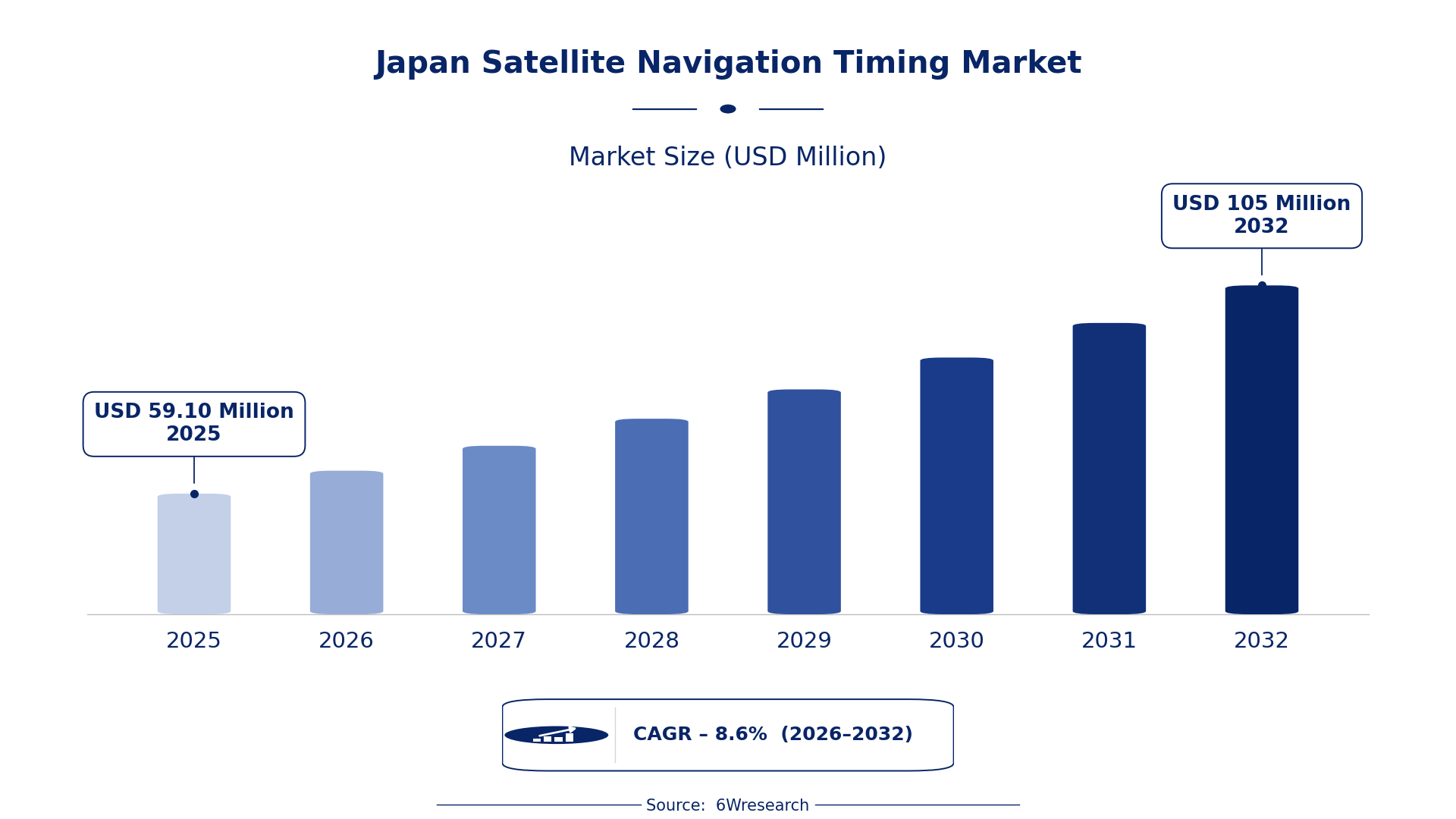
According to 6Wresearch internal database and industry insights, the Japan Satellite Navigation Timing Market was valued at USD 59.10 Million in 2025 and is projected to reach USD 105 Million by 2032, growing at a CAGR of approximately 8.6% during 2026–2032.
Japan Satellite Navigation Timing Market Highlights
| Report Metric | Details |
| Report Name | Japan Satellite Navigation Timing Market (2026-2032) |
| Market Size 2025 | USD 59.10 Million |
| Market Size 2032 | USD 105 Million |
| Absolute Growth 2025–2032 | USD 45.90 Million |
| CAGR 2026–2032 | 8.6% |
| Peak Annual Growth | 9.5% in 2032 |
| Forecast Period | 2026–2032 |
| Historical Data | 2022–2025 |
| Base Year | 2025 |
| Leading Service Type, 2025 | GNSS Timing (41% share) |
| Leading Timing Accuracy, 2025 | Nano to Microsecond (35% share) |
| Leading Application Type, 2025 | Telecom Synchronization (41% share) |
| Leading End User, 2025 | 5G Infrastructure Providers (50% share) |
| Fastest-Growing Service Type | Precise Point Positioning (PPP) (11.4% CAGR) |
| Fastest-Growing Application Type | Geolocation (11.9% CAGR) |
| Fastest-Growing End User | Aerospace Navigation (11.2% CAGR) |
| Growing Sector | Telecommunications |
| Key End Users | Telecommunications providers, military agencies, aerospace companies, 5G infrastructure developers |
Japan Satellite Navigation Timing Market Year-wise Growth Rate and Key Drivers (2022–2032)
This graph illustrates the annual growth rates of the market from 2022 to 2032, highlighting a steady upward trajectory and projected market expansion over the forecast period.
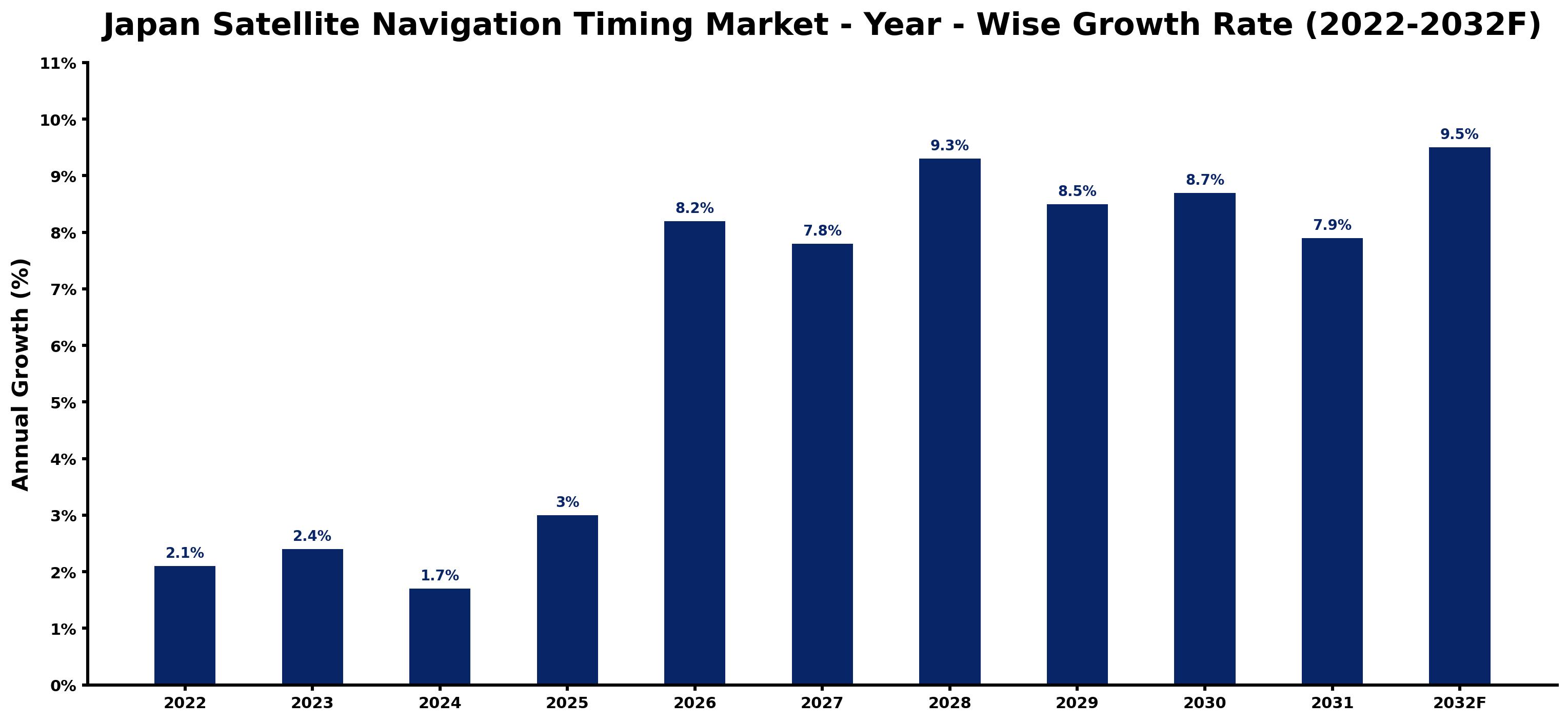
For each year, the table pairs the estimated growth rate with the leading influence on demand, showing how the drivers changed across the period.
| Year | Estimated Annual Growth (%) | Market Rationale |
| 2022 | 2.1 | The market experienced steady growth, supported by existing demand from technology sectors. |
| 2023 | 2.4 | Growth accelerated due to heightened demand from telecommunications and military applications. |
| 2024 | 1.7 | The market saw a slowdown as some sectors adjusted to previous growth rates. |
| 2025 | 3.0 | An increase in demand for precise timing solutions drove faster growth this year. |
| 2026 | 8.2 | Growth surged as investments in 5G infrastructure are anticipated to materialise. |
| 2027 | 7.8 | The market will experience a slight slowdown as initial investment impacts stabilise. |
| 2028 | 9.3 | Growth is projected to pick up again, driven by advancements in aerospace navigation technology. |
| 2029 | 8.5 | A slowdown will occur as the market adjusts to the rapid growth of previous years. |
| 2030 | 8.7 | The market is expected to rebound with renewed investments in satellite technologies. |
| 2031 | 7.9 | Growth will slow slightly as the market stabilises after a period of rapid expansion. |
| 2032 | 9.5 | Demand is projected to surge again, driven by the increasing need for precise timing solutions. |
Note: Market size estimations and growth projections presented in this report are based on 6Wresearch's proprietary forecasting methodology, utilizing the latest available industry data, government publications, and primary research inputs.
Japan Satellite Navigation Timing Market Synopsis
Satellite Navigation Timing involves precise timing signals from Global Navigation Satellite Systems, crucial for telecommunications synchronization, geolocation services, and military applications. The Japan Satellite Navigation Timing Market is growing due to rising demand from the telecommunications sector, which is anticipated to require precise timing solutions by 2025, alongside advancements in aerospace navigation technology, particularly in Tokyo, where notable developments are taking place.
Market Dynamics Impact Analysis (2026–2032)
| Factor | Type | Impact | Primary Segment Affected |
| Increasing demand for precise timing solutions in telecommunications | Driver | High | Telecom Synchronization |
| Growth in 5G infrastructure requiring accurate timing | Driver | High | 5G Infrastructure Providers |
| Investment in satellite-based augmentation systems | Opportunity | Medium | Satellite-Based Augmentation |
| Expansion of aerospace navigation technology in Tokyo | Opportunity | Medium | Aerospace Navigation |
| Competition from alternative timing solutions | Restraint | High | GNSS Timing |
| High costs associated with implementing advanced timing systems | Restraint | Medium | Precise Point Positioning (PPP) |
| Supply chain disruptions affecting satellite launches | Challenge | High | Military Timing Systems |
| Technological advancements outpacing current systems | Challenge | Medium | Geolocation |
Evaluation of Drivers in Japan Satellite Navigation Timing Market (2026–2032)
The factors lifting demand, and the evidence behind each, are summarised below.
| Drivers | Primary Segment Affected | Why It Matters (Evidence) |
| Rising telecommunications demand for synchronization | Telecom Synchronization | Japan's telecommunications sector is one of the largest in Asia, driving the need for precise timing solutions. |
| Investment in 5G infrastructure | 5G Infrastructure Providers | The total number of 5G base stations in Japan is projected to exceed 100,000 by 2025, increasing demand for timing solutions. |
| Advancements in aerospace navigation technology | Aerospace Navigation | Tokyo is a major hub for aerospace navigation technology development, increasing the demand for precise timing solutions. |
| Government support for satellite navigation systems | Satellite-Based Augmentation | The Japanese government has invested in satellite-based augmentation systems since 2021, boosting market growth. |
| Military applications requiring secure communications | Military Timing Systems | The Ministry of Defense in Japan utilises military timing systems for secure communications, driving demand. |
Purchasing is picking up as Japan's telecommunications sector expands, with the total number of 5G base stations projected to exceed 100,000 by 2025. This surge in infrastructure development increases demand for precise timing solutions, particularly in the Telecom Synchronization segment. Developments in aerospace navigation technology in Tokyo are raising the need for accurate timing, further driving market growth. Investments in satellite-based augmentation systems since 2021 are also contributing to heightened demand.
Evaluation of Restraints in Japan Satellite Navigation Timing Market
The key brakes on demand, and where they bite hardest, are shown below.
| Market Restraint | Primary Segment Affected | Why It Matters (Evidence) |
| Competition from alternative timing solutions | GNSS Timing | Emerging technologies may offer similar functionalities, potentially diverting demand from GNSS timing solutions. |
| High implementation costs for advanced systems | Precise Point Positioning (PPP) | The initial investment required for high-accuracy applications can deter potential buyers. |
| Supply chain disruptions affecting satellite launches | Military Timing Systems | Delays in satellite launches can hinder the availability of military timing systems, impacting operations. |
| Technological advancements outpacing current systems | Geolocation | Rapid technological changes can make existing systems obsolete, affecting buyer confidence. |
| Regulatory hurdles in implementing new technologies | Telecom Synchronization | Compliance with strict regulations can slow down the adoption of new timing solutions. |
Japan Satellite Navigation Timing Market Challenges
Buyers face delays in obtaining precise timing solutions due to the rapid growth of the telecommunications sector, which demands immediate access to reliable services. Supply chain disruptions arise as importers encounter difficulties in sourcing advanced technology following recent satellite launches, leading to service delivery delays for telecommunications companies. Technology integration poses a challenge for producers who must implement new GNSS advancements, resulting in slower timelines for their clients. Competition intensifies as local firms heavily invest in GNSS capabilities, forcing smaller buyers to either accept lower service quality or pay more for dependable solutions.
Trends in the Japan Satellite Navigation Timing Market
These developments are changing demand patterns in the Japan Satellite Navigation Timing Market.
- Shift from Traditional to Advanced Timing Solutions: Japan is moving towards advanced timing solutions, particularly in telecommunications. The government's investment in satellite-based augmentation systems since 2021 has played a key role, enhancing accuracy and reliability.
- Emergence of Precision Timing in Aerospace Navigation: Since 2023, aerospace navigation technology in Tokyo has increasingly embraced precision timing solutions. This shift addresses the need for improved safety and operational efficiency in flight operations.
- Growing Demand for Military Timing Systems: The demand for military timing systems has risen sharply since 2021, as the Ministry of Defense strengthens secure communications capabilities. This trend is likely to persist as military operations modernise.
- Expansion of 5G Infrastructure: The rollout of 5G infrastructure has accelerated since 2022, with over 100,000 base stations anticipated by 2025. This expansion requires precise timing solutions for optimal network performance.
Investment Opportunities in the Japan Satellite Navigation Timing Market
The opportunities below stand out in the Japan Satellite Navigation Timing Market for new entrants and existing suppliers.
- Partnership with Local Technology Firms: Forming joint ventures with local technology firms in Japan can ease market entry. The telecommunications sector, projected to grow rapidly, offers a promising opportunity.
- Investment in Satellite-Based Augmentation Systems: With the Japanese government investing in satellite-based augmentation systems, suppliers have an opportunity to provide advanced timing solutions. This investment is expected to exceed JPY 150 trillion over ten years.
- Supply of High-Precision Timing Solutions: The demand for high-precision timing solutions is increasing, particularly in aerospace navigation. Suppliers can target this growing sector by collaborating with aerospace technology developers.
- Certification for Military Timing Systems: Acquiring necessary certifications for military timing systems can lead to government contracts. The Ministry of Defense's emphasis on secure communications creates a demand for reliable solutions.
Government Initiatives in the Japan Satellite Navigation Timing Market
The Industrial Standardization Act, amended in 2019, governs product and test standards for satellite services in Japan. This law ensures that all satellite navigation timing products meet quality management requirements, aligning with ISO 9001 standards implemented in the sector.
In 2023, the Japan Aerospace Exploration Agency launched new satellites to improve timing accuracy. The National Institute of Information and Communications Technology oversees GNSS research and development, supporting advancements in satellite navigation.
Future Insight of the Japan Satellite Navigation Timing Market
Government initiatives will transform satellite navigation systems by 2032, opening new opportunities for buyers and suppliers. The telecommunications sector will experience heightened demand as infrastructure expands, with over 100,000 5G base stations projected to improve timing accuracy. Advancements in satellite augmentation systems will enhance service reliability across various applications. As the Ministry of Internal Affairs and Communications advocates for GNSS improvements, suppliers must refine their offerings to meet specific market needs.
Market Segmentation Analysis
Japan Satellite Navigation Timing Market report covers a detailed analysis of the following market segments:
By Service Type – GNSS Timing Leads, Precise Point Positioning (PPP) Expected to Grow Fastest
According to Saurav Kr Singh, Senior Research Analyst at 6Wresearch, in 2025, GNSS Timing led the service type split with a 41% share. GNSS Timing holds the largest share because it is essential for accurate positioning and timing in various applications, particularly within telecommunications. The substantial demand from Japan's telecommunications sector, which is one of the largest in Asia, reinforces this leading position. Over 2026–2032, Precise Point Positioning (PPP) is expected to post the fastest growth, at a CAGR of 11.4%. Precise Point Positioning (PPP) is experiencing rapid growth as its applications in high-accuracy surveying and mapping become increasingly vital. The expected increase in demand for precise location data in urban planning and infrastructure development is a key factor driving this segment's expansion. Suppliers should focus on enhancing GNSS Timing solutions to meet the rising demand from telecommunications and technology sectors.
By Timing Accuracy – Nano to Microsecond Leads and Records the Fastest Growth
Nano to Microsecond held 35% of the Japan Satellite Navigation Timing Market by timing accuracy in 2025. The Nano to Microsecond accuracy segment leads the market as it is crucial for applications that require extreme timing precision, especially in telecommunications and military operations. This level of accuracy is necessary for ensuring secure communications and operational effectiveness. Its lead should widen, with a projected CAGR of 11.8% during 2026–2032, the highest in this split. As the need for Nano to Microsecond accuracy rises, particularly with the deployment of advanced technologies like 5G, this segment is set to maintain its leading position. Continuous investments in satellite technology aimed at improving timing precision will further widen the gap. Buyers must seek solutions that offer Nano to Microsecond accuracy to ensure compliance with industry standards.
By Application Type – Telecom Synchronization Leads, Geolocation Expected to Grow Fastest
With 41% of application type revenue in 2025, Telecom Synchronization was the largest category. Telecom Synchronization captures the largest share as it is vital for maintaining network performance and reliability, especially with the growth of 5G infrastructure. The high demand for seamless connectivity in Japan's telecommunications sector drives this segment's prominence. Geolocation is projected to grow fastest, at a CAGR of 11.9% during 2026–2032. Geolocation is the fastest-growing segment due to the increasing dependence on navigation and location-based services across various sectors. The surge in smartphone usage and location-based applications significantly fuels this growth. Suppliers should invest in geolocation technologies to capitalise on the rising demand for navigation services.
By End User – 5G Infrastructure Providers Lead, Aerospace Navigation Expected to Grow Fastest
5G Infrastructure Providers accounted for 50% of the market by end user in 2025. 5G Infrastructure Providers account for the largest share as they are essential for the deployment and operation of 5G networks, which require precise timing solutions. The projected increase in 5G base stations in Japan underscores the critical importance of this segment. Aerospace Navigation is set to record the highest CAGR in this split, 11.2% over 2026–2032. Aerospace Navigation is experiencing rapid growth as advancements in aerospace technology necessitate improved timing solutions for flight operations. The increasing focus on safety and efficiency in aerospace operations drives this growth. Suppliers must align their offerings with the needs of 5G infrastructure providers to seize market opportunities.
Key Attractiveness of the Report
- 10 Years of Market Numbers
- Historical Data Starting from 2022 to 2025
- Base Year 2025
- Forecast Data until 2032
- Key Performance Indicators Impacting the Market
- Major Upcoming Developments and Projects
Key Highlights of the Report:
- Japan Satellite Navigation Timing Market Outlook
- Market Size of Japan Satellite Navigation Timing Market, 2025
- Forecast of Japan Satellite Navigation Timing Market, 2032
- Historical Data and Forecast of Japan Satellite Navigation Timing Revenues & Volume for the Period 2022-2032F
- Japan Satellite Navigation Timing Market Trend Evolution
- Japan Satellite Navigation Timing Market Drivers and Challenges
- Japan Satellite Navigation Timing Price Trends
- Japan Satellite Navigation Timing Porter's Five Forces
- Japan Satellite Navigation Timing Industry Life Cycle
- Historical Data and Forecast of Japan Satellite Navigation Timing Market Revenues & Volume By Service Type for the Period 2022-2032F
- Historical Data and Forecast of Japan Satellite Navigation Timing Market Revenues & Volume By GNSS Timing for the Period 2022-2032F
- Historical Data and Forecast of Japan Satellite Navigation Timing Market Revenues & Volume By Precise Point Positioning (PPP) for the Period 2022-2032F
- Historical Data and Forecast of Japan Satellite Navigation Timing Market Revenues & Volume By Time Transfer Service for the Period 2022-2032F
- Historical Data and Forecast of Japan Satellite Navigation Timing Market Revenues & Volume By Satellite-Based Augmentation for the Period 2022-2032F
- Historical Data and Forecast of Japan Satellite Navigation Timing Market Revenues & Volume By Timing Accuracy for the Period 2022-2032F
- Historical Data and Forecast of Japan Satellite Navigation Timing Market Revenues & Volume By Nano to Microsecond for the Period 2022-2032F
- Historical Data and Forecast of Japan Satellite Navigation Timing Market Revenues & Volume By High Precision for the Period 2022-2032F
- Historical Data and Forecast of Japan Satellite Navigation Timing Market Revenues & Volume By UTC Synchronization for the Period 2022-2032F
- Historical Data and Forecast of Japan Satellite Navigation Timing Market Revenues & Volume By Sub-Microsecond for the Period 2022-2032F
- Historical Data and Forecast of Japan Satellite Navigation Timing Market Revenues & Volume By Application Type for the Period 2022-2032F
- Historical Data and Forecast of Japan Satellite Navigation Timing Market Revenues & Volume By Telecom Synchronization for the Period 2022-2032F
- Historical Data and Forecast of Japan Satellite Navigation Timing Market Revenues & Volume By Geolocation for the Period 2022-2032F
- Historical Data and Forecast of Japan Satellite Navigation Timing Market Revenues & Volume By Military Timing Systems for the Period 2022-2032F
- Historical Data and Forecast of Japan Satellite Navigation Timing Market Revenues & Volume By Civilian Use for the Period 2022-2032F
- Historical Data and Forecast of Japan Satellite Navigation Timing Market Revenues & Volume By End User for the Period 2022-2032F
- Historical Data and Forecast of Japan Satellite Navigation Timing Market Revenues & Volume By 5G Infrastructure Providers for the Period 2022-2032F
- Historical Data and Forecast of Japan Satellite Navigation Timing Market Revenues & Volume By Aerospace Navigation for the Period 2022-2032F
- Historical Data and Forecast of Japan Satellite Navigation Timing Market Revenues & Volume By Defense Communications for the Period 2022-2032F
- Historical Data and Forecast of Japan Satellite Navigation Timing Market Revenues & Volume By Aviation Navigation for the Period 2022-2032F
- Japan Satellite Navigation Timing Import Export Trade Statistics
- Market Opportunity Assessment By Service Type
- Market Opportunity Assessment By Timing Accuracy
- Market Opportunity Assessment By Application Type
- Market Opportunity Assessment By End User
- Japan Satellite Navigation Timing Top Companies Market Share
- Japan Satellite Navigation Timing Competitive Benchmarking By Technical and Operational Parameters
- Japan Satellite Navigation Timing Company Profiles
- Japan Satellite Navigation Timing Key Strategic Recommendations
Market Covered
Coverage by segment is as follows.
By Service Type
- GNSS Timing
- Precise Point Positioning (PPP)
- Time Transfer Service
- Satellite-Based Augmentation
By Timing Accuracy
- Nano to Microsecond
- High Precision
- UTC Synchronization
- Sub-Microsecond
By Application Type
- Telecom Synchronization
- Geolocation
- Military Timing Systems
- Civilian Use
By End User
- 5G Infrastructure Providers
- Aerospace Navigation
- Defense Communications
- Aviation Navigation































