Japan Satellite Servicing Market Size & Growth Rate
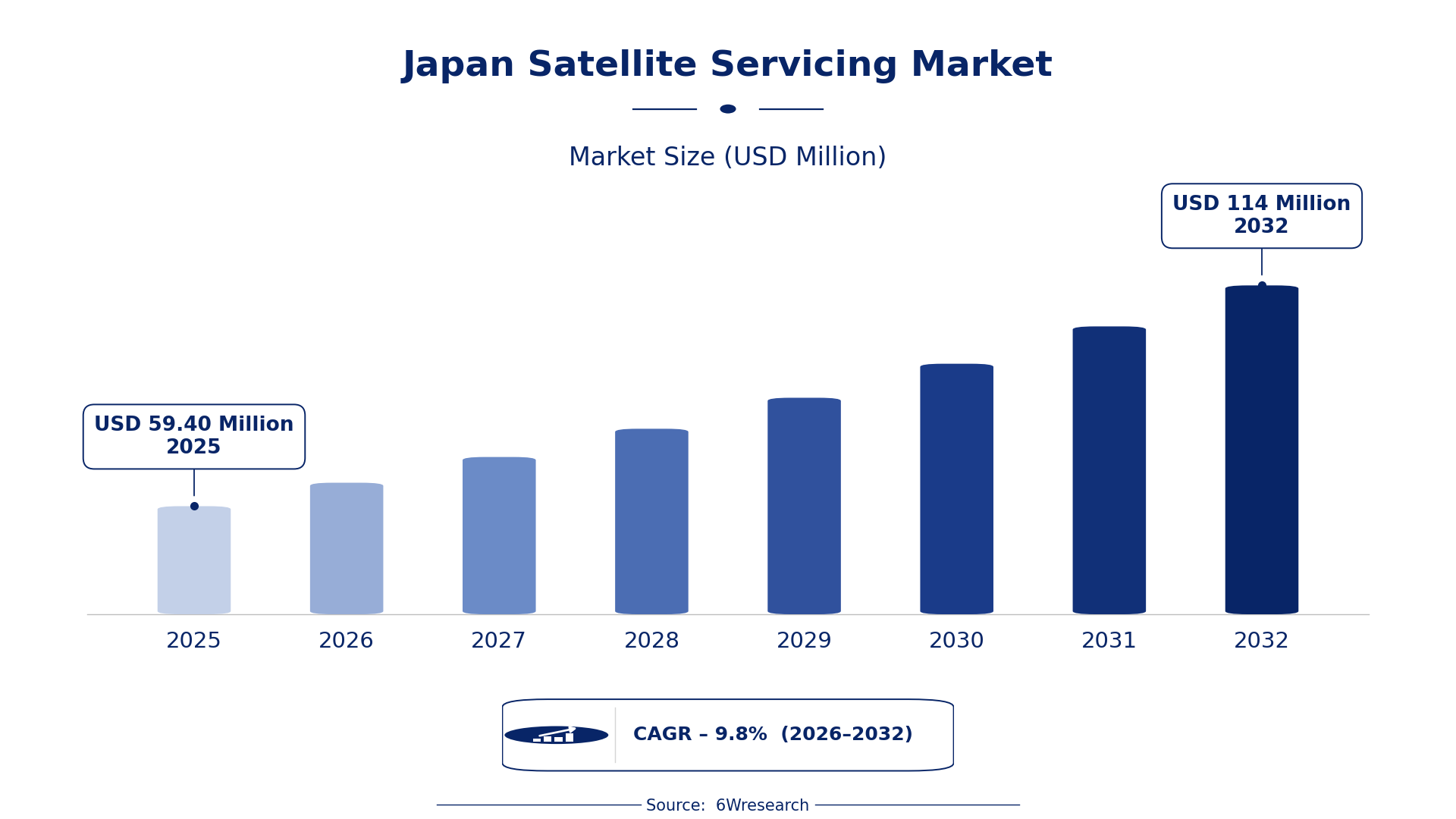
According to 6Wresearch internal database and industry insights, the Japan Satellite Servicing Market was valued at USD 59.40 Million in 2025 and is projected to reach USD 114 Million by 2032, growing at a CAGR of approximately 9.8% during 2026–2032.
Japan Satellite Servicing Market Highlights
| Report Metric | Details |
| Report Name | Japan Satellite Servicing Market (2026-2032) |
| Market Size 2025 | USD 59.40 Million |
| Market Size 2032 | USD 114 Million |
| Absolute Growth 2025–2032 | USD 54.60 Million |
| CAGR 2026–2032 | 9.8% |
| Peak Annual Growth | 11.5% in 2028 |
| Forecast Period | 2026–2032 |
| Historical Data | 2022–2025 |
| Base Year | 2025 |
| Leading Service Type, 2025 | Refueling (42% share) |
| Leading Operation Type, 2025 | Robotic (32% share) |
| Leading Orbit Type, 2025 | GEO (50% share) |
| Leading End User, 2025 | Commercial Satellite Owners (46% share) |
| Fastest-Growing Service Type | Repair & Maintenance (13.3% CAGR) |
| Fastest-Growing Operation Type | Autonomous/Manual (14.1% CAGR) |
| Fastest-Growing Orbit Type | LEO (13.7% CAGR) |
| Fastest-Growing End User | Government Satellites (12.6% CAGR) |
| Growing Sector | satellite servicing |
| Key End Users | Commercial Satellite Owners, Government Satellites, Space Agencies, Space Debris Control |
Japan Satellite Servicing Market Year-wise Growth Rate and Key Drivers (2022–2032)
This graph illustrates the annual growth rates of the market from 2022 to 2032, highlighting a steady upward trajectory and projected market expansion over the forecast period.
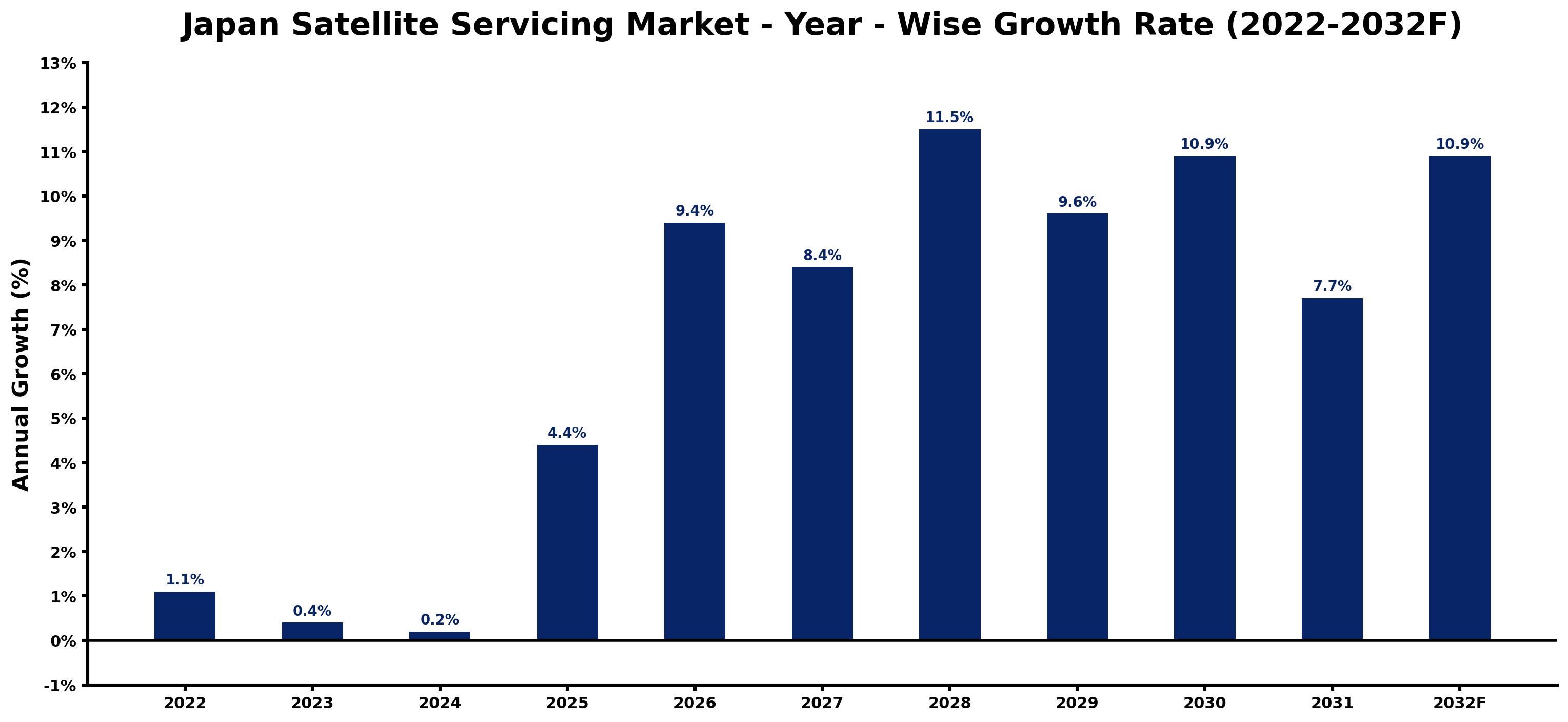
Year by year, the estimates below pair each growth rate with the development that shaped it.
| Year | Estimated Annual Growth (%) | Market Rationale |
| 2022 | 1.1 | The market showed moderate growth, reflecting ongoing satellite servicing initiatives. |
| 2023 | 0.4 | Growth slowed due to a temporary reduction in satellite launches and servicing projects. |
| 2024 | 0.2 | The market continued to experience a slowdown amid limited investments in new technologies. |
| 2025 | 4.4 | Growth accelerated as satellite servicing projects gained momentum and funding increased. |
| 2026 | 9.4 | Demand surged due to substantial investments in satellite servicing technologies and capabilities. |
| 2027 | 8.4 | Growth slowed slightly as the market adjusted to increased capacity and competition. |
| 2028 | 11.5 | A peak in growth occurred with the launch of new servicing missions and technologies. |
| 2029 | 9.6 | Growth decelerated as the market stabilised and matured with established players. |
| 2030 | 10.9 | Demand increased again as new satellite servicing contracts were awarded and executed. |
| 2031 | 7.7 | The market experienced a slowdown as projects reached completion and demand normalised. |
| 2032 | 10.9 | Growth accelerated again with new initiatives aimed at reducing space debris and improving satellite capabilities. |
Note: Market size estimations and growth projections presented in this report are based on 6Wresearch's proprietary forecasting methodology, utilizing the latest available industry data, government publications, and primary research inputs.
Japan Satellite Servicing Market Synopsis
Satellite servicing encompasses technologies for maintaining and operating satellites in orbit, including refueling, repairs, and upgrades. The Japan Satellite Servicing Market is expanding, driven by increasing satellite launches and a national strategy supporting space exploration. In 2023, the government allocated ¥10 billion for space debris mitigation, highlighting the growing demand from both domestic and international satellite operators for servicing solutions.
Market Dynamics Impact Analysis (2026–2032)
| Factor | Type | Impact | Primary Segment Affected |
| Increasing satellite launches drive demand for servicing technologies. | Driver | High | Refueling |
| Growing focus on space debris management creates opportunities for servicing. | Driver | High | De-Orbiting |
| Rising need for operational efficiency in satellite operations presents opportunities. | Opportunity | High | Repair & Maintenance |
| The upcoming commercial satellite servicing mission in 2025 opens new markets. | Opportunity | Medium | Upgrading |
| Limited investment in advanced servicing technologies constrains growth. | Restraint | High | Repair & Maintenance |
| Regulatory hurdles in satellite servicing projects can delay initiatives. | Restraint | Medium | De-Orbiting |
| High development costs for servicing technologies pose challenges for new entrants. | Challenge | High | Robotic |
| Competition among domestic and international players increases market pressure. | Challenge | Medium | Any Orbit |
Evaluation of Drivers in Japan Satellite Servicing Market (2026–2032)
The table below links each growth driver to the segment it affects and the evidence for it.
| Drivers | Primary Segment Affected | Why It Matters (Evidence) |
| Increasing satellite launches drive demand for refueling services. | Refueling | In 2022, Japan saw a rise in satellite launches, leading to greater need for refueling to extend satellite life. |
| Focus on space debris management boosts demand for de-orbiting services. | De-Orbiting | The Japanese government aims to reduce space debris by 50% by 2030, driving demand for de-orbiting solutions. |
| Operational efficiency needs fuel demand for repair and maintenance services. | Repair & Maintenance | The complexity of satellite systems necessitates regular maintenance for optimal performance. |
| Technological advancements in robotics improve servicing capabilities. | Robotic | Collaborative projects with space agencies increase the demand for servicing across various orbits. |
| Growing emphasis on sustainability enhances demand for de-orbiting services. | De-Orbiting | The Japanese government has committed to reducing space debris, creating a market for de-orbiting technologies. |
What keeps demand rising is the increasing number of satellite launches, with Japan's space population reaching approximately 126 million. The complexity of satellite systems drives demand for repair and maintenance services, with advancements in robotics improving servicing capabilities.
Evaluation of Restraints in Japan Satellite Servicing Market
The table below lists the restraints and the evidence behind each.
| Market Restraint | Primary Segment Affected | Why It Matters (Evidence) |
| High development costs for advanced servicing technologies limit market entry. | Robotic | The initial investment for robotic servicing systems is substantial, deterring new players from entering the market. |
| Regulatory hurdles can delay satellite servicing projects. | De-Orbiting | Compliance with safety regulations can slow down the implementation of de-orbiting initiatives. |
| Limited funding for research and development constrains innovation. | Repair & Maintenance | Insufficient investment in R&D hampers the development of new servicing technologies. |
| Market competition increases pressure on pricing and profitability. | Any Orbit | Intense competition among domestic and international players can lead to reduced profit margins. |
| Lack of standardisation in servicing practices can create inefficiencies. | Upgrading | Variability in servicing standards complicates operations and may lead to increased costs. |
Japan Satellite Servicing Market Challenges
Outdated technology in Japan's satellite servicing sector limits repair and upgrade efficiency, causing delays of up to six months for satellite operators. Supply chain disruptions arise from reliance on foreign components, leading to increased costs of approximately 20% and extended lead times for domestic manufacturers. A shortage of skilled workers in advanced robotics restricts the development of practical solutions, which affects the competitiveness of local firms. Competition intensifies as international players invest heavily in servicing capabilities, making it challenging for Japanese providers to maintain their market share.
Trends in the Japan Satellite Servicing Market
Buyers and suppliers in the Japan Satellite Servicing Market are adjusting to the following trends.
- Shift towards Autonomous Satellite Servicing: In 2022, Japan launched a satellite servicing demonstration mission, showcasing advancements in autonomous technologies. This shift is projected to streamline servicing operations, reducing costs and improving efficiency.
- Increase in International Collaborations: The Japan Space Forum promotes collaboration in satellite servicing technologies, encouraging partnerships with international agencies. This trend is evidenced by multiple joint projects, expanding the market's reach.
- Growing Focus on Space Debris Mitigation: The Japanese government aims to reduce space debris by 50% by 2030, prompting increased investment in de-orbiting technologies. This focus on sustainability is reshaping servicing practices.
- Rising Demand from Commercial Satellite Owners: Commercial Satellite Owners accounted for 46% of the market in 2025, driving demand for servicing solutions. This buyer group is increasingly seeking partnerships to improve satellite capabilities.
Investment Opportunities in the Japan Satellite Servicing Market
The openings below show where demand in the Japan Satellite Servicing Market is visible and how suppliers can enter.
- Current Investment in Space Technologies: With Japan's space budget for 2023 at approximately ¥400 billion, there is an opportunity for servicing providers to engage with government projects and initiatives.
- Growing Need for Space Debris Solutions: The upcoming commercial satellite servicing mission in 2025 presents an opportunity for companies to supply de-orbiting technologies, addressing the urgent need for space debris management.
- Demand for Advanced Robotics in Servicing: With the Space Robotics Challenge encouraging innovation, there is a need for suppliers of advanced robotic systems to meet the growing demand for servicing technologies.
- Expansion of the LEO Market: The increasing number of satellites in Low Earth Orbit (LEO) creates a gap for servicing providers to offer tailored solutions, with a projected growth rate of 13.7%.
Government Initiatives in the Japan Satellite Servicing Market
The Electrical Appliance and Material Safety Act (1961) regulates the safety of electrical appliances and materials, impacting satellite servicing technologies. This law ensures that all servicing equipment meets safety standards, protecting both operators and users. The New Robot Strategy (2015) encourages the use of robots in various sectors, facilitating advancements in satellite servicing technologies.
The National Institute of Space and Aeronautics (NISA) oversees satellite servicing regulations and ensures compliance with safety standards. In 2023, the agency approved several projects aimed at improving satellite servicing capabilities, focusing on sustainability and innovation.
Future Insight of the Japan Satellite Servicing Market
The upcoming satellite servicing demonstration mission will showcase new robotic technologies that streamline operations. By 2032, advancements in automation will enhance servicing processes, providing buyers with reduced downtime. The government's ¥400 billion space budget for 2023 will facilitate collaboration among suppliers, improving service offerings. New standards such as ISO 24113:2019 will establish best practices, ensuring Japan remains at the forefront of satellite servicing.
Market Segmentation Analysis
Japan Satellite Servicing Market report covers a detailed analysis of the following market segments:
By Service Type – Refueling Leads, Repair & Maintenance Expected to Grow Fastest
According to Saurav Kr Singh, Senior Research Analyst at 6Wresearch, with 42% of service type revenue in 2025, Refueling was the largest category. Refueling holds the largest share as it is essential for extending the operational life of satellites, a key focus for commercial satellite operators. The increasing number of satellite launches in Japan underscores the critical need for refueling services to maintain satellite functionality. Over 2026–2032, Repair & Maintenance is expected to post the fastest growth, at a CAGR of 13.3%. Repair & Maintenance is experiencing rapid growth due to its critical role in ensuring operational efficiency for satellites, particularly as the demand for reliable satellite operations rises. The advancements discussed at the 2023 Space Innovation Conference are expected to further propel this segment's growth. Suppliers should prioritise developing repair and maintenance solutions to address the increasing needs of satellite operators.
By Operation Type – Robotic Leads, Autonomous/Manual Expected to Grow Fastest
Robotic took 32% of operation type revenue in 2025, more than any other category. Robotic systems lead the market as they are extensively used for precision tasks in satellite servicing, appealing to a broad range of clients. The focus on robotic technologies at institutions like the Space Robotics Laboratory at Tohoku University highlights their importance in servicing applications. Autonomous/Manual is set to record the highest CAGR in this split, 14.1% over 2026–2032. The Autonomous/Manual operation type is rapidly growing due to its application in specific missions, offering flexibility in servicing tasks. The upcoming first commercial satellite servicing mission in 2025 is likely to increase the adoption of these operational methods. Buyers should consider integrating autonomous solutions to enhance servicing efficiency and reduce operational costs.
By Orbit Type – GEO Leads, LEO Expected to Grow Fastest
The largest orbit type category in 2025 was GEO, at 50% of revenue. GEO is the leading orbit type as most satellites operate in this region, making it a primary focus for servicing efforts. With Japan's national strategy for space exploration prioritising GEO satellites, this segment is well-supported. The quickest growth will come from LEO, forecast to expand at a CAGR of 13.7% between 2026 and 2032. LEO is the fastest-growing orbit type, driven by the increasing number of satellites being launched in this orbit. The Japanese government's aim to reduce space debris by 50% by 2030 highlights the urgency of servicing LEO satellites. Suppliers should invest in technologies tailored for LEO servicing to capitalise on this growth opportunity.
By End User – Commercial Satellite Owners Lead, Government Satellites Expected to Grow Fastest
In 2025, Commercial Satellite Owners led the end user split with a 46% share. Commercial Satellite Owners constitute the largest user group for satellite servicing, as they actively seek solutions to extend the life of their assets. The support from the Japan Satellite Industry Association ensures a strong market presence for servicing among these owners. Government Satellites are projected to grow fastest, at a CAGR of 12.6% during 2026–2032. Government Satellites represent the fastest-growing end user segment, driven by a significant demand for servicing to improve operational capabilities. The Ministry of Education, Culture, Sports, Science and Technology's support for satellite servicing research highlights the urgency of this trend. Suppliers must tailor their offerings to meet the specific needs of government clients to capitalise on this growing segment.
Key Attractiveness of the Report
- 10 Years of Market Numbers
- Historical Data Starting from 2022 to 2025
- Base Year 2025
- Forecast Data until 2032
- Key Performance Indicators Impacting the Market
- Major Upcoming Developments and Projects
Key Highlights of the Report:
- Japan Satellite Servicing Market Outlook
- Market Size of Japan Satellite Servicing Market, 2025
- Forecast of Japan Satellite Servicing Market, 2032
- Historical Data and Forecast of Japan Satellite Servicing Revenues & Volume for the Period 2022-2032F
- Japan Satellite Servicing Market Trend Evolution
- Japan Satellite Servicing Market Drivers and Challenges
- Japan Satellite Servicing Price Trends
- Japan Satellite Servicing Porter's Five Forces
- Japan Satellite Servicing Industry Life Cycle
- Historical Data and Forecast of Japan Satellite Servicing Market Revenues & Volume By Service Type for the Period 2022-2032F
- Historical Data and Forecast of Japan Satellite Servicing Market Revenues & Volume By Refueling for the Period 2022-2032F
- Historical Data and Forecast of Japan Satellite Servicing Market Revenues & Volume By Repair & Maintenance for the Period 2022-2032F
- Historical Data and Forecast of Japan Satellite Servicing Market Revenues & Volume By De-Orbiting for the Period 2022-2032F
- Historical Data and Forecast of Japan Satellite Servicing Market Revenues & Volume By Upgrading for the Period 2022-2032F
- Historical Data and Forecast of Japan Satellite Servicing Market Revenues & Volume By Operation Type for the Period 2022-2032F
- Historical Data and Forecast of Japan Satellite Servicing Market Revenues & Volume By Robotic for the Period 2022-2032F
- Historical Data and Forecast of Japan Satellite Servicing Market Revenues & Volume By Autonomous/Manual for the Period 2022-2032F
- Historical Data and Forecast of Japan Satellite Servicing Market Revenues & Volume By Tethered Tug Systems for the Period 2022-2032F
- Historical Data and Forecast of Japan Satellite Servicing Market Revenues & Volume By Modular Component for the Period 2022-2032F
- Historical Data and Forecast of Japan Satellite Servicing Market Revenues & Volume By Orbit Type for the Period 2022-2032F
- Historical Data and Forecast of Japan Satellite Servicing Market Revenues & Volume By GEO for the Period 2022-2032F
- Historical Data and Forecast of Japan Satellite Servicing Market Revenues & Volume By LEO for the Period 2022-2032F
- Historical Data and Forecast of Japan Satellite Servicing Market Revenues & Volume By MEO for the Period 2022-2032F
- Historical Data and Forecast of Japan Satellite Servicing Market Revenues & Volume By Any Orbit for the Period 2022-2032F
- Historical Data and Forecast of Japan Satellite Servicing Market Revenues & Volume By End User for the Period 2022-2032F
- Historical Data and Forecast of Japan Satellite Servicing Market Revenues & Volume By Commercial Satellite Owners for the Period 2022-2032F
- Historical Data and Forecast of Japan Satellite Servicing Market Revenues & Volume By Government Satellites for the Period 2022-2032F
- Historical Data and Forecast of Japan Satellite Servicing Market Revenues & Volume By Space Debris Control for the Period 2022-2032F
- Historical Data and Forecast of Japan Satellite Servicing Market Revenues & Volume By Space Agencies for the Period 2022-2032F
- Japan Satellite Servicing Import Export Trade Statistics
- Market Opportunity Assessment By Service Type
- Market Opportunity Assessment By Operation Type
- Market Opportunity Assessment By Orbit Type
- Market Opportunity Assessment By End User
- Japan Satellite Servicing Top Companies Market Share
- Japan Satellite Servicing Competitive Benchmarking By Technical and Operational Parameters
- Japan Satellite Servicing Company Profiles
- Japan Satellite Servicing Key Strategic Recommendations
Market Covered
The study includes the following segmentation.
By Service Type
- Refueling
- Repair & Maintenance
- De-Orbiting
- Upgrading
By Operation Type
- Robotic
- Autonomous/Manual
- Tethered Tug Systems
- Modular Component
By Orbit Type
- GEO
- LEO
- MEO
- Any Orbit
By End User
- Commercial Satellite Owners
- Government Satellites
- Space Debris Control
- Space Agencies






































