Japan Satellite Signal Protection Systems Market Size & Growth Rate
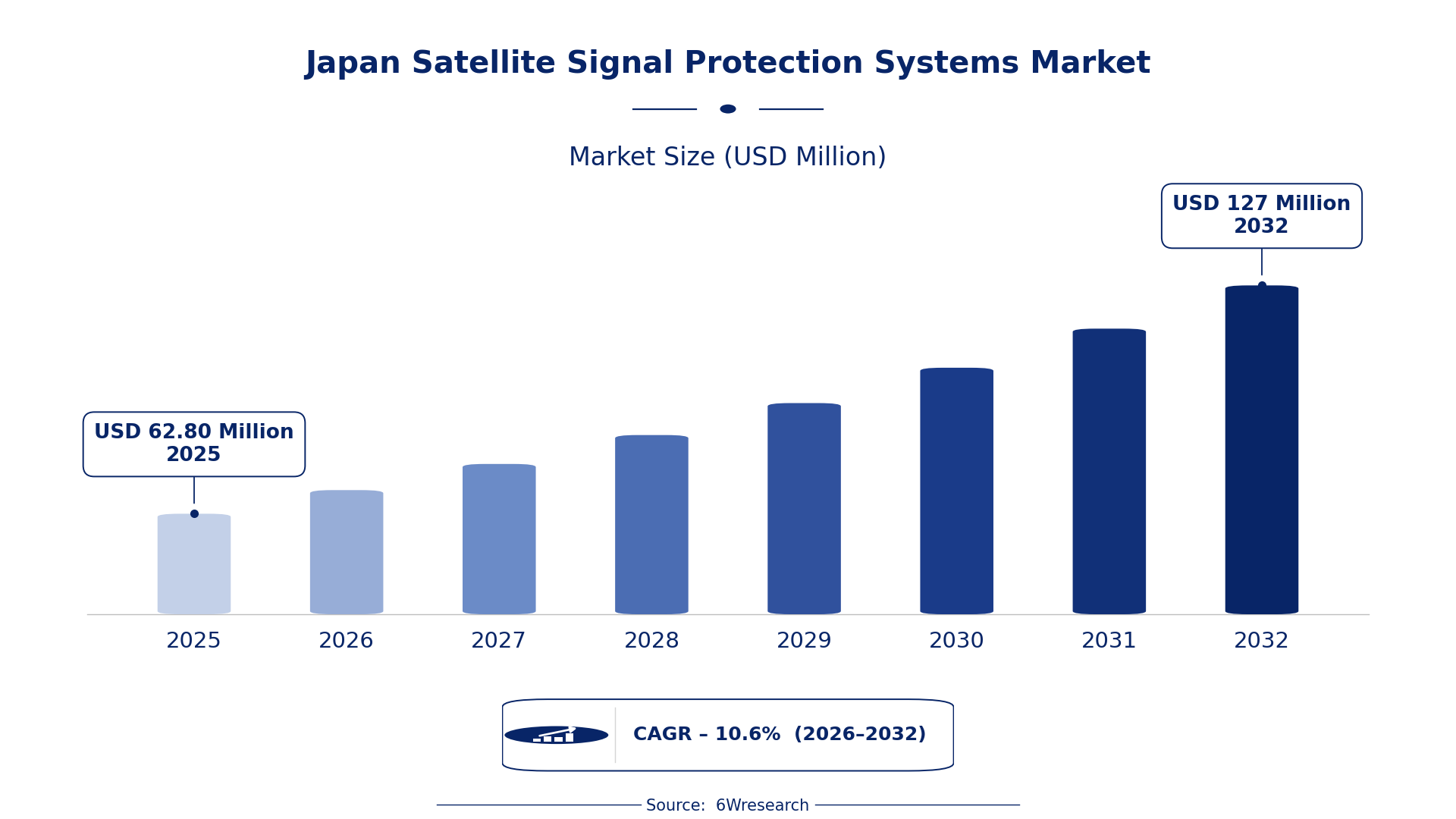
According to 6Wresearch internal database and industry insights, the Japan Satellite Signal Protection Systems Market was valued at USD 62.80 Million in 2025 and is projected to reach USD 127 Million by 2032, growing at a CAGR of approximately 10.6% during 2026–2032.
Japan Satellite Signal Protection Systems Market Highlights
| Report Metric | Details |
| Report Name | Japan Satellite Signal Protection Systems Market (2026-2032) |
| Market Size 2025 | USD 62.80 Million |
| Market Size 2032 | USD 127 Million |
| Absolute Growth 2025–2032 | USD 64.20 Million |
| CAGR 2026–2032 | 10.6% |
| Peak Annual Growth | 11.5% in 2032 |
| Forecast Period | 2026–2032 |
| Historical Data | 2022–2025 |
| Base Year | 2025 |
| Leading Protection Type, 2025 | Anti-Jamming Systems (36% share) |
| Leading Threat Type, 2025 | Cyber Threat (48% share) |
| Leading Technology Used, 2025 | AI-Powered Detection (46% share) |
| Leading End User, 2025 | Defense Satellites (37% share) |
| Fastest-Growing Protection Type | Signal Encryption (14.9% CAGR) |
| Fastest-Growing Technology Used | Cryptographic Chips (15.6% CAGR) |
| Fastest-Growing End User | Commercial ISPs (13.7% CAGR) |
| Growing Sector | Defense and Aerospace |
| Key End Users | Defense Agencies, Commercial ISPs, Intelligence Agencies, Aerospace Manufacturers |
Japan Satellite Signal Protection Systems Market Year-wise Growth Rate and Key Drivers (2022–2032)
This graph illustrates the annual growth rates of the market from 2022 to 2032, highlighting a steady upward trajectory and projected market expansion over the forecast period.
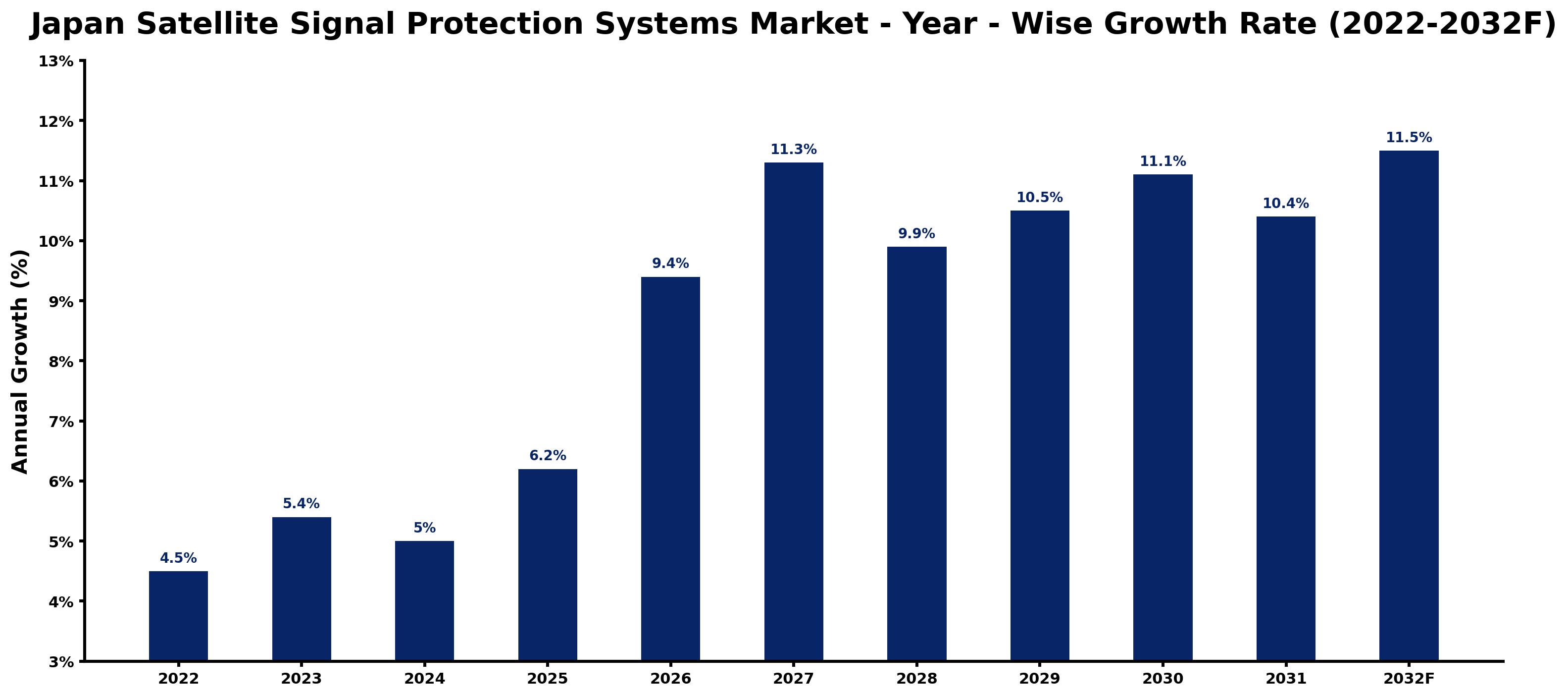
The yearly estimates that follow link every growth rate to its principal driver, so readers can see why the pace changed in each period.
| Year | Estimated Annual Growth (%) | Market Rationale |
| 2022 | 4.5 | The market showed steady growth, supported by increasing satellite deployments. |
| 2023 | 5.4 | Demand rose as the Ministry of Defense allocated funding for security improvements. |
| 2024 | 5.0 | Growth slowed slightly as the market adjusted to new technological standards. |
| 2025 | 6.2 | The market experienced a peak in growth due to heightened security concerns. |
| 2026 | 9.4 | Demand is expected to increase as military and commercial sectors invest in advanced systems. |
| 2027 | 11.3 | Growth is projected to accelerate with the rising importance of cybersecurity in satellite operations. |
| 2028 | 9.9 | The market will see a slight slowdown as technology adoption stabilises. |
| 2029 | 10.5 | Demand is expected to surge as new threats emerge, prompting increased investment in protection systems. |
| 2030 | 11.1 | Growth will continue as buyers seek to improve their satellite security measures. |
| 2031 | 10.4 | The market is projected to grow at a slower rate as saturation in some segments occurs. |
| 2032 | 11.5 | Demand is expected to peak as the focus on secure communications intensifies across sectors. |
Note: Market size estimations and growth projections presented in this report are based on 6Wresearch's proprietary forecasting methodology, utilizing the latest available industry data, government publications, and primary research inputs.
Japan Satellite Signal Protection Systems Market Synopsis
Satellite Signal Protection Systems are critical technologies that secure satellite communications against threats like jamming and spoofing. These systems play a key role in military communications and commercial satellite services. The Japan Satellite Signal Protection Systems Market is growing due to increased defence spending, the launch of new secure communication satellites, and a heightened focus on cybersecurity. The Ministry of Defense's allocation of ¥10 billion for satellite security in 2023 underscores the strong demand from both domestic and international users.
Market Dynamics Impact Analysis (2026–2032)
| Factor | Type | Impact | Primary Segment Affected |
| Increased defense budgets are driving demand for advanced protection systems. | Driver | High | Anti-Jamming Systems |
| The rise in cyber threats necessitates robust security measures for satellite communications. | Driver | High | Cyber Threat |
| Growing international collaborations in defense are creating new opportunities for suppliers. | Opportunity | High | Commercial ISPs |
| The expansion of satellite services in urban areas presents a significant market gap. | Opportunity | Medium | Signal Encryption |
| High development costs can limit access to advanced protection technologies. | Restraint | High | AI-Powered Detection |
| Compliance with international security standards can be challenging for local producers. | Restraint | Medium | Spoofing Detection |
| Limited domestic expertise in advanced technologies hinders market growth. | Challenge | High | Cryptographic Chips |
| Supply chain disruptions can delay the availability of critical components. | Challenge | Medium | Frequency Hopping |
Evaluation of Drivers in Japan Satellite Signal Protection Systems Market (2026–2032)
Demand rests on the following drivers, each shown with the segment it touches most.
| Drivers | Primary Segment Affected | Why It Matters (Evidence) |
| Increased military spending on satellite security. | Anti-Jamming Systems | Japan's defense budget has risen, with ¥10 billion allocated for satellite security in 2023. |
| Growing cybersecurity threats are prompting investments. | Cyber Threat | The Economic Security Promotion Act supports supply-chain resilience for critical products, leading to increased procurement. |
| Rising demand for secure commercial satellite services. | Signal Encryption | Commercial ISPs are investing in encryption technologies to protect customer data. |
| Technological advancements in AI are improving detection capabilities. | AI-Powered Detection | The adoption of AI technologies is increasing, improving threat identification in satellite systems. |
| International collaborations are expanding market opportunities. | Commercial ISPs | Joint ventures between domestic and international firms are enhancing local production capabilities. |
Several shifts outside the market lift sales. The rise in military spending, with ¥10 billion allocated for satellite security in 2023, has led to increased demand for advanced protection systems. Growing cybersecurity threats are prompting investments in new technologies, while advancements in AI are improving detection capabilities. International collaborations are creating new opportunities for suppliers, as the need for secure communications continues to rise.
Evaluation of Restraints in Japan Satellite Signal Protection Systems Market
Several factors work against faster growth; the main ones are summarised below.
| Market Restraint | Primary Segment Affected | Why It Matters (Evidence) |
| High development costs limit access to advanced technologies. | AI-Powered Detection | Producers face financial barriers, restricting their ability to innovate. |
| Compliance with international security standards poses challenges. | Spoofing Detection | Local producers must navigate complex regulations, increasing operational costs. |
| Limited domestic expertise in advanced technologies hinders growth. | Cryptographic Chips | A shortage of skilled professionals affects the development of new solutions. |
| Supply chain disruptions delay critical component availability. | Frequency Hopping | Global supply chain issues can lead to increased lead times for production. |
| Market saturation in some segments limits growth potential. | Signal Encryption | As competition increases, profit margins may decrease, affecting investment. |
Japan Satellite Signal Protection Systems Market Challenges
Competition from foreign suppliers pressures local producers to reduce prices, which can erode profit margins for manufacturers in Japan. High costs associated with developing advanced technologies, such as cryptographic chips, can reach ¥5 billion annually, straining budgets for smaller companies. Regulatory requirements, including compliance with ISO/IEC 27001, impose additional costs and delays, particularly for new entrants that must invest in certification processes. Buyers face uncertainty as the number of defence satellites is projected to increase to 20 by 2025, creating potential supply shortages if production cannot keep pace with demand.
Trends in the Japan Satellite Signal Protection Systems Market
The trends below show where the Japan Satellite Signal Protection Systems Market is heading.
- Defense Satellites Prioritising Cybersecurity: Defense Satellites are increasingly focusing on cybersecurity measures to protect communications. In 2023, Japan launched a satellite dedicated to secure communications, reflecting this shift and improving operational security.
- Rise in AI-Powered Detection Technologies: AI-Powered Detection technologies are gaining traction in satellite signal protection. The adoption of AI is expected to increase by 15% in the next few years, improving threat identification capabilities.
- Tokyo Emerging as a Satellite Technology Hub: Tokyo is becoming a key region for satellite technology development, with over 50 active satellites requiring protection systems. This concentration encourages innovation and collaboration among stakeholders.
- Shift Towards Signal Encryption in Commercial ISPs: Commercial ISPs are increasingly investing in Signal Encryption to protect customer data. This trend is driven by the growing need for secure communications, with a projected growth of 14.9% in this segment.
Investment Opportunities in the Japan Satellite Signal Protection Systems Market
Investors looking at the Japan Satellite Signal Protection Systems Market should consider the following areas.
- Commercial ISPs Seeking Advanced Security Solutions: Commercial ISPs are actively pursuing advanced security solutions to protect customer data. With the market expected to reach new heights, suppliers can enter through partnerships.
- Growing Demand for Signal Encryption: The need for Signal Encryption is increasing, driven by security concerns. Suppliers can target commercial sectors to meet this demand as investments rise.
- Defense Sector Investing in Advanced Technologies: The defence sector is ramping up investments in advanced protection technologies, creating opportunities for suppliers. The projected growth of defence satellites to 20 by 2025 highlights this trend.
- Tokyo's Satellite Technology Development: Tokyo is a hub for satellite technology development, with substantial investments in security. Suppliers can enter this market by collaborating with local firms and leveraging regional expertise.
Government Initiatives in the Japan Satellite Signal Protection Systems Market
The Semiconductor and Digital Industry Strategy, introduced in June 2021, improves domestic semiconductor manufacturing security. This law complements the Economic Security Promotion Act of 2022, which supports supply-chain resilience for critical products, ensuring a solid framework for satellite signal protection.
In 2023, the Ministry of Defense allocated ¥10 billion for satellite security, overseen by the Japan Aerospace Exploration Agency. This funding aims to strengthen satellite operations and security measures, ensuring compliance with international standards.
Future Insight of the Japan Satellite Signal Protection Systems Market
Buyers in the defence sector will benefit from improved satellite protection systems by 2032, driven by new technologies and standards. Funding from the Ministry of Defense will support the development of advanced security solutions, while the Japan Aerospace Exploration Agency will ensure these systems are effectively integrated into existing frameworks. Research initiatives from the National Institute of Information and Communications Technology will lead to breakthroughs in signal protection. With Japan launching a new satellite dedicated to secure communications in 2023, suppliers will find opportunities to provide cutting-edge solutions that address emerging security needs.
Market Segmentation Analysis
Japan Satellite Signal Protection Systems Market report covers a detailed analysis of the following market segments:
By Protection Type – Anti-Jamming Systems Lead, Signal Encryption Expected to Grow Fastest
According to Saurav Kr Singh, Senior Research Analyst at 6Wresearch, the largest protection type category in 2025 was Anti-Jamming Systems, at 36% of revenue. Anti-Jamming Systems are crucial for maintaining the reliability of satellite communications, especially in military contexts. The substantial investment from the Ministry of Defense for satellite security highlights the importance of these systems in safeguarding critical operations. The quickest growth will come from Signal Encryption, forecast to expand at a CAGR of 14.9% between 2026 and 2032. Signal Encryption is witnessing rapid growth due to the increasing necessity for secure data transmissions in various applications. The launch of a new satellite dedicated to secure communications in 2023 demonstrates the urgent need for advanced encryption technologies. Suppliers should focus on enhancing encryption capabilities to meet the rising demand for secure communication solutions.
By Threat Type – Cyber Threat Leads and Records the Fastest Growth
Cyber Threat held 48% of the Japan Satellite Signal Protection Systems Market by threat type in 2025. The Cyber Threat segment leads the market as it addresses the growing concerns surrounding satellite operations and the potential risks of cyberattacks. Japan's Cybersecurity Strategy prioritises satellite security, indicating a strong commitment to addressing these vulnerabilities. The same category is also set to grow fastest, at a CAGR of 12.3% during 2026–2032. The Cyber Threat segment is also the fastest growing, highlighting the urgent need for improved security measures against cyberattacks. The projected increase in defense satellites further intensifies the demand for effective cybersecurity solutions. Suppliers must prioritise the development of robust cybersecurity measures to effectively mitigate this escalating threat.
By Technology Used – AI-Powered Detection Leads, Cryptographic Chips Expected to Grow Fastest
In 2025, AI-Powered Detection led the technology used split with a 46% share. AI-Powered Detection leads the market due to its effectiveness in identifying and mitigating threats in real-time. The increasing reliance on AI technologies for threat identification in satellite operations has solidified its position as a market leader. Over 2026–2032, Cryptographic Chips are expected to post the fastest growth, at a CAGR of 15.6%. Cryptographic Chips are experiencing rapid growth as they are fundamental for encryption processes essential for secure communications. The emphasis on protecting customer data among Commercial ISPs is driving this demand. This suggests that suppliers should invest in advanced cryptographic technologies to capture the growing market.
By End User – Defense Satellites Lead, Commercial ISPs Expected to Grow Fastest
With 37% of end user revenue in 2025, Defense Satellites was the largest category. Defense Satellites represent the primary users of protection systems, essential for securing sensitive military communications. The anticipated growth in the number of defense satellites underscores their critical role in the market. Commercial ISPs are set to record the highest CAGR in this split, 13.7% over 2026–2032. Commercial ISPs are rapidly growing as they increasingly require protection systems to secure customer data transmissions. The heightened focus on cybersecurity within the commercial sector is propelling this segment's expansion. This indicates that suppliers should tailor their solutions to meet the specific needs of both defense and commercial sectors.
Key Attractiveness of the Report
- 10 Years of Market Numbers
- Historical Data Starting from 2022 to 2025
- Base Year 2025
- Forecast Data until 2032
- Key Performance Indicators Impacting the Market
- Major Upcoming Developments and Projects
Key Highlights of the Report:
- Japan Satellite Signal Protection Systems Market Outlook
- Market Size of Japan Satellite Signal Protection Systems Market, 2025
- Forecast of Japan Satellite Signal Protection Systems Market, 2032
- Historical Data and Forecast of Japan Satellite Signal Protection Systems Revenues & Volume for the Period 2022-2032F
- Japan Satellite Signal Protection Systems Market Trend Evolution
- Japan Satellite Signal Protection Systems Market Drivers and Challenges
- Japan Satellite Signal Protection Systems Price Trends
- Japan Satellite Signal Protection Systems Porter's Five Forces
- Japan Satellite Signal Protection Systems Industry Life Cycle
- Historical Data and Forecast of Japan Satellite Signal Protection Systems Market Revenues & Volume By Protection Type for the Period 2022-2032F
- Historical Data and Forecast of Japan Satellite Signal Protection Systems Market Revenues & Volume By Anti-Jamming Systems for the Period 2022-2032F
- Historical Data and Forecast of Japan Satellite Signal Protection Systems Market Revenues & Volume By Signal Encryption for the Period 2022-2032F
- Historical Data and Forecast of Japan Satellite Signal Protection Systems Market Revenues & Volume By Redundancy Routing for the Period 2022-2032F
- Historical Data and Forecast of Japan Satellite Signal Protection Systems Market Revenues & Volume By Spoofing Detection for the Period 2022-2032F
- Historical Data and Forecast of Japan Satellite Signal Protection Systems Market Revenues & Volume By Threat Type for the Period 2022-2032F
- Historical Data and Forecast of Japan Satellite Signal Protection Systems Market Revenues & Volume By Interference for the Period 2022-2032F
- Historical Data and Forecast of Japan Satellite Signal Protection Systems Market Revenues & Volume By Cyber Threat for the Period 2022-2032F
- Historical Data and Forecast of Japan Satellite Signal Protection Systems Market Revenues & Volume By Hardware Failures for the Period 2022-2032F
- Historical Data and Forecast of Japan Satellite Signal Protection Systems Market Revenues & Volume By Identity Fraud for the Period 2022-2032F
- Historical Data and Forecast of Japan Satellite Signal Protection Systems Market Revenues & Volume By Technology Used for the Period 2022-2032F
- Historical Data and Forecast of Japan Satellite Signal Protection Systems Market Revenues & Volume By Frequency Hopping for the Period 2022-2032F
- Historical Data and Forecast of Japan Satellite Signal Protection Systems Market Revenues & Volume By Cryptographic Chips for the Period 2022-2032F
- Historical Data and Forecast of Japan Satellite Signal Protection Systems Market Revenues & Volume By Mesh Networking for the Period 2022-2032F
- Historical Data and Forecast of Japan Satellite Signal Protection Systems Market Revenues & Volume By AI-Powered Detection for the Period 2022-2032F
- Historical Data and Forecast of Japan Satellite Signal Protection Systems Market Revenues & Volume By End User for the Period 2022-2032F
- Historical Data and Forecast of Japan Satellite Signal Protection Systems Market Revenues & Volume By Defense Satellites for the Period 2022-2032F
- Historical Data and Forecast of Japan Satellite Signal Protection Systems Market Revenues & Volume By Intelligence Agencies for the Period 2022-2032F
- Historical Data and Forecast of Japan Satellite Signal Protection Systems Market Revenues & Volume By Commercial ISPs for the Period 2022-2032F
- Historical Data and Forecast of Japan Satellite Signal Protection Systems Market Revenues & Volume By Aerospace Navigation Units for the Period 2022-2032F
- Japan Satellite Signal Protection Systems Import Export Trade Statistics
- Market Opportunity Assessment By Protection Type
- Market Opportunity Assessment By Threat Type
- Market Opportunity Assessment By Technology Used
- Market Opportunity Assessment By End User
- Japan Satellite Signal Protection Systems Top Companies Market Share
- Japan Satellite Signal Protection Systems Competitive Benchmarking By Technical and Operational Parameters
- Japan Satellite Signal Protection Systems Company Profiles
- Japan Satellite Signal Protection Systems Key Strategic Recommendations
Market Covered
Coverage by segment is as follows.
By Protection Type
- Anti-Jamming Systems
- Signal Encryption
- Redundancy Routing
- Spoofing Detection
By Threat Type
- Interference
- Cyber Threat
- Hardware Failures
- Identity Fraud
By Technology Used
- Frequency Hopping
- Cryptographic Chips
- Mesh Networking
- AI-Powered Detection
By End User
- Defense Satellites
- Intelligence Agencies
- Commercial ISPs
- Aerospace Navigation Units






































