Japan Satellite Uplink AI Market Size & Growth Rate
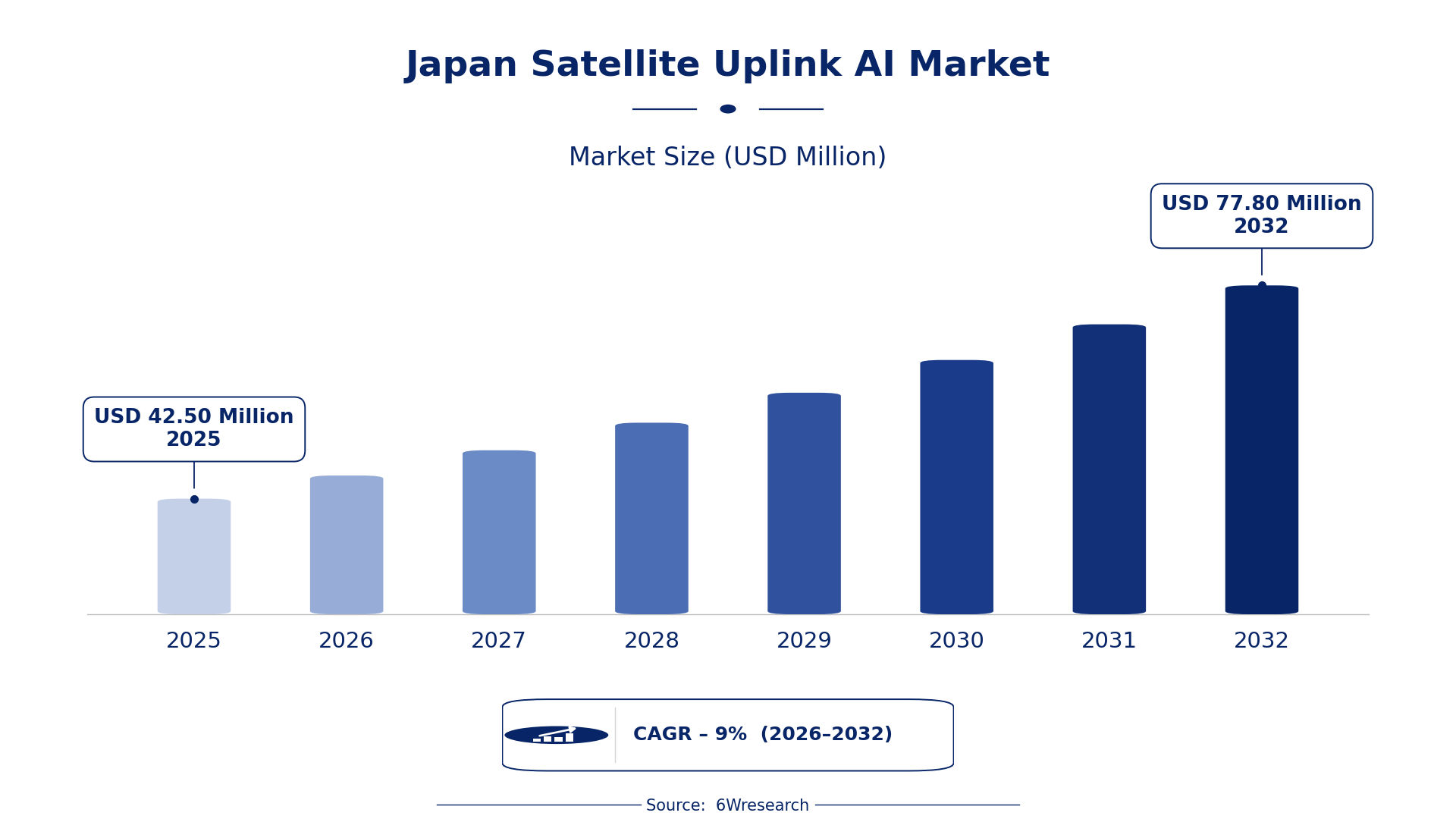
According to 6Wresearch internal database and industry insights, the Japan Satellite Uplink AI Market was valued at USD 42.50 Million in 2025 and is projected to reach USD 77.80 Million by 2032, growing at a CAGR of approximately 9% during 2026–2032.
Japan Satellite Uplink AI Market Highlights
| Report Metric | Details |
| Report Name | Japan Satellite Uplink AI Market (2026-2032) |
| Market Size 2025 | USD 42.50 Million |
| Market Size 2032 | USD 77.80 Million |
| Absolute Growth 2025–2032 | USD 35.30 Million |
| CAGR 2026–2032 | 9% |
| Peak Annual Growth | 9.4% in 2026 |
| Forecast Period | 2026–2032 |
| Historical Data | 2022–2025 |
| Base Year | 2025 |
| Leading AI Function Type, 2025 | Signal Optimization AI (35% share) |
| Leading Application Area, 2025 | Beam Steering (53% share) |
| Leading Integration Type, 2025 | Onboard + Ground (54% share) |
| Leading End User, 2025 | Satellite Operators (38% share) |
| Fastest-Growing AI Function Type | Fault Prediction AI (12.9% CAGR) |
| Fastest-Growing Application Area | Equipment Health (10.5% CAGR) |
| Fastest-Growing Integration Type | Cloud-Based (12.6% CAGR) |
| Fastest-Growing End User | Ground Station Providers (11.3% CAGR) |
| Growing Sector | satellite communication |
| Key End Users | satellite operators, ground station providers, defense systems |
Japan Satellite Uplink AI Market Year-wise Growth Rate and Key Drivers (2022–2032)
This graph illustrates the annual growth rates of the market from 2022 to 2032, highlighting a steady upward trajectory and projected market expansion over the forecast period.
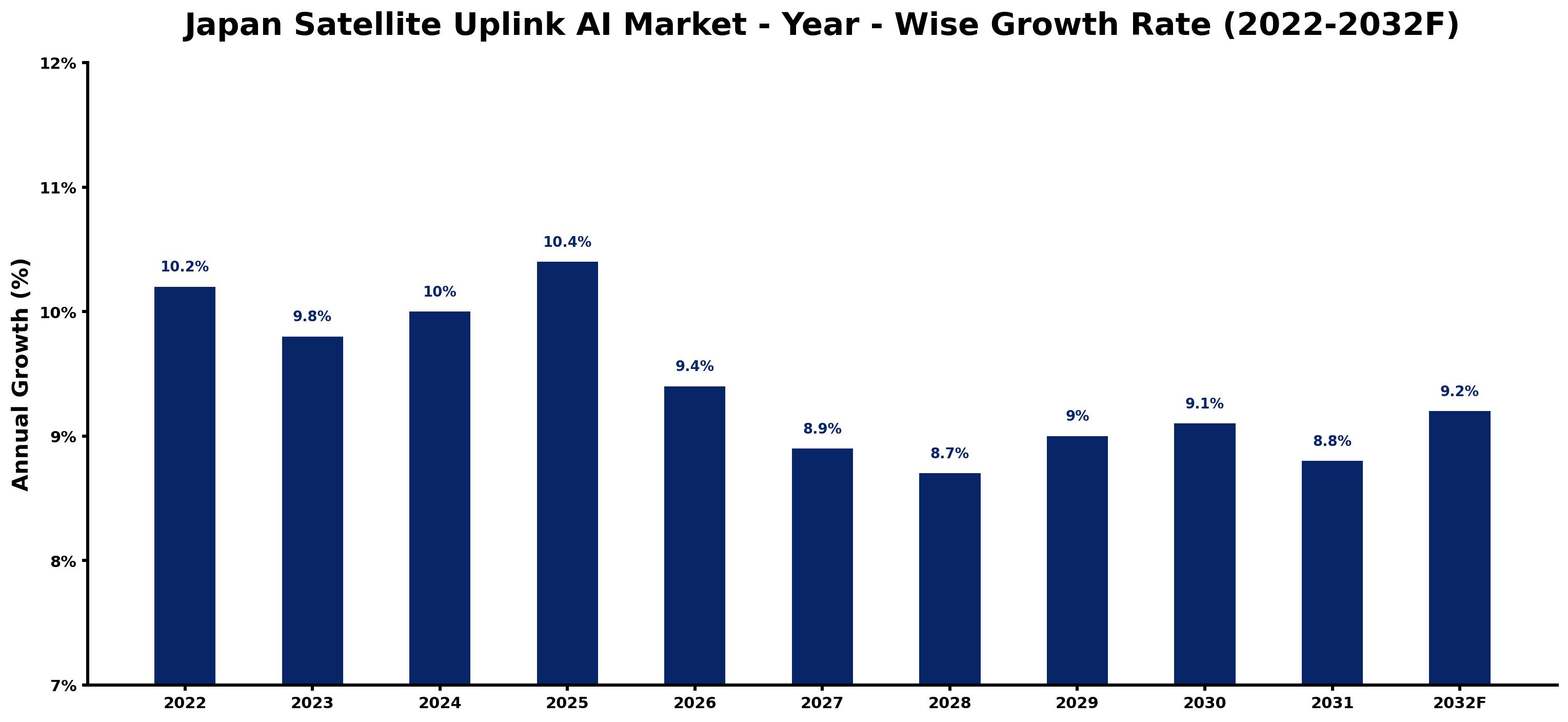
The table below sets out the estimated growth rate for each year and the main factor behind it.
| Year | Estimated Annual Growth (%) | Market Rationale |
| 2022 | 10.2 | The market experienced strong growth due to increased satellite launches and demand for communication services. |
| 2023 | 9.8 | Growth slowed slightly as the market adjusted to previous high levels of activity in satellite deployments. |
| 2024 | 10.0 | Demand rebounded with new satellite projects and advancements in AI technologies enhancing efficiency. |
| 2025 | 10.4 | The market peaked as investments in satellite technology reached new heights, driven by innovation. |
| 2026 | 9.4 | Growth is expected to slow as the market stabilises following the peak in 2025. |
| 2027 | 8.9 | Investment in satellite systems will contribute to a further slowdown in growth as projects mature. |
| 2028 | 8.7 | The market is projected to maintain steady growth as AI applications become more widespread in operations. |
| 2029 | 9.0 | Demand is expected to increase again with new applications in satellite communication emerging from technological advances. |
| 2030 | 9.1 | Growth will continue as advancements in AI further optimise satellite operations and service delivery. |
| 2031 | 8.8 | A slight slowdown is anticipated as the market begins to mature and stabilise after rapid expansion. |
| 2032 | 9.2 | Growth is expected to rise again as new technologies are adopted in satellite operations, enhancing capabilities. |
Note: Market size estimations and growth projections presented in this report are based on 6Wresearch's proprietary forecasting methodology, utilizing the latest available industry data, government publications, and primary research inputs.
Japan Satellite Uplink AI Market Synopsis
Satellite Uplink AI refers to technologies that optimise satellite communication through artificial intelligence algorithms. In Japan, the market is driven by domestic satellite operators and defence systems, supported by a ¥10 billion investment in satellite technology development. The Tokyo region serves as a key hub for communication technology, propelling growth in this sector. By 2032, the Japan Satellite Uplink AI Market will reach USD 77.80 million, reflecting rising demand for efficient satellite services and advanced solutions.
Market Dynamics Impact Analysis (2026–2032)
| Factor | Type | Impact | Primary Segment Affected |
| Growing demand for efficient satellite communication systems | Driver | High | Signal Optimization AI |
| Investment in satellite technology by the defense sector | Driver | High | Bandwidth Allocation AI |
| Emerging technologies in satellite communications | Opportunity | High | Beam Steering |
| Increased reliance on satellite data for various applications | Opportunity | High | Dynamic Routing |
| Regulatory compliance requirements for satellite operations | Restraint | Medium | Spectrum Monitoring |
| High costs associated with advanced satellite technologies | Restraint | Medium | Real-Time Processing |
| Limited availability of skilled professionals in AI and satellite technology | Challenge | High | Cloud-Based |
| Competition from international satellite technology providers | Challenge | High | Edge-Integrated |
Evaluation of Drivers in Japan Satellite Uplink AI Market (2026–2032)
The factors lifting demand, and the evidence behind each, are summarised below.
| Drivers | Primary Segment Affected | Why It Matters (Evidence) |
| Increased investment in satellite technology | Bandwidth Allocation AI | The Japanese government allocated ¥10 billion for satellite technology development, prompting operators to enhance bandwidth management. |
| Growing demand for real-time data processing | Dynamic Routing | With over 50 operational satellites, real-time data routing is essential for efficient satellite operations, driving demand for advanced solutions. |
| Adoption of cloud-based solutions | Cloud-Based | Cloud-based processing technologies are being increasingly adopted, with a projected CAGR of 12.6%, allowing for scalable data management. |
| Need for enhanced signal quality | Signal Optimization AI | The Tokyo region's role as a communication hub necessitates improved signal quality, leading satellite operators to invest in optimization technologies. |
| Focus on defense applications | Fault Prediction AI | Japan's defense sector prioritises AI for fault prediction, ensuring operational readiness and minimising downtime in critical satellite systems. |
Orders keep climbing as satellite operators increasingly adopt AI technologies to improve communication efficiency. In 2023, Japan's defense sector allocated ¥5 billion for satellite systems, driving demand for bandwidth allocation solutions. The Tokyo region is a hub for satellite communication technology, stimulating innovation and investment. With over 50 operational satellites, the need for signal optimisation is critical, resulting in heightened interest in AI applications. The integration of dynamic routing technologies is essential for real-time data processing, ensuring optimal performance in satellite communications.
Evaluation of Restraints in Japan Satellite Uplink AI Market
Below are the constraints most often cited by buyers and suppliers, with the segment each affects.
| Market Restraint | Primary Segment Affected | Why It Matters (Evidence) |
| High costs associated with outdated technology | Satellite Operators | Producers face operational costs exceeding ¥2 billion annually due to reliance on legacy systems, limiting budget for new technologies. |
| Regulatory compliance challenges | Ground Station Providers | The Ministry of Internal Affairs and Communications enforces strict regulations, with potential fines over ¥1 million for non-compliance, straining operational budgets. |
| Supply chain disruptions for components | Satellite ISPs | Interruptions in the supply chain for essential components can delay satellite launches, impacting service delivery timelines for ISPs. |
| Integration delays of advanced AI technologies | Defense Satellite Systems | Distributors experience integration delays of up to six months, hindering timely deployment of AI solutions in defense applications. |
| Limited access to skilled workforce | Equipment Health | A shortage of skilled professionals in AI technologies can impede the development and maintenance of advanced satellite systems. |
Japan Satellite Uplink AI Market Challenges
High operational costs burden producers due to reliance on outdated technology, which can inflate expenses by approximately ¥2 billion annually. Distributors encounter challenges in adopting advanced AI technologies, with integration delays reaching six months, hindering project timelines for satellite communications. Regulatory requirements enforced by the Ministry of Internal Affairs and Communications complicate compliance, with potential fines exceeding ¥1 million for non-compliance, straining budgets for satellite initiatives. Supply chain interruptions for essential components can postpone satellite launches, affecting schedules for both governmental and private operators, resulting in lost revenue opportunities.
Trends in the Japan Satellite Uplink AI Market
These developments are changing demand patterns in the Japan Satellite Uplink AI Market.
- Shift towards Cloud-Based Solutions: In 2023, cloud-based solutions for satellite data processing gained traction, with an increase in adoption rates to 30%. This shift results from the need for scalable and efficient data management, allowing satellite operators to improve service delivery.
- Emergence of Real-Time Processing Technologies: Since 2022, real-time processing technologies have become essential for defence applications, enabling immediate data analysis. The integration of these technologies is critical for improving operational capabilities in national security, with a 25% increase in adoption.
- Development of Beam Steering Technologies: Beginning in 2023, Japan has focused on developing beam steering technologies for next-generation satellites. This advancement aims to improve signal directionality, enhancing coverage and communication efficiency across various applications, with a projected growth rate of 15%.
- Increased Investment in Satellite Technology Development: In 2023, Japan invested ¥10 billion in satellite technology development, reflecting a commitment to advancing communication capabilities. This investment supports the growth of innovative solutions in the satellite uplink AI market.
Investment Opportunities in the Japan Satellite Uplink AI Market
Several openings in the Japan Satellite Uplink AI Market merit attention from investors.
- Tokyo as a Hub for Satellite Innovation: Tokyo's status as a communication technology hub presents opportunities for investment in satellite uplink AI solutions. With a growing market, suppliers can enter through partnerships with local operators, targeting a market projected to grow by 12%.
- Investment in Advanced Satellite Technologies: The ¥10 billion investment in satellite technology development highlights the potential for suppliers of advanced AI solutions. Engaging with satellite operators can lead to fruitful collaborations, especially as demand for new technologies rises.
- Growing Demand for Efficient Satellite Services: With Japan's population of approximately 125 million, the demand for efficient satellite services is increasing. Suppliers can target satellite ISPs to meet this growing need, as the market is expected to grow by 10%.
- Expansion of Ground Station Infrastructure: The installed base of around 300 ground stations in Japan indicates a need for upgraded AI solutions. Collaborating with ground station providers can facilitate market entry, as demand for modernisation increases.
Government Initiatives in the Japan Satellite Uplink AI Market
The Clinical Trials Act, established in 2017, introduced new standards for satellite technology testing and compliance, strengthening the regulatory framework for satellite operators. This law complements existing regulations by ensuring that satellite systems meet stringent performance and safety criteria, thereby promoting industry growth through enhanced compliance measures and oversight.
The Japan Aerospace Exploration Agency (JAXA) plays a vital role in promoting satellite technology advancements. By funding research and development projects, JAXA supports satellite operators in implementing innovative AI solutions, helping them comply with national standards and ensuring the effective use of allocated budgets.
Future Insight of the Japan Satellite Uplink AI Market
Domestic satellite operators will increasingly embrace advanced technologies by 2032, improving data processing and communication efficiency. The Japan Aerospace Exploration Agency will spearhead developments in signal transmission optimisation, bolstering reliability across various applications. By 2025, new standards for satellite communication will be implemented, encouraging industry innovation. With an annual budget of ¥5 billion for satellite communications research, investments will foster the creation of next-generation technologies, positioning Japan as a frontrunner in satellite uplink AI.
Market Segmentation Analysis
Japan Satellite Uplink AI Market report covers a detailed analysis of the following market segments:
By AI Function Type – Signal Optimization AI Leads, Fault Prediction AI Expected to Grow Fastest
According to Saurav Kr Singh, Senior Research Analyst at 6Wresearch, with 35% of ai function type revenue in 2025, Signal Optimization AI was the largest category. Signal Optimization holds the largest share as it directly improves signal quality and transmission efficiency for satellite operators. This is particularly important given Japan's operational satellites, which exceed 50, ensuring optimal communication performance. Over 2026–2032, Fault Prediction AI is expected to post the fastest growth, at a CAGR of 12.9%. Fault Prediction is experiencing rapid growth due to its ability to detect potential failures before they occur, which is vital for maintaining operational continuity in satellite systems. With increasing investments in satellite technology development, this segment is set to expand significantly. Suppliers should focus on enhancing capabilities to meet the growing demand for reliable satellite communication.
By Application Area – Beam Steering Leads, Equipment Health Expected to Grow Fastest
In 2025, Beam Steering led the application area split with a 53% share. Beam Steering leads the market because it enhances signal directionality for better coverage, which is essential for the effective operation of Japan's satellite network. The Tokyo region's status as a hub for satellite communication technology further supports this sub-segment's dominance. The quickest growth will come from Equipment Health, forecast to expand at a CAGR of 10.5% between 2026 and 2032. Equipment Health is growing quickly as it monitors the status of satellite equipment, ensuring operational efficiency and reducing downtime. The increasing complexity of satellite systems necessitates advanced monitoring solutions, driving this segment's rapid expansion. Buyers must invest in advanced monitoring technologies to ensure the reliability of their satellite operations.
By Integration Type – Onboard + Ground Leads, Cloud-Based Expected to Grow Fastest
Onboard + Ground accounted for 54% of the market by integration type in 2025. Onboard + Ground is the leading integration type as it combines processing on both satellite and ground systems, maximising efficiency in satellite operations. This integration is critical for Japan's extensive network of over 300 ground stations, ensuring seamless communication. Cloud-Based is projected to grow fastest, at a CAGR of 12.6% during 2026–2032. Cloud-Based integration is seeing the fastest growth as it leverages cloud computing for data processing, allowing for scalable and flexible solutions. The shift towards cloud solutions is being driven by the need for real-time data processing in the satellite sector. Suppliers should prioritise cloud-based solutions to align with the industry's shift towards more flexible data processing methods.
By End User – Satellite Operators Lead, Ground Station Providers Expected to Grow Fastest
The largest end user category in 2025 was Satellite Operators, at 38% of revenue. Satellite Operators dominate the market as they are the primary users of uplink solutions, relying on these technologies for efficient satellite communication. With both private and governmental entities operating in Japan, the demand from this group remains robust. Ground Station Providers are set to record the highest CAGR in this split, 11.3% over 2026–2032. Ground Station Providers are experiencing the fastest growth as they increasingly rely on technology for efficient ground operations, which are essential for managing satellite communications. The rise in satellite launches and operations creates a pressing need for advanced ground support technologies. Buyers in the ground station sector should seek out innovative solutions to optimise their operations and maintain competitive advantage.
Key Attractiveness of the Report
- 10 Years of Market Numbers
- Historical Data Starting from 2022 to 2025
- Base Year 2025
- Forecast Data until 2032
- Key Performance Indicators Impacting the Market
- Major Upcoming Developments and Projects
Key Highlights of the Report:
- Japan Satellite Uplink AI Market Outlook
- Market Size of Japan Satellite Uplink AI Market, 2025
- Forecast of Japan Satellite Uplink AI Market, 2032
- Historical Data and Forecast of Japan Satellite Uplink AI Revenues & Volume for the Period 2022-2032F
- Japan Satellite Uplink AI Market Trend Evolution
- Japan Satellite Uplink AI Market Drivers and Challenges
- Japan Satellite Uplink AI Price Trends
- Japan Satellite Uplink AI Porter's Five Forces
- Japan Satellite Uplink AI Industry Life Cycle
- Historical Data and Forecast of Japan Satellite Uplink AI Market Revenues & Volume By AI Function Type for the Period 2022-2032F
- Historical Data and Forecast of Japan Satellite Uplink AI Market Revenues & Volume By Signal Optimization AI for the Period 2022-2032F
- Historical Data and Forecast of Japan Satellite Uplink AI Market Revenues & Volume By Fault Prediction AI for the Period 2022-2032F
- Historical Data and Forecast of Japan Satellite Uplink AI Market Revenues & Volume By Bandwidth Allocation AI for the Period 2022-2032F
- Historical Data and Forecast of Japan Satellite Uplink AI Market Revenues & Volume By Interference Detection AI for the Period 2022-2032F
- Historical Data and Forecast of Japan Satellite Uplink AI Market Revenues & Volume By Application Area for the Period 2022-2032F
- Historical Data and Forecast of Japan Satellite Uplink AI Market Revenues & Volume By Beam Steering for the Period 2022-2032F
- Historical Data and Forecast of Japan Satellite Uplink AI Market Revenues & Volume By Equipment Health for the Period 2022-2032F
- Historical Data and Forecast of Japan Satellite Uplink AI Market Revenues & Volume By Dynamic Routing for the Period 2022-2032F
- Historical Data and Forecast of Japan Satellite Uplink AI Market Revenues & Volume By Spectrum Monitoring for the Period 2022-2032F
- Historical Data and Forecast of Japan Satellite Uplink AI Market Revenues & Volume By Integration Type for the Period 2022-2032F
- Historical Data and Forecast of Japan Satellite Uplink AI Market Revenues & Volume By Onboard + Ground for the Period 2022-2032F
- Historical Data and Forecast of Japan Satellite Uplink AI Market Revenues & Volume By Cloud-Based for the Period 2022-2032F
- Historical Data and Forecast of Japan Satellite Uplink AI Market Revenues & Volume By Edge-Integrated for the Period 2022-2032F
- Historical Data and Forecast of Japan Satellite Uplink AI Market Revenues & Volume By Real-Time Processing for the Period 2022-2032F
- Historical Data and Forecast of Japan Satellite Uplink AI Market Revenues & Volume By End User for the Period 2022-2032F
- Historical Data and Forecast of Japan Satellite Uplink AI Market Revenues & Volume By Satellite Operators for the Period 2022-2032F
- Historical Data and Forecast of Japan Satellite Uplink AI Market Revenues & Volume By Ground Station Providers for the Period 2022-2032F
- Historical Data and Forecast of Japan Satellite Uplink AI Market Revenues & Volume By Satellite ISPs for the Period 2022-2032F
- Historical Data and Forecast of Japan Satellite Uplink AI Market Revenues & Volume By Defense Satellite Systems for the Period 2022-2032F
- Japan Satellite Uplink AI Import Export Trade Statistics
- Market Opportunity Assessment By AI Function Type
- Market Opportunity Assessment By Application Area
- Market Opportunity Assessment By Integration Type
- Market Opportunity Assessment By End User
- Japan Satellite Uplink AI Top Companies Market Share
- Japan Satellite Uplink AI Competitive Benchmarking By Technical and Operational Parameters
- Japan Satellite Uplink AI Company Profiles
- Japan Satellite Uplink AI Key Strategic Recommendations
Market Covered
The following segment groups are covered in the report.
By AI Function Type
- Signal Optimization AI
- Fault Prediction AI
- Bandwidth Allocation AI
- Interference Detection AI
By Application Area
- Beam Steering
- Equipment Health
- Dynamic Routing
- Spectrum Monitoring
By Integration Type
- Onboard + Ground
- Cloud-Based
- Edge-Integrated
- Real-Time Processing
By End User
- Satellite Operators
- Ground Station Providers
- Satellite ISPs
- Defense Satellite Systems































