Japan SAW Sensor Market Size & Growth Rate
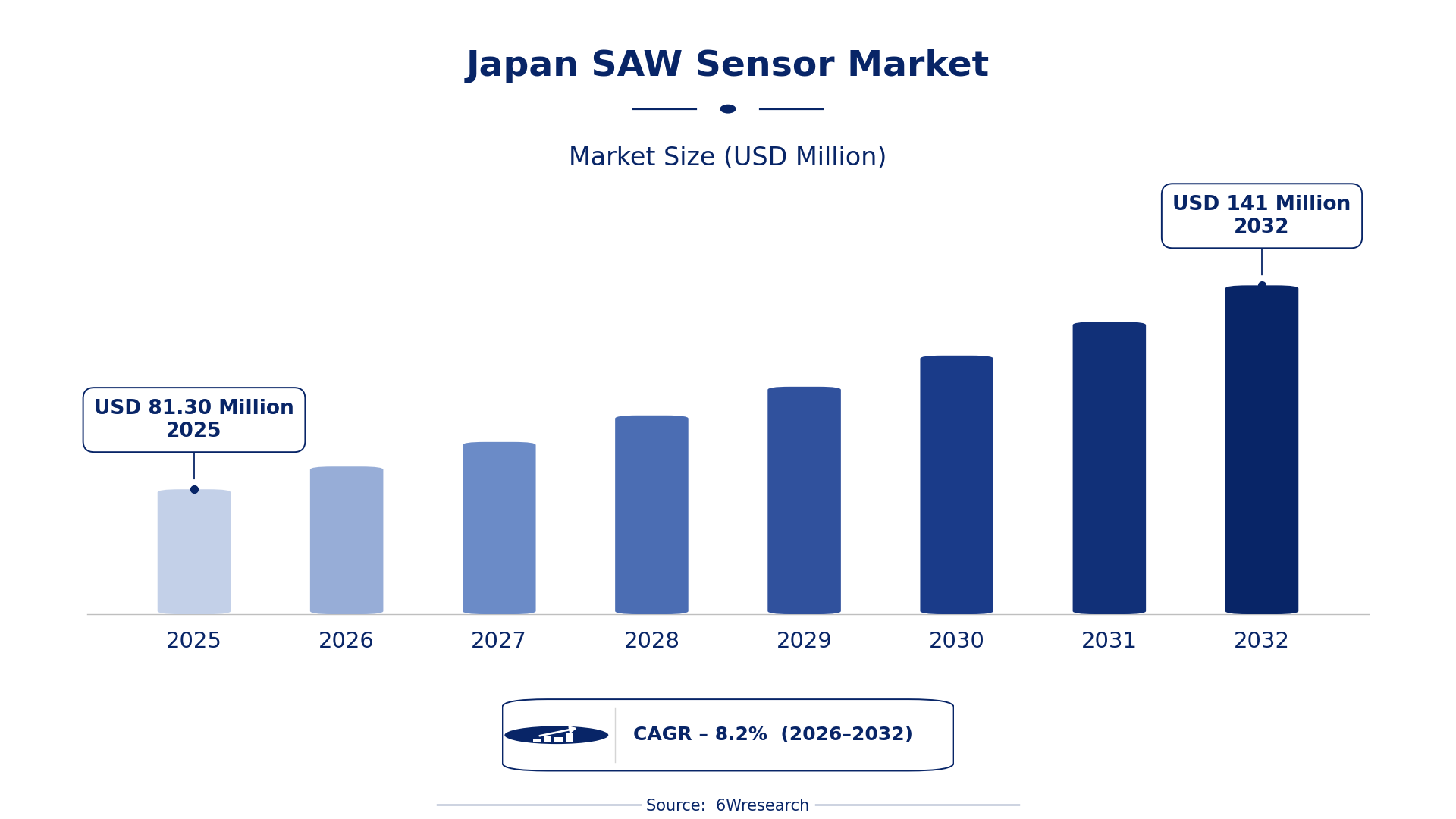
According to 6Wresearch internal database and industry insights, the Japan SAW Sensor Market was valued at USD 81.30 Million in 2025 and is projected to reach USD 141 Million by 2032, growing at a CAGR of approximately 8.2% during 2026–2032.
Japan SAW Sensor Market Highlights
| Report Metric | Details |
| Report Name | Japan SAW Sensor Market (2026-2032) |
| Market Size 2025 | USD 81.30 Million |
| Market Size 2032 | USD 141 Million |
| Absolute Growth 2025–2032 | USD 59.70 Million |
| CAGR 2026–2032 | 8.2% |
| Peak Annual Growth | 10.0% in 2026 |
| Forecast Period | 2026–2032 |
| Historical Data | 2022–2025 |
| Base Year | 2025 |
| Leading Sensor Type, 2025 | Pressure Sensors (44% share) |
| Leading Sensing Parameter, 2025 | Gas/Liquid Pressure (44% share) |
| Leading Packaging Format, 2025 | Chip-On-Board (COB) (46% share) |
| Leading End User, 2025 | Medical Devices (46% share) |
| Fastest-Growing Sensor Type | Gas/Volatile Sensors (11.8% CAGR) |
| Fastest-Growing Sensing Parameter | VOCs/Odor Detection (10.6% CAGR) |
| Fastest-Growing End User | Environmental Monitoring (10.4% CAGR) |
| Growing Sector | Medical Devices |
| Key End Users | Automotive Safety Systems, Medical Devices, Environmental Monitoring, Industrial Automation |
Japan SAW Sensor Market Year-wise Growth Rate and Key Drivers (2022–2032)
This graph illustrates the annual growth rates of the market from 2022 to 2032, highlighting a steady upward trajectory and projected market expansion over the forecast period.
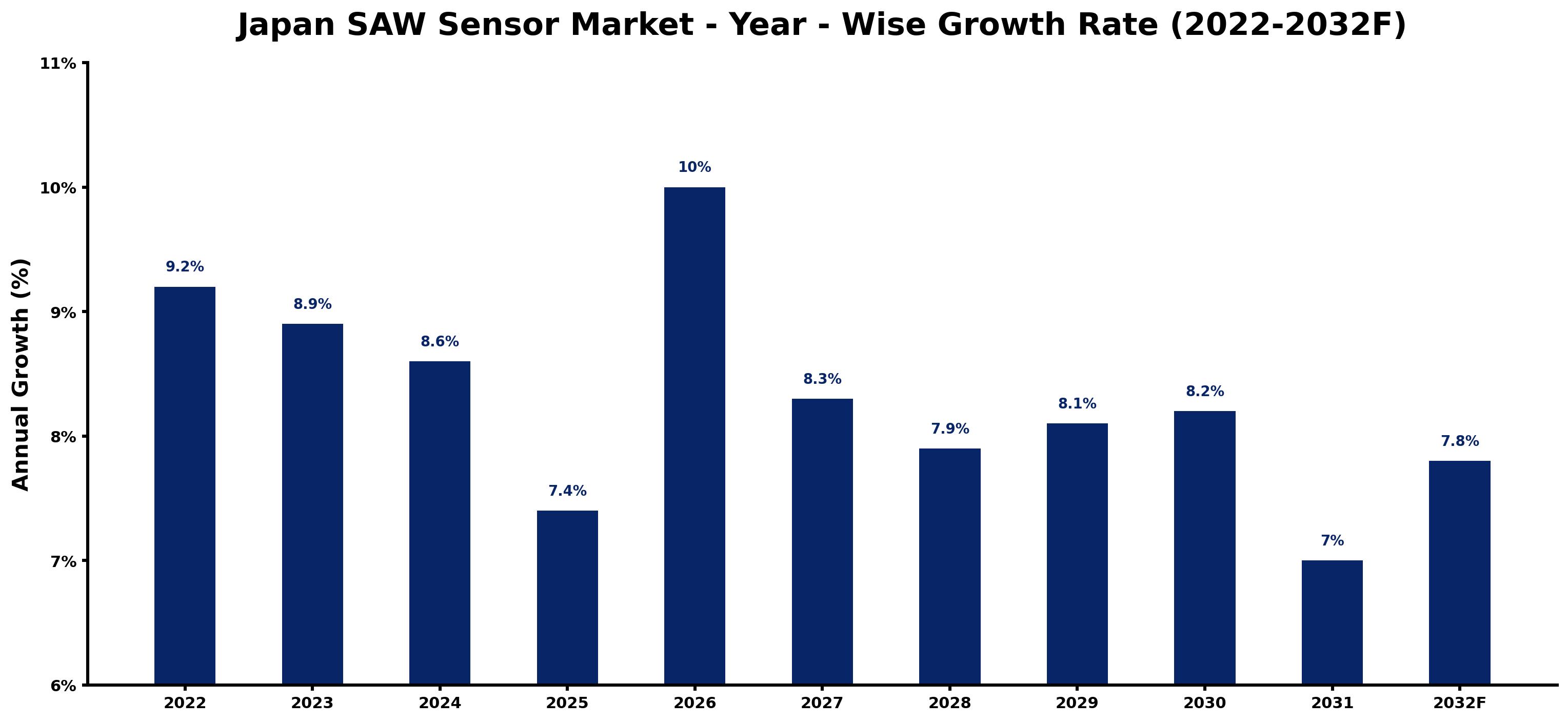
The table below sets out the estimated growth rate for each year and the main factor behind it.
| Year | Estimated Annual Growth (%) | Market Rationale |
| 2022 | 9.2 | The market experienced strong demand from automotive safety systems, driving growth. |
| 2023 | 8.9 | Growth slowed due to market saturation in certain applications, yet demand remained positive. |
| 2024 | 8.6 | Continued interest in medical devices contributed to a slower growth rate this year. |
| 2025 | 7.4 | The market faced a slowdown as industrial automation investments stabilised. |
| 2026 | 10.0 | Demand is anticipated to surge due to increased adoption of sensors in environmental monitoring. |
| 2027 | 8.3 | Growth is projected to slow as the market adjusts to new technological standards and applications. |
| 2028 | 7.9 | The market is expected to continue growing, driven by steady demand from healthcare applications. |
| 2029 | 8.1 | Demand is likely to accelerate as new automotive safety regulations prompt sensor upgrades. |
| 2030 | 8.2 | Growth is projected to remain strong with rising investments in industrial automation technologies. |
| 2031 | 7.0 | A slowdown is anticipated as the market begins to mature and competition intensifies. |
| 2032 | 7.8 | Growth is expected to accelerate again as new applications in environmental monitoring emerge. |
Note: Market size estimations and growth projections presented in this report are based on 6Wresearch's proprietary forecasting methodology, utilizing the latest available industry data, government publications, and primary research inputs.
Japan SAW Sensor Market Synopsis
Their primary applications include industrial automation and medical devices. The Japan SAW Sensor Market is growing due to rising demand from sectors like automotive safety and healthcare, with the industrial automation market estimated at 8 trillion JPY in 2023, driving further sensor adoption across these industries. This growth underscores the need for advanced sensing technologies to meet evolving industry standards.
Market Dynamics Impact Analysis (2026–2032)
| Factor | Type | Impact | Primary Segment Affected |
| Growing demand for automotive safety systems drives the need for advanced sensors. | Driver | High | Pressure Sensors |
| Rising healthcare investments drive the need for temperature sensors. | Driver | High | Temperature Sensors |
| Increased focus on environmental monitoring creates opportunities for gas sensing technologies. | Opportunity | High | Gas/Volatile Sensors |
| Demand for innovative sensor solutions in industrial automation is rising. | Opportunity | High | Gas/Liquid Pressure |
| Regulatory compliance costs can burden manufacturers, affecting pricing strategies. | Restraint | Medium | Temperature Sensors |
| High R&D costs for new sensor technologies can limit investment capacity. | Restraint | Medium | Gas/Liquid Pressure |
| Technological advancements can outpace manufacturer capabilities, leading to potential losses. | Challenge | High | Acceleration Sensors |
| Price competition among manufacturers can lead to reduced profit margins. | Challenge | Medium | Gas/Volatile Sensors |
Evaluation of Drivers in Japan SAW Sensor Market (2026–2032)
The main growth drivers and the segments they affect most are set out below.
| Drivers | Primary Segment Affected | Why It Matters (Evidence) |
| Increased automotive safety regulations require advanced pressure sensors. | Pressure Sensors | Over 50% of automotive safety systems in Japan utilise SAW sensors, boosting demand. |
| Rising healthcare investments drive the need for temperature sensors. | Temperature Sensors | The medical devices market is expanding rapidly, driving sensor usage. |
| Growing environmental awareness drives demand for gas sensing technologies. | Gas/Volatile Sensors | Japan has over 300 air quality monitoring stations, increasing sensor usage. |
| Technological advancements in industrial automation boost sensor adoption. | Gas/Liquid Pressure | Japan's industrial automation market is estimated at 8 trillion JPY in 2023. |
| Increased focus on healthcare safety standards drives demand for sensors. | VOCs/Odor Detection | The Ministry of Health, Labour and Welfare regulates medical device safety. |
Orders continue to rise as over 50% of automotive safety systems in Japan employ SAW sensors, leading to increased demand for pressure sensors. The medical devices market is expanding rapidly, further driving sensor usage. Japan's industrial automation market, estimated at 8 trillion JPY in 2023, fuels demand for gas sensing technologies. Growing environmental awareness has resulted in the installation of air quality monitoring stations, heightening the need for advanced sensors. These factors contribute to rising orders across various applications.
Evaluation of Restraints in Japan SAW Sensor Market
The main factors holding the market back are set out below.
| Market Restraint | Primary Segment Affected | Why It Matters (Evidence) |
| Regulatory compliance costs can burden manufacturers, affecting pricing strategies. | Temperature Sensors | The Ministry of Health, Labour and Welfare enforces strict safety regulations for medical devices. |
| Limited market penetration of certain packaging formats restricts growth. | Chip-On-Board (COB) | Adoption rates for COB packaging remain low in the consumer electronics sector. |
| Technological advancements can outpace manufacturer capabilities, leading to potential losses. | Acceleration Sensors | Rapid developments in sensor technology require constant investment and adaptation. |
| High R&D costs for new sensor technologies can limit investment capacity. | Gas/Liquid Pressure | Continuous innovation is necessary to meet evolving industry standards. |
| Increased competition from new entrants can pressure existing manufacturers. | Gas/Volatile Sensors | The influx of new entrants into the sensor market intensifies competitive pressures. |
Japan SAW Sensor Market Challenges
Intense competition among over 1,200 registered medical device manufacturers drives prices down, forcing suppliers to reduce margins and potentially delaying product development by several months. Stringent regulatory requirements from the Ministry of Health, Labour and Welfare necessitate extensive testing under the JIS Z 8801 standard, which can elevate compliance costs and postpone product launches by as much as six months for producers. Supply chain disruptions hinder the availability of critical components, compelling buyers to maintain larger inventories and increasing costs by 15%. A shortage of skilled professionals in sensor technology limits innovation, restricting clinics' ability to adopt new solutions swiftly.
Trends in the Japan SAW Sensor Market
These developments are changing demand patterns in the Japan SAW Sensor Market.
- Shift towards Advanced Environmental Monitoring: Japan's environmental monitoring sector is increasingly adopting sophisticated gas sensing technologies, with over 300 air quality monitoring stations in operation. This shift is expected to improve data accuracy and response times.
- Transition to Smart Medical Devices: The medical devices sector is rapidly integrating smart technologies, improving patient monitoring and safety outcomes. This transition is reflected in the growing demand for advanced sensing technologies.
- Emergence of Compact Sensor Designs: The demand for smaller, more efficient sensors is rising, particularly in automotive safety systems. This trend is driven by the need for space-saving solutions in modern vehicle designs.
- Prioritisation of Regulatory Compliance: Manufacturers are increasingly focusing on meeting stringent safety standards, particularly in the medical device sector. Compliance with the JIS Z 8801 standard is essential for market access.
Investment Opportunities in the Japan SAW Sensor Market
The following areas offer the clearest openings for investors and suppliers in the Japan SAW Sensor Market.
- Timing for Investment in Environmental Monitoring: With over 300 air quality monitoring stations, the demand for gas sensors is increasing. Investing in advanced gas sensing technologies can meet this growing need in urban areas.
- Demand from Medical Device Manufacturers: The medical devices market is expanding rapidly, presenting opportunities for sensor suppliers. Collaborating with local manufacturers can facilitate market entry.
- Gap in Advanced Sensor Technologies: The industrial automation market is estimated at 8 trillion JPY in 2023, indicating a need for innovative sensor solutions. Suppliers can target this gap by developing new technologies.
- Entry through Joint Ventures: Forming joint ventures with local firms can ease market entry for sensor manufacturers. This approach can utilise existing distribution networks and regulatory knowledge.
Government Initiatives in the Japan SAW Sensor Market
The Industrial Standardization Act, amended in 2019, governs product and test standards for sensors in Japan, ensuring quality and safety compliance. This law mandates that manufacturers adhere to the JIS Z 8801 standard, which regulates sensor testing protocols, thus influencing production practices.
The Japan Electronics and Information Technology Industries Association oversees the approval of medical devices, ensuring compliance with safety regulations. This agency also funds initiatives aimed at supporting innovation in the medical sector.
Future Insight of the Japan SAW Sensor Market
Healthcare providers will experience advancements in patient care through the integration of cutting-edge SAW sensors by 2032. The industrial automation sector will leverage MEMS technology to improve operational efficiency and reduce costs. Environmental monitoring efforts will expand with the addition of more air quality stations, facilitating timely data collection for better public health decisions. As Japan's industrial automation market is estimated at 8 trillion JPY in 2023, suppliers will need to adapt to new standards to remain competitive.
Market Segmentation Analysis
Japan SAW Sensor Market report covers a detailed analysis of the following market segments:
By Sensor Type – Pressure Sensors Lead, Gas/Volatile Sensors Expected to Grow Fastest
According to Saurav Kr Singh, Senior Research Analyst at 6Wresearch, with 44% of sensor type revenue in 2025, Pressure Sensors was the largest category. Pressure sensors hold the largest share due to their critical role in measuring pressure across various applications, particularly in industrial automation. For instance, they are essential in over 50% of automotive safety systems in Japan, showcasing their widespread adoption. Gas/Volatile Sensors are set to record the highest CAGR in this split, 11.8% over 2026–2032. Gas/volatile sensors are experiencing rapid growth as environmental monitoring becomes increasingly important, with over 300 air quality monitoring stations in Japan highlighting the need for effective gas detection. This focus on air quality will likely drive further demand for these sensors. Suppliers should prioritise the development of gas/volatile sensors to meet the growing environmental monitoring needs.
By Sensing Parameter – Gas/Liquid Pressure Leads, VOCs/Odor Detection Expected to Grow Fastest
Gas/Liquid Pressure took 44% of sensing parameter revenue in 2025, more than any other category. Gas and liquid pressure sensing holds the largest share due to its critical role in industrial automation and process control, ensuring operational efficiency and safety. This is particularly important in sectors such as automotive and manufacturing, where accurate pressure measurements are essential. Over 2026–2032, VOCs/Odor Detection is expected to post the fastest growth, at a CAGR of 10.6%. VOCs and odour detection is experiencing the highest growth rate, primarily due to increasing regulatory focus on air quality and environmental safety. The rise in air quality monitoring stations illustrates the urgent need for effective sensing solutions in this domain. Buyers should prioritise investments in VOCs and odour detection technologies to meet rising environmental compliance requirements.
By Packaging Format – Chip-On-Board (COB) Leads and Records the Fastest Growth
The largest packaging format category in 2025 was Chip-On-Board (COB), at 46% of revenue. Chip-on-board (COB) packaging leads the market due to its ability to integrate multiple components, making it suitable for compact sensor designs. Its prevalent use in medical devices, which are projected to reach 12 trillion JPY by 2025, solidifies its dominant share. Its lead should widen, with a projected CAGR of 11.0% during 2026–2032, the highest in this split. Chip-on-board (COB) packaging is also the fastest-growing format, as its advantages in miniaturisation and performance are increasingly recognised across various sectors. This established application, combined with rising demand, will likely widen its market lead further. Suppliers must focus on developing COB packaging capabilities to meet the increasing demand for compact and efficient sensor solutions.
By End User – Medical Devices Lead, Environmental Monitoring Expected to Grow Fastest
Medical Devices accounted for 46% of the market by end user in 2025. The medical devices sector is the largest end user of SAW sensors, driven by the necessity for accurate measurements in healthcare applications. With over 1,200 registered medical device manufacturers in Japan, the demand for reliable sensing solutions remains strong. The quickest growth will come from Environmental Monitoring, forecast to expand at a CAGR of 10.4% between 2026 and 2032. Environmental monitoring is the fastest-growing end user segment, spurred by rising awareness of air quality concerns and regulatory pressures. The establishment of numerous air quality monitoring stations highlights the urgent need for effective sensing technologies in this area. Suppliers should adjust their strategies to address the increasing demand from the environmental monitoring sector.
Key Attractiveness of the Report
- 10 Years of Market Numbers
- Historical Data Starting from 2022 to 2025
- Base Year 2025
- Forecast Data until 2032
- Key Performance Indicators Impacting the Market
- Major Upcoming Developments and Projects
Key Highlights of the Report:
- Japan SAW Sensor Market Outlook
- Market Size of Japan SAW Sensor Market, 2025
- Forecast of Japan SAW Sensor Market, 2032
- Historical Data and Forecast of Japan SAW Sensor Revenues & Volume for the Period 2022-2032F
- Japan SAW Sensor Market Trend Evolution
- Japan SAW Sensor Market Drivers and Challenges
- Japan SAW Sensor Price Trends
- Japan SAW Sensor Porter's Five Forces
- Japan SAW Sensor Industry Life Cycle
- Historical Data and Forecast of Japan SAW Sensor Market Revenues & Volume By Sensor Type for the Period 2022-2032F
- Historical Data and Forecast of Japan SAW Sensor Market Revenues & Volume By Pressure Sensors for the Period 2022-2032F
- Historical Data and Forecast of Japan SAW Sensor Market Revenues & Volume By Temperature Sensors for the Period 2022-2032F
- Historical Data and Forecast of Japan SAW Sensor Market Revenues & Volume By Gas/Volatile Sensors for the Period 2022-2032F
- Historical Data and Forecast of Japan SAW Sensor Market Revenues & Volume By Acceleration Sensors for the Period 2022-2032F
- Historical Data and Forecast of Japan SAW Sensor Market Revenues & Volume By Sensing Parameter for the Period 2022-2032F
- Historical Data and Forecast of Japan SAW Sensor Market Revenues & Volume By Gas/Liquid Pressure for the Period 2022-2032F
- Historical Data and Forecast of Japan SAW Sensor Market Revenues & Volume By Temperature for the Period 2022-2032F
- Historical Data and Forecast of Japan SAW Sensor Market Revenues & Volume By VOCs/Odor Detection for the Period 2022-2032F
- Historical Data and Forecast of Japan SAW Sensor Market Revenues & Volume By Vibration Detection for the Period 2022-2032F
- Historical Data and Forecast of Japan SAW Sensor Market Revenues & Volume By Packaging Format for the Period 2022-2032F
- Historical Data and Forecast of Japan SAW Sensor Market Revenues & Volume By Chip-On-Board (COB) for the Period 2022-2032F
- Historical Data and Forecast of Japan SAW Sensor Market Revenues & Volume By Surface Mount Device for the Period 2022-2032F
- Historical Data and Forecast of Japan SAW Sensor Market Revenues & Volume By TO-5 Can for the Period 2022-2032F
- Historical Data and Forecast of Japan SAW Sensor Market Revenues & Volume By MEMS Package for the Period 2022-2032F
- Historical Data and Forecast of Japan SAW Sensor Market Revenues & Volume By End User for the Period 2022-2032F
- Historical Data and Forecast of Japan SAW Sensor Market Revenues & Volume By Medical Devices for the Period 2022-2032F
- Historical Data and Forecast of Japan SAW Sensor Market Revenues & Volume By Industrial Automation for the Period 2022-2032F
- Historical Data and Forecast of Japan SAW Sensor Market Revenues & Volume By Environmental Monitoring for the Period 2022-2032F
- Historical Data and Forecast of Japan SAW Sensor Market Revenues & Volume By Automotive Safety Systems for the Period 2022-2032F
- Japan SAW Sensor Import Export Trade Statistics
- Market Opportunity Assessment By Sensor Type
- Market Opportunity Assessment By Sensing Parameter
- Market Opportunity Assessment By Packaging Format
- Market Opportunity Assessment By End User
- Japan SAW Sensor Top Companies Market Share
- Japan SAW Sensor Competitive Benchmarking By Technical and Operational Parameters
- Japan SAW Sensor Company Profiles
- Japan SAW Sensor Key Strategic Recommendations
Market Covered
The study includes the following segmentation.
By Sensor Type
- Pressure Sensors
- Temperature Sensors
- Gas/Volatile Sensors
- Acceleration Sensors
By Sensing Parameter
- Gas/Liquid Pressure
- Temperature
- VOCs/Odor Detection
- Vibration Detection
By Packaging Format
- Chip-On-Board (COB)
- Surface Mount Device
- TO-5 Can
- MEMS Package
By End User
- Medical Devices
- Industrial Automation
- Environmental Monitoring
- Automotive Safety Systems































