Japan Sawn Wood Market Size & Growth Rate
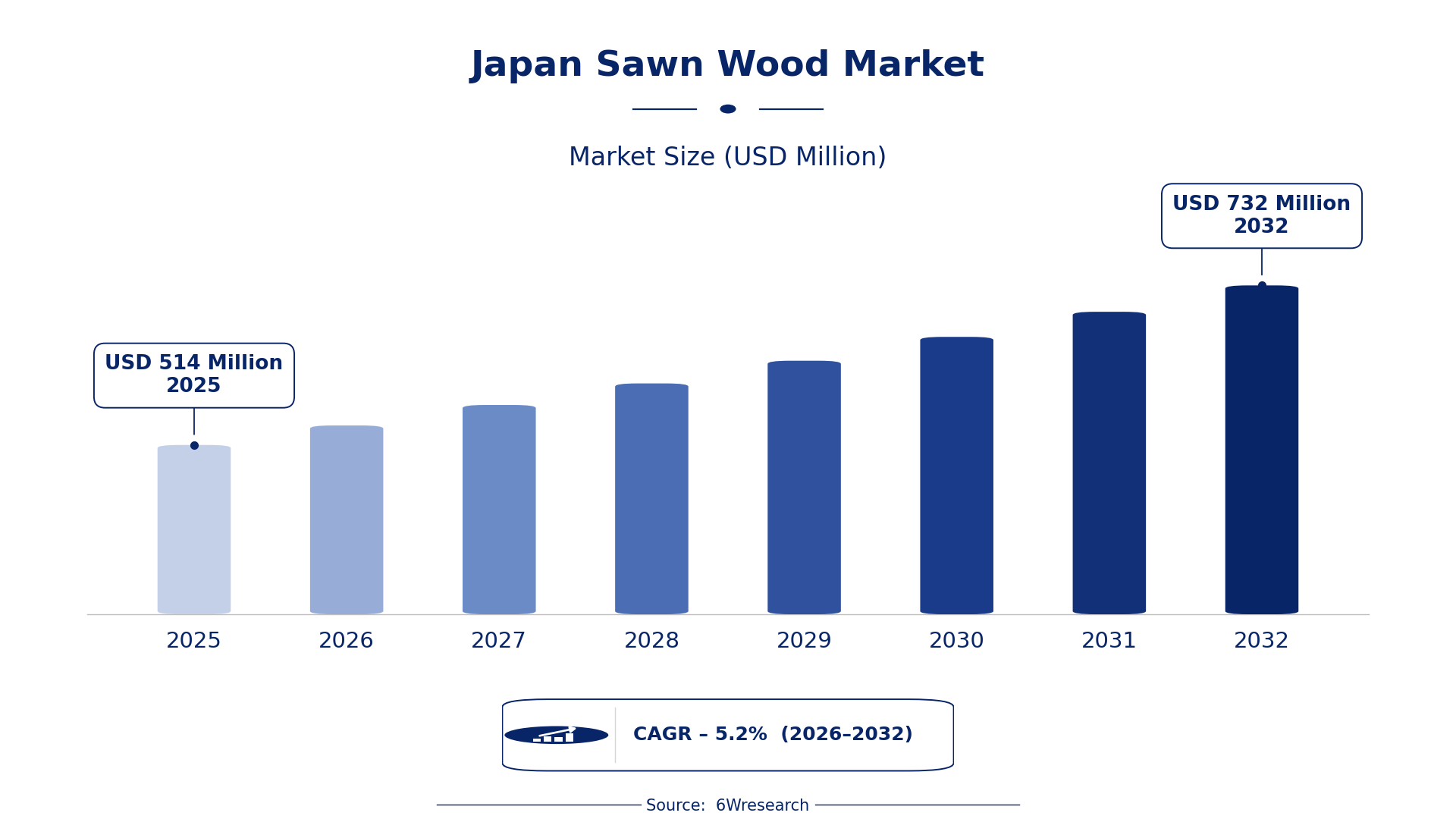
According to 6Wresearch internal database and industry insights, the Japan Sawn Wood Market was valued at USD 514 Million in 2025 and is projected to reach USD 732 Million by 2032, growing at a CAGR of approximately 5.2% during 2026–2032.
Japan Sawn Wood Market Highlights
| Report Metric | Details |
| Report Name | Japan Sawn Wood Market (2026-2032) |
| Market Size 2025 | USD 514 Million |
| Market Size 2032 | USD 732 Million |
| Absolute Growth 2025–2032 | USD 218 Million |
| CAGR 2026–2032 | 5.2% |
| Peak Annual Growth | 6.2% in 2028 |
| Forecast Period | 2026–2032 |
| Historical Data | 2022–2025 |
| Base Year | 2025 |
| Leading Type, 2025 | Hard Wood (55% share) |
| Fastest-Growing Type | Soft Wood (7.1% CAGR) |
| Growing Sector | Soft Wood |
| Key End Users | Hard Wood, Soft Wood |
Japan Sawn Wood Market Year-wise Growth Rate and Key Drivers (2022–2032)
This graph illustrates the annual growth rates of the market from 2022 to 2032, highlighting a steady upward trajectory and projected market expansion over the forecast period.
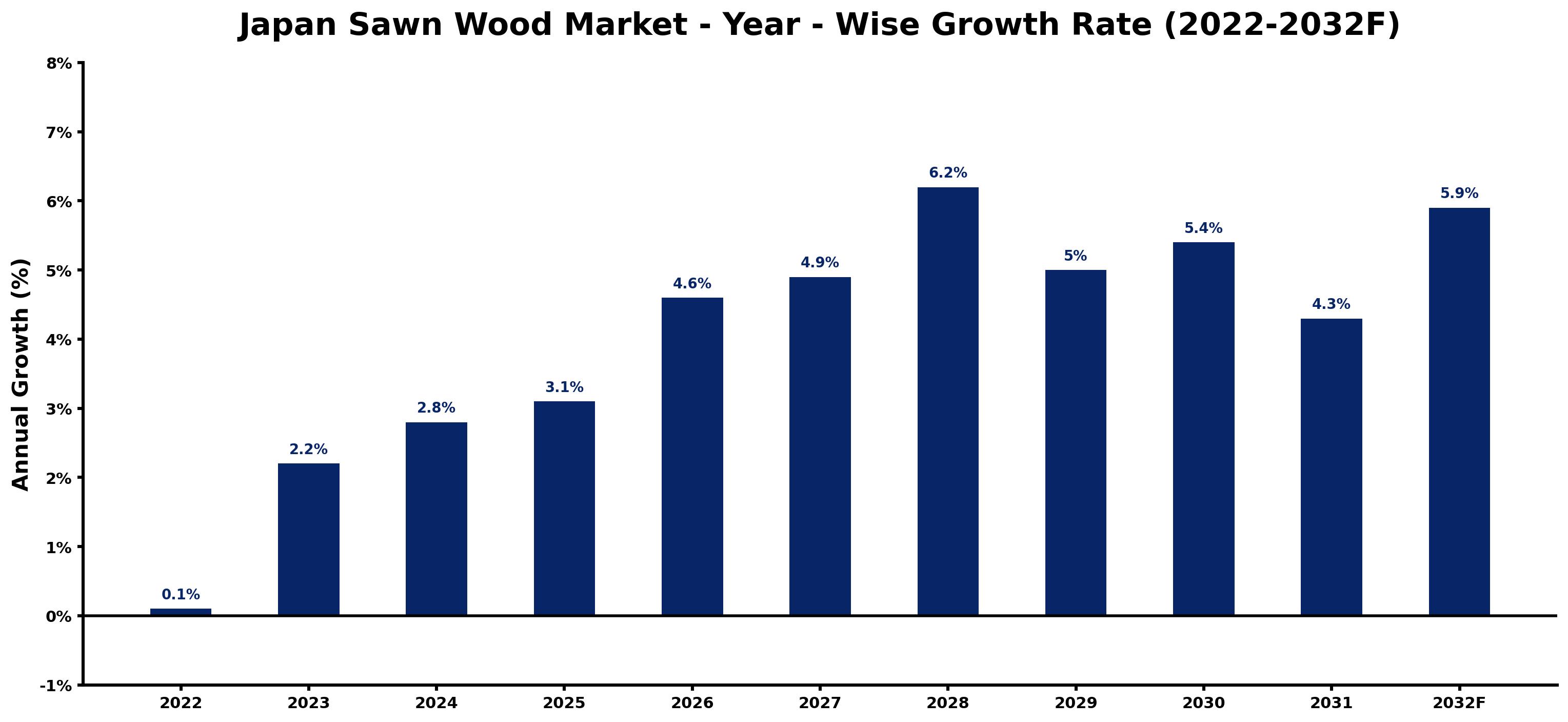
For each year, the table pairs the estimated growth rate with the leading influence on demand, showing how the drivers changed across the period.
| Year | Estimated Annual Growth (%) | Market Rationale |
| 2022 | 0.1 | The market experienced minimal growth due to ongoing supply chain disruptions. |
| 2023 | 2.2 | Growth accelerated as construction projects resumed following delays. |
| 2024 | 2.8 | Demand increased further with rising residential building activities and renovations. |
| 2025 | 3.1 | The market saw its peak growth rate due to a surge in public construction projects. |
| 2026 | 4.6 | Investment in domestic timber initiatives will drive further demand. |
| 2027 | 4.9 | Continued growth is anticipated as the construction sector expands its workforce. |
| 2028 | 6.2 | The peak annual growth is driven by the government's push for local timber usage. |
| 2029 | 5.0 | Growth slows slightly as the market stabilises after rapid expansion. |
| 2030 | 5.4 | Demand is projected to rise with increased public investment in infrastructure. |
| 2031 | 4.3 | A slowdown occurs as the market adjusts to previous high growth rates. |
| 2032 | 5.9 | Growth resumes as domestic timber use targets are pursued vigorously. |
Note: Market size estimations and growth projections presented in this report are based on 6Wresearch's proprietary forecasting methodology, utilizing the latest available industry data, government publications, and primary research inputs.
Japan Sawn Wood Market Synopsis
Sawn wood, a processed timber product derived from logs, is essential for construction and furniture making. The Japan Sawn Wood Market is influenced by active residential building projects, with average annual consumption around 4 million cubic meters. Recent government efforts aim to increase domestic timber use in public construction projects, targeting a 50% usage rate by 2025. This focus on local sourcing is anticipated to stimulate market growth and improve production capabilities.
Market Dynamics Impact Analysis (2026–2032)
| Factor | Type | Impact | Primary Segment Affected |
| Rising residential construction projects | Driver | High | Soft Wood |
| Government initiatives promoting domestic timber use | Driver | High | Hard Wood |
| Growing demand for sustainable building materials | Opportunity | High | Soft Wood |
| Increased renovations of existing properties | Opportunity | Medium | Hard Wood |
| Supply chain disruptions impacting availability | Restraint | High | Soft Wood |
| Rising prices of domestic sawn wood due to demand | Restraint | Medium | Hard Wood |
| Competition from imported sawn wood | Challenge | High | Soft Wood |
| Fluctuating timber prices affecting profitability | Challenge | Medium | Hard Wood |
Evaluation of Drivers in Japan Sawn Wood Market (2026–2032)
Demand rests on the following drivers, each shown with the segment it touches most.
| Drivers | Primary Segment Affected | Why It Matters (Evidence) |
| Increased residential construction | Soft Wood | The construction sector employs over 5 million people, driving demand for softwood, which accounts for 70% of consumption. |
| Government initiatives for domestic timber | Hard Wood | The Japanese government aims to increase domestic timber use to 50% in public projects by 2025, boosting local production. |
| Growing emphasis on sustainable materials | Soft Wood | The push for eco-friendly construction materials leads to higher demand for sustainably sourced softwood. |
| Rising renovation activities | Hard Wood | As homeowners invest in renovations, demand for high-quality hardwood for furniture and flooring rises. |
| Quality assurance certifications | Hard Wood | ISO 9001 certification is increasingly sought, ensuring quality and driving demand for certified hardwood products. |
Most of the extra volume comes from increased residential construction, with over 5 million people employed in the sector driving demand for softwood, which constitutes about 70% of total consumption. The growing emphasis on sustainable materials is pushing builders to source more eco-friendly softwood. Renovation activities are also rising, leading homeowners to seek high-quality hardwood for furniture and flooring. Consequently, demand for certified hardwood products is increasing due to quality assurance requirements.
Evaluation of Restraints in Japan Sawn Wood Market
These are the pressures that could keep growth below its potential.
| Market Restraint | Primary Segment Affected | Why It Matters (Evidence) |
| Supply chain disruptions affecting availability | Soft Wood | In 2022, Japan imported approximately 1.2 million cubic meters of sawn wood, indicating reliance on external sources. |
| Rising prices of domestic sawn wood | Hard Wood | The average price of domestic sawn wood increased by 10% in 2023, impacting affordability for buyers. |
| Limited production capacity in certain regions | Soft Wood | The Tohoku region, a major area for softwood production, may face capacity constraints. |
| Fluctuating timber prices affecting profitability | Hard Wood | Price volatility can hinder long-term contracts and investment decisions for suppliers. |
| Competition from imported sawn wood | Soft Wood | With imports accounting for about 30% of the market, local producers face stiff competition. |
Japan Sawn Wood Market Challenges
Japan's sawn wood market faces stringent regulations under JAS, resulting in lengthy product approval processes that delay market entry for manufacturers. Increased competition from imported sawn wood, particularly from North America, forces local producers to reduce prices, which can erode profit margins for domestic suppliers. Limited domestic production of 2.5 million cubic meters in 2022 has led to supply shortages, compelling buyers to rely on imports and causing higher costs and extended lead times. Rising domestic prices, which increased by 10% in 2023, strain budgets for contractors and developers, jeopardising project viability.
Trends in the Japan Sawn Wood Market
The following changes are redrawing the Japan Sawn Wood Market.
- Launch of Domestic Timber Promotion Programme: In 2023, the Japanese government initiated a programme to boost the use of domestic timber in public construction projects, aiming for 50% usage by 2025. This initiative is set to stimulate local production capabilities and demand.
- Increased Focus on Sustainable Building Materials: Construction firms are prioritising sustainable materials, with a notable rise in demand for eco-friendly softwood. This shift is observed in urban areas where green building standards are being adopted.
- Growth in Renovation Projects: Residential renovations are becoming more common, particularly in urban centres, as homeowners invest in upgrading their properties. This trend has led to a notable increase in hardwood purchases for flooring and cabinetry.
- Rising Certification Standards for Quality Assurance: Manufacturers are increasingly seeking ISO 14001 certification to meet environmental quality demands, reflecting a broader trend towards enhanced product standards in the sawn wood market.
Investment Opportunities in the Japan Sawn Wood Market
The opportunities below stand out in the Japan Sawn Wood Market for new entrants and existing suppliers.
- Tohoku Region's Production Facilities: The Tohoku region has a strong capacity for softwood production, with an opportunity to increase output to meet rising domestic demand, which was around 4 million cubic meters in 2022.
- Urban Construction Projects: Urban developers are increasingly looking for sustainable materials, creating opportunities for suppliers of certified softwood to enter the market and meet this demand.
- Public Sector Timber Procurement: With the government's target of 50% domestic timber use by 2025, suppliers can focus on meeting public sector needs through partnerships with local construction firms.
- Renovation Market Growth: The ongoing trend of residential renovations presents a timely opportunity for suppliers of high-quality hardwood, as homeowners invest in durable materials.
Government Initiatives in the Japan Sawn Wood Market
The regulatory framework for sawn wood in Japan is shaped by several key laws, including the Industrial Standardization Act (1949), which governs product standards, and the Act against Unjustifiable Premiums and Misleading Representations (1962), which prohibits misleading labelling. These regulations ensure that producers maintain quality and transparency in their offerings, positively impacting the overall market.
The Forestry Agency of Japan oversees the sustainable management of forest resources and funds various initiatives to promote domestic timber use. In 2023, the agency approved projects aimed at increasing domestic timber production, targeting local supply chains and supporting the construction sector's growing demand for sustainable materials.
Future Insight of the Japan Sawn Wood Market
The Japanese government's initiative to promote domestic timber use in public projects will reshape the market by 2032. This policy will encourage suppliers to enhance production capabilities and adopt sustainable practices. Increased investment in local forestry will boost the availability of sawn wood, providing buyers with more dependable sourcing options. By 2025, the target of 50% domestic timber usage will likely elevate the average consumption of sawn wood, currently around 4 million cubic meters, reflecting a shift towards local products in construction and furniture manufacturing.
Market Segmentation Analysis
Japan Sawn Wood Market report covers a detailed analysis of the following market segments:
By Type – Hard Wood Leads, Soft Wood Expected to Grow Fastest
According to Ravi Bhandari, Research Head at 6Wresearch, the largest type category in 2025 was Hard Wood, at 55% of revenue. Hard wood holds the largest share in Japan due to its extensive use in high-end furniture and flooring applications. The preference for premium quality furnishings, particularly in urban settings, drives significant demand for this segment. The quickest growth will come from Soft Wood, forecast to expand at a CAGR of 7.1% between 2026 and 2032. Soft wood is experiencing rapid growth as it is increasingly preferred for general construction and framing, appealing to builders for its lightweight and cost-effective properties. The government's initiatives to promote domestic timber use in public projects are accelerating this segment's expansion. This suggests that suppliers should focus on soft wood products to capitalise on the growing construction market.
Key Attractiveness of the Report
- 10 Years of Market Numbers
- Historical Data Starting from 2022 to 2025
- Base Year 2025
- Forecast Data until 2032
- Key Performance Indicators Impacting the Market
- Major Upcoming Developments and Projects
Key Highlights of the Report:
- Japan Sawn Wood Market Outlook
- Market Size of Japan Sawn Wood Market, 2025
- Forecast of Japan Sawn Wood Market, 2032
- Historical Data and Forecast of Japan Sawn Wood Revenues & Volume for the Period 2022-2032
- Japan Sawn Wood Market Trend Evolution
- Japan Sawn Wood Market Drivers and Challenges
- Japan Sawn Wood Price Trends
- Japan Sawn Wood Porter's Five Forces
- Japan Sawn Wood Industry Life Cycle
- Historical Data and Forecast of Japan Sawn Wood Market Revenues & Volume By Type for the Period 2022-2032
- Historical Data and Forecast of Japan Sawn Wood Market Revenues & Volume By Hard Wood for the Period 2022-2032
- Historical Data and Forecast of Japan Sawn Wood Market Revenues & Volume By Soft Wood for the Period 2022-2032
- Japan Sawn Wood Import Export Trade Statistics
- Market Opportunity Assessment By Type
- Japan Sawn Wood Top Companies Market Share
- Japan Sawn Wood Competitive Benchmarking By Technical and Operational Parameters
- Japan Sawn Wood Company Profiles
- Japan Sawn Wood Key Strategic Recommendations
Market Covered
This report examines the market across the segments below.
By Type
- Hard Wood
- Soft Wood































