Japan Scheduled Maintenance Market Size & Growth Rate
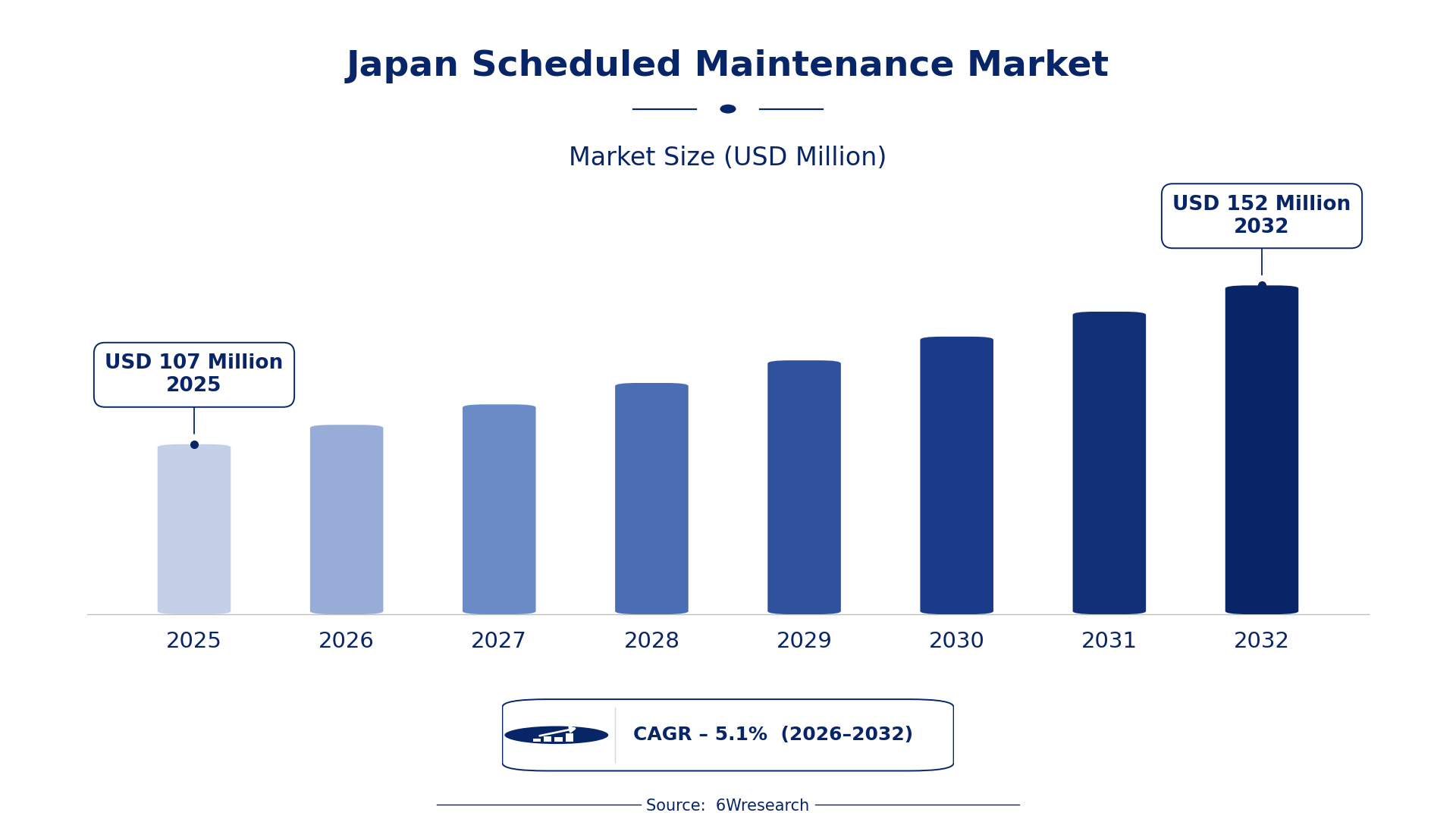
According to 6Wresearch internal database and industry insights, the Japan Scheduled Maintenance Market was valued at USD 107 Million in 2025 and is projected to reach USD 152 Million by 2032, growing at a CAGR of approximately 5.1% during 2026–2032.
Japan Scheduled Maintenance Market Highlights
| Report Metric | Details |
| Report Name | Japan Scheduled Maintenance Market (2026-2032) |
| Market Size 2025 | USD 107 Million |
| Market Size 2032 | USD 152 Million |
| Absolute Growth 2025–2032 | USD 45 Million |
| CAGR 2026–2032 | 5.1% |
| Peak Annual Growth | 6.2% in 2032 |
| Forecast Period | 2026–2032 |
| Historical Data | 2022–2025 |
| Base Year | 2025 |
| Leading Maintenance Type, 2025 | Preventive Maintenance (44% share) |
| Leading Asset Type, 2025 | Industrial Machinery (42% share) |
| Leading Scheduling Model, 2025 | Condition-Based (39% share) |
| Leading End User, 2025 | Manufacturing Firms (51% share) |
| Fastest-Growing Maintenance Type | Predictive Maintenance (7.1% CAGR) |
| Fastest-Growing Asset Type | Pumps/Rotating Equipment (7.2% CAGR) |
| Fastest-Growing End User | Chemical & Petrochemical Plants (6.8% CAGR) |
| Growing Sector | manufacturing |
| Key End Users | manufacturing firms, oil & gas facilities, chemical & petrochemical plants, commercial buildings |
Japan Scheduled Maintenance Market Year-wise Growth Rate and Key Drivers (2022–2032)
This graph illustrates the annual growth rates of the market from 2022 to 2032, highlighting a steady upward trajectory and projected market expansion over the forecast period.
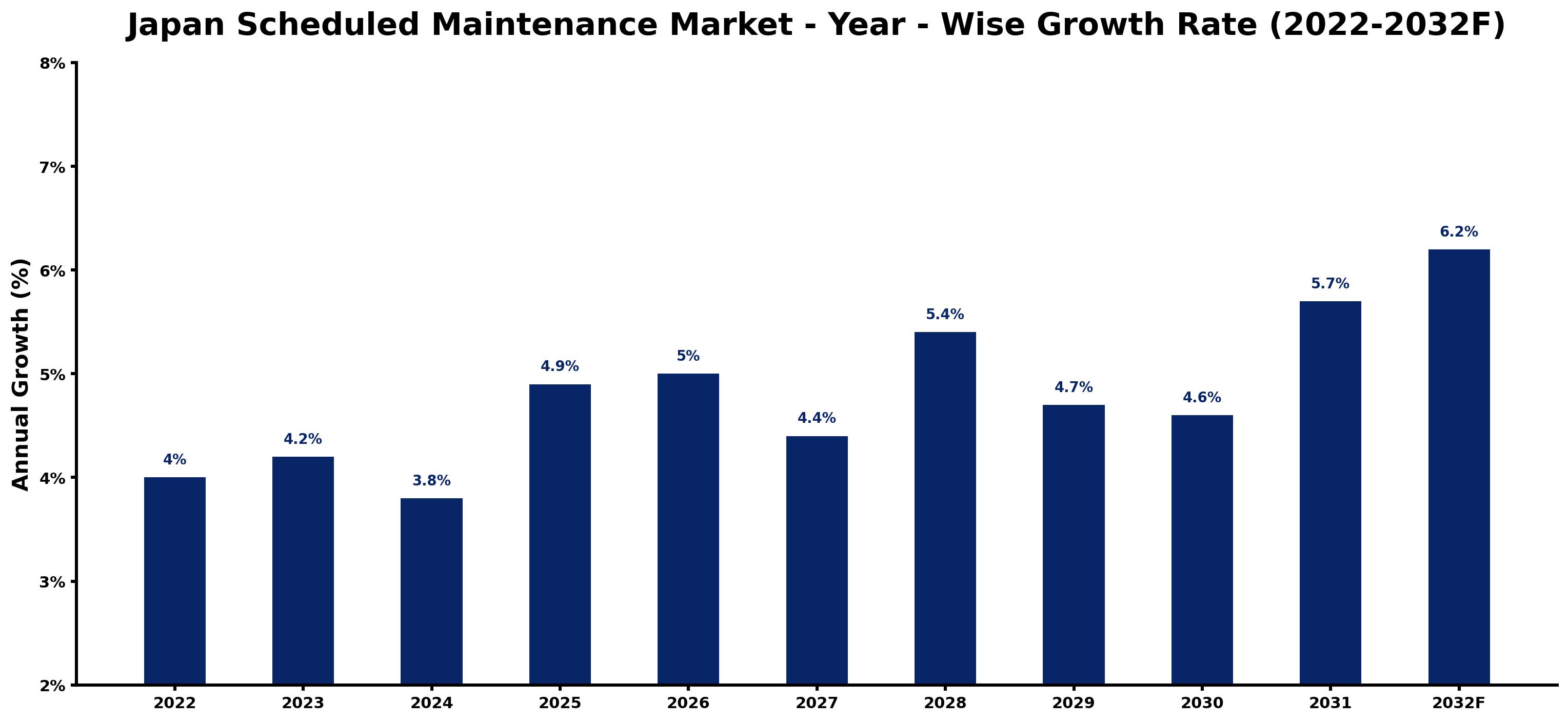
The following figures match every annual growth estimate with the main market development of that year, giving the reasoning behind each rise or slowdown.
| Year | Estimated Annual Growth (%) | Market Rationale |
| 2022 | 4.0 | The market showed steady growth driven by consistent demand from manufacturing sectors. |
| 2023 | 4.2 | Growth accelerated due to increased investments in preventive maintenance practices. |
| 2024 | 3.8 | Growth slowed as firms adjusted to economic conditions and maintenance budgets. |
| 2025 | 4.9 | Demand surged as firms adopted advanced maintenance technologies and practices. |
| 2026 | 5.0 | The market is expected to continue growing as predictive maintenance gains traction in various sectors. |
| 2027 | 4.4 | Growth is projected to slow slightly as companies face challenges in workforce management. |
| 2028 | 5.4 | Demand is anticipated to pick up again as energy efficiency regulations drive maintenance needs. |
| 2029 | 4.7 | Growth is expected to decelerate as firms focus on cost containment and operational efficiency. |
| 2030 | 4.6 | The market will maintain growth as aging machinery requires more frequent maintenance. |
| 2031 | 5.7 | Demand is projected to increase with rising investments in industrial infrastructure and technology. |
| 2032 | 6.2 | The market is expected to peak as advanced maintenance solutions become standard practice. |
Note: Market size estimations and growth projections presented in this report are based on 6Wresearch's proprietary forecasting methodology, utilizing the latest available industry data, government publications, and primary research inputs.
Japan Scheduled Maintenance Market Synopsis
Scheduled maintenance is a systematic approach to maintaining equipment and infrastructure, essential for preventing failures in industries like manufacturing and oil & gas. The Japan Scheduled Maintenance Market is expanding due to the high number of manufacturing firms, with over 100,000 requiring these services. Energy efficiency regulations are driving demand for HVAC systems maintenance, while the government’s allocation of ¥5 billion for infrastructure initiatives stimulates market growth.
Market Dynamics Impact Analysis (2026–2032)
| Factor | Type | Impact | Primary Segment Affected |
| Growing number of manufacturing firms requiring maintenance services | Driver | High | Preventive Maintenance |
| Increased adoption of predictive maintenance technologies | Driver | High | Predictive Maintenance |
| High demand for maintenance services in the oil and gas sector | Opportunity | High | Oil & Gas Facilities |
| Rising need for compliance with safety regulations in chemical plants | Opportunity | High | Chemical & Petrochemical Plants |
| Challenges in workforce management affecting service delivery | Restraint | Medium | Industrial Machinery |
| Aging industrial machinery leading to increased maintenance needs | Restraint | High | Pumps/Rotating Equipment |
| Limited availability of skilled maintenance professionals | Challenge | High | HVAC Systems |
| High costs associated with advanced maintenance technologies | Challenge | Medium | Process Plants |
Evaluation of Drivers in Japan Scheduled Maintenance Market (2026–2032)
Below are the drivers that matter most for revenue growth, with supporting evidence.
| Drivers | Primary Segment Affected | Why It Matters (Evidence) |
| High number of manufacturing firms | Preventive Maintenance | Over 100,000 manufacturing firms in Japan require scheduled maintenance services, driving demand for preventive measures. |
| Aging industrial machinery | Pumps/Rotating Equipment | The average age of industrial machinery in Japan exceeds 10 years, increasing the need for maintenance across sectors. |
| Energy efficiency regulations | HVAC Systems | New energy efficiency regulations are projected to impact the HVAC systems market, driving further investments in maintenance. |
| Growing demand in oil and gas sector | Process Plants | The oil and gas sector employs approximately 40,000 workers, creating consistent demand for maintenance services. |
| Increased focus on safety compliance | Chemical & Petrochemical Plants | Strict safety regulations necessitate regular maintenance checks, boosting demand for compliance services. |
The strongest pull on demand comes from the high number of manufacturing firms, with over 100,000 requiring scheduled maintenance services. Preventive measures are applied in over 60% of manufacturing processes, ensuring equipment reliability. The oil and gas sector employs approximately 40,000 workers, creating consistent demand for maintenance services. The average age of industrial machinery exceeds 10 years, leading to heightened maintenance needs for firms in various sectors.
Evaluation of Restraints in Japan Scheduled Maintenance Market
These are the pressures that could keep growth below its potential.
| Market Restraint | Primary Segment Affected | Why It Matters (Evidence) |
| Challenges in workforce management affecting service delivery | Industrial Machinery | A shortage of skilled maintenance professionals limits the ability to meet service demands. |
| Aging industrial machinery leading to increased maintenance needs | Pumps/Rotating Equipment | Older machinery requires more frequent maintenance, straining resources and budgets. |
| High costs associated with advanced maintenance technologies | Process Plants | Investment in advanced technologies can be prohibitive for smaller firms, limiting adoption. |
| Regulatory compliance costs in chemical plants | Chemical & Petrochemical Plants | Strict safety regulations increase operational costs, impacting maintenance budgets. |
| Limited availability of skilled maintenance professionals | HVAC Systems | The skills gap in the workforce makes it difficult to find qualified personnel for maintenance tasks. |
Japan Scheduled Maintenance Market Challenges
Regulatory demands in Japan impose compliance costs on maintenance providers, as strict safety regulations require frequent inspections, causing delays for manufacturing firms. Competition among over 100,000 service providers drives down prices, complicating profitability for suppliers while maintaining service quality. Rising operational costs, associated with an average industrial machinery age exceeding 10 years, increase upkeep expenses for producers, forcing them to allocate larger budgets for repairs. Supply chain disruptions for essential parts can delay projects, impacting timelines for oil and gas facilities and leading to increased downtime costs of approximately ¥2 million daily.
Trends in the Japan Scheduled Maintenance Market
The shifts below are changing how Japan Scheduled Maintenance Market products are bought and supplied.
- Shift towards Predictive Maintenance: Predictive maintenance is gaining traction, with a projected CAGR of 7.1% from 2026 to 2032, as firms use data analytics to improve equipment reliability in manufacturing.
- Transition from Preventive to Condition-Based Maintenance: Condition-based maintenance is becoming the norm, with a share of 39% in 2025, as firms seek to optimise maintenance schedules based on real-time data from equipment.
- Emergence of Energy Efficiency Standards: The Building Energy Efficiency Act, amended in 2022, requires new buildings to meet energy standards, influencing maintenance practices in the HVAC sector across Japan.
- Increase in Infrastructure Maintenance Funding: In 2023, the government allocated ¥5 billion for infrastructure maintenance initiatives, signalling a commitment to improving practices across sectors, particularly in manufacturing.
Investment Opportunities in the Japan Scheduled Maintenance Market
Below are the investment opportunities with the strongest case in the Japan Scheduled Maintenance Market.
- Gap in Predictive Maintenance Adoption: With a projected CAGR of 7.1%, there is a notable opportunity for investment in predictive maintenance technologies, particularly among manufacturing firms needing efficiency improvements.
- Growing HVAC Market Needs: The HVAC systems market is set to grow due to energy efficiency regulations, creating demand for maintenance services in commercial buildings and facilities.
- Investment in Chemical Plant Safety: With chemical plants facing strict regulations, there is a need for enhanced maintenance services, providing opportunities for firms specialising in safety compliance.
- Demand for Turnaround Planning Services: As industrial facilities plan for shutdowns, there is a growing need for turnaround planning services, particularly in manufacturing and oil & gas sectors.
Government Initiatives in the Japan Scheduled Maintenance Market
The Building Energy Efficiency Act, amended in 2022, requires that all new buildings meet energy standards from April 2025. This legislation impacts producers by necessitating investments in compliant systems and maintenance practices, ensuring energy efficiency in operations. The PRTR Law also mandates businesses to report designated chemical substances, influencing maintenance protocols in chemical plants.
In 2023, the government allocated ¥5 billion for infrastructure maintenance initiatives, overseen by the Ministry of Economy, Trade and Industry. This funding supports various projects aimed at enhancing maintenance efficiency and safety standards across sectors, benefiting both producers and buyers.
Future Insight of the Japan Scheduled Maintenance Market
A policy-driven shift towards improved maintenance efficiency will transform the market by 2032, prompting suppliers to adopt ISO 55000 standards for effective asset management. Government investments in infrastructure will boost demand for scheduled maintenance services, particularly in manufacturing. As energy efficiency regulations become stricter, the sector will experience notable growth, driving advancements in service practices. Training initiatives from industry associations will equip workers with essential skills, ensuring quality and reliability for buyers.
Market Segmentation Analysis
Japan Scheduled Maintenance Market report covers a detailed analysis of the following market segments:
By Maintenance Type – Preventive Maintenance Leads, Predictive Maintenance Expected to Grow Fastest
According to Saurav Kr Singh, Senior Research Analyst at 6Wresearch, Preventive Maintenance took 44% of maintenance type revenue in 2025, more than any other category. Preventive maintenance holds the largest share due to its critical role in avoiding equipment failures across various sectors. For instance, over 60% of manufacturing processes in Japan apply preventive maintenance techniques, ensuring operational continuity. The quickest growth will come from Predictive Maintenance, forecast to expand at a CAGR of 7.1% between 2026 and 2032. Predictive maintenance is experiencing rapid growth as industries increasingly adopt data-driven approaches to anticipate maintenance needs. The rise in industrial machinery age, averaging over 10 years, necessitates this shift towards predictive strategies. Suppliers should focus on developing predictive maintenance solutions to meet the evolving demands of the market.
By Asset Type – Industrial Machinery Leads, Pumps/Rotating Equipment Expected to Grow Fastest
Industrial Machinery held 42% of the Japan Scheduled Maintenance Market by asset type in 2025. Industrial machinery commands the largest share because it is a core asset in manufacturing that necessitates regular maintenance. The substantial number of manufacturing firms in Japan underscores the critical demand for reliable upkeep to maintain operational continuity. Pumps/Rotating Equipment is set to record the highest CAGR in this split, 7.2% over 2026–2032. Pumps and rotating equipment are witnessing the fastest growth due to their essential role in ensuring operational efficiency across multiple sectors. The rising focus on energy efficiency is prompting increased attention to these assets for enhanced maintenance practices. Suppliers should prioritise the development of tailored maintenance solutions for pumps and rotating equipment to meet growing market demands.
By Scheduling Model – Condition-Based Leads and Records the Fastest Growth
The largest scheduling model category in 2025 was Condition-Based, at 39% of revenue. Condition-based scheduling leads the market as it focuses on real-time equipment status, facilitating timely maintenance actions. This model is increasingly favoured for its ability to enhance maintenance efficiency and reliability across various industries. Its lead should widen, with a projected CAGR of 6.6% during 2026–2032, the highest in this split. Condition-based scheduling is also the fastest-growing model, as its real-time monitoring capabilities are becoming more essential for optimising maintenance strategies. The integration of advanced monitoring technologies will likely reinforce its market dominance. Suppliers must innovate their condition-based scheduling technologies to capitalise on the increasing demand for real-time maintenance solutions.
By End User – Manufacturing Firms Lead, Chemical & Petrochemical Plants Expected to Grow Fastest
In 2025, Manufacturing Firms led the end user split with a 51% share. Manufacturing firms hold the largest share as they are the primary users of scheduled maintenance services, driven by the necessity for operational reliability in production. The high concentration of manufacturing firms in Japan ensures a continuous demand for effective maintenance solutions. Chemical & Petrochemical Plants are projected to grow fastest, at a CAGR of 6.8% during 2026–2032. Chemical and petrochemical plants are experiencing rapid growth due to stringent compliance and safety regulations, which heighten the need for scheduled maintenance. The regulatory environment in Japan necessitates consistent maintenance to uphold safety standards, propelling this segment forward. Suppliers should tailor their maintenance offerings to meet the specific compliance and safety requirements of chemical and petrochemical plants.
Key Attractiveness of the Report
- 10 Years of Market Numbers
- Historical Data Starting from 2022 to 2025
- Base Year 2025
- Forecast Data until 2032
- Key Performance Indicators Impacting the Market
- Major Upcoming Developments and Projects
Key Highlights of the Report:
- Japan Scheduled Maintenance Market Outlook
- Market Size of Japan Scheduled Maintenance Market, 2025
- Forecast of Japan Scheduled Maintenance Market, 2032
- Historical Data and Forecast of Japan Scheduled Maintenance Revenues & Volume for the Period 2022-2032F
- Japan Scheduled Maintenance Market Trend Evolution
- Japan Scheduled Maintenance Market Drivers and Challenges
- Japan Scheduled Maintenance Price Trends
- Japan Scheduled Maintenance Porter's Five Forces
- Japan Scheduled Maintenance Industry Life Cycle
- Historical Data and Forecast of Japan Scheduled Maintenance Market Revenues & Volume By Maintenance Type for the Period 2022-2032F
- Historical Data and Forecast of Japan Scheduled Maintenance Market Revenues & Volume By Preventive Maintenance for the Period 2022-2032F
- Historical Data and Forecast of Japan Scheduled Maintenance Market Revenues & Volume By Predictive Maintenance for the Period 2022-2032F
- Historical Data and Forecast of Japan Scheduled Maintenance Market Revenues & Volume By Calendar Maintenance for the Period 2022-2032F
- Historical Data and Forecast of Japan Scheduled Maintenance Market Revenues & Volume By Shutdown Maintenance for the Period 2022-2032F
- Historical Data and Forecast of Japan Scheduled Maintenance Market Revenues & Volume By Asset Type for the Period 2022-2032F
- Historical Data and Forecast of Japan Scheduled Maintenance Market Revenues & Volume By Industrial Machinery for the Period 2022-2032F
- Historical Data and Forecast of Japan Scheduled Maintenance Market Revenues & Volume By Pumps/Rotating Equipment for the Period 2022-2032F
- Historical Data and Forecast of Japan Scheduled Maintenance Market Revenues & Volume By HVAC Systems for the Period 2022-2032F
- Historical Data and Forecast of Japan Scheduled Maintenance Market Revenues & Volume By Process Plants for the Period 2022-2032F
- Historical Data and Forecast of Japan Scheduled Maintenance Market Revenues & Volume By Scheduling Model for the Period 2022-2032F
- Historical Data and Forecast of Japan Scheduled Maintenance Market Revenues & Volume By Calendar-Based for the Period 2022-2032F
- Historical Data and Forecast of Japan Scheduled Maintenance Market Revenues & Volume By Condition-Based for the Period 2022-2032F
- Historical Data and Forecast of Japan Scheduled Maintenance Market Revenues & Volume By Seasonal for the Period 2022-2032F
- Historical Data and Forecast of Japan Scheduled Maintenance Market Revenues & Volume By Turnaround Planning for the Period 2022-2032F
- Historical Data and Forecast of Japan Scheduled Maintenance Market Revenues & Volume By End User for the Period 2022-2032F
- Historical Data and Forecast of Japan Scheduled Maintenance Market Revenues & Volume By Manufacturing Firms for the Period 2022-2032F
- Historical Data and Forecast of Japan Scheduled Maintenance Market Revenues & Volume By Oil & Gas Facilities for the Period 2022-2032F
- Historical Data and Forecast of Japan Scheduled Maintenance Market Revenues & Volume By Commercial Buildings for the Period 2022-2032F
- Historical Data and Forecast of Japan Scheduled Maintenance Market Revenues & Volume By Chemical & Petrochemical Plants for the Period 2022-2032F
- Japan Scheduled Maintenance Import Export Trade Statistics
- Market Opportunity Assessment By Maintenance Type
- Market Opportunity Assessment By Asset Type
- Market Opportunity Assessment By Scheduling Model
- Market Opportunity Assessment By End User
- Japan Scheduled Maintenance Top Companies Market Share
- Japan Scheduled Maintenance Competitive Benchmarking By Technical and Operational Parameters
- Japan Scheduled Maintenance Company Profiles
- Japan Scheduled Maintenance Key Strategic Recommendations
Market Covered
The study includes the following segmentation.
By Maintenance Type
- Preventive Maintenance
- Predictive Maintenance
- Calendar Maintenance
- Shutdown Maintenance
By Asset Type
- Industrial Machinery
- Pumps/Rotating Equipment
- HVAC Systems
- Process Plants
By Scheduling Model
- Calendar-Based
- Condition-Based
- Seasonal
- Turnaround Planning
By End User
- Manufacturing Firms
- Oil & Gas Facilities
- Commercial Buildings
- Chemical & Petrochemical Plants































