Japan SDK for Augmented Reality Market Size & Growth Rate
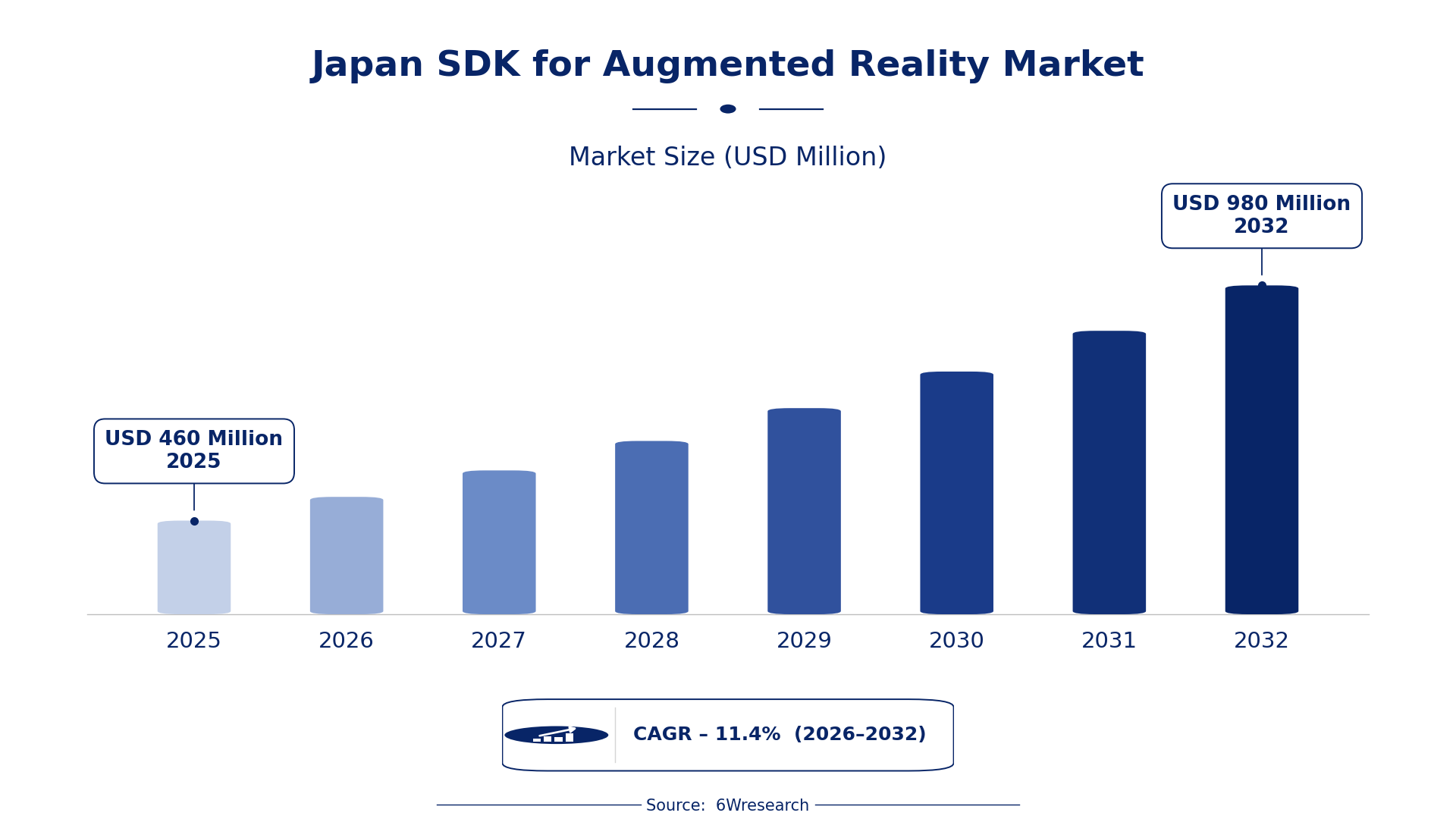
According to 6Wresearch internal database and industry insights, the Japan SDK for Augmented Reality Market was valued at USD 460 Million in 2025 and is projected to reach USD 980 Million by 2032, growing at a CAGR of approximately 11.4% during 2026–2032.
Japan SDK for Augmented Reality Market Highlights
| Report Metric | Details |
| Report Name | Japan SDK for Augmented Reality Market (2026-2032) |
| Market Size 2025 | USD 460 Million |
| Market Size 2032 | USD 980 Million |
| Absolute Growth 2025–2032 | USD 520 Million |
| CAGR 2026–2032 | 11.4% |
| Peak Annual Growth | 12.5% in 2029 |
| Forecast Period | 2026–2032 |
| Historical Data | 2022–2025 |
| Base Year | 2025 |
| Leading SDK Type, 2025 | SLAM-Based SDKs (45% share) |
| Leading Platform Support, 2025 | iOS / Android (54% share) |
| Leading Integration Scope, 2025 | Mobile App Developers (45% share) |
| Leading End User, 2025 | AR App Development Firms (41% share) |
| Fastest-Growing SDK Type | AR Cloud SDKs (16.4% CAGR) |
| Fastest-Growing Platform Support | Cross-Platform (17.5% CAGR) |
| Fastest-Growing Integration Scope | Cloud Integration (15.3% CAGR) |
| Fastest-Growing End User | Platform Providers (15.4% CAGR) |
| Growing Sector | Education and Training |
| Key End Users | Mobile App Developers, E-commerce Brands, AR App Development Firms, EdTech Developers |
Japan SDK for Augmented Reality Market Year-wise Growth Rate and Key Drivers (2022–2032)
This graph illustrates the annual growth rates of the market from 2022 to 2032, highlighting a steady upward trajectory and projected market expansion over the forecast period.
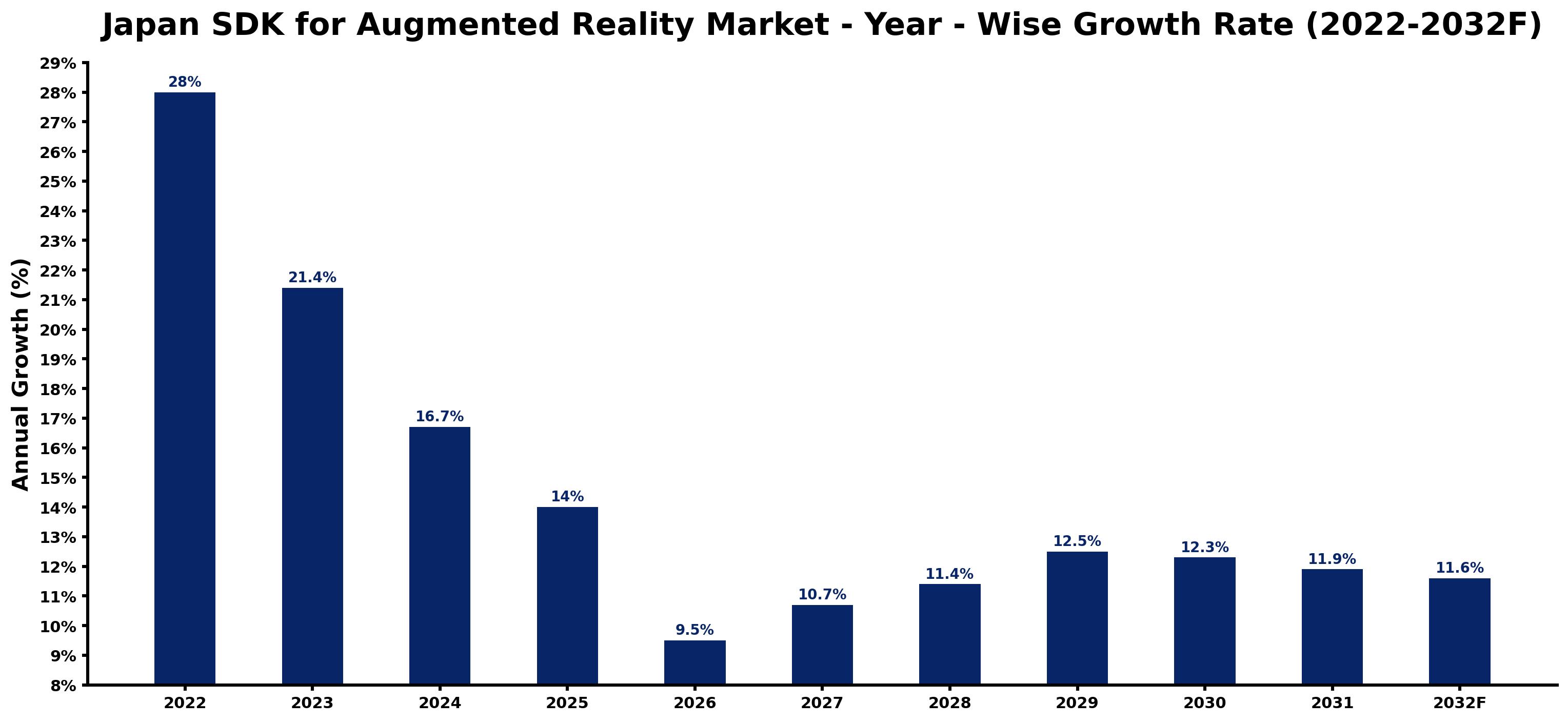
Below, each year's estimated growth is shown next to the factor that most influenced it.
| Year | Estimated Annual Growth (%) | Market Rationale |
| 2022 | 28.0 | The market experienced rapid growth due to high initial adoption rates. |
| 2023 | 21.4 | Demand continued but at a slower pace as early adopters filled the market. |
| 2024 | 16.7 | Growth slowed further as competition intensified among developers. |
| 2025 | 14.0 | A slowdown in growth rate reflected market saturation among existing users. |
| 2026 | 9.5 | The market will see a further slowdown as new entrants face challenges. |
| 2027 | 10.7 | Growth is expected to pick up as new applications emerge. |
| 2028 | 11.4 | Increased interest in AR for education will drive demand further. |
| 2029 | 12.5 | The market will peak as AR technology becomes mainstream in various sectors. |
| 2030 | 12.3 | Growth will moderate as the market stabilises after reaching its peak. |
| 2031 | 11.9 | A slowdown in growth rate is anticipated as competition increases. |
| 2032 | 11.6 | The market will continue to grow as new applications are developed. |
Note: Market size estimations and growth projections presented in this report are based on 6Wresearch's proprietary forecasting methodology, utilizing the latest available industry data, government publications, and primary research inputs.
Japan SDK for Augmented Reality Market Synopsis
An SDK for Augmented Reality is a software development kit that provides developers with tools and libraries to create AR applications. The Japan SDK for Augmented Reality Market is growing quickly, driven by rising demand from mobile app developers, gaming companies, and the educational sector. The market is projected to reach 1.5 billion USD by 2025, with strong contributions from urban tech hubs like Tokyo, supported by government initiatives that promote digital transformation in education.
Market Dynamics Impact Analysis (2026–2032)
| Factor | Type | Impact | Primary Segment Affected |
| Growing smartphone penetration | Driver | High | Mobile App Developers |
| Increasing use of AR in retail | Driver | High | E-commerce Brands |
| Rising demand for immersive educational tools | Opportunity | High | EdTech Developers |
| Expansion of AR in real estate for virtual tours | Opportunity | Medium | AR Cloud SDKs |
| Limited awareness of AR capabilities among businesses | Restraint | Medium | AR App Development Firms |
| High development costs for AR applications | Restraint | High | Mobile App Developers |
| Supply chain issues affecting SDK availability | Challenge | High | Platform Providers |
| Intense competition among AR developers | Challenge | Medium | AR App Development Firms |
Evaluation of Drivers in Japan SDK for Augmented Reality Market (2026–2032)
The factors lifting demand, and the evidence behind each, are summarised below.
| Drivers | Primary Segment Affected | Why It Matters (Evidence) |
| High smartphone penetration | Mobile App Developers | Approximately 80 million people in Japan use smartphones, driving demand for AR applications. |
| Increased investment in gaming | AR App Development Firms | The Tokyo Game Show 2023 showcased numerous AR innovations, attracting more developers. |
| Government support for digital transformation | E-commerce Brands | The Ministry of Internal Affairs and Communications promotes AR technology initiatives, boosting adoption. |
| Rising interest in virtual tours | AR Cloud SDKs | AR Cloud SDKs are gaining traction in the real estate industry for virtual tours, enhancing user experiences. |
| Growing adoption in education | EdTech Developers | In 2023, a government program promoted digital transformation in education, increasing AR use. |
Buyers are increasing capacity as approximately 80 million smartphone users in Japan fuel demand for AR applications. Investment in gaming is on the rise, with the Tokyo Game Show 2023 showcasing numerous AR innovations that attract more developers. Support for digital transformation encourages AR technology adoption in e-commerce applications, while interest in virtual tours within the real estate sector is boosting demand for AR solutions.
Evaluation of Restraints in Japan SDK for Augmented Reality Market
These restraints slow adoption and weigh on supplier margins.
| Market Restraint | Primary Segment Affected | Why It Matters (Evidence) |
| Limited awareness of AR capabilities | AR App Development Firms | Many businesses remain unaware of how AR can improve their operations, hindering adoption. |
| High development costs for AR applications | Mobile App Developers | Developers face expenses exceeding 500,000 USD per project, limiting market entry. |
| Supply chain issues affecting SDK availability | Platform Providers | Supply chain disruptions have led to delays in SDK availability, impacting development timelines. |
| Intense competition among AR developers | AR App Development Firms | The growing number of developers increases competition, making it difficult to capture market share. |
| Regulatory hurdles for new technologies | E-commerce Brands | Compliance with standards like JIS X 0210 can slow down the introduction of AR solutions. |
Japan SDK for Augmented Reality Market Challenges
High development costs deter buyers from adopting AR SDKs, with project expenses often exceeding 500,000 USD. Suppliers face intense competition, forcing them to lower prices, which can compromise quality and result in unsatisfactory products for developers. Rapid technological advancements create a gap, causing delays of up to six months for suppliers to update their offerings, impacting buyers' project timelines. A shortage of skilled professionals in AR technology limits suppliers' ability to meet demand, resulting in project delays for developers and potential revenue losses for their businesses.
Trends in the Japan SDK for Augmented Reality Market
The shifts below are changing how Japan SDK for Augmented Reality Market products are bought and supplied.
- Launch of Digital Transformation Program in Education: In 2023, the government initiated a program to promote digital transformation in education, increasing AR's role in learning environments. This initiative is expected to accelerate AR adoption in educational institutions, improving learning experiences.
- Shift Towards Cloud-Based AR Solutions: AR Cloud SDKs are gaining traction in the real estate industry, enabling virtual tours and enhanced customer experiences. This trend reflects the need for effective marketing strategies in a competitive environment.
- Integration of AR in Retail Experiences: AR technology is increasingly utilised in the retail sector, boosting customer engagement and providing interactive shopping experiences. This shift is clear as more retailers adopt AR solutions to attract consumers.
- Rise of Cross-Platform AR Development: Cross-Platform SDKs are becoming popular as developers aim to reach wider audiences across different operating systems. This trend is driven by a growing demand for adaptable AR applications.
Investment Opportunities in the Japan SDK for Augmented Reality Market
Where to invest in the Japan SDK for Augmented Reality Market: the main openings are set out below.
- E-commerce Brands seeking AR solutions: E-commerce brands are increasingly looking for AR solutions to improve customer engagement. With the AR market projected to reach 1.5 billion USD by 2025, there is substantial potential for investment in this area.
- Tokyo as a hub for AR development: Tokyo is a major hub for AR development, hosting numerous tech startups. Investing in local partnerships can help tap into this vibrant ecosystem and drive innovation.
- Cloud Integration for improved AR functionalities: Cloud integration is essential for enhancing AR functionalities, particularly in real estate. Companies can enter this space through joint ventures with local developers to utilise existing infrastructure.
- Growing demand for educational AR tools: The need for immersive educational tools is rising, particularly in schools. Investing in AR solutions for educational content can lead to fruitful opportunities as institutions seek to engage students more effectively.
Government Initiatives in the Japan SDK for Augmented Reality Market
The Digital Agency, established in September 2021, leads government digital transformation efforts, setting common system standards. This agency's initiatives support AR technology adoption, encouraging developers to create compliant applications that meet market needs. The Building Energy Efficiency Act, amended in 2022, requires new buildings to meet energy standards, indirectly promoting AR applications for energy management and efficiency improvements.
The Ministry of Internal Affairs and Communications funds various AR technology initiatives, aiming to improve digital capabilities across sectors. This agency's support for AR development projects is vital for driving innovation and ensuring compliance with relevant standards, benefiting both developers and end-users.
Future Insight of the Japan SDK for Augmented Reality Market
Technological advancements in AR will transform user experiences by 2032, opening new avenues for developers. The government's digital transformation initiative will encourage educational institutions to adopt AR tools, equipping students with necessary skills. The JIS X 0210 standard will improve compatibility across AR applications, boosting market trust. With AR app downloads surpassing 100 million in 2023, suppliers must innovate continuously to meet growing demand in sectors like retail and tourism.
Market Segmentation Analysis
Japan SDK for Augmented Reality Market report covers a detailed analysis of the following market segments:
By SDK Type – SLAM-Based SDKs Lead, AR Cloud SDKs Expected to Grow Fastest
According to Saurav Kr Singh, Senior Research Analyst at 6Wresearch, SLAM-Based SDKs held 45% of the Japan SDK for Augmented Reality Market by sdk type in 2025. SLAM-Based SDKs hold the largest share as they are vital for real-time environment mapping, which is essential in sectors like mobile gaming and education. Their widespread adoption in Japan's tech ecosystem underlines their importance for developers creating immersive AR experiences. Over 2026–2032, AR Cloud SDKs are expected to post the fastest growth, at a CAGR of 16.4%. AR Cloud SDKs are experiencing rapid growth as they enable shared AR experiences, which are increasingly sought after in industries such as real estate for virtual tours. This trend indicates a rising demand for collaborative AR applications that enhance user interaction. Suppliers should prioritise the development of AR Cloud SDKs to meet the growing demand for shared AR experiences.
By Platform Support – iOS / Android Leads, Cross-Platform Expected to Grow Fastest
iOS / Android took 54% of platform support revenue in 2025, more than any other category. iOS / Android platforms dominate the market as they are the primary channels for deploying AR applications, reaching a substantial share of Japan's smartphone users. With approximately 80 million users on these platforms, they are crucial for engaging a large audience in the AR space. Cross-Platform is projected to grow fastest, at a CAGR of 17.5% during 2026–2032. Cross-Platform support is growing quickly as it allows developers to create applications that work across various operating systems, thereby broadening their market reach. This flexibility is particularly appealing to developers looking to maximise user engagement across diverse devices. Developers should focus on enhancing cross-platform capabilities to attract a wider user base and improve accessibility of their applications.
By Integration Scope – Mobile App Developers Lead, Cloud Integration Expected to Grow Fastest
In 2025, Mobile App Developers led the integration scope split with a 45% share. Mobile App Developers represent the largest segment as they are the primary users of SDKs for creating diverse AR applications, driving innovation in the market. Their active involvement in sectors such as gaming and education highlights their critical role in shaping AR development. The quickest growth will come from Cloud Integration, forecast to expand at a CAGR of 15.3% between 2026 and 2032. Cloud Integration is rapidly gaining traction as it offers essential functionalities for managing AR data and improving user experiences. The increasing complexity of AR applications necessitates robust cloud solutions for effective deployment and operation. Suppliers must invest in cloud integration solutions to align with the evolving needs of AR developers.
By End User – AR App Development Firms Lead, Platform Providers Expected to Grow Fastest
With 41% of end user revenue in 2025, AR App Development Firms was the largest category. AR App Development Firms lead the market as they are the main producers of AR applications, significantly influencing the industry's overall growth trajectory. Their focus on creating engaging and interactive content drives the demand for advanced SDKs in the market. Platform Providers are set to record the highest CAGR in this split, 15.4% over 2026–2032. Platform Providers are experiencing the fastest growth due to their crucial role in providing the necessary infrastructure for AR applications, which is vital for the success of AR initiatives. Their support enables developers to focus on content creation while ensuring optimal performance of applications. Suppliers should collaborate with platform providers to enhance the infrastructure that supports AR applications.
Key Attractiveness of the Report
- 10 Years of Market Numbers
- Historical Data Starting from 2022 to 2025
- Base Year 2025
- Forecast Data until 2032
- Key Performance Indicators Impacting the Market
- Major Upcoming Developments and Projects
Key Highlights of the Report:
- Japan SDK for Augmented Reality Market Outlook
- Market Size of Japan SDK for Augmented Reality Market, 2025
- Forecast of Japan SDK for Augmented Reality Market, 2032
- Historical Data and Forecast of Japan SDK for Augmented Reality Revenues & Volume for the Period 2022-2032F
- Japan SDK for Augmented Reality Market Trend Evolution
- Japan SDK for Augmented Reality Market Drivers and Challenges
- Japan SDK for Augmented Reality Price Trends
- Japan SDK for Augmented Reality Porter's Five Forces
- Japan SDK for Augmented Reality Industry Life Cycle
- Historical Data and Forecast of Japan SDK for Augmented Reality Market Revenues & Volume By SDK Type for the Period 2022-2032F
- Historical Data and Forecast of Japan SDK for Augmented Reality Market Revenues & Volume By SLAM-Based SDKs for the Period 2022-2032F
- Historical Data and Forecast of Japan SDK for Augmented Reality Market Revenues & Volume By AR Cloud SDKs for the Period 2022-2032F
- Historical Data and Forecast of Japan SDK for Augmented Reality Market Revenues & Volume By Furniture Placement SDKs for the Period 2022-2032F
- Historical Data and Forecast of Japan SDK for Augmented Reality Market Revenues & Volume By Marker-Based SDKs for the Period 2022-2032F
- Historical Data and Forecast of Japan SDK for Augmented Reality Market Revenues & Volume By Platform Support for the Period 2022-2032F
- Historical Data and Forecast of Japan SDK for Augmented Reality Market Revenues & Volume By iOS / Android for the Period 2022-2032F
- Historical Data and Forecast of Japan SDK for Augmented Reality Market Revenues & Volume By Cross-Platform for the Period 2022-2032F
- Historical Data and Forecast of Japan SDK for Augmented Reality Market Revenues & Volume By iOS / Android for the Period 2022-2032F
- Historical Data and Forecast of Japan SDK for Augmented Reality Market Revenues & Volume By Web / Mobile for the Period 2022-2032F
- Historical Data and Forecast of Japan SDK for Augmented Reality Market Revenues & Volume By Integration Scope for the Period 2022-2032F
- Historical Data and Forecast of Japan SDK for Augmented Reality Market Revenues & Volume By Mobile App Developers for the Period 2022-2032F
- Historical Data and Forecast of Japan SDK for Augmented Reality Market Revenues & Volume By Cloud Integration for the Period 2022-2032F
- Historical Data and Forecast of Japan SDK for Augmented Reality Market Revenues & Volume By Commerce Integration for the Period 2022-2032F
- Historical Data and Forecast of Japan SDK for Augmented Reality Market Revenues & Volume By Education Content for the Period 2022-2032F
- Historical Data and Forecast of Japan SDK for Augmented Reality Market Revenues & Volume By End User for the Period 2022-2032F
- Historical Data and Forecast of Japan SDK for Augmented Reality Market Revenues & Volume By AR App Development Firms for the Period 2022-2032F
- Historical Data and Forecast of Japan SDK for Augmented Reality Market Revenues & Volume By Platform Providers for the Period 2022-2032F
- Historical Data and Forecast of Japan SDK for Augmented Reality Market Revenues & Volume By E-commerce Brands for the Period 2022-2032F
- Historical Data and Forecast of Japan SDK for Augmented Reality Market Revenues & Volume By EdTech Developers for the Period 2022-2032F
- Japan SDK for Augmented Reality Import Export Trade Statistics
- Market Opportunity Assessment By SDK Type
- Market Opportunity Assessment By Platform Support
- Market Opportunity Assessment By Integration Scope
- Market Opportunity Assessment By End User
- Japan SDK for Augmented Reality Top Companies Market Share
- Japan SDK for Augmented Reality Competitive Benchmarking By Technical and Operational Parameters
- Japan SDK for Augmented Reality Company Profiles
- Japan SDK for Augmented Reality Key Strategic Recommendations
Market Covered
This report examines the market across the segments below.
By SDK Type
- SLAM-Based SDKs
- AR Cloud SDKs
- Furniture Placement SDKs
- Marker-Based SDKs
By Platform Support
- iOS / Android
- Cross-Platform
- Web / Mobile
By Integration Scope
- Mobile App Developers
- Cloud Integration
- Commerce Integration
- Education Content
By End User
- AR App Development Firms
- Platform Providers
- E-commerce Brands
- EdTech Developers































