Japan Seafood Production Market Size & Growth Rate
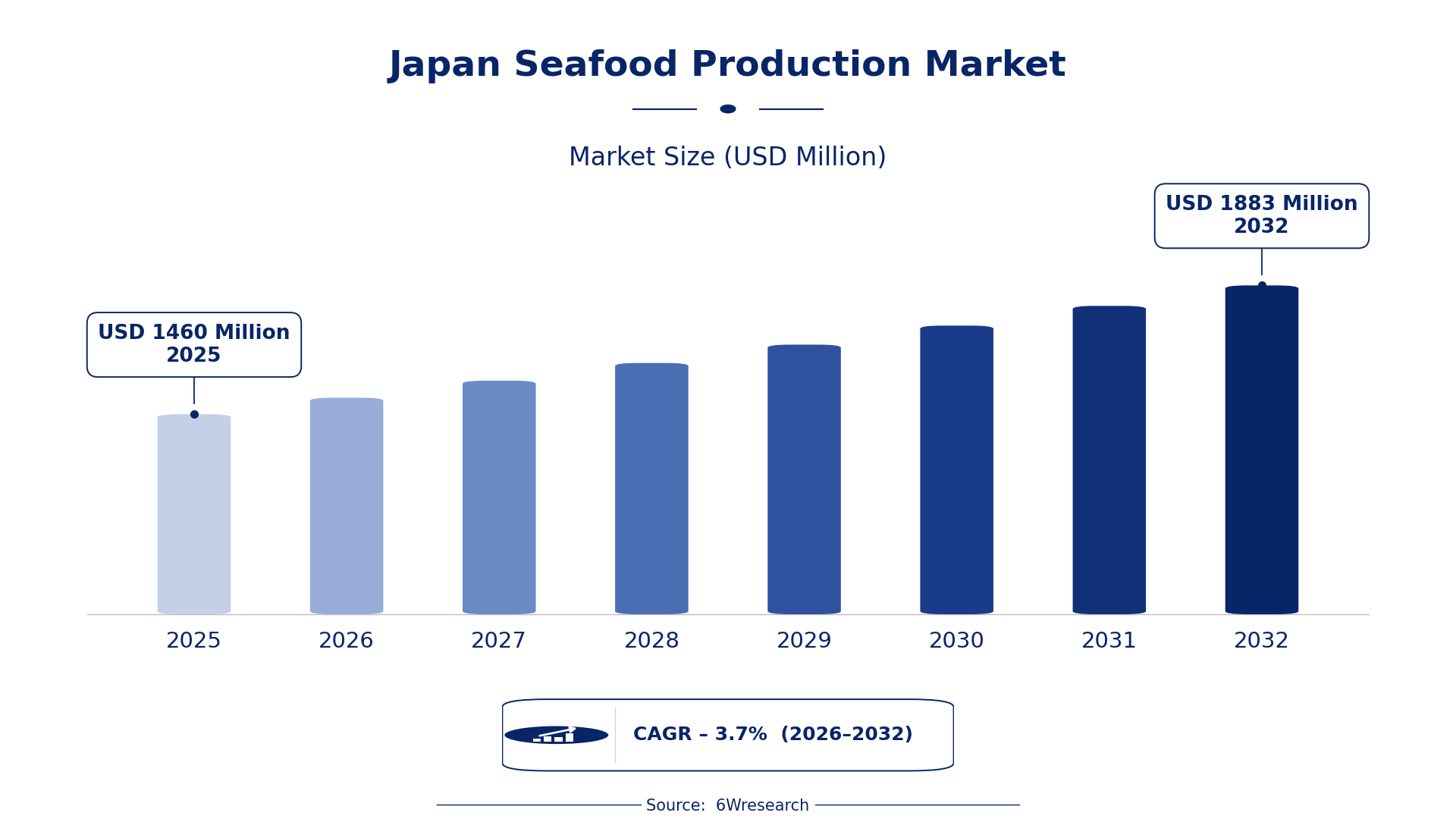
According to 6Wresearch internal database and industry insights, the Japan Seafood Production Market was valued at USD 1,460 Million in 2025 and is projected to reach USD 1,883 Million by 2032, growing at a CAGR of approximately 3.7% during 2026–2032.
Japan Seafood Production Market Highlights
| Report Metric | Details |
| Report Name | Japan Seafood Production Market (2026-2032) |
| Market Size 2025 | USD 1,460 Million |
| Market Size 2032 | USD 1,883 Million |
| Absolute Growth 2025–2032 | USD 423 Million |
| CAGR 2026–2032 | 3.7% |
| Peak Annual Growth | 4.4% in 2026 |
| Forecast Period | 2026–2032 |
| Historical Data | 2022–2025 |
| Base Year | 2025 |
| Leading Production Method, 2025 | Aquaculture (53% share) |
| Leading Species, 2025 | Shrimp (47% share) |
| Leading Farming Type, 2025 | Pond / Cage Farming (44% share) |
| Leading End User, 2025 | Export Companies (47% share) |
| Fastest-Growing Production Method | Wild Capture (5.1% CAGR) |
| Fastest-Growing Species | Salmon (5.0% CAGR) |
| Fastest-Growing Farming Type | Longline (5.3% CAGR) |
| Fastest-Growing End User | Seafood Distributors (4.7% CAGR) |
| Growing Sector | Aquaculture |
| Key End Users | Export Companies, Seafood Distributors, Foodservice Providers, Retail Seafood Markets |
Japan Seafood Production Market Year-wise Growth Rate and Key Drivers (2022–2032)
This graph illustrates the annual growth rates of the market from 2022 to 2032, highlighting a steady upward trajectory and projected market expansion over the forecast period.
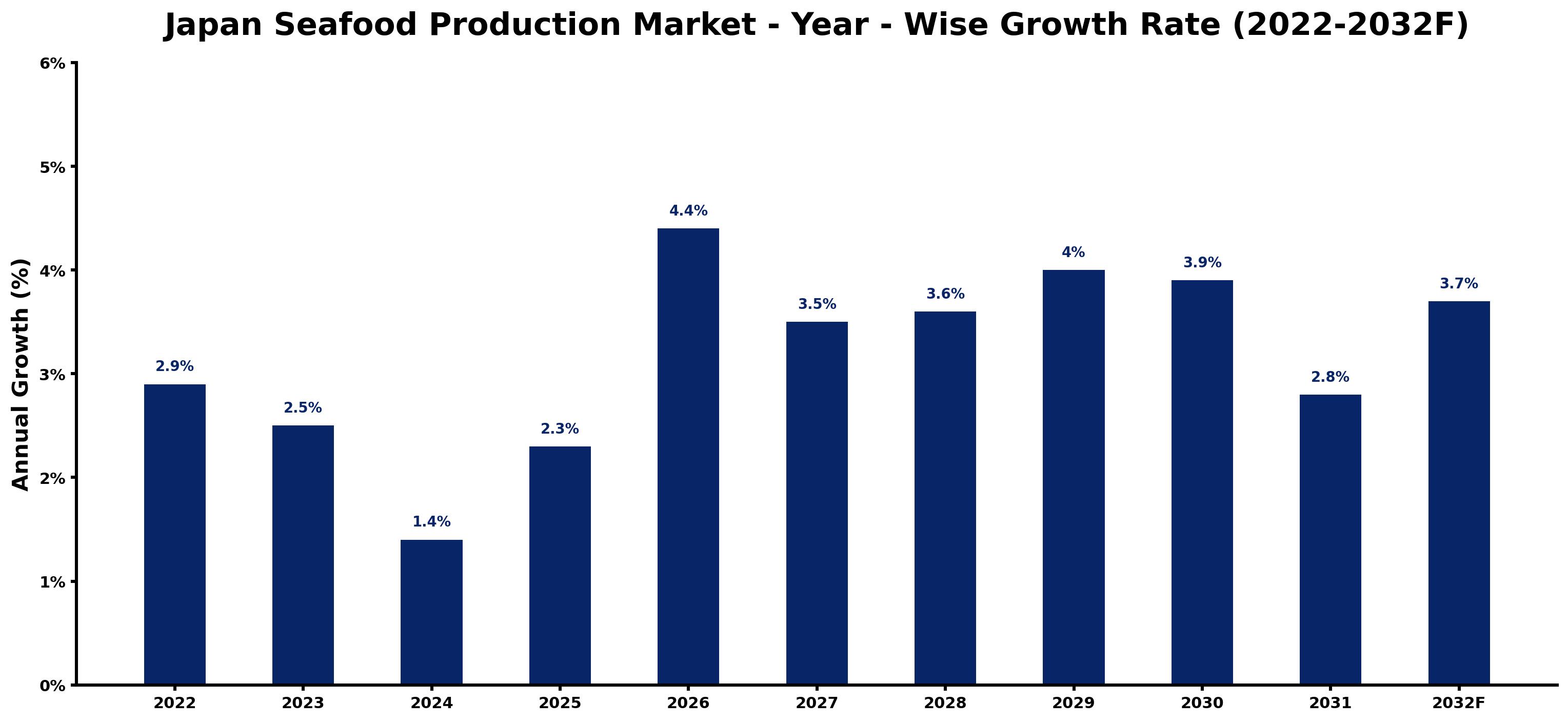
Year by year, the estimates below pair each growth rate with the development that shaped it.
| Year | Estimated Annual Growth (%) | Market Rationale |
| 2022 | 2.9 | Demand remained stable, driven by steady domestic consumption and export markets. |
| 2023 | 2.5 | Growth slowed due to a decrease in seafood consumption amid changing consumer preferences. |
| 2024 | 1.4 | Market growth continued to decelerate as production faced challenges from environmental factors. |
| 2025 | 2.3 | A resurgence in demand occurred as export markets expanded and local consumption increased. |
| 2026 | 4.4 | Growth surged as aquaculture investments boosted production capacity and efficiency. |
| 2027 | 3.5 | Market growth slowed due to rising operational costs affecting profitability. |
| 2028 | 3.6 | Demand increased again as new technologies improved aquaculture practices and yields. |
| 2029 | 4.0 | Growth remained strong, supported by rising exports and domestic consumption. |
| 2030 | 3.9 | Growth slowed as the market adjusted to fluctuating supply and demand. |
| 2031 | 2.8 | Demand continued to grow, driven by a stable export market and consumer interest. |
| 2032 | 3.7 | Growth accelerated as technological advancements in aquaculture improved production efficiency. |
Note: Market size estimations and growth projections presented in this report are based on 6Wresearch's proprietary forecasting methodology, utilizing the latest available industry data, government publications, and primary research inputs.
Japan Seafood Production Market Synopsis
Seafood production in Japan involves aquaculture and wild capture methods, focusing on farming practices and harvesting from natural waters. The Japan Seafood Production Market is expanding, with production reaching 4.5 million tons in 2022, driven by strong domestic consumption and exports valued at approximately $2.5 billion. Key factors include investments in aquaculture and the promotion of sustainable practices, which collectively support market growth and appeal to environmentally conscious consumers.
Market Dynamics Impact Analysis (2026–2032)
| Factor | Type | Impact | Primary Segment Affected |
| Rising domestic consumption of seafood products | Driver | High | Aquaculture |
| Increasing investments in aquaculture technologies | Driver | High | Aquaculture |
| Growing demand for sustainable seafood options | Opportunity | High | Mollusk Farming |
| Expansion of export markets for seafood products | Opportunity | High | Export Companies |
| Environmental regulations impacting production methods | Restraint | Medium | Wild Capture |
| Rising operational costs affecting profitability | Restraint | Medium | Aquaculture |
| Limited availability of skilled labour in seafood production | Challenge | High | Aquaculture |
| Compliance with stringent food safety regulations | Challenge | High | Seafood Distributors |
Evaluation of Drivers in Japan Seafood Production Market (2026–2032)
The factors lifting demand, and the evidence behind each, are summarised below.
| Drivers | Primary Segment Affected | Why It Matters (Evidence) |
| Increased seafood consumption driven by health trends | Aquaculture | The average annual seafood consumption per person in Japan is about 30 kg, prompting higher production levels. |
| Technological advancements in aquaculture practices | Aquaculture | The Fisheries Agency's initiatives aim to improve production efficiency, leading to increased investments. |
| Growing export opportunities for seafood products | Export Companies | Japan exported seafood worth approximately $2.5 billion in 2022, boosting production to meet demand. |
| Rising interest in sustainable seafood practices | Mollusk Farming | The Fisheries Agency oversees sustainable management, which can limit production capacities. |
| Support from local governments for seafood initiatives | Seafood Distributors | The Seafood Traceability Program launched in 2023 enhances consumer trust and boosts sales. |
Much of the new demand traces back to a growing interest in seafood as a healthy dietary choice, with average consumption at about 30 kg per person. Technological advancements are reshaping aquaculture practices, leading to increased investments in production efficiency. Export opportunities have expanded, with seafood exports valued at approximately $2.5 billion in 2022, prompting increased production.
Evaluation of Restraints in Japan Seafood Production Market
These are the pressures that could keep growth below its potential.
| Market Restraint | Primary Segment Affected | Why It Matters (Evidence) |
| Environmental regulations limiting fishing practices | Wild Capture | The Trawling Association of Japan advocates for sustainable practices, which can restrict fishing volumes. |
| Increasing operational costs due to rising wages | Aquaculture | Japan's national weighted-average minimum wage rose to JPY 1,055 per hour in October 2024, impacting profitability. |
| Challenges in maintaining sustainable production levels | Aquaculture | The Fisheries Agency oversees sustainable management, which can limit production capacities. |
| Competition from imported seafood products | Export Companies | Imported seafood can affect local market prices and demand for domestic products. |
| Limited access to skilled labour in the seafood sector | Aquaculture | The ageing population, with 29.3% aged 65 or older, reduces the available workforce. |
Japan Seafood Production Market Challenges
Producers face rising operational costs, as the national minimum wage reached JPY 1,055 per hour, which raises production expenses and compresses profit margins. Supply chain disruptions arise from Japan's declining population, which has decreased annually since 2011, resulting in a smaller workforce that delays seafood processing times. Competition intensifies with Japan exporting seafood worth approximately $2.5 billion in 2022, compelling local producers to innovate or risk losing market share to imports. Skills shortages are apparent as 29.3% of the population is aged 65 or older, reducing the pool of younger workers available for the industry.
Trends in the Japan Seafood Production Market
The trends below show where the Japan Seafood Production Market is heading.
- Shift towards Sustainable Seafood Practices: Japan is increasingly prioritising sustainable seafood production methods, as seen in the 'Green Seafood' initiative launched in 2023. This initiative promotes eco-friendly practices across the industry, encouraging producers to adopt more sustainable methods and improve market appeal.
- Growth in Aquaculture Technologies: The aquaculture sector is experiencing a surge in technological advancements, with investments aimed at improving production efficiency. The Fisheries Agency's initiatives target enhanced production capabilities, driving innovation in farming techniques.
- Rising Popularity of Mollusk Products: Mollusk farming is gaining traction in Japan, particularly for oysters and mussels. With over 300 registered farms, this segment is expanding rapidly, reflecting a growing consumer preference for these seafood options.
- Expansion of Export Markets for Seafood: Japan's seafood exports are on the rise, with a reported value of approximately $2.5 billion in 2022. This growth is prompting local producers to increase output to meet international demand.
Investment Opportunities in the Japan Seafood Production Market
Where to invest in the Japan Seafood Production Market: the main openings are set out below.
- Hokkaido as a Seafood Production Hub: Hokkaido is a key region for seafood production, especially for salmon. With production reaching 4.5 million tons in 2022, there is an opportunity for investment in processing facilities to cater to both domestic and export markets.
- Growing Demand for Eco-Friendly Seafood: The current market trend towards sustainable seafood practices presents an opportunity for investment in eco-friendly production methods. The 'Green Seafood' initiative encourages producers to adopt these practices, appealing to environmentally conscious consumers.
- Investment in Aquaculture Technology: Now is an ideal time to invest in aquaculture technology, as the government aims to enhance production by 2025. This creates opportunities for suppliers of advanced farming equipment and systems.
- Expansion of Seafood Distribution Channels: With over 1,200 registered seafood distributors in Japan, there is potential for growth in distribution networks. Investing in logistics and supply chain solutions can help meet the increasing demand for seafood products.
Government Initiatives in the Japan Seafood Production Market
The Seafood Production Market in Japan is significantly influenced by the Food Sanitation Act amendment of 2018, which mandates HACCP-based hygiene management for food businesses. This regulation ensures that seafood producers maintain high safety standards, thus boosting consumer confidence in domestic products. Compliance with these standards is crucial for producers aiming to access both local and international markets, as it affects their ability to meet export requirements and consumer expectations.
The Fisheries Agency of Japan oversees initiatives such as the Seafood Traceability Program, launched in 2023, which aims to enhance transparency in seafood sourcing. This program is part of a broader effort to promote sustainable practices within the industry, with funding allocated to support compliance and implementation. The agency's commitment to sustainable management is crucial for maintaining the health of marine ecosystems and ensuring the long-term viability of seafood production in Japan.
Future Insight of the Japan Seafood Production Market
Advanced technologies will reshape seafood production by 2032, with the Sustainable Seafood Initiative promoting eco-friendly practices that attract environmentally conscious buyers. The Aquaculture Development Strategy aims to enhance production, which could lead to an increase in average annual seafood consumption per person, potentially reaching 32 kg. Improved traceability measures will boost consumer confidence, encouraging higher domestic demand. Enhanced production methods will likely increase efficiency and product quality, benefiting both buyers and suppliers.
Market Segmentation Analysis
Japan Seafood Production Market report covers a detailed analysis of the following market segments:
By Production Method – Aquaculture Leads, Wild Capture Expected to Grow Fastest
According to Saurav Kr Singh, Senior Research Analyst at 6Wresearch, Aquaculture took 53% of production method revenue in 2025, more than any other category. Aquaculture holds the largest share due to its ability to produce seafood in controlled environments, meeting both domestic and export demands. For instance, this sector contributed approximately 1.3 million tons to Japan's total seafood production in 2022, showcasing its vital role. Over 2026–2032, Wild Capture is expected to post the fastest growth, at a CAGR of 5.1%. Wild capture is experiencing rapid growth as traditional fishing methods attract consumers interested in authentic flavours. This method is particularly valued for its contribution to traditional dishes, which are gaining popularity in Japan's culinary scene. Suppliers should focus on enhancing aquaculture capabilities to meet the increasing demand for seafood.
By Species – Shrimp Leads, Salmon Expected to Grow Fastest
In 2025, Shrimp led the species split with a 47% share. Shrimp farming leads the market as it is a vital aquaculture segment in Japan, ensuring a consistent seafood supply for local and export markets. The high demand for shrimp across various culinary applications reinforces its dominant position. The quickest growth will come from Salmon, forecast to expand at a CAGR of 5.0% between 2026 and 2032. Salmon is experiencing the fastest growth due to its popularity among consumers and widespread farming practices. The increasing preference for salmon in health-conscious diets is propelling this segment's rapid expansion. Buyers should diversify their seafood offerings to include more salmon in response to consumer preferences.
By Farming Type – Pond / Cage Farming Leads, Longline Expected to Grow Fastest
The largest farming type category in 2025 was Pond / Cage Farming, at 44% of revenue. Pond and cage farming are prevalent due to their adaptability and effectiveness in aquaculture, making them the primary methods for seafood production. These practices allow for the cultivation of various species, ensuring a steady supply to meet market demands. Longline is projected to grow fastest, at a CAGR of 5.3% during 2026–2032. Longline fishing is growing quickly as it targets high-value species, appealing to both domestic and international markets. This method's efficiency in capturing premium fish contributes to its rapid adoption among fishers. Suppliers may need to invest in longline techniques to capitalise on the increasing demand for high-value seafood.
By End User – Export Companies Lead, Seafood Distributors Expected to Grow Fastest
With 47% of end user revenue in 2025, Export Companies was the largest category. Export companies are pivotal in the seafood distribution chain, significantly shaping Japan's seafood market through their role in international trade. Their operations accounted for a considerable portion of the $2.5 billion worth of seafood exported in 2022, highlighting their influence. Seafood Distributors are set to record the highest CAGR in this split, 4.7% over 2026–2032. Seafood distributors are witnessing the fastest growth as they bridge the gap between producers and consumers, ensuring timely delivery and product freshness. The rising seafood consumption market is driving their increasing importance in the supply chain. Suppliers should strengthen partnerships with distributors to enhance market reach and operational efficiency.
Key Attractiveness of the Report
- 10 Years of Market Numbers
- Historical Data Starting from 2022 to 2025
- Base Year 2025
- Forecast Data until 2032
- Key Performance Indicators Impacting the Market
- Major Upcoming Developments and Projects
Key Highlights of the Report:
- Japan Seafood Production Market Outlook
- Market Size of Japan Seafood Production Market, 2025
- Forecast of Japan Seafood Production Market, 2032
- Historical Data and Forecast of Japan Seafood Production Revenues & Volume for the Period 2022-2032F
- Japan Seafood Production Market Trend Evolution
- Japan Seafood Production Market Drivers and Challenges
- Japan Seafood Production Price Trends
- Japan Seafood Production Porter's Five Forces
- Japan Seafood Production Industry Life Cycle
- Historical Data and Forecast of Japan Seafood Production Market Revenues & Volume By Production Method for the Period 2022-2032F
- Historical Data and Forecast of Japan Seafood Production Market Revenues & Volume By Aquaculture for the Period 2022-2032F
- Historical Data and Forecast of Japan Seafood Production Market Revenues & Volume By Wild Capture for the Period 2022-2032F
- Historical Data and Forecast of Japan Seafood Production Market Revenues & Volume By Recirculating Aquaculture Systems (RAS) for the Period 2022-2032F
- Historical Data and Forecast of Japan Seafood Production Market Revenues & Volume By Mollusk Farming for the Period 2022-2032F
- Historical Data and Forecast of Japan Seafood Production Market Revenues & Volume By Species for the Period 2022-2032F
- Historical Data and Forecast of Japan Seafood Production Market Revenues & Volume By Shrimp, Salmon for the Period 2022-2032F
- Historical Data and Forecast of Japan Seafood Production Market Revenues & Volume By Tuna, Mackerel for the Period 2022-2032F
- Historical Data and Forecast of Japan Seafood Production Market Revenues & Volume By Tilapia for the Period 2022-2032F
- Historical Data and Forecast of Japan Seafood Production Market Revenues & Volume By Oysters, Mussels for the Period 2022-2032F
- Historical Data and Forecast of Japan Seafood Production Market Revenues & Volume By Farming Type for the Period 2022-2032F
- Historical Data and Forecast of Japan Seafood Production Market Revenues & Volume By Pond / Cage Farming for the Period 2022-2032F
- Historical Data and Forecast of Japan Seafood Production Market Revenues & Volume By Longline, Trawling for the Period 2022-2032F
- Historical Data and Forecast of Japan Seafood Production Market Revenues & Volume By Indoor Farming for the Period 2022-2032F
- Historical Data and Forecast of Japan Seafood Production Market Revenues & Volume By Coastal Farming for the Period 2022-2032F
- Historical Data and Forecast of Japan Seafood Production Market Revenues & Volume By End User for the Period 2022-2032F
- Historical Data and Forecast of Japan Seafood Production Market Revenues & Volume By Export Companies for the Period 2022-2032F
- Historical Data and Forecast of Japan Seafood Production Market Revenues & Volume By Seafood Distributors for the Period 2022-2032F
- Historical Data and Forecast of Japan Seafood Production Market Revenues & Volume By Foodservice Providers for the Period 2022-2032F
- Historical Data and Forecast of Japan Seafood Production Market Revenues & Volume By Retail Seafood Markets for the Period 2022-2032F
- Japan Seafood Production Import Export Trade Statistics
- Market Opportunity Assessment By Production Method
- Market Opportunity Assessment By Species
- Market Opportunity Assessment By Farming Type
- Market Opportunity Assessment By End User
- Japan Seafood Production Top Companies Market Share
- Japan Seafood Production Competitive Benchmarking By Technical and Operational Parameters
- Japan Seafood Production Company Profiles
- Japan Seafood Production Key Strategic Recommendations
Market Covered
The study includes the following segmentation.
By Production Method
- Aquaculture
- Wild Capture
- Recirculating Aquaculture Systems (RAS)
- Mollusk Farming
By Species
- Shrimp
- Salmon
- Tuna
- Mackerel
- Tilapia
- Oysters
- Mussels
By Farming Type
- Pond / Cage Farming
- Longline
- Trawling
- Indoor Farming
- Coastal Farming
By End User
- Export Companies
- Seafood Distributors
- Foodservice Providers
- Retail Seafood Markets































