Japan Second-Generation Biofuel Market Size & Growth Rate
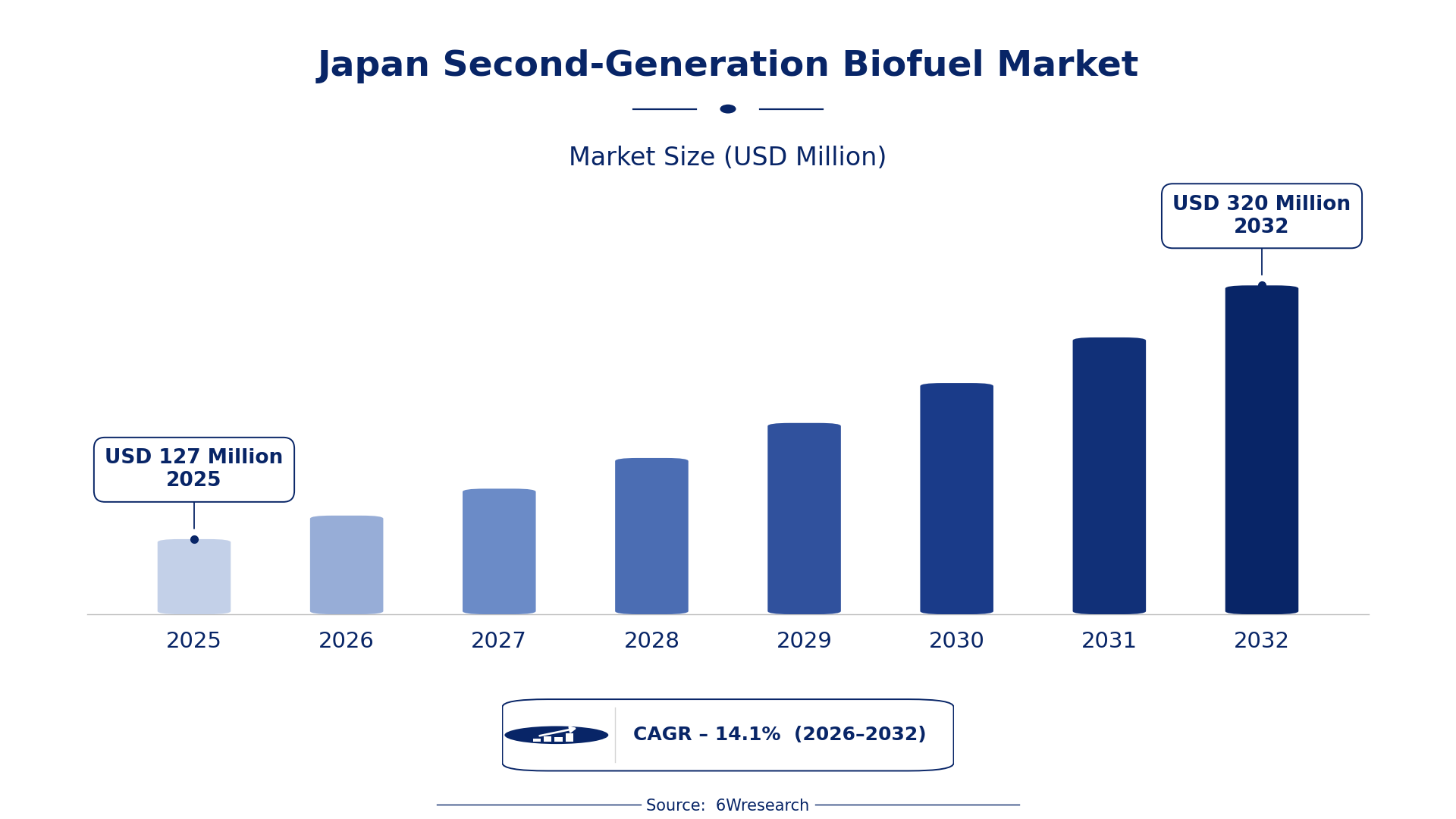
According to 6Wresearch internal database and industry insights, the Japan Second-Generation Biofuel Market was valued at USD 127 Million in 2025 and is projected to reach USD 320 Million by 2032, growing at a CAGR of approximately 14.1% during 2026–2032.
Japan Second-Generation Biofuel Market Highlights
| Report Metric | Details |
| Report Name | Japan Second-Generation Biofuel Market (2026-2032) |
| Market Size 2025 | USD 127 Million |
| Market Size 2032 | USD 320 Million |
| Absolute Growth 2025–2032 | USD 193 Million |
| CAGR 2026–2032 | 14.1% |
| Peak Annual Growth | 14.9% in 2029 |
| Forecast Period | 2026–2032 |
| Historical Data | 2022–2025 |
| Base Year | 2025 |
| Leading Feedstock, 2025 | Lignocellulosic Biomass (36% share) |
| Leading Biofuel Type, 2025 | 2G Ethanol (53% share) |
| Leading Production Technology, 2025 | Enzymatic Hydrolysis (54% share) |
| Leading End User, 2025 | Transportation Fuel Suppliers (37% share) |
| Fastest-Growing Feedstock | Algae-Derived Biofuel (20.1% CAGR) |
| Fastest-Growing Biofuel Type | Biodiesel (20.6% CAGR) |
| Fastest-Growing Production Technology | Transesterification (19.6% CAGR) |
| Fastest-Growing End User | Aviation & Marine Fuel Firms (18.3% CAGR) |
| Growing Sector | Transportation fuels |
| Key End Users | Transportation Fuel Suppliers, Urban Utility Providers, Industrial Fuel Consumers |
Japan Second-Generation Biofuel Market Year-wise Growth Rate and Key Drivers (2022–2032)
This graph illustrates the annual growth rates of the market from 2022 to 2032, highlighting a steady upward trajectory and projected market expansion over the forecast period.
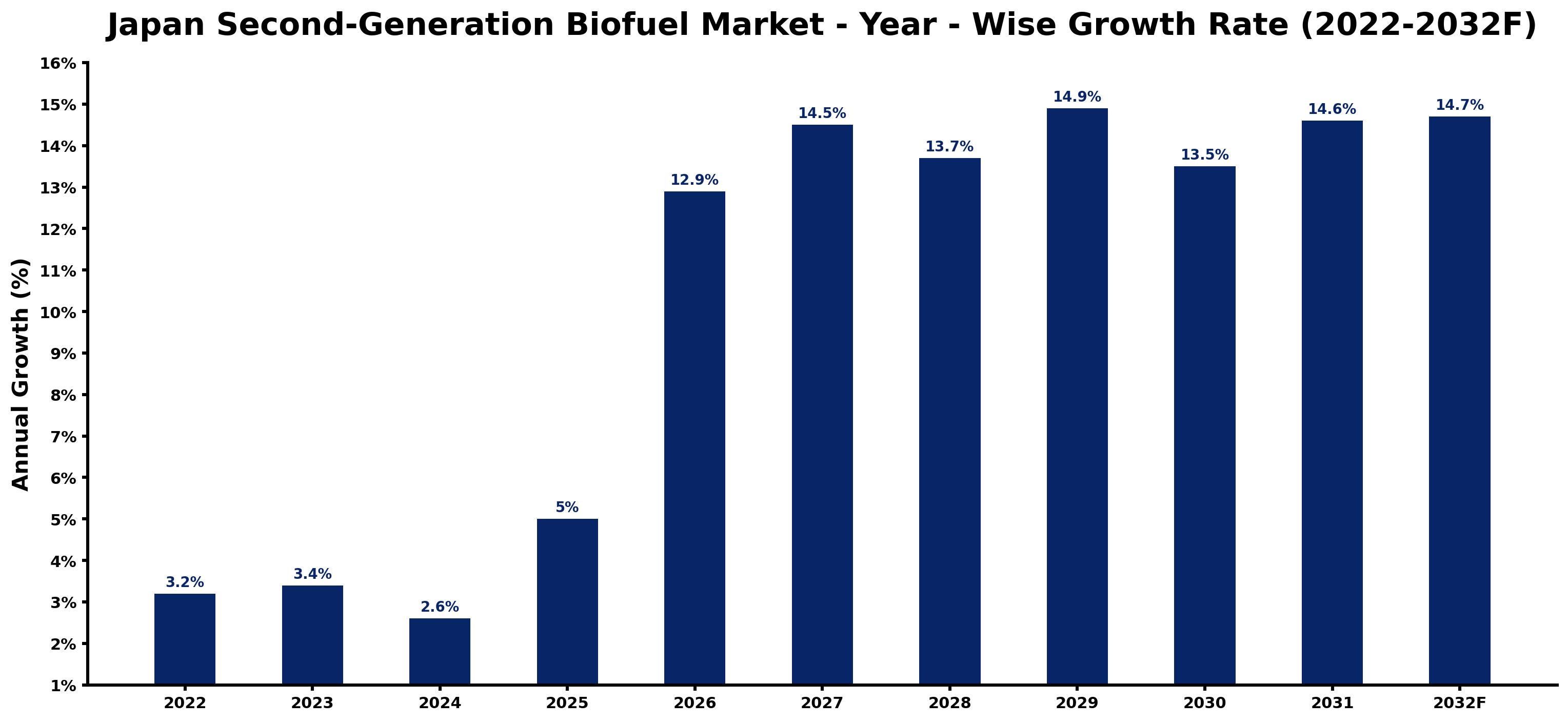
Below, each year's estimated growth is shown next to the factor that most influenced it.
| Year | Estimated Annual Growth (%) | Market Rationale |
| 2022 | 3.2 | Demand was stable as the market adjusted to emerging biofuel technologies. |
| 2023 | 3.4 | Growth was supported by increased investments in renewable energy projects. |
| 2024 | 2.6 | Demand slowed due to market saturation and competition from alternative fuels. |
| 2025 | 5.0 | Growth accelerated as biofuel policies began to take effect and attract investments. |
| 2026 | 12.9 | Demand is expected to surge with rising energy security concerns and government initiatives. |
| 2027 | 14.5 | The market is projected to expand further as technological advancements improve production efficiency. |
| 2028 | 13.7 | Growth is expected to moderate as the market matures and competition intensifies. |
| 2029 | 14.9 | Demand is projected to peak due to substantial investments in biofuel infrastructure and production. |
| 2030 | 13.5 | A slight slowdown is expected as market conditions begin to stabilise. |
| 2031 | 14.6 | Growth is expected to resume as new biofuel standards are adopted and implemented. |
| 2032 | 14.7 | Demand is projected to remain strong due to ongoing investments in sustainable energy solutions. |
Note: Market size estimations and growth projections presented in this report are based on 6Wresearch's proprietary forecasting methodology, utilizing the latest available industry data, government publications, and primary research inputs.
Japan Second-Generation Biofuel Market Synopsis
Second-Generation Biofuel is derived from non-food biomass sources, including agricultural residues and algae, through processes like enzymatic hydrolysis. The Japan Second-Generation Biofuel Market is expanding, driven by increasing energy security concerns and government initiatives. The market is projected to grow, with production of 2G ethanol reaching approximately 1.2 million litres in 2022, highlighting the rising demand from transportation fuel suppliers and urban utility providers.
Market Dynamics Impact Analysis (2026–2032)
| Factor | Type | Impact | Primary Segment Affected |
| Increased government support for renewable energy projects | Driver | High | 2G Ethanol |
| Growing demand for sustainable transportation fuels | Driver | High | Transportation Fuel Suppliers |
| Rising investments in biofuel production facilities | Opportunity | High | Biodiesel |
| Expansion of biogas production initiatives in urban areas | Opportunity | Medium | Biogas (Upgraded RNG) |
| Competition from alternative energy sources | Restraint | High | Biodiesel |
| High production costs associated with advanced biofuels | Restraint | Medium | 2G Ethanol |
| Limited infrastructure for biofuel distribution | Challenge | High | Transportation Fuel Suppliers |
| Regulatory compliance costs for biofuel producers | Challenge | Medium | Biodiesel |
Evaluation of Drivers in Japan Second-Generation Biofuel Market (2026–2032)
Below are the drivers that matter most for revenue growth, with supporting evidence.
| Drivers | Primary Segment Affected | Why It Matters (Evidence) |
| Government incentives for renewable energy investments | 2G Ethanol | These incentives encourage producers to invest in biofuel technologies, leading to increased production capacity. |
| Consumer preference for sustainable fuels | Transportation Fuel Suppliers | As consumers demand greener alternatives, suppliers are increasing their biofuel purchases to meet this trend. |
| Advancements in biofuel production technology | Biodiesel | Innovations in production processes reduce costs and improve yield, prompting higher investments in biodiesel facilities. |
| Urban utility providers seeking renewable energy sources | Biogas (Upgraded RNG) | Increased focus on sustainability drives urban utilities to adopt biogas for energy generation. |
| Supportive biofuel policies from the government | 2G Ethanol | Policies like the Biomass Utilization Promotion Law create a favourable environment for biofuel market growth. |
The growing focus on sustainability has prompted transportation fuel suppliers to boost their biofuel purchases. Technological advancements have notably reduced production costs, encouraging higher investments in biodiesel facilities. Urban utility providers are adopting biogas for energy generation due to rising demand for renewable energy sources.
Evaluation of Restraints in Japan Second-Generation Biofuel Market
These are the pressures that could keep growth below its potential.
| Market Restraint | Primary Segment Affected | Why It Matters (Evidence) |
| Competition from alternative energy sources | Biodiesel | These costs hinder the competitiveness of biofuels compared to fossil fuels, slowing market growth. |
| Limited infrastructure for biofuel distribution | Transportation Fuel Suppliers | Insufficient distribution networks impede the availability of biofuels, affecting supplier operations. |
| Regulatory compliance costs for biofuel producers | Biodiesel | Producers face expenses to meet regulatory standards, impacting their profit margins. |
| Market saturation in certain biofuel segments | 2G Ethanol | Increased competition leads to price pressures, affecting overall market profitability. |
| Technological limitations in production processes | Biodiesel | Outdated technology raises production costs by 20%, reducing competitiveness. |
Japan Second-Generation Biofuel Market Challenges
Japan's biofuel producers struggle with outdated technology, increasing production costs by 20% for suppliers. Many facilities rely on traditional methods, causing delays that can extend lead times by up to six months for buyers. Supply chain disruptions arise from inconsistent biomass sourcing, leading to production shortfalls that compel buyers to seek alternative fuels. A shortage of skilled workers in the biofuel sector creates a talent gap, delaying project timelines by an average of three months for producers. Regulatory hurdles, including compliance with the ISO 14067 standard, impose additional costs that burden energy providers.
Trends in the Japan Second-Generation Biofuel Market
These developments are changing demand patterns in the Japan Second-Generation Biofuel Market.
- Shift from Fossil Fuels to Renewable Energy Sources: Japan is increasingly moving towards renewable energy sources, with a notable rise in biogas production initiatives in urban areas. In 2023, the government allocated ¥10 billion for renewable energy projects, indicating a strong commitment to sustainability.
- Transition from Traditional to Advanced Biofuels: The biofuel market is transitioning from traditional biofuels to advanced options like 2G ethanol. In 2022, Japan produced approximately 1.2 million litres of 2G ethanol, reflecting a growing focus on sustainable fuel alternatives.
- Emergence of Algae-Derived Biofuels: Algae-derived biofuels are gaining traction due to their high oil yield and sustainability. The market for algae-derived biofuels is projected to grow at a CAGR of 20.1% from 2026 to 2032, driven by increasing investments in production technology.
- Increased Adoption of ISO 14067 Standard: The ISO 14067 standard for carbon footprint is becoming more prevalent among biofuel producers in Japan. This standard encourages producers to assess and reduce their carbon emissions, aligning with national sustainability goals.
Investment Opportunities in the Japan Second-Generation Biofuel Market
Below are the investment opportunities with the strongest case in the Japan Second-Generation Biofuel Market.
- Forming Joint Ventures with Local Producers: Now is an opportune time to form joint ventures with local biofuel producers to expand market presence. The Chiba Prefecture is known for its biofuel production initiatives, providing a strategic location for collaboration.
- Investing in Biogas Production Facilities: The demand for biogas is rising, particularly in urban areas. Investing in biogas production facilities can meet this demand, with urban utility providers increasingly seeking renewable energy sources.
- Entering the 2G Ethanol Market: With a projected production of 1.2 million litres in 2022, the 2G ethanol market presents a valuable opportunity. Collaborating with transportation fuel suppliers can facilitate market entry and growth.
- Expanding Biodiesel Production Capabilities: The biodiesel market is projected to grow rapidly, with a notable increase in demand. Investing in biodiesel production capabilities can effectively capture this growing market.
Government Initiatives in the Japan Second-Generation Biofuel Market
The Biomass Utilization Promotion Law implemented in 2021 has strengthened the regulatory framework for biofuel producers, encouraging the use of renewable energy sources. This law supports investments in biofuel technologies and aims to increase the share of biofuels in Japan's energy mix, contributing to national sustainability goals. The law also incentivises the use of agricultural and forestry residues as feedstock for biofuel production, enhancing resource utilisation.
In 2023, the Japanese government allocated ¥10 billion for renewable energy projects, administered by the Ministry of the Environment. This funding supports research and development in biofuel technologies, aiming to improve production efficiency and reduce greenhouse gas emissions. The allocation is expected to benefit biofuel producers and enhance the overall market.
Future Insight of the Japan Second-Generation Biofuel Market
Japan's shift towards renewable energy will transform the biofuel market by 2032, prompting suppliers to adopt advanced production technologies. The government allocated ¥10 billion for renewable energy projects, which will support the expansion of biofuel facilities and enhance production capacity. Increasing urban demand for biogas will stimulate innovation in biomass utilisation methods. As Japan targets a 46% reduction in greenhouse gas emissions, buyers will benefit from cleaner energy options, while suppliers must adapt to evolving standards and consumer preferences.
Market Segmentation Analysis
Japan Second-Generation Biofuel Market report covers a detailed analysis of the following market segments:
By Feedstock – Lignocellulosic Biomass Leads, Algae-Derived Biofuel Expected to Grow Fastest
According to Saurav Kr Singh, Senior Research Analyst at 6Wresearch, Lignocellulosic Biomass accounted for 36% of the market by feedstock in 2025. Lignocellulosic biomass holds the largest share due to its abundant availability from agricultural and forestry residues across Japan, which are vital for biofuel production. The Chiba Prefecture exemplifies this trend with its active biofuel production initiatives leveraging this feedstock. Over 2026–2032, Algae-Derived Biofuel is expected to post the fastest growth, at a CAGR of 20.1%. Algae-derived biofuel is experiencing rapid growth driven by its high oil yield and sustainability, which aligns with national energy security goals. The government's support for biofuel research further accelerates this segment's expansion. Suppliers should focus on developing algae-derived biofuels to meet the increasing market demand.
By Biofuel Type – 2G Ethanol Leads, Biodiesel Expected to Grow Fastest
2G Ethanol took 53% of biofuel type revenue in 2025, more than any other category. 2G ethanol leads the market as it is produced from non-food sources, offering a sustainable solution for transportation fuels. This aligns with Japan's greenhouse gas reduction targets, which aim for a 30% decrease by 2030. Biodiesel is set to record the highest CAGR in this split, 20.6% over 2026–2032. Biodiesel is the fastest-growing segment, appealing as a renewable alternative to fossil diesel, which is increasingly favoured by fuel suppliers. The transition towards cleaner energy sources is propelling this growth further. Buyers are expected to prioritise biodiesel in their procurement strategies to ensure compliance with environmental regulations.
By Production Technology – Enzymatic Hydrolysis Leads, Transesterification Expected to Grow Fastest
The largest production technology category in 2025 was Enzymatic Hydrolysis, at 54% of revenue. Enzymatic hydrolysis is the leading technology as it effectively converts biomass to sugars, essential for biofuel production. Its established use in Japan's biofuel facilities underscores its importance in the market. Transesterification is projected to grow fastest, at a CAGR of 19.6% during 2026–2032. Transesterification is growing quickly due to its critical role in biodiesel production, which is gaining traction among fuel suppliers. The increasing demand for renewable diesel alternatives propels this technology's adoption. Suppliers must invest in advanced transesterification technologies to stay competitive in the biodiesel market.
By End User – Transportation Fuel Suppliers Lead, Aviation & Marine Fuel Firms Expected to Grow Fastest
In 2025, Transportation Fuel Suppliers led the end user split with a 37% share. Transportation fuel suppliers represent the largest user group, being the primary consumers of biofuels for vehicle fuel. Their significant demand plays a crucial role in shaping the overall growth trajectory of Japan's biofuel market. The quickest growth will come from Aviation & Marine Fuel Firms, forecast to expand at a CAGR of 18.3% between 2026 and 2032. Aviation and marine fuel firms are the fastest-growing segment, reflecting a rising interest in sustainable aviation fuel options. This trend indicates a broader shift towards greener energy solutions within the transport sector. Suppliers should seek partnerships with aviation and marine fuel firms to capitalise on this emerging market opportunity.
Key Attractiveness of the Report
- 10 Years of Market Numbers
- Historical Data Starting from 2022 to 2025
- Base Year 2025
- Forecast Data until 2032
- Key Performance Indicators Impacting the Market
- Major Upcoming Developments and Projects
Key Highlights of the Report:
- Japan Second-Generation Biofuel Market Outlook
- Market Size of Japan Second-Generation Biofuel Market, 2025
- Forecast of Japan Second-Generation Biofuel Market, 2032
- Historical Data and Forecast of Japan Second-Generation Biofuel Revenues & Volume for the Period 2022-2032F
- Japan Second-Generation Biofuel Market Trend Evolution
- Japan Second-Generation Biofuel Market Drivers and Challenges
- Japan Second-Generation Biofuel Price Trends
- Japan Second-Generation Biofuel Porter's Five Forces
- Japan Second-Generation Biofuel Industry Life Cycle
- Historical Data and Forecast of Japan Second-Generation Biofuel Market Revenues & Volume By Feedstock for the Period 2022-2032F
- Historical Data and Forecast of Japan Second-Generation Biofuel Market Revenues & Volume By Lignocellulosic Biomass for the Period 2022-2032F
- Historical Data and Forecast of Japan Second-Generation Biofuel Market Revenues & Volume By Algae-Derived Biofuel for the Period 2022-2032F
- Historical Data and Forecast of Japan Second-Generation Biofuel Market Revenues & Volume By Agricultural Residue for the Period 2022-2032F
- Historical Data and Forecast of Japan Second-Generation Biofuel Market Revenues & Volume By Forestry Residue for the Period 2022-2032F
- Historical Data and Forecast of Japan Second-Generation Biofuel Market Revenues & Volume By Biofuel Type for the Period 2022-2032F
- Historical Data and Forecast of Japan Second-Generation Biofuel Market Revenues & Volume By 2G Ethanol for the Period 2022-2032F
- Historical Data and Forecast of Japan Second-Generation Biofuel Market Revenues & Volume By Biodiesel for the Period 2022-2032F
- Historical Data and Forecast of Japan Second-Generation Biofuel Market Revenues & Volume By Biogas (Upgraded RNG) for the Period 2022-2032F
- Historical Data and Forecast of Japan Second-Generation Biofuel Market Revenues & Volume By Synthetic Hydrocarbons for the Period 2022-2032F
- Historical Data and Forecast of Japan Second-Generation Biofuel Market Revenues & Volume By Production Technology for the Period 2022-2032F
- Historical Data and Forecast of Japan Second-Generation Biofuel Market Revenues & Volume By Enzymatic Hydrolysis for the Period 2022-2032F
- Historical Data and Forecast of Japan Second-Generation Biofuel Market Revenues & Volume By Transesterification for the Period 2022-2032F
- Historical Data and Forecast of Japan Second-Generation Biofuel Market Revenues & Volume By Anaerobic Digestion for the Period 2022-2032F
- Historical Data and Forecast of Japan Second-Generation Biofuel Market Revenues & Volume By Fischer-Tropsch for the Period 2022-2032F
- Historical Data and Forecast of Japan Second-Generation Biofuel Market Revenues & Volume By End User for the Period 2022-2032F
- Historical Data and Forecast of Japan Second-Generation Biofuel Market Revenues & Volume By Transportation Fuel Suppliers for the Period 2022-2032F
- Historical Data and Forecast of Japan Second-Generation Biofuel Market Revenues & Volume By Aviation & Marine Fuel Firms for the Period 2022-2032F
- Historical Data and Forecast of Japan Second-Generation Biofuel Market Revenues & Volume By Urban Utility Providers for the Period 2022-2032F
- Historical Data and Forecast of Japan Second-Generation Biofuel Market Revenues & Volume By Industrial Fuel Consumers for the Period 2022-2032F
- Japan Second-Generation Biofuel Import Export Trade Statistics
- Market Opportunity Assessment By Feedstock
- Market Opportunity Assessment By Biofuel Type
- Market Opportunity Assessment By Production Technology
- Market Opportunity Assessment By End User
- Japan Second-Generation Biofuel Top Companies Market Share
- Japan Second-Generation Biofuel Competitive Benchmarking By Technical and Operational Parameters
- Japan Second-Generation Biofuel Company Profiles
- Japan Second-Generation Biofuel Key Strategic Recommendations
Market Covered
The report covers the following segments.
By Feedstock
- Lignocellulosic Biomass
- Algae-Derived Biofuel
- Agricultural Residue
- Forestry Residue
By Biofuel Type
- 2G Ethanol
- Biodiesel
- Biogas (Upgraded RNG)
- Synthetic Hydrocarbons
By Production Technology
- Enzymatic Hydrolysis
- Transesterification
- Anaerobic Digestion
- Fischer-Tropsch
By End User
- Transportation Fuel Suppliers
- Aviation & Marine Fuel Firms
- Urban Utility Providers
- Industrial Fuel Consumers































