Japan Secondary Battery Market Size & Growth Rate
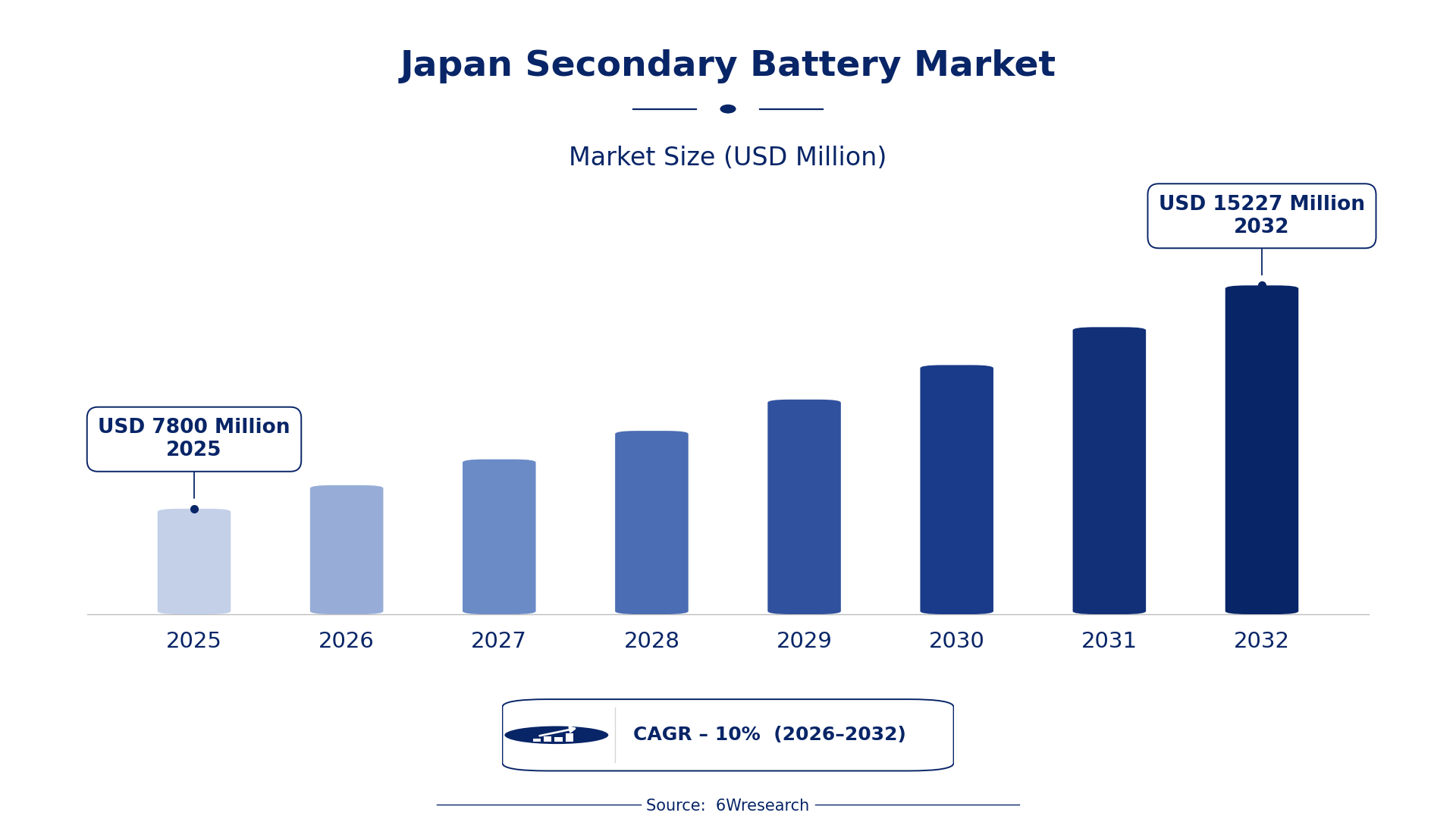
According to 6Wresearch internal database and industry insights, the Japan Secondary Battery Market was valued at USD 7,800 Million in 2025 and is projected to reach USD 15,227 Million by 2032, growing at a CAGR of approximately 10% during 2026–2032.
Japan Secondary Battery Market Highlights
| Report Metric | Details |
| Report Name | Japan Secondary Battery Market (2026-2032) |
| Market Size 2025 | USD 7,800 Million |
| Market Size 2032 | USD 15,227 Million |
| Absolute Growth 2025–2032 | USD 7,427 Million |
| CAGR 2026–2032 | 10% |
| Peak Annual Growth | 11.3% in 2027 |
| Forecast Period | 2026–2032 |
| Historical Data | 2022–2025 |
| Base Year | 2025 |
| Leading Technology, 2025 | Lead-acid Battery (55% share) |
| Fastest-Growing Technology | Lithium-ion Battery (14.1% CAGR) |
| Growing Sector | Lithium-ion Battery |
| Key End Users | Lead-acid Battery, Lithium-ion Battery, Other Technologies (NiMh, NiCD, etc.) |
Japan Secondary Battery Market Year-wise Growth Rate and Key Drivers (2022–2032)
This graph illustrates the annual growth rates of the market from 2022 to 2032, highlighting a steady upward trajectory and projected market expansion over the forecast period.
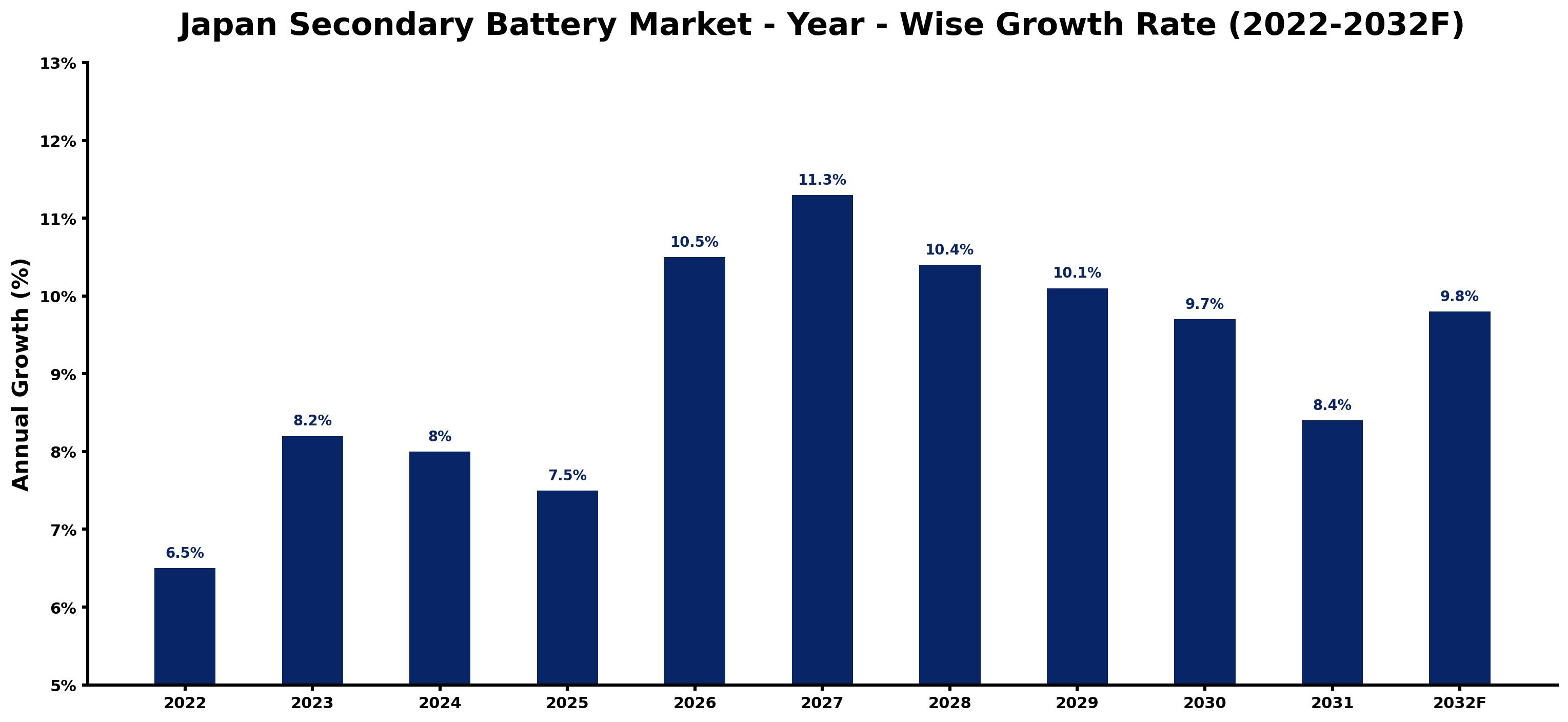
Annual growth estimates for each year appear below with the principal reason behind them, explaining the shifts that set the pace of the market.
| Year | Estimated Annual Growth (%) | Market Rationale |
| 2022 | 6.5 | Domestic demand from automotive and electronics sectors remained strong, supporting growth. |
| 2023 | 8.2 | The lithium-ion battery market experienced increased investment and consumer adoption, driving demand. |
| 2024 | 8.0 | Growth slowed slightly as market maturation and competition intensified among manufacturers. |
| 2025 | 7.5 | Demand continued to grow, but at a reduced rate due to market saturation in some segments. |
| 2026 | 10.5 | Investment in battery technology is expected to surge, leading to an increase in production capacity. |
| 2027 | 11.3 | The market is projected to peak as electric vehicle adoption accelerates, boosting lithium-ion battery sales. |
| 2028 | 10.4 | Growth is expected to slow as competition intensifies and production capacity stabilises across the industry. |
| 2029 | 10.1 | Market expansion will continue, but at a slower pace as supply chains adjust to demand. |
| 2030 | 9.7 | Growth is projected to moderate as the market approaches saturation in key segments like electric vehicles. |
| 2031 | 8.4 | Demand is expected to remain steady, driven by ongoing investments in renewable energy storage solutions. |
| 2032 | 9.8 | The market is projected to grow as new technologies emerge and consumer preferences shift. |
Note: Market size estimations and growth projections presented in this report are based on 6Wresearch's proprietary forecasting methodology, utilizing the latest available industry data, government publications, and primary research inputs.
Japan Secondary Battery Market Synopsis
Secondary batteries, including lead-acid and lithium-ion types, are essential electrochemical devices that store and release electrical energy. They are primarily used in electric vehicles, consumer electronics, and renewable energy systems. The Japan Secondary Battery Market is expanding due to rising electric vehicle adoption, which reached 15% in 2023, alongside public and private investments targeting decarbonisation. With a projected JPY 150 trillion investment over ten years, demand from automotive and electronics sectors will continue to drive growth.
Market Dynamics Impact Analysis (2026–2032)
| Factor | Type | Impact | Primary Segment Affected |
| Rising electric vehicle adoption | Driver | High | Lithium-ion Battery |
| Increased investment in battery technology | Driver | High | Lead-acid Battery |
| Growing demand for renewable energy storage solutions | Opportunity | High | Lithium-ion Battery |
| Expansion of recycling programs for batteries | Opportunity | Medium | Lead-acid Battery |
| Market saturation in certain segments | Restraint | Medium | Lithium-ion Battery |
| Intense competition among manufacturers | Restraint | High | Lead-acid Battery |
| Supply chain disruptions affecting production capacity | Challenge | High | Lithium-ion Battery |
| Technological advancements outpacing current manufacturing capabilities | Challenge | Medium | Lead-acid Battery |
Evaluation of Drivers in Japan Secondary Battery Market (2026–2032)
Demand rests on the following drivers, each shown with the segment it touches most.
| Drivers | Primary Segment Affected | Why It Matters (Evidence) |
| Increased electric vehicle production | Lithium-ion Battery | The total installed base of electric vehicles in Japan surpassed 1 million units in 2023, driving demand for lithium-ion batteries. |
| Growing consumer electronics market | Lead-acid Battery | Japan produced 1.2 million tons of lead-acid batteries in 2022, reflecting strong demand from the electronics sector. |
| Government decarbonisation targets | Lithium-ion Battery | Japan targets a 46% cut in greenhouse-gas emissions by fiscal 2030, boosting demand for energy storage solutions. |
| Investment in battery recycling initiatives | Lead-acid Battery | The Ministry of the Environment launched a recycling program for lithium-ion batteries in 2023, enhancing sustainability. |
| Technological advancements in battery efficiency | Lithium-ion Battery | The adoption rate of electric vehicles in Japan reached 15% in 2023, increasing the need for efficient battery technologies. |
Spending rises because Tokyo hosts key production facilities that cater to the growing electric vehicle market. The total installed base of electric vehicles surpassed 1 million units in 2023, increasing demand for lithium-ion batteries. Japan's target to cut greenhouse-gas emissions by 46% by 2030 is driving investments in battery technology. The production of lead-acid batteries reached 1.2 million tons in 2022, reflecting strong demand from the consumer electronics sector.
Evaluation of Restraints in Japan Secondary Battery Market
These are the pressures that could keep growth below its potential.
| Market Restraint | Primary Segment Affected | Why It Matters (Evidence) |
| Market saturation in electric vehicle segment | Lithium-ion Battery | As the adoption rate of electric vehicles reaches 15%, the market faces saturation, limiting growth potential. |
| Intense competition among battery manufacturers | Lead-acid Battery | With numerous players in the market, price competition is fierce, impacting profit margins for manufacturers. |
| Supply chain disruptions affecting lead-acid battery production | Lead-acid Battery | Global supply chain issues have delayed the delivery of raw materials, impacting production timelines. |
| Regulatory compliance costs for battery recycling | Lead-acid Battery | Compliance with new recycling regulations increases operational costs for lead-acid battery manufacturers. |
| Limited availability of raw materials for lithium-ion batteries | Lithium-ion Battery | High demand for battery-grade lithium has led to price increases, affecting production costs. |
Japan Secondary Battery Market Challenges
Producers of lead-acid batteries face challenges from rising raw material costs, which inflate production expenses by 20% and compress profit margins. Importers encounter supply chain disruptions, as shipping delays can extend lead times for battery components by 30%, complicating their ability to meet market demand. Some manufacturers struggle with technology adoption, as outdated production methods result in 15% lower output compared to those employing modern techniques. Buyers deal with higher prices, as the overall cost of secondary batteries has risen by 10%, affecting their purchasing decisions and budget allocations.
Trends in the Japan Secondary Battery Market
Buyers and suppliers in the Japan Secondary Battery Market are adjusting to the following trends.
- Shift towards Sustainable Battery Solutions: Tokyo is increasing its focus on sustainable battery production, with the Ministry of the Environment launching a recycling program for lithium-ion batteries in 2023. This initiative aims to improve sustainability and reduce waste in the battery lifecycle.
- Transition from Lead-acid to Lithium-ion Batteries: The market is shifting from lead-acid to lithium-ion batteries, driven by the growing demand for electric vehicles. The lithium-ion battery market was valued at approximately 1 trillion JPY in 2023, indicating a clear trend.
- Emergence of Advanced Battery Technologies: Japan is investing heavily in advanced battery technologies, with 50 billion JPY allocated for battery technology innovation in 2023. This funding supports the development of more efficient and sustainable battery solutions.
- Increase in Renewable Energy Storage Capacity: Japan's target to increase renewable energy storage capacity to 30 GWh by 2030 reflects a shift towards integrating renewable energy sources. This goal is driving demand for secondary batteries in energy storage applications.
Investment Opportunities in the Japan Secondary Battery Market
Investors looking at the Japan Secondary Battery Market should consider the following areas.
- Tokyo's Battery Manufacturing Facilities: Tokyo's battery manufacturing facilities offer an opportunity to supply advanced battery technologies, with a projected investment of 50 billion JPY for innovation in 2023. Collaborating with local manufacturers can facilitate market entry.
- Electric Vehicle Charging Stations: The rise in electric vehicle adoption creates a demand for charging infrastructure, with an estimated market gap of 30,000 stations by 2030. Partnering with local governments can help establish a foothold in this sector.
- Renewable Energy Storage Solutions: With Japan aiming for 30 GWh of renewable energy storage capacity by 2030, there is an opportunity to supply secondary batteries for this purpose. Engaging with energy providers can improve market access.
- Battery Recycling Initiatives: The introduction of lithium-ion battery recycling programs presents a chance to invest in recycling technologies, with potential growth in demand for sustainable battery solutions. Collaborating with environmental agencies can support compliance and market entry.
Government Initiatives in the Japan Secondary Battery Market
The Economic Security Promotion Act (2022) supports supply chain resilience for critical products and materials, ensuring that battery manufacturers can secure essential components for production. This act aims to strengthen domestic capabilities and reduce reliance on imports, creating a more stable market environment.
In 2023, the Ministry of the Environment allocated 50 billion JPY for battery technology innovation, focusing on improving recycling processes and sustainability. This funding supports initiatives that enhance the overall lifecycle management of batteries, benefiting both producers and consumers.
Future Insight of the Japan Secondary Battery Market
Japan's GX Basic Policy will drive a shift towards decarbonisation, prompting suppliers to invest in advanced battery technologies. By 2032, the target of 30 GWh for renewable energy storage capacity will transform the market for secondary batteries. The recycling program for lithium-ion batteries will create a more sustainable supply chain, benefiting buyers through reduced material costs. The adoption rate of electric vehicles is expected to rise significantly, further increasing the demand for efficient energy storage solutions.
Market Segmentation Analysis
Japan Secondary Battery Market report covers a detailed analysis of the following market segments:
By Technology – Lead-acid Battery Leads, Lithium-ion Battery Expected to Grow Fastest
According to Sumit Sagar, AM at 6Wresearch, with 55% of technology revenue in 2025, Lead-acid Battery was the largest category. Lead-acid batteries hold the largest share due to their extensive use in automotive applications and backup power systems. Their significance is highlighted by Japan producing 1.2 million tons of lead-acid batteries in 2022, underscoring their critical role in energy storage. Over 2026–2032, Lithium-ion Battery is expected to post the fastest growth, at a CAGR of 14.1%. The lithium-ion battery segment is expanding rapidly, driven by the increasing adoption of electric vehicles, which reached 15% in 2023. With over 1 million electric vehicles now in use, this growth trajectory is expected to continue, further strengthening lithium-ion's market presence. This suggests that suppliers should focus on enhancing lithium-ion technologies to meet the rising demand in the market.
Key Attractiveness of the Report
- 10 Years of Market Numbers
- Historical Data Starting from 2022 to 2025
- Base Year 2025
- Forecast Data until 2032
- Key Performance Indicators Impacting the Market
- Major Upcoming Developments and Projects
Key Highlights of the Report:
- Japan Secondary Battery Market Outlook
- Market Size of Japan Secondary Battery Market, 2025
- Forecast of Japan Secondary Battery Market, 2032
- Historical Data and Forecast of Japan Secondary Battery Revenues & Volume for the Period 2022-2032
- Japan Secondary Battery Market Trend Evolution
- Japan Secondary Battery Market Drivers and Challenges
- Japan Secondary Battery Price Trends
- Japan Secondary Battery Porter's Five Forces
- Japan Secondary Battery Industry Life Cycle
- Historical Data and Forecast of Japan Secondary Battery Market Revenues & Volume By Technology for the Period 2022-2032
- Historical Data and Forecast of Japan Secondary Battery Market Revenues & Volume By Lead-acid Battery for the Period 2022-2032
- Historical Data and Forecast of Japan Secondary Battery Market Revenues & Volume By Lithium-ion Battery for the Period 2022-2032
- Historical Data and Forecast of Japan Secondary Battery Market Revenues & Volume By Other Technologies (NiMh, NiCD, etc.) for the Period 2022-2032
- Historical Data and Forecast of Japan Secondary Battery Market Revenues & Volume By Application for the Period 2022-2032
- Historical Data and Forecast of Japan Secondary Battery Market Revenues & Volume By Automotive Batteries (HEV, PHEV, and EV) for the Period 2022-2032
- Historical Data and Forecast of Japan Secondary Battery Market Revenues & Volume By Industrial Batteries (Motive, Stationary (Telecom, UPS, Energy Storage Systems (ESS), etc.) for the Period 2022-2032
- Historical Data and Forecast of Japan Secondary Battery Market Revenues & Volume By Portable Batteries (Consumer Electronics, etc.) for the Period 2022-2032
- Historical Data and Forecast of Japan Secondary Battery Market Revenues & Volume By Other Applications for the Period 2022-2032
- Japan Secondary Battery Import Export Trade Statistics
- Market Opportunity Assessment By Technology
- Market Opportunity Assessment By Application
- Japan Secondary Battery Top Companies Market Share
- Japan Secondary Battery Competitive Benchmarking By Technical and Operational Parameters
- Japan Secondary Battery Company Profiles
- Japan Secondary Battery Key Strategic Recommendations
Market Covered
The report covers the following segments.
By Technology
- Lead-acid Battery
- Lithium-ion Battery
- Other Technologies (NiMh, NiCD, etc.)






































