Japan Secure Food Packaging Market Size & Growth Rate
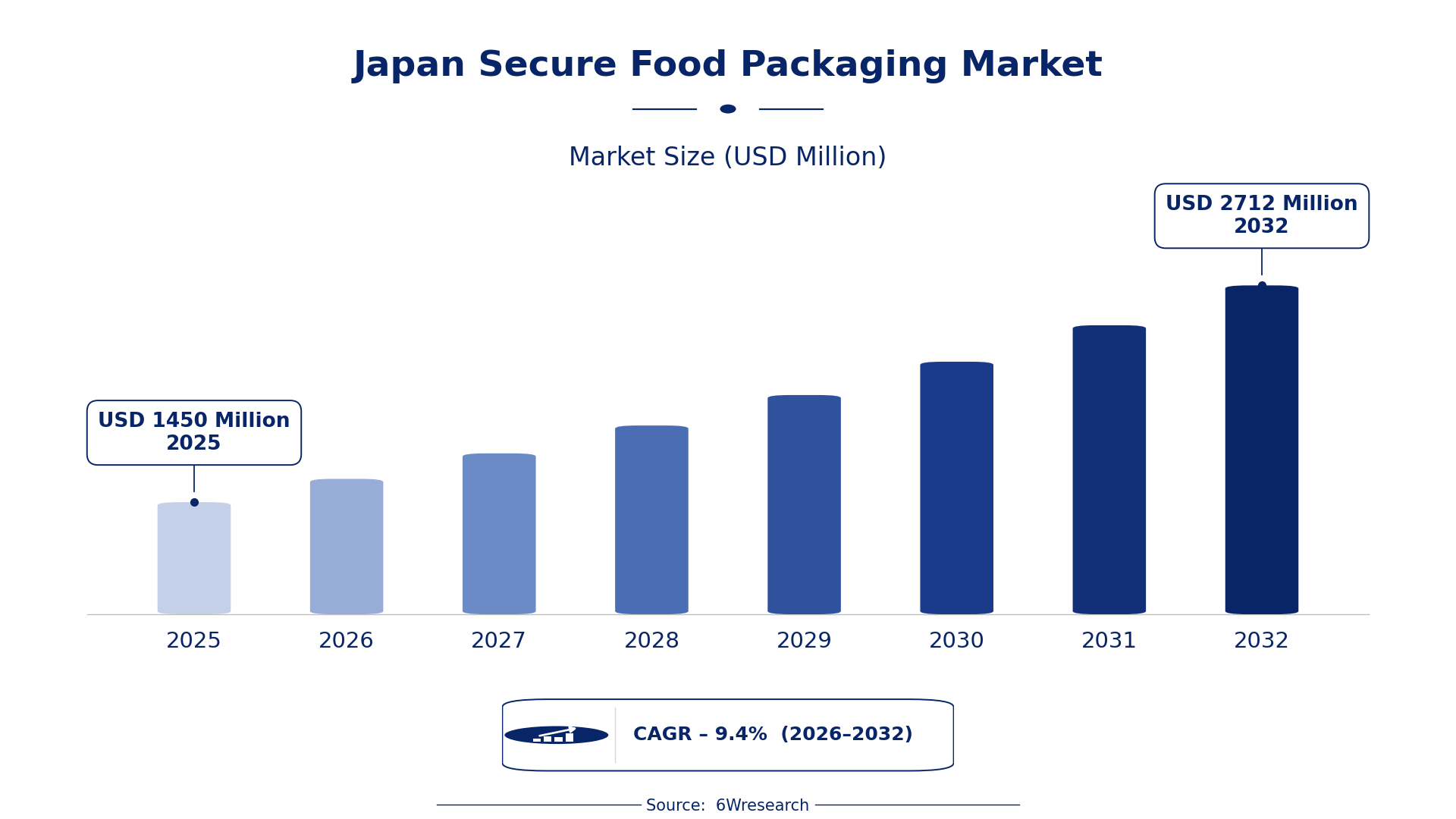
According to 6Wresearch internal database and industry insights, the Japan Secure Food Packaging Market was valued at USD 1,450 Million in 2025 and is projected to reach USD 2,712 Million by 2032, growing at a CAGR of approximately 9.4% during 2026–2032.
Japan Secure Food Packaging Market Highlights
| Report Metric | Details |
| Report Name | Japan Secure Food Packaging Market (2026-2032) |
| Market Size 2025 | USD 1,450 Million |
| Market Size 2032 | USD 2,712 Million |
| Absolute Growth 2025–2032 | USD 1,262 Million |
| CAGR 2026–2032 | 9.4% |
| Peak Annual Growth | 10.2% in 2028 |
| Forecast Period | 2026–2032 |
| Historical Data | 2022–2025 |
| Base Year | 2025 |
| Leading Packaging Format, 2025 | Tamper-Evident Seals (43% share) |
| Leading Security Feature, 2025 | Track-and-Trace (47% share) |
| Leading Material, 2025 | Polyethylene (53% share) |
| Leading End User, 2025 | Packaged Food Brands (40% share) |
| Fastest-Growing Packaging Format | RFID-Integrated Packs (13.0% CAGR) |
| Fastest-Growing Material | Multi-layer Film (13.5% CAGR) |
| Fastest-Growing End User | Cold Chain Logistics (11.9% CAGR) |
| Growing Sector | Packaged Foods |
| Key End Users | Packaged Food Brands, Health Food Manufacturers, Cold Chain Logistics, Retail Grocery Chains |
Japan Secure Food Packaging Market Year-wise Growth Rate and Key Drivers (2022–2032)
This graph illustrates the annual growth rates of the market from 2022 to 2032, highlighting a steady upward trajectory and projected market expansion over the forecast period.
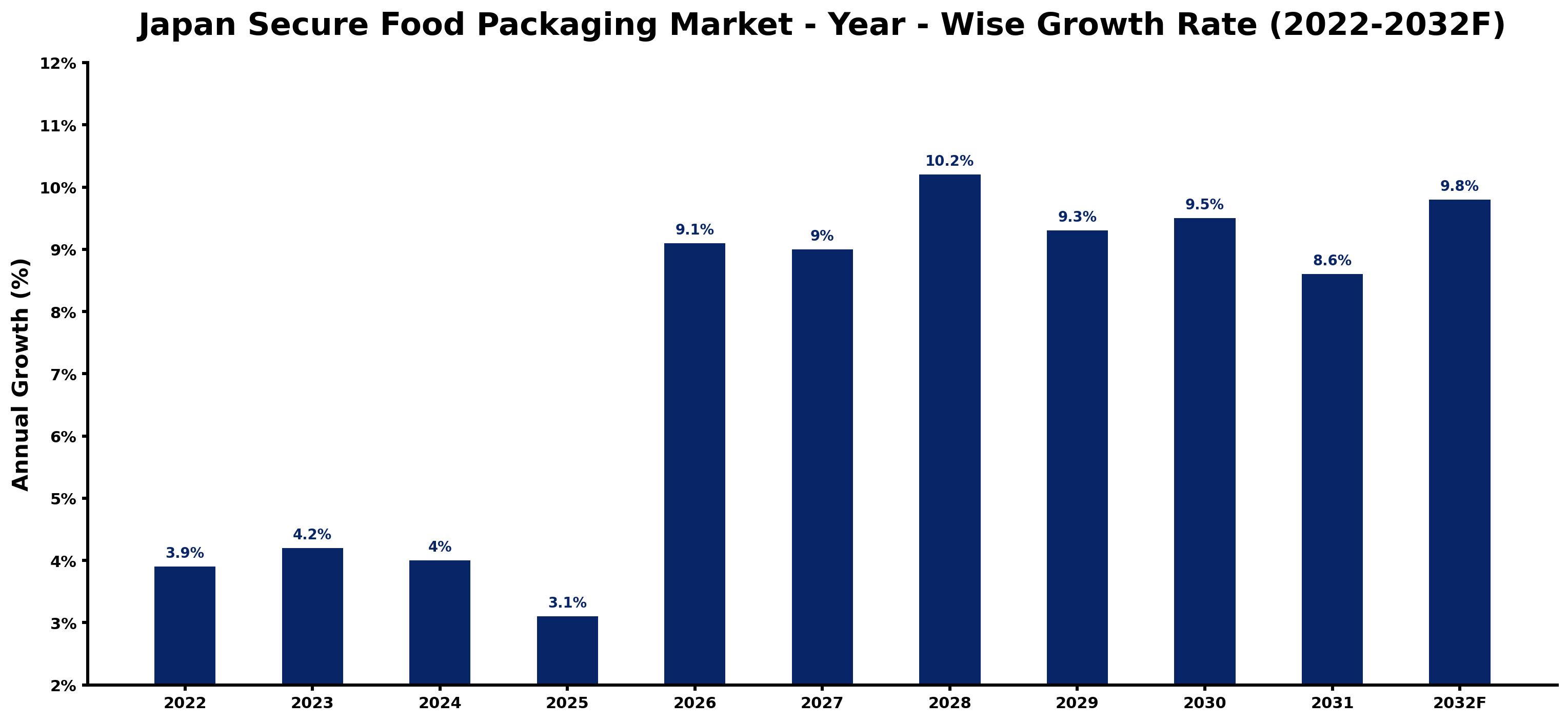
The yearly estimates that follow link every growth rate to its principal driver, so readers can see why the pace changed in each period.
| Year | Estimated Annual Growth (%) | Market Rationale |
| 2022 | 3.9 | The market experienced stable growth due to ongoing demand for secure food packaging solutions. |
| 2023 | 4.2 | Growth was driven by increased health awareness among consumers and rising packaged food sales. |
| 2024 | 4.0 | A slight slowdown occurred as the growth rate moderated from the previous year. |
| 2025 | 3.1 | Demand continued to grow, albeit at a slower pace, reflecting market maturation and competition. |
| 2026 | 9.1 | Growth is expected to accelerate as investments in cold chain logistics gain traction. |
| 2027 | 9.0 | The market is projected to maintain a strong growth rate, supported by rising health food product launches. |
| 2028 | 10.2 | The peak growth year will be attributed to heightened consumer focus on food safety and integrity. |
| 2029 | 9.3 | Growth is expected to slow slightly, but demand will remain strong due to ongoing investments in technology. |
| 2030 | 9.5 | The market is projected to rebound with renewed interest in packaging solutions for perishables. |
| 2031 | 8.6 | Growth will moderate as the market stabilises, reflecting a mature phase of development. |
| 2032 | 9.8 | The market is expected to grow steadily, driven by advancements in packaging technologies. |
Note: Market size estimations and growth projections presented in this report are based on 6Wresearch's proprietary forecasting methodology, utilizing the latest available industry data, government publications, and primary research inputs.
Japan Secure Food Packaging Market Synopsis
Secure food packaging protects food from contamination and tampering, using materials and technologies such as laminating and anti-counterfeit labels. The Japan Secure Food Packaging Market is valued at approximately 1.2 trillion JPY, driven by increasing demand from packaged food brands and cold chain logistics. Growth stems from rising health awareness, technological advancements, and a focus on food safety, particularly with initiatives like the Food Sanitation Act amendment and ISO 22000 standards promoting better practices in packaging.
Market Dynamics Impact Analysis (2026–2032)
| Factor | Type | Impact | Primary Segment Affected |
| Rising health awareness among consumers drives demand for secure food packaging solutions. | Driver | High | Packaged Food Brands |
| The integration of advanced technologies enhances packaging security and tracking capabilities. | Driver | High | RFID-Integrated Packs |
| The growing cold chain logistics sector presents opportunities for innovative packaging solutions. | Opportunity | High | Cold Chain Logistics |
| Health food manufacturers are increasingly adopting secure packaging to protect product integrity. | Opportunity | Medium | Health Food Manufacturers |
| Regulatory compliance challenges can hinder the adoption of new packaging technologies. | Restraint | High | Anti-Counterfeit Labels |
| Market competition may limit pricing flexibility for secure packaging solutions. | Restraint | Medium | Tamper-Evident Seals |
| Supply chain disruptions can delay the delivery of packaging materials to producers. | Challenge | High | Temperature Indicators |
| Technological advancements require continuous investment, which can strain smaller producers. | Challenge | Medium | Multi-layer Film |
Evaluation of Drivers in Japan Secure Food Packaging Market (2026–2032)
The table below links each growth driver to the segment it affects and the evidence for it.
| Drivers | Primary Segment Affected | Why It Matters (Evidence) |
| Increasing health consciousness among consumers drives demand for secure food packaging. | Packaged Food Brands | The rise in health awareness leads consumers to prefer products with safety features. |
| Advancements in packaging materials improve food safety and tracking capabilities. | RFID-Integrated Packs | Innovations in technology enable better inventory management and product traceability. |
| The growth of the cold chain logistics sector necessitates secure packaging solutions. | Cold Chain Logistics | As more food products require temperature control, secure packaging ensures safety during transport. |
| Regulatory changes mandate higher food safety standards, boosting demand for secure packaging. | Anti-Counterfeit Labels | Compliance with new regulations encourages manufacturers to invest in secure packaging technologies. |
| Consumer preference for convenience drives demand for ready-to-eat packaged foods. | Tamper-Evident Seals | The rise in demand for convenience foods increases the need for secure packaging options. |
A wider customer base explains much of the growth, as the market value for secure food packaging in Japan stands at approximately 1.2 trillion JPY. The cold chain logistics sector, which accounts for 15% of the food supply chain, is driving demand for packaging solutions. Rising health awareness among consumers has led to increased purchases of packaged foods, with health food manufacturers adopting anti-counterfeit labels to protect their brands. Advancements in packaging materials improve safety and tracking, encouraging more buyers to invest in secure packaging options.
Evaluation of Restraints in Japan Secure Food Packaging Market
Below are the constraints most often cited by buyers and suppliers, with the segment each affects.
| Market Restraint | Primary Segment Affected | Why It Matters (Evidence) |
| Regulatory compliance can be complex and costly for producers. | Anti-Counterfeit Labels | Compliance with the Food Sanitation Act amendment requires investments in testing and certification. |
| Intense competition may lead to price wars, affecting profitability. | Tamper-Evident Seals | Producers face pressure to lower prices, impacting their ability to invest in quality improvements. |
| Supply chain disruptions can delay material availability, impacting production schedules. | Temperature Indicators | Recent global supply chain challenges have made it harder for producers to source necessary materials. |
| Technological advancements require continuous investment, which can strain smaller producers. | Multi-layer Film | Smaller producers may struggle to keep up with the latest packaging technologies due to high costs. |
| Consumer preferences can shift rapidly, leading to potential overstock of certain packaging types. | RFID-Integrated Packs | Changes in consumer trends can leave producers with excess inventory of less popular packaging. |
Japan Secure Food Packaging Market Challenges
Outdated technology in secure food packaging limits efficiency, as many producers rely on traditional methods that increase contamination risks, costing buyers potential losses of up to 10% in product value. Intense price competition among suppliers forces some to compromise on quality, resulting in safety breaches that erode consumer trust. A shortage of skilled workers constrains innovation, delaying the rollout of modern packaging solutions and impacting suppliers' ability to meet market demands. Stringent regulations from the Ministry of Health, Labour and Welfare require compliance, which can postpone product launches for manufacturers by as much as six months.
Trends in the Japan Secure Food Packaging Market
Buyers and suppliers in the Japan Secure Food Packaging Market are adjusting to the following trends.
- Shift to Smart Packaging Solutions: Since 2023, there has been a notable shift towards smart packaging solutions in Japan. Health food manufacturers are increasingly adopting RFID-integrated packs, which improve tracking and inventory management. This trend reflects a growing emphasis on food safety and transparency.
- Emergence of Eco-Friendly Packaging Solutions: In 2024, eco-friendly packaging options began gaining traction among packaged food brands. The Plastic Resource Circulation Act has spurred innovations in sustainable materials, with 10% of new packaging solutions focusing on recyclability and reduced environmental impact.
- Increased Use of Temperature Indicators in Logistics: Starting in 2025, temperature indicators have become more prevalent in cold chain logistics. This change is driven by the need to monitor temperature exposure for perishable goods, ensuring safety during transport, particularly in urban areas like Tokyo.
- Adoption of Anti-Counterfeit Technologies: In 2026, health food manufacturers began widely adopting anti-counterfeit labels to protect their brands. This shift is a response to rising concerns about product authenticity, with 20% of new products incorporating these security features.
Investment Opportunities in the Japan Secure Food Packaging Market
Where to invest in the Japan Secure Food Packaging Market: the main openings are set out below.
- Growing Demand for Cold Chain Logistics: With 15% of the food supply chain involved in cold chain logistics, there is an opportunity for secure packaging solutions. Investing in temperature indicators can help meet the needs of logistics providers in urban areas.
- Rising Health Awareness Among Consumers: As health awareness rises, packaged food brands are seeking secure packaging to ensure product integrity. This presents an opportunity for suppliers of anti-counterfeit labels to enter the market and cater to this demand.
- Expansion of Smart Packaging Technologies: The market gap for RFID-integrated packs is widening. Suppliers can collaborate with health food manufacturers to develop solutions that enhance product tracking.
- Increasing Regulatory Requirements for Food Safety: The Food Sanitation Act amendment has created a demand for compliance-driven packaging solutions. Producers can invest in tamper-evident seals to meet these new regulations and enhance consumer trust.
Government Initiatives in the Japan Secure Food Packaging Market
The Food Sanitation Act amendment (2018) established a system ensuring only safe materials are used in food packaging. This law builds on previous regulations by protecting consumers and producers alike through rigorous testing and certification processes. The amendment mandates that synthetic resins used in food packaging undergo a positive list system, enhancing safety standards across the industry.
Buyers, particularly packaged food brands, benefit from the Ministry of Health, Labour and Welfare's oversight of food safety regulations. The agency ensures compliance with the Food Sanitation Act, which mandates rigorous testing and certification of packaging materials, boosting consumer confidence in safety.
Future Insight of the Japan Secure Food Packaging Market
A government programme to enhance food safety technologies will commence by 2032, introducing advanced monitoring systems for secure food packaging. Rising health awareness will drive demand for secure solutions, particularly in the packaged food sector, which is projected to grow significantly. The adoption of ISO 22000 standards will standardise safety practices across the industry, benefiting both buyers and suppliers. By 2032, the use of temperature-sensitive packaging will increase, ensuring product quality throughout the logistics chain.
Market Segmentation Analysis
Japan Secure Food Packaging Market report covers a detailed analysis of the following market segments:
By Packaging Format – Tamper-Evident Seals Lead, RFID-Integrated Packs Expected to Grow Fastest
According to Saurav Kr Singh, Senior Research Analyst at 6Wresearch, with 43% of packaging format revenue in 2025, Tamper-Evident Seals was the largest category. Tamper-evident seals are extensively utilised in convenience stores across Tokyo, ensuring that consumers receive unaltered products. This widespread adoption among retailers highlights the critical role these seals play in maintaining food integrity and safety. The quickest growth will come from RFID-Integrated Packs, forecast to expand at a CAGR of 13.0% between 2026 and 2032. The growth of RFID-integrated packs is propelled by the increasing need for efficient tracking and inventory management in the food supply chain. This technology is becoming essential as businesses seek to streamline operations and reduce losses. Suppliers should focus on developing advanced tracking solutions to meet the rising demand for efficient inventory management.
By Security Feature – Track-and-Trace Leads and Records the Fastest Growth
Track-and-Trace took 47% of security feature revenue in 2025, more than any other category. Track-and-trace systems are crucial for ensuring supply chain transparency, allowing stakeholders to monitor product movement and safety. This feature is increasingly required by regulations and consumer expectations for food safety. Track-and-Trace is also forecast to expand faster than any other category, at a CAGR of 11.4% over 2026–2032. The track-and-trace segment is experiencing rapid growth due to its dual role in enhancing safety and meeting regulatory requirements. As food safety standards tighten, the demand for these systems will only increase, solidifying their market position. Investing in advanced track-and-trace technologies will be vital for suppliers to comply with evolving food safety regulations.
By Material – Polyethylene Leads, Multi-layer Film Expected to Grow Fastest
Polyethylene accounted for 53% of the market by material in 2025. Polyethylene is widely used in secure food packaging due to its versatility and cost-effectiveness, making it a popular choice among manufacturers. Its extensive application across various packaging types solidifies its leading position in the market. Multi-layer Film is projected to grow fastest, at a CAGR of 13.5% during 2026–2032. The multi-layer film segment is gaining traction as it offers superior protection against external factors, catering to the growing demand for enhanced food safety. This trend is particularly relevant in sectors where product integrity is paramount. Suppliers should explore multi-layer film innovations to cater to the increasing demand for robust food packaging solutions.
By End User – Packaged Food Brands Lead, Cold Chain Logistics Expected to Grow Fastest
The largest end user category in 2025 was Packaged Food Brands, at 40% of revenue. Packaged food brands are the primary users of secure food packaging solutions, as they prioritise product safety and consumer trust. Their significant market presence drives the demand for reliable packaging technologies. Over 2026–2032, Cold Chain Logistics is expected to post the fastest growth, at a CAGR of 11.9%. Cold chain logistics is rapidly expanding, essential for maintaining food safety during transport, especially for perishable goods. This growth is driven by the increasing focus on food safety and quality assurance in the supply chain. Suppliers must align their offerings with the needs of cold chain logistics to capture emerging opportunities in this critical sector.
Key Attractiveness of the Report
- 10 Years of Market Numbers
- Historical Data Starting from 2022 to 2025
- Base Year 2025
- Forecast Data until 2032
- Key Performance Indicators Impacting the Market
- Major Upcoming Developments and Projects
Key Highlights of the Report:
- Japan Secure Food Packaging Market Outlook
- Market Size of Japan Secure Food Packaging Market, 2025
- Forecast of Japan Secure Food Packaging Market, 2032
- Historical Data and Forecast of Japan Secure Food Packaging Revenues & Volume for the Period 2022-2032F
- Japan Secure Food Packaging Market Trend Evolution
- Japan Secure Food Packaging Market Drivers and Challenges
- Japan Secure Food Packaging Price Trends
- Japan Secure Food Packaging Porter's Five Forces
- Japan Secure Food Packaging Industry Life Cycle
- Historical Data and Forecast of Japan Secure Food Packaging Market Revenues & Volume By Packaging Format for the Period 2022-2032F
- Historical Data and Forecast of Japan Secure Food Packaging Market Revenues & Volume By Tamper-Evident Seals for the Period 2022-2032F
- Historical Data and Forecast of Japan Secure Food Packaging Market Revenues & Volume By Anti-Counterfeit Labels for the Period 2022-2032F
- Historical Data and Forecast of Japan Secure Food Packaging Market Revenues & Volume By RFID-Integrated Packs for the Period 2022-2032F
- Historical Data and Forecast of Japan Secure Food Packaging Market Revenues & Volume By Temperature Indicators for the Period 2022-2032F
- Historical Data and Forecast of Japan Secure Food Packaging Market Revenues & Volume By Security Feature for the Period 2022-2032F
- Historical Data and Forecast of Japan Secure Food Packaging Market Revenues & Volume By Shrink Bands for the Period 2022-2032F
- Historical Data and Forecast of Japan Secure Food Packaging Market Revenues & Volume By QR/Cryptographic Tag for the Period 2022-2032F
- Historical Data and Forecast of Japan Secure Food Packaging Market Revenues & Volume By Track-and-Trace for the Period 2022-2032F
- Historical Data and Forecast of Japan Secure Food Packaging Market Revenues & Volume By Spoilage Detection for the Period 2022-2032F
- Historical Data and Forecast of Japan Secure Food Packaging Market Revenues & Volume By Material for the Period 2022-2032F
- Historical Data and Forecast of Japan Secure Food Packaging Market Revenues & Volume By Polyethylene for the Period 2022-2032F
- Historical Data and Forecast of Japan Secure Food Packaging Market Revenues & Volume By Laminated Film for the Period 2022-2032F
- Historical Data and Forecast of Japan Secure Food Packaging Market Revenues & Volume By Multi-layer Film for the Period 2022-2032F
- Historical Data and Forecast of Japan Secure Food Packaging Market Revenues & Volume By Thermochromic Ink for the Period 2022-2032F
- Historical Data and Forecast of Japan Secure Food Packaging Market Revenues & Volume By End User for the Period 2022-2032F
- Historical Data and Forecast of Japan Secure Food Packaging Market Revenues & Volume By Packaged Food Brands for the Period 2022-2032F
- Historical Data and Forecast of Japan Secure Food Packaging Market Revenues & Volume By Health Food Manufacturers for the Period 2022-2032F
- Historical Data and Forecast of Japan Secure Food Packaging Market Revenues & Volume By Retail Grocery Chains for the Period 2022-2032F
- Historical Data and Forecast of Japan Secure Food Packaging Market Revenues & Volume By Cold Chain Logistics for the Period 2022-2032F
- Japan Secure Food Packaging Import Export Trade Statistics
- Market Opportunity Assessment By Packaging Format
- Market Opportunity Assessment By Security Feature
- Market Opportunity Assessment By Material
- Market Opportunity Assessment By End User
- Japan Secure Food Packaging Top Companies Market Share
- Japan Secure Food Packaging Competitive Benchmarking By Technical and Operational Parameters
- Japan Secure Food Packaging Company Profiles
- Japan Secure Food Packaging Key Strategic Recommendations
Market Covered
The study includes the following segmentation.
By Packaging Format
- Tamper-Evident Seals
- Anti-Counterfeit Labels
- RFID-Integrated Packs
- Temperature Indicators
By Security Feature
- Shrink Bands
- QR/Cryptographic Tag
- Track-and-Trace
- Spoilage Detection
By Material
- Polyethylene
- Laminated Film
- Multi-layer Film
- Thermochromic Ink
By End User
- Packaged Food Brands
- Health Food Manufacturers
- Retail Grocery Chains
- Cold Chain Logistics































