Japan Secure Hardware Market Size & Growth Rate
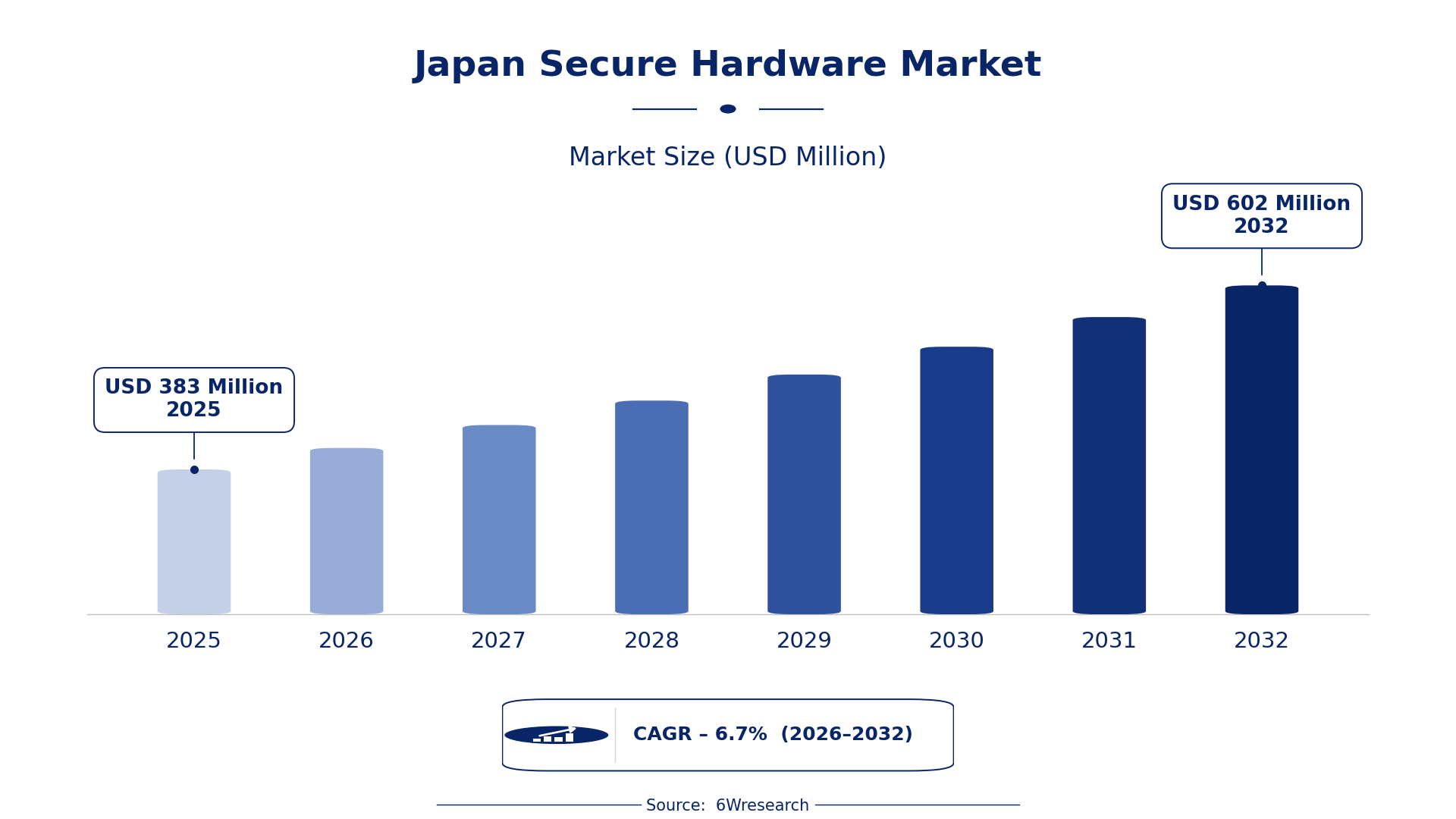
According to 6Wresearch internal database and industry insights, the Japan Secure Hardware Market was valued at USD 383 Million in 2025 and is projected to reach USD 602 Million by 2032, growing at a CAGR of approximately 6.7% during 2026–2032.
Japan Secure Hardware Market Highlights
| Report Metric | Details |
| Report Name | Japan Secure Hardware Market (2026-2032) |
| Market Size 2025 | USD 383 Million |
| Market Size 2032 | USD 602 Million |
| Absolute Growth 2025–2032 | USD 219 Million |
| CAGR 2026–2032 | 6.7% |
| Peak Annual Growth | 7.8% in 2026 |
| Forecast Period | 2026–2032 |
| Historical Data | 2022–2025 |
| Base Year | 2025 |
| Leading Hardware Type, 2025 | HSMs (Hardware Security Modules) (37% share) |
| Leading Security Feature, 2025 | Tamper-resistant (44% share) |
| Leading Deployment Mode, 2025 | On-premise (42% share) |
| Leading End User, 2025 | Financial Institutions (42% share) |
| Fastest-Growing Hardware Type | Secure Elements (9.0% CAGR) |
| Fastest-Growing Security Feature | Secure Boot (8.3% CAGR) |
| Fastest-Growing Deployment Mode | Embedded (9.5% CAGR) |
| Fastest-Growing End User | Device OEMs (8.4% CAGR) |
| Growing Sector | Financial Services |
| Key End Users | Financial Institutions, Government Agencies, Device OEMs, Enterprise Hardware Makers |
Japan Secure Hardware Market Year-wise Growth Rate and Key Drivers (2022–2032)
This graph illustrates the annual growth rates of the market from 2022 to 2032, highlighting a steady upward trajectory and projected market expansion over the forecast period.
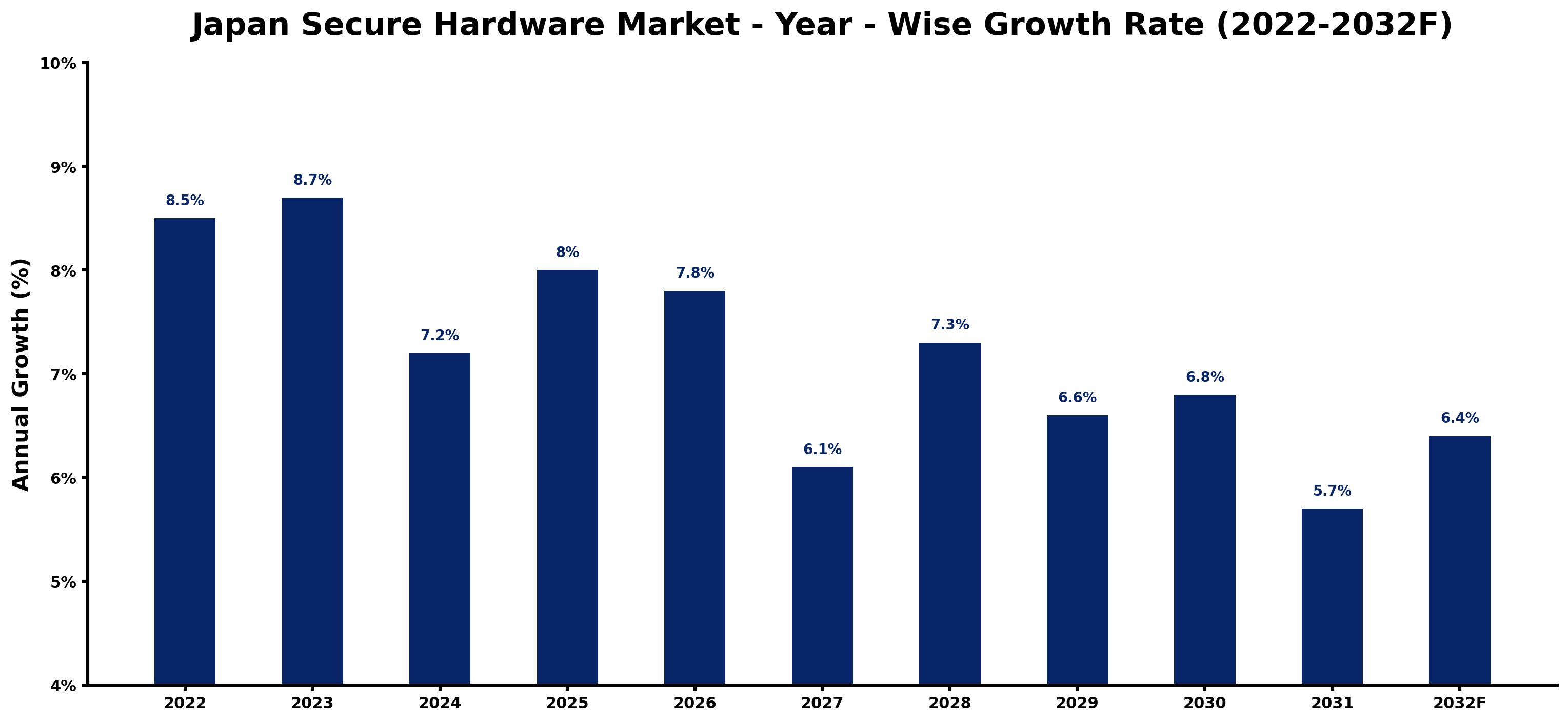
Annual growth estimates for each year appear below with the principal reason behind them, explaining the shifts that set the pace of the market.
| Year | Estimated Annual Growth (%) | Market Rationale |
| 2022 | 8.5 | The market showed strong activity with high demand from financial institutions. |
| 2023 | 8.7 | Growth accelerated as more enterprises adopted secure hardware solutions. |
| 2024 | 7.2 | Growth slowed due to market saturation in some segments, yet demand remained stable. |
| 2025 | 8.0 | Demand increased as government agencies enhanced cybersecurity measures. |
| 2026 | 7.8 | A slowdown occurred as the market adjusted to previous high growth rates. |
| 2027 | 6.1 | Growth continued to slow as competition intensified among suppliers. |
| 2028 | 7.3 | Demand picked up as new technologies were integrated into secure hardware. |
| 2029 | 6.6 | Growth slowed again, reflecting a maturing market with established players. |
| 2030 | 6.8 | A slight increase in growth was noted as cybersecurity threats evolved. |
| 2031 | 5.7 | The market experienced another slowdown as demand stabilised. |
| 2032 | 6.4 | Growth resumed as new government initiatives spurred further adoption. |
Note: Market size estimations and growth projections presented in this report are based on 6Wresearch's proprietary forecasting methodology, utilizing the latest available industry data, government publications, and primary research inputs.
Japan Secure Hardware Market Synopsis
Secure hardware encompasses devices that deliver critical security functions like encryption and authentication, developed through advanced semiconductor technologies. In Japan, the market is expanding, fuelled by more than 100 financial institutions employing hardware security modules and a robust emphasis on cybersecurity. The Tokyo metropolitan area serves as a central hub for development, with 70% of demand originating from domestic users, supported by government initiatives aimed at increasing secure hardware adoption by 2025.
Market Dynamics Impact Analysis (2026–2032)
| Factor | Type | Impact | Primary Segment Affected |
| Increasing investment in cybersecurity infrastructure | Driver | High | HSMs (Hardware Security Modules) |
| Growing adoption of secure payment methods | Driver | High | Secure Elements |
| Rising need for secure data transfer solutions | Opportunity | High | Secure USB Drives |
| Demand for secure communications in mobile devices | Opportunity | High | Trusted Platform Modules |
| Challenges in meeting evolving cybersecurity standards | Restraint | High | Secure Boot |
| Market saturation in certain secure hardware segments | Restraint | Medium | Encryption Chip |
| High competition among suppliers leading to pricing pressures | Challenge | High | HSMs (Hardware Security Modules) |
| Technological advancements requiring constant updates | Challenge | Medium | Secure Elements |
Evaluation of Drivers in Japan Secure Hardware Market (2026–2032)
The table below links each growth driver to the segment it affects and the evidence for it.
| Drivers | Primary Segment Affected | Why It Matters (Evidence) |
| Increased investment in cybersecurity measures | HSMs (Hardware Security Modules) | Over 100 financial institutions in Japan rely on HSMs for secure transactions, driving demand significantly. |
| Adoption of mobile payment solutions | Secure Elements | Embedded secure elements are used in over 80% of smartphones sold, boosting demand for secure hardware. |
| Growth in government cybersecurity initiatives | Trusted Platform Modules | Trusted Platform Modules are mandated for all government IT procurement, increasing their usage across sectors. |
| Demand for secure data transfer solutions | Secure USB Drives | Government agencies commonly use secure USB drives for data transfer, maintaining security and compliance. |
| Technological advancements in secure hardware | Secure Boot | Integration of secure boot technology in new consumer electronics models improves security and user confidence. |
Demand is primarily driven by heightened investment in cybersecurity measures, with over 100 financial institutions in Japan depending on HSMs for secure transactions. The rise of mobile payment solutions is notable, as embedded secure elements feature in over 80% of smartphones sold. Technological advancements in secure hardware, including secure boot technology in new consumer electronics, further strengthen security measures for users.
Evaluation of Restraints in Japan Secure Hardware Market
Below are the constraints most often cited by buyers and suppliers, with the segment each affects.
| Market Restraint | Primary Segment Affected | Why It Matters (Evidence) |
| Challenges in meeting evolving cybersecurity standards | Secure Boot | As standards evolve, manufacturers must continuously adapt, increasing compliance costs by approximately 15%. |
| Market saturation in certain secure hardware segments | Encryption Chip | With many players established, price competition has intensified, impacting profitability by an estimated 10%. |
| Limited awareness among smaller enterprises about secure hardware benefits | Secure USB Drives | Smaller enterprises often overlook secure solutions, restricting potential market growth by around 20%. |
| Technological advancements requiring constant updates | Secure Elements | Suppliers face pressure to innovate, resulting in increased R&D costs of about 12%. |
| High competition among suppliers leading to pricing pressures | HSMs (Hardware Security Modules) | Intense competition results in reduced margins, affecting long-term sustainability by 8%. |
Japan Secure Hardware Market Challenges
Financial institutions face rising costs due to semiconductor supply chain disruptions, which delay secure hardware availability and inflate expenses for users relying on these technologies. Distributors encounter financial burdens from regulations mandating Trusted Platform Modules, increasing operational costs that may be passed on to end-users. Producers struggle with a shortage of skilled cybersecurity professionals, hindering innovation and limiting product diversity for enterprises. Buyers experience fluctuating prices for secure hardware, complicating budgeting and potentially resulting in unexpected IT infrastructure expenses.
Trends in the Japan Secure Hardware Market
Several trends are reshaping the Japan Secure Hardware Market; the most important are set out below.
- Shift towards Stricter Cybersecurity Standards: Government agencies are increasingly adopting stringent cybersecurity standards, with 70% of secure hardware demand coming from domestic users. This shift is clear as the Ministry of Internal Affairs and Communications advocates for secure hardware standards.
- Transition from Traditional to Embedded Security Solutions: The adoption of embedded secure elements in consumer electronics is on the rise, with over 80% of smartphones sold in Japan incorporating this technology. This trend underscores a growing focus on security in everyday devices.
- Emergence of Secure Boot Technology: Secure boot technology is becoming standard in new consumer electronics models, ensuring device integrity during startup. This change is motivated by the necessity for improved security in an increasingly digital environment.
- Growing Demand for On-Premise Solutions: Enterprises are progressively adopting on-premise secure hardware solutions, with over 50% of businesses implementing these systems. This trend highlights the need for greater control over security measures.
Investment Opportunities in the Japan Secure Hardware Market
The opportunities below stand out in the Japan Secure Hardware Market for new entrants and existing suppliers.
- Rising Demand for Secure Payment Solutions: With 70% of secure hardware demand from domestic users, there exists a gap in secure payment solutions. Financial institutions are seeking advanced HSMs, presenting an opportunity for suppliers to penetrate this market through partnerships.
- Investment in Cybersecurity Infrastructure: The government allocated ¥5 billion for cybersecurity improvements, generating a need for secure hardware. This funding provides an opportunity for device OEMs to deliver effective solutions in response to government initiatives.
- Growing Need for Secure Data Transfer Solutions: As secure USB drives are widely used in government agencies, there is a substantial opportunity to supply advanced models. Suppliers can enter the market by collaborating with local partners to meet specific requirements.
- Expansion of Embedded Security in Consumer Electronics: With over 80% of smartphones featuring embedded secure elements, there is a demand for effective solutions. Device OEMs can invest in partnerships to enhance security features in their products.
Government Initiatives in the Japan Secure Hardware Market
The Semiconductor and Digital Industry Strategy, established by METI in June 2021, has implemented measures to secure domestic semiconductor manufacturing, affecting producers of secure hardware. Additionally, the Economic Security Promotion Act of 2022 supports supply-chain resilience for critical products, influencing the secure hardware sector by ensuring stable access to necessary components and maintaining production efficiency.
The National Institute of Standards and Technology (NIST) collaborates on secure hardware guidelines, approving standards that manufacturers must adhere to. Furthermore, the Japan Information Technology Services Industry Association promotes secure hardware initiatives, providing funding and support for projects that improve cybersecurity.
Future Insight of the Japan Secure Hardware Market
The rollout of new cybersecurity infrastructure projects will begin transforming secure hardware capabilities by 2025, creating opportunities for buyers and suppliers. Government funding of ¥5 billion for cybersecurity improvements will drive the creation of innovative secure hardware solutions. By 2032, widespread adoption of secure boot technology in consumer electronics will provide enhanced protection for users. Collaborations with the National Institute of Standards and Technology will ensure adherence to evolving security standards, raising the overall quality of secure hardware.
Market Segmentation Analysis
Japan Secure Hardware Market report covers a detailed analysis of the following market segments:
By Hardware Type – HSMs (Hardware Security Modules) Leads, Secure Elements Expected to Grow Fastest
According to Saurav Kr Singh, Senior Research Analyst at 6Wresearch, the largest hardware type category in 2025 was HSMs (Hardware Security Modules), at 37% of revenue. HSMs play a crucial role in securing transactions, particularly for Japan's financial institutions, where over 100 entities rely on them for safe operations. This dependence underscores their importance in maintaining data integrity and customer trust within the sector. Over 2026–2032, Secure Elements are expected to post the fastest growth, at a CAGR of 9.0%. The growth of secure elements is driven by their essential role in mobile payments and secure communications, with over 80% of smartphones sold in Japan incorporating them. This trend highlights a significant shift towards secure mobile solutions, further solidifying their market presence. Suppliers should focus on enhancing secure element offerings to meet the rising demand in mobile technology.
By Security Feature – Tamper-resistant Leads, Secure Boot Expected to Grow Fastest
With 44% of security feature revenue in 2025, Tamper-resistant was the largest category. Tamper-resistant features are essential for safeguarding sensitive hardware, making them indispensable in secure hardware applications. Their necessity is underscored by the demand for robust security measures across various sectors, particularly in finance and government. Secure Boot is projected to grow fastest, at a CAGR of 8.3% during 2026–2032. The increasing adoption of secure boot technology is propelled by its vital role in ensuring device integrity during startup, reflecting a broader trend towards enhanced security in consumer electronics. This growth indicates a heightened awareness of security vulnerabilities in new devices. Buyers must prioritise tamper-resistant features in their procurement processes to safeguard sensitive information.
By Deployment Mode – On-premise Leads, Embedded Expected to Grow Fastest
On-premise accounted for 42% of the market by deployment mode in 2025. On-premise deployment is the predominant choice among enterprises in Japan, as it provides control and security for sensitive data management. This preference is particularly strong in sectors like finance, where data protection is paramount. The quickest growth will come from Embedded, forecast to expand at a CAGR of 9.5% between 2026 and 2032. Embedded secure hardware is rapidly gaining traction due to its widespread application in consumer electronics, reflecting the increasing demand for integrated security solutions. This trend suggests that manufacturers are prioritising security in their product designs. Suppliers should consider expanding embedded solutions to align with market trends in consumer electronics.
By End User – Financial Institutions Lead, Device OEMs Expected to Grow Fastest
Financial Institutions held 42% of the Japan Secure Hardware Market by end user in 2025. Financial institutions are the largest users of secure hardware, relying on it to ensure transaction security across a vast network of operations. This sector's considerable investment in secure technology illustrates its critical importance in maintaining trust and regulatory compliance. Device OEMs are set to record the highest CAGR in this split, 8.4% over 2026–2032. Device OEMs are witnessing rapid growth as they increasingly integrate security features into their products, driven by consumer demand for secure technology. This trend signifies a shift towards prioritising security in product development across various industries. Suppliers must collaborate with device OEMs to develop tailored secure hardware solutions that address emerging market needs.
Key Attractiveness of the Report
- 10 Years of Market Numbers
- Historical Data Starting from 2022 to 2025
- Base Year 2025
- Forecast Data until 2032
- Key Performance Indicators Impacting the Market
- Major Upcoming Developments and Projects
Key Highlights of the Report:
- Japan Secure Hardware Market Outlook
- Market Size of Japan Secure Hardware Market, 2025
- Forecast of Japan Secure Hardware Market, 2032
- Historical Data and Forecast of Japan Secure Hardware Revenues & Volume for the Period 2022-2032F
- Japan Secure Hardware Market Trend Evolution
- Japan Secure Hardware Market Drivers and Challenges
- Japan Secure Hardware Price Trends
- Japan Secure Hardware Porter's Five Forces
- Japan Secure Hardware Industry Life Cycle
- Historical Data and Forecast of Japan Secure Hardware Market Revenues & Volume By Hardware Type for the Period 2022-2032F
- Historical Data and Forecast of Japan Secure Hardware Market Revenues & Volume By HSMs (Hardware Security Modules) for the Period 2022-2032F
- Historical Data and Forecast of Japan Secure Hardware Market Revenues & Volume By Secure Elements for the Period 2022-2032F
- Historical Data and Forecast of Japan Secure Hardware Market Revenues & Volume By Trusted Platform Modules for the Period 2022-2032F
- Historical Data and Forecast of Japan Secure Hardware Market Revenues & Volume By Secure USB Drives for the Period 2022-2032F
- Historical Data and Forecast of Japan Secure Hardware Market Revenues & Volume By Security Feature for the Period 2022-2032F
- Historical Data and Forecast of Japan Secure Hardware Market Revenues & Volume By Tamper-resistant for the Period 2022-2032F
- Historical Data and Forecast of Japan Secure Hardware Market Revenues & Volume By Secure Boot for the Period 2022-2032F
- Historical Data and Forecast of Japan Secure Hardware Market Revenues & Volume By Cryptoprocessor for the Period 2022-2032F
- Historical Data and Forecast of Japan Secure Hardware Market Revenues & Volume By Encryption Chip for the Period 2022-2032F
- Historical Data and Forecast of Japan Secure Hardware Market Revenues & Volume By Deployment Mode for the Period 2022-2032F
- Historical Data and Forecast of Japan Secure Hardware Market Revenues & Volume By On-premise for the Period 2022-2032F
- Historical Data and Forecast of Japan Secure Hardware Market Revenues & Volume By Embedded for the Period 2022-2032F
- Historical Data and Forecast of Japan Secure Hardware Market Revenues & Volume By Board-integrated for the Period 2022-2032F
- Historical Data and Forecast of Japan Secure Hardware Market Revenues & Volume By Portable for the Period 2022-2032F
- Historical Data and Forecast of Japan Secure Hardware Market Revenues & Volume By End User for the Period 2022-2032F
- Historical Data and Forecast of Japan Secure Hardware Market Revenues & Volume By Financial Institutions for the Period 2022-2032F
- Historical Data and Forecast of Japan Secure Hardware Market Revenues & Volume By Device OEMs for the Period 2022-2032F
- Historical Data and Forecast of Japan Secure Hardware Market Revenues & Volume By Enterprise Hardware Makers for the Period 2022-2032F
- Historical Data and Forecast of Japan Secure Hardware Market Revenues & Volume By Government Agencies for the Period 2022-2032F
- Japan Secure Hardware Import Export Trade Statistics
- Market Opportunity Assessment By Hardware Type
- Market Opportunity Assessment By Security Feature
- Market Opportunity Assessment By Deployment Mode
- Market Opportunity Assessment By End User
- Japan Secure Hardware Top Companies Market Share
- Japan Secure Hardware Competitive Benchmarking By Technical and Operational Parameters
- Japan Secure Hardware Company Profiles
- Japan Secure Hardware Key Strategic Recommendations
Market Covered
Coverage by segment is as follows.
By Hardware Type
- HSMs (Hardware Security Modules)
- Secure Elements
- Trusted Platform Modules
- Secure USB Drives
By Security Feature
- Tamper-resistant
- Secure Boot
- Cryptoprocessor
- Encryption Chip
By Deployment Mode
- On-premise
- Embedded
- Board-integrated
- Portable
By End User
- Financial Institutions
- Device OEMs
- Enterprise Hardware Makers
- Government Agencies































