Japan Security Data Lake Market Size & Growth Rate
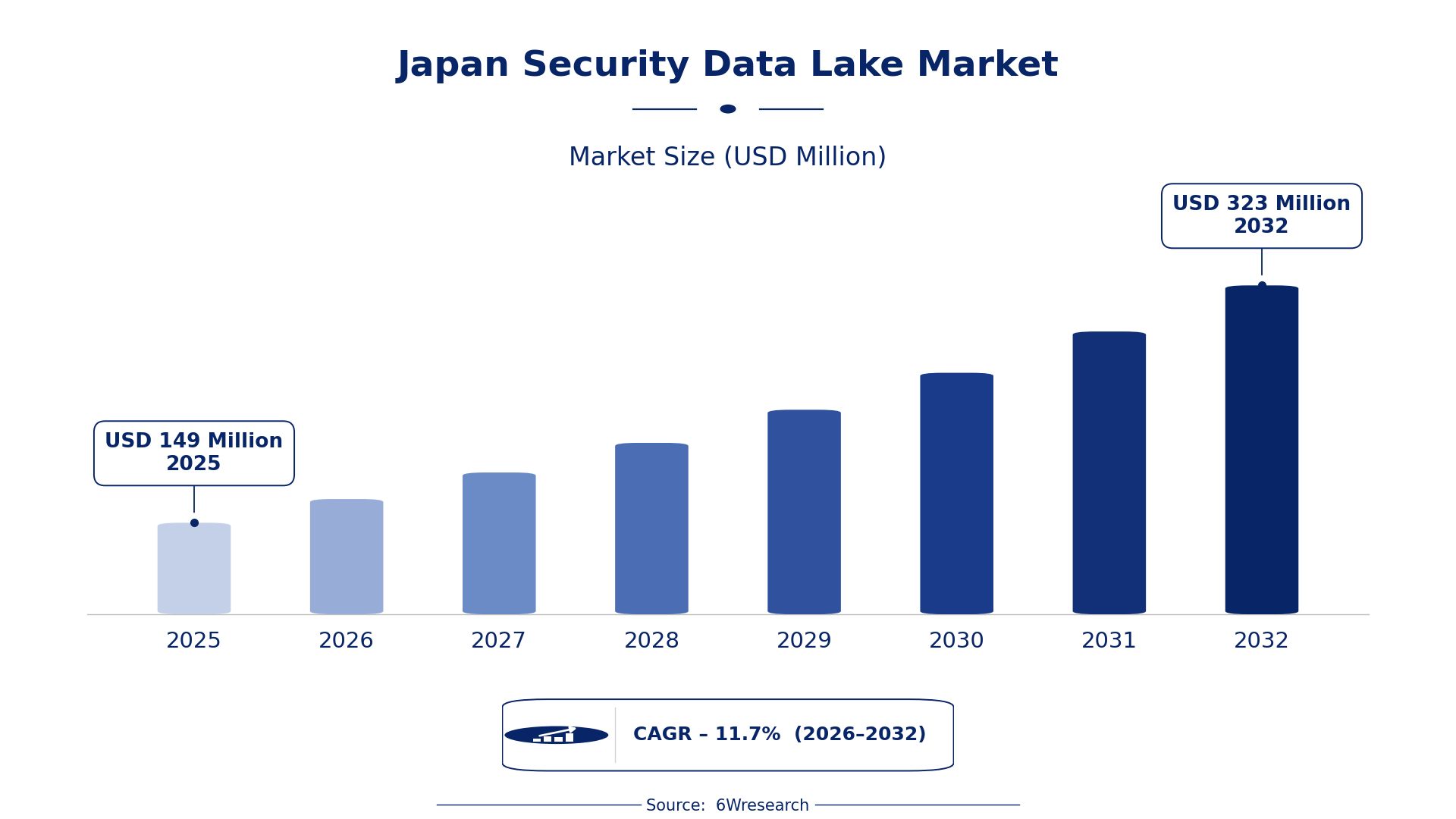
According to 6Wresearch internal database and industry insights, the Japan Security Data Lake Market was valued at USD 149 Million in 2025 and is projected to reach USD 323 Million by 2032, growing at a CAGR of approximately 11.7% during 2026–2032.
Japan Security Data Lake Market Highlights
| Report Metric | Details |
| Report Name | Japan Security Data Lake Market (2026-2032) |
| Market Size 2025 | USD 149 Million |
| Market Size 2032 | USD 323 Million |
| Absolute Growth 2025–2032 | USD 174 Million |
| CAGR 2026–2032 | 11.7% |
| Peak Annual Growth | 13.2% in 2026 |
| Forecast Period | 2026–2032 |
| Historical Data | 2022–2025 |
| Base Year | 2025 |
| Leading Deployment Type, 2025 | Cloud-Native Data Lake (41% share) |
| Leading Data Type Supported, 2025 | SIEM/Logs/Events (38% share) |
| Leading Security Model, 2025 | Zero-Trust Architecture (39% share) |
| Leading End User, 2025 | Enterprise Security Teams (41% share) |
| Fastest-Growing Deployment Type | AI-Powered Insights (16.9% CAGR) |
| Fastest-Growing Data Type Supported | Anomaly Detection Logs (17.1% CAGR) |
| Fastest-Growing End User | Government Cyber Agencies (14.4% CAGR) |
| Growing Sector | Government Cyber Agencies |
| Key End Users | Enterprise Security Teams, Government Cyber Agencies, Financial Services Firms, Security Operations Centers |
Japan Security Data Lake Market Year-wise Growth Rate and Key Drivers (2022–2032)
This graph illustrates the annual growth rates of the market from 2022 to 2032, highlighting a steady upward trajectory and projected market expansion over the forecast period.
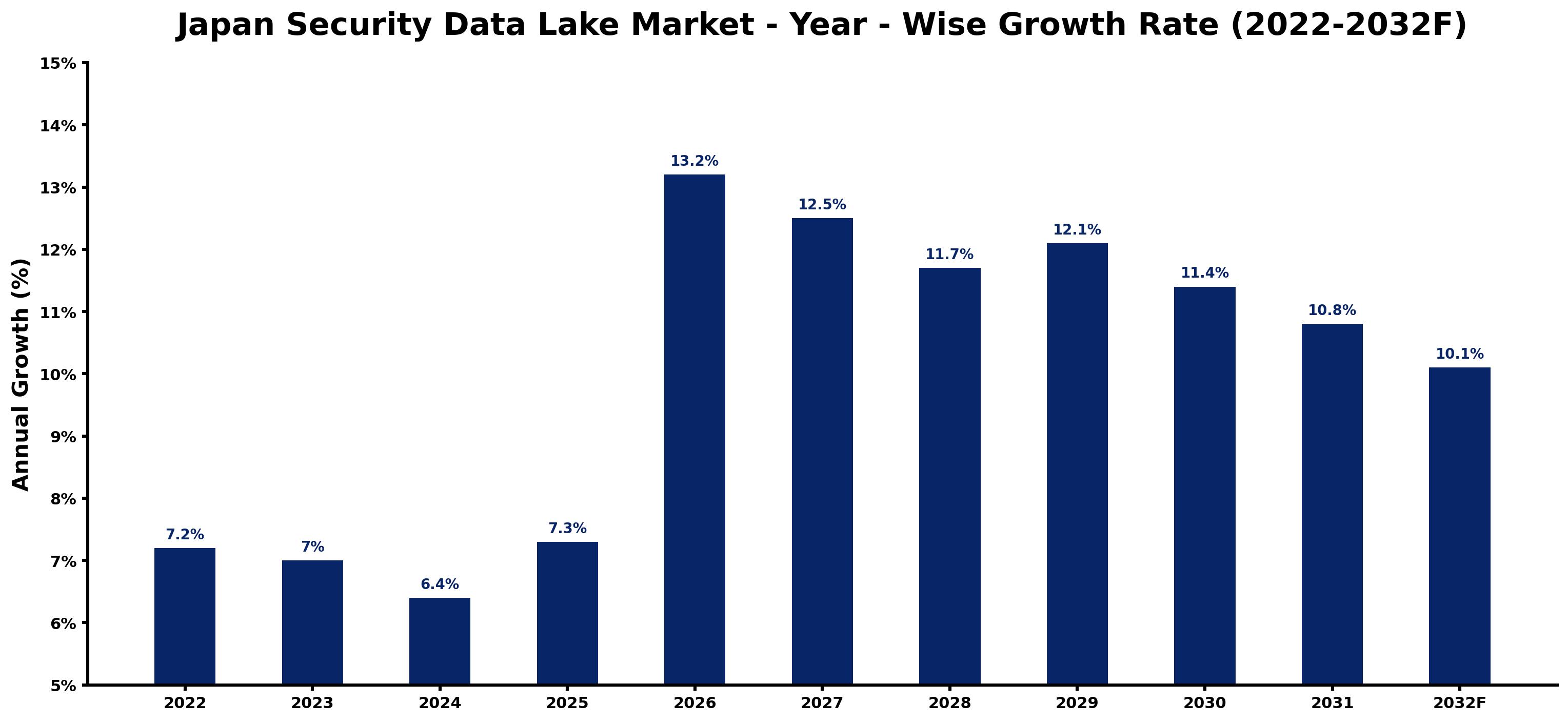
For each year, the table pairs the estimated growth rate with the leading influence on demand, showing how the drivers changed across the period.
| Year | Estimated Annual Growth (%) | Market Rationale |
| 2022 | 7.2 | The market experienced steady growth, driven by increased cybersecurity awareness and investments. |
| 2023 | 7.0 | Growth slowed slightly as organizations adapted to evolving threats and refined their strategies. |
| 2024 | 6.4 | The market maintained a slower growth rate as enterprises focused on improving security infrastructure. |
| 2025 | 7.3 | Growth accelerated as enterprises prioritized cybersecurity measures and increased funding for solutions. |
| 2026 | 13.2 | The market will peak as demand for advanced security solutions rises sharply. |
| 2027 | 12.5 | Growth will slow as the market stabilizes after a rapid expansion phase in previous years. |
| 2028 | 11.7 | The market will continue to grow, albeit at a more moderate pace as maturity sets in. |
| 2029 | 12.1 | Demand will rise again as organizations strengthen their security frameworks and compliance efforts. |
| 2030 | 11.4 | Growth will slow as market maturity sets in, stabilizing demand levels across sectors. |
| 2031 | 10.8 | The market will maintain steady growth as cybersecurity remains a top priority for organizations. |
| 2032 | 10.1 | Growth will slow further as the market reaches a more stable phase with established practices. |
Note: Market size estimations and growth projections presented in this report are based on 6Wresearch's proprietary forecasting methodology, utilizing the latest available industry data, government publications, and primary research inputs.
Japan Security Data Lake Market Synopsis
Security Data Lakes function as central repositories for extensive security-related data, facilitating real-time analytics for threat detection, incident response, and compliance monitoring. The Japan Security Data Lake Market is driven by enterprises and government agencies that prioritise cybersecurity, especially within the technology and financial sectors. With the cybersecurity market expected to reach 1.6 trillion JPY by 2025, considerable investments in security infrastructure and advanced technologies are apparent.
Market Dynamics Impact Analysis (2026–2032)
| Factor | Type | Impact | Primary Segment Affected |
| Growing cybersecurity incidents | Driver | High | Cloud-Native Data Lake |
| Increased investment in cybersecurity solutions | Driver | High | AI-Powered Insights |
| Demand for flexible data solutions | Opportunity | High | Hybrid Data Lake |
| Need for advanced threat detection capabilities | Opportunity | High | Anomaly Detection Logs |
| Limited awareness of Security Data Lake benefits | Restraint | Medium | On-Prem Data Lake |
| Concerns over data privacy and compliance | Restraint | Medium | Encryption at Rest |
| Shortage of skilled cybersecurity professionals | Challenge | High | Enterprise Security Teams |
| High implementation costs for advanced solutions | Challenge | Medium | Government Cyber Agencies |
Evaluation of Drivers in Japan Security Data Lake Market (2026–2032)
The factors lifting demand, and the evidence behind each, are summarised below.
| Drivers | Primary Segment Affected | Why It Matters (Evidence) |
| Increase in reported cybersecurity incidents | SIEM/Logs/Events | The number of incidents reached 10,000 in 2022, prompting demand for real-time monitoring solutions. |
| Rising investment in cybersecurity measures | Cloud-Native Data Lake | Japan's cybersecurity market is projected to reach 1.6 trillion JPY by 2025, driving purchases of security solutions. |
| Adoption of advanced analytics for threat detection | AI-Powered Insights | Organizations are investing in solutions that improve threat detection capabilities. |
| Growing need for compliance with security standards | Zero-Trust Architecture | Compliance with security standards drives organizations to adopt Zero-Trust models for enhanced security. |
| Expansion of cybersecurity initiatives by government agencies | Government Cyber Agencies | The Cybersecurity Strategy launched in 2023 promotes national resilience and increases demand for security solutions. |
What keeps demand rising is the surge in reported cybersecurity incidents, which totalled 10,000 in 2022, prompting organisations to invest in SIEM solutions for real-time monitoring. Investment in cybersecurity measures is anticipated to exceed 50 billion JPY in 2023, propelling purchases of advanced security solutions. The necessity for compliance with security standards promotes the adoption of Zero-Trust Architecture, further increasing demand. The introduction of new standards shapes compliance requirements and influences how suppliers design their offerings.
Evaluation of Restraints in Japan Security Data Lake Market
Below are the constraints most often cited by buyers and suppliers, with the segment each affects.
| Market Restraint | Primary Segment Affected | Why It Matters (Evidence) |
| Limited domestic suppliers of essential security technologies | Cloud-Native Data Lake | This shortage can inflate operational expenses for producers, impacting pricing strategies. |
| Intense competition among cybersecurity firms | SIEM/Logs/Events | The high number of reported incidents forces firms to invest heavily in advanced solutions to retain clients. |
| Technological advancements lag behind demand | AI-Powered Insights | Many enterprises struggle to integrate real-time analytics, delaying incident response times for buyers by an average of three weeks. |
| Complex regulatory compliance requirements | Zero-Trust Architecture | Financial institutions must adhere to stringent mandates from the Financial Services Agency, leading to increased compliance costs. |
| High costs of cybersecurity solutions | Government Cyber Agencies | Budget constraints can limit the ability of agencies to invest in necessary security technologies. |
Japan Security Data Lake Market Challenges
In Japan, escalating input costs pose challenges for cybersecurity firms that depend on a limited pool of domestic suppliers for crucial security technologies, inflating operational expenses by up to 15% for producers. Competition intensifies as the number of cybersecurity incidents reached 12,000 in 2022, compelling firms to invest heavily in advanced solutions to attract and retain clients. Many enterprises struggle to integrate real-time analytics into their existing systems, delaying incident response times for buyers by an average of three weeks. Regulatory pressures from the Financial Services Agency complicate operations, raising compliance costs by around 20% for financial institutions.
Trends in the Japan Security Data Lake Market
Buyers and suppliers in the Japan Security Data Lake Market are adjusting to the following trends.
- Shift from Traditional Security Models to Zero-Trust Architecture: Enterprise Security Teams are increasingly adopting Zero-Trust Architecture, which gained traction in 2023 as organizations seek to strengthen their security frameworks. This shift reflects a growing recognition of the need for stringent access controls.
- Transition from On-Premises Solutions to Cloud-Native Data Lakes: The installed base of Cloud-Native Data Lakes is expanding rapidly, with a 41% market share in 2025. This trend is driven by the need for scalable and flexible security solutions in the technology sector.
- Emergence of AI-Powered Security Solutions: AI-Powered Insights are becoming essential for threat detection, with a projected growth rate of 16.9% from 2026 to 2032. This trend is evident as organizations invest in advanced analytics to improve their security posture.
- Increased Focus on Compliance and Standards: The adoption of ISO/IEC 27001 is growing, with organizations prioritizing compliance to strengthen security. This trend is supported by the establishment of new standards that shape security practices.
Investment Opportunities in the Japan Security Data Lake Market
The openings below show where demand in the Japan Security Data Lake Market is visible and how suppliers can enter.
- Investment in Cloud-Native Security Solutions: The gap in scalable security solutions presents an opportunity for suppliers to invest in Cloud-Native Data Lakes. The Tokyo metropolitan area, a hub for cybersecurity firms, is ideal for partnerships and development.
- Supply of Advanced Analytics Tools: The demand for AI-Powered Insights is increasing, with enterprises in the technology sector actively seeking advanced analytics tools to enhance their security capabilities.
- Development of Zero-Trust Security Solutions: The growing emphasis on compliance with security standards creates an opportunity to develop Zero-Trust Architecture solutions. Government Cyber Agencies are seeking innovative approaches to strengthen national security.
- Provision of Incident Forensics Services: The need for Incident Forensics is rising as organisations aim to improve their post-incident analysis capabilities. Financial Services Firms are particularly focused on enhancing their incident response strategies.
Government Initiatives in the Japan Security Data Lake Market
The AI Promotion Act (2025) introduces a structured approach to integrating AI in cybersecurity measures, building on previous laws. This act encourages organisations to adopt AI technologies for improved security outcomes, influencing how Security Data Lakes are developed and utilised.
The Cybersecurity Agency of Japan oversees national security policies and funds various initiatives aimed at strengthening cybersecurity infrastructure. In 2023, the government allocated 50 billion JPY for cybersecurity initiatives, supporting projects that enhance national resilience.
Future Insight of the Japan Security Data Lake Market
Investment in cybersecurity initiatives is expected to surpass 50 billion JPY by 2032, generating robust demand for advanced Security Data Lakes. New strategies will emerge, particularly in the technology sector, improving threat detection capabilities. The establishment of the Cybersecurity Agency of Japan will shape national policies and compliance requirements, influencing how suppliers develop their offerings. As the installed base of SIEM solutions continues to grow, buyers will benefit from improved analytics and faster incident response capabilities.
Market Segmentation Analysis
Japan Security Data Lake Market report covers a detailed analysis of the following market segments:
By Deployment Type – Cloud-Native Data Lake Leads, AI-Powered Insights Expected to Grow Fastest
According to Saurav Kr Singh, Senior Research Analyst at 6Wresearch, Cloud-Native Data Lake took 41% of deployment type revenue in 2025, more than any other category. The Cloud-Native Data Lake holds the largest share due to its widespread adoption among enterprises seeking scalable security solutions. This is particularly evident in the Tokyo metropolitan area, where numerous cybersecurity firms leverage cloud-native technologies for enhanced performance. AI-Powered Insights are projected to grow fastest, at a CAGR of 16.9% during 2026–2032. The segment focusing on advanced analytics is experiencing rapid growth as organisations increasingly prioritise real-time insights for security data. The rising number of reported cybersecurity incidents in Japan underscores the urgent need for improved analytical capabilities in security operations. Suppliers should focus on developing cloud-native solutions that meet the growing demand for scalable security analytics.
By Data Type Supported – SIEM/Logs/Events Lead, Anomaly Detection Logs Expected to Grow Fastest
In 2025, SIEM/Logs/Events led the data type supported split with a 38% share. SIEM/Logs/Events leads the market as it is essential for real-time monitoring, allowing organisations to respond quickly to potential threats. The increasing installed base of SIEM solutions in Japan highlights the critical importance of this data type for effective security management. The quickest growth will come from Anomaly Detection Logs, forecast to expand at a CAGR of 17.1% between 2026 and 2032. Anomaly Detection Logs is the fastest-growing segment, driven by the need for organisations to identify unusual patterns in security data. As cyber threats become more complex, the demand for sophisticated detection methods is intensifying. Buyers should prioritise solutions that integrate comprehensive SIEM capabilities with effective anomaly detection features.
By Security Model – Zero-Trust Architecture Leads and Records the Fastest Growth
With 39% of security model revenue in 2025, Zero-Trust Architecture was the largest category. Zero-Trust Architecture commands the largest share as it is increasingly adopted for modern security frameworks, providing robust protection against evolving threats. The recent Cybersecurity Strategy launched in 2023 highlights the importance of this model in enhancing national security. Zero-Trust Architecture is also forecast to expand faster than any other category, at a CAGR of 14.5% over 2026–2032. Zero-Trust Architecture is also the fastest-growing segment, as its principles align with the urgent need for improved cybersecurity resilience. This trend will likely widen its lead as more organisations adopt zero-trust principles in their security strategies. Suppliers must align their offerings with the zero-trust approach to capture emerging market opportunities.
By End User – Enterprise Security Teams Lead, Government Cyber Agencies Expected to Grow Fastest
Enterprise Security Teams held 41% of the Japan Security Data Lake Market by end user in 2025. Enterprise Security Teams represent the largest segment as they are the primary users of Security Data Lakes, utilising them for comprehensive threat management. Their critical role in safeguarding organisational security drives a substantial demand for these solutions. Over 2026–2032, Government Cyber Agencies are expected to post the fastest growth, at a CAGR of 14.4%. Government Cyber Agencies are the fastest-growing segment, employing Security Data Lakes for national security purposes. The establishment of the Cybersecurity Agency of Japan indicates a heightened focus on governmental cybersecurity initiatives and resource allocation. Suppliers should tailor their solutions to meet the specific needs of both enterprise and government sectors.
Key Attractiveness of the Report
- 10 Years of Market Numbers
- Historical Data Starting from 2022 to 2025
- Base Year 2025
- Forecast Data until 2032
- Key Performance Indicators Impacting the Market
- Major Upcoming Developments and Projects
Key Highlights of the Report:
- Japan Security Data Lake Market Outlook
- Market Size of Japan Security Data Lake Market, 2025
- Forecast of Japan Security Data Lake Market, 2032
- Historical Data and Forecast of Japan Security Data Lake Revenues & Volume for the Period 2022-2032F
- Japan Security Data Lake Market Trend Evolution
- Japan Security Data Lake Market Drivers and Challenges
- Japan Security Data Lake Price Trends
- Japan Security Data Lake Porter's Five Forces
- Japan Security Data Lake Industry Life Cycle
- Historical Data and Forecast of Japan Security Data Lake Market Revenues & Volume By Deployment Type for the Period 2022-2032F
- Historical Data and Forecast of Japan Security Data Lake Market Revenues & Volume By Cloud-Native Data Lake for the Period 2022-2032F
- Historical Data and Forecast of Japan Security Data Lake Market Revenues & Volume By Hybrid Data Lake for the Period 2022-2032F
- Historical Data and Forecast of Japan Security Data Lake Market Revenues & Volume By On-Prem Data Lake for the Period 2022-2032F
- Historical Data and Forecast of Japan Security Data Lake Market Revenues & Volume By AI-Powered Insights for the Period 2022-2032F
- Historical Data and Forecast of Japan Security Data Lake Market Revenues & Volume By Data Type Supported for the Period 2022-2032F
- Historical Data and Forecast of Japan Security Data Lake Market Revenues & Volume By SIEM/Logs/Events for the Period 2022-2032F
- Historical Data and Forecast of Japan Security Data Lake Market Revenues & Volume By Incident Forensics for the Period 2022-2032F
- Historical Data and Forecast of Japan Security Data Lake Market Revenues & Volume By Network/Telco Data for the Period 2022-2032F
- Historical Data and Forecast of Japan Security Data Lake Market Revenues & Volume By Anomaly Detection Logs for the Period 2022-2032F
- Historical Data and Forecast of Japan Security Data Lake Market Revenues & Volume By Security Model for the Period 2022-2032F
- Historical Data and Forecast of Japan Security Data Lake Market Revenues & Volume By Encryption at Rest for the Period 2022-2032F
- Historical Data and Forecast of Japan Security Data Lake Market Revenues & Volume By Access Control for the Period 2022-2032F
- Historical Data and Forecast of Japan Security Data Lake Market Revenues & Volume By Role-Based Access for the Period 2022-2032F
- Historical Data and Forecast of Japan Security Data Lake Market Revenues & Volume By Zero-Trust Architecture for the Period 2022-2032F
- Historical Data and Forecast of Japan Security Data Lake Market Revenues & Volume By End User for the Period 2022-2032F
- Historical Data and Forecast of Japan Security Data Lake Market Revenues & Volume By Enterprise Security Teams for the Period 2022-2032F
- Historical Data and Forecast of Japan Security Data Lake Market Revenues & Volume By Government Cyber Agencies for the Period 2022-2032F
- Historical Data and Forecast of Japan Security Data Lake Market Revenues & Volume By Financial Services Firms for the Period 2022-2032F
- Historical Data and Forecast of Japan Security Data Lake Market Revenues & Volume By Security Operations Centers for the Period 2022-2032F
- Japan Security Data Lake Import Export Trade Statistics
- Market Opportunity Assessment By Deployment Type
- Market Opportunity Assessment By Data Type Supported
- Market Opportunity Assessment By Security Model
- Market Opportunity Assessment By End User
- Japan Security Data Lake Top Companies Market Share
- Japan Security Data Lake Competitive Benchmarking By Technical and Operational Parameters
- Japan Security Data Lake Company Profiles
- Japan Security Data Lake Key Strategic Recommendations
Market Covered
Segments analysed in this report are listed below.
By Deployment Type
- Cloud-Native Data Lake
- Hybrid Data Lake
- On-Prem Data Lake
- AI-Powered Insights
By Data Type Supported
- SIEM/Logs/Events
- Incident Forensics
- Network/Telco Data
- Anomaly Detection Logs
By Security Model
- Encryption at Rest
- Access Control
- Role-Based Access
- Zero-Trust Architecture
By End User
- Enterprise Security Teams
- Government Cyber Agencies
- Financial Services Firms
- Security Operations Centers































