Japan Security Orchestration AI (SOAR) Market Size & Growth Rate
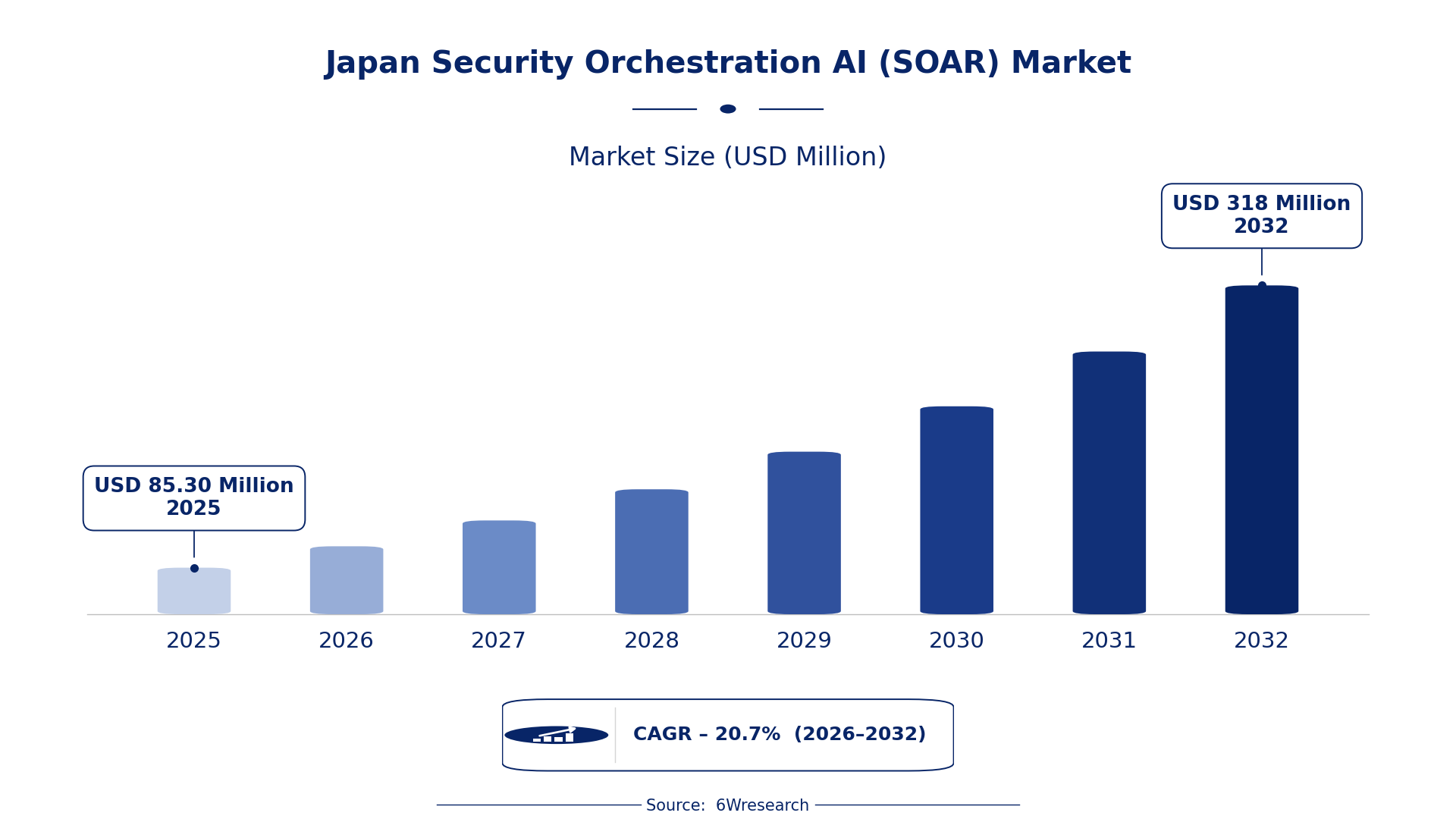
According to 6Wresearch internal database and industry insights, the Japan Security Orchestration AI (SOAR) Market was valued at USD 85.30 Million in 2025 and is projected to reach USD 318 Million by 2032, growing at a CAGR of approximately 20.7% during 2026–2032.
Japan Security Orchestration AI (SOAR) Market Highlights
| Report Metric | Details |
| Report Name | Japan Security Orchestration AI (SOAR) Market (2026-2032) |
| Market Size 2025 | USD 85.30 Million |
| Market Size 2032 | USD 318 Million |
| Absolute Growth 2025–2032 | USD 232.70 Million |
| CAGR 2026–2032 | 20.7% |
| Peak Annual Growth | 21.8% in 2032 |
| Forecast Period | 2026–2032 |
| Historical Data | 2022–2025 |
| Base Year | 2025 |
| Leading Orchestration Type, 2025 | Incident Automation (38% share) |
| Leading AI Capability, 2025 | Machine Learning (44% share) |
| Leading Integration Type, 2025 | SIEM & ITSM Integration (55% share) |
| Leading End User, 2025 | Financial Institutions (39% share) |
| Fastest-Growing Orchestration Type | Threat Hunting SOAR (22.6% CAGR) |
| Fastest-Growing AI Capability | Automated Workflows (28.7% CAGR) |
| Fastest-Growing Integration Type | Threat Intelligence Feeds (22.8% CAGR) |
| Fastest-Growing End User | SOC Analysts (27.0% CAGR) |
| Growing Sector | Cybersecurity |
| Key End Users | Financial Institutions, SOC Analysts, Legal & Compliance Teams |
Japan Security Orchestration AI (SOAR) Market Year-wise Growth Rate and Key Drivers (2022–2032)
This graph illustrates the annual growth rates of the market from 2022 to 2032, highlighting a steady upward trajectory and projected market expansion over the forecast period.
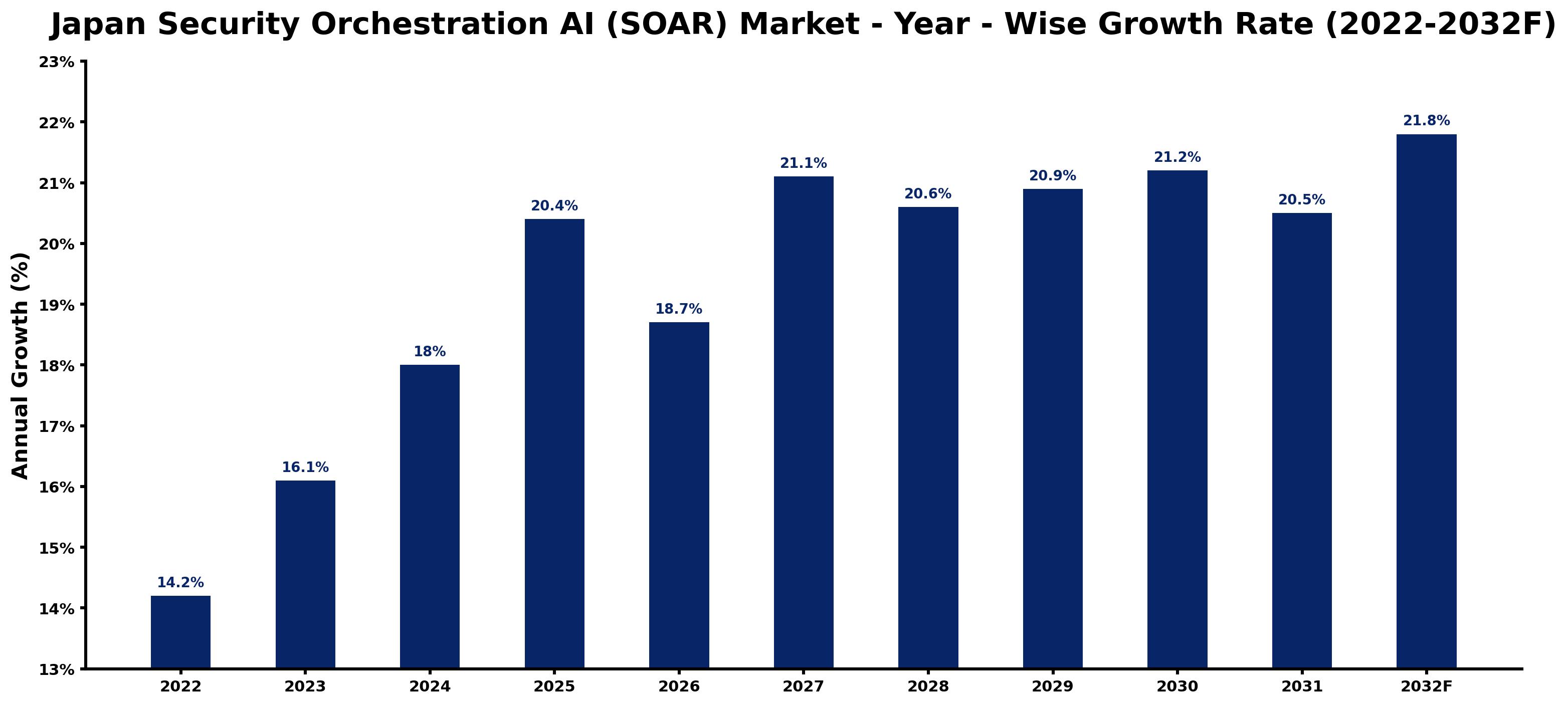
Below, each year's estimated growth is shown next to the factor that most influenced it.
| Year | Estimated Annual Growth (%) | Market Rationale |
| 2022 | 14.2 | The market showed steady growth as cybersecurity incidents increased. |
| 2023 | 16.1 | Demand accelerated due to heightened awareness of cyber threats among organizations. |
| 2024 | 18.0 | Growth continued as more enterprises adopted AI-driven security solutions. |
| 2025 | 20.4 | Investment surged following the Tokyo 2020 Olympics, boosting security measures. |
| 2026 | 18.7 | Growth is expected to slow slightly as the market stabilises after rapid expansion. |
| 2027 | 21.1 | Demand is projected to rise again as organizations seek advanced threat detection capabilities. |
| 2028 | 20.6 | Growth is anticipated to moderate as the market adjusts to increased competition and maturity. |
| 2029 | 20.9 | Demand is expected to pick up with a focus on integrating threat intelligence feeds. |
| 2030 | 21.2 | Continued investment in security orchestration is projected to drive further market expansion. |
| 2031 | 20.5 | The market is expected to experience a slowdown as saturation begins to set in. |
| 2032 | 21.8 | Growth is projected to peak as organizations fully embrace automated incident response solutions. |
Note: Market size estimations and growth projections presented in this report are based on 6Wresearch's proprietary forecasting methodology, utilizing the latest available industry data, government publications, and primary research inputs.
Japan Security Orchestration AI (SOAR) Market Synopsis
Security Orchestration AI (SOAR) integrates various security tools and processes to automate incident response and improve threat management. The Japan Security Orchestration AI (SOAR) Market is expanding due to rising cybersecurity incidents, with over 1,000 reported in 2022. The Tokyo metropolitan area serves as a key hub for innovation, driving investments in advanced security technologies and propelling market growth further. Financial institutions are increasingly prioritising these solutions to safeguard sensitive data, reflecting a growing demand for effective cybersecurity measures.
Market Dynamics Impact Analysis (2026–2032)
| Factor | Type | Impact | Primary Segment Affected |
| Increasing cybersecurity incidents drive demand for automated solutions. | Driver | High | Incident Automation |
| Financial institutions are investing heavily in advanced security technologies. | Driver | High | Financial Institutions |
| Growing need for efficient incident response solutions presents opportunities. | Opportunity | High | Automated Workflows |
| High adoption rates of AI-driven solutions create market entry points. | Opportunity | Medium | Machine Learning |
| Competition among cybersecurity firms may limit market share for new entrants. | Restraint | Medium | Threat Hunting SOAR |
| Integration challenges with existing systems can hinder adoption rates. | Restraint | High | SIEM & ITSM Integration |
| Shortage of skilled cybersecurity professionals poses a challenge. | Challenge | High | SOC Analysts |
| Rapid technological changes can outpace current security measures. | Challenge | Medium | Forensic Orchestration |
Evaluation of Drivers in Japan Security Orchestration AI (SOAR) Market (2026–2032)
Below are the drivers that matter most for revenue growth, with supporting evidence.
| Drivers | Primary Segment Affected | Why It Matters (Evidence) |
| Increase in reported cyber incidents drives demand for incident automation. | Incident Automation | The number of reported cyber incidents reached 1,000 in 2022, prompting organizations to automate responses. |
| Financial institutions are investing heavily in security technologies. | Financial Institutions | These institutions are prioritizing advanced security solutions to safeguard sensitive data. |
| High adoption of AI-driven solutions improves operational efficiency. | Automated Workflows | Over 70% of enterprises in Japan are adopting AI-driven security solutions to streamline processes. |
| Growing focus on threat intelligence integration enhances security management. | Threat Intelligence Feeds | This integration supports real-time data sharing, improving overall threat detection capabilities. |
| Increased investment in cybersecurity measures following major events. | Forensic Orchestration | The Tokyo 2020 Olympics prompted significant investments in cybersecurity infrastructure. |
Spending rises because the number of reported cyber incidents in Japan reached 1,000 in 2022, prompting organisations to automate incident responses. Financial institutions are investing heavily in advanced security technologies to protect sensitive data, with a substantial portion of enterprises adopting AI-driven security solutions to improve operational efficiency. The focus on integrating threat intelligence feeds supports real-time data sharing, enhancing overall threat detection capabilities. Major events, such as the Tokyo 2020 Olympics, have prompted investments in cybersecurity infrastructure, driving market growth.
Evaluation of Restraints in Japan Security Orchestration AI (SOAR) Market
These restraints slow adoption and weigh on supplier margins.
| Market Restraint | Primary Segment Affected | Why It Matters (Evidence) |
| Integration challenges with existing systems hinder adoption rates. | SIEM & ITSM Integration | Many organizations struggle to integrate SOAR solutions with legacy systems, delaying implementation. |
| Shortage of skilled cybersecurity professionals limits operational capacity. | SOC Analysts | The average salary for SOC analysts is approximately ¥6 million, reflecting high demand and limited supply. |
| Rapid technological changes can outpace current security measures. | Forensic Orchestration | Organizations may find it difficult to keep up with evolving threats and technologies. |
| High competition among cybersecurity firms could limit market share. | Threat Hunting SOAR | New entrants face challenges in differentiating their offerings in a crowded market. |
| Budget constraints may limit investments in advanced security solutions. | Automated Workflows | Organizations may prioritize other expenditures over cybersecurity improvements. |
Japan Security Orchestration AI (SOAR) Market Challenges
Producers face supply chain disruptions due to reliance on imported components, causing delays in product availability for cybersecurity firms. Intense competition exists among over 1,000 domestic firms, which pressures smaller entities to reduce prices and diminishes their profit margins. A skills shortage hampers recruitment efforts, as the average salary for SOC analysts is approximately ¥6 million annually, making it difficult for producers to attract qualified talent. Regulatory compliance with ISO/IEC 27001 standards raises operational costs and extends project timelines for buyers, limiting their ability to implement effective security measures.
Trends in the Japan Security Orchestration AI (SOAR) Market
Several trends are reshaping the Japan Security Orchestration AI (SOAR) Market; the most important are set out below.
- Shift towards Automated Incident Response Solutions: The trend towards automated incident response solutions began gaining traction post-2020, as organisations sought to improve efficiency. In 2023, over 70% of enterprises adopted AI-driven security solutions, indicating a shift in strategy.
- Transition from Reactive to Proactive Threat Management: Organisations are increasingly shifting from reactive to proactive threat management strategies. The adoption of threat intelligence feeds has risen, with a projected 22.8% CAGR for 2026-2032, reflecting this change.
- Emergence of Integrated Security Platforms: Integrated security platforms are becoming more prevalent, driven by the need for streamlined operations. In 2023, the Ministry of Economy, Trade and Industry launched a cybersecurity strategy to promote this integration.
- Focus on Compliance with Regulatory Standards: The Cybersecurity Basic Act, enacted in 2014, has led to a heightened focus on compliance among organisations. This has resulted in increased demand for SOAR solutions that align with ISO/IEC 27001 standards.
Investment Opportunities in the Japan Security Orchestration AI (SOAR) Market
The following areas offer the clearest openings for investors and suppliers in the Japan Security Orchestration AI (SOAR) Market.
- Financial Institutions Seeking Advanced Security Solutions: Financial institutions are increasingly prioritising advanced security technologies, holding over 39% market share in 2025. Investing in automated workflows can help meet this demand effectively.
- Growing Demand for Threat Intelligence Integration: With a projected 22.8% growth for threat intelligence feeds, there is an opportunity for suppliers. Collaborating with financial institutions can facilitate market entry.
- Investment in Cybersecurity Research and Development: Japan allocated ¥10 billion for cybersecurity research in 2023, creating opportunities for innovation. Partnering with local cybersecurity firms can enhance product development.
- Rising Adoption of AI-Driven Solutions: Over 70% of enterprises are adopting AI-driven security solutions, indicating a gap in supply. Investing in automated workflows can meet this growing need effectively.
Government Initiatives in the Japan Security Orchestration AI (SOAR) Market
The Cybersecurity Basic Act, enacted in 2014, mandates organizations to improve their security measures. This law requires companies to implement effective cybersecurity protocols, ensuring compliance with international standards like ISO/IEC 27001, which is vital for maintaining data integrity and security.
In 2023, Japan allocated ¥10 billion for cybersecurity research and development, administered by the Ministry of Economy, Trade and Industry. This funding supports initiatives aimed at improving cybersecurity infrastructure and capabilities across various sectors.
Future Insight of the Japan Security Orchestration AI (SOAR) Market
The launch of new cybersecurity research initiatives will enhance local capabilities by 2032. Increased investment in automation technologies will streamline incident response processes, benefiting both buyers and suppliers. As the number of Security Operations Centres grows, collaboration will improve threat detection and management. With over 70% of enterprises adopting AI-driven security solutions, the market will shift towards more advanced technologies that effectively address emerging cyber threats.
Market Segmentation Analysis
Japan Security Orchestration AI (SOAR) Market report covers a detailed analysis of the following market segments:
By Orchestration Type – Incident Automation Leads, Threat Hunting SOAR Expected to Grow Fastest
According to Saurav Kr Singh, Senior Research Analyst at 6Wresearch, with 38% of orchestration type revenue in 2025, Incident Automation was the largest category. Incident Automation holds the largest share due to its ability to streamline repetitive security tasks, which is vital for organisations facing increasing cyber threats. The concentration of cybersecurity firms in the Tokyo metropolitan area exemplifies the focus on incident automation to enhance operational efficiency. Over 2026–2032, Threat Hunting SOAR is expected to post the fastest growth, at a CAGR of 22.6%. Threat Hunting SOAR is experiencing rapid growth as organisations increasingly prioritise proactive threat identification in response to the rising number of cyber incidents reported in Japan. This focus on threat hunting will likely widen the lead of incident automation as both areas are essential for comprehensive security strategies. Suppliers should focus on developing solutions that enhance incident automation and threat hunting capabilities to meet the growing market demands.
By AI Capability – Machine Learning Leads, Automated Workflows Expected to Grow Fastest
In 2025, Machine Learning led the ai capability split with a 44% share. Machine Learning leads this segment as it underpins various functions, enhancing the overall effectiveness of security operations. Its integration into existing systems is crucial for improving threat detection and response across multiple sectors in Japan. The quickest growth will come from Automated Workflows, forecast to expand at a CAGR of 28.7% between 2026 and 2032. Automated Workflows is the fastest-growing sub-segment as organisations aim to streamline security processes and reduce response times. The trend towards efficiency is underscored by the fact that over 70% of enterprises are adopting AI-driven security solutions. Buyers will benefit from solutions that provide streamlined workflows, leading to quicker incident responses and improved security outcomes.
By Integration Type – SIEM & ITSM Integration Leads, Threat Intelligence Feeds Expected to Grow Fastest
SIEM & ITSM Integration accounted for 55% of the market by integration type in 2025. SIEM & ITSM Integration dominates this category as it allows organisations to leverage existing security management systems, thereby enhancing their overall security posture. This integration is particularly important for firms in the Tokyo area, where cybersecurity innovation is a primary focus. Threat Intelligence Feeds are projected to grow fastest, at a CAGR of 22.8% during 2026–2032. Threat Intelligence Feeds are growing rapidly as they provide real-time data that significantly improves threat detection capabilities. The increasing number of cyber incidents has heightened the demand for timely and actionable threat intelligence. Suppliers must ensure their solutions enable seamless integration with SIEM and ITSM systems to attract a wider client base.
By End User – Financial Institutions Lead, SOC Analysts Expected to Grow Fastest
The largest end user category in 2025 was Financial Institutions, at 39% of revenue. Financial Institutions represent the largest share as they have a high demand for security solutions to protect sensitive financial data. The substantial investments made by these institutions highlight their commitment to safeguarding against cyber threats. SOC Analysts are set to record the highest CAGR in this split, 27.0% over 2026–2032. SOC Analysts are the fastest-growing user group, as they are the primary users of SOAR tools for effective incident management. The rise in the number of Security Operations Centres (SOCs) in Japan reflects the increasing reliance on skilled analysts to combat cyber threats. Vendors should tailor their offerings to meet the specific needs of financial institutions and SOC analysts to capture a larger market share.
Key Attractiveness of the Report
- 10 Years of Market Numbers
- Historical Data Starting from 2022 to 2025
- Base Year 2025
- Forecast Data until 2032
- Key Performance Indicators Impacting the Market
- Major Upcoming Developments and Projects
Key Highlights of the Report:
- Japan Security Orchestration AI (SOAR) Market Outlook
- Market Size of Japan Security Orchestration AI (SOAR) Market, 2025
- Forecast of Japan Security Orchestration AI (SOAR) Market, 2032
- Historical Data and Forecast of Japan Security Orchestration AI (SOAR) Revenues & Volume for the Period 2022-2032F
- Japan Security Orchestration AI (SOAR) Market Trend Evolution
- Japan Security Orchestration AI (SOAR) Market Drivers and Challenges
- Japan Security Orchestration AI (SOAR) Price Trends
- Japan Security Orchestration AI (SOAR) Porter's Five Forces
- Japan Security Orchestration AI (SOAR) Industry Life Cycle
- Historical Data and Forecast of Japan Security Orchestration AI (SOAR) Market Revenues & Volume By Orchestration Type for the Period 2022-2032F
- Historical Data and Forecast of Japan Security Orchestration AI (SOAR) Market Revenues & Volume By Incident Automation for the Period 2022-2032F
- Historical Data and Forecast of Japan Security Orchestration AI (SOAR) Market Revenues & Volume By Threat Hunting SOAR for the Period 2022-2032F
- Historical Data and Forecast of Japan Security Orchestration AI (SOAR) Market Revenues & Volume By Phishing Response for the Period 2022-2032F
- Historical Data and Forecast of Japan Security Orchestration AI (SOAR) Market Revenues & Volume By Forensic Orchestration for the Period 2022-2032F
- Historical Data and Forecast of Japan Security Orchestration AI (SOAR) Market Revenues & Volume By AI Capability for the Period 2022-2032F
- Historical Data and Forecast of Japan Security Orchestration AI (SOAR) Market Revenues & Volume By NLP & Playbook Triggers for the Period 2022-2032F
- Historical Data and Forecast of Japan Security Orchestration AI (SOAR) Market Revenues & Volume By Machine Learning for the Period 2022-2032F
- Historical Data and Forecast of Japan Security Orchestration AI (SOAR) Market Revenues & Volume By Automated Workflows for the Period 2022-2032F
- Historical Data and Forecast of Japan Security Orchestration AI (SOAR) Market Revenues & Volume By AI-based Analytics for the Period 2022-2032F
- Historical Data and Forecast of Japan Security Orchestration AI (SOAR) Market Revenues & Volume By Integration Type for the Period 2022-2032F
- Historical Data and Forecast of Japan Security Orchestration AI (SOAR) Market Revenues & Volume By SIEM & ITSM Integration for the Period 2022-2032F
- Historical Data and Forecast of Japan Security Orchestration AI (SOAR) Market Revenues & Volume By Threat Intelligence Feeds for the Period 2022-2032F
- Historical Data and Forecast of Japan Security Orchestration AI (SOAR) Market Revenues & Volume By Email Gateway Integration for the Period 2022-2032F
- Historical Data and Forecast of Japan Security Orchestration AI (SOAR) Market Revenues & Volume By E-Discovery Tools for the Period 2022-2032F
- Historical Data and Forecast of Japan Security Orchestration AI (SOAR) Market Revenues & Volume By End User for the Period 2022-2032F
- Historical Data and Forecast of Japan Security Orchestration AI (SOAR) Market Revenues & Volume By Enterprise Security Labs for the Period 2022-2032F
- Historical Data and Forecast of Japan Security Orchestration AI (SOAR) Market Revenues & Volume By SOC Analysts for the Period 2022-2032F
- Historical Data and Forecast of Japan Security Orchestration AI (SOAR) Market Revenues & Volume By Financial Institutions for the Period 2022-2032F
- Historical Data and Forecast of Japan Security Orchestration AI (SOAR) Market Revenues & Volume By Legal & Compliance Teams for the Period 2022-2032F
- Japan Security Orchestration AI (SOAR) Import Export Trade Statistics
- Market Opportunity Assessment By Orchestration Type
- Market Opportunity Assessment By AI Capability
- Market Opportunity Assessment By Integration Type
- Market Opportunity Assessment By End User
- Japan Security Orchestration AI (SOAR) Top Companies Market Share
- Japan Security Orchestration AI (SOAR) Competitive Benchmarking By Technical and Operational Parameters
- Japan Security Orchestration AI (SOAR) Company Profiles
- Japan Security Orchestration AI (SOAR) Key Strategic Recommendations
Market Covered
The report covers the following segments.
By Orchestration Type
- Incident Automation
- Threat Hunting SOAR
- Phishing Response
- Forensic Orchestration
By AI Capability
- NLP & Playbook Triggers
- Machine Learning
- Automated Workflows
- AI-based Analytics
By Integration Type
- SIEM & ITSM Integration
- Threat Intelligence Feeds
- Email Gateway Integration
- E-Discovery Tools
By End User
- Enterprise Security Labs
- SOC Analysts
- Financial Institutions
- Legal & Compliance Teams































