Japan Security Scanner Market Size & Growth Rate
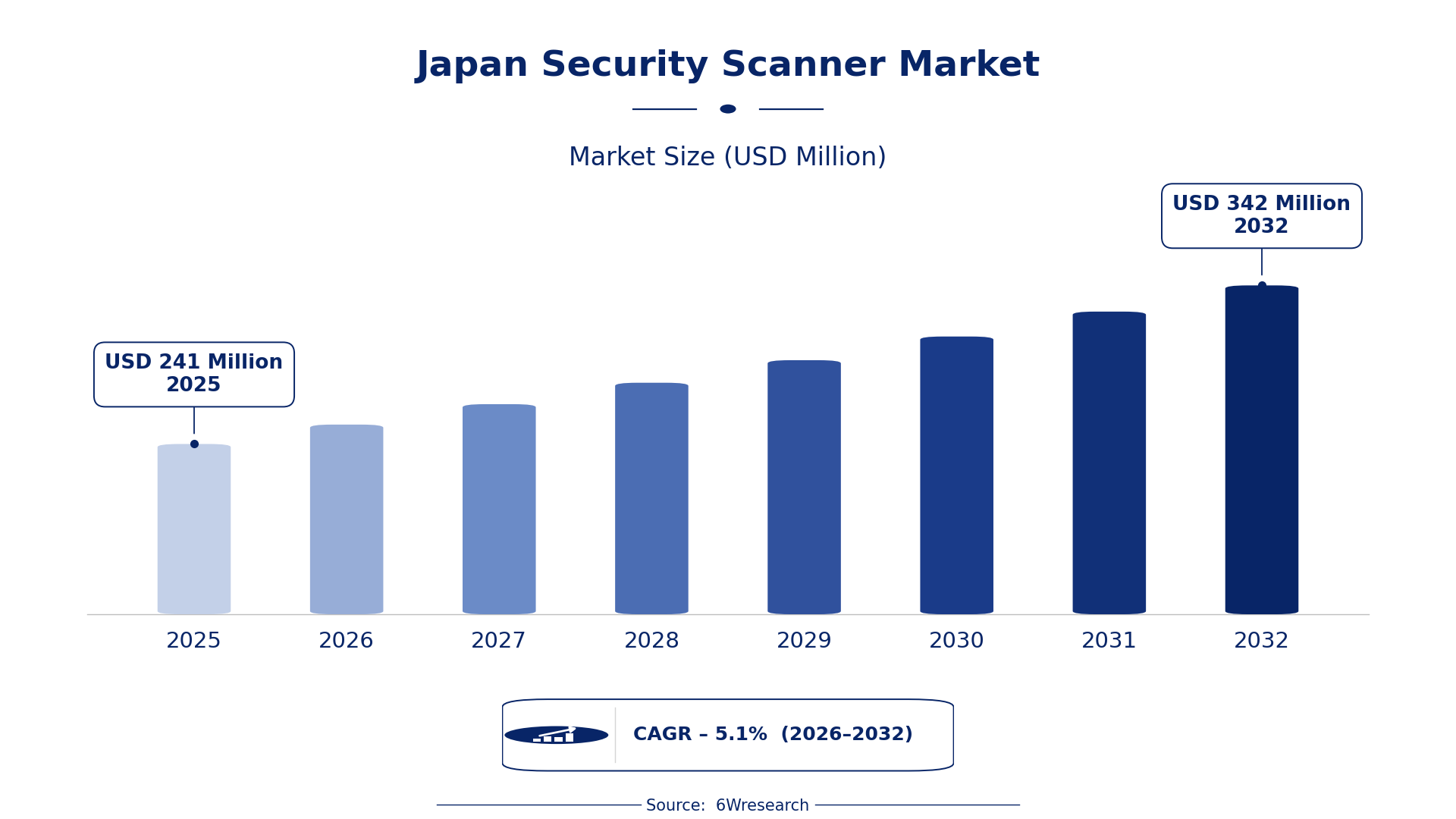
According to 6Wresearch internal database and industry insights, the Japan Security Scanner Market was valued at USD 241 Million in 2025 and is projected to reach USD 342 Million by 2032, growing at a CAGR of approximately 5.1% during 2026–2032.
Japan Security Scanner Market Highlights
| Report Metric | Details |
| Report Name | Japan Security Scanner Market (2026-2032) |
| Market Size 2025 | USD 241 Million |
| Market Size 2032 | USD 342 Million |
| Absolute Growth 2025–2032 | USD 101 Million |
| CAGR 2026–2032 | 5.1% |
| Peak Annual Growth | 6.2% in 2032 |
| Forecast Period | 2026–2032 |
| Historical Data | 2022–2025 |
| Base Year | 2025 |
| Leading Scanner Type, 2025 | X-ray Baggage Scanners (45% share) |
| Leading Detection Mode, 2025 | Dual-Energy Imaging (44% share) |
| Leading Mounting Type, 2025 | Tunnel-Mounted (39% share) |
| Leading End User, 2025 | Airports (35% share) |
| Fastest-Growing Scanner Type | Body Scanners (7.2% CAGR) |
| Fastest-Growing Detection Mode | Millimeter Wave (6.7% CAGR) |
| Fastest-Growing Mounting Type | Fixed Gateway (7.5% CAGR) |
| Fastest-Growing End User | High-Security Sites (6.6% CAGR) |
| Growing Sector | Public Safety |
| Key End Users | Airports, High-Security Sites, Event Venues, Border Checkpoints |
Japan Security Scanner Market Year-wise Growth Rate and Key Drivers (2022–2032)
This graph illustrates the annual growth rates of the market from 2022 to 2032, highlighting a steady upward trajectory and projected market expansion over the forecast period.
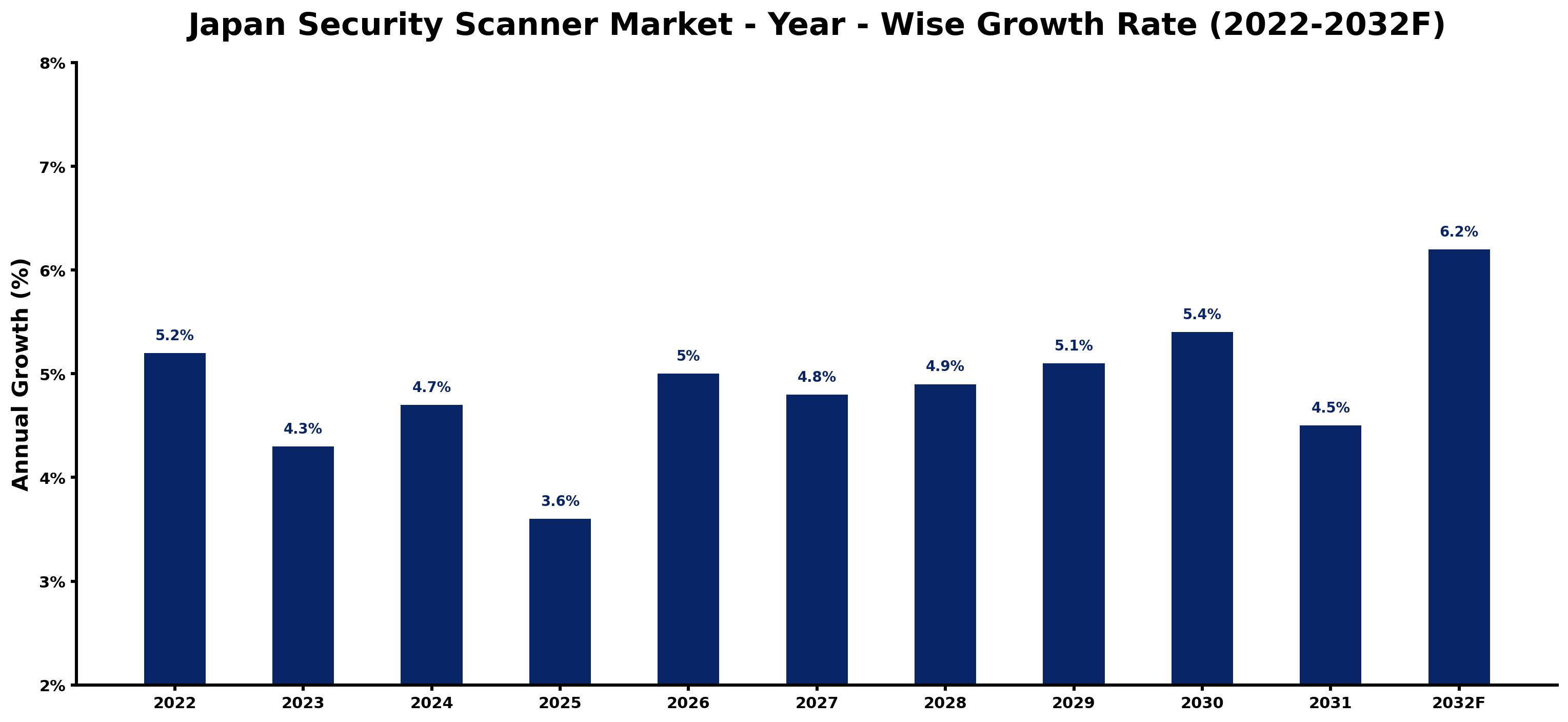
Annual growth estimates for each year appear below with the principal reason behind them, explaining the shifts that set the pace of the market.
| Year | Estimated Annual Growth (%) | Market Rationale |
| 2022 | 5.2 | The market experienced solid growth due to heightened security concerns following recent incidents. |
| 2023 | 4.3 | Demand slowed slightly as installations stabilised after a surge in previous years. |
| 2024 | 4.7 | Growth picked up again as new security standards were implemented across airports. |
| 2025 | 3.6 | A slowdown occurred as market saturation began to affect new purchases. |
| 2026 | 5.0 | Demand is expected to rise as public safety initiatives gain traction. |
| 2027 | 4.8 | Growth will slow as the market adjusts to increased supply capacity. |
| 2028 | 4.9 | Demand is projected to rise as technology adoption continues in high-security sites. |
| 2029 | 5.1 | Growth is anticipated to increase due to rising security needs at public events. |
| 2030 | 5.4 | Demand will continue to rise as the adoption of advanced scanners becomes widespread. |
| 2031 | 4.5 | A slowdown is expected as the market matures and competition intensifies. |
| 2032 | 6.2 | The market is set to peak due to substantial investments in security infrastructure. |
Note: Market size estimations and growth projections presented in this report are based on 6Wresearch's proprietary forecasting methodology, utilizing the latest available industry data, government publications, and primary research inputs.
Japan Security Scanner Market Synopsis
Security scanners are advanced detection devices that identify concealed weapons and explosives, primarily used in airports and high-security facilities. The Japan Security Scanner Market is propelled by increasing public safety measures and technological advancements. With over 90 international airports employing these devices, demand is bolstered by government initiatives and the rising need for improved security at public venues. The Tokyo region alone accounts for 30% of national demand, reflecting substantial investment in security technology.
Market Dynamics Impact Analysis (2026–2032)
| Factor | Type | Impact | Primary Segment Affected |
| Increased public safety initiatives drive demand for advanced security solutions. | Driver | High | Body Scanners |
| Technological advancements in imaging technologies enhance scanner capabilities. | Driver | High | Dual-Energy Imaging |
| Growing investments in public safety measures present opportunities for suppliers. | Opportunity | High | X-ray Baggage Scanners |
| Rising demand for security at events creates a market for portable scanners. | Opportunity | Medium | Handheld Metal Detectors |
| Market saturation limits growth potential for new installations. | Restraint | High | X-ray Baggage Scanners |
| High costs associated with advanced scanners can deter purchases. | Restraint | Medium | Body Scanners |
| Supply chain disruptions can delay the availability of security scanners. | Challenge | High | Dual-Energy Imaging |
| Competition among manufacturers may lead to price wars affecting margins. | Challenge | Medium | X-ray Baggage Scanners |
Evaluation of Drivers in Japan Security Scanner Market (2026–2032)
The factors lifting demand, and the evidence behind each, are summarised below.
| Drivers | Primary Segment Affected | Why It Matters (Evidence) |
| Increased security threats lead to higher demand for body scanners. | Body Scanners | The National Police Agency reported a 15% increase in installations at public venues. |
| Technological advancements improve detection capabilities of dual-energy imaging. | Dual-Energy Imaging | The adoption rate of this technology is mandated in all major airports. |
| Government funding for public safety initiatives boosts demand for X-ray scanners. | X-ray Baggage Scanners | The Tokyo Metropolitan Government allocated ¥500 million for enhancing security measures. |
| Growing awareness of security needs at public events drives handheld metal detector sales. | Handheld Metal Detectors | Over 1,000 handheld metal detectors were reported in use across various sectors. |
| Increased border security measures necessitate vehicle under-vehicle scanners. | Vehicle Under-Vehicle Scanners | Security scanners are installed at over 200 border checkpoints across Japan. |
Spending rises because heightened security concerns have led to increased demand for body scanners, with a reported 15% rise in installations at public venues. Technological advancements in dual-energy imaging improve detection capabilities, aligning with mandates in major airports. The growing awareness of security needs at public events drives sales of handheld metal detectors, with over 1,000 units reported in use across various sectors. Increased border security measures further necessitate the deployment of vehicle under-vehicle scanners at over 200 checkpoints nationwide.
Evaluation of Restraints in Japan Security Scanner Market
These are the pressures that could keep growth below its potential.
| Market Restraint | Primary Segment Affected | Why It Matters (Evidence) |
| Market saturation limits growth potential for new installations. | X-ray Baggage Scanners | Many airports have already implemented advanced scanning technologies. |
| High costs associated with advanced scanners can deter purchases. | Body Scanners | The average cost of a high-end X-ray baggage scanner is approximately ¥20 million. |
| Supply chain disruptions can delay the availability of security scanners. | Dual-Energy Imaging | Global supply chain issues affect the timely delivery of components. |
| Regulatory compliance can complicate the installation process. | Handheld Metal Detectors | Manufacturers must meet various standards set by the Japan Civil Aviation Bureau. |
| Intense competition may lead to price wars affecting margins. | X-ray Baggage Scanners | Numerous suppliers are vying for market share in a saturated environment. |
Japan Security Scanner Market Challenges
In Japan, suppliers face challenges in sourcing high-quality components for security scanners, which delays production and raises costs for manufacturers. A limited number of local suppliers meet the stringent quality standards, resulting in installation delays for airports and public venues of up to six months. Rapid advancements in imaging technology require substantial R&D investments, straining budgets and slowing product launches for producers. Regulatory updates from the Ministry of Land, Infrastructure, Transport and Tourism introduce compliance costs, affecting pricing strategies for buyers and potentially increasing expenses by 10% in the short term.
Trends in the Japan Security Scanner Market
Below are the shifts with the largest effect on the Japan Security Scanner Market.
- Shift to Portable Scanners: A growing trend towards portable scanners is emerging in urban areas, particularly for public events. The Kansai region has seen a rise in installations, with portable scanners becoming essential for crowd control.
- Transition to Advanced Imaging Technologies: Airports are increasingly adopting advanced imaging technologies, such as dual-energy imaging, to improve security measures. The adoption rate has reached 60% as of 2023, indicating a notable shift in security protocols.
- Emergence of Integrated Security Solutions: Integrated security solutions are becoming standard in high-security sites, combining various scanning technologies. This trend is reflected in the Tokyo region, where comprehensive security systems are being implemented.
- Prioritisation of Public Safety Investments: Public safety investments are being prioritised, particularly in urban areas. The government has launched initiatives aimed at increasing security funding by 2025, reflecting a commitment to improving safety.
Investment Opportunities in the Japan Security Scanner Market
The following areas offer the clearest openings for investors and suppliers in the Japan Security Scanner Market.
- Timing for Investment in Portable Scanners: With a 15% rise in public venue installations, now is the ideal moment to invest in portable scanners. Event venues in urban areas are actively seeking suppliers to enhance security measures.
- Growing Demand for Body Scanners in High-Security Sites: The Kansai region is experiencing a surge in body scanner installations, driven by heightened security needs. Suppliers can penetrate this market through local partnerships or joint ventures.
- Expansion of X-ray Scanner Use in Airports: The Tokyo region accounts for 30% of national demand for security scanners, presenting a prime opportunity for suppliers. Collaborating with local manufacturers can facilitate market entry.
- Investment in Advanced Imaging Technologies: The adoption rate of dual-energy imaging technology is mandated in major airports, creating a demand for advanced scanners. Suppliers should focus on meeting regulatory standards to gain market access.
Government Initiatives in the Japan Security Scanner Market
The Economic Security Promotion Act enacted in 2022 supports supply-chain resilience for critical products, including security scanners. This law encourages manufacturers to invest in advanced technologies and ensures compliance with safety standards, promoting growth in the security scanner market. The PRTR Law requires businesses to report chemical substances, impacting the production processes of security scanner components.
The Japan Civil Aviation Bureau oversees regulations for security measures in airports, ensuring compliance with the latest standards. The agency has approved numerous projects aimed at improving airport security, including the installation of advanced scanners. In 2023, the Ministry of Land, Infrastructure, Transport and Tourism updated security standards, further driving demand for compliant security technologies.
Future Insight of the Japan Security Scanner Market
Investment in security technologies will increase significantly by 2032, driven by government initiatives aimed at improving public safety. The integration of advanced scanners at over 200 border checkpoints will create heightened demand for innovative solutions. The adoption of dual-energy imaging technology will become standard across major venues, providing suppliers with a more predictable market. Enhanced collaboration between public and private sectors will facilitate the development of more effective security measures, benefiting buyers with improved safety outcomes.
Market Segmentation Analysis
Japan Security Scanner Market report covers a detailed analysis of the following market segments:
By Scanner Type – X-ray Baggage Scanners Lead, Body Scanners Expected to Grow Fastest
According to Saurav Kr Singh, Senior Research Analyst at 6Wresearch, with 45% of scanner type revenue in 2025, X-ray Baggage Scanners was the largest category. X-ray baggage scanners are extensively used in airports across Japan, making them the preferred choice for luggage screening. Their established presence and reliability in high-traffic areas contribute to their leading market share. Over 2026–2032, Body Scanners are expected to post the fastest growth, at a CAGR of 7.2%. Body scanners are gaining traction due to their deployment at security checkpoints, particularly in response to heightened security measures. The increasing focus on passenger safety at airports is propelling this segment's rapid growth. Suppliers should prioritise innovations in body scanner technology to meet the rising demand in security environments.
By Detection Mode – Dual-Energy Imaging Leads, Millimeter Wave Expected to Grow Fastest
Dual-Energy Imaging accounted for 44% of the market by detection mode in 2025. Dual-energy imaging technology is essential for accurately identifying different materials in baggage, which is critical for airport security. Its effectiveness in enhancing detection capabilities solidifies its leading position in the market. Millimeter Wave is set to record the highest CAGR in this split, 6.7% over 2026–2032. Millimeter wave technology is being increasingly adopted for non-invasive body scanning in airports, especially as security protocols become more stringent. This method's ability to efficiently ensure passenger safety is accelerating its growth. Suppliers need to focus on advancing detection technologies to align with the rising security requirements.
By Mounting Type – Tunnel-Mounted Leads, Fixed Gateway Expected to Grow Fastest
The largest mounting type category in 2025 was Tunnel-Mounted, at 39% of revenue. Tunnel-mounted scanners are the standard in airport baggage handling systems, ensuring efficient screening for large volumes of luggage. Their integration into existing infrastructures has strengthened their dominant market share. Fixed Gateway is projected to grow fastest, at a CAGR of 7.5% during 2026–2032. Fixed gateway scanners are being rapidly deployed at secure facility entry points, highlighting the increasing demand for enhanced security solutions. Their adaptability and effectiveness in various settings are propelling their swift growth. Suppliers should prioritise the development of fixed gateway solutions to meet the growing needs of secure facilities.
By End User – Airports Lead, High-Security Sites Expected to Grow Fastest
Airports held 35% of the Japan Security Scanner Market by end user in 2025. Airports are the primary users of security scanners, utilising them for both passenger and baggage screening to ensure safety. Their consistent demand for advanced security measures maintains their leading position in the market. The quickest growth will come from High-Security Sites, forecast to expand at a CAGR of 6.6% between 2026 and 2032. High-security sites are increasingly investing in security scanners to safeguard sensitive areas, reflecting a growing emphasis on security. This trend indicates a rapid expansion in this segment as security needs escalate. Suppliers must tailor their offerings to meet the specific requirements of high-security sites to capitalise on this growth opportunity.
Key Attractiveness of the Report
- 10 Years of Market Numbers
- Historical Data Starting from 2022 to 2025
- Base Year 2025
- Forecast Data until 2032
- Key Performance Indicators Impacting the Market
- Major Upcoming Developments and Projects
Key Highlights of the Report:
- Japan Security Scanner Market Outlook
- Market Size of Japan Security Scanner Market, 2025
- Forecast of Japan Security Scanner Market, 2032
- Historical Data and Forecast of Japan Security Scanner Revenues & Volume for the Period 2022-2032F
- Japan Security Scanner Market Trend Evolution
- Japan Security Scanner Market Drivers and Challenges
- Japan Security Scanner Price Trends
- Japan Security Scanner Porter's Five Forces
- Japan Security Scanner Industry Life Cycle
- Historical Data and Forecast of Japan Security Scanner Market Revenues & Volume By Scanner Type for the Period 2022-2032F
- Historical Data and Forecast of Japan Security Scanner Market Revenues & Volume By X-ray Baggage Scanners for the Period 2022-2032F
- Historical Data and Forecast of Japan Security Scanner Market Revenues & Volume By Body Scanners for the Period 2022-2032F
- Historical Data and Forecast of Japan Security Scanner Market Revenues & Volume By Handheld Metal Detectors for the Period 2022-2032F
- Historical Data and Forecast of Japan Security Scanner Market Revenues & Volume By Vehicle Under-Vehicle Scanners for the Period 2022-2032F
- Historical Data and Forecast of Japan Security Scanner Market Revenues & Volume By Detection Mode for the Period 2022-2032F
- Historical Data and Forecast of Japan Security Scanner Market Revenues & Volume By Dual-Energy Imaging for the Period 2022-2032F
- Historical Data and Forecast of Japan Security Scanner Market Revenues & Volume By Millimeter Wave for the Period 2022-2032F
- Historical Data and Forecast of Japan Security Scanner Market Revenues & Volume By Magnetic Detection for the Period 2022-2032F
- Historical Data and Forecast of Japan Security Scanner Market Revenues & Volume By CCD Imaging for the Period 2022-2032F
- Historical Data and Forecast of Japan Security Scanner Market Revenues & Volume By Mounting Type for the Period 2022-2032F
- Historical Data and Forecast of Japan Security Scanner Market Revenues & Volume By Tunnel-Mounted for the Period 2022-2032F
- Historical Data and Forecast of Japan Security Scanner Market Revenues & Volume By Fixed Gateway for the Period 2022-2032F
- Historical Data and Forecast of Japan Security Scanner Market Revenues & Volume By Portable for the Period 2022-2032F
- Historical Data and Forecast of Japan Security Scanner Market Revenues & Volume By Drive-Through Systems for the Period 2022-2032F
- Historical Data and Forecast of Japan Security Scanner Market Revenues & Volume By End User for the Period 2022-2032F
- Historical Data and Forecast of Japan Security Scanner Market Revenues & Volume By Airports for the Period 2022-2032F
- Historical Data and Forecast of Japan Security Scanner Market Revenues & Volume By High-Security Sites for the Period 2022-2032F
- Historical Data and Forecast of Japan Security Scanner Market Revenues & Volume By Event Venue Entrances for the Period 2022-2032F
- Historical Data and Forecast of Japan Security Scanner Market Revenues & Volume By Border Checkpoints for the Period 2022-2032F
- Japan Security Scanner Import Export Trade Statistics
- Market Opportunity Assessment By Scanner Type
- Market Opportunity Assessment By Detection Mode
- Market Opportunity Assessment By Mounting Type
- Market Opportunity Assessment By End User
- Japan Security Scanner Top Companies Market Share
- Japan Security Scanner Competitive Benchmarking By Technical and Operational Parameters
- Japan Security Scanner Company Profiles
- Japan Security Scanner Key Strategic Recommendations
Market Covered
Coverage by segment is as follows.
By Scanner Type
- X-ray Baggage Scanners
- Body Scanners
- Handheld Metal Detectors
- Vehicle Under-Vehicle Scanners
By Detection Mode
- Dual-Energy Imaging
- Millimeter Wave
- Magnetic Detection
- CCD Imaging
By Mounting Type
- Tunnel-Mounted
- Fixed Gateway
- Portable
- Drive-Through Systems
By End User
- Airports
- High-Security Sites
- Event Venue Entrances
- Border Checkpoints































