Japan Security Surveillance Market Size & Growth Rate
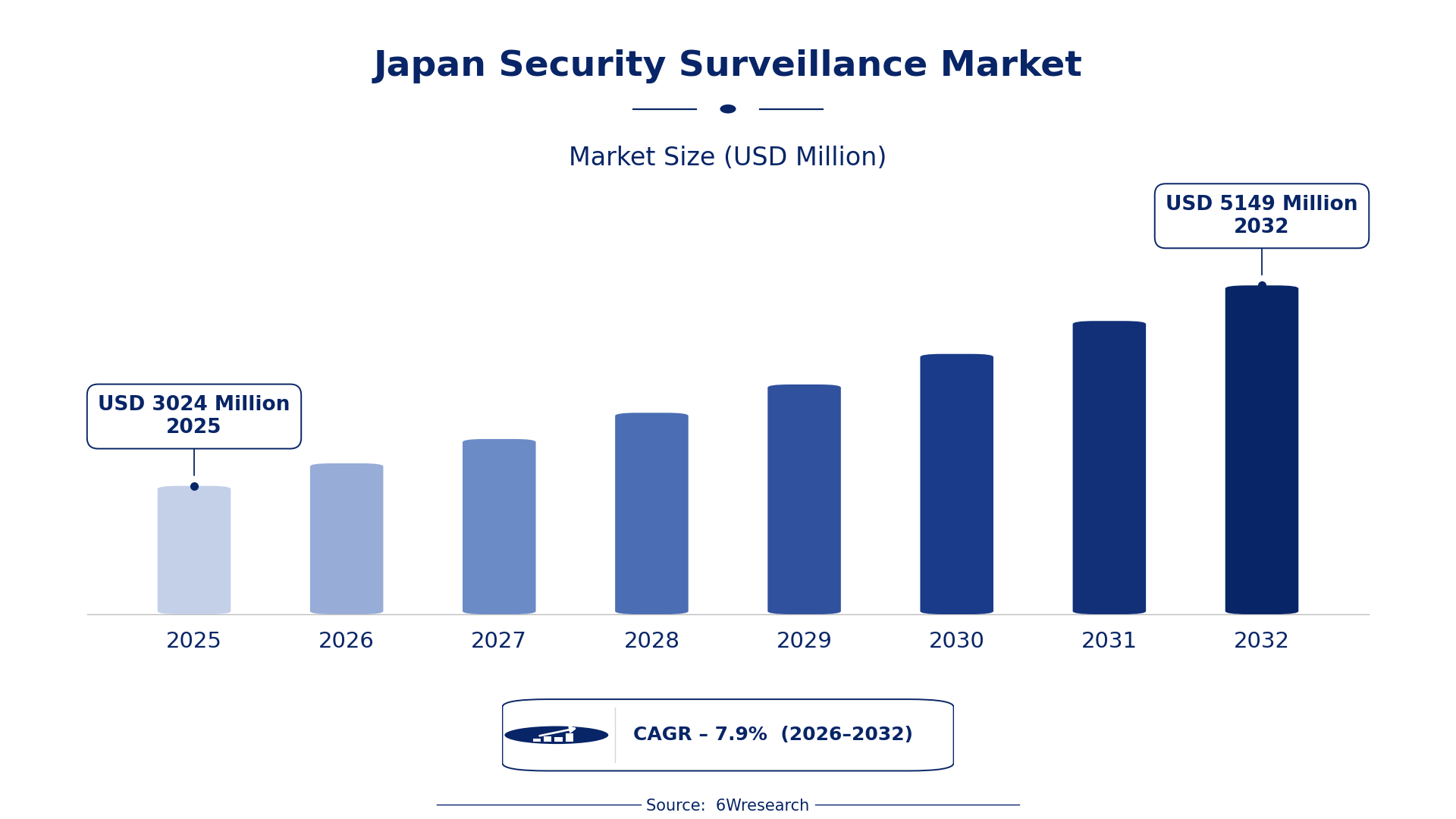
According to 6Wresearch internal database and industry insights, the Japan Security Surveillance Market was valued at USD 3,024 Million in 2025 and is projected to reach USD 5,149 Million by 2032, growing at a CAGR of approximately 7.9% during 2026–2032.
Japan Security Surveillance Market Highlights
| Report Metric | Details |
| Report Name | Japan Security Surveillance Market (2026-2032) |
| Market Size 2025 | USD 3,024 Million |
| Market Size 2032 | USD 5,149 Million |
| Absolute Growth 2025–2032 | USD 2,125 Million |
| CAGR 2026–2032 | 7.9% |
| Peak Annual Growth | 8.8% in 2029 |
| Forecast Period | 2026–2032 |
| Historical Data | 2022–2025 |
| Base Year | 2025 |
| Leading Camera Type, 2025 | PTZ Cameras (44% share) |
| Leading Imaging Feature, 2025 | AI Object Detection (44% share) |
| Leading Deployment Model, 2025 | Fixed Install (37% share) |
| Leading End User, 2025 | City Surveillance (44% share) |
| Fastest-Growing Camera Type | Smart Analytics Cameras (11.3% CAGR) |
| Fastest-Growing Deployment Model | Cloud-Connected (12.0% CAGR) |
| Fastest-Growing End User | Public Infrastructure (10.1% CAGR) |
| Growing Sector | City Surveillance |
| Key End Users | Public institutions, Retail chains, Urban municipalities, Infrastructure developers |
Japan Security Surveillance Market Year-wise Growth Rate and Key Drivers (2022–2032)
This graph illustrates the annual growth rates of the market from 2022 to 2032, highlighting a steady upward trajectory and projected market expansion over the forecast period.
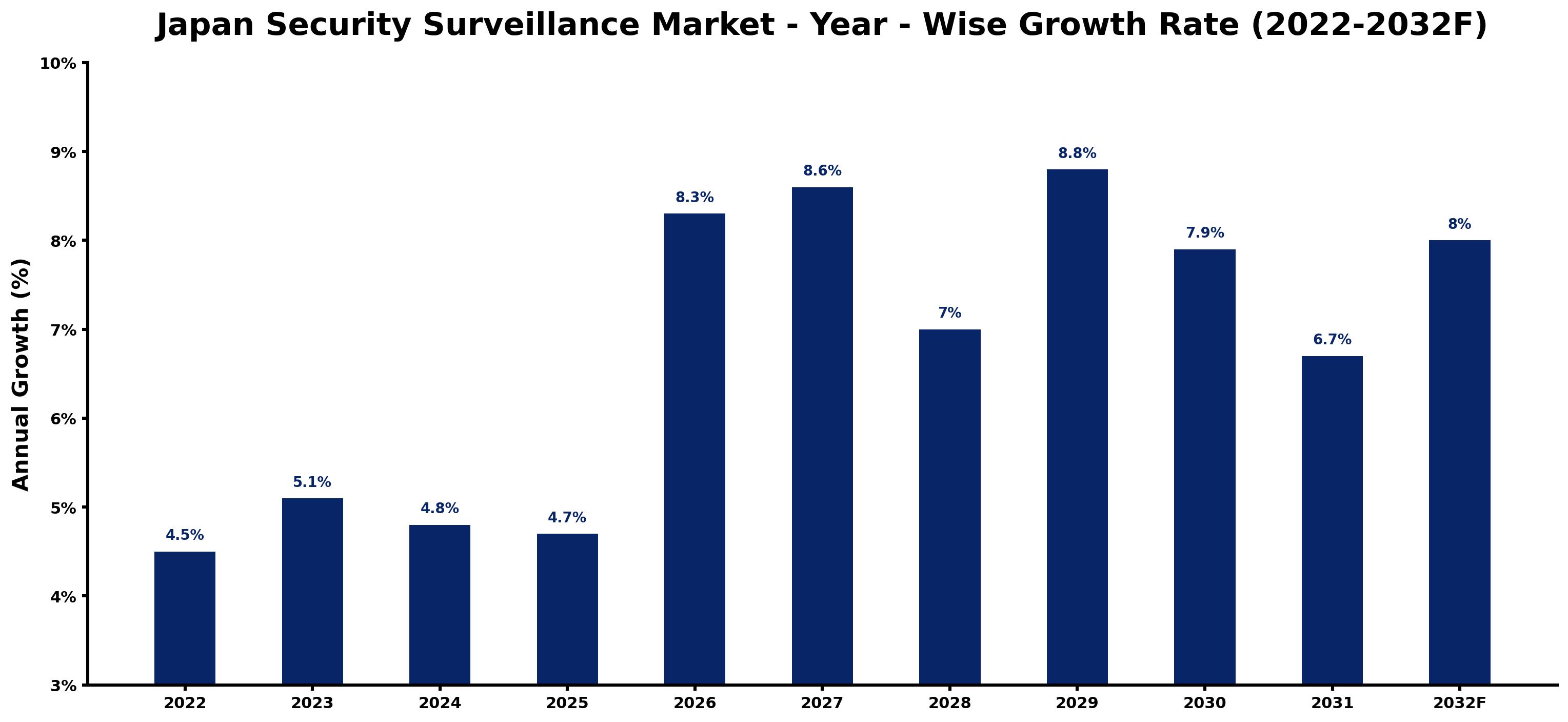
The table below sets out the estimated growth rate for each year and the main factor behind it.
| Year | Estimated Annual Growth (%) | Market Rationale |
| 2022 | 4.5 | The market showed steady growth due to increasing urbanisation and security concerns. |
| 2023 | 5.1 | Growth accelerated as urban areas expanded their surveillance capabilities. |
| 2024 | 4.8 | The rate slowed as some projects faced delays and budget constraints. |
| 2025 | 4.7 | Continued investment in public safety maintained positive growth, albeit at a slower pace. |
| 2026 | 8.3 | Demand surged with the introduction of advanced surveillance technologies. |
| 2027 | 8.6 | Urban safety initiatives further boosted installations, driving growth higher. |
| 2028 | 7.0 | Growth moderated as some sectors reached saturation in surveillance adoption. |
| 2029 | 8.8 | The peak growth year reflects heightened security investments across urban centres. |
| 2030 | 7.9 | Market growth is projected to slow slightly as competition intensifies among providers. |
| 2031 | 6.7 | A further slowdown is expected as the market stabilises after rapid expansions. |
| 2032 | 8.0 | Growth is expected to pick up again with renewed focus on smart city initiatives. |
Note: Market size estimations and growth projections presented in this report are based on 6Wresearch's proprietary forecasting methodology, utilizing the latest available industry data, government publications, and primary research inputs.
Japan Security Surveillance Market Synopsis
Security surveillance involves advanced camera technologies for monitoring environments, essential for public safety and crime prevention. The Japan Security Surveillance Market is expanding, with over 1,000 municipalities implementing city surveillance systems and the Tokyo Metropolitan Police Department operating more than 10,000 cameras. Rising urbanisation, increased government investment in smart city initiatives, and the growing adoption of AI object detection technologies are driving this growth, improving threat identification and response capabilities.
Market Dynamics Impact Analysis (2026–2032)
| Factor | Type | Impact | Primary Segment Affected |
| Increasing urbanisation drives demand for public safety measures. | Driver | High | City Surveillance |
| The adoption of AI object detection enhances surveillance system efficiency. | Driver | High | AI Object Detection |
| The integration of smart surveillance in public infrastructure projects presents growth opportunities. | Opportunity | High | Public Infrastructure |
| Retail chains increasingly seek advanced surveillance solutions to prevent losses. | Opportunity | Medium | Retail/Commercial Chains |
| High installation costs can deter smaller municipalities from upgrading systems. | Restraint | High | City Surveillance |
| Competition among providers may lead to price wars, affecting profitability. | Restraint | Medium | AI Object Detection |
| Talent shortages in technology integration can delay project timelines. | Challenge | High | Public Infrastructure |
| Rapid technological advancements may outpace market adaptation capabilities. | Challenge | Medium | Retail/Commercial Chains |
Evaluation of Drivers in Japan Security Surveillance Market (2026–2032)
These are the developments adding the most demand over the forecast period.
| Drivers | Primary Segment Affected | Why It Matters (Evidence) |
| Urbanisation drives demand for surveillance systems in city planning. | City Surveillance | With over 1,000 municipalities adopting systems, demand for safety measures rises. |
| AI object detection improves monitoring capabilities and reduces false alarms. | AI Object Detection | As of 2023, 30% of new installations incorporate this technology. |
| Government initiatives promote smart city projects integrating surveillance. | Public Infrastructure | The Ministry of Internal Affairs supports over 500 projects with surveillance features. |
| Retail chains adopt advanced surveillance for loss prevention. | Retail/Commercial Chains | Smart analytics cameras are used in over 5,000 retail locations. |
| Technological advancements in surveillance equipment improve capabilities. | Thermal Imaging Cameras | The average installation cost for thermal cameras is around ¥300,000. |
What keeps demand rising is the increasing urbanisation in Japan, with over 1,000 municipalities implementing city surveillance systems. The adoption of AI object detection technology in new installations improves monitoring efficiency and reduces false alarms, with 30% of new installations incorporating this technology. The integration of smart analytics cameras in retail chains strengthens loss prevention strategies, evident in over 5,000 retail locations. Technological advancements have led to a surge in the installation of thermal imaging cameras, with approximately 200,000 units installed as of 2022, driving further demand for effective surveillance solutions.
Evaluation of Restraints in Japan Security Surveillance Market
The following restraints limit how fast demand can grow.
| Market Restraint | Primary Segment Affected | Why It Matters (Evidence) |
| High installation costs deter smaller municipalities from upgrading. | City Surveillance | The average installation cost for a thermal imaging camera is around ¥300,000. |
| Intense competition may lead to price wars among providers. | AI Object Detection | Price reductions can affect profit margins for surveillance system providers, impacting financial sustainability. |
| Limited availability of skilled professionals can hinder project timelines. | Public Infrastructure | A shortage of trained technicians can delay the implementation of advanced systems, affecting project schedules. |
| Market saturation in urban areas slows new installations. | Retail/Commercial Chains | Many urban centres have reached high levels of surveillance adoption, limiting growth opportunities. |
| Regulatory compliance costs can burden smaller firms. | Thermal Imaging Cameras | Compliance with JIS X 0129 adds to operational expenses for providers, straining resources. |
Japan Security Surveillance Market Challenges
High installation costs burden producers, with thermal imaging cameras averaging ¥300,000 each, limiting access for smaller municipalities. Technology gaps persist, as many existing systems lack smart analytics, delaying upgrades and increasing operational inefficiencies for public institutions. A shortage of skilled technicians hinders progress, as only a small percentage are proficient in advanced surveillance technologies, causing project delays for buyers. Regulatory inconsistencies across municipalities create compliance challenges for suppliers, which can prolong project timelines and inflate costs, affecting the overall efficiency of security implementations.
Trends in the Japan Security Surveillance Market
The following changes are redrawing the Japan Security Surveillance Market.
- Shift Towards AI-Driven Surveillance Solutions: Since 2023, AI object detection technology has gained traction in Japan's surveillance market, with 30% of new installations adopting it. This trend improves threat identification and response, benefiting urban safety initiatives.
- Transition from Traditional to Smart Surveillance Systems: In 2022, the integration of smart analytics cameras in numerous retail chains marked a notable shift. This transition improves loss prevention strategies and customer safety measures, with over 5,000 installations.
- Emergence of Cloud-Connected Surveillance: The growing trend of cloud-connected surveillance systems allows for remote access and data storage. As of 2023, this model is increasingly adopted in public infrastructure projects, improving monitoring capabilities.
- Rise of Thermal Imaging in Security Applications: The use of thermal imaging cameras has become essential for low visibility surveillance. In 2023, the average installation cost was around ¥300,000, reflecting its growing importance in security.
Investment Opportunities in the Japan Security Surveillance Market
The opportunities below stand out in the Japan Security Surveillance Market for new entrants and existing suppliers.
- Gap in Advanced Surveillance Solutions: Investing in AI object detection technology can meet the rising demand from municipalities seeking improved monitoring capabilities, with 30% adoption in new installations.
- Public Infrastructure Projects Needing Surveillance: Local governments are actively seeking partnerships to implement advanced surveillance systems, with over 500 public infrastructure projects integrating smart surveillance.
- Retail Chains Seeking Loss Prevention Solutions: With many retail chains adopting smart analytics cameras, the demand for these solutions is clear, as seen in over 5,000 installations across Japan.
- Smart City Initiatives Driving Demand: Investing in cloud-connected systems can meet the needs of municipalities looking to improve their surveillance capabilities, supported by government funding for smart city projects.
Government Initiatives in the Japan Security Surveillance Market
The Building Energy Efficiency Act (2015, amended 2022) mandates that all new constructions incorporate energy-efficient designs, promoting the integration of surveillance technologies in urban planning. This law complements existing regulations by ensuring that new buildings include advanced security measures, benefiting producers and buyers alike.
The Digital Agency, established in September 2021, leads the government's digital transformation efforts, including the approval of common system standards for surveillance technologies. This agency facilitates the integration of smart surveillance in public infrastructure, allowing municipalities to access funding and support for implementing advanced systems. As of 2023, over 500 projects have received funding under this scheme.
Future Insight of the Japan Security Surveillance Market
The investment pipeline for smart surveillance technologies will exceed ¥100 billion by 2032, driven by urbanisation and public safety demands. This growth will create opportunities for suppliers to develop advanced solutions that meet evolving requirements. The integration of JIS X 0129 standards will enhance system interoperability, facilitating smoother operations. As smart city initiatives expand, the adoption of cutting-edge surveillance technologies will rise, significantly improving operational capabilities for buyers and strengthening security measures in urban environments.
Market Segmentation Analysis
Japan Security Surveillance Market report covers a detailed analysis of the following market segments:
By Camera Type – PTZ Cameras Lead, Smart Analytics Cameras Expected to Grow Fastest
According to Saurav Kr Singh, Senior Research Analyst at 6Wresearch, with 44% of camera type revenue in 2025, PTZ Cameras was the largest category. PTZ cameras are essential for active monitoring and tracking, making them a preferred choice in urban surveillance. Their extensive deployment is evident in the Tokyo Metropolitan Police Department, which utilises over 10,000 such cameras. Smart Analytics Cameras are projected to grow fastest, at a CAGR of 11.3% during 2026–2032. The rapid growth of smart analytics cameras is attributed to their capability for real-time data analysis, which is increasingly vital in urban environments. Their adoption in more than 5,000 retail chains demonstrates their rising importance across various sectors. Suppliers should focus on enhancing smart analytics capabilities to meet the growing demand for sophisticated surveillance solutions.
By Imaging Feature – AI Object Detection Leads and Records the Fastest Growth
AI Object Detection accounted for 44% of the market by imaging feature in 2025. AI object detection technology plays a crucial role in automating threat identification, making it a fundamental aspect of modern surveillance systems. Its widespread use across numerous installations highlights its effectiveness in improving security measures. The same category is also set to grow fastest, at a CAGR of 10.5% during 2026–2032. As the leading feature, AI object detection's ongoing advancements will solidify its market position. The increasing reliance on this technology suggests that its growth will continue to outpace other imaging features. Buyers should prioritise systems equipped with AI object detection to stay competitive in the security technology landscape.
By Deployment Model – Fixed Install Leads, Cloud-Connected Expected to Grow Fastest
In 2025, Fixed Install led the deployment model split with a 37% share. Fixed installations are the standard choice for permanent surveillance setups, ensuring consistent coverage in key areas. Their prevalent use in urban settings underscores their importance in maintaining security operations. Cloud-Connected is set to record the highest CAGR in this split, 12.0% over 2026–2032. The cloud-connected model is gaining traction due to its advantages in remote access and data storage, appealing to organisations seeking adaptability. This trend is reflected in the adoption of cloud solutions in numerous public infrastructure projects. Suppliers need to adapt their offerings to include cloud-connected systems to align with the evolving preferences of end users.
By End User – City Surveillance Leads, Public Infrastructure Expected to Grow Fastest
The largest end user category in 2025 was City Surveillance, at 44% of revenue. City surveillance is vital for urban safety and crime deterrence, contributing to its leading position in the market. The implementation of surveillance systems across over 1,000 municipalities illustrates the high priority given to this segment. Over 2026–2032, Public Infrastructure is expected to post the fastest growth, at a CAGR of 10.1%. Public infrastructure is experiencing notable growth as the importance of safeguarding public assets becomes more recognised. The integration of smart surveillance in over 500 infrastructure projects highlights the urgent need for enhanced security measures. Buyers in public infrastructure should invest in advanced surveillance technologies to bolster the security of essential facilities.
Key Attractiveness of the Report
- 10 Years of Market Numbers
- Historical Data Starting from 2022 to 2025
- Base Year 2025
- Forecast Data until 2032
- Key Performance Indicators Impacting the Market
- Major Upcoming Developments and Projects
Key Highlights of the Report:
- Japan Security Surveillance Market Outlook
- Market Size of Japan Security Surveillance Market, 2025
- Forecast of Japan Security Surveillance Market, 2032
- Historical Data and Forecast of Japan Security Surveillance Revenues & Volume for the Period 2022-2032F
- Japan Security Surveillance Market Trend Evolution
- Japan Security Surveillance Market Drivers and Challenges
- Japan Security Surveillance Price Trends
- Japan Security Surveillance Porter's Five Forces
- Japan Security Surveillance Industry Life Cycle
- Historical Data and Forecast of Japan Security Surveillance Market Revenues & Volume By Camera Type for the Period 2022-2032F
- Historical Data and Forecast of Japan Security Surveillance Market Revenues & Volume By PTZ Cameras for the Period 2022-2032F
- Historical Data and Forecast of Japan Security Surveillance Market Revenues & Volume By Thermal Imaging Cameras for the Period 2022-2032F
- Historical Data and Forecast of Japan Security Surveillance Market Revenues & Volume By Vandal-Proof Domes for the Period 2022-2032F
- Historical Data and Forecast of Japan Security Surveillance Market Revenues & Volume By Smart Analytics Cameras for the Period 2022-2032F
- Historical Data and Forecast of Japan Security Surveillance Market Revenues & Volume By Imaging Feature for the Period 2022-2032F
- Historical Data and Forecast of Japan Security Surveillance Market Revenues & Volume By Optical Zoom + Night Vision for the Period 2022-2032F
- Historical Data and Forecast of Japan Security Surveillance Market Revenues & Volume By Heat Detection for the Period 2022-2032F
- Historical Data and Forecast of Japan Security Surveillance Market Revenues & Volume By Housing Resistance for the Period 2022-2032F
- Historical Data and Forecast of Japan Security Surveillance Market Revenues & Volume By AI Object Detection for the Period 2022-2032F
- Historical Data and Forecast of Japan Security Surveillance Market Revenues & Volume By Deployment Model for the Period 2022-2032F
- Historical Data and Forecast of Japan Security Surveillance Market Revenues & Volume By Outdoor/Indoor for the Period 2022-2032F
- Historical Data and Forecast of Japan Security Surveillance Market Revenues & Volume By Fixed Install for the Period 2022-2032F
- Historical Data and Forecast of Japan Security Surveillance Market Revenues & Volume By Pole-Mounted for the Period 2022-2032F
- Historical Data and Forecast of Japan Security Surveillance Market Revenues & Volume By Cloud-Connected for the Period 2022-2032F
- Historical Data and Forecast of Japan Security Surveillance Market Revenues & Volume By End User for the Period 2022-2032F
- Historical Data and Forecast of Japan Security Surveillance Market Revenues & Volume By City Surveillance for the Period 2022-2032F
- Historical Data and Forecast of Japan Security Surveillance Market Revenues & Volume By Perimeter Security for the Period 2022-2032F
- Historical Data and Forecast of Japan Security Surveillance Market Revenues & Volume By Public Infrastructure for the Period 2022-2032F
- Historical Data and Forecast of Japan Security Surveillance Market Revenues & Volume By Retail/Commercial Chains for the Period 2022-2032F
- Japan Security Surveillance Import Export Trade Statistics
- Market Opportunity Assessment By Camera Type
- Market Opportunity Assessment By Imaging Feature
- Market Opportunity Assessment By Deployment Model
- Market Opportunity Assessment By End User
- Japan Security Surveillance Top Companies Market Share
- Japan Security Surveillance Competitive Benchmarking By Technical and Operational Parameters
- Japan Security Surveillance Company Profiles
- Japan Security Surveillance Key Strategic Recommendations
Market Covered
The report covers the following segments.
By Camera Type
- PTZ Cameras
- Thermal Imaging Cameras
- Vandal-Proof Domes
- Smart Analytics Cameras
By Imaging Feature
- Optical Zoom + Night Vision
- Heat Detection
- Housing Resistance
- AI Object Detection
By Deployment Model
- Outdoor/Indoor
- Fixed Install
- Pole-Mounted
- Cloud-Connected
By End User
- City Surveillance
- Perimeter Security
- Public Infrastructure
- Retail/Commercial Chains































