Japan Security Video AI Market Size & Growth Rate
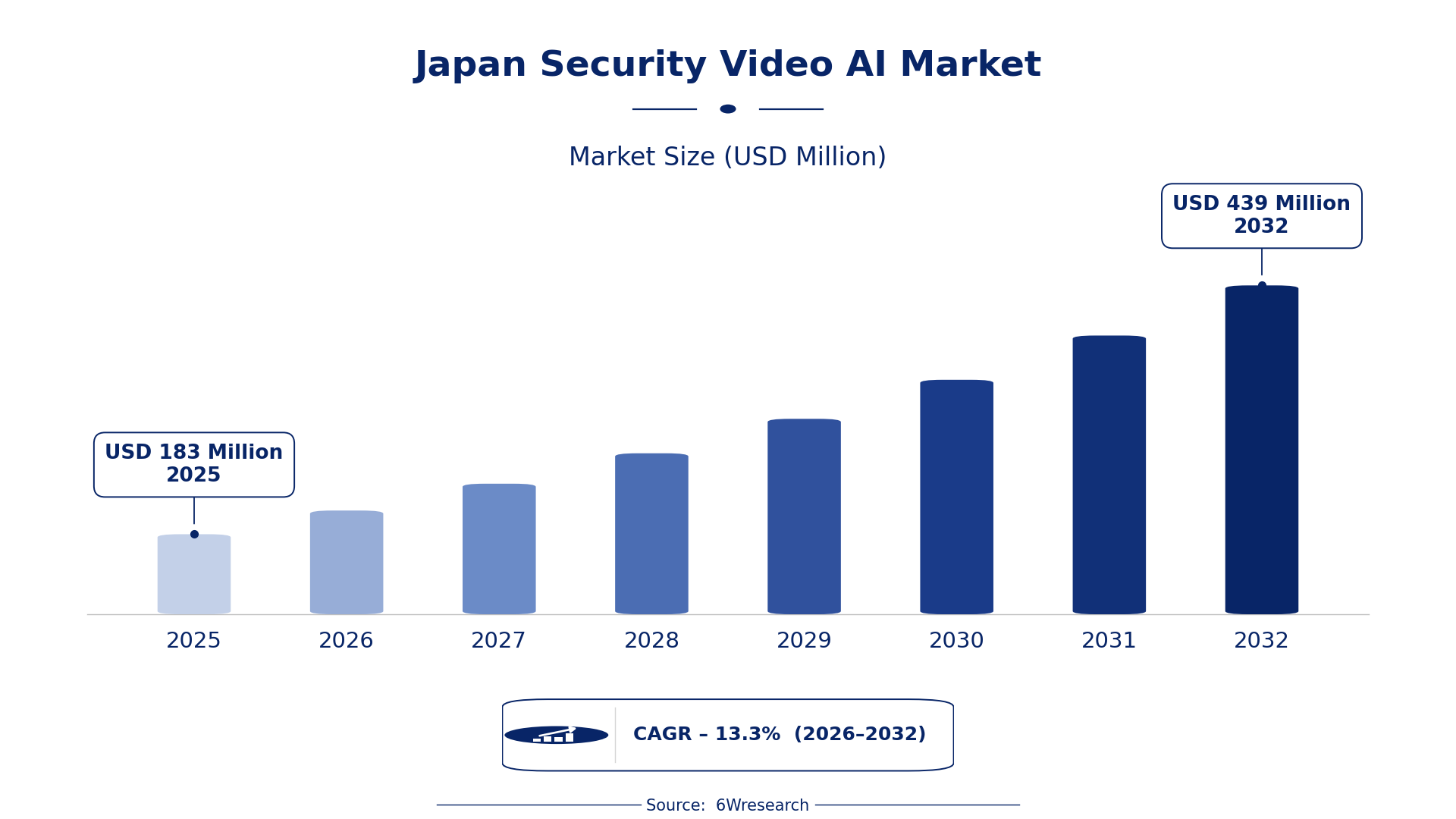
According to 6Wresearch internal database and industry insights, the Japan Security Video AI Market was valued at USD 183 Million in 2025 and is projected to reach USD 439 Million by 2032, growing at a CAGR of approximately 13.3% during 2026–2032.
Japan Security Video AI Market Highlights
| Report Metric | Details |
| Report Name | Japan Security Video AI Market (2026-2032) |
| Market Size 2025 | USD 183 Million |
| Market Size 2032 | USD 439 Million |
| Absolute Growth 2025–2032 | USD 256 Million |
| CAGR 2026–2032 | 13.3% |
| Peak Annual Growth | 14.8% in 2028 |
| Forecast Period | 2026–2032 |
| Historical Data | 2022–2025 |
| Base Year | 2025 |
| Leading AI Capability, 2025 | Facial Recognition (38% share) |
| Leading Analytics Feature, 2025 | Suspicious Activity Alerts (41% share) |
| Leading Form Factor, 2025 | Edge Cameras (41% share) |
| Leading End User, 2025 | Public Safety Agencies (41% share) |
| Fastest-Growing AI Capability | Behavioral Analytics (17.1% CAGR) |
| Fastest-Growing Analytics Feature | People/Vehicle Counting (17.4% CAGR) |
| Fastest-Growing Form Factor | Cloud Processed (19.1% CAGR) |
| Fastest-Growing End User | Traffic Enforcement (17.2% CAGR) |
| Growing Sector | Public Safety |
| Key End Users | Public Safety Agencies, Retail Sector, Traffic Enforcement, Corporate HQs |
Japan Security Video AI Market Year-wise Growth Rate and Key Drivers (2022–2032)
This graph illustrates the annual growth rates of the market from 2022 to 2032, highlighting a steady upward trajectory and projected market expansion over the forecast period.
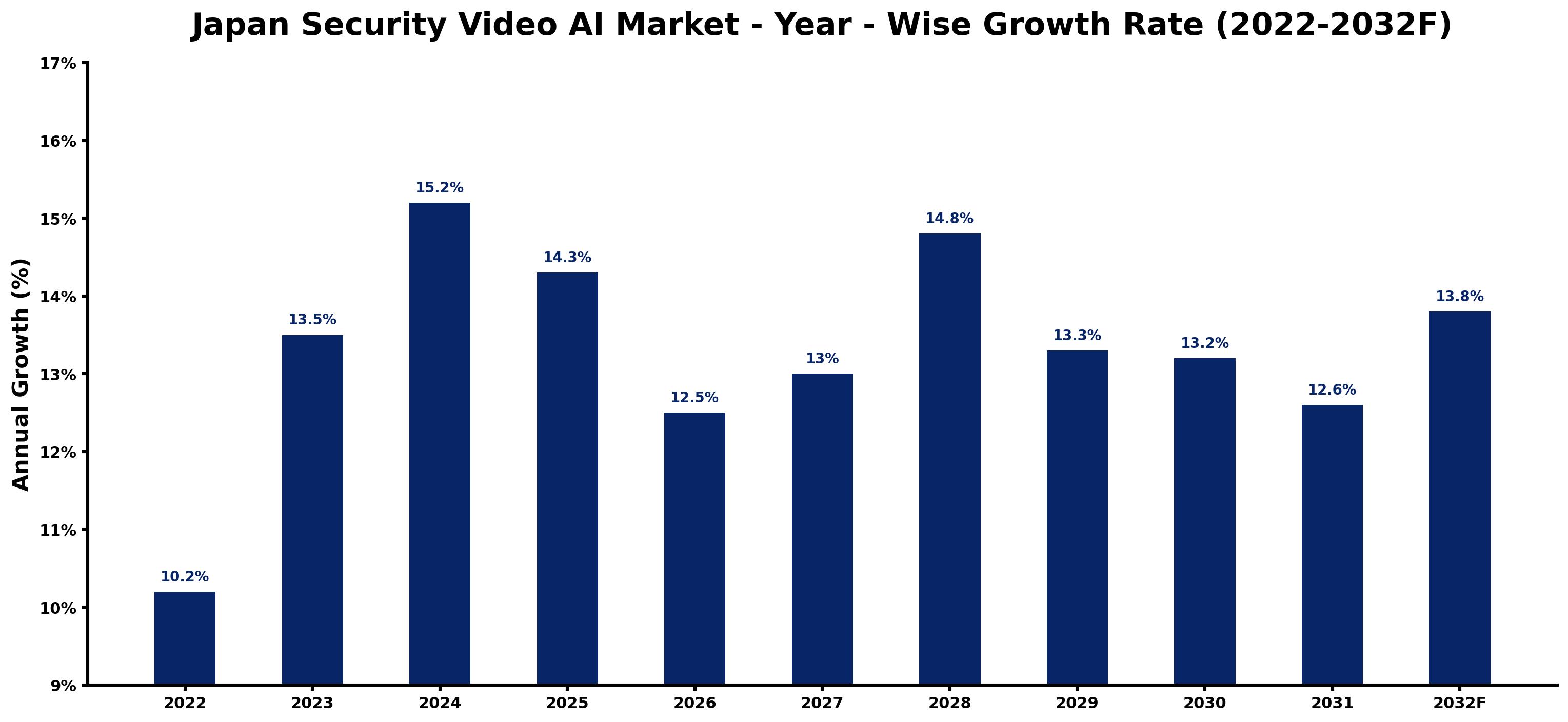
For each year, the table pairs the estimated growth rate with the leading influence on demand, showing how the drivers changed across the period.
| Year | Estimated Annual Growth (%) | Market Rationale |
| 2022 | 10.2 | The market was influenced by the increasing installation of surveillance systems across urban areas. |
| 2023 | 13.5 | Growth was supported by the Tokyo Metropolitan Police's adoption of AI for facial recognition. |
| 2024 | 15.2 | The market experienced heightened demand due to the implementation of AI-driven traffic management systems. |
| 2025 | 14.3 | Growth slowed as the retail sector began investments in security AI technologies. |
| 2026 | 12.5 | The market will continue expanding, bolstered by smart city initiatives focusing on AI. |
| 2027 | 13.0 | Demand is set to rise as public safety agencies expand their use of AI for event monitoring. |
| 2028 | 14.8 | The peak growth will stem from advancements in AI technology and integration in surveillance. |
| 2029 | 13.3 | Growth is anticipated to slow as the market matures and adoption rates stabilise across sectors. |
| 2030 | 13.2 | The market will continue growing, driven by ongoing investments in AI surveillance systems. |
| 2031 | 12.6 | Growth will decelerate as the market reaches a more mature phase with established technologies. |
| 2032 | 13.8 | Demand is projected to rise as new AI capabilities are integrated into existing surveillance frameworks. |
Note: Market size estimations and growth projections presented in this report are based on 6Wresearch's proprietary forecasting methodology, utilizing the latest available industry data, government publications, and primary research inputs.
Japan Security Video AI Market Synopsis
Security Video AI employs machine learning and computer vision to analyse video footage in real-time, improving monitoring in urban areas and traffic management. The Japan Security Video AI Market is growing due to rising surveillance needs, with over 1,000,000 cameras installed across cities. Public safety agencies are increasingly adopting AI technologies, supported by initiatives like the 2023 program for enhanced public safety. The retail sector is projected to invest ¥50 billion in security AI by 2025, further driving market growth.
Market Dynamics Impact Analysis (2026–2032)
| Factor | Type | Impact | Primary Segment Affected |
| Increasing urban surveillance needs drive demand for advanced security solutions. | Driver | High | Facial Recognition |
| Growing investments in public safety initiatives create new opportunities for AI integration. | Driver | High | Suspicious Activity Alerts |
| The retail sector's projected ¥50 billion investment in security AI presents a significant opportunity. | Opportunity | High | Retail & Transportation |
| The implementation of AI-driven traffic management systems in Tokyo enhances demand for related technologies. | Opportunity | Medium | Traffic Enforcement |
| Concerns over privacy regulations may limit the deployment of facial recognition technologies. | Restraint | High | Facial Recognition |
| The need for compliance with JIS Q 17025 standards may slow down system approvals. | Restraint | Medium | Suspicious Activity Alerts |
| The challenge of integrating AI with existing infrastructure can delay implementation. | Challenge | High | Edge Cameras |
| The high costs associated with advanced AI systems may deter smaller public safety agencies from adoption. | Challenge | Medium | Public Safety Agencies |
Evaluation of Drivers in Japan Security Video AI Market (2026–2032)
Below are the drivers that matter most for revenue growth, with supporting evidence.
| Drivers | Primary Segment Affected | Why It Matters (Evidence) |
| Increasing installation of surveillance cameras in urban areas. | Facial Recognition | Over 1,000,000 surveillance cameras are installed across urban areas, increasing the need for AI solutions. |
| Government initiatives promoting smart city technologies. | Suspicious Activity Alerts | A ¥10 billion allocation for smart city initiatives boosts demand for AI surveillance. |
| Adoption of AI by public safety agencies for event monitoring. | Behavioral Analytics | Public safety agencies are increasingly using AI for monitoring events, improving response times. |
| Investment in AI technologies by the retail sector. | Retail & Transportation | The retail sector is projected to invest ¥50 billion in security AI by 2025, driving demand. |
| Implementation of AI-driven traffic management systems. | Traffic Enforcement | Tokyo's AI-driven traffic management systems are reducing congestion and improving monitoring capabilities. |
Most of the extra volume comes from the increasing installation of surveillance cameras in urban areas, with over 1,000,000 units deployed nationwide. The retail sector is set to invest ¥50 billion in security AI by 2025, driven by the need for effective loss prevention measures. AI-driven traffic management systems in Tokyo are reducing congestion and improving monitoring capabilities.
Evaluation of Restraints in Japan Security Video AI Market
The main factors holding the market back are set out below.
| Market Restraint | Primary Segment Affected | Why It Matters (Evidence) |
| Privacy regulations may restrict the use of facial recognition technologies. | Facial Recognition | Facial recognition technology is regulated under the Act on the Protection of Personal Information, limiting deployment. |
| Compliance with JIS Q 17025 standards can slow down system approvals. | Suspicious Activity Alerts | The National Police Agency's standards for AI surveillance systems create additional compliance hurdles. |
| Integration challenges with existing infrastructure can delay AI implementation. | Edge Cameras | Many public safety agencies face difficulties in integrating AI with their current surveillance systems. |
| High costs of advanced AI systems may deter smaller agencies from adoption. | Public Safety Agencies | Smaller public safety agencies may struggle to afford the latest AI technologies, limiting their use. |
| Limited public awareness of AI capabilities may slow market growth. | Behavioral Analytics | Lack of understanding about AI's benefits can hinder adoption rates among potential users. |
Japan Security Video AI Market Challenges
Competition among suppliers for AI surveillance systems creates pressure on pricing, forcing buyers to navigate a crowded market with varied offerings. This situation arises from rapid technological advancements and the influx of new entrants, complicating procurement decisions for buyers. High operational costs linked to compliance with the Act on the Protection of Personal Information burden suppliers, potentially increasing prices for buyers by 15%. Limited availability of skilled personnel in AI technology restricts suppliers' capacity to meet demand, causing delays in project timelines for public safety agencies reliant on timely system deployment.
Trends in the Japan Security Video AI Market
These developments are changing demand patterns in the Japan Security Video AI Market.
- Shift Towards AI-Driven Public Safety: Tokyo is implementing AI-driven solutions for public safety, with the Metropolitan Police using AI for real-time facial recognition. This initiative aims to improve security measures across the city, reflecting a growing trend in urban safety management.
- Increase in Retail AI Investments: The retail sector is projected to invest ¥50 billion in security AI by 2025, focusing on loss prevention technologies. This surge indicates a shift towards advanced security measures in retail environments, prompted by rising theft concerns.
- Adoption of AI for Traffic Management: Tokyo has implemented AI-driven traffic management systems to reduce congestion, showcasing a notable trend in urban planning. This initiative aims to improve traffic flow and safety, reflecting a broader move towards smart city solutions.
- Growing Use of Edge Cameras: Edge cameras are increasingly used in retail for localized processing of video data, improving security measures. This trend is driven by the need for real-time analytics, with a notable increase in installations across urban retail spaces.
Investment Opportunities in the Japan Security Video AI Market
Investors looking at the Japan Security Video AI Market should consider the following areas.
- Investment in Smart City Initiatives: Tokyo's ongoing smart city initiatives present an opportunity for AI surveillance suppliers. With a ¥10 billion government allocation, companies can partner with local agencies to provide advanced security solutions.
- Expansion of AI in Retail Security: The projected ¥50 billion investment in security AI by the retail sector creates opportunities for technology providers. Suppliers can enter this market by forming joint ventures with retail chains to improve loss prevention strategies.
- Growth in Traffic Enforcement Technologies: The implementation of AI-driven traffic management systems in Tokyo offers opportunities for technology firms. Suppliers can engage with local government agencies to provide effective solutions for traffic monitoring.
- Development of Behavioral Analytics Solutions: The increasing demand for behavioral analytics in public safety creates opportunities for specialized AI firms. Companies can invest in developing tailored solutions for public safety agencies to improve monitoring capabilities.
Government Initiatives in the Japan Security Video AI Market
The Building Energy Efficiency Act, amended in 2022, mandates that all new buildings meet energy efficiency standards starting April 2025. This law impacts security video AI producers by necessitating compliance with energy-efficient technologies in surveillance systems. The Electrical Appliance and Material Safety Act regulates the safety of electrical appliances, ensuring that AI surveillance devices meet safety standards before market entry.
The Ministry of Internal Affairs and Communications oversees the implementation of smart city initiatives, approving projects that improve public safety through AI. In 2023, the ministry launched a program aimed at integrating AI into public safety measures, allocating ¥10 billion for this purpose.
Future Insight of the Japan Security Video AI Market
Investment in AI surveillance systems will drive demand, particularly as the retail sector is projected to allocate ¥50 billion by 2025. Urbanisation will push for AI integration in traffic management and public safety initiatives. By 2032, advancements in AI algorithms will enhance real-time monitoring capabilities, allowing for quicker response times and improved safety measures. This shift will create new opportunities for suppliers while ensuring urban residents benefit from increased security and operational efficiency.
Market Segmentation Analysis
Japan Security Video AI Market report covers a detailed analysis of the following market segments:
By AI Capability – Facial Recognition Leads, Behavioral Analytics Expected to Grow Fastest
According to Saurav Kr Singh, Senior Research Analyst at 6Wresearch, the largest ai capability category in 2025 was Facial Recognition, at 38% of revenue. Facial recognition technology plays a crucial role in identifying individuals, making it indispensable for public safety operations. This capability is particularly vital in urban areas where over 1,000,000 surveillance cameras are installed, ensuring comprehensive monitoring. Over 2026–2032, Behavioral Analytics is expected to post the fastest growth, at a CAGR of 17.1%. Behavioral analytics is witnessing rapid growth due to its effectiveness in analysing patterns to detect unusual behaviour, especially in crowded settings. The implementation of AI-driven traffic management systems in Tokyo exemplifies the increasing reliance on behavioural insights for safety. Suppliers must focus on enhancing facial recognition features to cater to the growing needs of public safety agencies.
By Analytics Feature – Suspicious Activity Alerts Lead, People/Vehicle Counting Expected to Grow Fastest
Suspicious Activity Alerts held 41% of the Japan Security Video AI Market by analytics feature in 2025. Suspicious activity alerts are essential for providing immediate notifications regarding security threats, making them critical for public safety efforts. This feature allows agencies to react promptly to incidents, significantly enhancing safety in urban environments. People/Vehicle Counting is projected to grow fastest, at a CAGR of 17.4% during 2026–2032. People and vehicle counting is experiencing swift growth as it aids in analytics for urban planning and traffic management. The Japanese government's commitment to smart city initiatives highlights the rising importance of this feature for effective monitoring. Buyers should invest in systems that improve alert functionalities to optimise response times.
By Form Factor – Edge Cameras Lead, Cloud Processed Expected to Grow Fastest
Edge Cameras took 41% of form factor revenue in 2025, more than any other category. Edge cameras are vital for localised processing of video data, enabling quick analysis and response in security situations. Their use in urban settings allows for efficient real-time monitoring without straining central systems. The quickest growth will come from Cloud Processed, forecast to expand at a CAGR of 19.1% between 2026 and 2032. Cloud processed solutions are increasingly popular as they facilitate efficient data storage and analytics, addressing the rising demand for effective data management in surveillance. The trend towards cloud integration is pivotal for enhancing monitoring capabilities. Suppliers should prioritise the advancement of edge camera technologies to meet the demands of urban surveillance.
By End User – Public Safety Agencies Lead, Traffic Enforcement Expected to Grow Fastest
In 2025, Public Safety Agencies led the end user split with a 41% share. Public safety agencies are the main users of security video AI, depending on these systems to maintain safety in urban areas. Their extensive use of AI for monitoring public events underscores their vital role in ensuring security. Traffic Enforcement is set to record the highest CAGR in this split, 17.2% over 2026–2032. Traffic enforcement is rapidly expanding as it is crucial for monitoring and enforcing traffic regulations, particularly in densely populated regions. The Tokyo Metropolitan Police's application of AI for real-time facial recognition illustrates this trend in improving traffic safety. Buyers in the traffic enforcement sector should pursue advanced solutions to enhance their monitoring capabilities.
Key Attractiveness of the Report
- 10 Years of Market Numbers
- Historical Data Starting from 2022 to 2025
- Base Year 2025
- Forecast Data until 2032
- Key Performance Indicators Impacting the Market
- Major Upcoming Developments and Projects
Key Highlights of the Report:
- Japan Security Video AI Market Outlook
- Market Size of Japan Security Video AI Market, 2025
- Forecast of Japan Security Video AI Market, 2032
- Historical Data and Forecast of Japan Security Video AI Revenues & Volume for the Period 2022-2032F
- Japan Security Video AI Market Trend Evolution
- Japan Security Video AI Market Drivers and Challenges
- Japan Security Video AI Price Trends
- Japan Security Video AI Porter's Five Forces
- Japan Security Video AI Industry Life Cycle
- Historical Data and Forecast of Japan Security Video AI Market Revenues & Volume By AI Capability for the Period 2022-2032F
- Historical Data and Forecast of Japan Security Video AI Market Revenues & Volume By Object Detection for the Period 2022-2032F
- Historical Data and Forecast of Japan Security Video AI Market Revenues & Volume By Facial Recognition for the Period 2022-2032F
- Historical Data and Forecast of Japan Security Video AI Market Revenues & Volume By Behavioral Analytics for the Period 2022-2032F
- Historical Data and Forecast of Japan Security Video AI Market Revenues & Volume By License Plate Recognition for the Period 2022-2032F
- Historical Data and Forecast of Japan Security Video AI Market Revenues & Volume By Analytics Feature for the Period 2022-2032F
- Historical Data and Forecast of Japan Security Video AI Market Revenues & Volume By People/Vehicle Counting for the Period 2022-2032F
- Historical Data and Forecast of Japan Security Video AI Market Revenues & Volume By Access Control Integration for the Period 2022-2032F
- Historical Data and Forecast of Japan Security Video AI Market Revenues & Volume By Suspicious Activity Alerts for the Period 2022-2032F
- Historical Data and Forecast of Japan Security Video AI Market Revenues & Volume By ANPR Integration for the Period 2022-2032F
- Historical Data and Forecast of Japan Security Video AI Market Revenues & Volume By Form Factor for the Period 2022-2032F
- Historical Data and Forecast of Japan Security Video AI Market Revenues & Volume By Edge Cameras for the Period 2022-2032F
- Historical Data and Forecast of Japan Security Video AI Market Revenues & Volume By Server-Based for the Period 2022-2032F
- Historical Data and Forecast of Japan Security Video AI Market Revenues & Volume By Cloud Processed for the Period 2022-2032F
- Historical Data and Forecast of Japan Security Video AI Market Revenues & Volume By Roadside Units for the Period 2022-2032F
- Historical Data and Forecast of Japan Security Video AI Market Revenues & Volume By End User for the Period 2022-2032F
- Historical Data and Forecast of Japan Security Video AI Market Revenues & Volume By Retail & Transportation for the Period 2022-2032F
- Historical Data and Forecast of Japan Security Video AI Market Revenues & Volume By Corporate HQs for the Period 2022-2032F
- Historical Data and Forecast of Japan Security Video AI Market Revenues & Volume By Public Safety Agencies for the Period 2022-2032F
- Historical Data and Forecast of Japan Security Video AI Market Revenues & Volume By Traffic Enforcement for the Period 2022-2032F
- Japan Security Video AI Import Export Trade Statistics
- Market Opportunity Assessment By AI Capability
- Market Opportunity Assessment By Analytics Feature
- Market Opportunity Assessment By Form Factor
- Market Opportunity Assessment By End User
- Japan Security Video AI Top Companies Market Share
- Japan Security Video AI Competitive Benchmarking By Technical and Operational Parameters
- Japan Security Video AI Company Profiles
- Japan Security Video AI Key Strategic Recommendations
Market Covered
Segments analysed in this report are listed below.
By AI Capability
- Object Detection
- Facial Recognition
- Behavioral Analytics
- License Plate Recognition
By Analytics Feature
- People/Vehicle Counting
- Access Control Integration
- Suspicious Activity Alerts
- ANPR Integration
By Form Factor
- Edge Cameras
- Server-Based
- Cloud Processed
- Roadside Units
By End User
- Retail & Transportation
- Corporate HQs
- Public Safety Agencies
- Traffic Enforcement































