Japan Seed Binders Market Size & Growth Rate
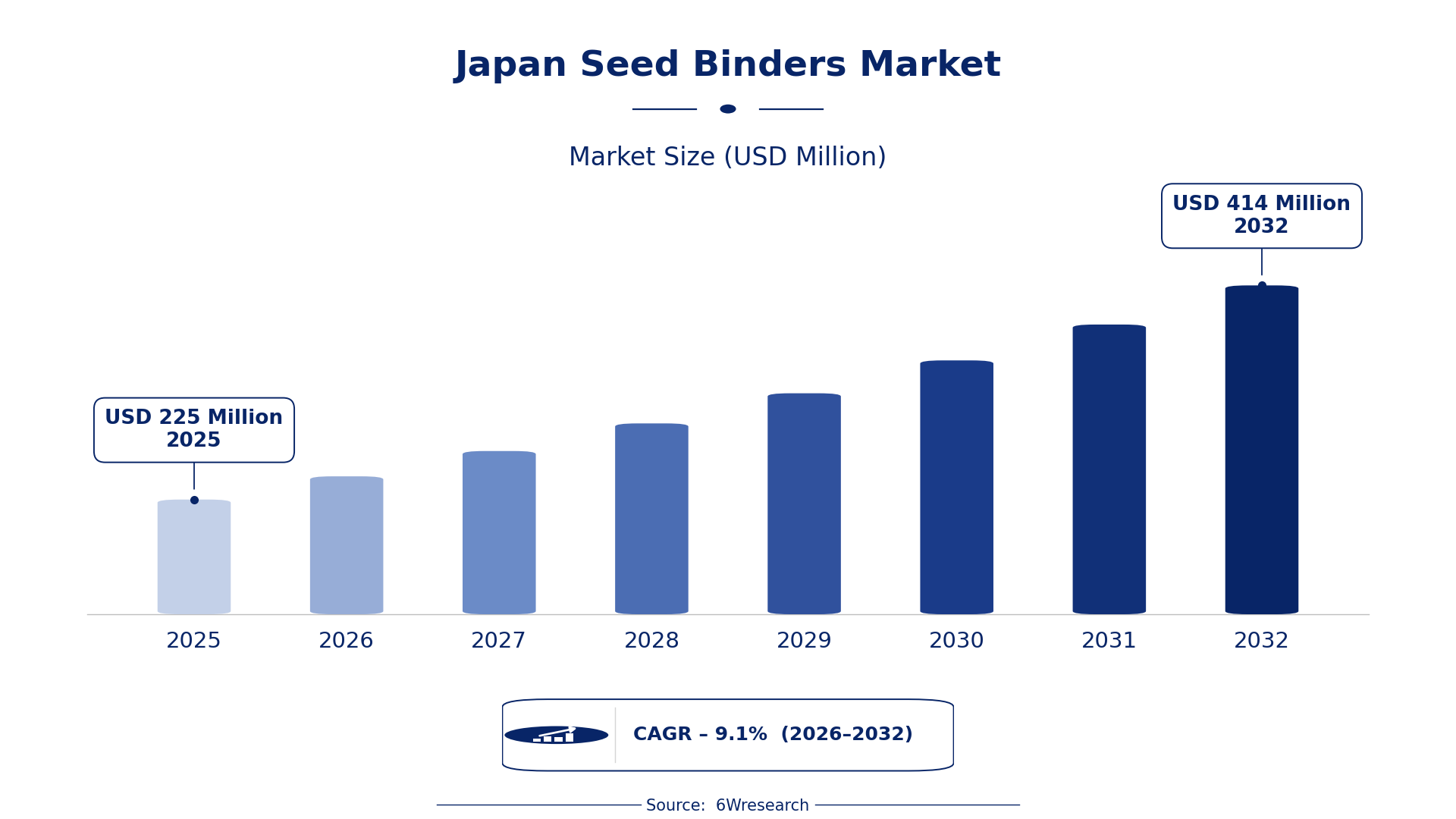
According to 6Wresearch internal database and industry insights, the Japan Seed Binders Market was valued at USD 225 Million in 2025 and is projected to reach USD 414 Million by 2032, growing at a CAGR of approximately 9.1% during 2026–2032.
Japan Seed Binders Market Highlights
| Report Metric | Details |
| Report Name | Japan Seed Binders Market (2026-2032) |
| Market Size 2025 | USD 225 Million |
| Market Size 2032 | USD 414 Million |
| Absolute Growth 2025–2032 | USD 189 Million |
| CAGR 2026–2032 | 9.1% |
| Peak Annual Growth | 10.0% in 2032 |
| Forecast Period | 2026–2032 |
| Historical Data | 2022–2025 |
| Base Year | 2025 |
| Leading Binder Type, 2025 | Polymer-based (42% share) |
| Leading Material Type, 2025 | Synthetic Polymers (50% share) |
| Leading Application Area, 2025 | Seed Coating (37% share) |
| Leading Distribution Channel, 2025 | Agro Distributors (42% share) |
| Leading End User, 2025 | Seed Companies (39% share) |
| Fastest-Growing Binder Type | Natural Binders (12.8% CAGR) |
| Fastest-Growing Material Type | Bio-based Materials (13.1% CAGR) |
| Fastest-Growing Application Area | Precision Farming (11.5% CAGR) |
| Fastest-Growing Distribution Channel | Online Platforms (12.0% CAGR) |
| Fastest-Growing End User | Agritech Firms (11.8% CAGR) |
| Growing Sector | Agriculture |
| Key End Users | Seed Companies, Agricultural Producers, Agritech Firms, Farmers |
Japan Seed Binders Market Year-wise Growth Rate and Key Drivers (2022–2032)
This graph illustrates the annual growth rates of the market from 2022 to 2032, highlighting a steady upward trajectory and projected market expansion over the forecast period.
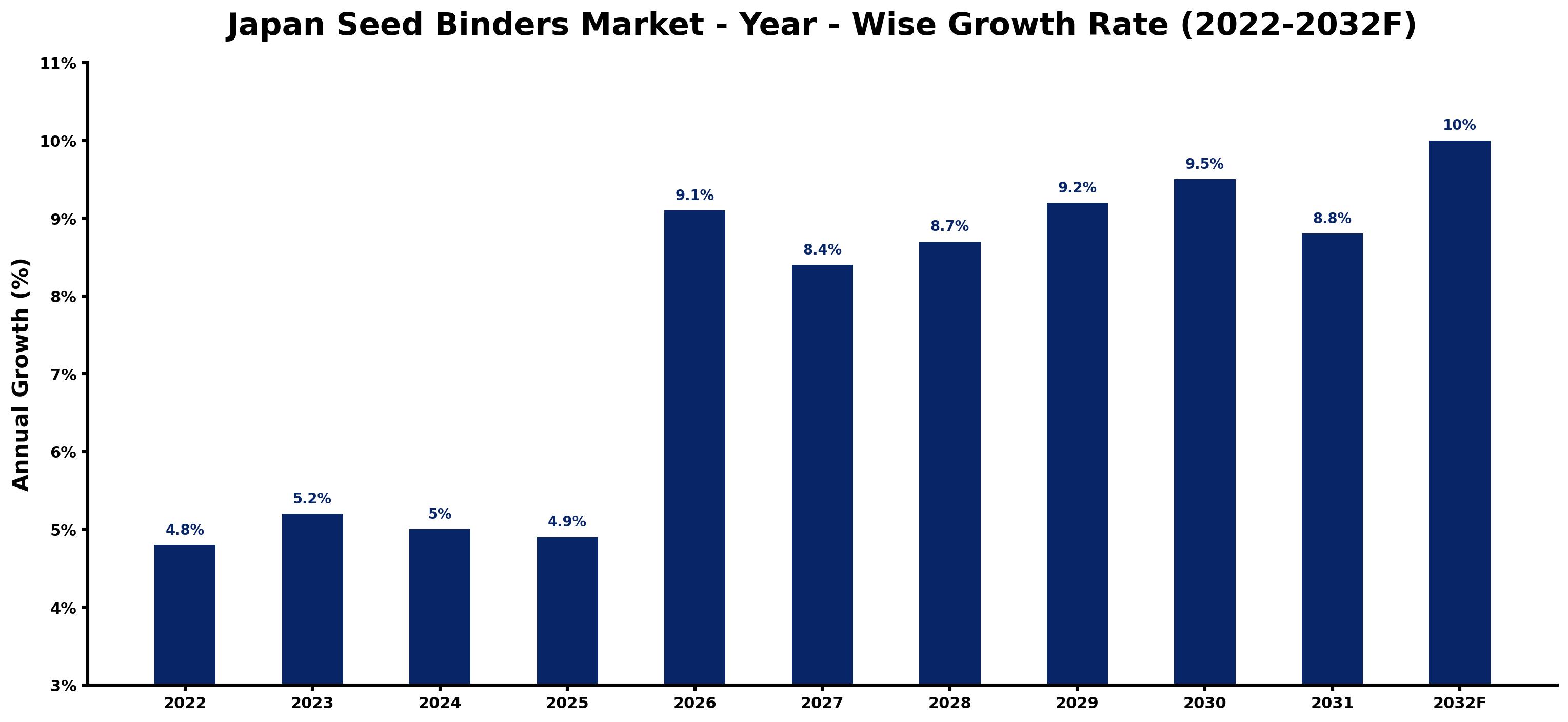
Each row of the following table gives one year's estimated growth and the event or demand shift that explains it.
| Year | Estimated Annual Growth (%) | Market Rationale |
| 2022 | 4.8 | The agricultural sector showed steady demand for seed binders, reflecting ongoing farming practices. |
| 2023 | 5.2 | Growth accelerated due to increased adoption of seed coating techniques among producers. |
| 2024 | 5.0 | The market experienced a slight slowdown as producers adjusted to changing supply conditions. |
| 2025 | 4.9 | Demand continued to grow, albeit at a slower pace, as farmers optimised their planting strategies. |
| 2026 | 9.1 | Investment in agricultural technology is projected to surge, driving a notable increase in seed binder usage. |
| 2027 | 8.4 | Growth is expected to moderate as the market stabilises after the previous year's surge in demand. |
| 2028 | 8.7 | A renewed interest in sustainable practices will boost the use of environmentally friendly binders. |
| 2029 | 9.2 | Demand is anticipated to rise as precision farming techniques become more widely adopted in the Tohoku region. |
| 2030 | 9.5 | The market is expected to expand further with technological advancements improving binder performance. |
| 2031 | 8.8 | Growth is projected to slow slightly as market conditions normalise after several years of rapid expansion. |
| 2032 | 10.0 | A peak in growth is anticipated as new standards and practices are fully integrated. |
Note: Market size estimations and growth projections presented in this report are based on 6Wresearch's proprietary forecasting methodology, utilizing the latest available industry data, government publications, and primary research inputs.
Japan Seed Binders Market Synopsis
Seed binders are substances that improve seed adhesion and performance during planting, made from polymers, natural substances, and adhesives. Their primary applications include seed coating and improving germination efficiency. The Japan Seed Binders Market is expanding due to rising agricultural innovation and the adoption of advanced farming techniques. With the agricultural sector valued at approximately 4 trillion yen, demand is driven by seed companies and agricultural producers focused on optimising crop yield through effective seed treatments.
Market Dynamics Impact Analysis (2026–2032)
| Factor | Type | Impact | Primary Segment Affected |
| Rising adoption of seed coating techniques | Driver | High | Seed Coating |
| Increased focus on sustainable agricultural practices | Driver | High | Bio-based Materials |
| Growing demand for precision farming solutions | Opportunity | High | Precision Farming |
| Expansion of online sales channels for niche products | Opportunity | Medium | Online Platforms |
| Limited awareness of seed binder benefits among small-scale farmers | Restraint | Medium | Seed Companies |
| Regulatory challenges in introducing new binder formulations | Restraint | High | Synthetic Polymers |
| High costs associated with advanced binder technologies | Challenge | High | Natural Binders |
| Competition from alternative seed treatment methods | Challenge | Medium | Adhesive Binders |
Evaluation of Drivers in Japan Seed Binders Market (2026–2032)
The table below links each growth driver to the segment it affects and the evidence for it.
| Drivers | Primary Segment Affected | Why It Matters (Evidence) |
| Investment in agricultural technology | Synthetic Polymers | This investment leads to improved seed binder formulations, increasing demand from seed companies focused on yield improvement. |
| Rising awareness of seed performance benefits | Seed Coating | As over 70% of seeds are coated, producers are increasingly purchasing binders to optimise germination rates. |
| Government initiatives promoting sustainable agriculture | Bio-based Materials | The Green Food System initiative encourages the use of bio-based binders, driving demand among environmentally conscious farmers. |
| Technological advancements in binder formulations | Water-soluble Binders | These innovations improve environmental compliance, prompting agricultural producers to adopt water-soluble options. |
| Expansion of distribution channels through agro distributors | Agro Distributors | This growth facilitates easier access to seed binders for farmers, increasing overall market consumption. |
The strongest pull on demand comes from significant investment in agricultural technology, which improves seed binder formulations and increases purchases from seed companies. With over 70% of seeds in Japan coated, producers are increasingly purchasing binders to optimise germination rates. The expansion of agro distributors facilitates access to these products, further boosting market consumption.
Evaluation of Restraints in Japan Seed Binders Market
These are the pressures that could keep growth below its potential.
| Market Restraint | Primary Segment Affected | Why It Matters (Evidence) |
| Limited awareness of seed binder benefits among small-scale farmers | Seed Companies | Many small-scale farmers lack knowledge about the advantages of using seed binders, resulting in lower demand. |
| Regulatory challenges in introducing new binder formulations | Synthetic Polymers | Strict regulations can delay the introduction of new binder products, impacting market growth. |
| High production costs for advanced binder technologies | Natural Binders | The cost of developing and producing high-performance binders can deter investment from smaller producers. |
| Competition from alternative seed treatment methods | Adhesive Binders | The availability of other seed treatment options can limit the market share of adhesive binders. |
| Environmental regulations affecting binder formulations | Water-soluble Binders | Compliance with stringent environmental standards can restrict the types of binders that can be used. |
Japan Seed Binders Market Challenges
Over 70% of seeds planted in Japan require coating, yet rising costs of synthetic polymers, which account for 60% of the market, strain budgets for agricultural producers. Supply chain disruptions in the Tohoku region can delay seed binder availability, forcing farmers to postpone planting schedules. Buyers face increased costs due to environmental regulations that mandate the use of bio-based seed binders, complicating their procurement processes. Compliance with ISO 9001 standards raises manufacturing expenses, impacting pricing for agricultural cooperatives distributing these products in rural areas.
Trends in the Japan Seed Binders Market
Buyers and suppliers in the Japan Seed Binders Market are adjusting to the following trends.
- Shift from Traditional to Precision Farming: Since 2023, the Tohoku region has embraced precision farming techniques, increasing seed binder use. Over 70% of seeds are now coated, reflecting this trend's impact on agricultural practices.
- Increasing Adoption of Bio-based Materials: Beginning in 2023, farmers have increasingly adopted bio-based seed binders. This trend aligns with the Green Food System initiative, promoting sustainable agriculture practices across Japan.
- Growth of Online Sales Channels: In 2023, online platforms for seed binders gained traction, with a 12% increase in sales. This shift allows niche products to reach a broader audience, improving market accessibility.
- Rising Demand for Water-soluble Binders: Since 2023, the use of water-soluble binders has increased due to environmental regulations. This shift supports sustainable agricultural practices and meets the needs of eco-conscious farmers.
Investment Opportunities in the Japan Seed Binders Market
The following opportunities in the Japan Seed Binders Market pair current demand with a clear way in.
- Tohoku Region's Seed Production Facilities: The Tohoku region, a major seed production area, presents an opportunity for investment in seed binders, with a growing market. Collaborating with local agricultural cooperatives can improve distribution.
- Gap in Sustainable Binder Solutions: With the market for bio-based materials projected to grow at 13.1%, there is an opportunity for suppliers to develop sustainable binder solutions. Seed companies focused on eco-friendly practices are ideal partners.
- Precision Farming Techniques in Demand: The increasing adoption of precision farming techniques creates a demand for advanced seed binders. Agritech firms are seeking innovative solutions to improve crop yields, presenting a lucrative investment opportunity.
- Growing Online Sales Channels: The rise of online platforms for seed binders indicates a gap in distribution channels, with a 12% growth rate. Suppliers can enter this market by partnering with e-commerce platforms.
Government Initiatives in the Japan Seed Binders Market
The regulatory framework for seed binders is shaped by several laws, including the Chemical Substances Control Law of 1973, which mandates the evaluation of chemical substances. The PRTR Law of 1999 requires businesses to report on designated chemicals, ensuring transparency in the agricultural sector. These regulations impact producers by necessitating compliance with safety and environmental standards.
The Ministry of Agriculture, Forestry and Fisheries oversees agricultural input regulations, approving new seed binder formulations. The government supports innovation through funding for research projects aimed at improving agricultural productivity. In 2023, a program was launched to promote precision farming techniques, further encouraging the adoption of advanced seed binders.
Future Insight of the Japan Seed Binders Market
Investment in agricultural innovation will create demand for advanced seed binders by 2032. The launch of new precision farming techniques will require higher-quality binders to optimise seed performance. As the average farm size remains at 1.5 hectares, suppliers will need to tailor their products to cater to smaller agricultural operations. The increasing emphasis on water-soluble options will align with environmental regulations, fostering opportunities for market growth.
Market Segmentation Analysis
Japan Seed Binders Market report covers a detailed analysis of the following market segments:
By Binder Type – Polymer-based Leads, Natural Binders Expected to Grow Fastest
According to Prakhar Dixit, Senior Research Analyst at 6Wresearch, Polymer-based held 42% of the Japan Seed Binders Market by binder type in 2025. Polymer-based binders dominate the market due to their widespread application in seed adhesion and protection, essential for over 70% of seeds planted in Japan. Their extensive use in the Tohoku region, a major seed production area, reinforces their leading position. The quickest growth will come from Natural Binders, forecast to expand at a CAGR of 12.8% between 2026 and 2032. Natural binders are experiencing rapid growth as organic farming practices gain popularity, with a notable increase in demand from environmentally conscious producers. This trend is supported by government initiatives promoting sustainable agricultural practices. Suppliers should focus on developing and marketing natural binders to capitalise on the growing organic farming segment.
By Material Type – Synthetic Polymers Lead, Bio-based Materials Expected to Grow Fastest
The largest material type category in 2025 was Synthetic Polymers, at 50% of revenue. Synthetic polymers hold the largest share as they are the primary material for most seed binder formulations, ensuring effective seed adhesion. Their extensive application among seed companies in Japan illustrates their vital role in enhancing agricultural productivity. Bio-based Materials are set to record the highest CAGR in this split, 13.1% over 2026–2032. Bio-based materials are witnessing rapid growth due to increasing emphasis on sustainable agriculture, with government initiatives encouraging the adoption of eco-friendly practices. This trend is evident as seed companies progressively incorporate bio-based solutions into their offerings. Suppliers should consider expanding their product lines to include bio-based options to align with sustainability trends.
By Application Area – Seed Coating Leads, Precision Farming Expected to Grow Fastest
Seed Coating took 37% of application area revenue in 2025, more than any other category. Seed coating is the leading application area, crucial for improving seed performance and directly impacting germination efficiency. The fact that over 70% of seeds planted in Japan undergo this process highlights its significance in the agricultural sector. Over 2026–2032, Precision Farming is expected to post the fastest growth, at a CAGR of 11.5%. Precision farming is the fastest-growing application area, spurred by government initiatives aimed at advancing agricultural techniques. This growth signifies a broader shift towards technology-driven farming practices that necessitate effective seed binders. Suppliers should focus on developing products that meet the demands of the precision farming segment to align with modern agricultural advancements.
By Distribution Channel – Agro Distributors Lead, Online Platforms Expected to Grow Fastest
In 2025, Agro Distributors led the distribution channel split with a 42% share. Agro distributors are the primary channel for seed binder distribution, serving as essential intermediaries for agricultural cooperatives in rural areas. Their established networks ensure that seed binders are effectively delivered to a wide range of end users. Online Platforms are projected to grow fastest, at a CAGR of 12.0% during 2026–2032. Online platforms are rapidly emerging as a preferred distribution channel, particularly for niche products, as buyers increasingly seek convenience and efficiency. This shift indicates changing purchasing behaviours within the agricultural sector. Suppliers must enhance their online presence to capture the growing demand for seed binders through digital channels.
By End User – Seed Companies Lead, Agritech Firms Expected to Grow Fastest
With 39% of end user revenue in 2025, Seed Companies was the largest category. Seed companies represent the largest consumer group for seed binders, using them extensively to ensure seed quality and performance. Their pivotal role in the seed supply chain drives the demand for various types of binders. The quickest growth will come from Agritech Firms, forecast to expand at a CAGR of 11.8% between 2026 and 2032. Agritech firms are the fastest-growing end users, leveraging seed binders in their advanced agricultural technologies to improve efficiency and yield. This trend reflects a rising integration of technology within the agricultural sector, increasing the need for innovative solutions. Suppliers should engage with agritech firms to create tailored solutions that meet the needs of contemporary agricultural practices.
Key Attractiveness of the Report
- 10 Years of Market Numbers
- Historical Data Starting from 2022 to 2025
- Base Year 2025
- Forecast Data until 2032
- Key Performance Indicators Impacting the Market
- Major Upcoming Developments and Projects
Key Highlights of the Report:
- Japan Seed Binders Market Outlook
- Market Size of Japan Seed Binders Market, 2025
- Forecast of Japan Seed Binders Market, 2032
- Historical Data and Forecast of Japan Seed Binders Market Revenues & Volume for the Period 2022-2032F
- Japan Seed Binders Market Trend Evolution
- Japan Seed Binders Market Drivers and Challenges
- Japan Seed Binders Market Price Trends
- Japan Seed Binders Market Porter's Five Forces
- Japan Seed Binders Market Industry Life Cycle
- Historical Data and Forecast of Japan Seed Binders Market Revenues & Volume By Binder Type for the Period 2022-2032F
- Historical Data and Forecast of Japan Seed Binders Market Revenues & Volume By Polymer-based for the Period 2022-2032F
- Historical Data and Forecast of Japan Seed Binders Market Revenues & Volume By Natural Binders for the Period 2022-2032F
- Historical Data and Forecast of Japan Seed Binders Market Revenues & Volume By Adhesive Binders for the Period 2022-2032F
- Historical Data and Forecast of Japan Seed Binders Market Revenues & Volume By Water-soluble Binders for the Period 2022-2032F
- Historical Data and Forecast of Japan Seed Binders Market Revenues & Volume By Material Type for the Period 2022-2032F
- Historical Data and Forecast of Japan Seed Binders Market Revenues & Volume By Synthetic Polymers for the Period 2022-2032F
- Historical Data and Forecast of Japan Seed Binders Market Revenues & Volume By Bio-based Materials for the Period 2022-2032F
- Historical Data and Forecast of Japan Seed Binders Market Revenues & Volume By Resin-based for the Period 2022-2032F
- Historical Data and Forecast of Japan Seed Binders Market Revenues & Volume By Cellulose-based for the Period 2022-2032F
- Historical Data and Forecast of Japan Seed Binders Market Revenues & Volume By Application Area for the Period 2022-2032F
- Historical Data and Forecast of Japan Seed Binders Market Revenues & Volume By Seed Coating for the Period 2022-2032F
- Historical Data and Forecast of Japan Seed Binders Market Revenues & Volume By Pellet Formation for the Period 2022-2032F
- Historical Data and Forecast of Japan Seed Binders Market Revenues & Volume By Precision Farming for the Period 2022-2032F
- Historical Data and Forecast of Japan Seed Binders Market Revenues & Volume By Crop Protection for the Period 2022-2032F
- Historical Data and Forecast of Japan Seed Binders Market Revenues & Volume By Distribution Channel for the Period 2022-2032F
- Historical Data and Forecast of Japan Seed Binders Market Revenues & Volume By Agro Distributors for the Period 2022-2032F
- Historical Data and Forecast of Japan Seed Binders Market Revenues & Volume By Direct Sales for the Period 2022-2032F
- Historical Data and Forecast of Japan Seed Binders Market Revenues & Volume By Online Platforms for the Period 2022-2032F
- Historical Data and Forecast of Japan Seed Binders Market Revenues & Volume By Retail Suppliers for the Period 2022-2032F
- Historical Data and Forecast of Japan Seed Binders Market Revenues & Volume By End User for the Period 2022-2032F
- Historical Data and Forecast of Japan Seed Binders Market Revenues & Volume By Seed Companies for the Period 2022-2032F
- Historical Data and Forecast of Japan Seed Binders Market Revenues & Volume By Agricultural Producers for the Period 2022-2032F
- Historical Data and Forecast of Japan Seed Binders Market Revenues & Volume By Agritech Firms for the Period 2022-2032F
- Historical Data and Forecast of Japan Seed Binders Market Revenues & Volume By Farmers for the Period 2022-2032F
- Japan Seed Binders Market Import Export Trade Statistics
- Market Opportunity Assessment By Binder Type
- Market Opportunity Assessment By Material Type
- Market Opportunity Assessment By Application Area
- Market Opportunity Assessment By Distribution Channel
- Market Opportunity Assessment By End User
- Japan Seed Binders Market Top Companies Market Share
- Japan Seed Binders Market Competitive Benchmarking By Technical and Operational Parameters
- Japan Seed Binders Market Company Profiles
- Japan Seed Binders Market Key Strategic Recommendations
Market Covered
This report examines the market across the segments below.
By Binder Type
- Polymer-based
- Natural Binders
- Adhesive Binders
- Water-soluble Binders
By Material Type
- Synthetic Polymers
- Bio-based Materials
- Resin-based
- Cellulose-based
By Application Area
- Seed Coating
- Pellet Formation
- Precision Farming
- Crop Protection
By Distribution Channel
- Agro Distributors
- Direct Sales
- Online Platforms
- Retail Suppliers
By End User
- Seed Companies
- Agricultural Producers
- Agritech Firms
- Farmers






































