Japan Seeding & Planting Equipment Market Size & Growth Rate
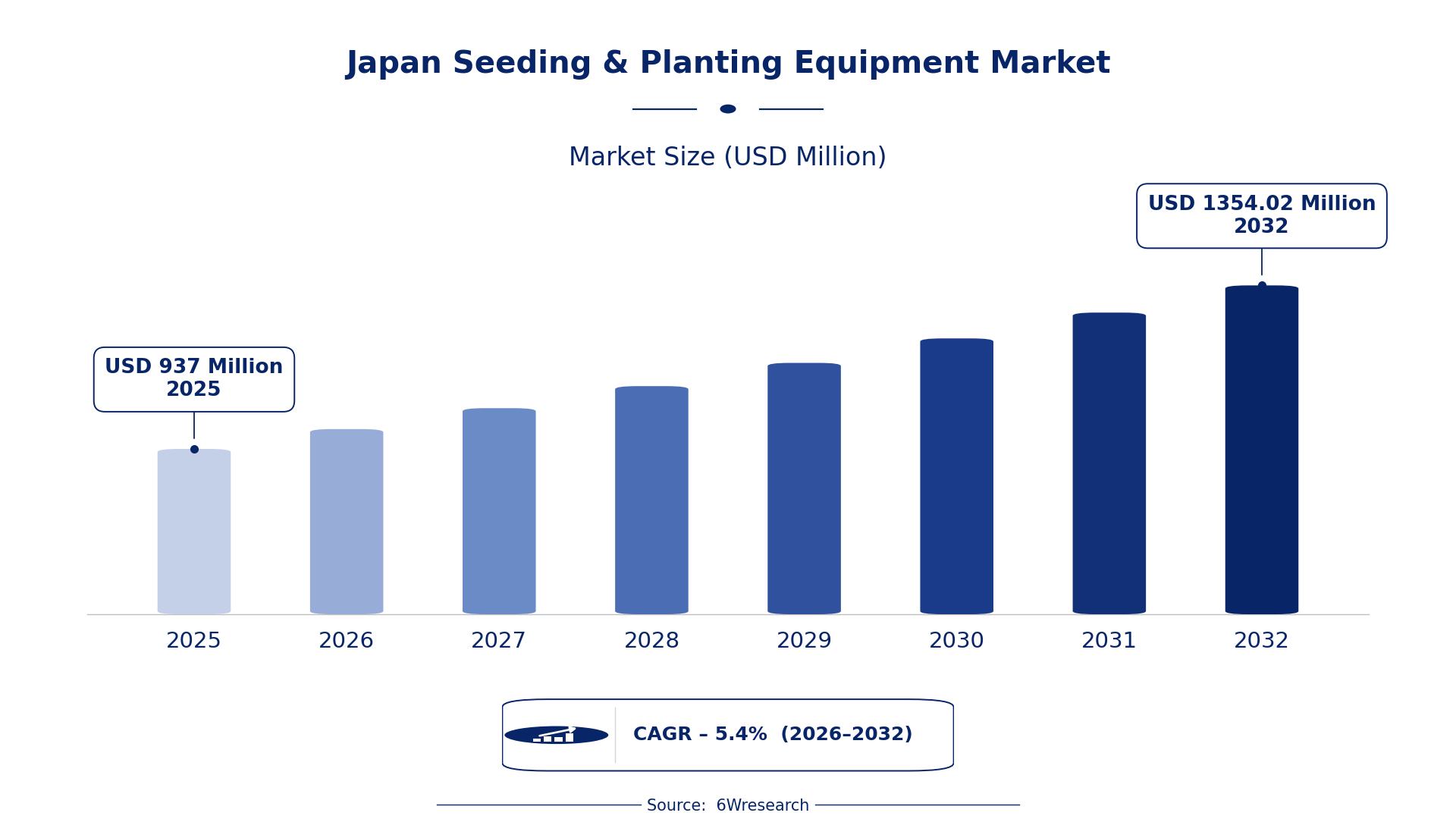
According to 6Wresearch internal database and industry insights, the Japan Seeding & Planting Equipment Market was valued at USD 937.0 million in 2025 and is projected to reach USD 1,354.02 million by 2032, growing at a CAGR of approximately 5.4% during 2026–2032.
Japan Seeding & Planting Equipment Market Highlights
| Report Metric | Details |
| Report Name | Japan Seeding & Planting Equipment Market |
| Market Size 2025 | USD 937.0 million |
| Market Size 2032 | USD 1,354.02 million |
| Absolute Growth 2025–2032 | USD 417.02 million |
| CAGR 2026–2032 | 5.4% |
| Peak Annual Growth | 8.0% in 2027 |
| Forecast Period | 2026–2032 |
| Historical Data | 2022–2025 |
| Base Year | 2025 |
| Leading Equipment Type, 2025 | Planters (48% share) |
| Leading Mechanism Type, 2025 | Pneumatic (44% share) |
| Leading Distribution Channel, 2025 | Equipment Dealers (52% share) |
| Leading End User, 2025 | Large Farms (42% share) |
| Fastest-Growing Equipment Type | Precision Planters (7.8% CAGR) |
| Fastest-Growing Mechanism Type | GPS-Guided (6.9% CAGR) |
| Fastest-Growing Distribution Channel | Online Platforms (8.1% CAGR) |
| Fastest-Growing End User | Agritech Firms (6.6% CAGR) |
| Growing Sector | Agritech |
| Key End Users | Large Farms, Agritech Firms, Crop Growers |
Japan Seeding & Planting Equipment Market Year-wise Growth Rate and Key Drivers (2022–2032)
This graph illustrates the annual growth rates of the market from 2022 to 2032, highlighting a steady upward trajectory and projected market expansion over the forecast period.
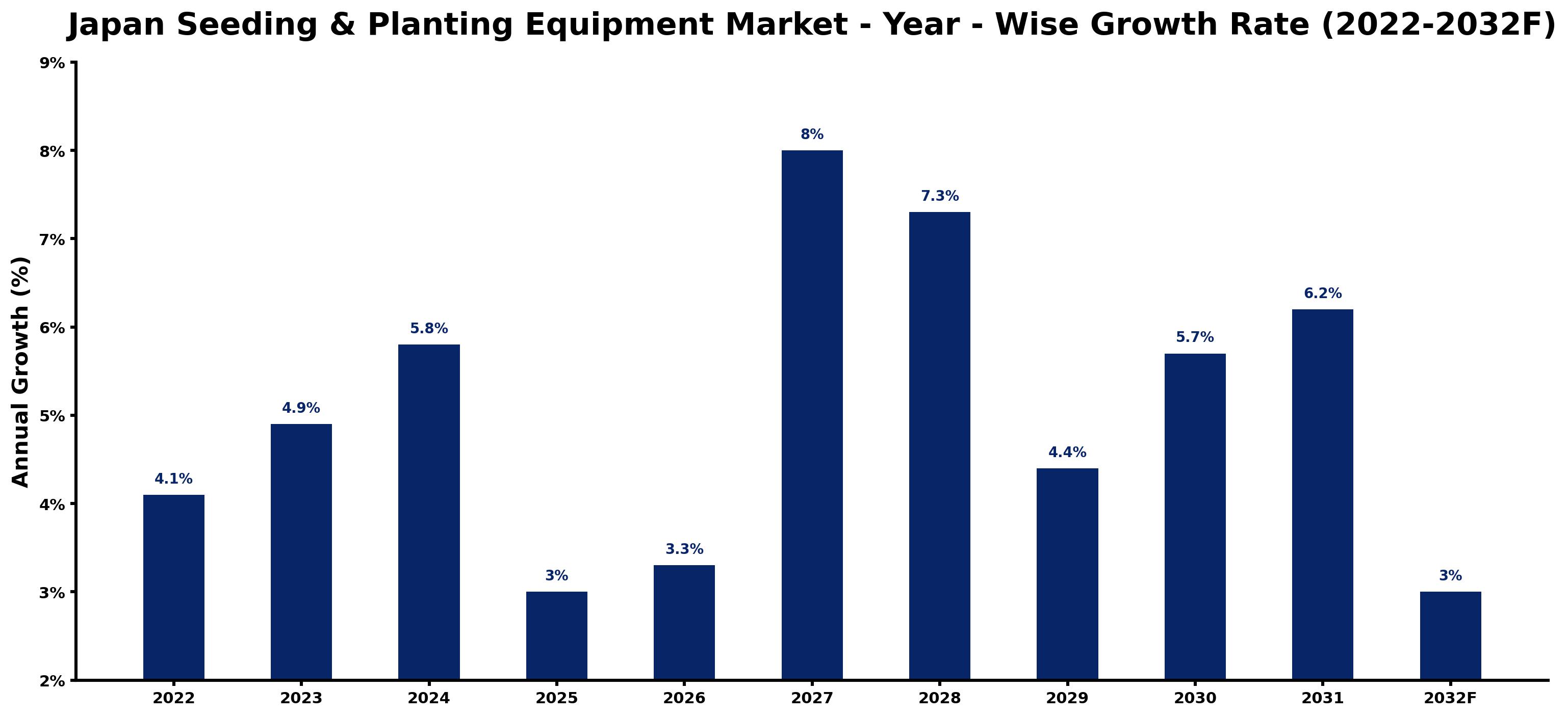
The table below sets out the estimated growth rate for each year and the main factor behind it.
| Year | Estimated Annual Growth (%) | Market Rationale |
| 2022 | 4.1 | The market showed steady growth as farmers adopted mechanized planting methods, supported by the 'Smart Agriculture' initiative. |
| 2023 | 4.9 | Increased adoption of precision planting technologies boosted growth rates in the sector, particularly among large farms. |
| 2024 | 5.8 | The introduction of advanced planting equipment further accelerated market expansion and efficiency, especially in Hokkaido. |
| 2025 | 3.0 | Growth slowed as the market adjusted to previous years' rapid advancements in technology and equipment. |
| 2026 | 3.3 | Demand is expected to increase as farmers seek to improve planting efficiency and yields through mechanization. |
| 2027 | 8.0 | The market is projected to peak due to heightened investments in advanced planting solutions and technology adoption. |
| 2028 | 7.3 | Growth is anticipated to decelerate as the market begins to stabilise after the peak in investment. |
| 2029 | 4.4 | Demand will continue to slow as farmers consolidate their equipment needs and focus on efficiency improvements. |
| 2030 | 5.7 | Growth is expected to pick up again as agritech firms expand their operations and technology use in agriculture. |
| 2031 | 6.2 | Increased mechanization among large farms will drive further growth in the market, enhancing productivity. |
| 2032 | 3.0 | The market is projected to stabilise as demand from agritech firms continues to rise, ensuring ongoing investment. |
Note: Market size estimations and growth projections presented in this report are based on 6Wresearch's proprietary forecasting methodology, utilizing the latest available industry data, government publications, and primary research inputs.
Japan Seeding & Planting Equipment Market Synopsis
Seeding and planting equipment in Japan includes tools designed for sowing seeds and planting crops, primarily made from metal and plastic. These tools improve agricultural productivity through precise seed placement and optimal planting conditions. The Japan Seeding & Planting Equipment Market is growing due to rising demand from large farms and agritech firms focused on improving crop yields. Approximately 40% of Japanese farmers use mechanized planting equipment, supported by the 'Smart Agriculture' initiative from the Ministry of Agriculture, Forestry and Fisheries, which promotes advanced planting technology adoption across the sector.
Market Dynamics Impact Analysis (2026–2032)
| Factor | Type | Impact | Primary Segment Affected |
| Rising adoption of precision planting technologies | Driver | High | Precision Planters |
| Increasing mechanization among large farms | Driver | High | Planters |
| Growing demand for advanced planting solutions | Opportunity | High | Agritech Firms |
| Expansion of online sales channels for equipment | Opportunity | Medium | Online Platforms |
| High initial investment costs for advanced equipment | Restraint | High | Precision Planters |
| Limited availability of skilled operators for advanced machinery | Restraint | Medium | Pneumatic |
| The Seeding & Planting Equipment Market in Japan faces high initial investment costs | Challenge | High | Planters |
| Competition from imported advanced planting technologies | Challenge | Medium | Seeders |
Evaluation of Drivers in Japan Seeding & Planting Equipment Market (2026–2032)
Below mentioned are some major drivers and their influence on market dynamics.
| Drivers | Primary Segment Affected | Why It Matters (Evidence) |
| Increased mechanization among large farms drives demand for planting equipment. | Planters | The average size of a large farm in Japan is about 30 hectares, necessitating efficient planting solutions. |
| Rising adoption of precision planting technologies improves efficiency. | Precision Planters | Precision planters are increasingly adopted in Hokkaido, known for its large-scale agriculture, enhancing productivity. |
| Growing agritech firms are investing in advanced planting solutions. | Agritech Firms | Agritech firms in Japan are projected to grow by 15% annually, increasing demand for planting equipment. |
| Expansion of online sales channels increases accessibility to equipment. | Online Platforms | Online platforms are gaining traction as a sales channel for planting equipment, improving access for farmers. |
| Government initiatives promote the use of advanced planting technology. | Seeders | The Ministry of Agriculture, Forestry and Fisheries promotes the use of advanced planting technology under the 'Smart Agriculture' initiative. |
Growth in the Seeding & Planting Equipment market in Japan comes from increased mechanization among large farms, rising adoption of precision planting technologies, and growing investments from agritech firms in advanced planting solutions. Approximately 40% of Japanese farmers are using some form of mechanized planting equipment, which improves efficiency and productivity. The ongoing expansion of agritech firms is projected to increase demand for planting equipment by 15% annually, creating opportunities for suppliers. The adoption of precision planters is particularly notable in regions like Hokkaido, where large-scale agriculture thrives, further driving market growth.
Evaluation of Restraints in Japan Seeding & Planting Equipment Market
The main factors holding the market back are set out below.
| Market Restraint | Primary Segment Affected | Why It Matters (Evidence) |
| High initial investment costs for advanced planting equipment limit market access. | Precision Planters | The average cost of advanced planting equipment can exceed several million yen, deterring smaller farms from investing. |
| Limited availability of skilled operators for advanced machinery hampers adoption. | Pneumatic | Many farmers lack the necessary training to operate complex planting technologies effectively, impacting productivity. |
| Competition from imported advanced planting technologies affects local producers. | Seeders | Japan imported approximately 10% of its agricultural machinery from other countries in 2022, impacting local sales. |
| Regulatory compliance can increase operational costs for manufacturers. | Transplanters | Manufacturers must adhere to the ISO 9001 standard, which requires significant investment in quality management processes. |
| Market consolidation among suppliers may limit choices for buyers. | Planters | As larger firms acquire smaller competitors, the variety of equipment options may decrease, affecting farmer choices. |
Japan Seeding & Planting Equipment Market Challenges
The Japan seeding and planting equipment market confronts a major supply challenge, as reliance on imported machinery can lead to delays in availability for farmers. This dependency means that when global supply chains are disrupted, local users may experience a 10% increase in equipment costs. Technological adoption remains low, with only 40% of farmers currently using mechanized planting tools, which restricts productivity improvements across the sector. Regulatory compliance with standards like ISO 9001 incurs additional costs for manufacturers, which can slow down innovation and raise prices for buyers. Competition from advanced foreign technologies compels local producers to invest heavily, diverting resources from essential improvements.
Trends in the Japan Seeding & Planting Equipment Market
Buyers and suppliers in the Japan Seeding & Planting Equipment Market are adjusting to the following trends.
- Shift from Traditional to Precision Planting: Large farms in Japan are increasingly embracing precision planting techniques to boost crop yields. This trend is reflected in the 'Smart Agriculture' initiative, which promotes advanced technologies, with 40% of farmers utilising mechanised planting equipment.
- Transition from Equipment Dealers to Online Platforms: The distribution of seeding and planting equipment is evolving from traditional equipment dealers to online platforms. This shift is driven by an 8.1% annual growth in online sales channels, making purchasing more convenient for farmers.
- Emergence of Agritech Firms as Key Buyers: Agritech firms are becoming prominent buyers of planting equipment, with their projected growth of 15% annually. This trend is reshaping demand dynamics, as these firms seek modern solutions to enhance agricultural productivity.
- Increasing Use of GPS-Guided Planting Equipment: GPS-guided planting technology is gaining popularity among Japanese farmers, particularly in regions like Hokkaido. This trend is evidenced by a 6.9% CAGR in the GPS-guided segment, improving planting accuracy.
Investment Opportunities in the Japan Seeding & Planting Equipment Market
The following opportunities in the Japan Seeding & Planting Equipment Market pair current demand with a clear way in.
- Gap in Advanced Planting Technology Adoption: With 10% of farmers using advanced planting technologies, there remains a gap for suppliers to fill. Agritech firms are actively seeking solutions, creating opportunities for new suppliers to enter the market.
- Collaborations with Local Agritech Firms: The shift towards online platforms presents a unique opportunity for suppliers. Investing in online sales channels can help reach a broader audience, especially among tech-savvy farmers looking for modern solutions.
- Expansion of Precision Planting Solutions: As precision planters are increasingly adopted, suppliers should focus on expanding their offerings in this segment. Large farms are key buyers, requiring efficient and accurate planting solutions.
- Investment in Training Programs for Farmers: With many farmers lacking the necessary skills to operate advanced planting equipment, there is a need for training programs. Collaborating with local agricultural colleges can help bridge this gap and improve adoption.
Government Initiatives in the Japan Seeding & Planting Equipment Market
The Agricultural Machinery Promotion Act, updated in 2021, aims to encourage technology adoption within the agricultural sector. This law motivates manufacturers to invest in advanced planting technologies and ensures that farmers have access to modern equipment. Additionally, the GX Basic Policy, adopted in 2023, aims for JPY 150 trillion of public-private decarbonisation investment over the next decade, which includes support for agricultural innovation and technology upgrades. This investment is anticipated to drive advancements in planting equipment and improve overall productivity in the sector.
The Digital Agency, established in September 2021, spearheads government digital transformation initiatives and sets common system standards for agricultural technology. This agency supports projects that enhance the efficiency of planting equipment through digital solutions, ensuring that farmers can effectively utilise advanced technologies to boost productivity. The agency's initiatives are expected to benefit over 100 agricultural technology projects, improving access to modern equipment for farmers throughout Japan.
Future Insight of the Japan Seeding & Planting Equipment Market
The Japan seeding and planting equipment market is set to evolve by 2032, influenced by the 'Smart Agriculture' initiative and rising mechanization among farmers. The agricultural machinery market, valued at approximately 1.5 trillion yen in 2021, will likely shift towards more efficient planting solutions. Precision planting technologies will become increasingly popular, particularly in regions like Hokkaido, where large-scale agriculture is prevalent. With the updated Agricultural Machinery Promotion Act promoting technology adoption, local manufacturers will focus on innovation to maintain competitiveness.
Market Segmentation Analysis
The report offers a comprehensive study of the following market segments and their leading categories in the market.
By Equipment Type – Planters Dominated, Precision Planters Expected to Grow Fastest
According to Shubham Padhi, Research Analyst at 6Wresearch, Planters accounted for a 48% market share by equipment type in 2025. Planters hold the largest share in the Japan seeding and planting equipment market due to their essential role in accurately and efficiently planting seeds across the country's 1.2 million hectares of arable land. Large farms rely heavily on planters to optimise crop yields and maintain productivity. Precision Planters are projected to grow fastest, at a CAGR of 7.8% during 2026–2032. Precision planters are experiencing rapid growth as agritech firms, projected to expand by 15% annually, increasingly adopt these advanced tools to maximise planting accuracy and minimise seed waste. This trend indicates that the demand for precision planters will continue to rise as technology advances. Suppliers need to focus on developing advanced features in precision planters to cater to the increasing demands of the agritech sector.
By Mechanism Type – Pneumatic Dominated, GPS-Guided Expected to Grow Fastest
In 2025, Pneumatic led the mechanism type split with a 44% share. Pneumatic mechanisms dominate the market share because they effectively distribute seeds using air pressure, which enhances planting efficiency. This method is widely used among large farms that seek reliable and consistent planting solutions. GPS-Guided is set to record the highest CAGR in this split, 6.9% over 2026–2032. GPS-guided mechanisms are rapidly gaining popularity as they provide precision agriculture capabilities and mapping features that improve planting accuracy. As more farmers adopt these technologies, the demand for GPS-guided equipment is expected to rise significantly. Manufacturers should invest in GPS-guided technology to align with the increasing trend towards precision agriculture among farmers.
By Distribution Channel – Equipment Dealers Dominated, Online Platforms Expected to Grow Fastest
With a 52% revenue share in 2025, Equipment Dealers was the largest distribution channel category. Equipment dealers account for the largest share of the market as they serve as the primary distribution method for reaching farmers and agricultural businesses in Japan. Their established networks and strong customer relationships make them a crucial channel for planting equipment sales. The quickest growth will come from Online Platforms, forecast to expand at a CAGR of 8.1% between 2026 and 2032. Online platforms are emerging as the fastest-growing distribution channel, gaining traction among tech-savvy farmers seeking convenient purchasing options. As digital engagement continues to rise, online sales are projected to expand significantly in the coming years. Suppliers should enhance their online presence to capitalise on the growing trend of digital purchasing in the agricultural equipment market.
By End User – Large Farms Dominated, Agritech Firms Expected to Grow Fastest
Large Farms took a 42% share of end user in 2025, more than any other category. Large farms represent the largest share of the market as they are major users of advanced planting technology, enhancing their operational efficiency. The scale of their operations necessitates the use of reliable and effective planting solutions to maximise productivity. Over 2026–2032, Agritech Firms are expected to post the fastest growth, at a CAGR of 6.6%. Agritech firms are the fastest-growing end user segment, leveraging advanced planting technologies to innovate and improve crop yields. Their focus on efficiency and productivity drives the demand for modern planting equipment. Suppliers should tailor their offerings to meet the specific needs of agritech firms, ensuring competitiveness in this rapidly expanding segment.
Key Attractiveness of the Report
- 10 Years of Market Numbers
- Historical Data Starting from 2022 to 2025
- Base Year 2025
- Forecast Data until 2032
- Key Performance Indicators Impacting the Market
- Major Upcoming Developments and Projects
Key Highlights of the Report:
- Japan Seeding & Planting Equipment Market Outlook
- Market Size of Japan Seeding & Planting Equipment Market, 2025
- Forecast of Japan Seeding & Planting Equipment Market, 2032
- Historical Data and Forecast of Japan Seeding & Planting Equipment Revenues & Volume for the Period 2022 - 2032F
- Japan Seeding & Planting Equipment Market Trend Evolution
- Japan Seeding & Planting Equipment Market Drivers and Challenges
- Japan Seeding & Planting Equipment Price Trends
- Japan Seeding & Planting Equipment Porter's Five Forces
- Japan Seeding & Planting Equipment Industry Life Cycle
- Historical Data and Forecast of Japan Seeding & Planting Equipment Market Revenues & Volume By Equipment Type for the Period 2022 - 2032F
- Historical Data and Forecast of Japan Seeding & Planting Equipment Market Revenues & Volume By Planters for the Period 2022 - 2032F
- Historical Data and Forecast of Japan Seeding & Planting Equipment Market Revenues & Volume By Seeders for the Period 2022 - 2032F
- Historical Data and Forecast of Japan Seeding & Planting Equipment Market Revenues & Volume By Transplanters for the Period 2022 - 2032F
- Historical Data and Forecast of Japan Seeding & Planting Equipment Market Revenues & Volume By Precision Planters for the Period 2022 - 2032F
- Historical Data and Forecast of Japan Seeding & Planting Equipment Market Revenues & Volume By Mechanism Type for the Period 2022 - 2032F
- Historical Data and Forecast of Japan Seeding & Planting Equipment Market Revenues & Volume By Mechanical for the Period 2022 - 2032F
- Historical Data and Forecast of Japan Seeding & Planting Equipment Market Revenues & Volume By Pneumatic for the Period 2022 - 2032F
- Historical Data and Forecast of Japan Seeding & Planting Equipment Market Revenues & Volume By Semi-Automatic for the Period 2022 - 2032F
- Historical Data and Forecast of Japan Seeding & Planting Equipment Market Revenues & Volume By GPS-Guided for the Period 2022 - 2032F
- Historical Data and Forecast of Japan Seeding & Planting Equipment Market Revenues & Volume By Distribution Channel for the Period 2022 - 2032F
- Historical Data and Forecast of Japan Seeding & Planting Equipment Market Revenues & Volume By Direct Sales for the Period 2022 - 2032F
- Historical Data and Forecast of Japan Seeding & Planting Equipment Market Revenues & Volume By Equipment Dealers for the Period 2022 - 2032F
- Historical Data and Forecast of Japan Seeding & Planting Equipment Market Revenues & Volume By Online Platforms for the Period 2022 - 2032F
- Historical Data and Forecast of Japan Seeding & Planting Equipment Market Revenues & Volume By Industrial Suppliers for the Period 2022 - 2032F
- Historical Data and Forecast of Japan Seeding & Planting Equipment Market Revenues & Volume By End User for the Period 2022 - 2032F
- Historical Data and Forecast of Japan Seeding & Planting Equipment Market Revenues & Volume By Large Farms for the Period 2022 - 2032F
- Historical Data and Forecast of Japan Seeding & Planting Equipment Market Revenues & Volume By Crop Growers for the Period 2022 - 2032F
- Historical Data and Forecast of Japan Seeding & Planting Equipment Market Revenues & Volume By Greenhouse Operators for the Period 2022 - 2032F
- Historical Data and Forecast of Japan Seeding & Planting Equipment Market Revenues & Volume By Agritech Firms for the Period 2022 - 2032F
- Japan Seeding & Planting Equipment Import Export Trade Statistics
- Market Opportunity Assessment By Equipment Type
- Market Opportunity Assessment By Mechanism Type
- Market Opportunity Assessment By Distribution Channel
- Market Opportunity Assessment By End User
- Japan Seeding & Planting Equipment Top Companies Market Share
- Japan Seeding & Planting Equipment Competitive Benchmarking By Technical and Operational Parameters
- Japan Seeding & Planting Equipment Company Profiles
- Japan Seeding & Planting Equipment Key Strategic Recommendations
Market Covered
Segments analysed in this report are listed below.
By Equipment Type
- Planters
- Seeders
- Transplanters
- Precision Planters
By Mechanism Type
- Mechanical
- Pneumatic
- Semi-Automatic
- GPS-Guided
By Distribution Channel
- Direct Sales
- Equipment Dealers
- Online Platforms
- Industrial Suppliers
By End User
- Large Farms
- Crop Growers
- Greenhouse Operators
- Agritech Firms































