Japan Self-Cleaning Filter Systems Market Size & Growth Rate
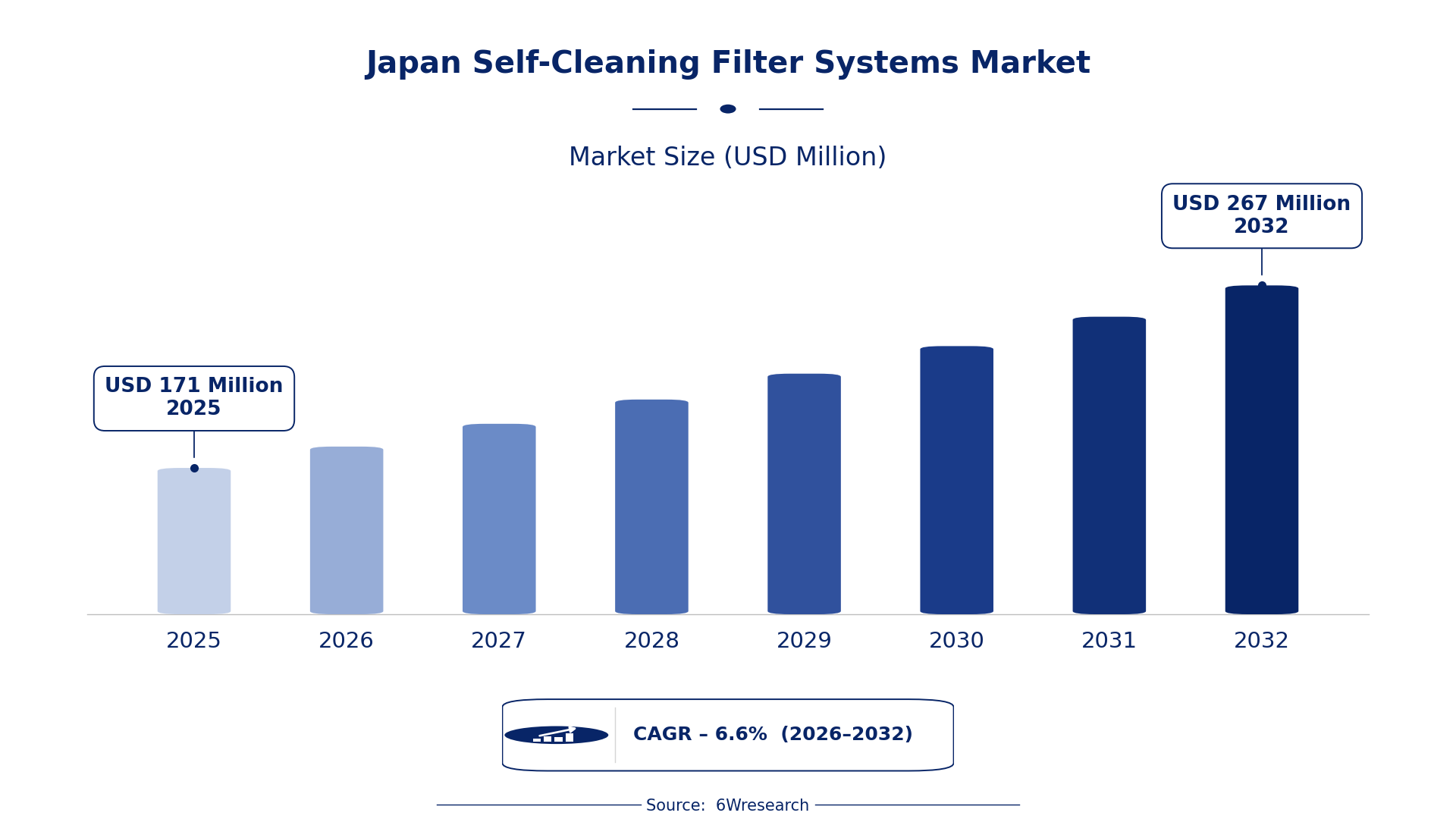
According to 6Wresearch internal database and industry insights, the Japan Self-Cleaning Filter Systems Market was valued at USD 171 Million in 2025 and is projected to reach USD 267 Million by 2032, growing at a CAGR of approximately 6.6% during 2026–2032.
Japan Self-Cleaning Filter Systems Market Highlights
| Report Metric | Details |
| Report Name | Japan Self-Cleaning Filter Systems Market (2026-2032) |
| Market Size 2025 | USD 171 Million |
| Market Size 2032 | USD 267 Million |
| Absolute Growth 2025–2032 | USD 96 Million |
| CAGR 2026–2032 | 6.6% |
| Peak Annual Growth | 8.0% in 2032 |
| Forecast Period | 2026–2032 |
| Historical Data | 2022–2025 |
| Base Year | 2025 |
| Leading Filter Type, 2025 | Backwash Filters (45% share) |
| Leading Cleaning Mechanism, 2025 | Hydraulic Reverse Flow (38% share) |
| Leading Application Area, 2025 | Wastewater Treatment (51% share) |
| Leading End User, 2025 | Municipal Corporations (41% share) |
| Fastest-Growing Filter Type | Magnetic Filters (9.7% CAGR) |
| Fastest-Growing Cleaning Mechanism | Magnetic Separation (8.7% CAGR) |
| Fastest-Growing Application Area | Oil & Gas Pipelines (8.2% CAGR) |
| Fastest-Growing End User | Beverage Industries (8.6% CAGR) |
| Growing Sector | Wastewater Treatment |
| Key End Users | Municipal Corporations, Food Processing Facilities, Oil & Gas Companies |
Japan Self-Cleaning Filter Systems Market Year-wise Growth Rate and Key Drivers (2022–2032)
This graph illustrates the annual growth rates of the market from 2022 to 2032, highlighting a steady upward trajectory and projected market expansion over the forecast period.
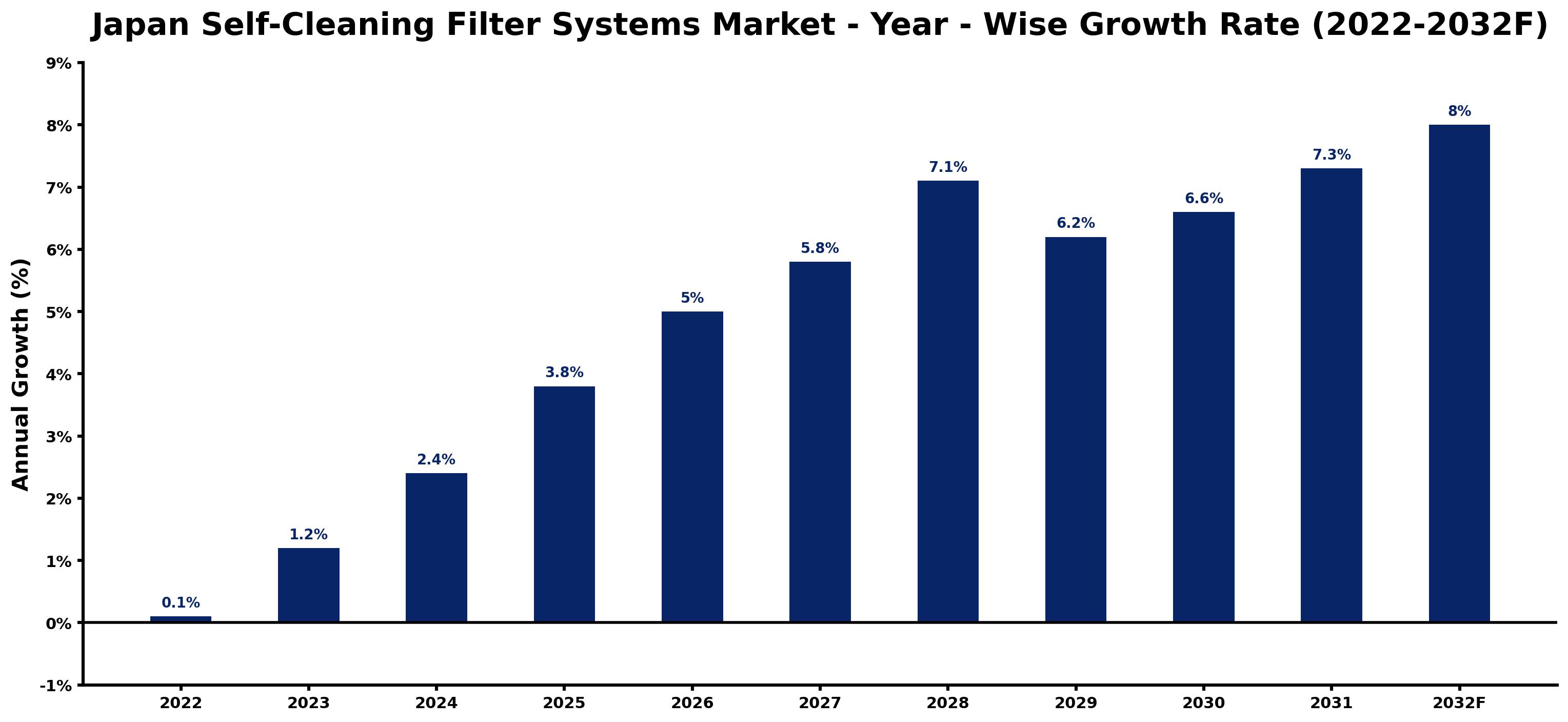
For each year, the table pairs the estimated growth rate with the leading influence on demand, showing how the drivers changed across the period.
| Year | Estimated Annual Growth (%) | Market Rationale |
| 2022 | 0.1 | The market showed minimal growth as industries began to recover from previous impacts. |
| 2023 | 1.2 | Demand increased due to rising urban populations and wastewater treatment needs. |
| 2024 | 2.4 | Growth accelerated as more facilities adopted advanced filtration technologies. |
| 2025 | 3.8 | The market peaked as municipalities upgraded systems to meet new standards. |
| 2026 | 5.0 | Growth is expected to continue as investments in infrastructure expand filtration capacity. |
| 2027 | 5.8 | Demand is projected to rise further with increased focus on environmental sustainability. |
| 2028 | 7.1 | The market is expected to experience a boost from technological advancements in filtration. |
| 2029 | 6.2 | Growth is projected to slow slightly as the market begins to stabilise after rapid expansion. |
| 2030 | 6.6 | Demand is expected to pick up again as new projects in wastewater treatment initiate. |
| 2031 | 7.3 | The market is projected to grow steadily as food processing sectors adopt more filters. |
| 2032 | 8.0 | The peak growth rate is expected to be reached as industries modernise filtration systems. |
Note: Market size estimations and growth projections presented in this report are based on 6Wresearch's proprietary forecasting methodology, utilizing the latest available industry data, government publications, and primary research inputs.
Japan Self-Cleaning Filter Systems Market Synopsis
Self-cleaning filter systems represent advanced technologies that automatically perform cleaning, which enhances efficiency and minimises maintenance. Municipal corporations and industrial facilities, particularly in wastewater treatment and food processing, are driving the demand for these systems. As urban populations expand, the necessity for effective filtration solutions rises. Technological progress and government initiatives further encourage the adoption of these systems, improving overall treatment efficiency.
Market Dynamics Impact Analysis (2026–2032)
| Factor | Type | Impact | Primary Segment Affected |
| Increased urban population drives demand for wastewater treatment solutions. | Driver | High | Wastewater Treatment |
| Growing food safety regulations necessitate advanced filtration in food processing. | Driver | High | Food Processing |
| Modernisation of oil and gas pipelines presents opportunities for filtration upgrades. | Opportunity | High | Oil & Gas Pipelines |
| Rising investments in municipal infrastructure create a demand gap for filtration systems. | Opportunity | High | Wastewater Treatment |
| High initial costs of self-cleaning filter systems limit adoption among smaller facilities. | Restraint | Medium | Backwash Filters |
| Limited awareness of advanced filtration technologies hampers market growth. | Restraint | Medium | Backwash Filters |
| Technological complexity can deter smaller buyers from investing in new systems. | Challenge | High | Backwash Filters |
| Competition from traditional filtration methods poses a risk to market expansion. | Challenge | Medium | Backwash Filters |
Evaluation of Drivers in Japan Self-Cleaning Filter Systems Market (2026–2032)
The factors lifting demand, and the evidence behind each, are summarised below.
| Drivers | Primary Segment Affected | Why It Matters (Evidence) |
| Rising urban population increases demand for wastewater treatment systems. | Wastewater Treatment | The Tokyo metropolitan area, with approximately 14 million residents, drives the need for efficient filtration. |
| Food safety regulations require advanced filtration in food processing. | Food Processing | The food processing sector employs over 1 million workers, emphasizing the need for effective filtration. |
| Modernisation in the oil and gas sector boosts demand for filtration solutions. | Oil & Gas Pipelines | The sector is undergoing upgrades, necessitating high-quality filtration to maintain pipeline integrity. |
| Government initiatives support the adoption of advanced filtration technologies. | Wastewater Treatment | In 2023, a subsidy program was launched for upgrading wastewater treatment plants. |
| ISO 9001 certification is pursued by manufacturers to ensure product quality. | Municipal Corporations | This certification is essential for gaining trust among municipal corporations and industrial buyers. |
Several shifts outside the market lift sales. The rising urban population in Japan increases demand for wastewater treatment systems, prompting municipalities to invest in filtration solutions. The food processing sector, employing over 1 million workers, requires effective filtration to meet stringent safety standards, driving purchases. Modernisation in the oil and gas sector boosts demand for filtration solutions, as upgrades necessitate high-quality systems.
Evaluation of Restraints in Japan Self-Cleaning Filter Systems Market
Below are the constraints most often cited by buyers and suppliers, with the segment each affects.
| Market Restraint | Primary Segment Affected | Why It Matters (Evidence) |
| High initial costs deter smaller facilities from adopting self-cleaning filters. | Backwash Filters | Smaller facilities often lack the budget for advanced filtration technologies, limiting market reach. |
| Limited awareness of advanced filtration technologies hampers adoption rates. | Backwash Filters | Many potential buyers are unaware of the benefits, resulting in slower market penetration. |
| Complexity of advanced systems can deter smaller buyers from investing in new technologies. | Backwash Filters | Complex systems may require specialized training, which smaller facilities may not afford. |
| Competition from traditional filtration methods poses a risk to market expansion. | Backwash Filters | Established methods are often perceived as sufficient, hindering the shift to advanced systems. |
| Regulatory compliance can be challenging for new entrants in the market. | Backwash Filters | Navigating standards set by the Japan Water Works Association can delay market entry. |
Japan Self-Cleaning Filter Systems Market Challenges
Regulatory hurdles from the Japan Water Works Association can delay the approval of new filtration technologies, affecting over 1,200 municipal wastewater treatment facilities. Buyers in the food processing sector encounter rising costs due to strict safety regulations mandating advanced filtration systems, which can significantly strain budgets. Limited domestic production of essential components results in supply chain disruptions, leading suppliers to face longer lead times and higher costs, ultimately burdening buyers with inflated prices. Competition intensifies as government subsidy programs encourage upgrades, compelling some producers to lower prices, which may compromise quality for end users.
Trends in the Japan Self-Cleaning Filter Systems Market
The shifts below are changing how Japan Self-Cleaning Filter Systems Market products are bought and supplied.
- Shift towards Advanced Filtration Technologies: The Japan Water Works Association has updated guidelines to promote advanced filtration technologies. As a result, more facilities are adopting self-cleaning filters, with over 300 municipal wastewater plants using hydraulic reverse flow filters.
- Increased Adoption in Food Processing: In 2023, the food processing sector saw a rise in self-cleaning filter adoption, with over 1 million workers emphasizing safety. This trend is vital for maintaining product quality and compliance with regulations.
- Growing Demand in Oil & Gas Sector: The oil and gas sector is modernising, with filtration solutions becoming essential for maintaining pipeline integrity. This shift is evident as investments in filtration technologies increase, reflecting an industry worth billions.
- Expansion of Subsidy Programs: In 2023, the government initiated subsidy programs for upgrading wastewater treatment plants, encouraging municipalities to adopt advanced filtration. This initiative aims to improve overall water quality and treatment efficiency.
Investment Opportunities in the Japan Self-Cleaning Filter Systems Market
Where to invest in the Japan Self-Cleaning Filter Systems Market: the main openings are set out below.
- Engage with Local Municipalities: Now is the perfect moment to collaborate with local municipalities to supply advanced filtration systems, as they seek to upgrade wastewater treatment facilities. The average annual investment in this sector is approximately 500 billion yen.
- Invest in Food Processing Filtration: The food processing sector is increasingly adopting self-cleaning filters to comply with safety standards. Suppliers can penetrate this market by partnering with food manufacturers and ensuring adherence to the Food Sanitation Act.
- Utilise Government Subsidies: With the government's subsidy program for wastewater treatment upgrades, there exists a notable opportunity to supply filtration systems. Engaging with municipal corporations can facilitate entry into this expanding market.
- Focus on Oil & Gas Modernisation: The ongoing modernisation in the oil and gas sector presents a timely opportunity to provide filtration solutions. Collaborating with refinery plants can lead to substantial contracts as they enhance fluid quality.
Government Initiatives in the Japan Self-Cleaning Filter Systems Market
The Water Supply Act and the Sewerage Act set standards for drinking-water quality and wastewater treatment, impacting producers and buyers of filtration systems. Compliance with these regulations is essential for manufacturers, ensuring their products meet necessary safety and efficiency standards.
The Ministry of the Environment oversees the implementation of subsidy programs for wastewater treatment upgrades. This agency funds initiatives aimed at improving filtration technologies, benefiting municipal corporations and industrial facilities.
Future Insight of the Japan Self-Cleaning Filter Systems Market
A new programme for enhancing wastewater treatment technologies will stimulate innovation in filtration systems. By 2032, self-cleaning filter systems will experience substantial advancements in design and efficiency, benefiting buyers in industrial facilities with improved performance. The integration of smart technologies will facilitate real-time monitoring and maintenance, streamlining operations. With an average installed base of 20,000 filtration systems in industrial facilities, suppliers will observe a notable increase in demand for high-quality filtration solutions.
Market Segmentation Analysis
Japan Self-Cleaning Filter Systems Market report covers a detailed analysis of the following market segments:
By Filter Type – Backwash Filters Lead, Magnetic Filters Expected to Grow Fastest
According to Saurav Kr Singh, Senior Research Analyst at 6Wresearch, Backwash Filters accounted for 45% of the market by filter type in 2025. Backwash filters are extensively used in Japan's municipal wastewater treatment facilities, which exceed 1,200 in number. Their reliability and efficiency in automatic cleaning processes make them the preferred option among facility operators. Magnetic Filters are set to record the highest CAGR in this split, 9.7% over 2026–2032. The adoption of magnetic filters is surging in sectors such as automotive, where they effectively remove ferrous contaminants from fluids. This trend is particularly noticeable as industries modernise their filtration systems to enhance operational efficiency. Suppliers should focus on developing advanced magnetic filtration solutions to meet the rising demand across diverse industries.
By Cleaning Mechanism – Hydraulic Reverse Flow Leads, Magnetic Separation Expected to Grow Fastest
With 38% of cleaning mechanism revenue in 2025, Hydraulic Reverse Flow was the largest category. Hydraulic reverse flow mechanisms are fundamental to the operation of over 300 municipal wastewater treatment plants in Japan, ensuring effective cleaning and maintenance. Their critical role in maintaining public health standards solidifies their leading position in the market. Magnetic Separation is projected to grow fastest, at a CAGR of 8.7% during 2026–2032. The increasing emphasis on magnetic separation in industries like food processing is driving rapid growth for this mechanism. As companies prioritise product quality and safety, the demand for magnetic separation technologies is anticipated to rise significantly. Buyers ought to consider investing in magnetic separation technologies to enhance their filtration capabilities and comply with safety regulations.
By Application Area – Wastewater Treatment Leads, Oil & Gas Pipelines Expected to Grow Fastest
Wastewater Treatment held 51% of the Japan Self-Cleaning Filter Systems Market by application area in 2025. Wastewater treatment remains a vital application area, with over 1,200 municipal facilities relying on effective filtration systems for management. This critical role in public health and environmental protection contributes to its dominant market share. Over 2026–2032, Oil & Gas Pipelines are expected to post the fastest growth, at a CAGR of 8.2%. The oil and gas pipelines sector is experiencing a surge in demand for filtration solutions as companies modernise their infrastructure to maintain pipeline integrity. This focus on efficiency and safety is expected to fuel rapid growth in this application area. Suppliers must prioritise the development of tailored filtration solutions for the oil and gas sector to capitalise on this growing market opportunity.
By End User – Municipal Corporations Lead, Beverage Industries Expected to Grow Fastest
The largest end user category in 2025 was Municipal Corporations, at 41% of revenue. Municipal corporations are the key users of self-cleaning filter systems, overseeing public wastewater treatment facilities that necessitate reliable filtration solutions. Their ongoing investment in infrastructure guarantees a steady demand for these systems. The quickest growth will come from Beverage Industries, forecast to expand at a CAGR of 8.6% between 2026 and 2032. The beverage industries are increasingly incorporating self-cleaning filters to comply with rigorous safety standards, resulting in substantial growth in this end-user segment. As consumer safety remains a priority, the demand for advanced filtration solutions is set to rise. Suppliers should focus on the beverage industry with tailored filtration solutions that ensure safety and quality compliance.
Key Attractiveness of the Report
- 10 Years of Market Numbers
- Historical Data Starting from 2022 to 2025
- Base Year 2025
- Forecast Data until 2032
- Key Performance Indicators Impacting the Market
- Major Upcoming Developments and Projects
Key Highlights of the Report:
- Japan Self-Cleaning Filter Systems Market Outlook
- Market Size of Japan Self-Cleaning Filter Systems Market, 2025
- Forecast of Japan Self-Cleaning Filter Systems Market, 2032
- Historical Data and Forecast of Japan Self-Cleaning Filter Systems Revenues & Volume for the Period 2022-2032F
- Japan Self-Cleaning Filter Systems Market Trend Evolution
- Japan Self-Cleaning Filter Systems Market Drivers and Challenges
- Japan Self-Cleaning Filter Systems Price Trends
- Japan Self-Cleaning Filter Systems Porter's Five Forces
- Japan Self-Cleaning Filter Systems Industry Life Cycle
- Historical Data and Forecast of Japan Self-Cleaning Filter Systems Market Revenues & Volume By Filter Type for the Period 2022-2032F
- Historical Data and Forecast of Japan Self-Cleaning Filter Systems Market Revenues & Volume By Backwash Filters for the Period 2022-2032F
- Historical Data and Forecast of Japan Self-Cleaning Filter Systems Market Revenues & Volume By Magnetic Filters for the Period 2022-2032F
- Historical Data and Forecast of Japan Self-Cleaning Filter Systems Market Revenues & Volume By Ultrasonic Filters for the Period 2022-2032F
- Historical Data and Forecast of Japan Self-Cleaning Filter Systems Market Revenues & Volume By Air Pulse Filters for the Period 2022-2032F
- Historical Data and Forecast of Japan Self-Cleaning Filter Systems Market Revenues & Volume By Cleaning Mechanism for the Period 2022-2032F
- Historical Data and Forecast of Japan Self-Cleaning Filter Systems Market Revenues & Volume By Hydraulic Reverse Flow for the Period 2022-2032F
- Historical Data and Forecast of Japan Self-Cleaning Filter Systems Market Revenues & Volume By Magnetic Separation for the Period 2022-2032F
- Historical Data and Forecast of Japan Self-Cleaning Filter Systems Market Revenues & Volume By Sonic Vibration for the Period 2022-2032F
- Historical Data and Forecast of Japan Self-Cleaning Filter Systems Market Revenues & Volume By Air Jet Cleaning for the Period 2022-2032F
- Historical Data and Forecast of Japan Self-Cleaning Filter Systems Market Revenues & Volume By Application Area for the Period 2022-2032F
- Historical Data and Forecast of Japan Self-Cleaning Filter Systems Market Revenues & Volume By Wastewater Treatment for the Period 2022-2032F
- Historical Data and Forecast of Japan Self-Cleaning Filter Systems Market Revenues & Volume By Oil & Gas Pipelines for the Period 2022-2032F
- Historical Data and Forecast of Japan Self-Cleaning Filter Systems Market Revenues & Volume By Food Processing for the Period 2022-2032F
- Historical Data and Forecast of Japan Self-Cleaning Filter Systems Market Revenues & Volume By HVAC Systems for the Period 2022-2032F
- Historical Data and Forecast of Japan Self-Cleaning Filter Systems Market Revenues & Volume By End User for the Period 2022-2032F
- Historical Data and Forecast of Japan Self-Cleaning Filter Systems Market Revenues & Volume By Municipal Corporations for the Period 2022-2032F
- Historical Data and Forecast of Japan Self-Cleaning Filter Systems Market Revenues & Volume By Refinery Plants for the Period 2022-2032F
- Historical Data and Forecast of Japan Self-Cleaning Filter Systems Market Revenues & Volume By Beverage Industries for the Period 2022-2032F
- Historical Data and Forecast of Japan Self-Cleaning Filter Systems Market Revenues & Volume By Industrial Facilities for the Period 2022-2032F
- Japan Self-Cleaning Filter Systems Import Export Trade Statistics
- Market Opportunity Assessment By Filter Type
- Market Opportunity Assessment By Cleaning Mechanism
- Market Opportunity Assessment By Application Area
- Market Opportunity Assessment By End User
- Japan Self-Cleaning Filter Systems Top Companies Market Share
- Japan Self-Cleaning Filter Systems Competitive Benchmarking By Technical and Operational Parameters
- Japan Self-Cleaning Filter Systems Company Profiles
- Japan Self-Cleaning Filter Systems Key Strategic Recommendations
Market Covered
Segments analysed in this report are listed below.
By Filter Type
- Backwash Filters
- Magnetic Filters
- Ultrasonic Filters
- Air Pulse Filters
By Cleaning Mechanism
- Hydraulic Reverse Flow
- Magnetic Separation
- Sonic Vibration
- Air Jet Cleaning
By Application Area
- Wastewater Treatment
- Oil & Gas Pipelines
- Food Processing
- HVAC Systems
By End User
- Municipal Corporations
- Refinery Plants
- Beverage Industries
- Industrial Facilities































