Japan Self-Driving System Market Size & Growth Rate
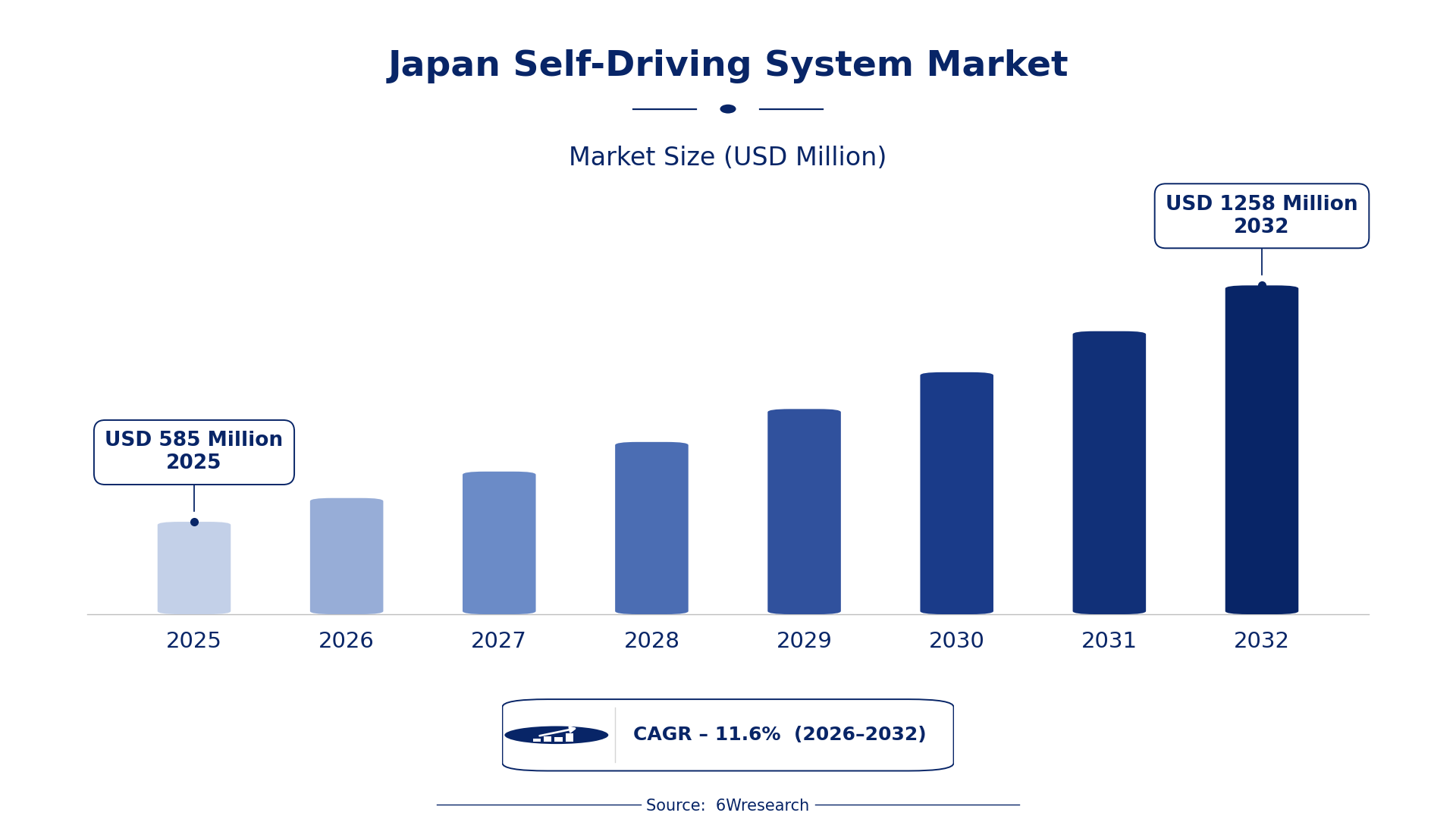
According to 6Wresearch internal database and industry insights, the Japan Self-Driving System Market was valued at USD 585 Million in 2025 and is projected to reach USD 1,258 Million by 2032, growing at a CAGR of approximately 11.6% during 2026–2032.
Japan Self-Driving System Market Highlights
| Report Metric | Details |
| Report Name | Japan Self-Driving System Market (2026-2032) |
| Market Size 2025 | USD 585 Million |
| Market Size 2032 | USD 1,258 Million |
| Absolute Growth 2025–2032 | USD 673 Million |
| CAGR 2026–2032 | 11.6% |
| Peak Annual Growth | 14.5% in 2026 |
| Forecast Period | 2026–2032 |
| Historical Data | 2022–2025 |
| Base Year | 2025 |
| Leading System Type, 2025 | Perception System (46% share) |
| Leading Core Component, 2025 | LiDAR (31% share) |
| Leading Integration Level, 2025 | Vehicle Integrated (40% share) |
| Leading End User, 2025 | OEM Manufacturers (48% share) |
| Fastest-Growing System Type | Planning System (15.5% CAGR) |
| Fastest-Growing Core Component | Radar (16.2% CAGR) |
| Fastest-Growing Integration Level | ECU Based (15.2% CAGR) |
| Fastest-Growing End User | Automotive Software Cos. (14.9% CAGR) |
| Growing Sector | automotive |
| Key End Users | OEM Manufacturers, ADAS Developers, Automotive Software Companies |
Japan Self-Driving System Market Year-wise Growth Rate and Key Drivers (2022–2032)
This graph illustrates the annual growth rates of the market from 2022 to 2032, highlighting a steady upward trajectory and projected market expansion over the forecast period.
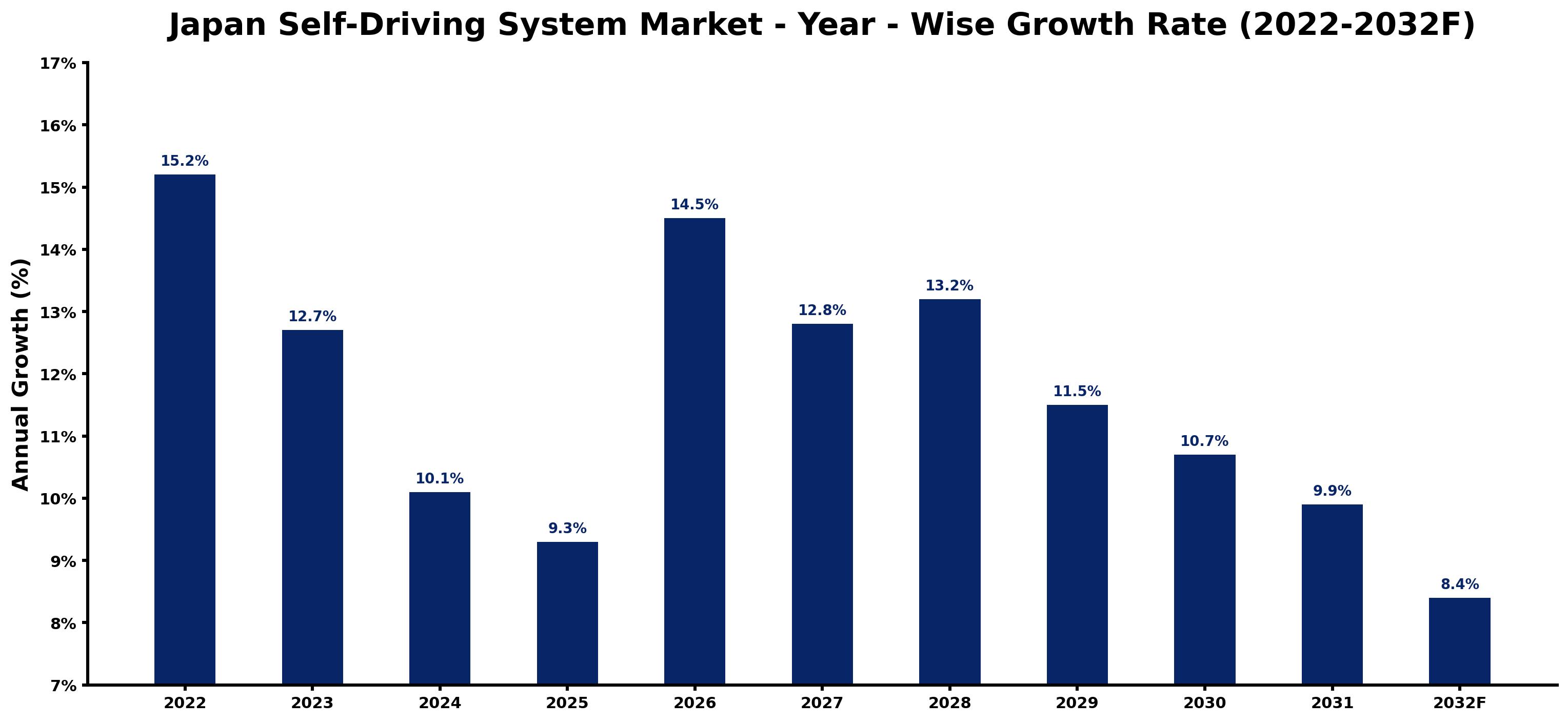
Annual growth estimates for each year appear below with the principal reason behind them, explaining the shifts that set the pace of the market.
| Year | Estimated Annual Growth (%) | Market Rationale |
| 2022 | 15.2 | Demand surged as consumers embraced self-driving technology, reflecting a growing acceptance of autonomous vehicles. |
| 2023 | 12.7 | Growth slowed as the market adjusted to previous peaks, yet interest in self-driving solutions remained strong. |
| 2024 | 10.1 | Continued investment in R&D supported market expansion, although growth rates began to normalise. |
| 2025 | 9.3 | The market experienced a further slowdown as adoption rates stabilised, reflecting a maturing sector. |
| 2026 | 14.5 | Demand is expected to accelerate again due to increased technological advancements in self-driving systems. |
| 2027 | 12.8 | Growth will moderate as the market absorbs new technologies and consumer expectations evolve. |
| 2028 | 13.2 | Demand is projected to rise as more vehicles integrate advanced self-driving features, improving road safety and efficiency. |
| 2029 | 11.5 | The market will see a slight slowdown as competition intensifies among manufacturers and technology providers. |
| 2030 | 10.7 | Growth is anticipated to continue decelerating as the market approaches saturation in urban areas. |
| 2031 | 9.9 | Demand will remain steady, driven by ongoing technological improvements and consumer interest in autonomous vehicles. |
| 2032 | 8.4 | The market is projected to grow at a slower pace as the focus shifts to regulatory compliance and safety standards. |
Note: Market size estimations and growth projections presented in this report are based on 6Wresearch's proprietary forecasting methodology, utilizing the latest available industry data, government publications, and primary research inputs.
Japan Self-Driving System Market Synopsis
Self-driving systems utilise advanced technologies such as AI, LiDAR, and radar to enable autonomous vehicle operation, improving road safety and traffic efficiency. The Japan Self-Driving System Market is expanding due to substantial investments from domestic manufacturers and international collaborations. The automotive sector, valued at over 70 trillion JPY, drives demand, with more than half of Japanese consumers open to self-driving cars. The government's target for 100% adoption of autonomous vehicles by 2030 further fuels this growth.
Market Dynamics Impact Analysis (2026–2032)
| Factor | Type | Impact | Primary Segment Affected |
| Rising consumer acceptance of self-driving vehicles | Driver | High | OEM Manufacturers |
| Government initiatives promoting autonomous vehicle testing | Driver | High | ADAS Developers |
| Growing demand for advanced safety features | Opportunity | High | LiDAR |
| Increased investment in autonomous vehicle R&D | Opportunity | High | Automotive Software Cos. |
| Technological challenges in system integration | Restraint | Medium | Control System |
| High development costs for autonomous technologies | Restraint | Medium | Planning System |
| Competition among technology providers | Challenge | High | Perception System |
| Regulatory compliance requirements for safety standards | Challenge | Medium | Simulation Systems |
Evaluation of Drivers in Japan Self-Driving System Market (2026–2032)
The factors lifting demand, and the evidence behind each, are summarised below.
| Drivers | Primary Segment Affected | Why It Matters (Evidence) |
| Increased consumer interest in autonomous vehicles | OEM Manufacturers | Over 50% of Japanese consumers are open to self-driving cars, driving OEMs to improve their offerings. |
| Government funding for autonomous vehicle research | ADAS Developers | The Japanese government allocated 10 billion JPY for autonomous vehicle research in 2023, boosting development. |
| Technological advancements in AI and LiDAR | Control System | AI-based decision-making systems are being integrated into 70% of new vehicles by 2025, enhancing navigation capabilities. |
| Rising demand for advanced road safety features | Control System | The installed base of ADAS reached 8 million units in 2022, indicating strong demand for safety technologies. |
| Collaboration between domestic and international manufacturers | Automotive Software Cos. | International partnerships are driving innovation and expanding the market for software solutions in self-driving systems. |
Behind the steady rise in orders sits increased consumer interest in autonomous vehicles, with over 50% of Japanese consumers open to self-driving cars. The installed base of ADAS reached 8 million units in 2022, indicating a strong demand for advanced safety features. Collaboration between domestic and international manufacturers is driving innovation in the sector, particularly in software solutions for self-driving systems. Technological advancements in AI and LiDAR are critical for accurate navigation, further driving demand.
Evaluation of Restraints in Japan Self-Driving System Market
Below are the constraints most often cited by buyers and suppliers, with the segment each affects.
| Market Restraint | Primary Segment Affected | Why It Matters (Evidence) |
| Integration challenges of advanced technologies | Control System | Technological challenges hinder integration of various components, affecting system performance and safety. |
| High costs associated with R&D and production | Planning System | Development costs for autonomous technologies can exceed budgets, limiting investment in new projects. |
| Regulatory hurdles for autonomous vehicle deployment | Simulation Systems | Compliance with safety regulations can delay the introduction of new self-driving technologies to the market. |
| Limited consumer understanding of self-driving systems | Perception System | Consumer hesitance due to lack of knowledge can slow adoption rates, impacting overall market growth. |
| Intense competition among technology providers | LiDAR | The competitive environment complicates pricing strategies, affecting profitability for manufacturers. |
Japan Self-Driving System Market Challenges
Japanese automotive producers face high compliance costs due to stringent regulations, which can exceed 2 billion JPY per manufacturer annually. Buyers experience delays in vehicle availability as new autonomous vehicle regulations are implemented, potentially extending delivery times by six months. Rising development costs for self-driving technologies, estimated at 15% annually, burden suppliers and limit their ability to invest in innovation. The reliance on advanced components like LiDAR creates supply chain vulnerabilities, as shortages can disrupt production schedules and increase lead times for producers by up to three months.
Trends in the Japan Self-Driving System Market
Four trends stand out in the Japan Self-Driving System Market.
- Shift from Traditional to Autonomous Vehicles: In 2023, Japan launched a program to support autonomous vehicle testing, reflecting a shift in automotive development. This initiative aims to improve road safety and efficiency, encouraging manufacturers to invest in self-driving technologies.
- Transition from Manual to AI-Driven Decision Making: By 2025, AI-based decision-making systems are projected to be integrated into 70% of new vehicles, transforming how vehicles operate. This trend indicates a move towards smarter, safer driving solutions across Japan.
- Emergence of Cloud Testing Platforms: Cloud testing platforms are increasingly used for vehicle simulation, allowing for large-scale data analysis. This shift began in 2022, enabling manufacturers to validate self-driving algorithms more efficiently.
- Growth in Robotics Startups: Robotics startups are receiving government grants to develop autonomous solutions, with funding increasing since 2023. This trend supports innovation in the self-driving sector, creating new applications and technologies.
Investment Opportunities in the Japan Self-Driving System Market
Where to invest in the Japan Self-Driving System Market: the main openings are set out below.
- Collaborating with Local Automotive Manufacturers: By partnering with local automotive manufacturers, companies can tap into Japan's extensive automotive sector, valued at over 70 trillion JPY. This strategy is vital for entering the market effectively.
- Investment in AI and LiDAR Technologies: With the projected adoption rate of self-driving technology reaching 30% by 2025, investing in AI and LiDAR technologies presents a strong opportunity for suppliers targeting OEMs and developers.
- Expansion in Chiba Prefecture: Chiba Prefecture, a hub for automotive innovation, offers opportunities for businesses to invest in testing and development facilities. The region's focus on self-driving technologies supports growth potential.
- Navigating Approval Pathways for Autonomous Vehicles: Engaging with the Ministry of Land, Infrastructure, Transport and Tourism is essential for entering the autonomous vehicle market. This approach can facilitate compliance and market entry.
Government Initiatives in the Japan Self-Driving System Market
The AI Promotion Act, established in 2025, sets a national framework for AI research and development, improving the regulatory environment for self-driving systems. This law builds on the Electrical Appliance and Material Safety Act, which ensures that autonomous technologies meet safety standards by regulating their compliance with established protocols.
The Ministry of Land, Infrastructure, Transport and Tourism oversees the approval of autonomous vehicle testing programs. This agency funds various initiatives aimed at promoting the safe integration of self-driving technologies into the automotive sector.
Future Insight of the Japan Self-Driving System Market
A shift towards 100% adoption of autonomous vehicles by 2030 will drive significant technological advancements by 2032. Suppliers will develop new standards to improve vehicle safety and efficiency. The integration of AI-based decision-making systems into 70% of new vehicles will streamline operations. With the Japanese government allocating 10 billion JPY for autonomous vehicle research, buyers can expect enhanced vehicle performance and reliability, while cloud testing platforms will facilitate more efficient vehicle simulation.
Market Segmentation Analysis
Japan Self-Driving System Market report covers a detailed analysis of the following market segments:
By System Type – Perception System Leads, Planning System Expected to Grow Fastest
According to Saurav Kr Singh, Senior Research Analyst at 6Wresearch, the largest system type category in 2025 was Perception System, at 46% of revenue. Perception systems are crucial for detecting the environment and ensuring safe navigation in self-driving vehicles. Their widespread use in over 8 million units of advanced driver-assistance systems in Japan highlights their essential role in enhancing road safety. The quickest growth will come from Planning System, forecast to expand at a CAGR of 15.5% between 2026 and 2032. The planning system is experiencing rapid growth due to its importance in optimising routes and making decisions for autonomous vehicles. With the adoption rate of self-driving technology expected to reach 30% by 2025, the demand for planning systems will likely increase significantly. Suppliers should focus on enhancing planning system capabilities to meet the growing need for efficient autonomous vehicle operations.
By Core Component – LiDAR Leads, Radar Expected to Grow Fastest
LiDAR held 31% of the Japan Self-Driving System Market by core component in 2025. LiDAR technology plays a vital role in accurate distance measurement and 3D mapping, which are critical for the effective functioning of self-driving systems. Its extensive application in Japan's automotive sector, particularly in Tokyo, underscores its significance as the leading core component. Radar is projected to grow fastest, at a CAGR of 16.2% during 2026–2032. Radar is rapidly gaining traction due to its effectiveness in detecting objects and measuring speed, both essential for safe autonomous driving. The government's allocation of 10 billion JPY for research is expected to accelerate the integration of radar technology in vehicles. Buyers should prioritise the integration of radar technology to enhance the safety features of their self-driving systems.
By Integration Level – Vehicle Integrated Leads, ECU Based Expected to Grow Fastest
Vehicle Integrated accounted for 40% of the market by integration level in 2025. Vehicle integrated systems are fundamental to the core architecture of self-driving vehicles, ensuring seamless operation and performance. The strong presence of OEM manufacturers in Japan reinforces the dominance of this integration level in the market. Over 2026–2032, ECU Based is expected to post the fastest growth, at a CAGR of 15.2%. ECU based systems are advancing quickly as they are embedded into electronic control units, enhancing the functionality of self-driving vehicles. Ongoing innovations in automotive software are likely to further propel growth in this segment. Suppliers must invest in ECU based solutions to align with the evolving integration requirements of modern vehicles.
By End User – OEM Manufacturers Lead, Automotive Software Cos. Expected to Grow Fastest
OEM Manufacturers took 48% of end user revenue in 2025, more than any other category. OEM manufacturers are the primary developers of self-driving vehicles, establishing themselves as the largest end user group in the market. Their commitment to advancing autonomous vehicle technology is reflected in substantial investments in research and development across Japan's automotive sector. Automotive Software Cos. is set to record the highest CAGR in this split, 14.9% over 2026–2032. Automotive software companies are witnessing rapid growth as they provide essential software solutions that enable the functionality of self-driving systems. The increasing complexity of autonomous technologies is driving demand for advanced software solutions in this sector. Suppliers should collaborate with automotive software companies to enhance the software capabilities of self-driving systems.
Key Attractiveness of the Report
- 10 Years of Market Numbers
- Historical Data Starting from 2022 to 2025
- Base Year 2025
- Forecast Data until 2032
- Key Performance Indicators Impacting the Market
- Major Upcoming Developments and Projects
Key Highlights of the Report:
- Japan Self-Driving System Market Outlook
- Market Size of Japan Self-Driving System Market, 2025
- Forecast of Japan Self-Driving System Market, 2032
- Historical Data and Forecast of Japan Self-Driving System Revenues & Volume for the Period 2022-2032F
- Japan Self-Driving System Market Trend Evolution
- Japan Self-Driving System Market Drivers and Challenges
- Japan Self-Driving System Price Trends
- Japan Self-Driving System Porter's Five Forces
- Japan Self-Driving System Industry Life Cycle
- Historical Data and Forecast of Japan Self-Driving System Market Revenues & Volume By System Type for the Period 2022-2032F
- Historical Data and Forecast of Japan Self-Driving System Market Revenues & Volume By Perception System for the Period 2022-2032F
- Historical Data and Forecast of Japan Self-Driving System Market Revenues & Volume By Planning System for the Period 2022-2032F
- Historical Data and Forecast of Japan Self-Driving System Market Revenues & Volume By Control System for the Period 2022-2032F
- Historical Data and Forecast of Japan Self-Driving System Market Revenues & Volume By Simulation Systems for the Period 2022-2032F
- Historical Data and Forecast of Japan Self-Driving System Market Revenues & Volume By Core Component for the Period 2022-2032F
- Historical Data and Forecast of Japan Self-Driving System Market Revenues & Volume By LiDAR, Radar for the Period 2022-2032F
- Historical Data and Forecast of Japan Self-Driving System Market Revenues & Volume By AI + Decision-Making for the Period 2022-2032F
- Historical Data and Forecast of Japan Self-Driving System Market Revenues & Volume By Motor Controllers for the Period 2022-2032F
- Historical Data and Forecast of Japan Self-Driving System Market Revenues & Volume By ML-Based Models for the Period 2022-2032F
- Historical Data and Forecast of Japan Self-Driving System Market Revenues & Volume By Integration Level for the Period 2022-2032F
- Historical Data and Forecast of Japan Self-Driving System Market Revenues & Volume By Vehicle Integrated for the Period 2022-2032F
- Historical Data and Forecast of Japan Self-Driving System Market Revenues & Volume By ECU Based for the Period 2022-2032F
- Historical Data and Forecast of Japan Self-Driving System Market Revenues & Volume By Drive-by-Wire Interface for the Period 2022-2032F
- Historical Data and Forecast of Japan Self-Driving System Market Revenues & Volume By Cloud Testing for the Period 2022-2032F
- Historical Data and Forecast of Japan Self-Driving System Market Revenues & Volume By End User for the Period 2022-2032F
- Historical Data and Forecast of Japan Self-Driving System Market Revenues & Volume By OEM Manufacturers for the Period 2022-2032F
- Historical Data and Forecast of Japan Self-Driving System Market Revenues & Volume By Automotive Software Cos. for the Period 2022-2032F
- Historical Data and Forecast of Japan Self-Driving System Market Revenues & Volume By Robotics Startups for the Period 2022-2032F
- Historical Data and Forecast of Japan Self-Driving System Market Revenues & Volume By ADAS Developers for the Period 2022-2032F
- Japan Self-Driving System Import Export Trade Statistics
- Market Opportunity Assessment By System Type
- Market Opportunity Assessment By Core Component
- Market Opportunity Assessment By Integration Level
- Market Opportunity Assessment By End User
- Japan Self-Driving System Top Companies Market Share
- Japan Self-Driving System Competitive Benchmarking By Technical and Operational Parameters
- Japan Self-Driving System Company Profiles
- Japan Self-Driving System Key Strategic Recommendations
Market Covered
This report examines the market across the segments below.
By System Type
- Perception System
- Planning System
- Control System
- Simulation Systems
By Core Component
- LiDAR
- Radar
- AI + Decision-Making
- Motor Controllers
- ML-Based Models
By Integration Level
- Vehicle Integrated
- ECU Based
- Drive-by-Wire Interface
- Cloud Testing
By End User
- OEM Manufacturers
- Automotive Software Cos.
- Robotics Startups
- ADAS Developers































