Japan Self-Guided Navigation Software Market Size & Growth Rate
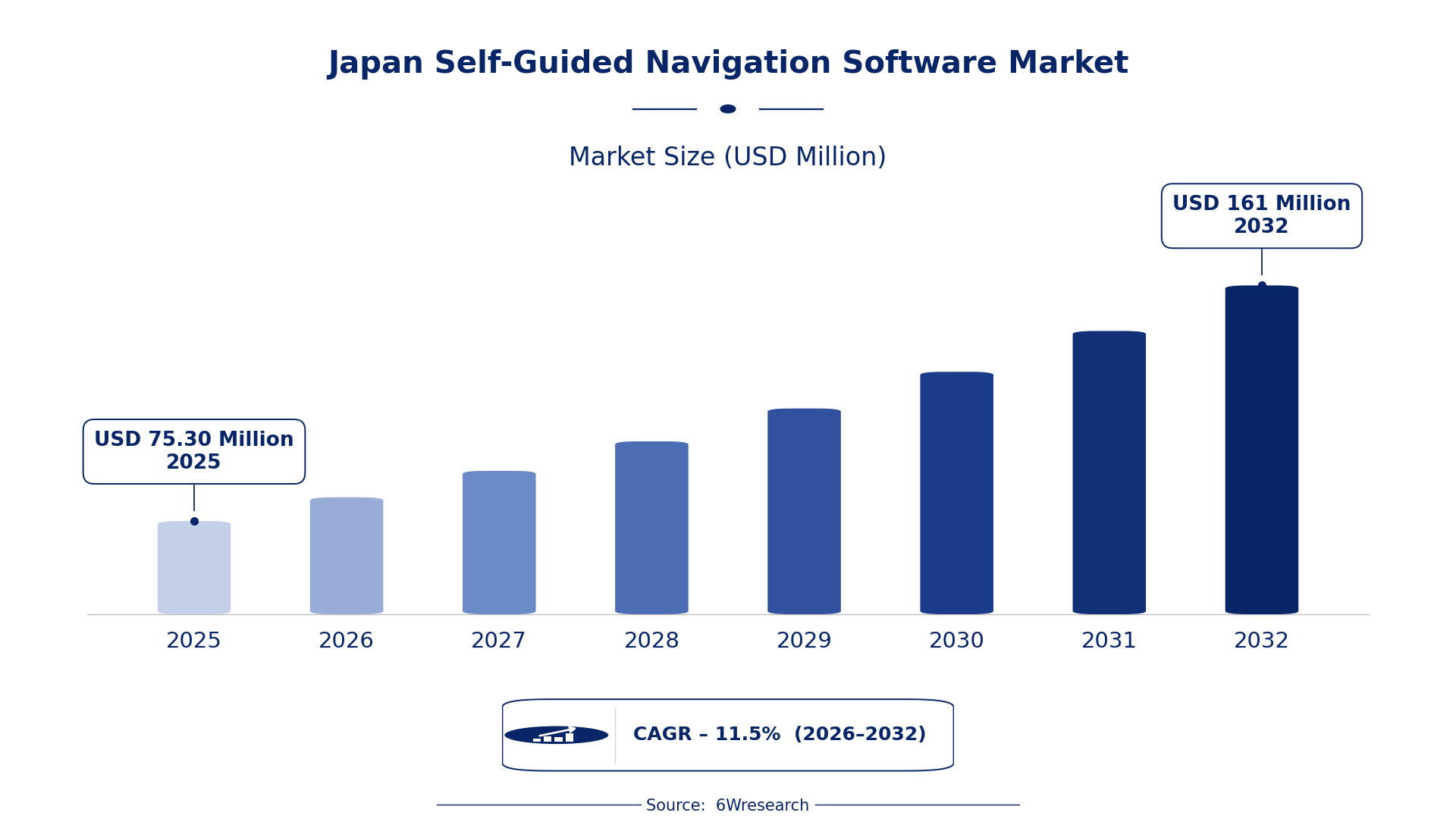
According to 6Wresearch internal database and industry insights, the Japan Self-Guided Navigation Software Market was valued at USD 75.30 Million in 2025 and is projected to reach USD 161 Million by 2032, growing at a CAGR of approximately 11.5% during 2026–2032.
Japan Self-Guided Navigation Software Market Highlights
| Report Metric | Details |
| Report Name | Japan Self-Guided Navigation Software Market (2026-2032) |
| Market Size 2025 | USD 75.30 Million |
| Market Size 2032 | USD 161 Million |
| Absolute Growth 2025–2032 | USD 85.70 Million |
| CAGR 2026–2032 | 11.5% |
| Peak Annual Growth | 12.5% in 2032 |
| Forecast Period | 2026–2032 |
| Historical Data | 2022–2025 |
| Base Year | 2025 |
| Leading Navigation Type, 2025 | Outdoor Navigation (49% share) |
| Leading Technology Used, 2025 | GPS/GLONASS (34% share) |
| Leading Application Area, 2025 | Autonomous Cars (49% share) |
| Leading End User, 2025 | Automotive Companies (48% share) |
| Fastest-Growing Navigation Type | Robotic Navigation (16.8% CAGR) |
| Fastest-Growing Technology Used | AI Pathfinding (17.3% CAGR) |
| Fastest-Growing Application Area | Warehouse Robotics (14.5% CAGR) |
| Fastest-Growing End User | Logistics Firms (15.8% CAGR) |
| Growing Sector | Warehouse Robotics |
| Key End Users | Autonomous Cars, Warehouse Robotics, Agricultural Drones, Shopping Malls |
Japan Self-Guided Navigation Software Market Year-wise Growth Rate and Key Drivers (2022–2032)
This graph illustrates the annual growth rates of the market from 2022 to 2032, highlighting a steady upward trajectory and projected market expansion over the forecast period.
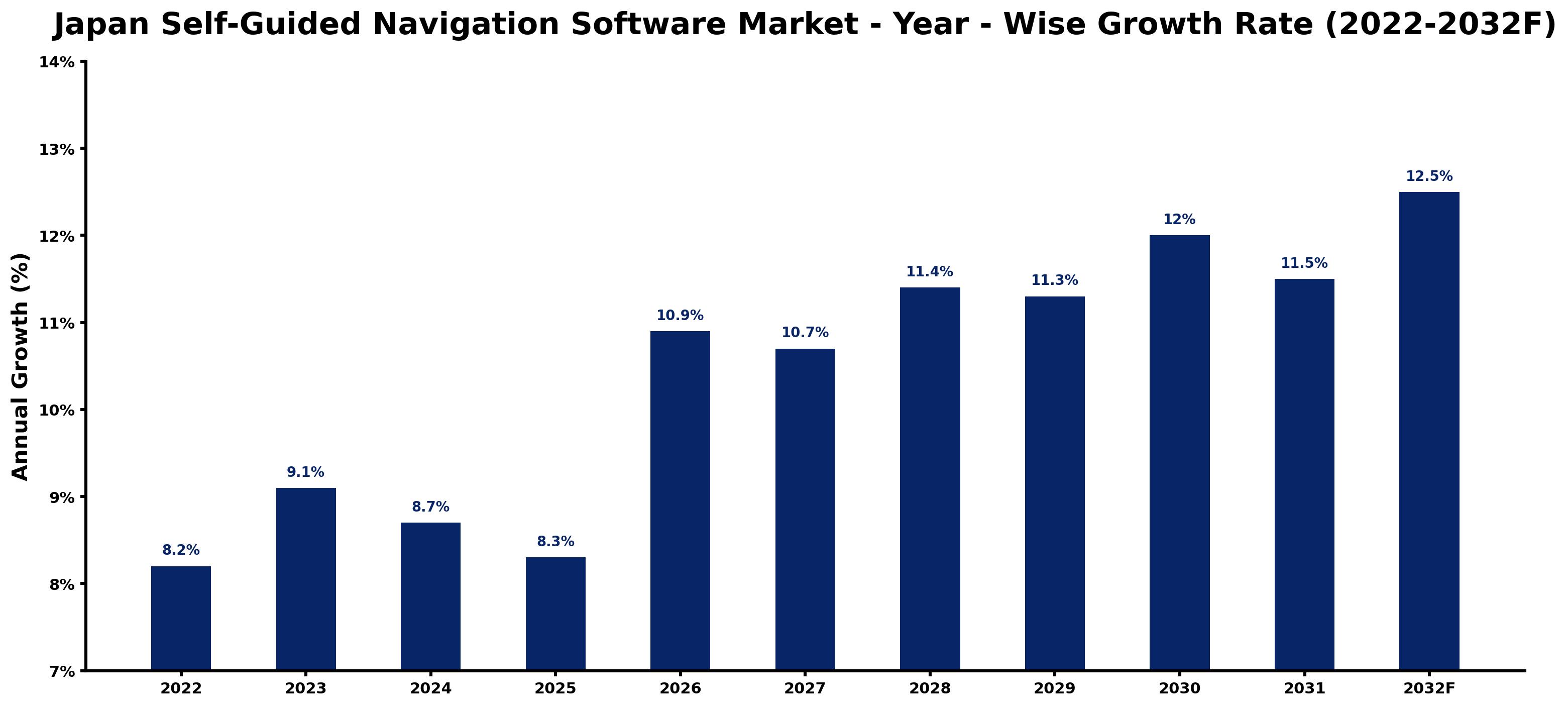
Annual growth estimates for each year appear below with the principal reason behind them, explaining the shifts that set the pace of the market.
| Year | Estimated Annual Growth (%) | Market Rationale |
| 2022 | 8.2 | Demand for navigation solutions was strong, driven by urbanisation and technological advancements. |
| 2023 | 9.1 | Growth accelerated as the automotive sector increased investments in autonomous navigation software. |
| 2024 | 8.7 | The market experienced a slowdown in growth due to stabilising demand in indoor navigation technologies. |
| 2025 | 8.3 | Growth continued to slow as competition intensified among navigation software providers. |
| 2026 | 10.9 | The market is set to grow faster as advancements in AI pathfinding technologies emerge. |
| 2027 | 10.7 | Growth is likely to slow slightly due to market saturation in certain segments. |
| 2028 | 11.4 | Demand is anticipated to rise again as robotic navigation applications expand across industries. |
| 2029 | 11.3 | The growth rate is projected to slow as the market matures and competition increases. |
| 2030 | 12.0 | A faster growth rate is expected as autonomous vehicles gain traction in urban areas. |
| 2031 | 11.5 | Growth is likely to slow as the market stabilises after reaching new peaks. |
| 2032 | 12.5 | The market is projected to peak due to advancements in navigation software technologies. |
Note: Market size estimations and growth projections presented in this report are based on 6Wresearch's proprietary forecasting methodology, utilizing the latest available industry data, government publications, and primary research inputs.
Japan Self-Guided Navigation Software Market Synopsis
Self-Guided Navigation Software enables autonomous navigation through algorithms and sensors, integrating GPS, LiDAR, and AI technologies. Its main applications include indoor navigation, autonomous vehicles, and logistics optimization. The Japan Self-Guided Navigation Software Market is expanding, driven by a booming automotive sector investing in autonomous technologies. The Japanese government aims to increase AI technology adoption by 30% by 2025, stimulating demand for advanced navigation solutions.
Market Dynamics Impact Analysis (2026–2032)
| Factor | Type | Impact | Primary Segment Affected |
| Increased investment in autonomous vehicle technologies | Driver | High | Autonomous Cars |
| Growing demand for logistics efficiency | Driver | High | Logistics Firms |
| Expansion of smart city projects | Opportunity | High | Indoor Navigation |
| Rising agricultural applications for drones | Opportunity | High | Drone Navigation |
| High competition among software providers | Restraint | Medium | Robotic Navigation |
| Regulatory compliance costs for safety standards | Restraint | Medium | GPS/GLONASS |
| High development costs for advanced navigation technologies | Challenge | High | AI Pathfinding |
| Limited integration capabilities with existing systems | Challenge | Medium | LiDAR Integration |
Evaluation of Drivers in Japan Self-Guided Navigation Software Market (2026–2032)
These are the developments adding the most demand over the forecast period.
| Drivers | Primary Segment Affected | Why It Matters (Evidence) |
| Investment in autonomous vehicle navigation software | Autonomous Cars | The automotive sector in Japan is investing heavily, with projections indicating 1 million autonomous vehicles by 2025. |
| Demand for logistics efficiency improvements | Logistics Firms | The logistics industry aims to enhance efficiency, with advanced navigation solutions projected to reduce delivery times by 20% by 2025. |
| Growth in smart city initiatives | Indoor Navigation | Tokyo's smart city project focuses on navigation technologies, enhancing urban navigation for approximately 14 million residents. |
| Increased use of drones in agriculture | Drone Navigation | Japan's agricultural sector is expected to increase drone usage by 40% by 2025 for precision farming. |
| Adoption of AI technologies in navigation | AI Pathfinding | The government aims to boost AI adoption by 30% by 2025, driving demand for AI-based navigation solutions. |
Volumes grow on the back of investments in autonomous vehicle technologies, with the automotive sector increasing its focus on navigation software. Demand for logistics efficiency improvements is rising, as the logistics industry aims to reduce delivery times by 20% by 2025. The agricultural sector anticipates a 40% increase in drone usage by 2025, boosting demand for drone navigation software.
Evaluation of Restraints in Japan Self-Guided Navigation Software Market
Below are the constraints most often cited by buyers and suppliers, with the segment each affects.
| Market Restraint | Primary Segment Affected | Why It Matters (Evidence) |
| High competition among navigation software providers | Robotic Navigation | Intense competition limits profit margins, affecting investment in innovation and development for many software providers. |
| Regulatory compliance costs for safety standards | GPS/GLONASS | Compliance with ISO 26262 increases operational costs for producers, impacting pricing strategies in the market. |
| High development costs for advanced navigation technologies | AI Pathfinding | Investment is required to develop and implement AI technologies, deterring smaller firms from entering the market. |
| Limited integration capabilities with existing systems | LiDAR Integration | Challenges in integrating new technologies with legacy systems can slow adoption rates among potential buyers. |
| Market saturation in certain navigation segments | Indoor Navigation | As the market matures, growth potential diminishes, leading to increased competition and reduced profitability. |
Japan Self-Guided Navigation Software Market Challenges
Producers struggle with supply chain disruptions caused by reliance on specific technology components, delaying product launches by up to six months for software developers. Competition intensifies as new entrants utilise advanced algorithms, forcing established firms to cut prices and diminishing profit margins by approximately 15%. Buyers encounter rising costs as demand for navigation solutions grows, with prices expected to increase by 10% over the next year. Technology adoption is slow in logistics, leading to inefficient integration of navigation software, which can reduce operational efficiency for logistics providers by 20%.
Trends in the Japan Self-Guided Navigation Software Market
Buyers and suppliers in the Japan Self-Guided Navigation Software Market are adjusting to the following trends.
- Shift towards AI-Driven Navigation Solutions: Japan is increasingly adopting AI-driven navigation solutions, particularly in urban areas. The Tokyo Metropolitan Government's smart city project focuses on integrating AI technologies for improved traffic management.
- Transition from Traditional to Autonomous Navigation: The automotive sector is moving from traditional navigation systems to autonomous technologies. With an expected 1 million autonomous vehicles by 2025, this shift drives demand for advanced navigation software.
- Emergence of Drones in Precision Agriculture: Drones are becoming essential in Japan's agricultural sector, with a projected 40% increase in usage by 2025. This change highlights the growing importance of drone navigation software for precision farming.
- Growth of Indoor Navigation in Urban Areas: Indoor navigation technology is gaining traction in shopping malls, with over 500 malls implementing Bluetooth beacon technology. This trend reflects the increasing demand for customer navigation solutions in complex environments.
Investment Opportunities in the Japan Self-Guided Navigation Software Market
Investors looking at the Japan Self-Guided Navigation Software Market should consider the following areas.
- Partner with Local Firms: Invest in AI pathfinding technologies to meet the growing needs of automotive companies, particularly in urban areas. Collaborating with local firms can facilitate market entry and strengthen product offerings.
- Supply Advanced Navigation Software: Focus on providing advanced navigation solutions for logistics firms aiming to improve efficiency. The logistics industry is projected to adopt these technologies to reduce delivery times by 20% by 2025.
- Engage with Agricultural Sector: Target agricultural firms that require drone navigation software for precision farming. The agricultural sector is expected to increase drone usage by 40% by 2025, creating a significant demand opportunity.
- Develop Indoor Navigation Solutions: Capitalize on the growing need for indoor navigation in shopping malls and urban environments. With over 500 malls implementing Bluetooth technology, there is a strong market for navigation solutions.
Government Initiatives in the Japan Self-Guided Navigation Software Market
The Digital Agency oversees the implementation of the AI Promotion Act, providing funding for projects that improve AI capabilities in navigation technologies. This agency supports initiatives that aim to enhance the integration of AI in various sectors, benefiting producers and buyers alike.
The Ministry of Economy, Trade and Industry (METI) promotes the use of AI technologies and robotics in navigation applications. This agency facilitates funding for research and development, helping buyers access advanced solutions and ensuring compliance with national standards.
Future Insight of the Japan Self-Guided Navigation Software Market
The integration of AI technologies will reshape demand for navigation solutions, driving advancements in autonomous systems. By 2032, the logistics sector will implement enhanced navigation tools, significantly improving operational efficiency. The government’s initiative to boost AI adoption will stimulate market growth and innovation. Urban planning will increasingly incorporate advanced navigation systems, creating smarter infrastructures that benefit both suppliers and users.
Market Segmentation Analysis
Japan Self-Guided Navigation Software Market report covers a detailed analysis of the following market segments:
By Navigation Type – Outdoor Navigation Leads, Robotic Navigation Expected to Grow Fastest
According to Saurav Kr Singh, Senior Research Analyst at 6Wresearch, Outdoor Navigation accounted for 49% of the market by navigation type in 2025. Outdoor Navigation holds the largest share because it is essential for location tracking in open areas, particularly for activities such as hiking and outdoor sports. The extensive use of GPS technology in these applications reinforces its dominant position in the market. The quickest growth will come from Robotic Navigation, forecast to expand at a CAGR of 16.8% between 2026 and 2032. Robotic Navigation is experiencing rapid growth as autonomous robots become increasingly vital in sectors like manufacturing and logistics. The ongoing push for automation and efficiency in operations is propelling this segment's expansion. Suppliers should focus on enhancing features that cater to outdoor and robotic navigation needs.
By Technology Used – GPS/GLONASS Leads, AI Pathfinding Expected to Grow Fastest
GPS/GLONASS took 34% of technology used revenue in 2025, more than any other category. GPS/GLONASS is the leading technology as it is fundamental for outdoor positioning, ensuring accurate navigation across various environments. Its established presence in both consumer and commercial applications solidifies its market position. Over 2026–2032, AI Pathfinding is expected to post the fastest growth, at a CAGR of 17.3%. AI Pathfinding is growing quickly because it optimises navigation routes, significantly improving efficiency in dynamic environments such as warehouses. The rising adoption of advanced technologies across industries fuels this segment's growth. Buyers may benefit from investing in AI-enhanced navigation solutions to improve operational efficiency.
By Application Area – Autonomous Cars Lead, Warehouse Robotics Expected to Grow Fastest
The largest application area category in 2025 was Autonomous Cars, at 49% of revenue. Autonomous Cars dominate the application area due to their integral role in vehicle navigation and safety systems, bolstered by substantial investments in automotive technology. The projected increase in autonomous vehicle numbers further cements this segment's leadership. Warehouse Robotics are projected to grow fastest, at a CAGR of 14.5% during 2026–2032. Warehouse Robotics is rapidly growing as businesses seek to automate inventory management and enhance logistics efficiency. The increasing demand for automated solutions in warehouses drives this segment's expansion. Suppliers should consider developing tailored solutions for both autonomous vehicles and warehouse robotics.
By End User – Automotive Companies Lead, Logistics Firms Expected to Grow Fastest
Automotive Companies held 48% of the Japan Self-Guided Navigation Software Market by end user in 2025. Automotive Companies lead the end-user segment as they are crucial for developing and implementing autonomous vehicle technologies, which are in high demand. Their investment in navigation software is pivotal for enhancing vehicle safety and performance. Logistics Firms are set to record the highest CAGR in this split, 15.8% over 2026–2032. Logistics Firms are experiencing the fastest growth due to their need for optimised supply chain and delivery processes, particularly as e-commerce continues to expand. The emphasis on efficiency in logistics operations accelerates this trend. Buyers in the logistics sector should prioritise advanced navigation solutions to remain competitive.
Key Attractiveness of the Report
- 10 Years of Market Numbers
- Historical Data Starting from 2022 to 2025
- Base Year 2025
- Forecast Data until 2032
- Key Performance Indicators Impacting the Market
- Major Upcoming Developments and Projects
Key Highlights of the Report:
- Japan Self-Guided Navigation Software Market Outlook
- Market Size of Japan Self-Guided Navigation Software Market, 2025
- Forecast of Japan Self-Guided Navigation Software Market, 2032
- Historical Data and Forecast of Japan Self-Guided Navigation Software Revenues & Volume for the Period 2022-2032F
- Japan Self-Guided Navigation Software Market Trend Evolution
- Japan Self-Guided Navigation Software Market Drivers and Challenges
- Japan Self-Guided Navigation Software Price Trends
- Japan Self-Guided Navigation Software Porter's Five Forces
- Japan Self-Guided Navigation Software Industry Life Cycle
- Historical Data and Forecast of Japan Self-Guided Navigation Software Market Revenues & Volume By Navigation Type for the Period 2022-2032F
- Historical Data and Forecast of Japan Self-Guided Navigation Software Market Revenues & Volume By Indoor Navigation for the Period 2022-2032F
- Historical Data and Forecast of Japan Self-Guided Navigation Software Market Revenues & Volume By Outdoor Navigation for the Period 2022-2032F
- Historical Data and Forecast of Japan Self-Guided Navigation Software Market Revenues & Volume By Robotic Navigation for the Period 2022-2032F
- Historical Data and Forecast of Japan Self-Guided Navigation Software Market Revenues & Volume By Drone Navigation for the Period 2022-2032F
- Historical Data and Forecast of Japan Self-Guided Navigation Software Market Revenues & Volume By Technology Used for the Period 2022-2032F
- Historical Data and Forecast of Japan Self-Guided Navigation Software Market Revenues & Volume By Bluetooth Beacons for the Period 2022-2032F
- Historical Data and Forecast of Japan Self-Guided Navigation Software Market Revenues & Volume By GPS/GLONASS for the Period 2022-2032F
- Historical Data and Forecast of Japan Self-Guided Navigation Software Market Revenues & Volume By LiDAR Integration for the Period 2022-2032F
- Historical Data and Forecast of Japan Self-Guided Navigation Software Market Revenues & Volume By AI Pathfinding for the Period 2022-2032F
- Historical Data and Forecast of Japan Self-Guided Navigation Software Market Revenues & Volume By Application Area for the Period 2022-2032F
- Historical Data and Forecast of Japan Self-Guided Navigation Software Market Revenues & Volume By Shopping Malls for the Period 2022-2032F
- Historical Data and Forecast of Japan Self-Guided Navigation Software Market Revenues & Volume By Autonomous Cars for the Period 2022-2032F
- Historical Data and Forecast of Japan Self-Guided Navigation Software Market Revenues & Volume By Warehouse Robotics for the Period 2022-2032F
- Historical Data and Forecast of Japan Self-Guided Navigation Software Market Revenues & Volume By Agricultural Drones for the Period 2022-2032F
- Historical Data and Forecast of Japan Self-Guided Navigation Software Market Revenues & Volume By End User for the Period 2022-2032F
- Historical Data and Forecast of Japan Self-Guided Navigation Software Market Revenues & Volume By Retailers for the Period 2022-2032F
- Historical Data and Forecast of Japan Self-Guided Navigation Software Market Revenues & Volume By Automotive Companies for the Period 2022-2032F
- Historical Data and Forecast of Japan Self-Guided Navigation Software Market Revenues & Volume By Logistics Firms for the Period 2022-2032F
- Historical Data and Forecast of Japan Self-Guided Navigation Software Market Revenues & Volume By Precision Farming Ops for the Period 2022-2032F
- Japan Self-Guided Navigation Software Import Export Trade Statistics
- Market Opportunity Assessment By Navigation Type
- Market Opportunity Assessment By Technology Used
- Market Opportunity Assessment By Application Area
- Market Opportunity Assessment By End User
- Japan Self-Guided Navigation Software Top Companies Market Share
- Japan Self-Guided Navigation Software Competitive Benchmarking By Technical and Operational Parameters
- Japan Self-Guided Navigation Software Company Profiles
- Japan Self-Guided Navigation Software Key Strategic Recommendations
Market Covered
The following segment groups are covered in the report.
By Navigation Type
- Indoor Navigation
- Outdoor Navigation
- Robotic Navigation
- Drone Navigation
By Technology Used
- Bluetooth Beacons
- GPS/GLONASS
- LiDAR Integration
- AI Pathfinding
By Application Area
- Shopping Malls
- Autonomous Cars
- Warehouse Robotics
- Agricultural Drones
By End User
- Retailers
- Automotive Companies
- Logistics Firms
- Precision Farming Ops































